
Life, 1911-06-15 · page 19 of 44
Life — June 15, 1911 — page 19: what you’re looking at
What you’re looking at
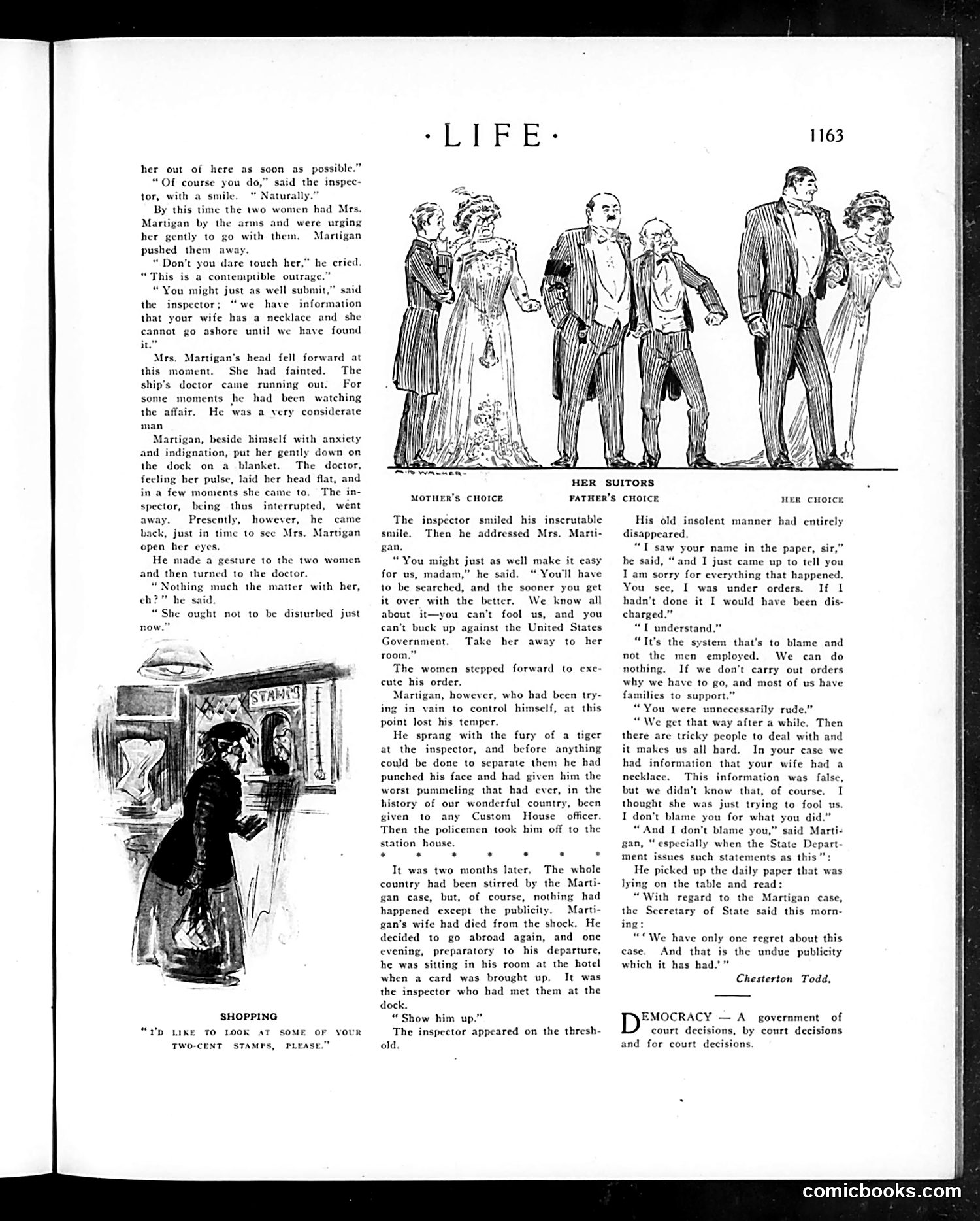
This page depicts a satirical story about government overreach and bureaucratic abuse. A customs inspector humiliates Mrs. Martigan at a dock, searching for a necklace he suspects she's smuggling. When her husband assaults the inspector in protest, he's arrested. Two months later, the inspector visits Martigan, now apologetic and claiming he was "just following orders"—a defense the story presents as hollow. The inspector blames "the system," not himself. The satire targets American customs officials' arbitrary power and their dehumanizing treatment of citizens. The "shopping" cartoon below mocks customs agents' absurd focus on trivial items (two-cent stamps). The broader critique: government employees hide behind bureaucratic necessity while citizens suffer unjust treatment. The story ends with a State Department statement, implying official hypocrisy about protecting citizens' rights—a common target of *Life* magazine's political commentary.
📄 Transcribed text from this page (OCR, searchable)
Machine-transcribed from the original scan — historical spelling and the odd misread are preserved.
her out of here as soon as possible.” “Of course you do,” said the inspec- tor, with a “ Naturally.” By this time the two women had Mrs. Martigan by the arms and were urging her gently to go with them. Martigan pushed them away. “Don’t you dare touch her,” he cried. “This is a contemptible outrag “You might just as well submit,” said the inspector; “we have information that your wife has a necklace and she cannot go ashore until we have found it.” Mrs. Martigan’s head fell forward at this ent. She had fainted. The ship's doctor came running out. For some moments he had been watching the affair. He was a very considerate man Martigan, beside himself with anxiety and indignation, put her gently down on the dock on a blanket. The doctor, fecling her pulse, laid her head flat, and in a few moments she came to. The in- spector, being thus interrupted, wént away. Presently, however, he came back, just in time to see Mrs, Martigan open her eyes. He made a gesture to the two women and then turned to the doctor. Nothing much the matter with her, he said. “She ought not to be disturbed just mile. SHOPPING TO 100K AT CENT STAMP! SOME OF YOUR PLEASE.” HER SUITORS MOTHER'S CHOICE The inspector smiled his inscrutable smile. Then he addressed Mrs. Marti- gan. “You might just as well make it easy for us, madam,” he said. “ You'll have to be searched, and the sooner you get it over with the better. We know all about fool us, and you can’t buck up against the United States Government. Take her away to her room.” The women stepped forward to exe- cute his order. Martigan, however, who had been try- ing in vain to control himself, at this point lost his temper. He sprang with the fury of a tiger at the inspector, and before anything could be done to separate them he had punched his face and had given him the worst pummeling that had ever, in the history of our wonderful country, been given to any Custom House officer. Then the policemen took him off to the station house. It was two months later. The whole country had been stirred by the Marti- gan case, but, of course, nothing had happened except the publicity. Marti- gan’s wife had died from the shock. He decided to go abroad again, and one evening, preparatory to his departure, he was sitting in his room at the hotel when a card was brought up. It was the inspector who had met them at the dock. “Show him up.” The inspector appeared on the thresh- old. it—you can't FATHER'S CHOICE MER CHOICE His old insolent manner had entirely disappeared. “T saw your name in the paper, sir, he said, “and I just came up to tell you I am sorry for everything that happened. You see, I was under orders. If 1 hadn't done it I would have been dis- charged.” “T understand.” “It's the system that’s to blame and not the men employed. We can do nothing. If we don’t carry out orders why we have to go, and most of us have families to support.” “You were unnecessarily rude.” “We get that way after a while. Then there are tricky people to deal with and it makes us all hard. In your case we had information that your wife had a necklace. This information was false, but we didn't know that, of course. I thought she was just trying to fool us. I don't blame you for what you did.” “And I don’t blame you,” said Marti« gan, “ especially when the State Depart- ment issues such statements as this”: He picked up the daily paper that was lying on the table and read: “With regard to the Martigan case, the Secretary of State said this morn- ing: “*We have only one regret about this case. And that is the undue publicity which it has had.” Chesterton Todd. {OCRACY — A government of court decisions, by court decisions and for court decisions comicbooks.com