
Life, 1911-06-15 · page 8 of 44
Life — June 15, 1911 — page 8: what you’re looking at
What you’re looking at
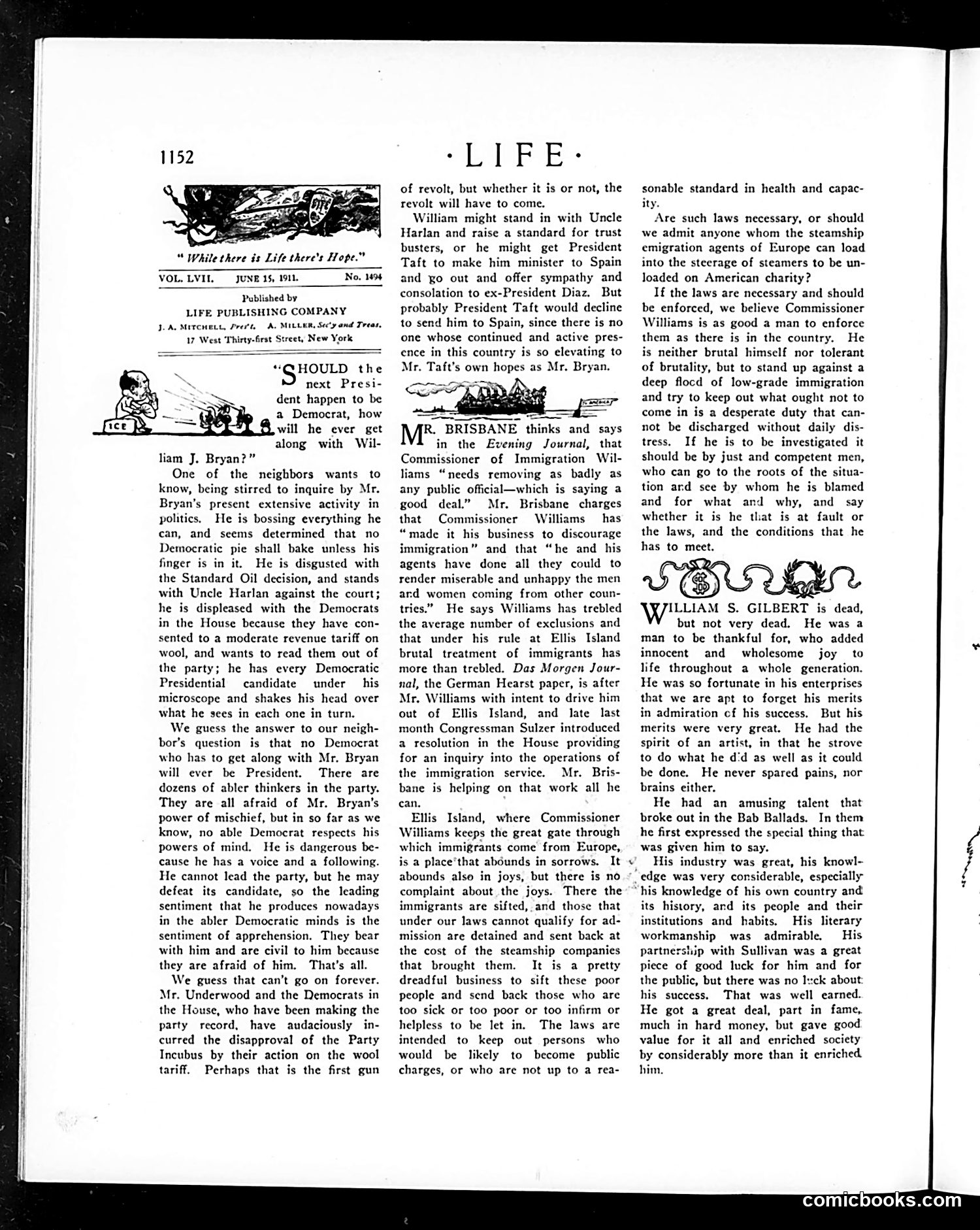
This page contains political commentary and editorial discussion rather than cartoons. The main content addresses the 1912 presidential election and immigration policy debates. The text discusses William Jennings Bryan's Democratic Party activities and criticizes Commissioner of Immigration Williams for his strict enforcement policies at Ellis Island. The authors argue Williams has been too harsh in excluding immigrants, characterizing his methods as creating "miserable and unhappy" conditions. There's also a tribute to William S. Gilbert (of Gilbert and Sullivan), noting his death and contributions to artistic culture. The page satirically questions whether Bryan and Democratic leadership can effectively challenge the Republican establishment, while debating the proper balance between immigration restriction and humanitarian treatment of arrivals.
📄 Transcribed text from this page (OCR, searchable)
Machine-transcribed from the original scan — historical spelling and the odd misread are preserved.
“ While there is Life there's Hope.” No. 1494 VOL. LVIT, JUNE 15, 1911. Published by LIFE PUBLISHING COMPANY A. MILLKR, Sec'y and Treas, et, New York JA. Mirenent, Prev, 17 West Thirty-frst HOULD the next Presi- dent happen to be , 2 Democrat, how Swill he ever get along with Wil- liam J. Bryan?” One of the neighbors wants to know, being stirred to inquire by Mr. Bryan’s present extensive activity in politics, He is bossing everything he can, and seems determined that no Democratic pie shall bake unless his finger is in it. He is disgusted with the Standard Oil decision, and stands with Uncle Harlan against the court; he is displeased with the Democrats in the House because they have con- sented to a moderate revenue tariff on wool, and wants to read them out of the party; he has every Democratic Presidential candidate under his microscope and shakes his head over what he sees in each one in turn. We guess the answer to our neigh- bor’s question is that no Democrat who has to get along with Mr. Bryan will ever be President. There are dozens of abler thinkers in the party. They are all afraid of Mr. Bryan's power of mischief, but in so far as we know, no able Democrat respects his powers of mind. He is dangerous be- cause he has a voice and a following. He cannot lead the party, but he may defeat its candidate, so the leading sentiment that he produces nowadays in the abler Democratic minds is the sentiment of apprehension. They bear with him and are civil to him because they are afraid of him. That's all. We guess that can’t go on forever. Mr. Underwood and the Democrats in the House, who have been making the party record, have audaciously in- curred the disapproval of the Party Incubus by their action on the wool tariff. Perhaps that is the first gun LEE of revolt, but whether it is or not, the revolt will have to come. William might stand in with Uncle Harlan and raise a standard for trust busters, or he might get President Taft to make him minister to Spain and yo out and offer sympathy and consolation to ex-President Diaz. But probably President Taft would decline to send him to Spain, since there is no one whose continued and active pres- ence in this country is so elevating to Mr. Taft’s own hopes as Mr. Bryan. IR. BRISBANE thinks and says in the Evening Journal, that Commissioner of Immigration Wil- liams “needs removing as badly as any public official—which is saying a good deal.” Mr. Brisbane charges that Commissioner Williams has “made it his business to discourage immigration” and that “he and his agents have done all they could to render miserable and unhappy the men ard women coming from other coun- tries.” He says Williams has trebled the average number of exclusions and that under his rule at Ellis Island brutal treatment of immigrants has more than trebled. Das Morgen Jour- nal, the German Hearst paper, is after Mr. Williams with intent to drive him out of Ellis Island, and late last month Congressman Sulzer introduced a resolution in the House providing for an inquiry into the operations of the immigration service. Mr. Bris- bane is helping on that work all he can, Ellis Island, where Commissioner Williams keeps the great gate through which immigrants come from Europe, is a place'that abounds in sorrows. It abounds also in joys, but there is no complaint about the joys. There the immigrants are sifted, and those that under our laws cannot qualify for ad- mission are detained and sent back at the cost of the steamship companies that brought them. It is a pretty dreadful business to sift these poor people and send back those who are too sick or too poor or too infirm or helpless to be let in. The laws are intended to keep out persons who would be likely to become public charges, or who are not up to a rea- sonable standard in health and capac- ity. Are such laws necessary, or should we admit anyone whom the steamship emigration agents of Europe can load into the steerage of steamers to be un- loaded on American charity? If the laws are necessary and should be enforced, we believe Commissioner Williams is as good a man to enforce them as there is in the country. He is neither brutal himself nor tolerant of brutality, but to stand up against a deep flocd of low-grade immigration and try to keep out what ought not to come in is a desperate duty that can- not be discharged without daily dis- tress. If he is to be investigated it should be by just and competent men, who can go to the roots of the situa- tion ard see by whom he is blamed and for what and why, and say whether it is he that is at fault or the laws, and the conditions that he has to meet. ILLIAM S. GILBERT is dead, but not very dead. He was a man to be thankful for, who added innocent and wholesome joy to life throughout a whole generation. He was so fortunate in his enterprises that we are apt to forget his merits in admiration cf his success. But his merits were very great. He had the spirit of an artist, in that he strove to do what he did as well as it could be done. He never spared pains, nor brains either. He had an amusing talent that broke out in the Bab Ballads. In them he first expressed the special thing that was given him to say. His industry was great, his knowl- edge was very considerable, especially “his knowledge of his own country and its history, and its people and their institutions and habits. His literary workmanship was admirable. His partnership with Sullivan was a great piece of good luck for him and for the public, but there was no I::ck about: his success, That was well earned. He got a great deal, part in fame, much in hard money, but gave good value for it all and enriched society by considerably more than it enriched him. comicbooks.com