
Life, 1911-06-15 · page 28 of 44
Life — June 15, 1911 — page 28: what you’re looking at
What you’re looking at
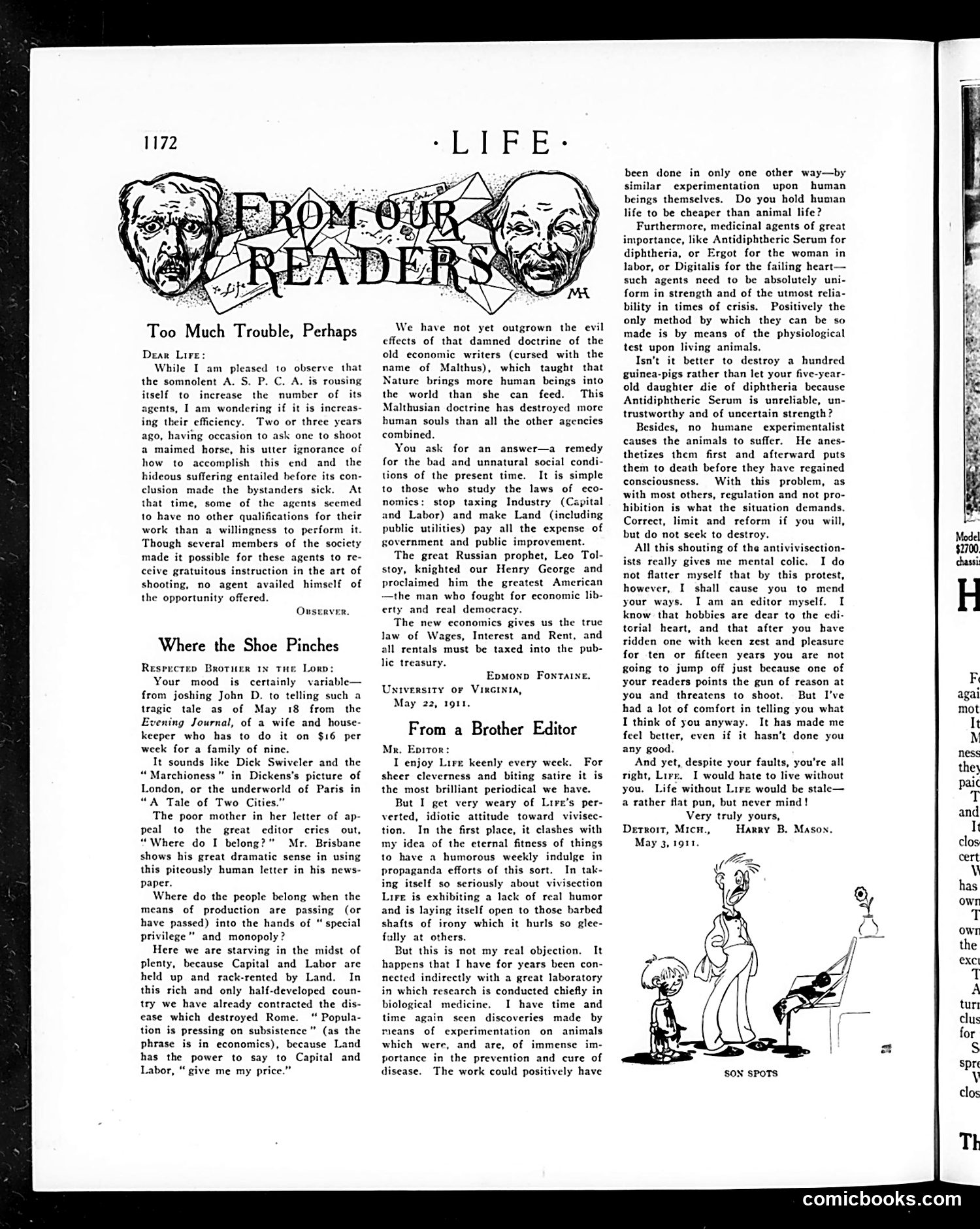
This page collects reader letters responding to *Life* magazine's editorial positions. The key content concerns **animal experimentation (vivisection)**. The "Son Spots" cartoon (bottom right) depicts a child confronting an adult, likely satirizing debates over medical research on animals—a major controversy in early 1900s America. The third letter, from "a Brother Editor," criticizes *Life's* "perverted, idiotic attitude toward vivisection." The writer defends animal experimentation as necessary for medical advancement, arguing that *Life* undermines its satirical credibility by taking a serious moral stance rather than remaining humorous. The tension reflects genuine Gilded Age conflict: animal welfare advocates (represented by references to the ASPCA) versus medical/scientific researchers who viewed animal testing as essential. The letter-writer essentially tells *Life*: stick to satire, not activism—your preaching weakens your jokes.
📄 Transcribed text from this page (OCR, searchable)
Machine-transcribed from the original scan — historical spelling and the odd misread are preserved.
Too Much Trouble, Perhaps Dear Lire: While I am pleased to observe that the somnolent A. S. P. C. A. is rousing itself to increase the number of its agents, I am wondering if it is incre: ing their efficiency. Two or three years ago, having occasion to ask one to shoot a maimed horse, his utter ignorance of how to accomplish this end and the hideous suffering entailed before its con- clusion made the bystanders sick. At that time, some of the agents scemed to have no other qualifications for their work than a willingness to perform it. Though several members of the society made it possible for these agents to re- ceive gratuitous instruction in the art of shooting, no agent availed himself of the opportunity offered. Ouserver. Where the Shoe Pinches Resrectep Brotuer 1x THe Lorp: Your mood is certainly variable— from joshing John D. to telling such a tragic tale as of May 18 from the Evening Journal, of a wife and house- keeper who has to do it on $16 per week for a family of nine. It sounds like Dick Swiveler and the “ Marchioness" in Dickens's picture of London, or the underworld of Paris in “A Tale of Two Cities.” The poor mother in her letter of ap- peal to the great editor cries out, “Where do I belong?" Mr. Brisbane shows his great dramatic sense in using this piteously human letter in his news- Paper. Where do the people belong when the means of production are passing (or have passed) into the hands of “ special privilege” and monopoly? Here we are starving in the midst of plenty, because Capital and Labor are held up and rack-rented by Land. In this rich and only half-developed coun- try we have already contracted the dis- ease which destroyed Rome. “ Popula- tion is pressing on subsistence” (as the phrase is in economics), because Land has the power to say to Capital and Labor, “ give me my price.” We have not yet outgrown the evil effects of that damned doctrine of the old economic writers (cursed with the name of Malthus), which taught that Nature brings more human beings into the world than she can feed. This Malthusian doctrine has destroyed more buman souls than all the other agencies combined. You ask for an answer—a remedy for the bad and unnatural social condi- tions of the present time. It is simple to those who study the laws of eco- nomics: stop taxing Industry (Capital and Labor) and make Land (including public utilities) pay all the expense of government and public improvement. The great Russian prophet, Leo Tol- stoy, knighted our Henry George and proclaimed him the greatest American —the man who fought for economic lib- erty and real democrac The new economics gives us the truc law of Wages, Interest and Rent, and all rentals must be taxed into the pub- lic treasury. Epmonp Fontaine. NIVERSITY OF VIRGINIA, May 22, 1911. From a Brother Editor Mr, Epitor: I enjoy Lire keenly every week. For sheer cleverness and biting satire it is the most brilliant periodical we have. But I get very weary of Lire’s per- verted, idiotic attitude toward vivisec- tion. In the first place, it clashes with my idea of the eternal fitness of things to have a humorous weekly indulge in propaganda efforts of this sort. In tak- ing itself so seriously about vivisection Lire is exhibiting a lack of real humor and is laying itself open to those barbed shafts of irony which it hurls so glec- fully at others. But this is not my real objection. It happens that I have for years been con- nected indirectly with a great laboratory in which research is conducted chiefly in biological medicine. I have time and time again scen discoveries made by means of experimentation on animals which were, and are, of immense im- portance in the prevention and cure of disease. The work could positively have been done in only one other way—by similar experimentation upon human beings themselves. Do you hold human life to be cheaper than animal life? Furthermore, medicinal agents of great importance, like Antidiphtheric Serum for diphtheria, or Ergot for the woman in labor, or Digitalis for the failing heart— such agents need to be absolutely uni- form in strength and of the utmost relia- bility in times of crisis. Positively the only method by which they can be so made is by means of the physiological test upon living animals. Isn’t it better to destroy a hundred guinea-pigs rather than let your five-year- old daughter die of diphtheria because Antidiphtheric Serum is unreliable, un- trustworthy and of uncertain strength? Besides, no humane experimentalist causes the animals to suffer. He anes- thetizes them first and afterward puts them to death before they have regained consciousness. With this problem, as with most others, regulation and not pro- hibition is what the situation demands. Correct, limit and reform if you will, but do not seek to destroy. All this shouting of the antivivisection- ists really gives me mental colic. I do not flatter myself that by this protest, however, I shall cause you to mend your ways. I am an editor myself. I know that hobbies are dear to the cdi- torial heart, and that after you have ridden one with keen zest and pleasure for ten or fifteen years you are not going to jump off just because one of your readers points the gun of reason at you and threatens to shoot. But I've had a lot of comfort in telling you what I think of you anyway. It has made me feel better, even if it hasn’t done you any good. And yet, despite your faults, you're all right, Lire. I would hate to live without you. Life without Lire would be stale— a rather flat pun, but never mind! Very truly yours, Detroit, Micn., Harry B. Mason. May 3, 1911. —> SON SPOTS comicbooks.com