
Life, 1911-06-15 · page 24 of 44
Life — June 15, 1911 — page 24: what you’re looking at
What you’re looking at
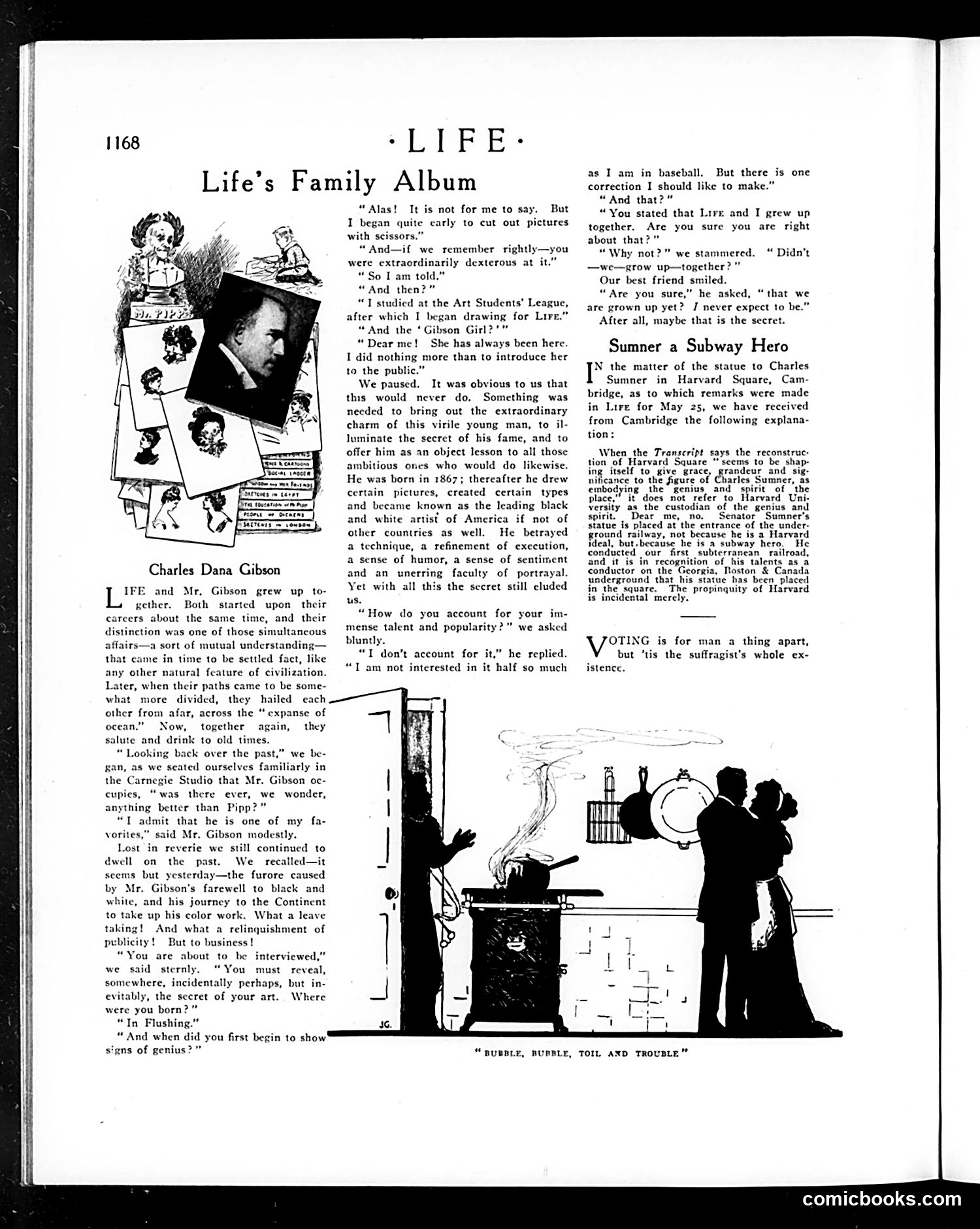
This page features a celebrity interview with **Charles Dana Gibson**, the renowned illustrator famous for creating the "Gibson Girl" — an idealized feminine type that defined American beauty standards in the early 1900s. The interview reveals Gibson's modest, somewhat evasive personality. When pressed about the secret to his immense talent and popularity, he deflects, claiming he's more interested in baseball. He corrects the interviewer's assumption that he and *Life* magazine grew up together, joking that neither he nor the magazine has truly "grown up yet"—a humorous critique suggesting both remain youthful or juvenile in spirit. The lower section includes a satirical note about a statue of Senator Charles Sumner at Harvard Square, facetiously arguing he's a "subway hero" rather than a Harvard ideal, mocking the pompous language used to justify its placement. The cartoons throughout use Gibson's own illustration style to enhance the piece's self-referential humor.
📄 Transcribed text from this page (OCR, searchable)
Machine-transcribed from the original scan — historical spelling and the odd misread are preserved.
= “LP E* Life’s Family Album Charles Dana Gibson and Mr, Gibson grew up to- gether. Both started upon their carcers about the same time, and their distinction was one of those simultancous affairs—a sort of mutual understanding— that came in time to be settled fact, like any other natural feature of civilization. Later, when their paths came to be some- what more divided, they hailed each other from afar, across the “expanse of Now, together again, they and drink to old times. “Looking back over the past,” we be- gan, as we seated ourselves familiarly in the Carnegie Studio that Mr. Gibson oc- cupies, “was there ever, we wonder, anything better than Pipp?”” “T admit that he is one of my fa- vorites,” said Mr, Gibson modestly. Lost in reverie we still continued to dwell on the past. We recalled—it scems but yesterday—the furore caused by Mr, Gibson’s farewell to black and white, and his journey to the Continent to take up his color work, What a leave taking! And what a relinquishment of publicity! But to business! “You are about to be interviewed,” we said sternly. “You must reveal, somewhere, incidentally perhaps, but in- evitably, the secret of your art. Where were you born?” “In Flushing.” “ And when did you first begin to show! signs of genius?” “Alas! It is not for me to say. But I began quite carly to cut out pictures with scissors.” “And—if we remember rightly—you were extraordinarily dexterous at it.” So I am told.” “And then?” “T studied at the Art Students’ League, after which I began drawing for Lire. “And the ‘Gibson Girl?'” “Dear me! She has always been here. I did nothing more than to introduce her to the public.” We paused. It was obvious to us that this would never do. Something was necded to bring out the extraordinary charm of this virile young man, to il- luminate the secret of his fame, and to offer him as an object lesson to all those ambitious ones who would do likewise. He was born in 1867; thereafter he drew certain pictures, created certain types and became known as the leading black and white artist of America if not of other countries as well. He betrayed a technique, a refinement of execution, a sense of humor, a sense of sentiment and an unerring faculty of portrayal. Yet with all this the secret still cluded us. “How do you account for your im- mense talent and popularity?” we asked bluntly. “I don't account for it,” he replied. “Tam not interested in it half so much as I am in baseball. But there is one correction I should like to make.” “And that?” “You stated that Lire and I grew up together. Are you sure you are right about that? “Why not?” we stammered. “ Didn't —we—grow up—together?” Our best friend smiled. “Are you sure,” he asked, “that we are grown up yet? J never expect to be.” After all, maybe that is the secret. Sumner a Subway Hero the matter of the statue to Charles Sumner in Harvard Square, Cam- bridge, as to which remarks were made in Lire for May 25, we have received from Cambridge the following explana- tion: When the Transcript says the reconstruc: tion of Harvard Square “seems to be shap- ing itself to give grace, grandeur and sig- nificance to the figure of Charles Sumner, as embodying the’ genius and spirit of ‘the place,” it does not refer to Harvard Uni- versity as the custodian of the genius and spirit. Dear me, no. Senator Sumner’s statue is placed at'the entrance of the under- round railway, not because he is a Harvard ideal, but-because he is a subway hero. He conducted our first subterranean. railroad, and it is in recognition of his talents as a conductor on the Georgia, Roston & Canada underground that his statue has been placed in the square. The propinquity of Harvard is incidental merely. OTING is for man a thing apart, but ‘tis the suffragist’s whole ex- istence. “BUBBLE, RUBBLE, TOIL AND TROUBLE” comicbooks.com