
A complete issue · 44 pages · 1911
Life — March 9, 1911
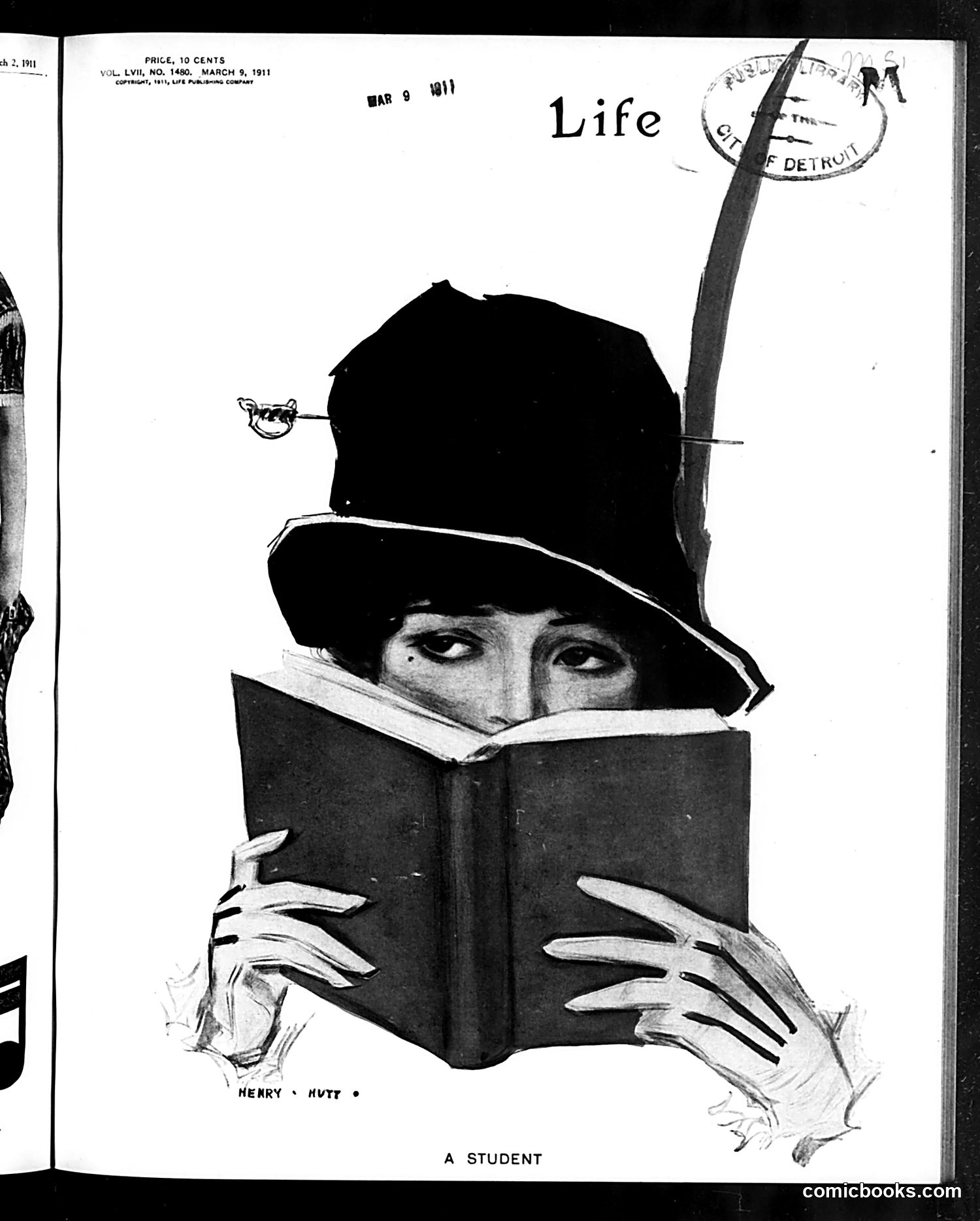
This cover illustration by Henry Hutt depicts a woman in a large black hat reading a book, captioned simply "A Student." The work appears to satirize early 20th-century women's education and intellectual pretension. The exaggerated hat—a fashionable accessory of the era—and the woman's somewhat affected pose suggest satire about whether female students were serious scholars or merely adopting the appearance of intellectuality as fashion. The small cat perched on her hat adds whimsical humor. This reflects ongoing cultural anxieties about women's expanding access to higher education during the Progressive Era, when debates about women's intellectual capabilities and proper social roles remained contentious. The cartoon gently mocks rather than celebrates female education.
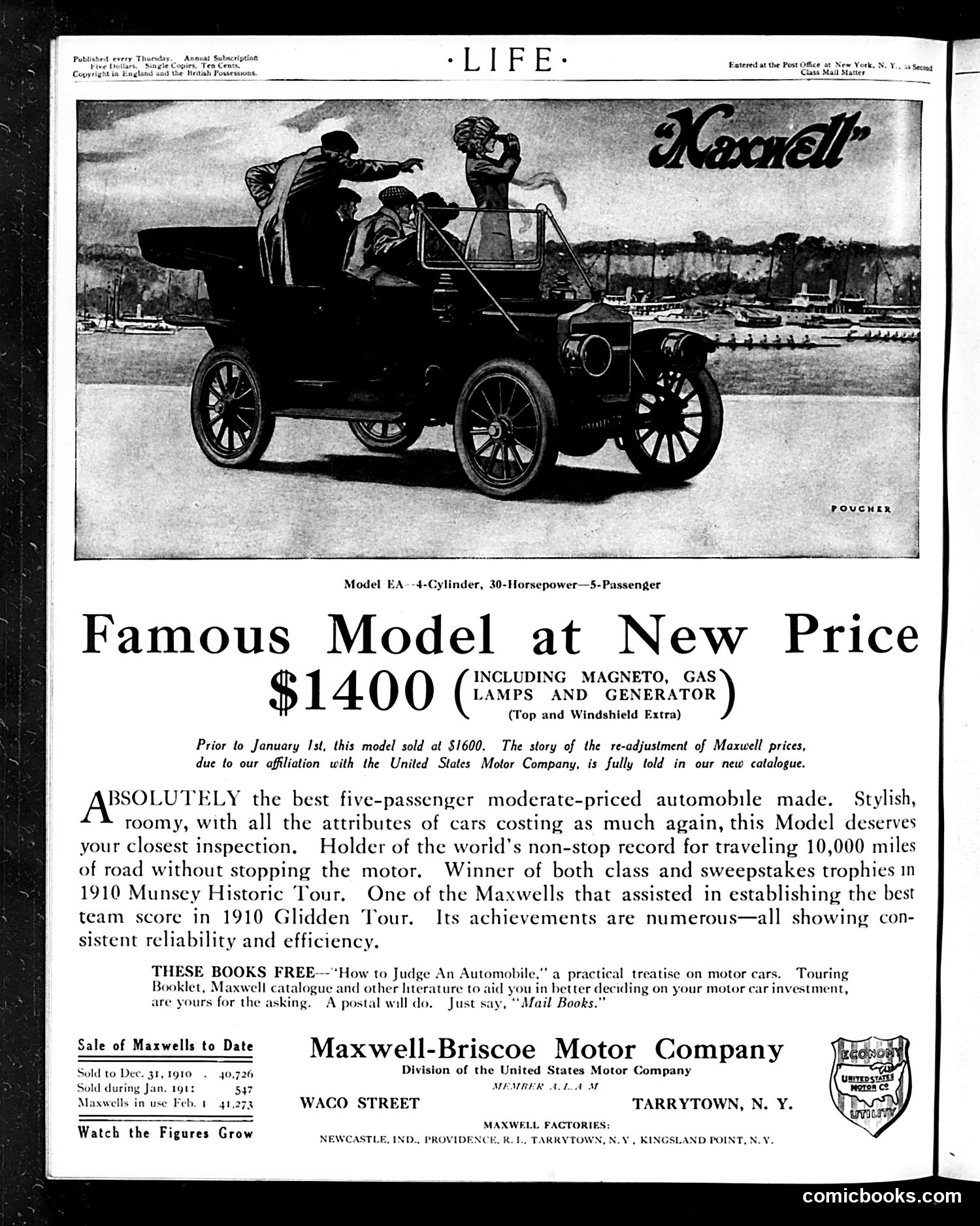
This is a **automobile advertisement**, not political satire. The page promotes the Maxwell Model EA, a 4-cylinder, 30-horsepower automobile priced at $1,400 (reduced from $1,600). The image shows a period car with well-dressed passengers near a waterfront, emphasizing the vehicle's stylishness and reliability. The advertisement highlights the car's achievements: a non-stop 10,000-mile driving record and victories in the 1910 Glidden Tour (a prominent early automotive competition). The text positions Maxwell as "the best five-passenger moderate-priced automobile made"—competing in the growing mass-market vehicle segment. The affiliation with United States Motor Company is emphasized, suggesting corporate stability. This reflects the competitive early automotive industry around 1911.
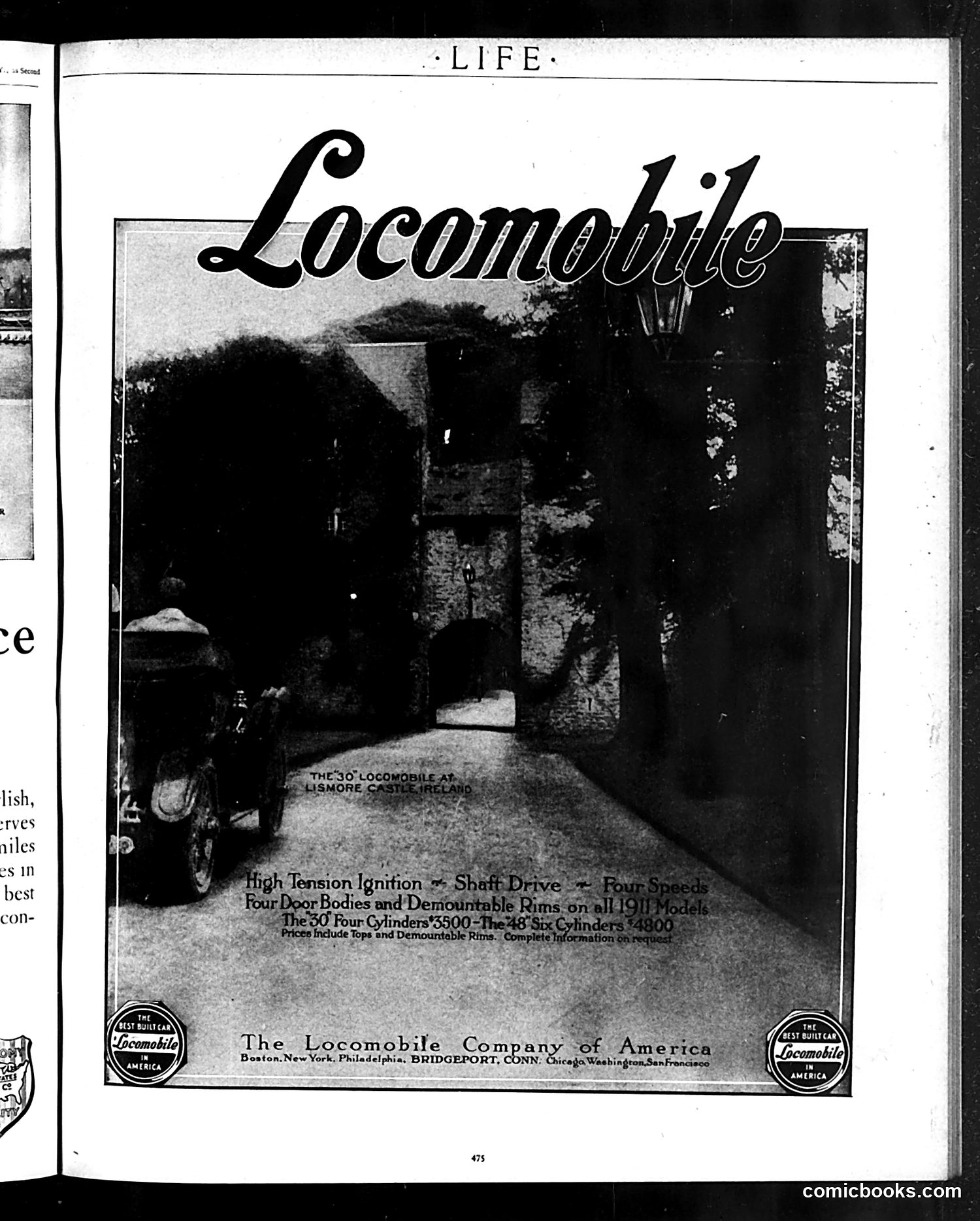
This page is **not a political cartoon or satire**—it's a straightforward **automobile advertisement** for the Locomobile Company of America, appearing in *Life* magazine. The ad features a photograph of a 1911 Locomobile automobile positioned at Lismore Castle in Ireland. The image showcases the vehicle's features: high-tension ignition, shaft drive, four speeds, four-door bodies, and demountable rims. Pricing information for different cylinder models is included. The advertisement uses the castle setting to suggest luxury and prestige, associating the Locomobile with elegance and international sophistication. This is period marketing strategy—using aspirational locations to appeal to wealthy consumers. The company's offices were located in Boston, New York, Philadelphia, Bridgeport, and other major cities.
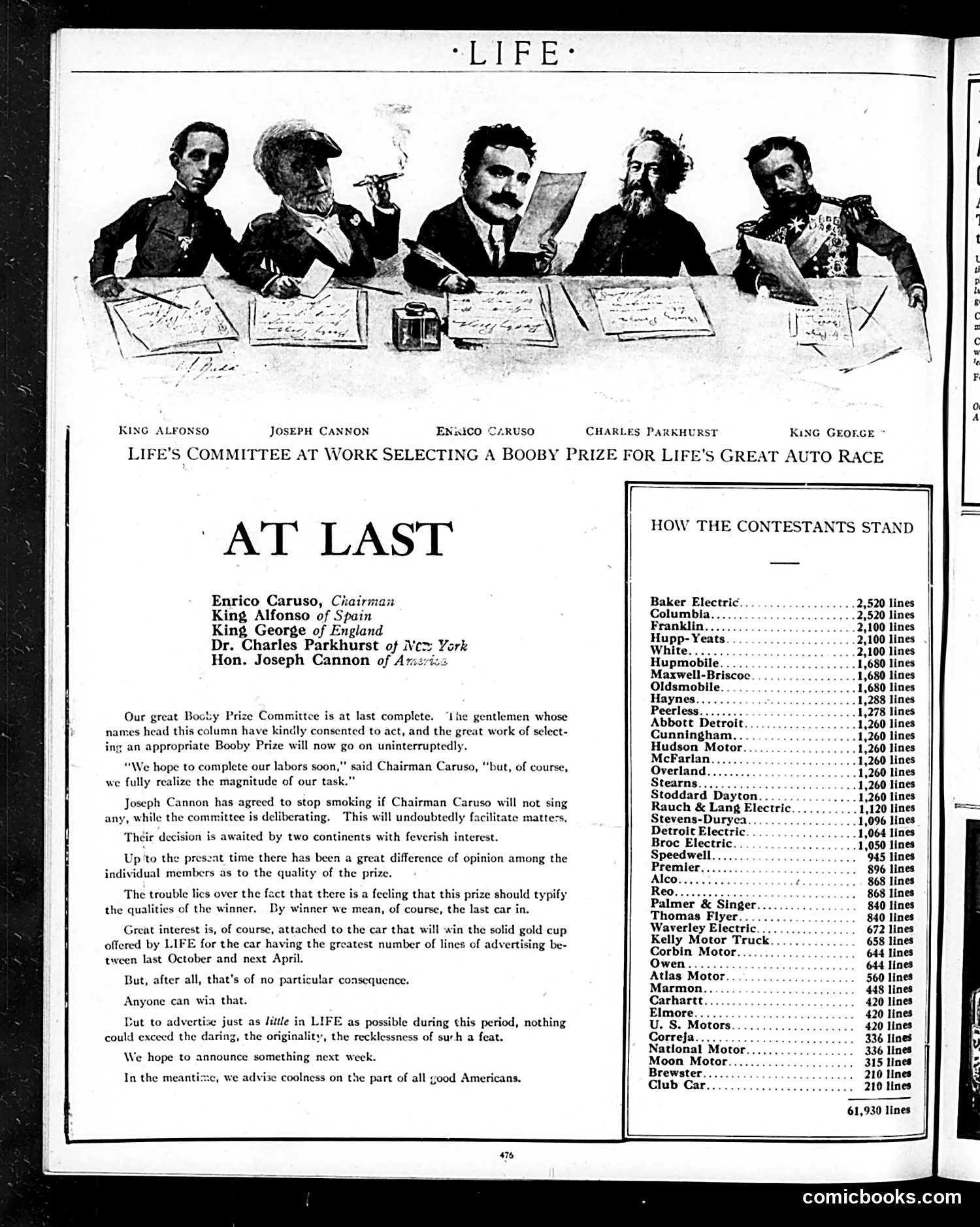
This LIFE magazine page satirizes a prestigious automobile prize committee. The five caricatured figures—identified as King Alfonso (Spain), Joseph Cannon (U.S. politician), Enrico Caruso (opera singer, committee chairman), Charles Parkhurst (clergyman), and King George (England)—supposedly judge LIFE's "Great Auto Race." The satire mocks the absurdity of assembling such an eclectic, international panel of famous men to select a car prize. The joke suggests their disparate expertise makes them ridiculous judges for automotive matters. The accompanying text humorously notes disagreements among committee members and quips that advertising the contest in LIFE magazine during this period would be daring. The right column lists participating automobile manufacturers ranked by advertising lines purchased—revealing the real commerce behind the "prize."
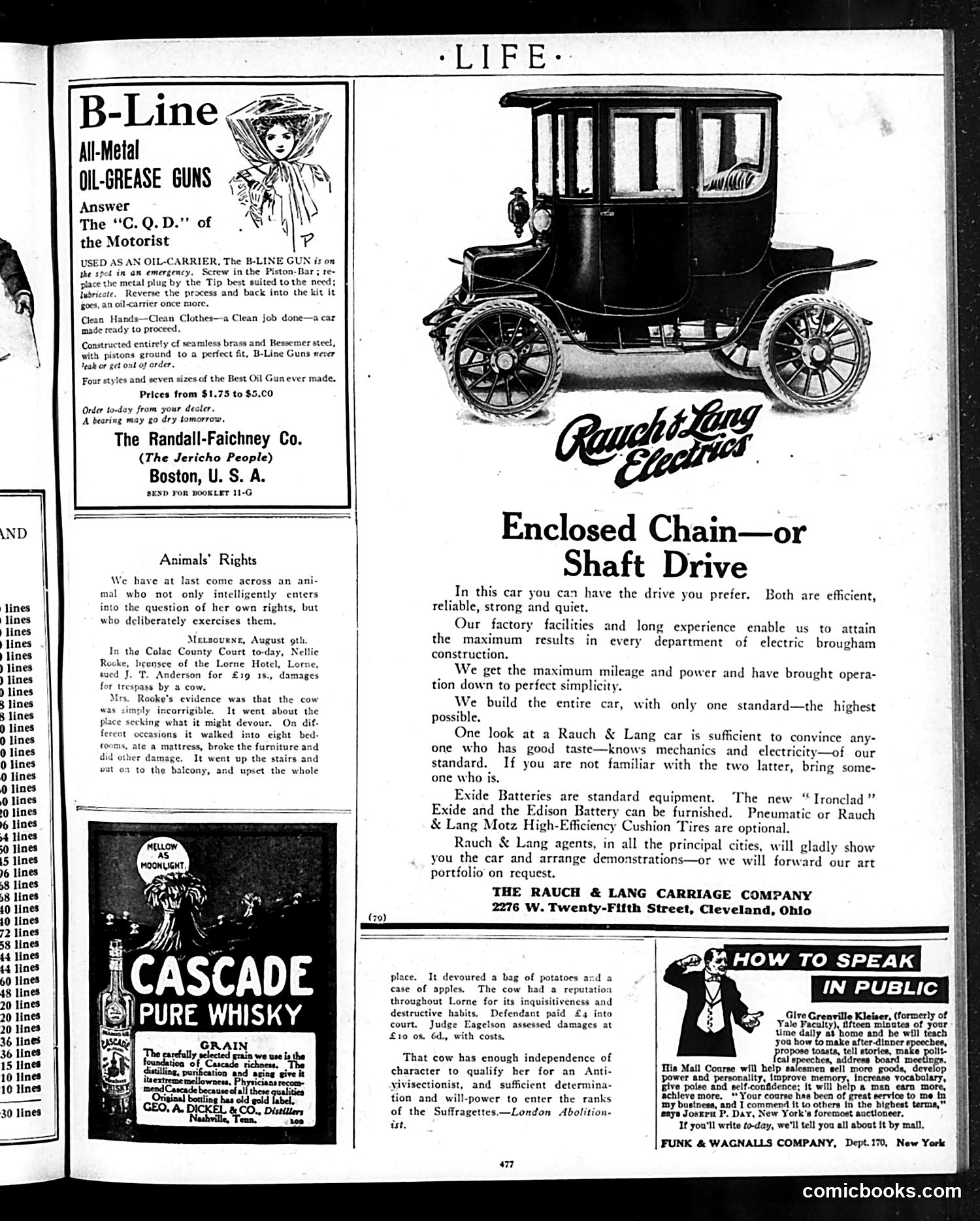
This page is primarily **advertising**, not political satire. It contains four advertisements: 1. **B-Line Oil-Grease Guns** (top left): A practical product ad for motorists, priced $1.75-$5.00. 2. **Rauch & Lang Electrics** (center-right): An early electric automobile advertisement emphasizing reliability and efficiency—notable as electric cars were a viable alternative to gasoline vehicles in this era. 3. **Cascade Pure Whisky** (bottom left): A spirits advertisement. 4. **How to Speak in Public** (bottom right): A self-improvement course advertisement. The page includes one brief editorial piece, "Animals' Rights," discussing a cow's legal case in Coke County, but this is minor content. The page reflects early 20th-century consumer culture and advertising trends rather than political commentary.
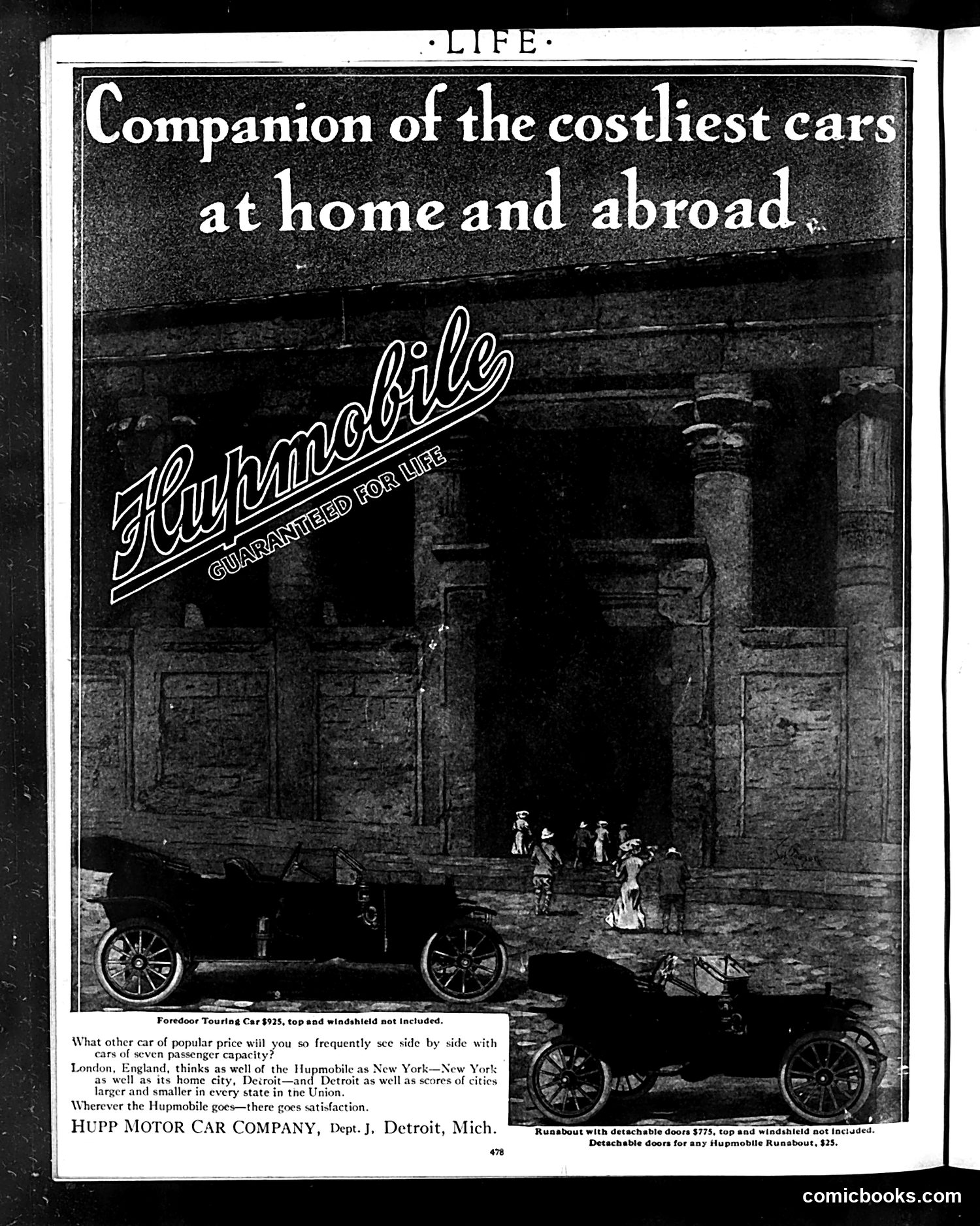
This is **not a political cartoon or satire page**—it's a straightforward automobile advertisement for Hupmobile cars, placed in Life magazine. The ad compares Hupmobile's pricing favorably against other luxury vehicles. It shows two car models with prices and features listed. The text emphasizes that Hupmobiles are seen "side by side" with expensive competitors in major cities (London, New York, Detroit) and perform equally well everywhere. The architectural backdrop (classical columns) appears designed to convey stability and prestige. The small figures and horses provide period-appropriate street scene context. The "Guaranteed for Life" slogan was Hupmobile's actual marketing claim. This represents early 1900s automotive marketing strategy—positioning a mid-priced vehicle as comparable in quality to costlier rivals.
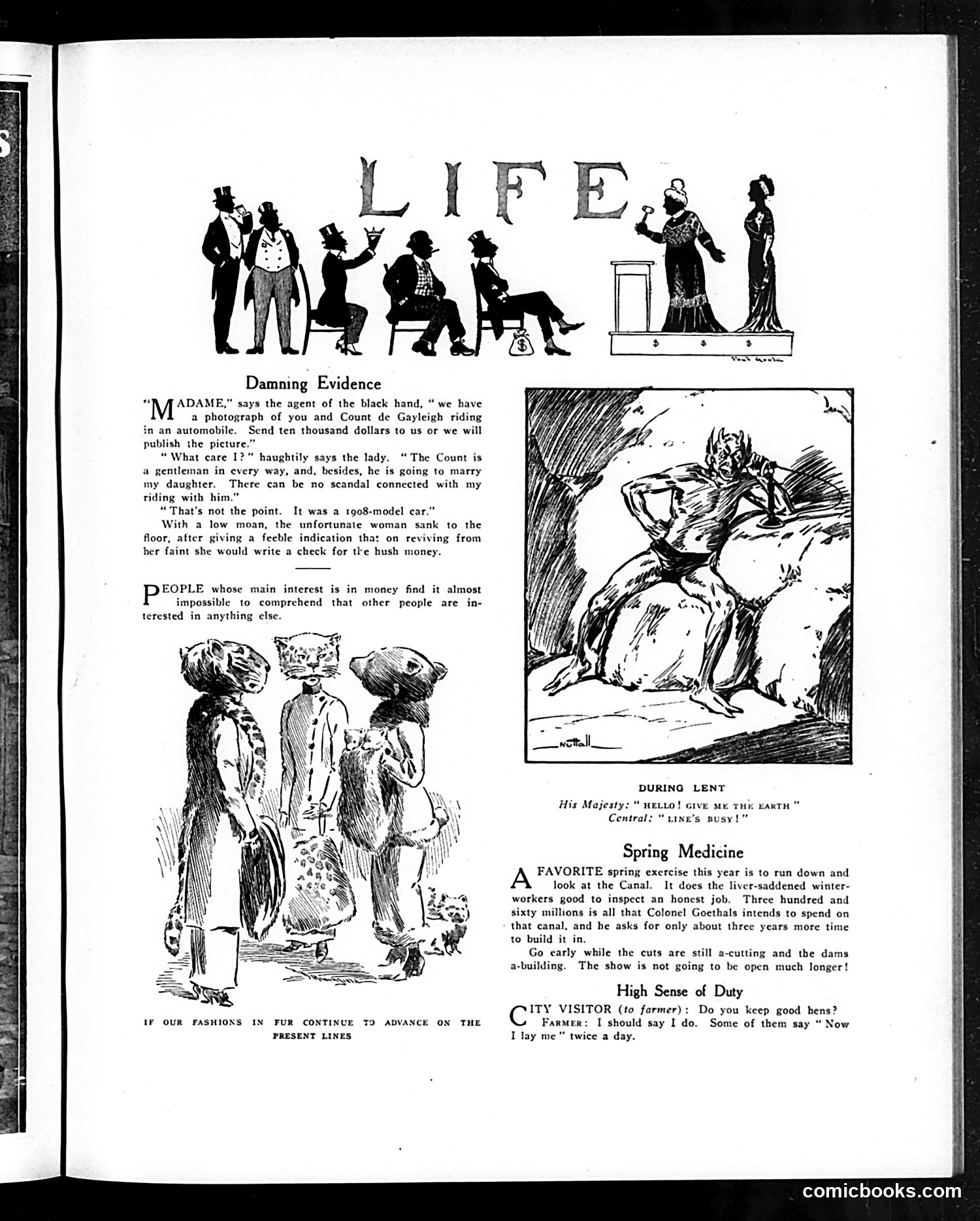
This page contains three satirical pieces mocking wealthy society and hypocrisy: **"Damning Evidence"** ridicules a wealthy lady who dismisses scandal from her daughter riding in a 1908-model automobile with a gentleman, claiming the car's age proves impropriety impossible. The joke: she's more concerned with appearing respectable than actual morality. **"If Our Fashions in Fur Continue to Advance on the Present Lines"** shows fashionably-dressed women who appear increasingly animal-like, satirizing excessive fur fashion trends. **"Spring Medicine"** and **"High Sense of Duty"** are brief satirical vignettes about canal inspections and farm visits—likely mocking upper-class tourism and performative civic interest. The overall theme: wealthy society's pretense, shallow values, and disconnect from reality.
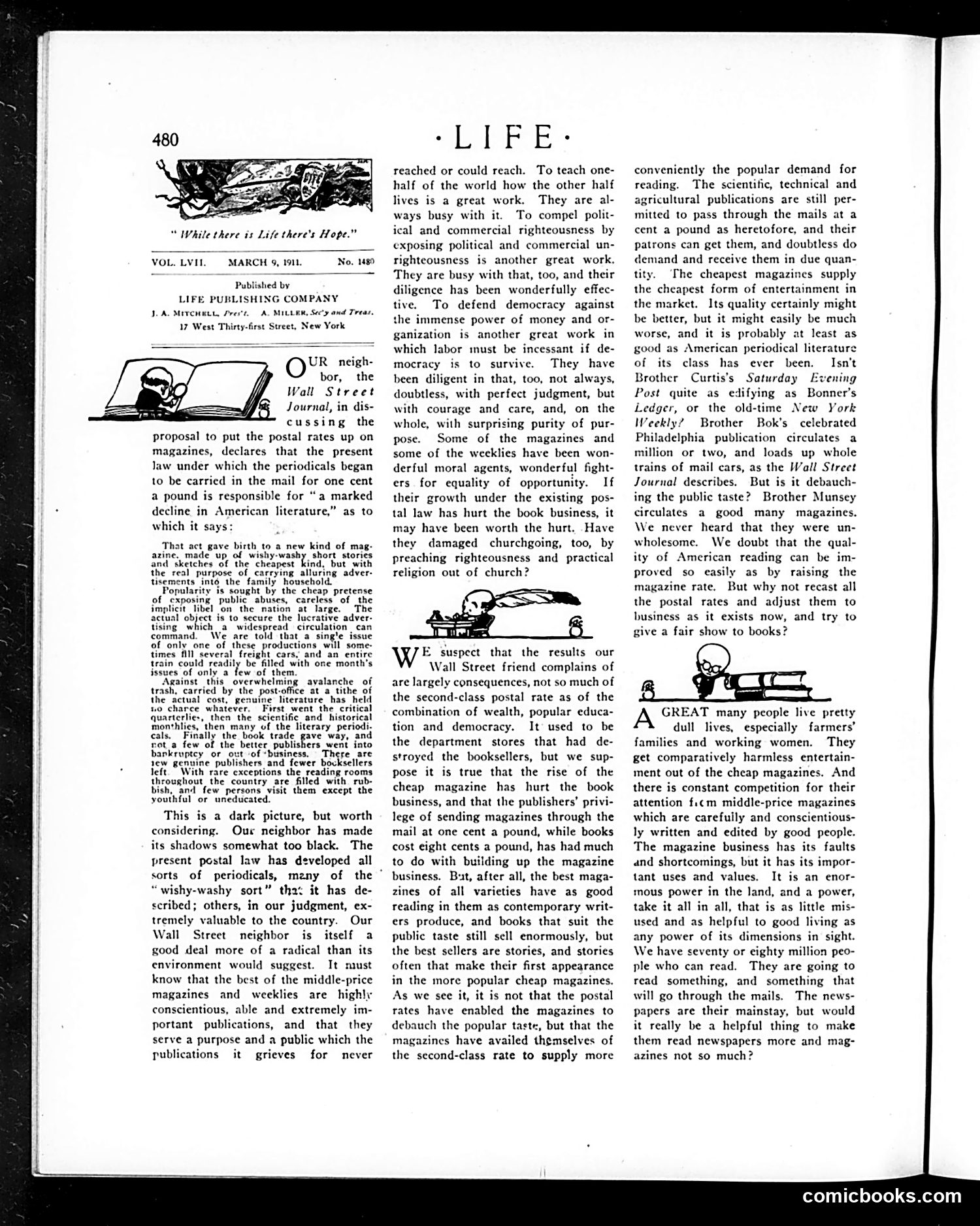
This page contains editorial text (no political cartoon visible) discussing the impact of U.S. postal rates on the magazine publishing industry. The author argues that cheap magazine postage has paradoxically *hurt* the book business by flooding the market with inexpensive periodicals, reducing demand for books. The piece critiques both the postal system and magazine publishers themselves for exploiting low second-class rates. It defends middle-class magazines as "highly conscientious" while acknowledging they've damaged the publishing ecosystem. The author suggests recalibrating postal rates to support books over magazines, framing this as necessary to preserve American reading quality and democratic literacy—a progressive-era concern about commercial versus intellectual value.
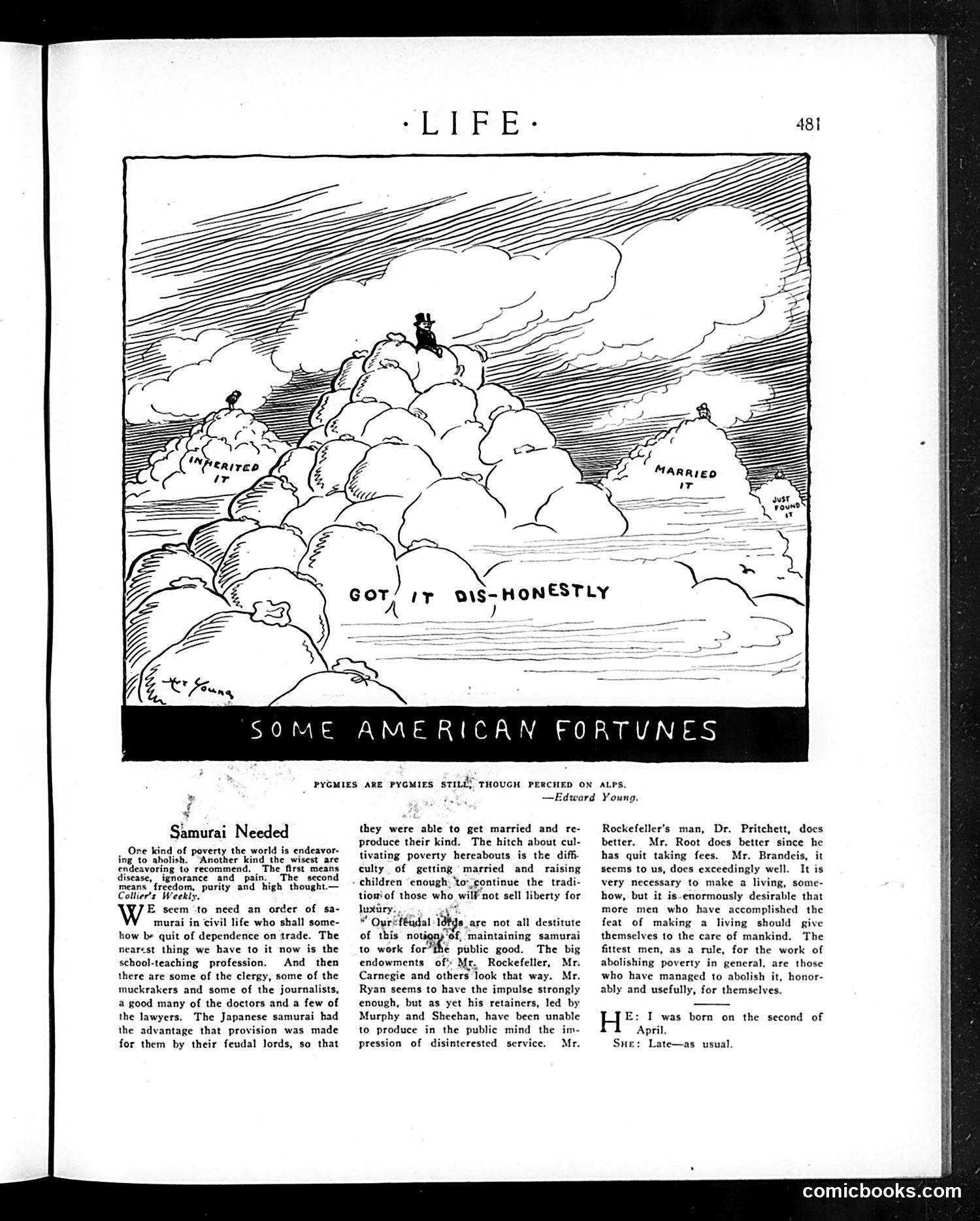
This cartoon satirizes wealth accumulation through dishonest means. A figure stands atop a massive pile of clouds labeled "Got it dis-honestly," with smaller clouds labeled "Inherited it" and "Married it" visible nearby. The image suggests that American fortunes are built on moral compromises rather than honest work. The accompanying article discusses poverty and wealth inequality, mentioning prominent figures like Rockefeller and referencing samurai codes of honor. The text argues that wealthy industrialists and public figures lack the integrity and disinterested service that should characterize leadership. The satire contrasts ideals of honorable conduct with the reality of how American wealth was actually accumulated during the Gilded Age.
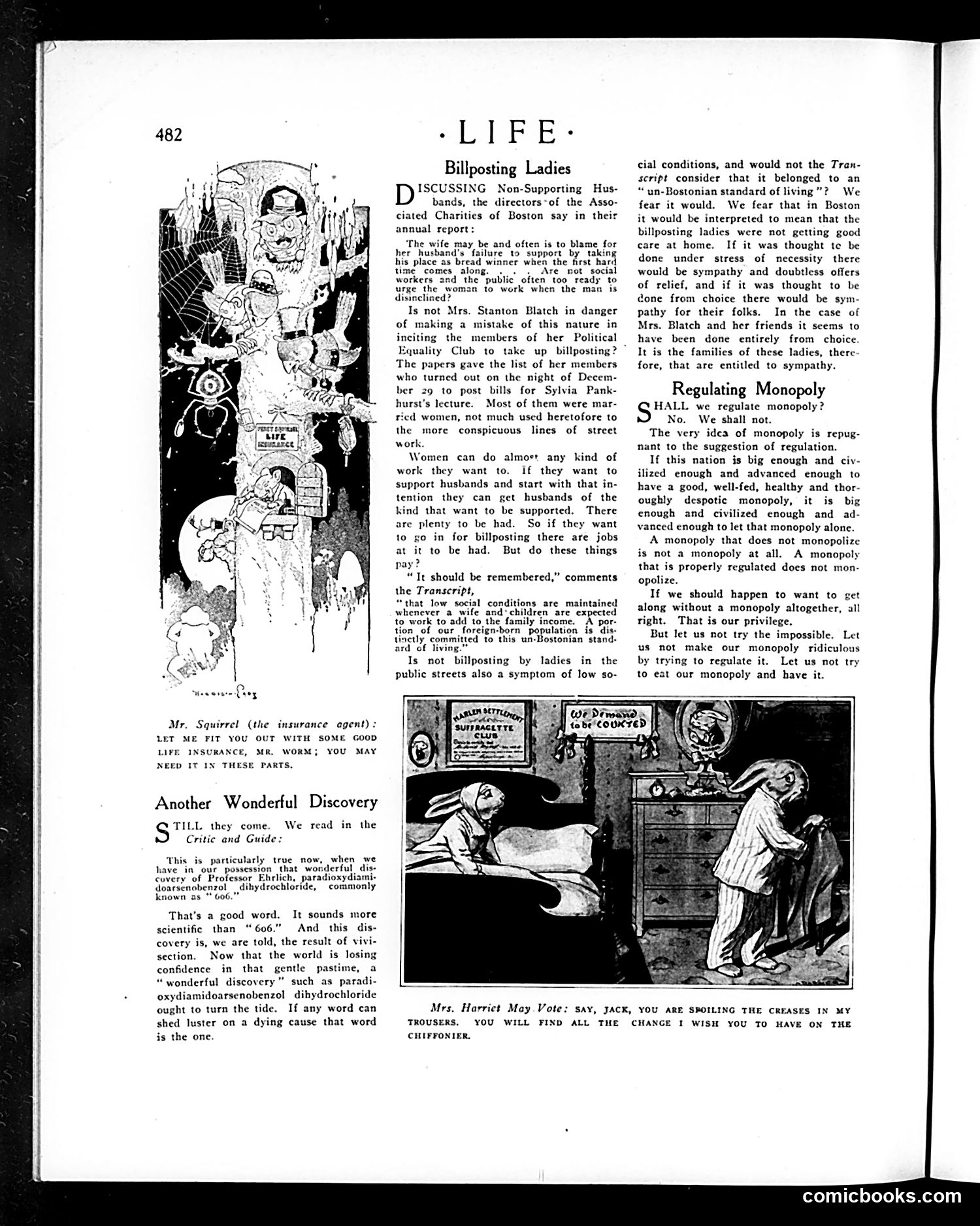
This page contains three distinct pieces of satire: 1. **"Billposting Ladies"** (left): A cartoon critiquing wives of non-supporting husbands who post bills publicly to shame their partners into providing income. The illustration shows a woman confronting her deadbeat husband, satirizing both marital financial disputes and public shaming tactics. 2. **"Regulating Monopoly"** (center): A debate piece questioning whether monopolies should be regulated. It argues that poorly-regulated monopolies are problematic, but suggests satirically that making regulation ridiculous might be preferable to actual enforcement—a tongue-in-cheek commentary on ineffective regulation. 3. **"Another Wonderful Discovery"** (bottom): Mocks scientific pretension by highlighting a made-up medical term ("paradoxydiamiodaesohobenzol dihydrochloride") to criticize how pseudoscientific language obscures simple truths.
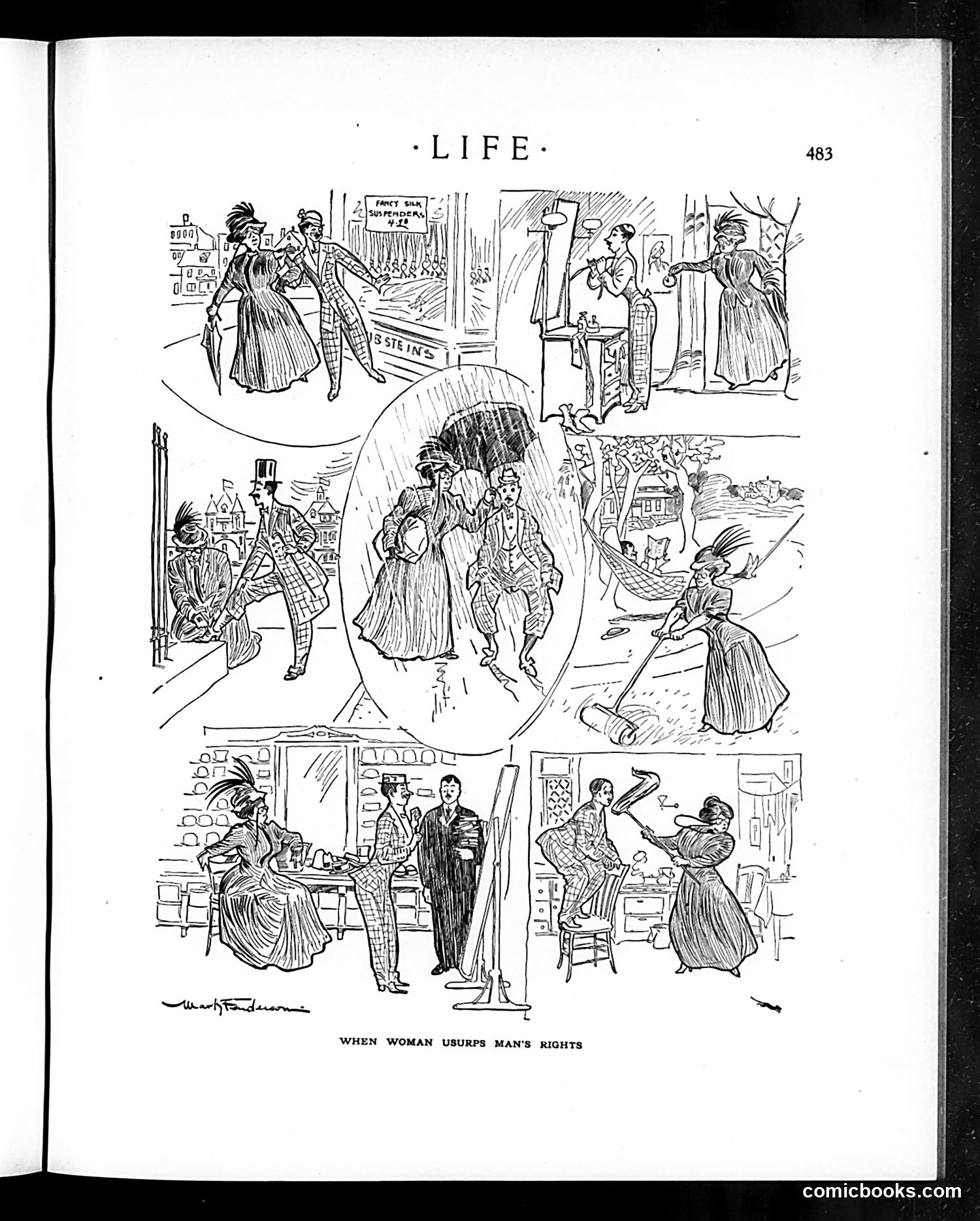
This satirical cartoon from *Life* magazine presents six vignettes depicting role reversals where women assume traditionally male activities and authority. The caption's phrase "usurps man's rights" indicates this was meant as humorous commentary on early feminist activism. The scenes show women in male-coded roles: conducting business, wearing masculine clothing, exercising authority over men, and engaging in typically male social behaviors. The cartoonist portrays these reversals as absurd or comedic rather than legitimate. This reflects early-20th-century anxieties about women's suffrage and expanded rights movements. The satire assumes readers would find women in positions of power or authority inherently ridiculous—the joke depends on the audience sharing assumptions about "proper" gender roles. The cartoon mocks feminist demands by depicting them as unnatural disruptions of social order.
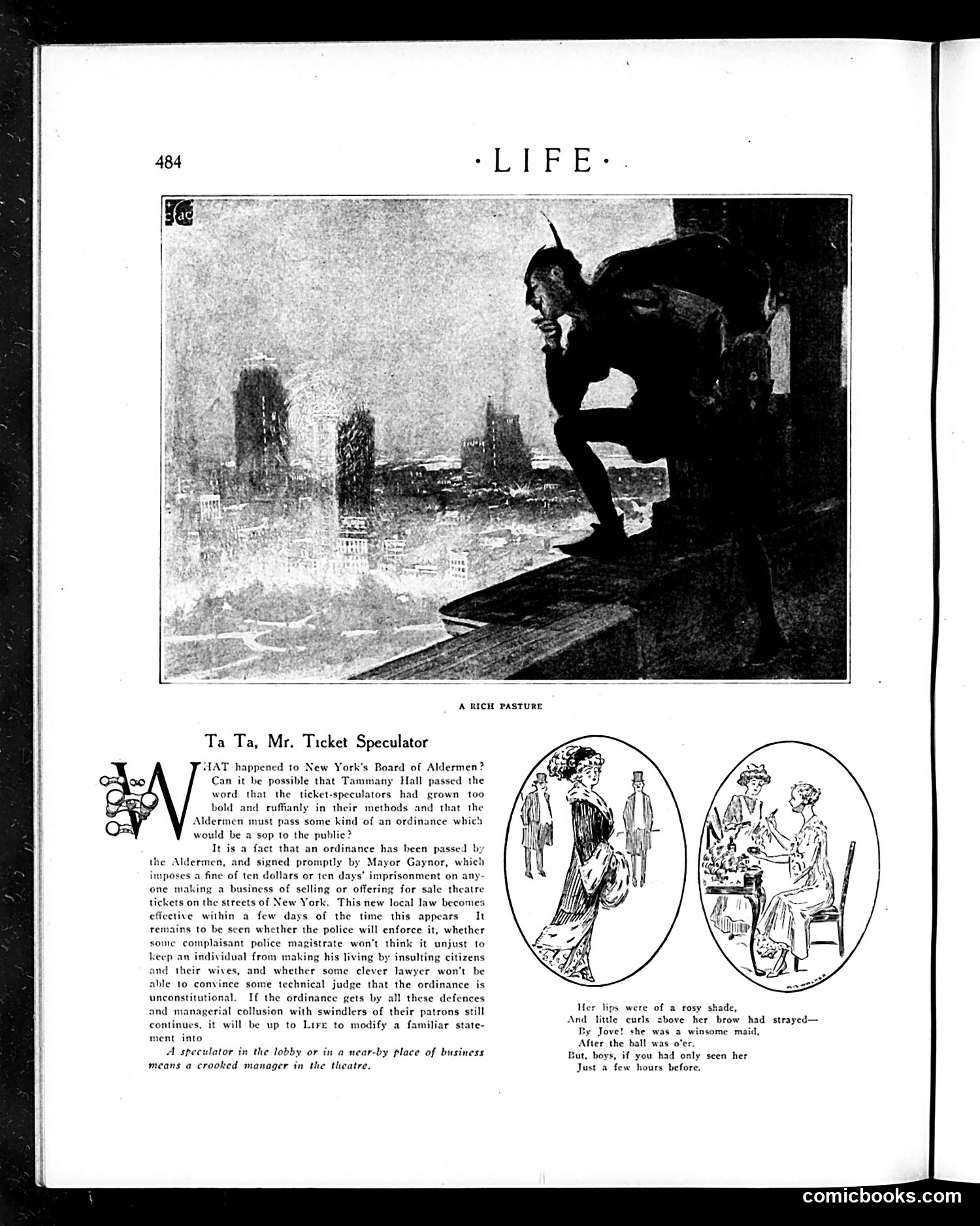
This satirical piece addresses New York's Board of Aldermen passing an ordinance against street ticket scalpers. The top illustration shows a demonic figure perched over the city skyline—representing the ticket speculator as a predatory threat to New York. The article criticizes the ordinance as ineffective, predicting it won't stop scalpers from profiting. It sardonically suggests the real problem is that wealthy patrons and theater managers benefit from scalping, making enforcement unlikely. The two oval illustrations appear to depict theater-goers complaining about missing a show due to scalping. The joke implies that despite official crackdowns, the corrupt practice will persist because those in power have financial incentives to allow it—a critique of municipal hypocrisy and corruption.
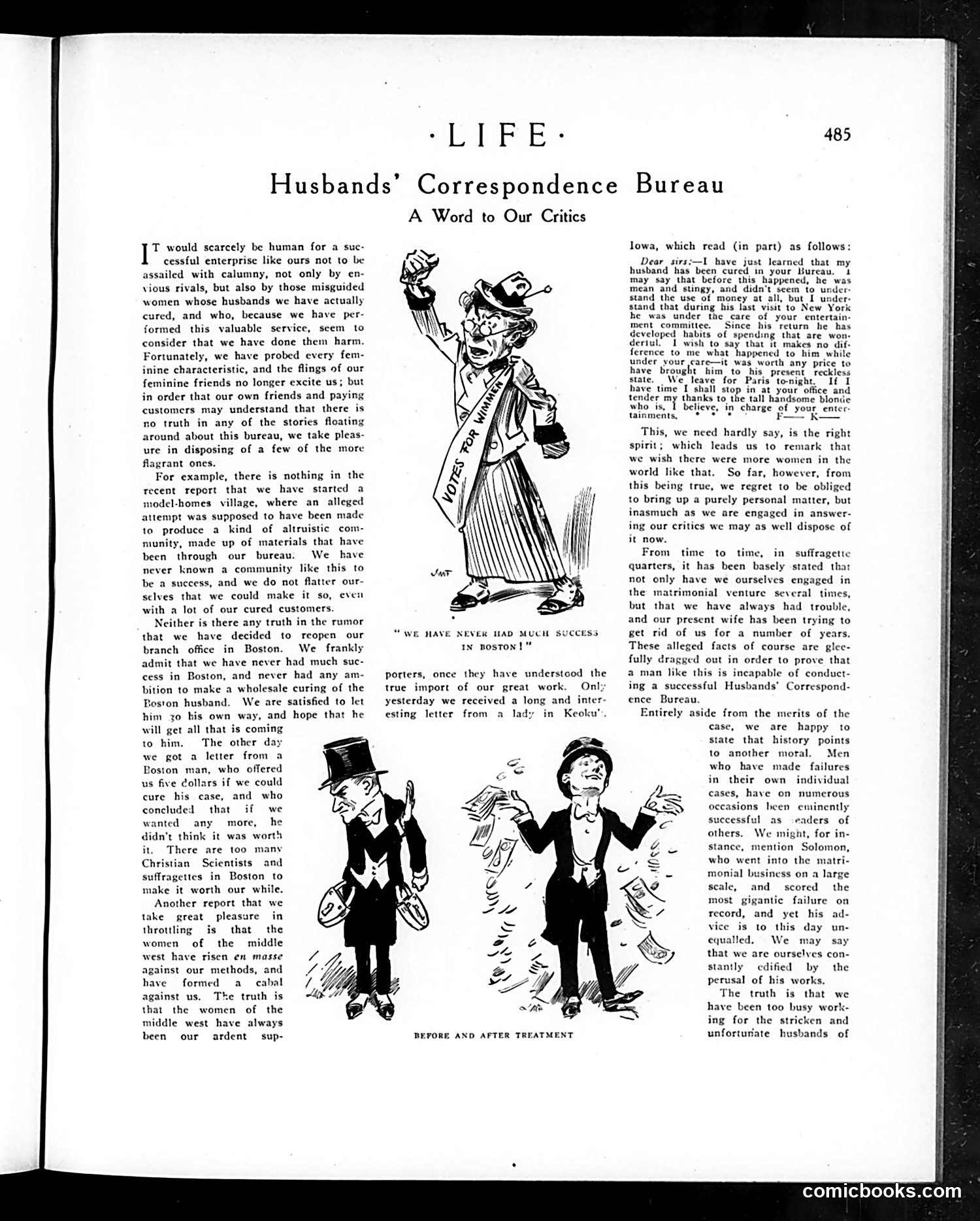
This page satirizes a real service—a "Husbands' Correspondence Bureau"—that apparently helped reform neglectful or troublesome husbands. The text defends the bureau against critics who questioned its legitimacy. The cartoons illustrate the bureau's supposed effectiveness: the top image shows a woman triumphantly holding money and documents (suggesting financial or legal victory), while the "Before and After Treatment" panel below contrasts a well-dressed, reformed husband with his earlier slovenly self surrounded by scattered cash. The satire mocks both the bureau's dubious methods and contemporary anxieties about marital discord. The text acknowledges skeptics who claimed the bureau engaged in matrimonial manipulation, while defending it as addressing real domestic problems—a tongue-in-cheek commentary on early-20th-century marriage troubles and commercialized "solutions."
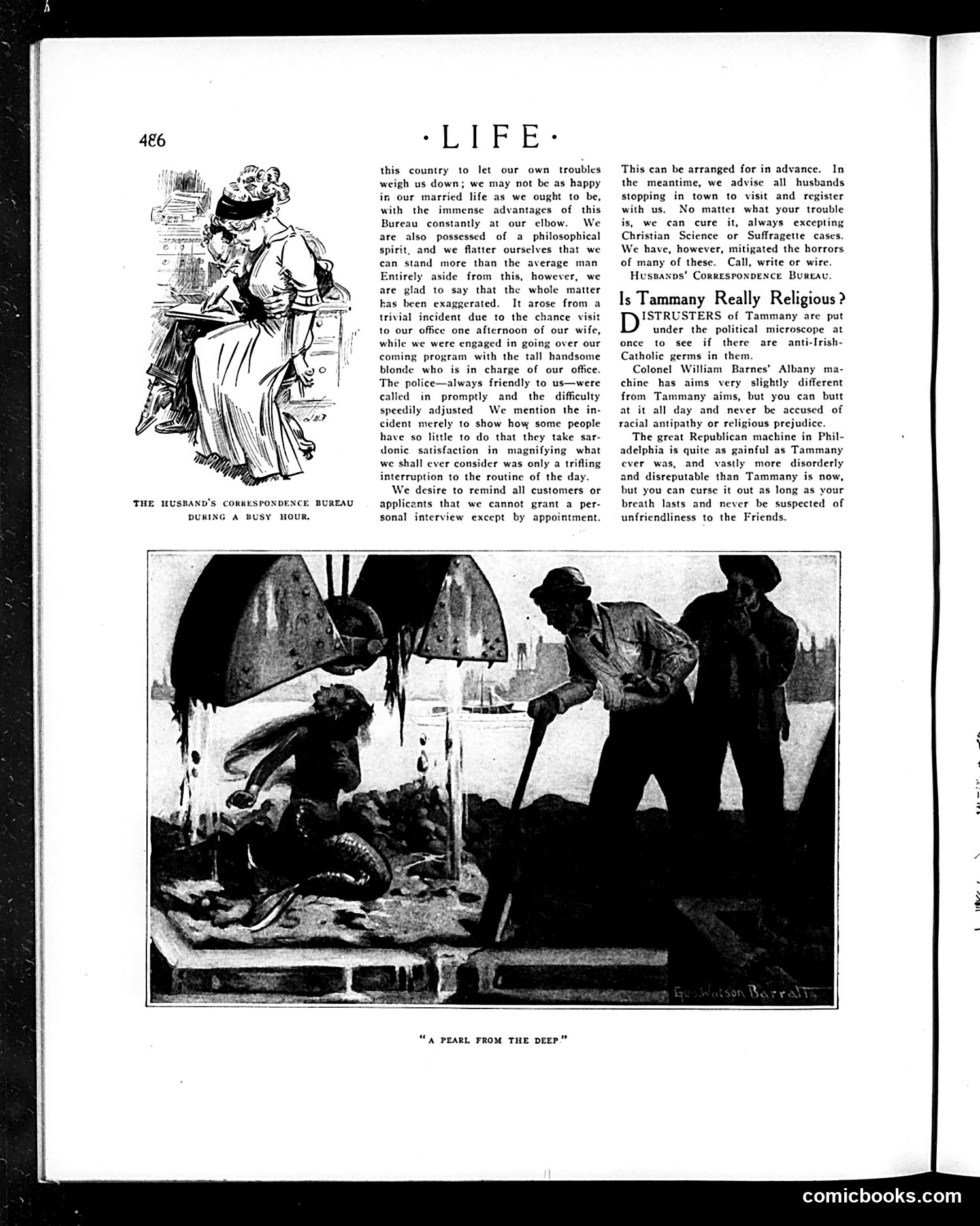
**Top Cartoon: "The Husband's Correspondence Bureau During a Busy Hour"** This satirizes marital infidelity and domestic discord. A "correspondence bureau" ostensibly helps husbands with problems, but the cartoon shows the real scandal: a wife has caught her husband with an attractive blonde secretary in the office. The accompanying text humorously describes how the wife's unexpected visit caused a disturbance, police were called, and the situation was "speedily adjusted"—yet the bureau's management dismisses it as a trivial interruption. The satire targets both philandering husbands and their convenient rationalizations. **Bottom Article: "Is Tammany Really Religious?"** This critiques political corruption and selective outrage. It argues that Tammany Hall (New York's Democratic political machine) faces accusations of anti-Irish-Catholic bias, while equally corrupt Republican machines in Albany and Philadelphia escape such criticism. The piece suggests that accusations of religious prejudice are weaponized selectively against Tammany while similar corruption elsewhere goes unchallenged—exposing hypocrisy in how different political organizations are judged.
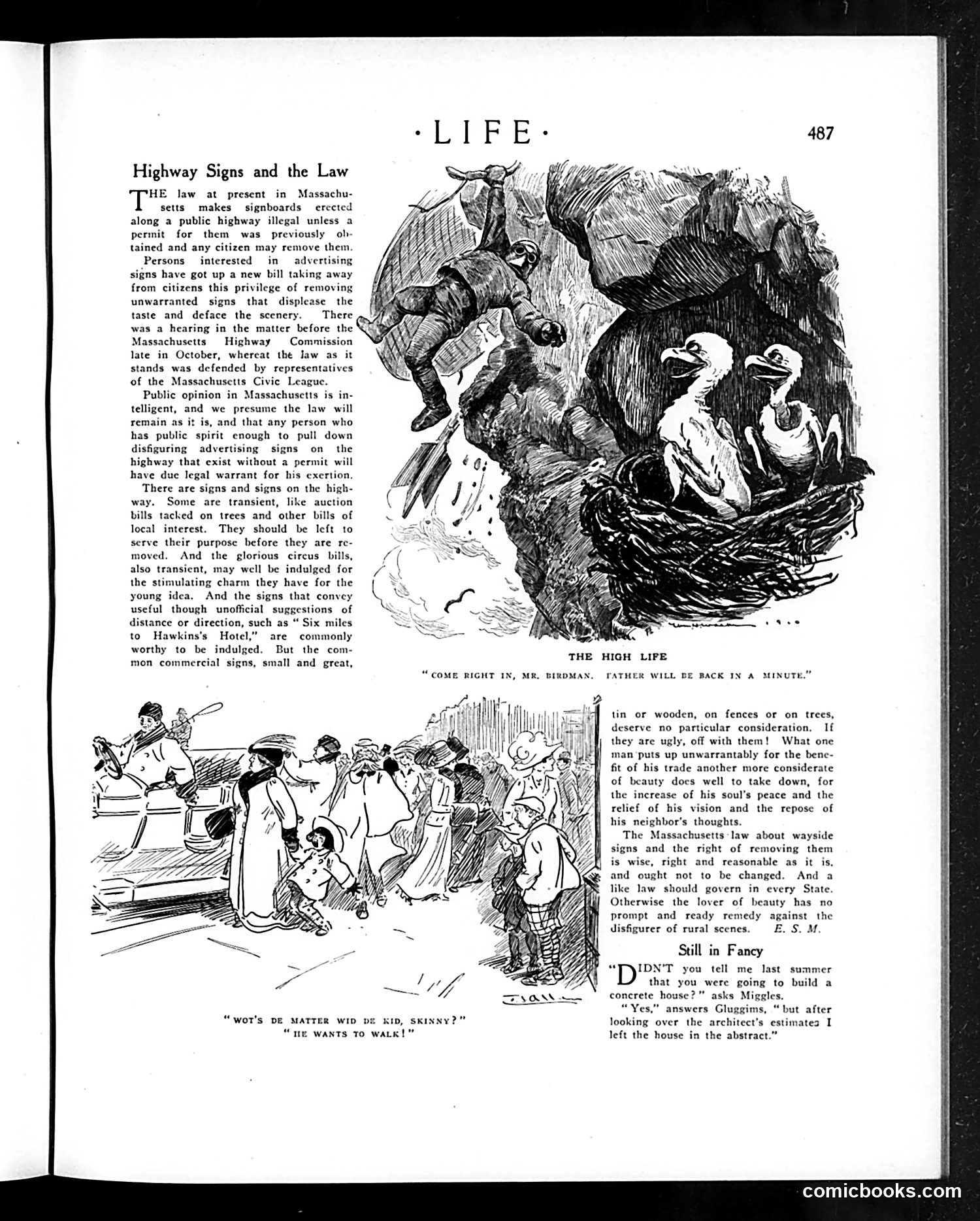
This page presents a serious editorial argument against commercial roadside advertising, defending Massachusetts law allowing citizens to remove unpermitted signs. The author (E.S.M.) distinguishes between acceptable "transient" signs (circus bills, local notices) and objectionable permanent commercial advertisements that deface rural scenery. The piece advocates for the right of beauty-conscious citizens to remove ugly commercial signboards without legal penalty. The cartoons are satirical asides: "The High Life" shows a birdman crashing into a tree (commenting on reckless behavior), while "Still in Fancy" jokes about an architect's estimate so expensive it left the concrete house design "in the abstract"—meaning only theoretical, never built. Both cartoons are social humor unrelated to the main editorial topic.
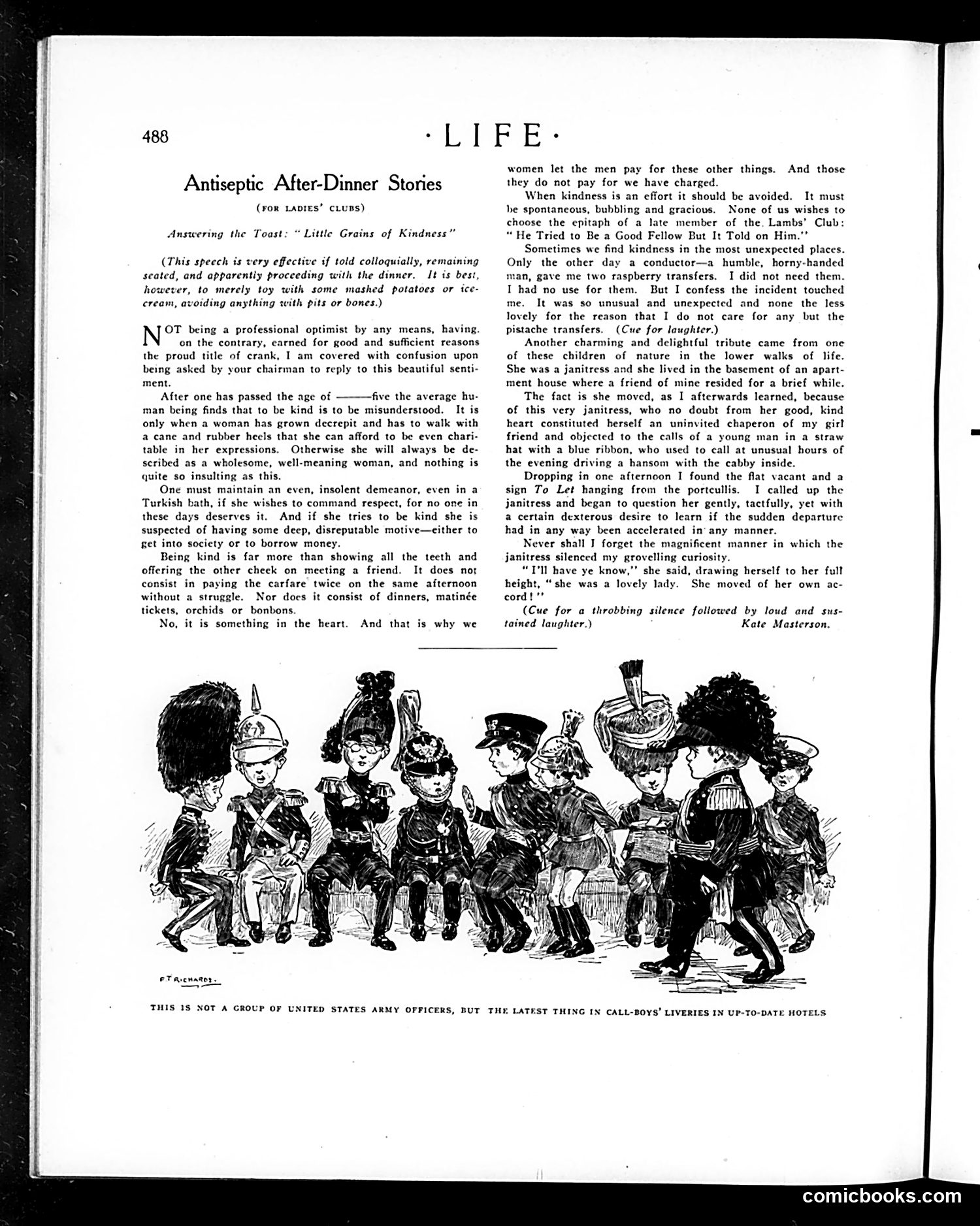
This page contains a satirical after-dinner speech about kindness, written for ladies' clubs. The speaker cynically mocks genuine charity: kindness performed as effort is insulting, and women who attempt it are suspected of ulterior motives (social climbing or borrowing money). The speech includes anecdotes illustrating unexpected kindness from working-class people—a conductor giving extra transfers and a janitress protecting the author's friend from a man in a straw hat arriving by hansom cab at odd hours. The janitress's protective intervention (causing the friend to move) is presented as touching devotion, despite its controlling nature. The accompanying cartoon depicts fashionable people in exaggerated military and formal dress, captioned as "the latest thing in call-boys' liveries in up-to-date hotels"—mocking hotel staff uniforms mimicking military garb. The satire targets upper-class pretension and hypocrisy regarding charity while paradoxically valorizing working-class "kindness" that is actually intrusive paternalism.
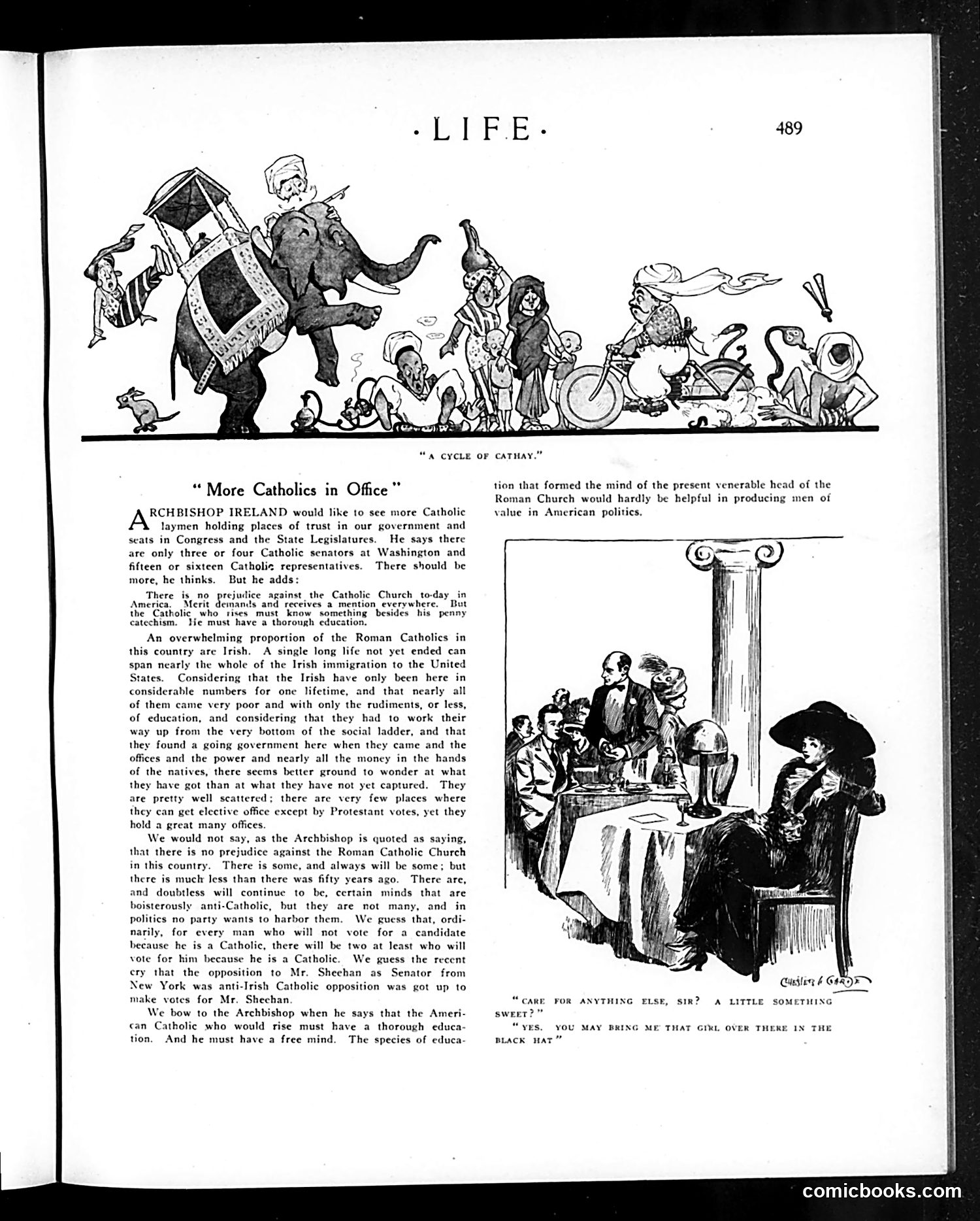
This *Life* page addresses Catholic representation in American government through Archbishop Ireland's advocacy. The top cartoon, "A Cycle of Cathay," satirizes the Irish Catholic immigrant experience—depicting arrival by elephant (exotic/foreign imagery), children, poverty, and struggle progressing toward integration. The main article argues Irish Catholics deserve more political office given their social climb from poverty, though it acknowledges some anti-Catholic prejudice persists. Notably, it criticizes the Pope's education as unsuitable for American politics—a pointed jab at Vatican influence. The bottom cartoon depicts a servant or attendant offering a girl "in the black hat" to a seated gentleman, likely satirizing either sexual exploitation or the vulnerability of poor (possibly immigrant) women in service positions—contrasting sharply with the article's claims of Irish Catholic advancement and respectability. Together, the page presents simultaneous uplift narrative and darker social realities facing Catholic immigrants.
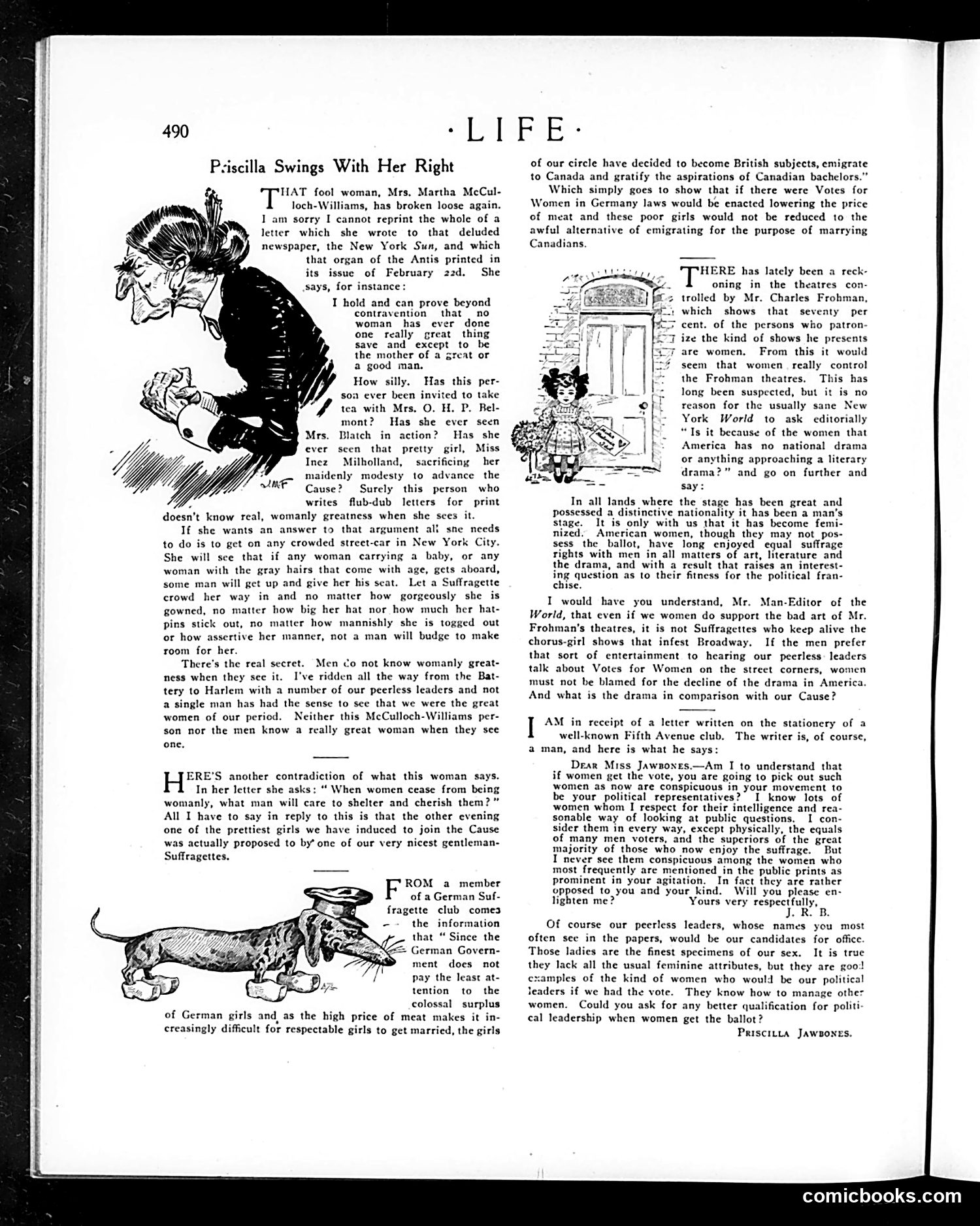
This page satirizes anti-suffrage arguments through Priscilla Jawbones's column. **Main Cartoon (left):** A caricatured woman in exaggerated dress swinging her arm—likely representing a suffragette activist, mocking the physical assertiveness associated with the movement. **The Satire:** Jawbones attacks Martha McCulloch-Williams, an apparent anti-suffrage writer, who claimed women's greatness lies only in motherhood. Jawbones sarcastically cites suffragettes like Inez Milholland as examples of female achievement, then reveals the *real* irony: men don't recognize suffragettes as worthy of basic courtesy (giving up subway seats) despite their "greatness." **Additional Jabs:** The page mocks German suffragettes emigrating to Canada to marry, suggesting that voting rights would solve real problems. It also critiques the *New York World* for blaming women's theater patronage for America's lack of national drama—exposing the contradictory logic that women's cultural influence is simultaneously dismissed. The humor targets both anti-suffragists and mainstream media dismissiveness toward women's roles and achievements.
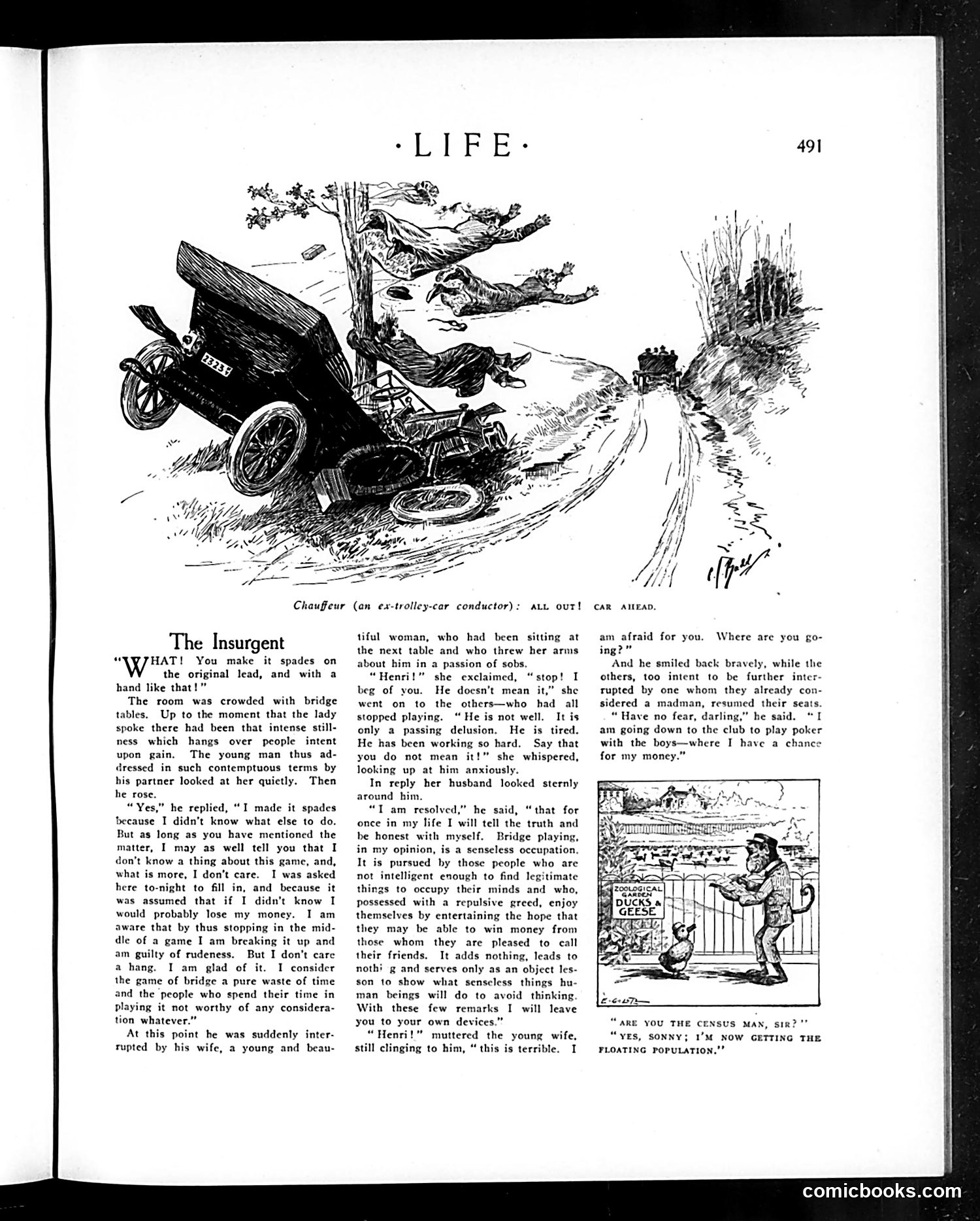
**Top Illustration:** A chauffeur (identified as "an ex-trolley-car conductor") crashes a car into a tree while passengers fly through the air. The caption reads "ALL OUT! CAR AHEAD"—a pun on trolley conductor language, satirizing the transition from public transit workers to automobile chauffeurs and the chaos that ensues. **"The Insurgent" Story:** A man disrupts a bridge game, declaring it a waste of time pursued by unintelligent, greedy people. His wife tries to suppress him, claiming he's delusional and ill. He leaves to play poker instead—revealing the satire: his "honest" rebellion against frivolous bridge is merely exchanged for gambling, contradicting his moral stance. The story mocks self-righteous insurgents who claim principle while practicing hypocrisy. **Bottom Cartoon:** A census taker counts the "floating population"—a pun suggesting homeless or transient people, likely reflecting Progressive Era concerns about labor mobility and urban poverty.
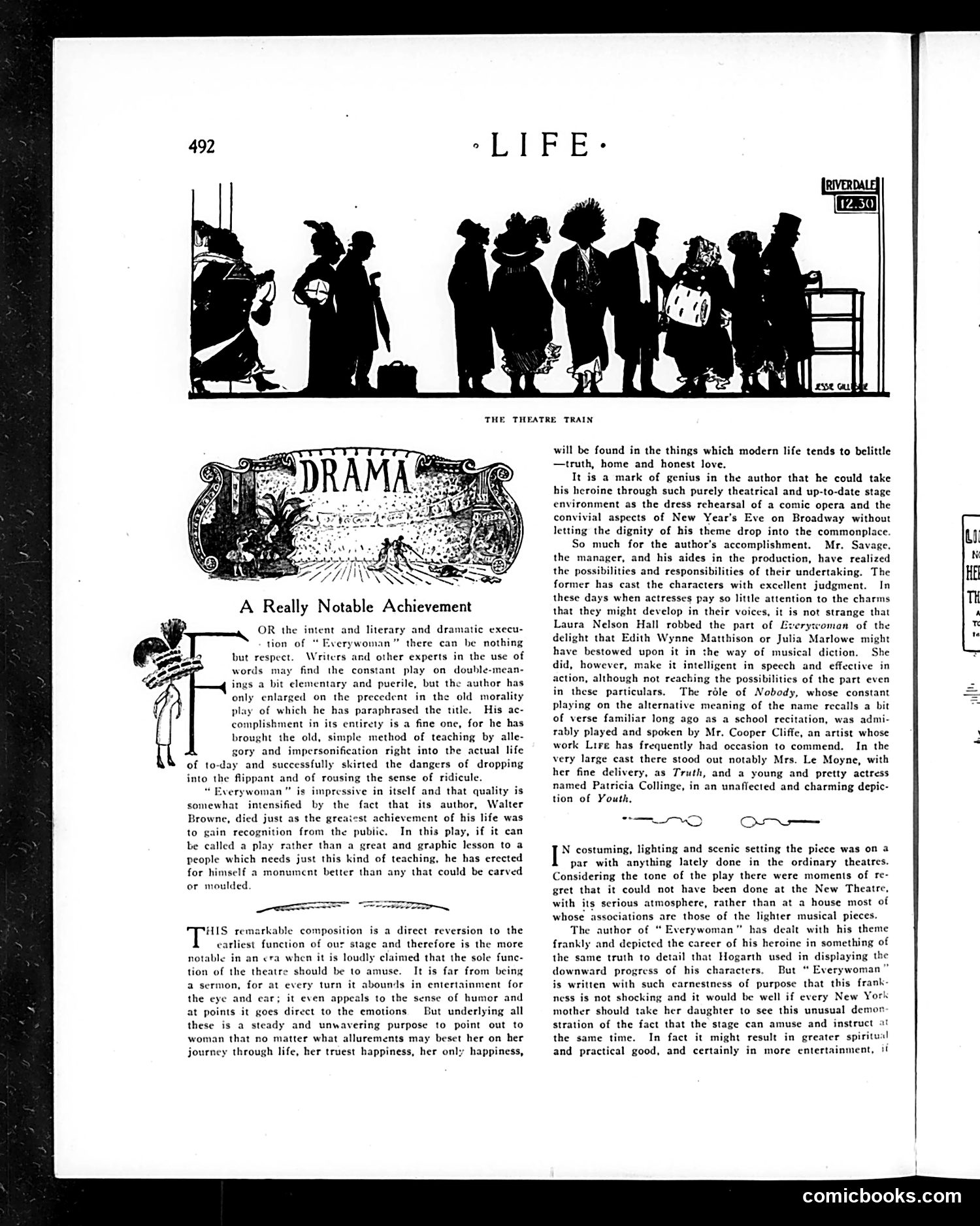
This page reviews **"Everywoman,"** a morality play by Walter Browne (who died before its premiere success). The silhouette at top depicts theater-goers boarding a "theatre train"—a metaphorical reference to attending this production. The review praises the play as a modern adaptation of classical morality plays, using allegory and personified characters (like "Nobody" and "Truth") to teach lessons about life. The author notes this approach was considered old-fashioned in an era demanding pure entertainment, yet Browne successfully navigates Broadway settings (comic opera rehearsals, New Year's Eve) without losing the play's moral dignity. The review credits the production's cast, particularly praising Cooper Cliffe's performance and noting Laura Nelson Hall's adequate but uninspired lead performance. It celebrates the production's scenic design and costuming as excellent, while lamenting the piece wasn't staged at the more prestigious New Theatre venue.
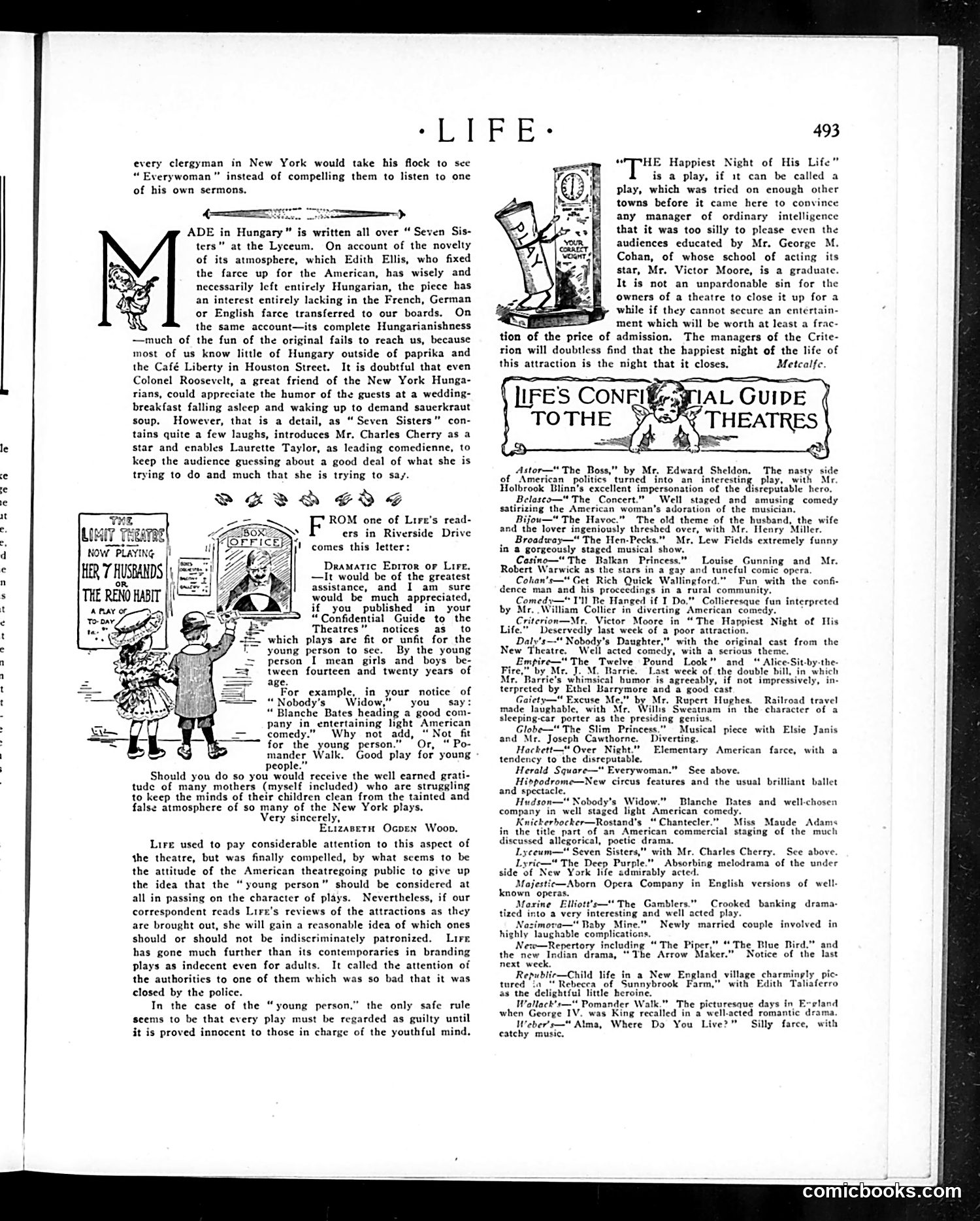
This page from *Life* magazine contains theater reviews and a reader's letter about theatrical content standards. **The Letter and Response:** Elizabeth Ogden Wood writes complaining that *Life* should label plays as unsuitable for young people (ages 14-20). She cites their review of "Nobody's Widow" as an example—it describes entertainment without warning of moral content. *Life* responds that they've tried this approach but American audiences don't care; they've stopped assuming "young persons" need protection. However, they note they've gone further than competitors in flagging indecent plays and even reported one to authorities that was subsequently closed. **The Theater Reviews:** The page includes advertisements and brief reviews of current productions, including "Made in Hungary," "Seven Sisters," and "The Happiest Night of His Life." **The Satire:** The cartoon advertisement mockingly lists plays ("Her 7 Husbands," "The Reno Habit") with questionable morality, contrasting with the earnest parental concern expressed in Wood's letter about protecting youth from theatrical "taint."
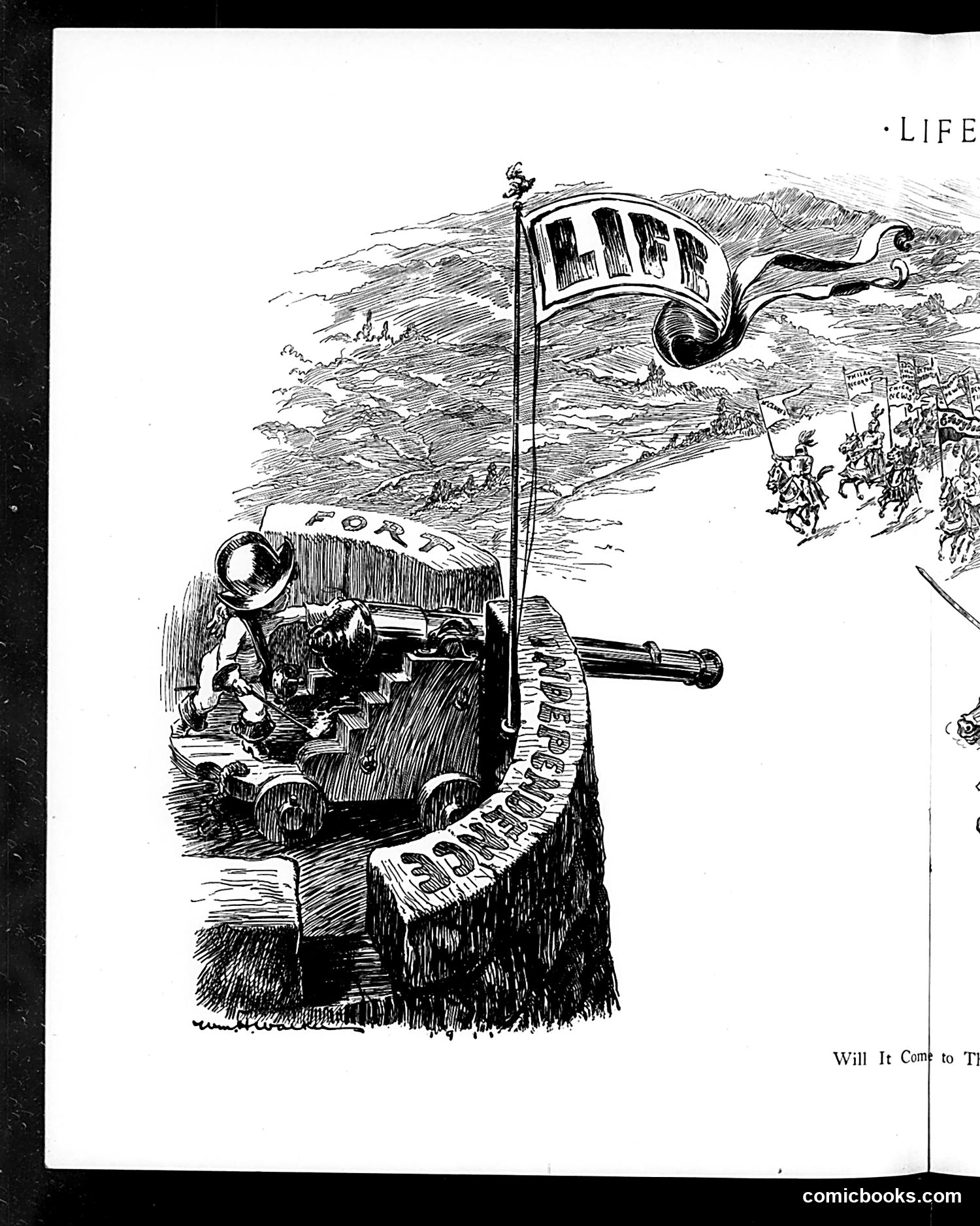
This is a satirical illustration from *Life* magazine showing a military figure operating a cannon from a fortified position. The cannon is mounted on what appears to be a hilltop or defensive structure, with a flag reading "LIFE" planted above it. The surrounding landscape depicts a battle scene with troops and military activity. The satire appears to critique militarism or war itself—*Life* magazine, through its mascot or emblem (the flag), is depicted as weaponized, participating in conflict. The incomplete caption "Will It Come to Ty[?]" suggests commentary on whether something will escalate or develop into warfare, though the full text is cut off, making the specific historical reference unclear without additional context.
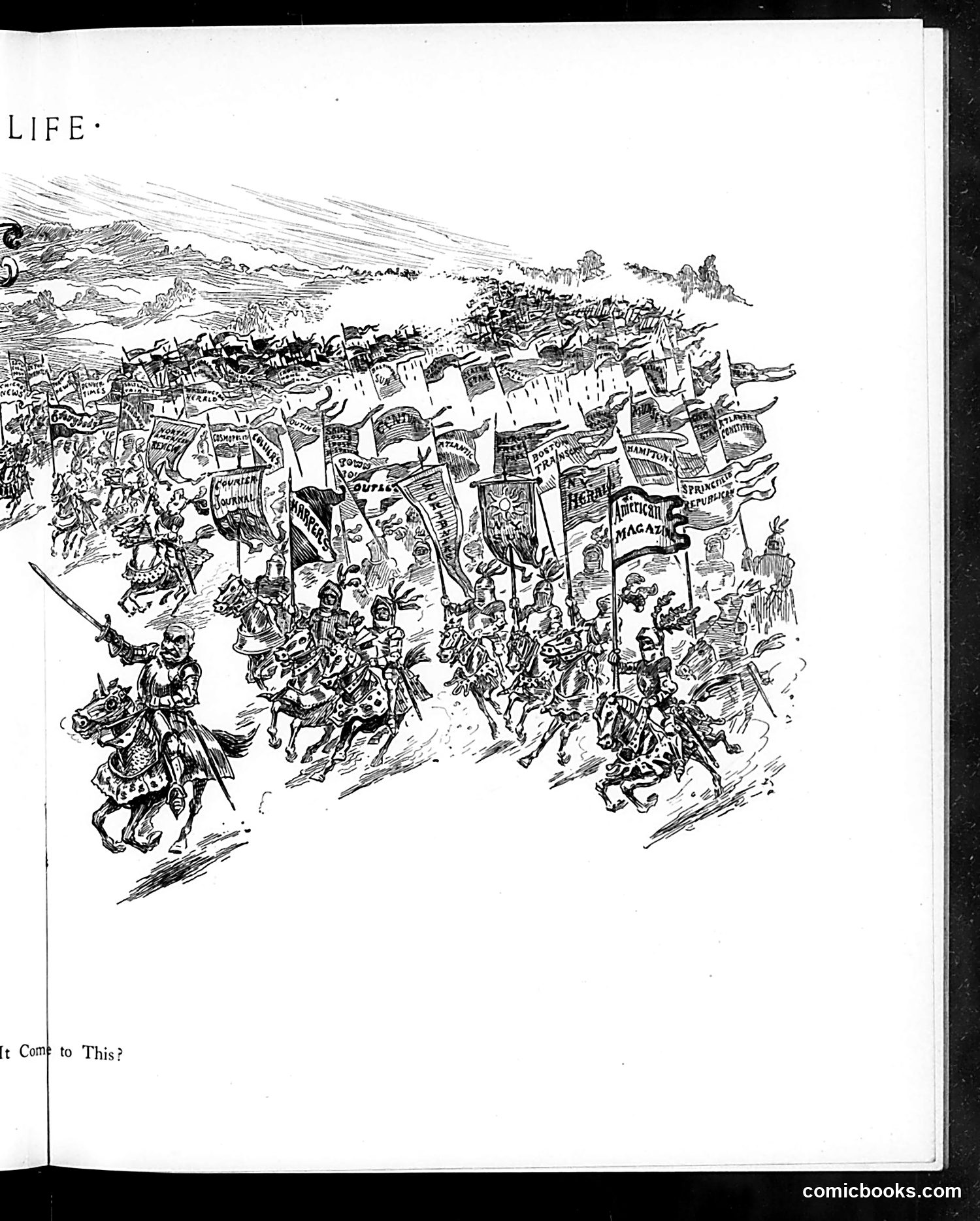
This is a satirical illustration from *Life* magazine titled "It Come to This?" The cartoon depicts a chaotic military or political procession featuring mounted figures on horseback in the foreground, with numerous flags and banners held aloft bearing text that appears to reference various American publications and institutions (including what looks like "American Magazine" and other periodicals visible on the banners). The composition suggests a critique of American public life—possibly satirizing media influence, commercial interests, or political movements of the era. The mounted figures appear to be leading or representing these various institutions as if in a triumphal march or invasion. The title's question format implies concern about the direction American society is heading. Without clearer dates or context, the specific political moment remains unclear.
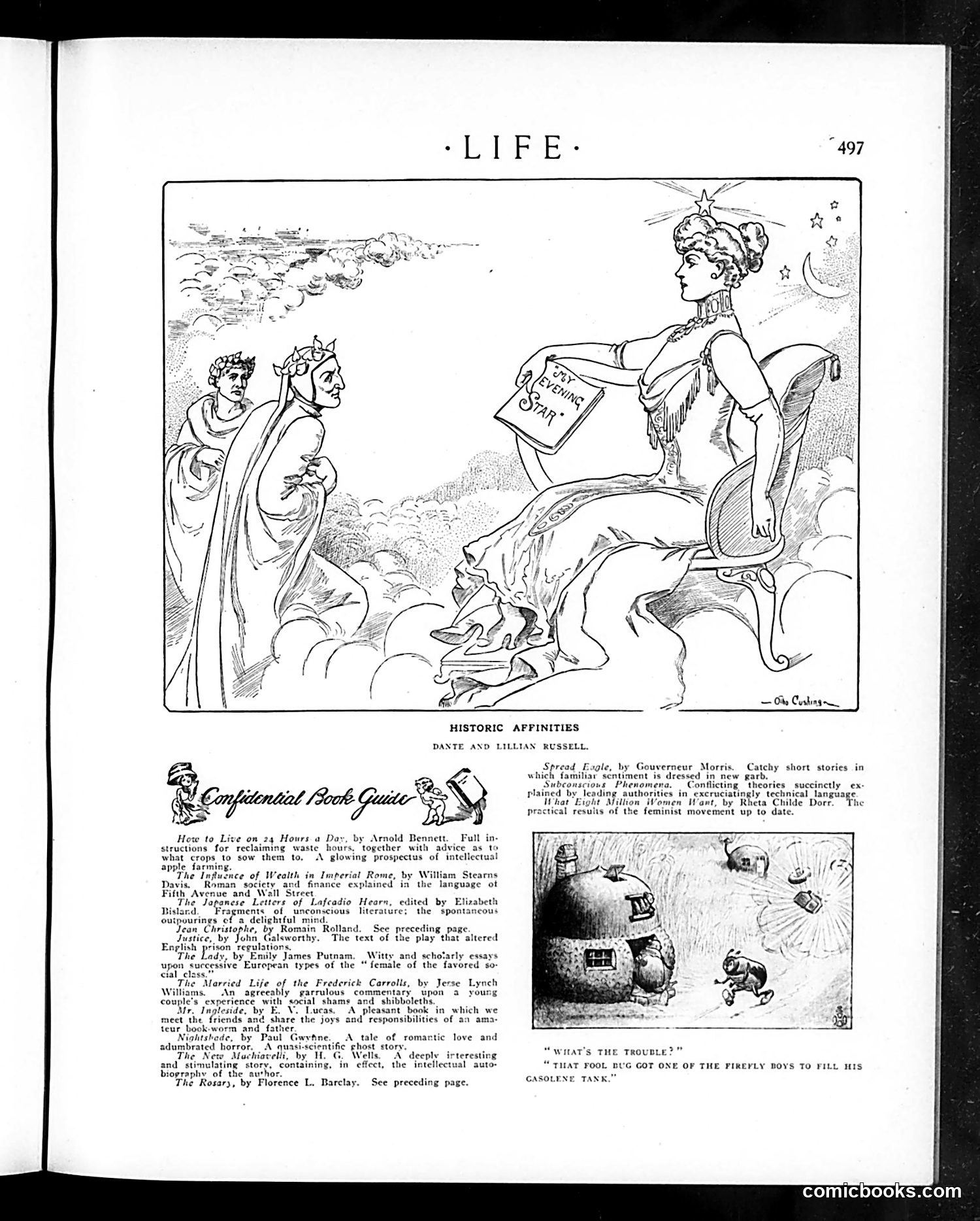
The main cartoon titled "Historic Affinities: Dante and Lillian Russell" presents a satirical comparison. On the left, two crowned figures (representing Dante Alighieri, the medieval Italian poet) observe a scene on the right where a woman identified as Lillian Russell—a famous American actress and Gibson Girl icon of the era—sits enthroned in clouds holding a book labeled "Spring Suit," surrounded by cherubs and celestial imagery. The joke conflates Dante's *Divine Comedy*, where he encounters idealized women in paradise, with Russell's celebrity status as a glamorous symbol of American beauty and consumerism. The satire mocks how contemporary American culture treats fashionable actresses as modern "muses" worthy of reverence, paralleling Dante's spiritual devotion with trivial commercial celebrity worship. The caption and adjacent book advertisements suggest Life magazine's typical blend of literary criticism and social commentary on American values.
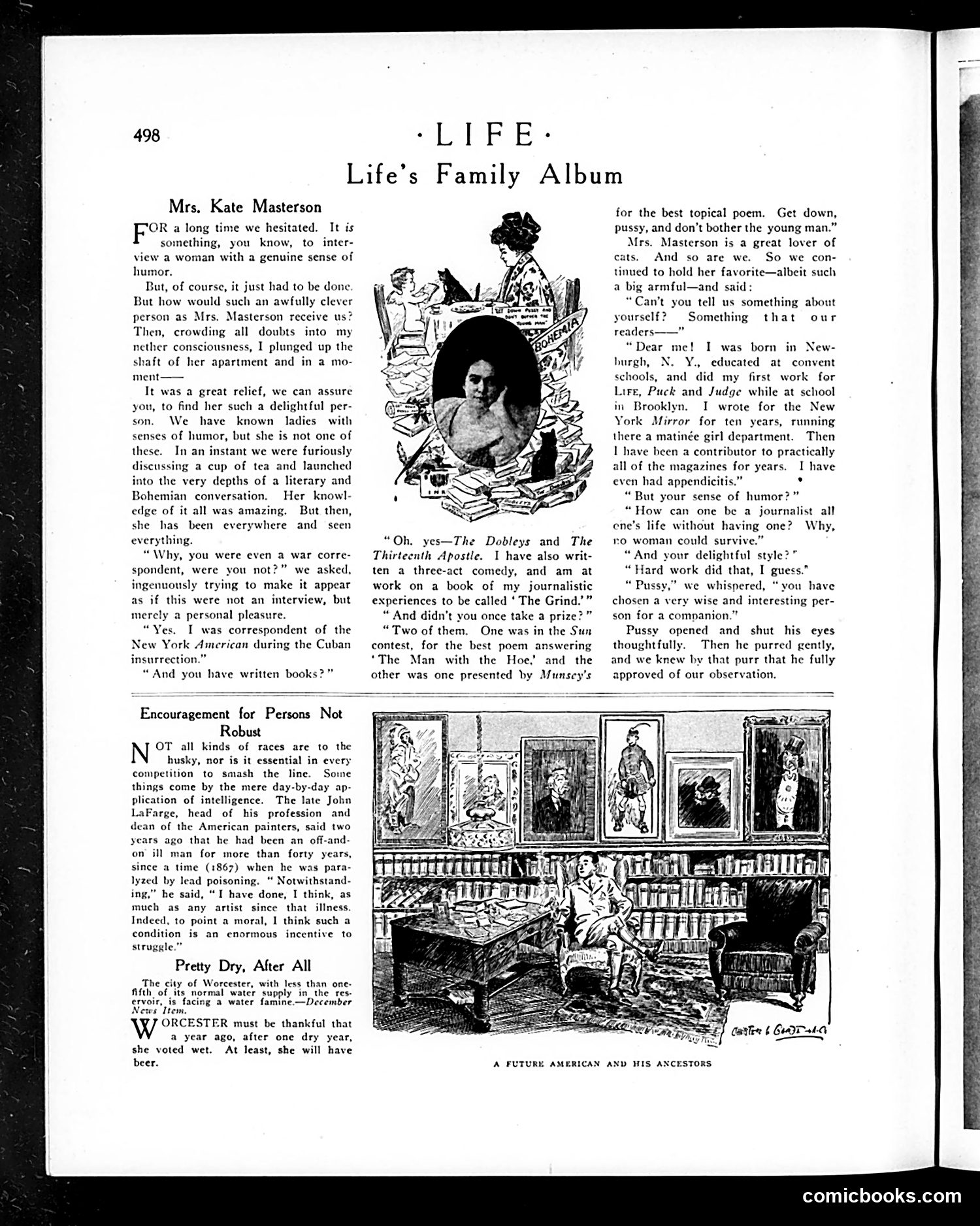
This page profiles Kate Masterson, a female journalist and author, presenting her as an accomplished, witty woman worthy of *Life* magazine's attention. The interview format—somewhat tongue-in-cheek—documents her credentials: war correspondent during the Cuban insurrection, published author, prize-winning poet, and contributor to major magazines like *Life*, *Puck*, and *Judge*. The satire is gentle: the interviewer affects casualness ("merely a personal pleasure") while clearly conducting an interview. The humor peaks when Masterson dismisses her own accomplishments—attributing her style to "hard work"—and when her cat's approval supposedly validates the interviewer's judgment. The accompanying illustration shows her surrounded by literary and domestic imagery, emphasizing she balanced intellectual pursuits with conventional femininity (notably, the cat). The lower cartoon about Worcester's water shortage is unrelated political commentary on local governance.
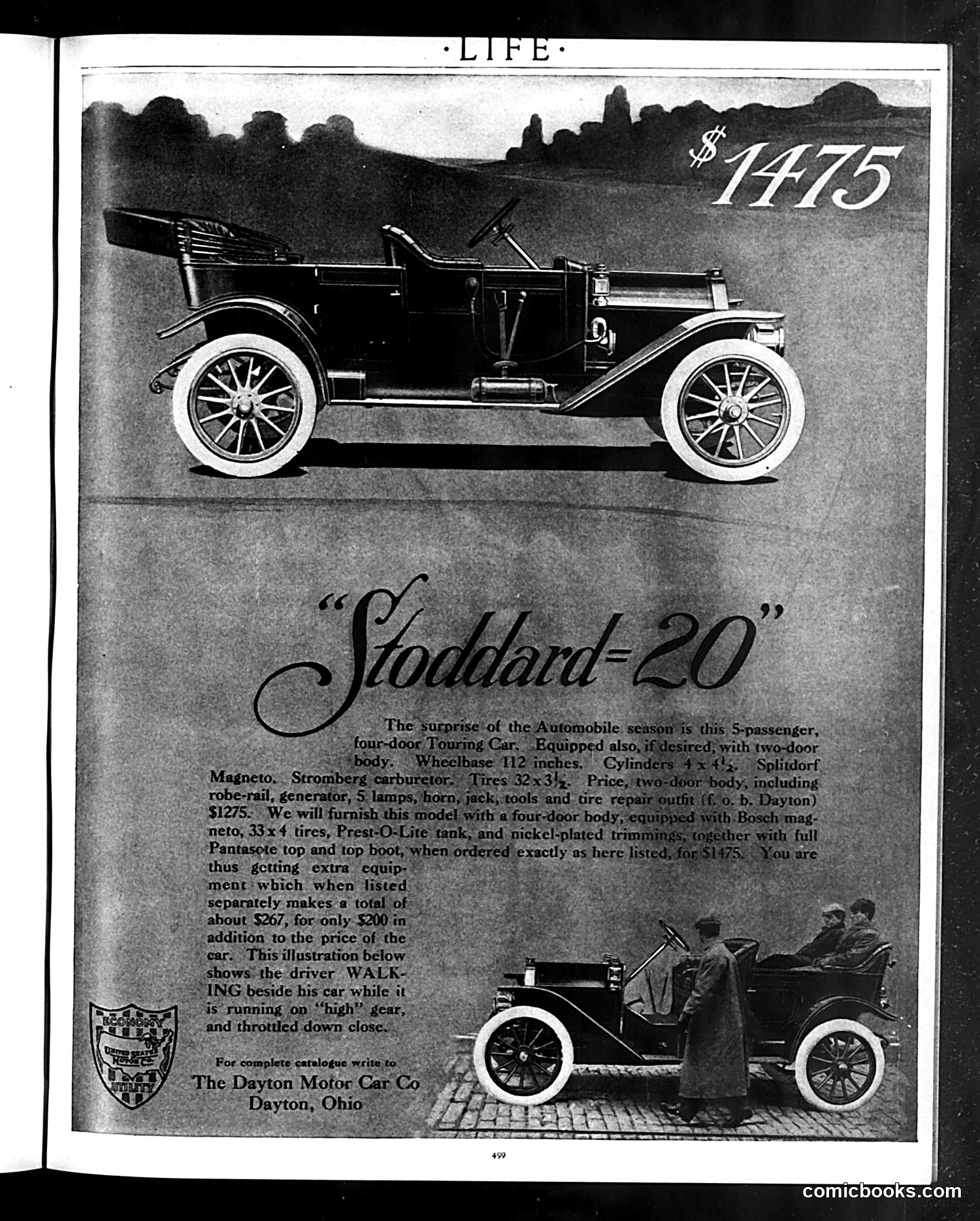
This is primarily an **advertisement**, not political satire. The page promotes the Stoddard-20 automobile, manufactured by the Dayton Motor Car Co. in Dayton, Ohio, priced at $1475. The ad emphasizes the car's features: a 5-passenger touring car with a 112-inch wheelbase, four cylinders, and optional accessories. The lower photograph shows a man demonstrating the vehicle's capabilities—walking beside it while it runs in high gear with throttle closed, highlighting its reliability and ease of operation. For modern readers: this represents early automotive advertising that emphasized mechanical innovation and practical performance rather than style or luxury. The "surprise of the automobile season" language reflects the novelty of automobiles themselves in this pre-WWI era.
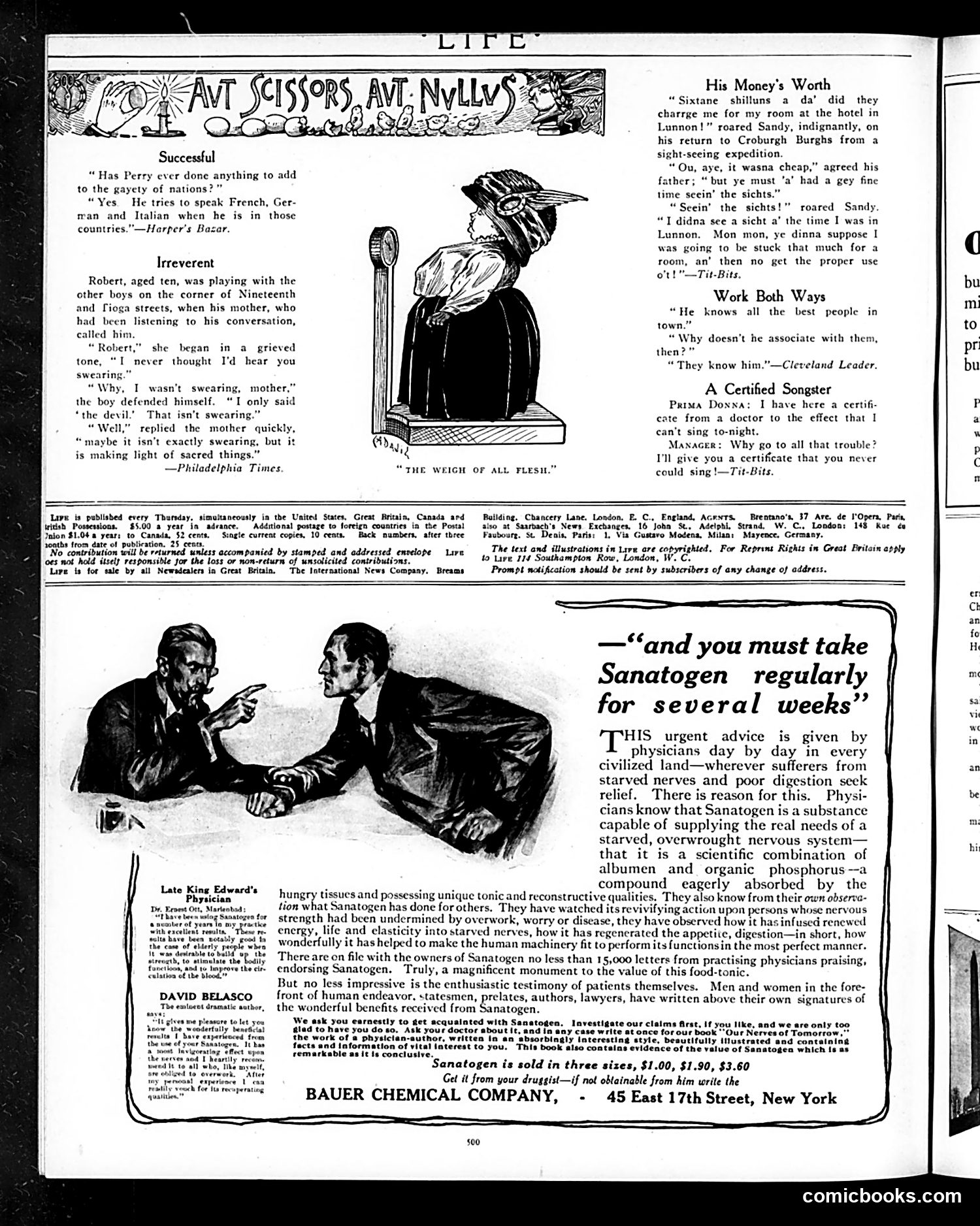
This page from *Life* magazine contains several satirical humor pieces typical of early 20th-century American comedy: **Top section ("Wit, Scissors, Wit, Nulls"):** Three brief jokes mocking social pretension and hypocrisy. "Successful" jokes about someone speaking foreign languages to impress. "Irreverent" ridicules a child using mild language ("the devil") while his mother accuses him of blasphemy—the satire being her overreaction. "Work Both Ways" mocks selective social climbing. **Central illustration:** Shows a figure weighing themselves, captioned "The Weigh of All Flesh"—a pun on vanity and physical appearance. **Bottom half:** A Sanatogen pharmaceutical advertisement featuring "Late King Edward's Physician," leveraging royal endorsement to sell a digestive tonic/nerve supplement. This represents the era's widespread use of celebrity medical testimonials to market dubious health products. The page exemplifies *Life's* format: light social satire mixed with period advertising reflecting contemporary concerns about digestion, nervousness, and social propriety.
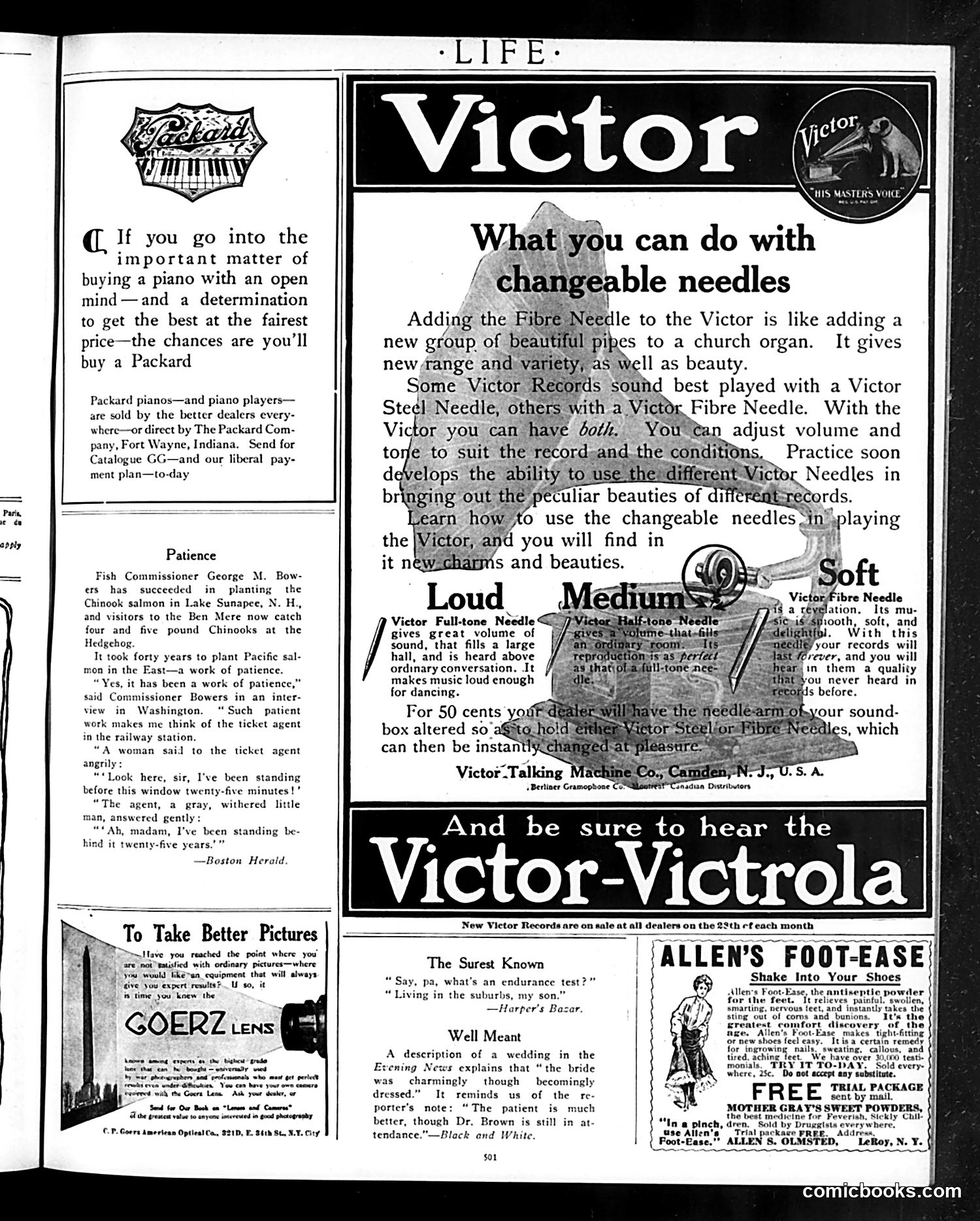
This page is primarily **advertisements** interspersed with brief humorous anecdotes rather than political cartoons. The ads promote consumer goods (Packard pianos, Goerz camera lenses, Victor phonographs and needles, Allen's Foot-Ease powder) typical of early 20th-century Life magazine's revenue model. The humor comes from short jokes: - A **patience anecdote** about a Fish Commissioner planting salmon, featuring a ticket agent's deadpan response about waiting twenty-five years—satirizing bureaucratic tedium. - Two brief, mild jokes about endurance tests (suburban living) and medical language ("patient is much better, though Dr. Brown is still in attendance")—gentle wordplay with no political content. The **Victor Victrola advertisement** emphasizes interchangeable needles for different sound qualities, positioned as innovation in home entertainment. There is **no political satire or caricature** on this page—it reflects Life's evolution toward advertising-heavy content while maintaining light, domestic humor for middle-class readers.
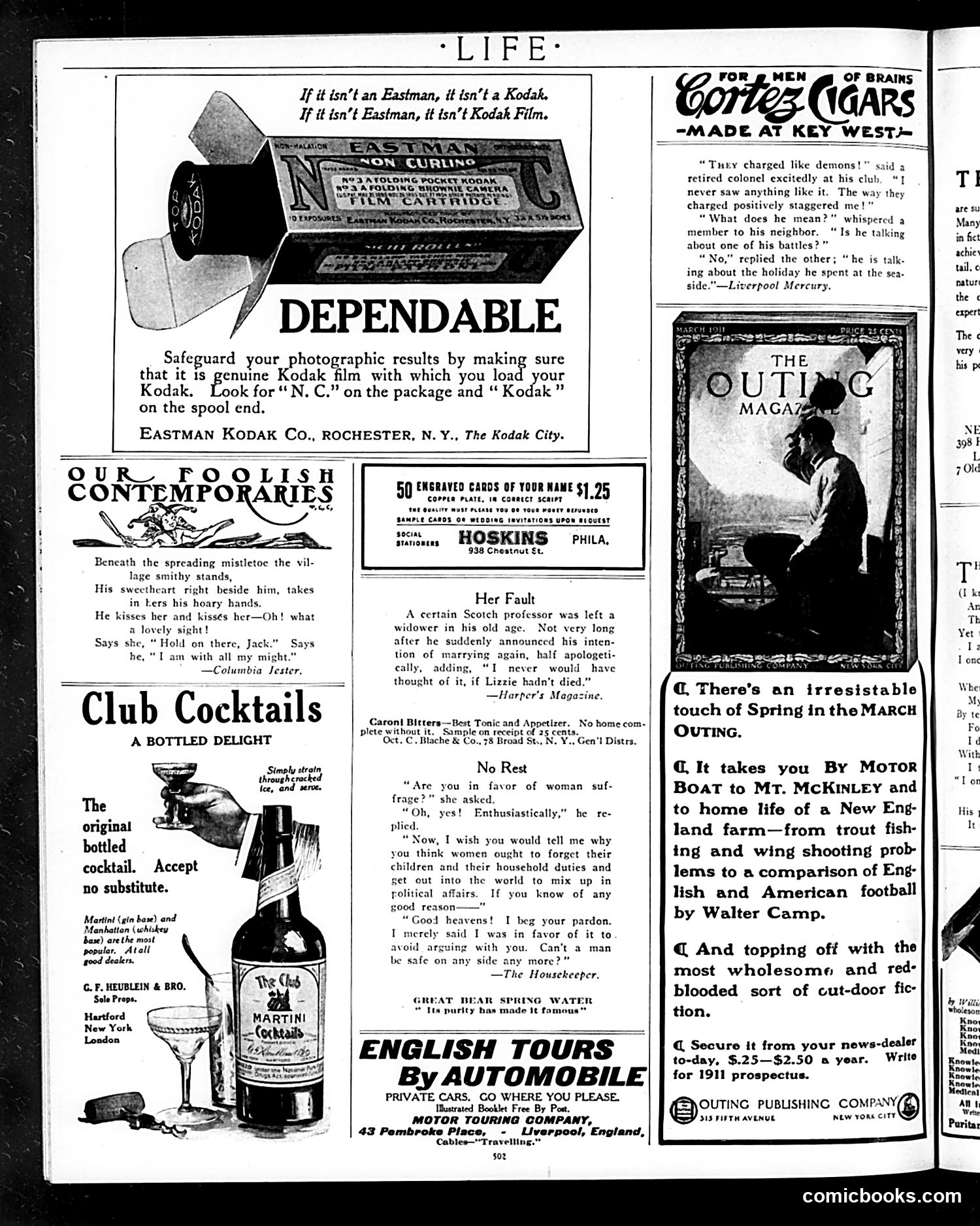
This page is primarily **advertising and light humor** rather than political satire. The content includes: **"Our Foolish Contemporaries"** section presents short, gentle jokes mocking social conventions: - A mistletoe kissing scene where a woman protests a man's overzealousness - A Scottish professor's awkward admission he only remarried because his wife died - A man who agrees with women's suffrage purely to avoid argument, then complains when pressed on reasons **Advertisements** dominate: Kodak film (emphasizing authenticity), Club Cocktails, engraved cards, and Outing Magazine. **The satire is mild**, targeting everyday social awkwardness—romantic misconduct, marital indifference, and conversational dishonesty—rather than political issues. The humor reflects early 20th-century attitudes about gender relations and domestic life, with women portrayed as nagging or men as evasive. This appears to be a **general-interest society page** mixing consumer ads with amusing anecdotes rather than sharp political commentary.
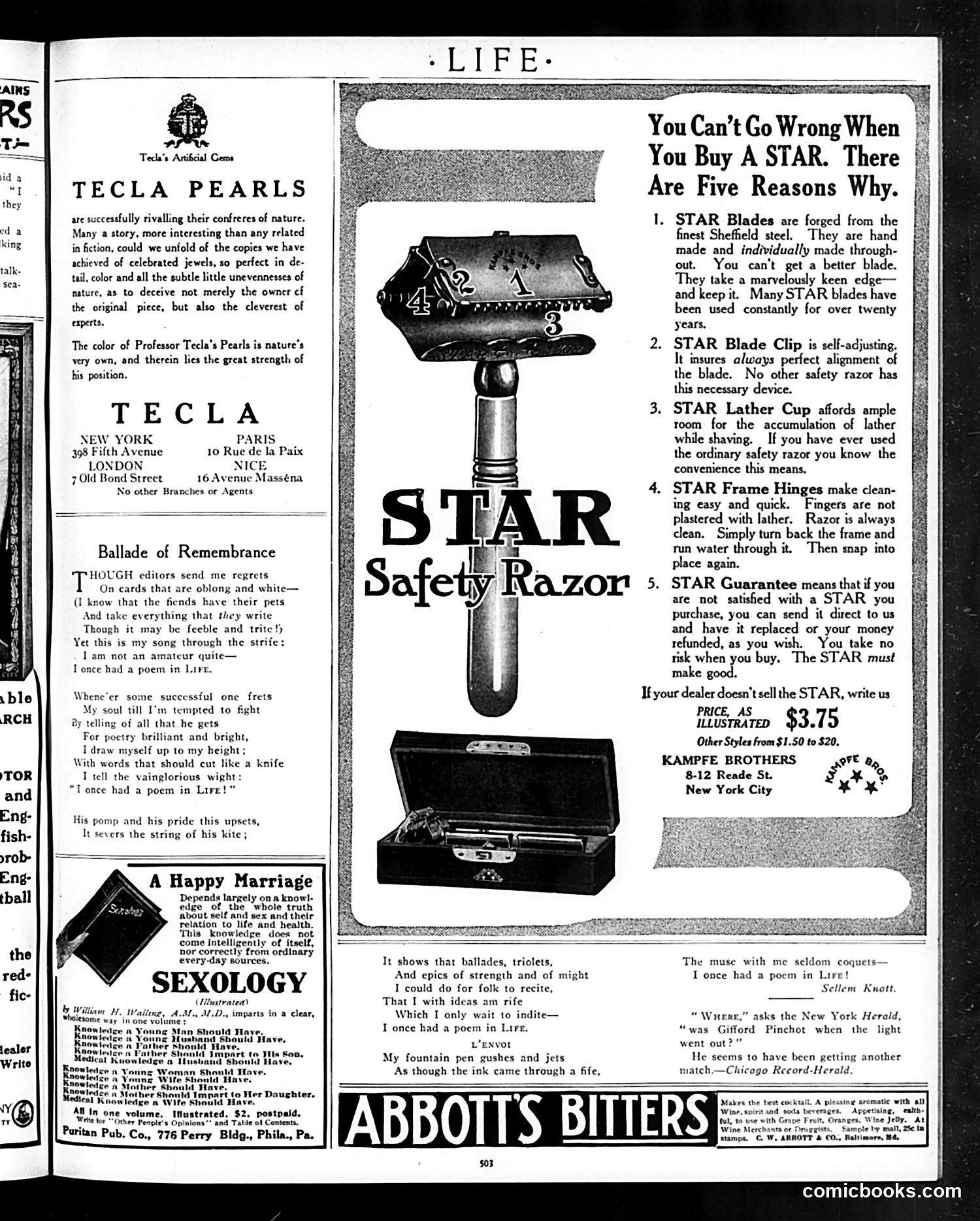
This page is primarily **advertising and light verse**, not political satire. The content includes: **Main Features:** - **Tecla Pearls advertisement**: Promotes artificial pearls that rival natural ones in quality - **"Ballade of Remembrance"**: A humorous poem about a writer's frustration with rejection—he consoled himself by repeatedly claiming "I once had a poem in Life" (the magazine itself), treating past publication as his sole credential - **Abbott's Bitters & Sexology book ads**: Standard period advertising - **Star Safety Razor ad**: Highlighting product features and a satisfaction guarantee **The Humor:** The poem gently mocks aspiring writers and the publishing world. The speaker uses his single past publication in *Life* as a badge of honor to silence successful competitors, treating it like an unbeatable trump card. It's self-deprecating humor about literary ambition and the competitive anxieties of writers—relatable to *Life*'s educated readership. The page contains **no identified political figures or current events commentary**—it's entertainment and commercial content typical of 1920s magazine publishing.
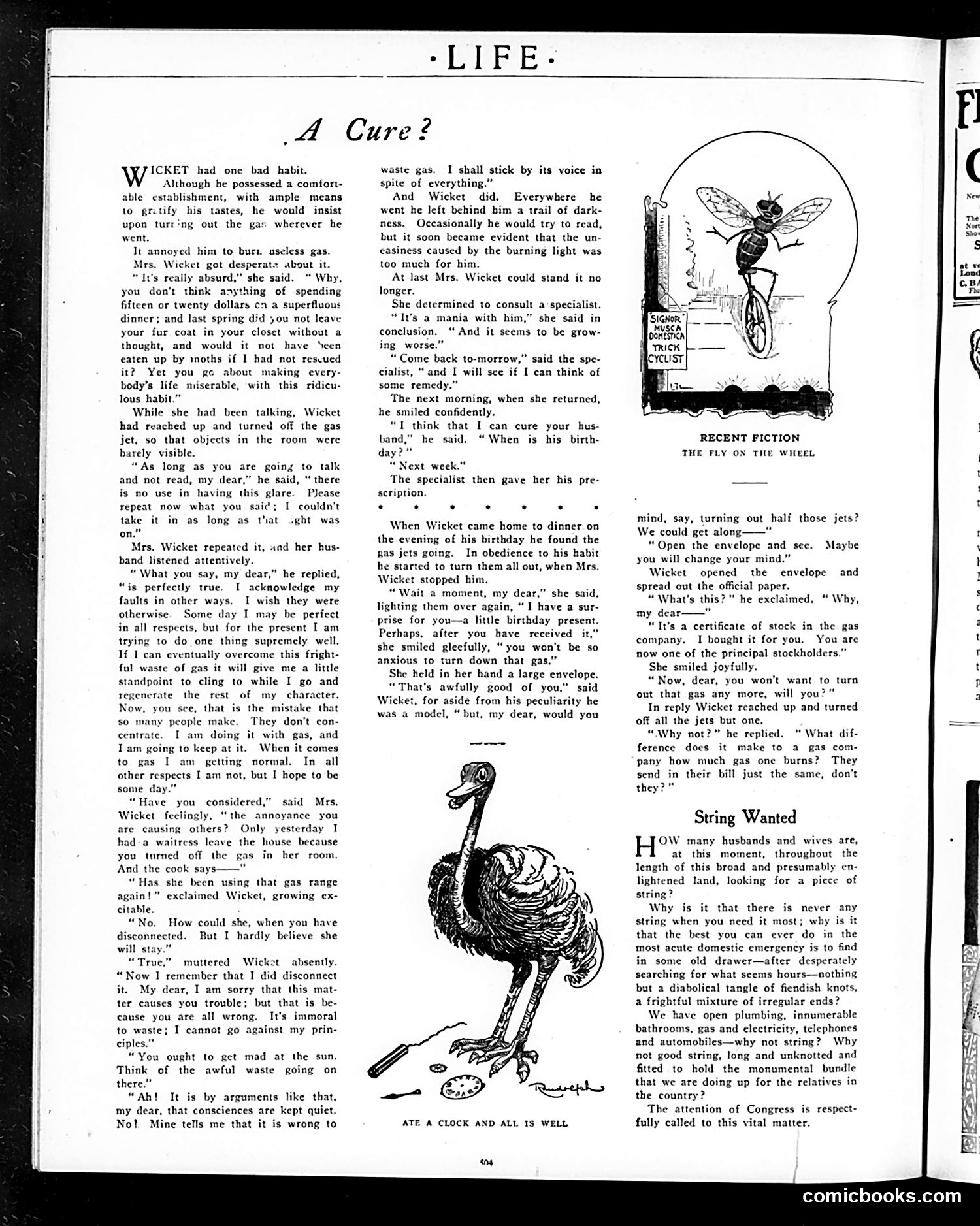
This domestic comedy satirizes obsessive frugality and single-minded self-improvement. Mr. Wicket compulsively turns off gas lights everywhere, wasteful behavior he's determined to eliminate through sheer willpower—despite annoying his wife, servants, and guests by leaving them in darkness. The satire targets two things: first, Wicket's absurd prioritization (he'll spend lavishly on dinners but agonizes over gas), and second, his sanctimonious self-righteousness about this one "moral" habit while ignoring broader character flaws. His wife consults a specialist, suggesting his behavior borders on mental illness. The punch line (partially cut off) appears to involve a birthday "cure"—likely her forcing him to confront his obsession by having the lights deliberately on. The cartoon mocks rigid, eccentric penny-pinching and the Victorian tendency toward moralistic self-flagellation over trivial matters while ignoring genuine problems.
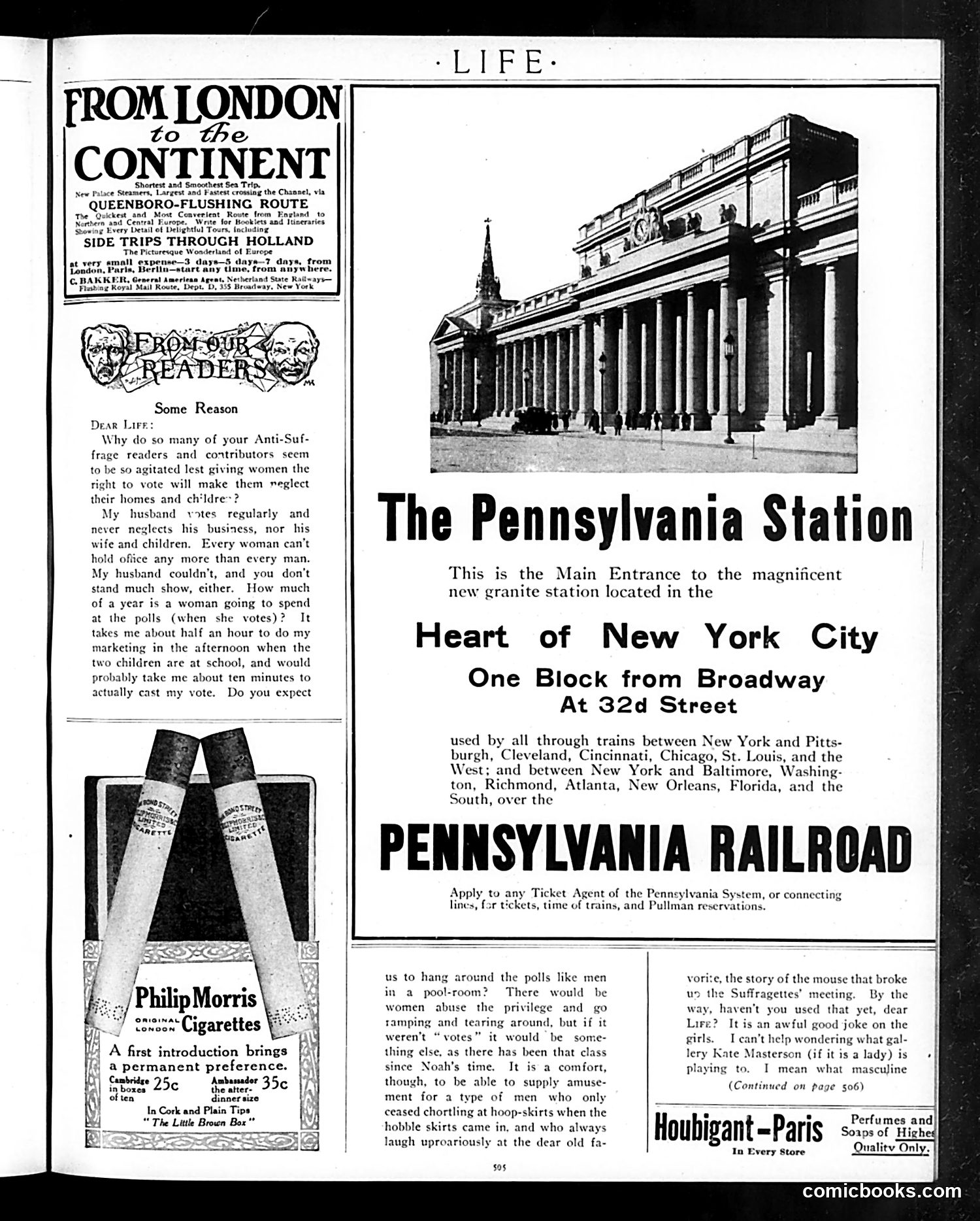
This page is primarily **advertising and reader mail**, not political satire, though it contains significant social commentary about women's suffrage. The main editorial content is a **pro-suffrage letter** responding to anti-suffrage arguments. The writer (identified only as a woman) rebuts claims that voting will make women neglect homes and children, pointing out that voting takes minimal time (about ten minutes) compared to her existing responsibilities. She mocks men who fear women at polls, suggesting such men are intellectually immature and have historically mocked women's fashion changes (hoop-skirts, hobble skirts). The letter appears designed to counter anti-suffrage readers who dominated *Life*'s correspondence at the time. The sarcasm about men gathering at polls "like men in a pool-room" and the dismissive tone toward masculine anxieties reflects genuine early-1900s suffrage debate rhetoric. The page also contains period advertisements (Pennsylvania Railroad, Philip Morris cigarettes, Houbigant perfume) typical of *Life* magazine's revenue model.
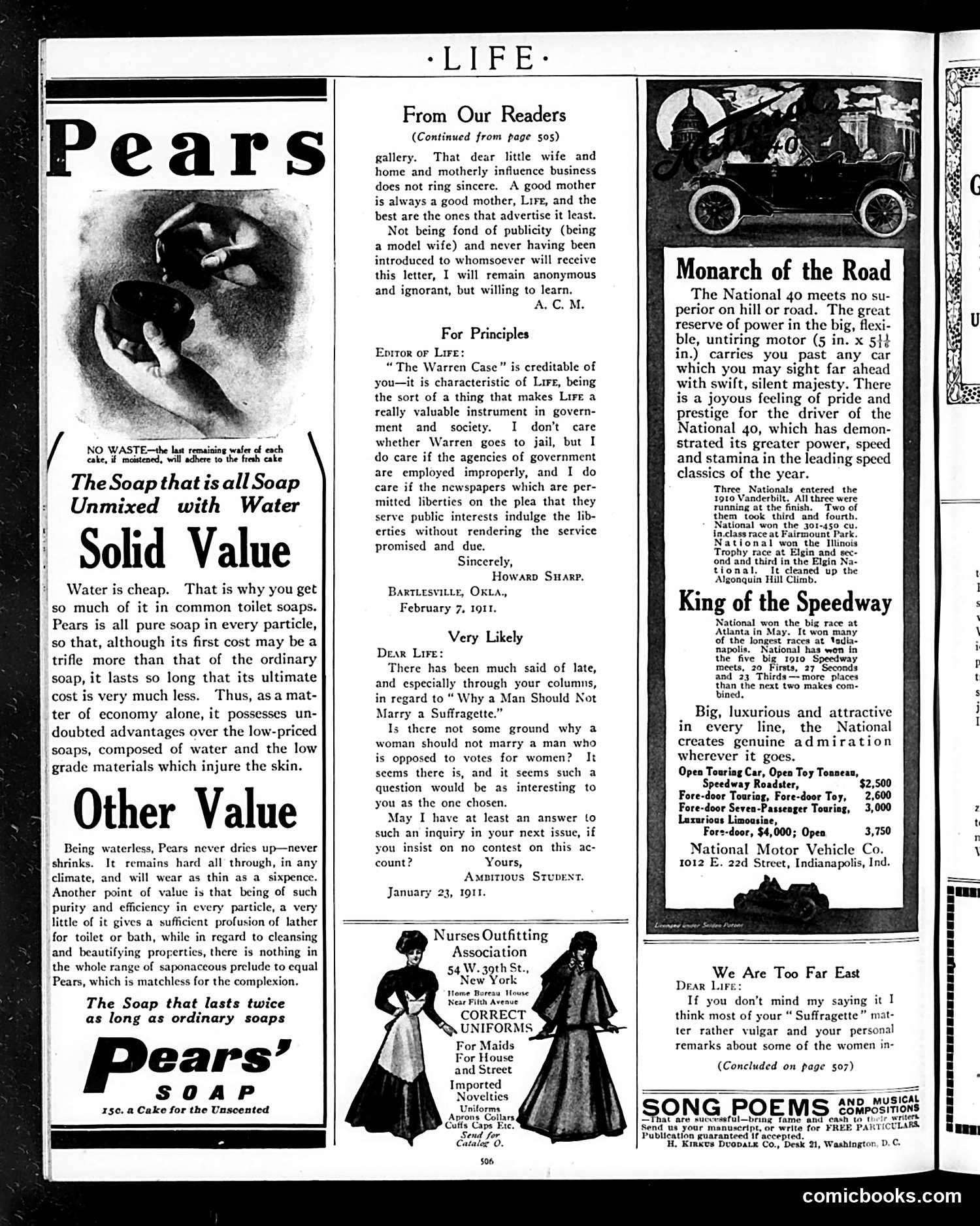
This is primarily an **advertisement and reader-letters page** from *Life* magazine, not a political cartoon. The content includes ads for Pears' soap (emphasizing economy and purity), the National automobile (claiming superiority), and a Nurses Outfitting Association. The reader letters touch on contemporary social debates: one criticizes the advertisement of motherhood as insincere; another defends *Life*'s investigative journalism in "The Warren Case"; and notably, a reader calling themselves "Ambitious Student" turns a feminist question back on *Life*, asking why women shouldn't avoid marrying men opposed to **women's suffrage**—a provocative counterpoint to *Life*'s apparent position against suffragettes marrying. The page reflects early 1911 concerns: women's voting rights, journalistic ethics, and consumer values.
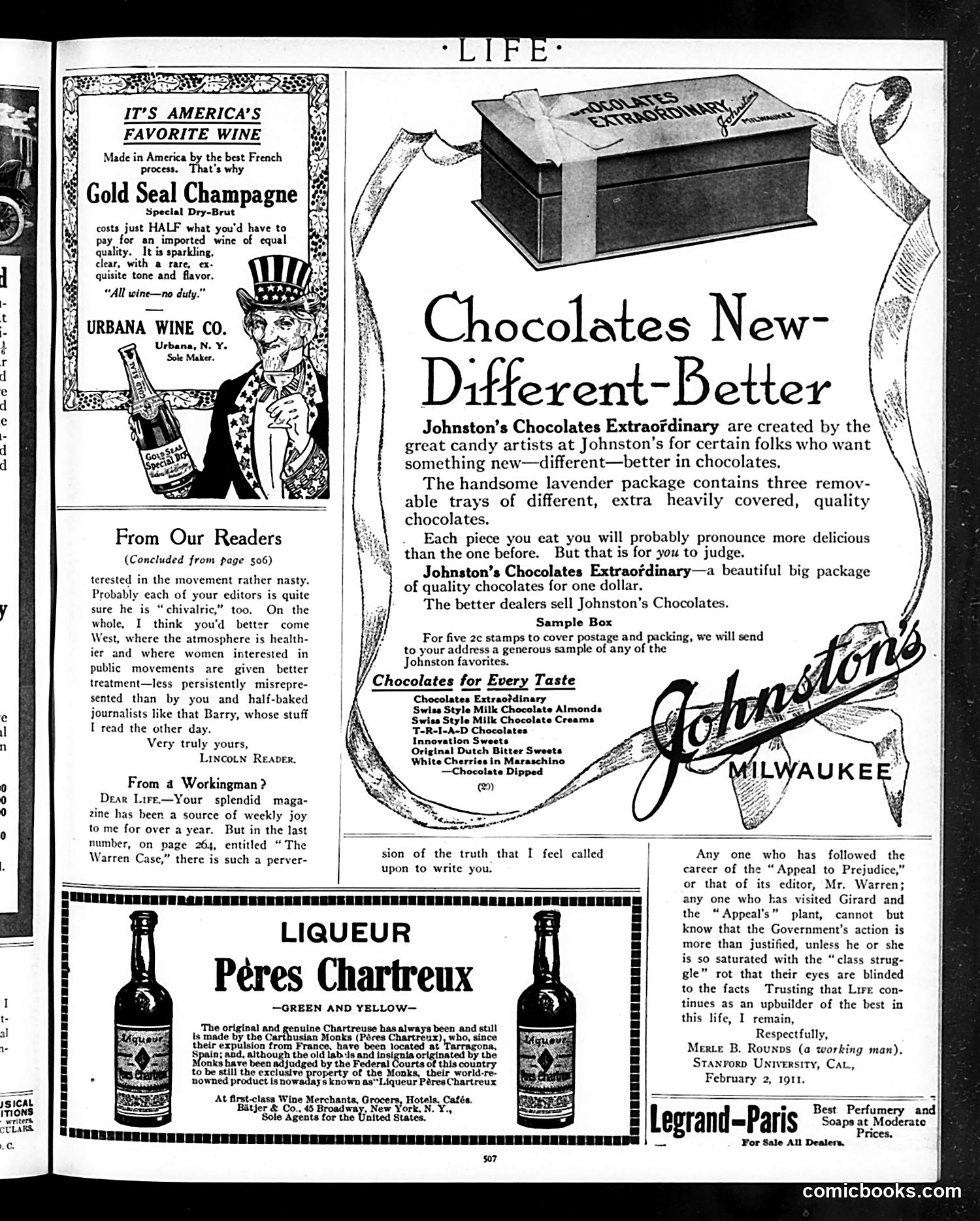
This page is primarily **advertising content** interspersed with reader letters to the editor. The main cartoon appears in the **Gold Seal Champagne ad** (top left): Uncle Sam in patriotic dress holds a wine bottle, promoting American-made champagne as cheaper than imported versions—a nationalist economic pitch emphasizing domestic production and tariff advantages ("All wine—no duty"). The **Johnston's Chocolates ad** (center) is straightforward product marketing with no satirical content. The **reader letters** include commentary on gender treatment in journalism and a working-man's defense of the government's action against "The Appeal to Prejudice" (apparently a socialist publication). The latter writer criticizes class-struggle rhetoric and praises *Life* as an "upbuilder." The **Péres Chartreux liqueur ad** (bottom) emphasizes the product's authentic French monastic origins. This page reflects early 20th-century concerns: economic nationalism, women's rights skepticism, and anti-socialist sentiment during the Progressive Era.
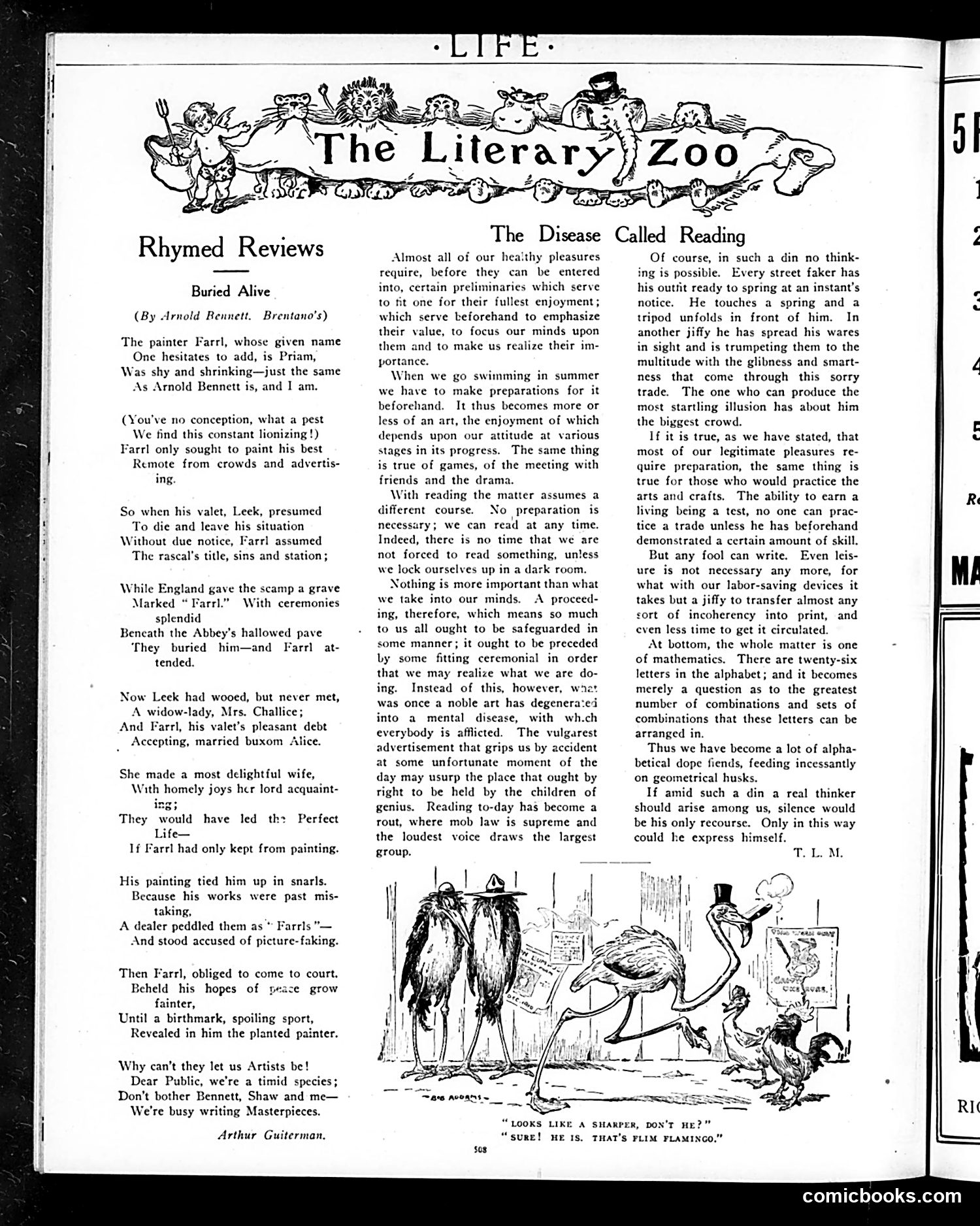
This Life magazine page contains two distinct pieces of satirical content: **"Buried Alive" Book Review** (by Arthur Guiterman): A humorous verse review of Arnold Bennett's novel about painter "Priam Farrl." The satire mocks both the novel's plot (where the painter assumes his valet's identity and accidentally gets buried under the wrong name) and the broader complaint of artists about public lionization. Guiterman uses self-deprecating humor—grouping Bennett, George Bernard Shaw, and himself as "timid" artists annoyed by public attention—to critique how society treats creative figures. **"The Disease Called Reading"** (by T.L.M.): An essay lamenting that reading has become degraded into mindless consumption. The author argues that authentic pleasures require preparation and focus, but modern reading (influenced by street vendors and sensational advertisements) has become a chaotic "mental disease" where "mob law is supreme." The accompanying cartoon illustrates this chaos. The **cartoon** depicts various creatures and figures engaging in frenzied, undignified reading behavior, with the caption "Looks like a sharper, don't he?" / "Sure! He is. That's 'Plim Flamingo'"—mocking both con artists and gullible readers.
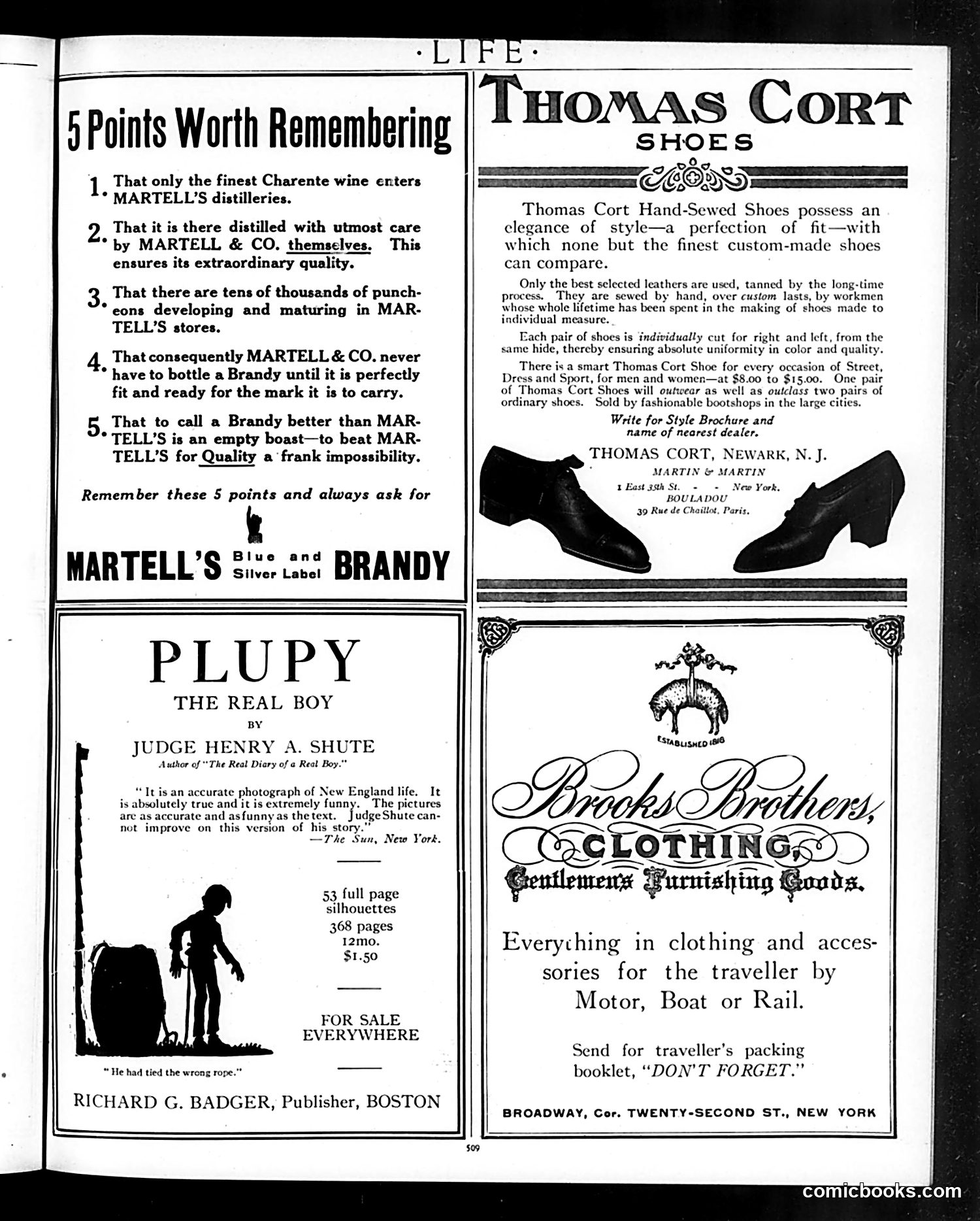
This page is primarily **advertising**, not satire or political commentary. It contains four commercial advertisements typical of an early 20th-century magazine: 1. **Martell's Brandy** - Lists five quality assurances about French brandy production and aging 2. **Thomas Cort Shoes** - Promotes hand-sewn, custom shoes for men and women 3. **"Plupy: The Real Boy"** - Book advertisement featuring a silhouette illustration of a boy with rope, promoting Judge Henry A. Shute's humorous New England children's book (368 pages, $1.50) 4. **Brooks Brothers Clothing** - Advertises travel clothing and accessories with a packing booklet The only potentially humorous element is the "Plupy" book illustration captioned "He had tied the wrong rope"—a domestic mishap joke suited to the book's comedic tone about boyhood pranks. This appears to be a straightforward commercial page with no political content or satirical cartoons.
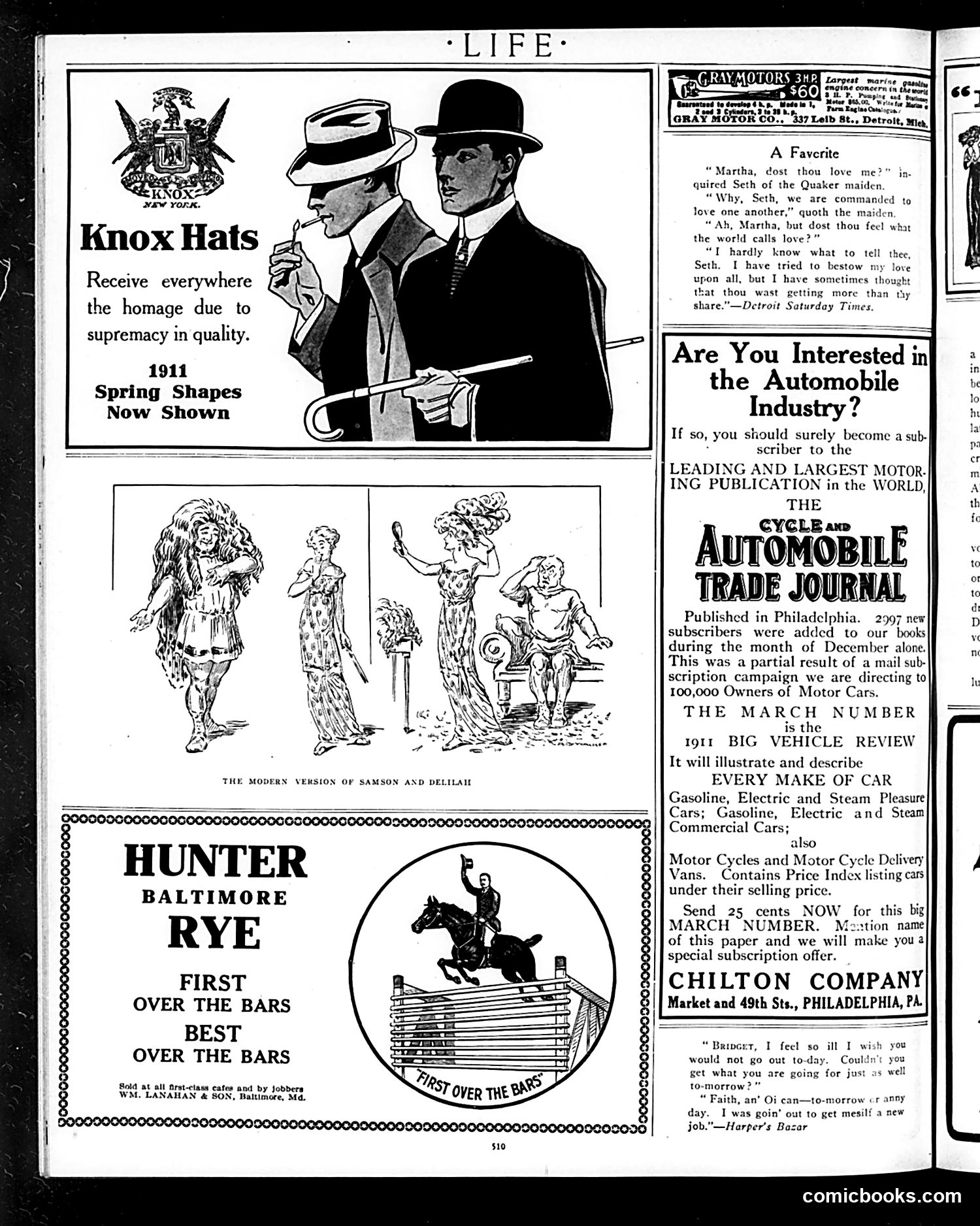
This page contains primarily **advertisements and humor content** rather than political satire. The main cartoon, "The Modern Version of Samson and Delilah," presents four figures in classical dress, updating the biblical story for contemporary audiences—likely suggesting women's power over men through romance or manipulation, a common satirical theme of the era. The page features multiple ads: **Knox Hats** (promoting 1911 spring styles), **Hunter Baltimore Rye** whiskey, and the **Automobile Trade Journal** (reflecting the period's fascination with the emerging auto industry). The humor pieces include romantic and domestic jokes from *Detroit Saturday Times* and *Harper's Bazar*, touching on courtship, marriage, and Irish immigrant life—typical light content for Life's general readership. The overall page reflects early 20th-century advertising, fashion, and consumer culture rather than serious political commentary.
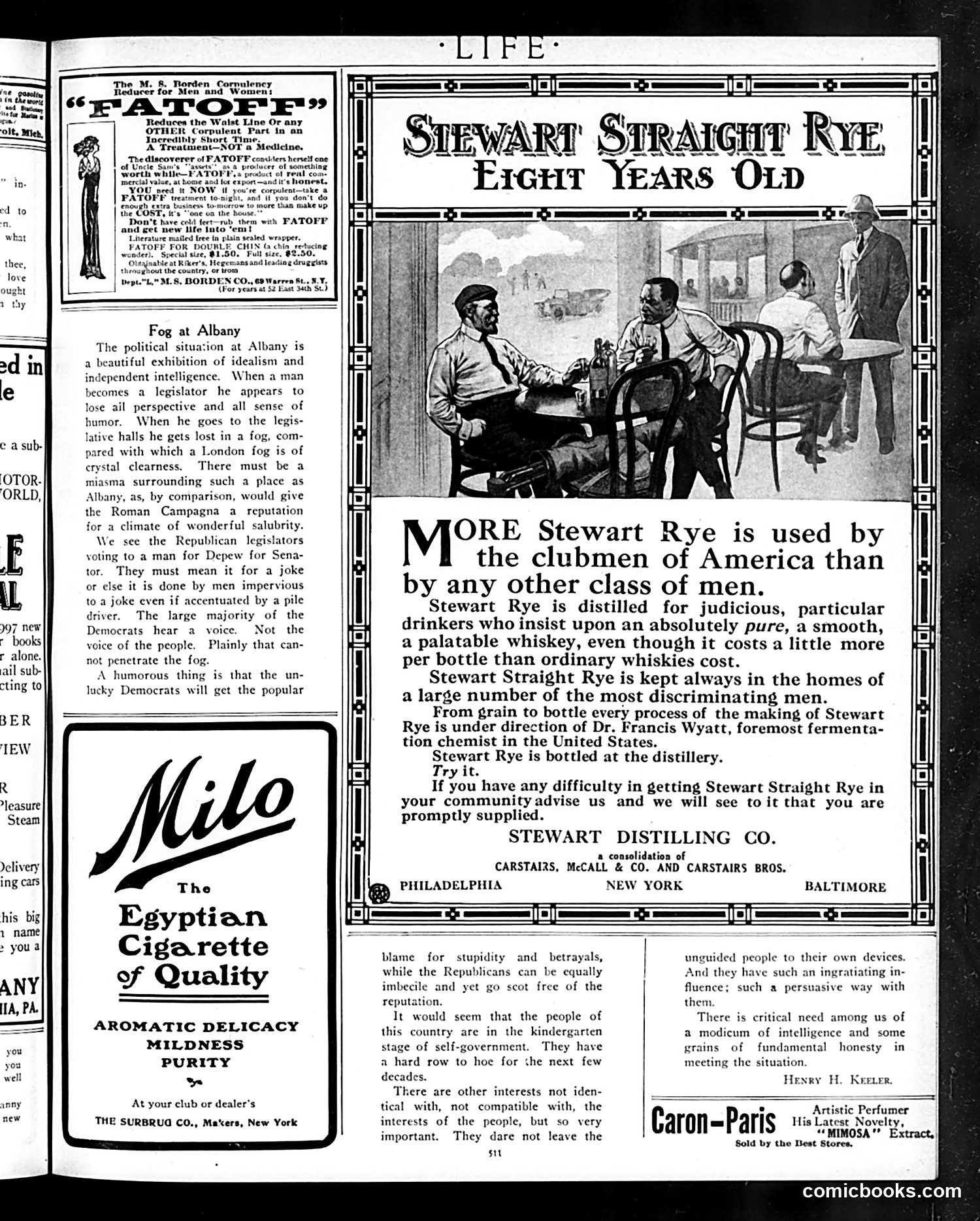
This page is primarily **advertising** rather than editorial content or political cartoons. The main feature is a full-page advertisement for **Stewart Straight Rye whiskey**, marketed to affluent American clubmen as a premium, pure spirit distilled under the supervision of "Dr. Francis Wyatt, foremost fermentation chemist." The illustration shows men in formal attire in what appears to be a gentlemen's club setting, reinforcing the product's association with upper-class leisure and respectability. The page also includes smaller ads for other luxury goods: **Milo Egyptian cigarettes** (emphasizing "aromatic delicacy, mildness, purity") and **Caron-Paris perfume**. A brief editorial piece titled "Fog at Albany" critiques New York legislators for voting as a bloc without independent judgment—comparing their mental fog to London fog. The author mocks both Republicans and Democrats as equally foolish, suggesting the public has poor governance. The page reflects early 20th-century advertising targeting wealthy, sophisticated male consumers.
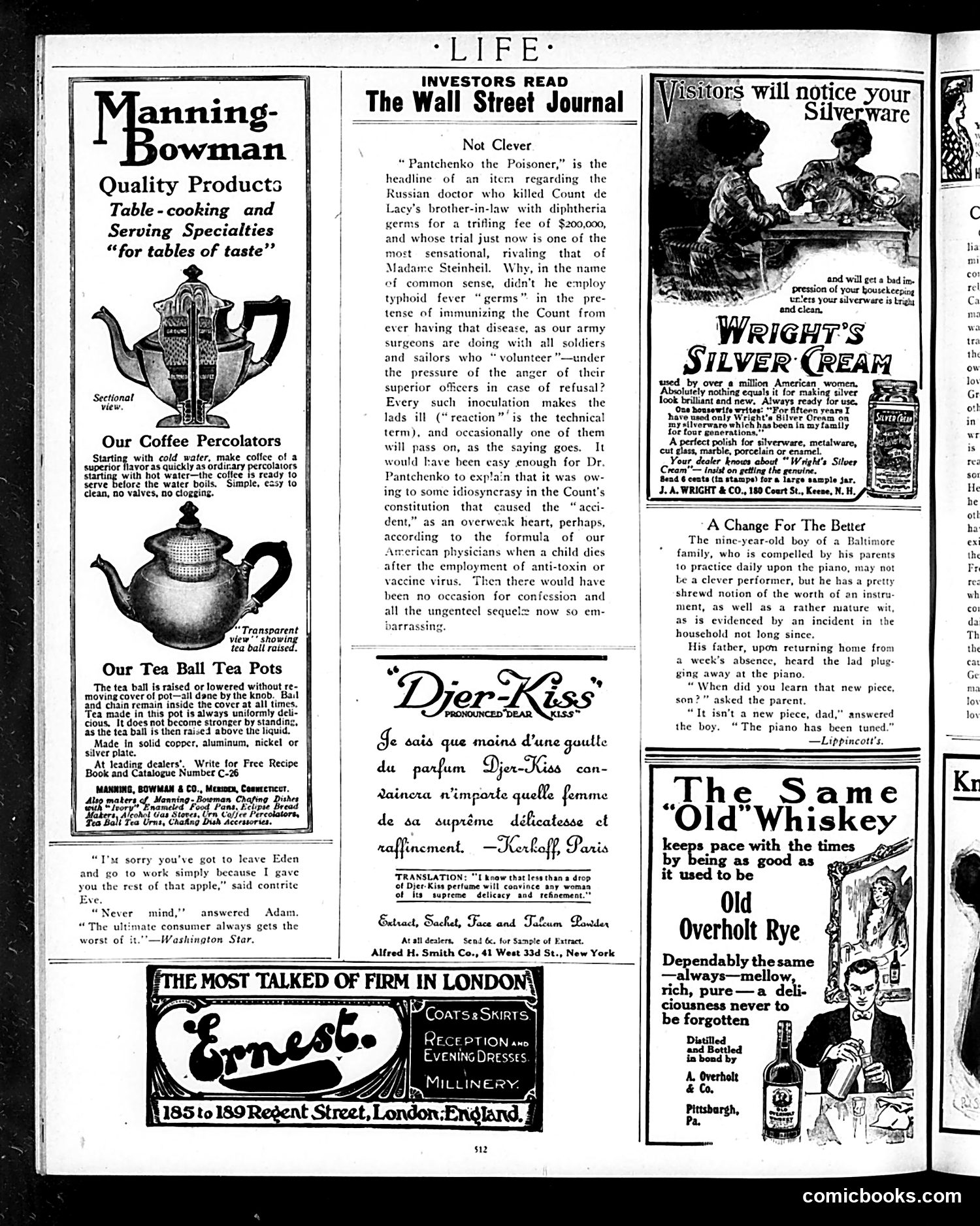
This is primarily an **advertising page** from Life magazine, typical of early 20th-century publications. The content includes: **Main Advertisement Section:** Manning-Bowman kitchen products (coffee percolators, tea pots) marketed as quality items "for tables of taste." **Social Commentary:** A brief joke about Adam and Eve, where Adam cynically notes that "the ultimate consumer always gets the worst of it"—a swipe at economic inequality and worker exploitation. **Wall Street Journal Editorial:** A darkly satirical piece criticizing Russian doctor "Pantchenko the Poisoner" for inefficiency. The writer sarcastically suggests the doctor should have used typhoid germs instead, noting that American military doctors accomplish similar deaths through mandatory soldier vaccinations with impunity. This is **anti-vaccination satire**, implying the U.S. military's vaccine programs kill soldiers just as deliberately (though legally). **Minor Items:** Perfume and silverware ads, plus a brief anecdote about a Baltimore boy forced to practice piano. The page reflects early-1900s concerns about medical authority, military practices, and consumer culture.
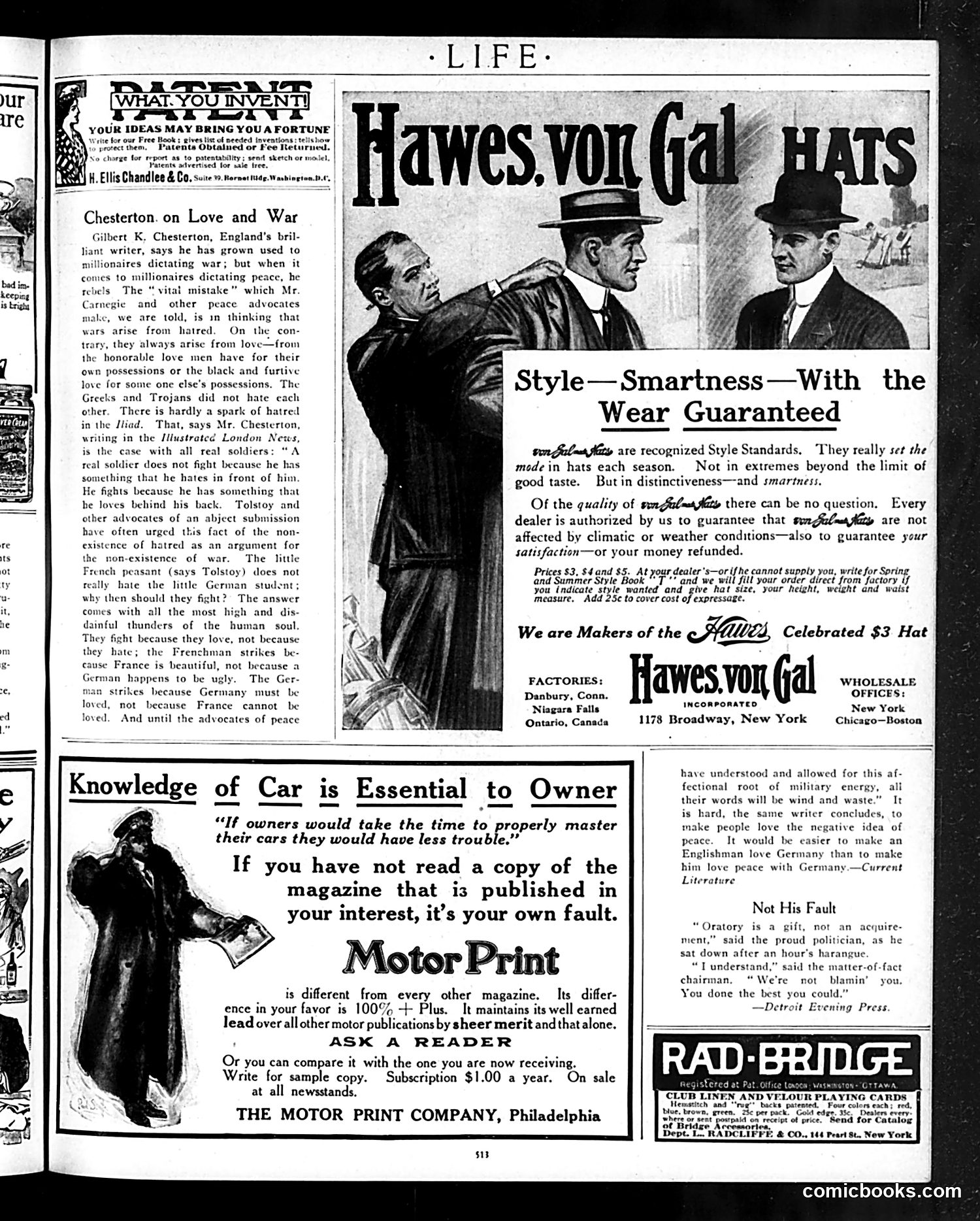
This page contains several distinct elements: **Main Editorial Content:** An essay by Gilbert K. Chesterton arguing that wars arise not from hatred but from love—soldiers fight to protect what they love (possessions, homeland). He critiques peace advocates like Carnegie for misunderstanding war's emotional roots. The piece uses the Trojan War as historical example. **Hatves, von Gal Hat Advertisement:** A major hat manufacturer advertisement emphasizing style, quality, and durability guarantees. The illustration shows three men in fedoras, positioning the product as a fashion standard. **Motor Print Magazine Advertisement:** Promotes a specialized automotive magazine, arguing car owners need technical knowledge. **"Not His Fault" Anecdote:** A brief satirical joke about a politician's self-satisfied oratory. **Overall Context:** This appears to be a typical early 20th-century Life magazine page mixing serious literary commentary (Chesterton) with advertising and light humor—characteristic of Life's format as a satirical yet commercially-driven publication.
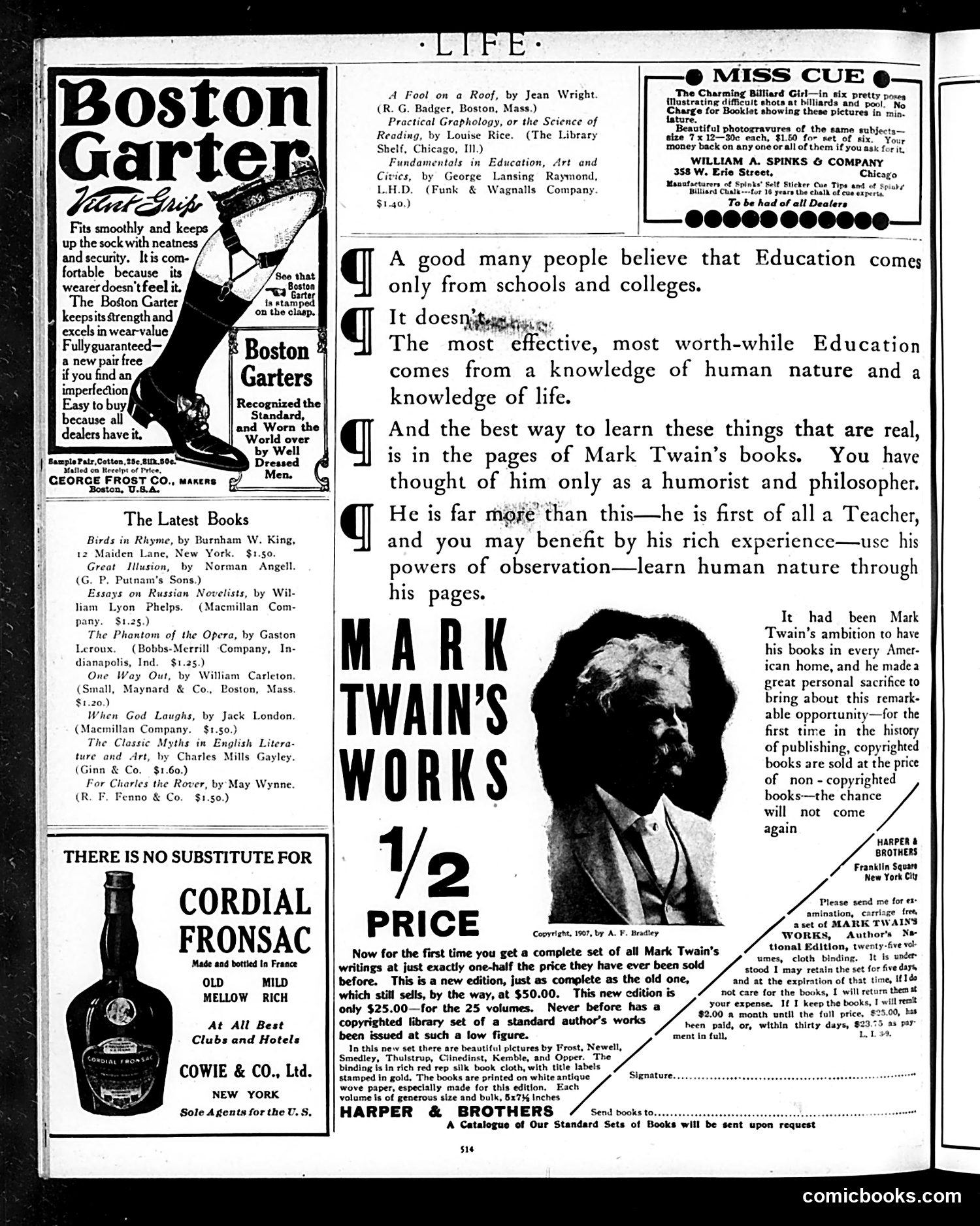
This page is primarily **advertising and book promotion**, not satire or political commentary. The main content advertises a new half-price edition of Mark Twain's complete works ($25 instead of $50). The accompanying essay argues that true education comes not from schools alone but from reading literature—specifically Twain's books, which teach "human nature" and "life" through observation and experience. Twain is positioned as a "Teacher" first, humorist second. The page also includes ads for Boston Garters (socks), Miss Cue (billiard-themed photographs), Cordial Fronsac (French liqueur), and book listings. **There is no political cartoon or satirical commentary visible.** This appears to be a standard commercial magazine page from approximately 1907-1908, designed to sell books and consumer goods to educated, middle-class readers.
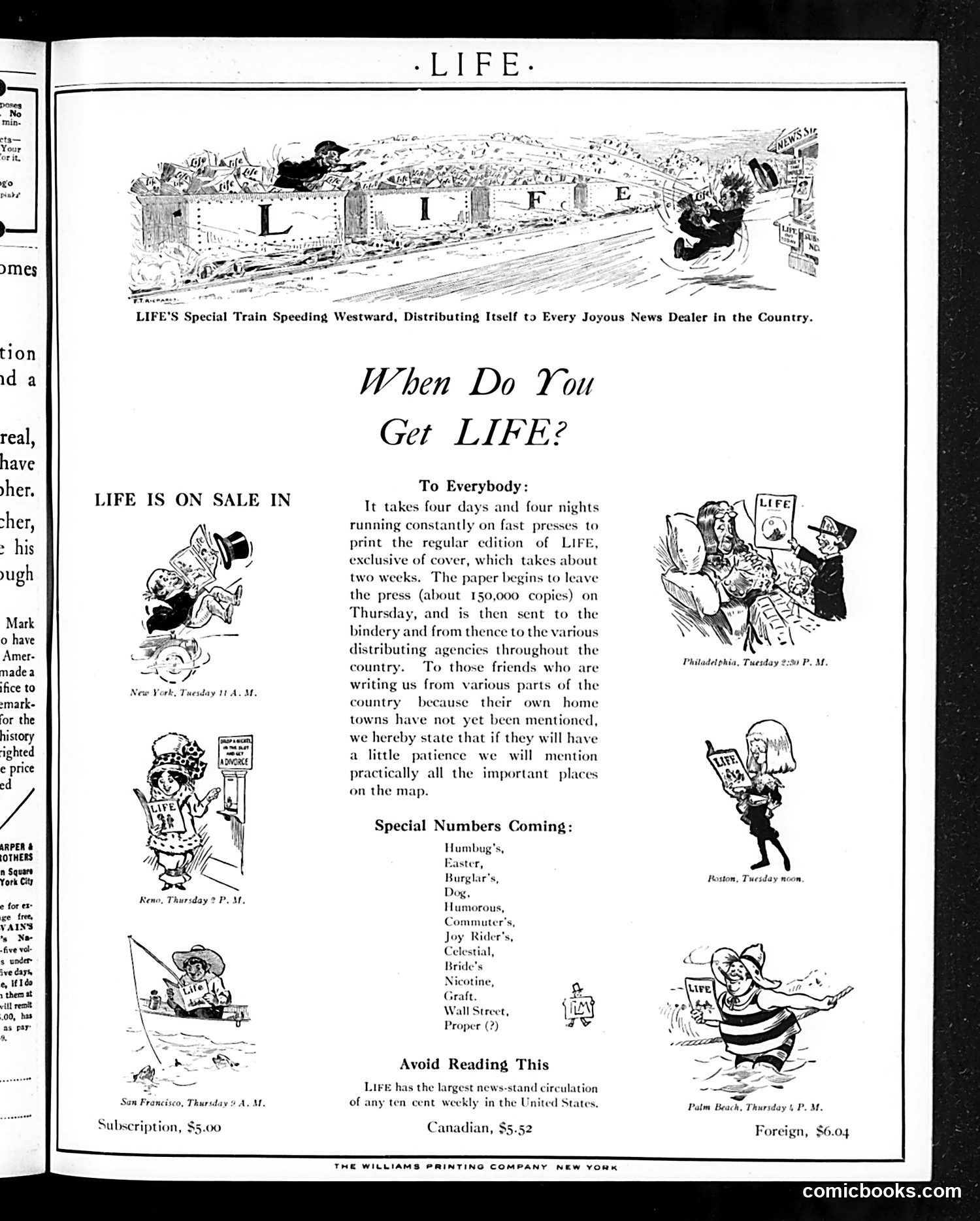
This is primarily an **advertisement for Life magazine**, explaining its distribution and subscription details to readers. The page features humorous illustrations showing Life copies arriving in different U.S. cities on different days (New York Tuesday 11 A.M., Kansas Thursday 7 P.M., San Francisco Thursday 9 A.M., Philadelphia Tuesday 5:00 P.M., Boston Tuesday noon, and Palm Beach Thursday 4 P.M.). These cartoons joke about the magazine's wide circulation and the time lag between printing and delivery across the country. The text explains that Life prints 150,000 copies weekly, requiring four days and nights on fast presses, then takes additional time for binding and distribution nationwide. The page promises upcoming "Special Numbers" with thematic issues (Humbug's, Easter, Burglar's, etc.) and boasts that Life has the largest newsstand circulation of any ten-cent weekly in America. The subscription costs listed—$5.00 domestic, $5.52 Canadian, $6.04 foreign—indicate this is an early 20th-century publication targeting affluent readers.
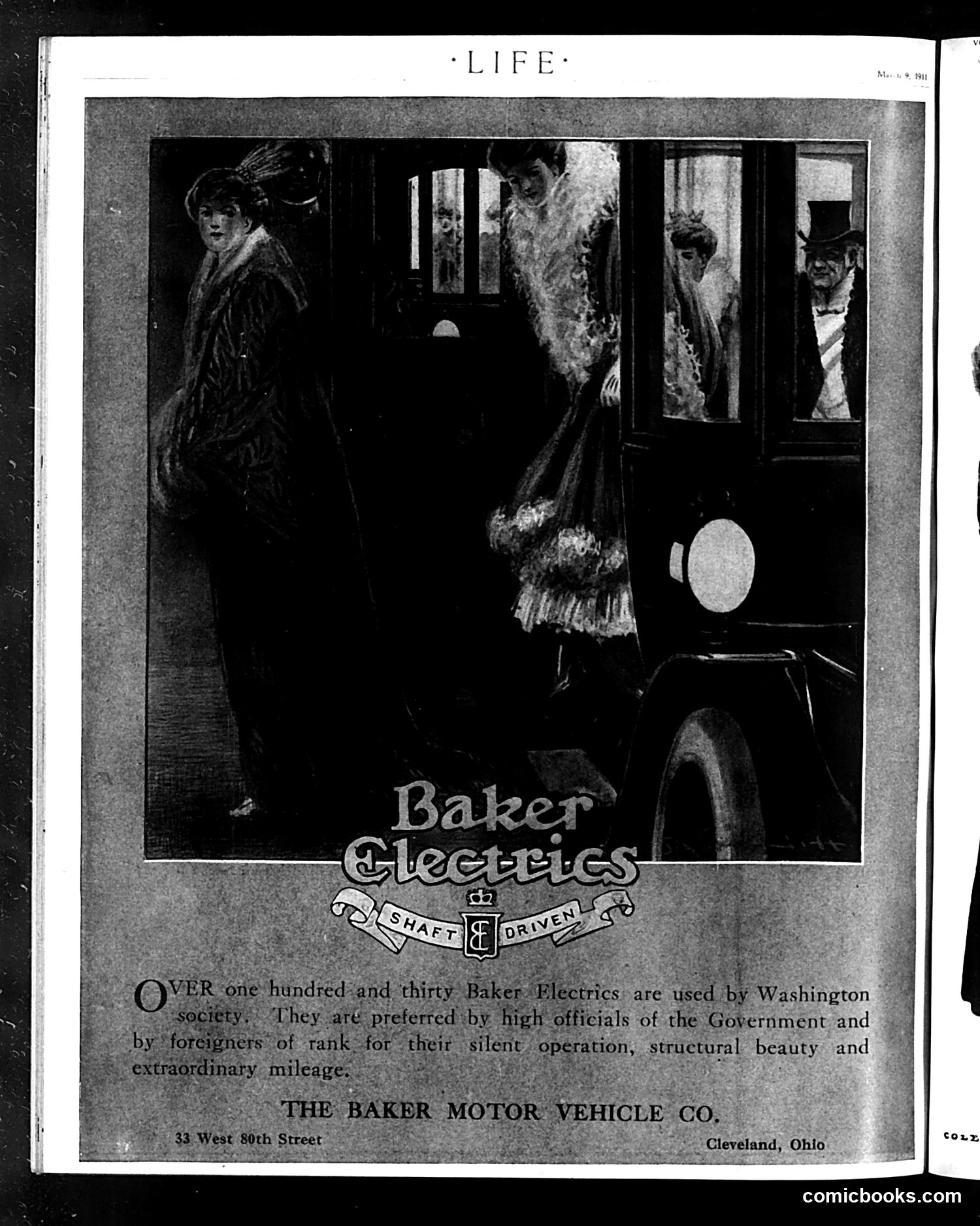
This is an advertisement for Baker Electric automobiles, not political satire. The image shows a luxurious early automobile with elegantly dressed passengers in furs and formal attire, with a uniformed chauffeur. The car appears to be arriving at or departing from a formal social event. The ad's text claims over 130 Baker Electrics are used by Washington society, preferred by "high officials of the Government and by foreigners of rank" for their "silent operation, structural beauty and extraordinary mileage." This reflects early-1900s marketing positioning electric vehicles as sophisticated, quiet luxury cars suited to the wealthy and elite—before gasoline engines became dominant. The company was based in Cleveland, Ohio.