
Life, 1911-03-09 · page 16 of 44
Life — March 9, 1911 — page 16: what you’re looking at
What you’re looking at
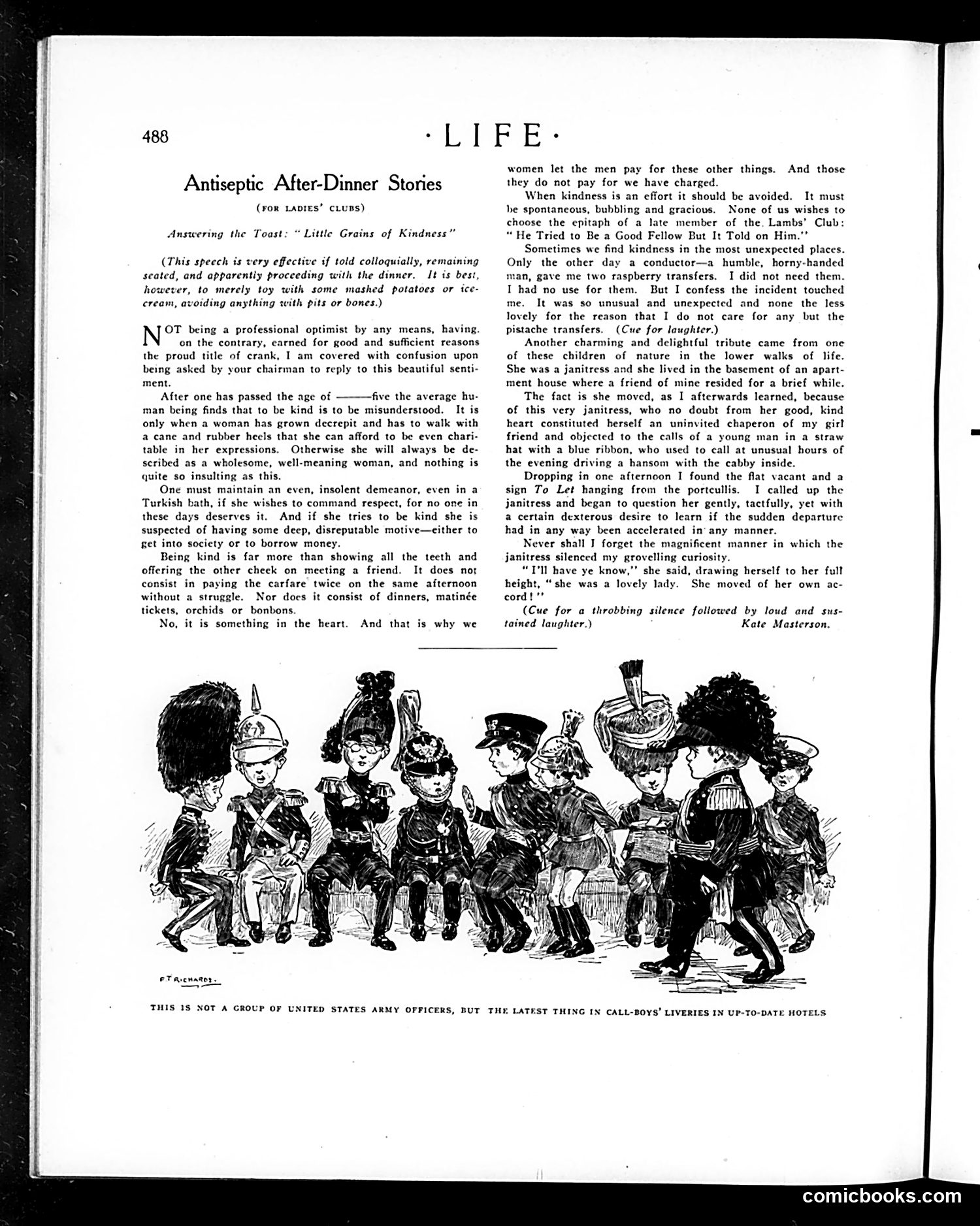
This page contains a satirical after-dinner speech about kindness, written for ladies' clubs. The speaker cynically mocks genuine charity: kindness performed as effort is insulting, and women who attempt it are suspected of ulterior motives (social climbing or borrowing money). The speech includes anecdotes illustrating unexpected kindness from working-class people—a conductor giving extra transfers and a janitress protecting the author's friend from a man in a straw hat arriving by hansom cab at odd hours. The janitress's protective intervention (causing the friend to move) is presented as touching devotion, despite its controlling nature. The accompanying cartoon depicts fashionable people in exaggerated military and formal dress, captioned as "the latest thing in call-boys' liveries in up-to-date hotels"—mocking hotel staff uniforms mimicking military garb. The satire targets upper-class pretension and hypocrisy regarding charity while paradoxically valorizing working-class "kindness" that is actually intrusive paternalism.
📄 Transcribed text from this page (OCR, searchable)
Machine-transcribed from the original scan — historical spelling and the odd misread are preserved.
“LIP EE Antiseptic After-Dinner Stories (ror Lavtes’ cLuns) Answering the Toast: “Little Grains of Kindness” (This speech is very effective if told colloquially, remaining seated, and apparently proceeding with the dinner. It is best, however, to merely toy with some mashed potatoes or ice- cream, avoiding anything with pits or bones.) OT being a professional optimist by any means, having. on the contrary, earned for good and sufficient reasons the proud title of crank, I am covered with confusion upon being asked by your chairman to reply to this beautiful senti- ment. After one has passed the age of five the average hu- man being finds that to be kind is to be misunderstood. It is only when a woman has grown decrepit and has to walk with a cane and rubber heels that she can afford to be even chari- table in her expressions. Otherwise she will always be de- scribed as a wholesome, well-meaning woman, and nothing is quite so insulting as this. One must maintain an even, insolent demeanor, even in a Turkish bath, if she wishes to command respect, for no one in these days deserves it. And if she tries to be kind she is suspected of having some deep, disreputable motive—either to fet into society or to borrow money. Being kind is far more than showing all the teeth and offering the other cheek on meeting a friend. It does not consist in paying the carfare twice on the same afternoon without a struggle. Nor does it consist of dinners, matinée tickets, orchids or bonbons. No, it is something in the heart. And that is why we PT Ricnagor. women let the men pay for these other things. And those they do not pay for we have charged. When kindness is an effort it should be avoided. It must he spontaneous, bubbling and gracious. None of us wishes to choose the epitaph of a late member of the. Lambs’ Club: “He Tried to Be a Good Fellow But It Told on Him.” Sometimes we find kindness in the most unexpected places. Only the other day a conductor—a humble, horny-handed man, gave me two raspberry transfers. I did not need them. I had no use for them. But I confess the incident touched me. It was so unusual and unexpected and none the less lovely for the reason that I do not care for any but the pistache transfers. (Cue for laughter.) Another charming and delightful tribute came from one of these children of nature in the lower walks of life. She was a janitress and she lived in the basement of an apart- ment house where a friend of mine resided for a brief while. The fact is she moved, as I afterwards learned, because of this very janitress, who no doubt from her good, kind heart constituted herself an uninvited chaperon of my girl friend and objected to the calls of a young man in a straw hat with a blue ribbon, who used to call at unusual hours of the evening driving a hansom with the cabby inside. Dropping in one afternoon I found the flat vacant and a sign To Let hanging from the portcullis. I called up the janitress and began to question her gently, tactfully, yet with a certain dexterous desire to learn if the sudden departure had in any way been accelerated in’ any manner. Never shall J forget the magnificent manner in which the janitress silenced my grovelling curiosity. “T'll have ye know,” she said, drawing herself to her full height, “she was a lovely lady. She moved of her own ac- cord!” (Cue for a throbbing silence followed by loud and sus- tained laughter.) Kate Masterson. THIS 18 NOT A GROUP OF UNITED STATES ARMY OFFICERS, BUT THY. LATEST THING IN CALL-BOYS’ LIVERIES IN UP-TO-DATE HOTELS comicbooks.com