
Life, 1911-03-09 · page 36 of 44
Life — March 9, 1911 — page 36: what you’re looking at
What you’re looking at
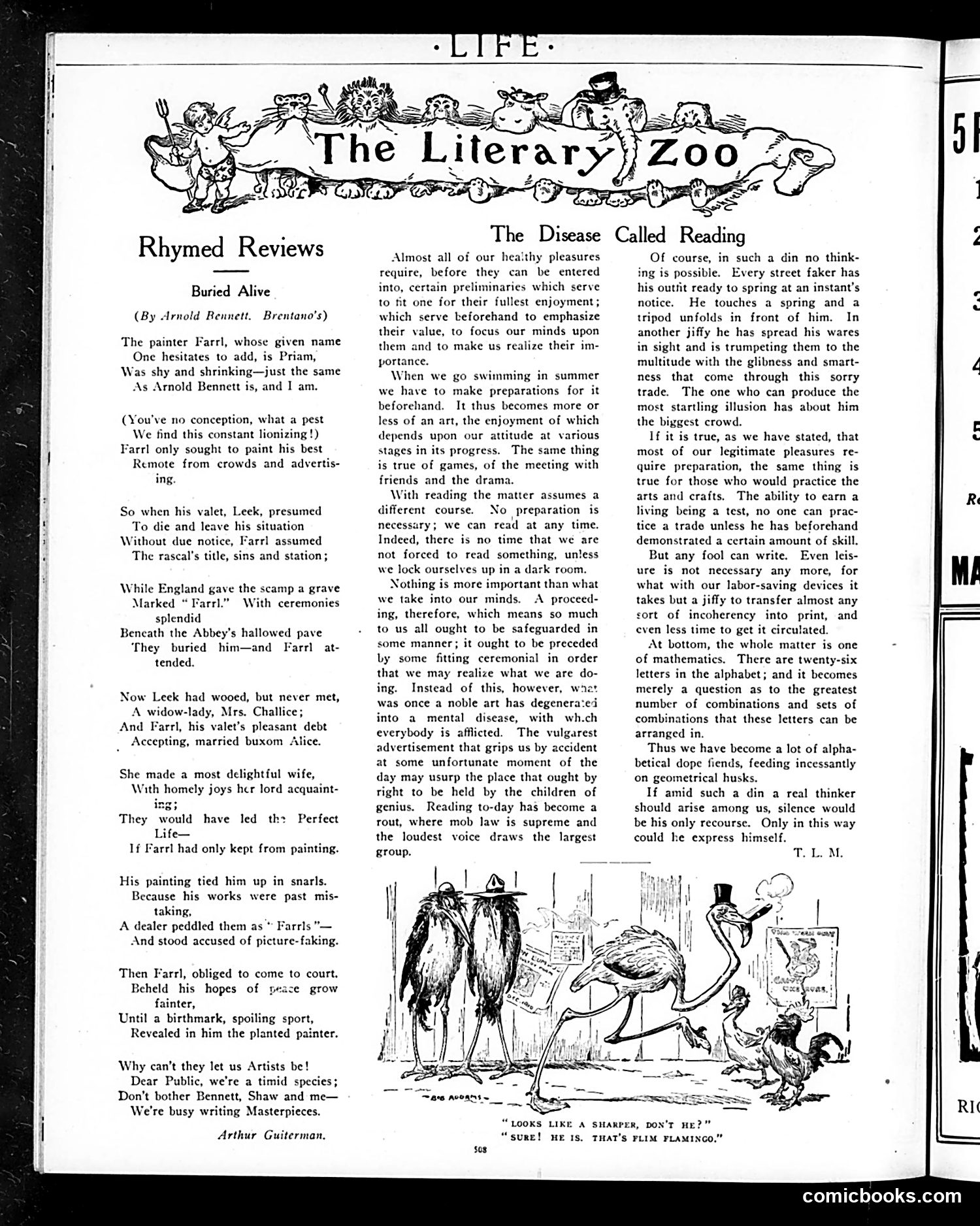
This Life magazine page contains two distinct pieces of satirical content: **"Buried Alive" Book Review** (by Arthur Guiterman): A humorous verse review of Arnold Bennett's novel about painter "Priam Farrl." The satire mocks both the novel's plot (where the painter assumes his valet's identity and accidentally gets buried under the wrong name) and the broader complaint of artists about public lionization. Guiterman uses self-deprecating humor—grouping Bennett, George Bernard Shaw, and himself as "timid" artists annoyed by public attention—to critique how society treats creative figures. **"The Disease Called Reading"** (by T.L.M.): An essay lamenting that reading has become degraded into mindless consumption. The author argues that authentic pleasures require preparation and focus, but modern reading (influenced by street vendors and sensational advertisements) has become a chaotic "mental disease" where "mob law is supreme." The accompanying cartoon illustrates this chaos. The **cartoon** depicts various creatures and figures engaging in frenzied, undignified reading behavior, with the caption "Looks like a sharper, don't he?" / "Sure! He is. That's 'Plim Flamingo'"—mocking both con artists and gullible readers.
📄 Transcribed text from this page (OCR, searchable)
Machine-transcribed from the original scan — historical spelling and the odd misread are preserved.
Rhymed Reviews Buried Alive (By Arnold Bennett, Brentano's) The painter Farrl, whose given name One hesitates to add, is Priam, Was shy and shrinking—just the same As Arnold Bennett is, and I am, (You've no conception, what a pest We find this constant lionizing !) Farrl only sought to paint his best Remote from crowds and advertis- ing. So when his valet, Leek, presumed To die and leave his situation Without due notice, Farrl assumed The rascal’s title, sins and station; While England gave the scamp a grave Marked “ Farrl.” With ceremonies splendid Beneath the Abbey's hallowed pave ‘They buried him—and Farr] at- tended. Now Leek had wooed, but never met, A widow-lady, Mrs. Challice; And Farrl, his valet’s pleasant debt Accepting, married buxom Alice. She made a most delightful wife, With homely joys her lord acquaint- ing; They would have led tht Perfect Life— If Farrl had only kept from painting. His painting tied him up in snarls. Because his works were past mis- taking, A dealer peddled them as * Farrls "— And stood accused of picture- faking. Then Farrl, obliged to come to court. Beheld his hopes of race grow fainter, Until a birthmark, spoiling sport, Revealed in him the planted painter. Why can’t they let us Artists be! Dear Public, we're a timid species; Don’t bother Bennett, Shaw and me— We're busy writing Masterpieces. Arthur Guiterman, The Disease Called Reading Almost all of our healthy pleasures require, before they can be entered into, certain preliminaries which serve to ft one for their fullest enjoyment; which serve beforehand to emphasize their value, to focus our minds upon them and to make us realize their im- portance. When we go swimming in summer we have to make preparations for it beforehand. It thus becomes more or less of an art, the enjoyment of which depends upon our attitude at various stages in its progress. The same thing is true of games, of the meeting with friends and the drama. With reading the matter assumes a different course. No preparation is necessary; we can read at any time. Indeed, there is no time that we are not forced to read something, unless we lock ourselves up in a dark room, othing is more important than what we take into our minds. A proceed- ing, therefore, which means so much to us all ought to be safeguarded in some manner; it ought to be preceded by some fitting ceremonial in order that we may realize what we are do- ing. Instead of this, however, w was once a noble art has degenerazed into a mental disease, with wh.ch everybody is afflicted. The vulgarest advertisement that grips us by accident at some unfortunate moment of the day may usurp the place that ought by right to be held by the children of genius. Reading to-day has become a rout, where mob law is supreme and the loudest voice draws the largest group. Of course, in such a din no think- ing is possible. Every street faker has his outfit ready to spring at an instant’s notice. He touches a spring and a tripod unfolds in front of him. In another jiffy he has spread his wares in sight and is trumpeting them to the multitude with the glibness and smart- ness that come through this sorry trade. The one who can produce the most startling illusion has about him the biggest crowd. If it is true, as we have stated, that most of our legitimate pleasures re- quire preparation, the same thing is true for those who would practice the arts and crafts. The ability to earn a living being a test, no one can prac- tice a trade unless he has beforehand demonstrated a certain amount of skill. But any fool can write. Even leis- ure is not necessary any more, for what with our labor-saving devices it takes but a jiffy to transfer almost any sort of incoherency into print, and even less time to get it circulated. At bottom, the whole matter is one of mathematics. There are twenty-six letters in the alphabet; and it becomes merely a question as to the greatest number of combinations and sets of combinations that these letters can be arranged in. Thus we have become a lot of alpha- betical dope fiends, feeding incessantly on geometrical husks. If amid such a din a real thinker should arise among us, silence would be his only recourse. Only in this way could he express himself. Te Lo M “LOOKS LIKE A SHARPER, DON'T HE?” “sure! ME IS, THAT'S PLIM FLAMINGO.” na R RI comicbooks.com