
Life, 1911-03-09 · page 21 of 44
Life — March 9, 1911 — page 21: what you’re looking at
What you’re looking at
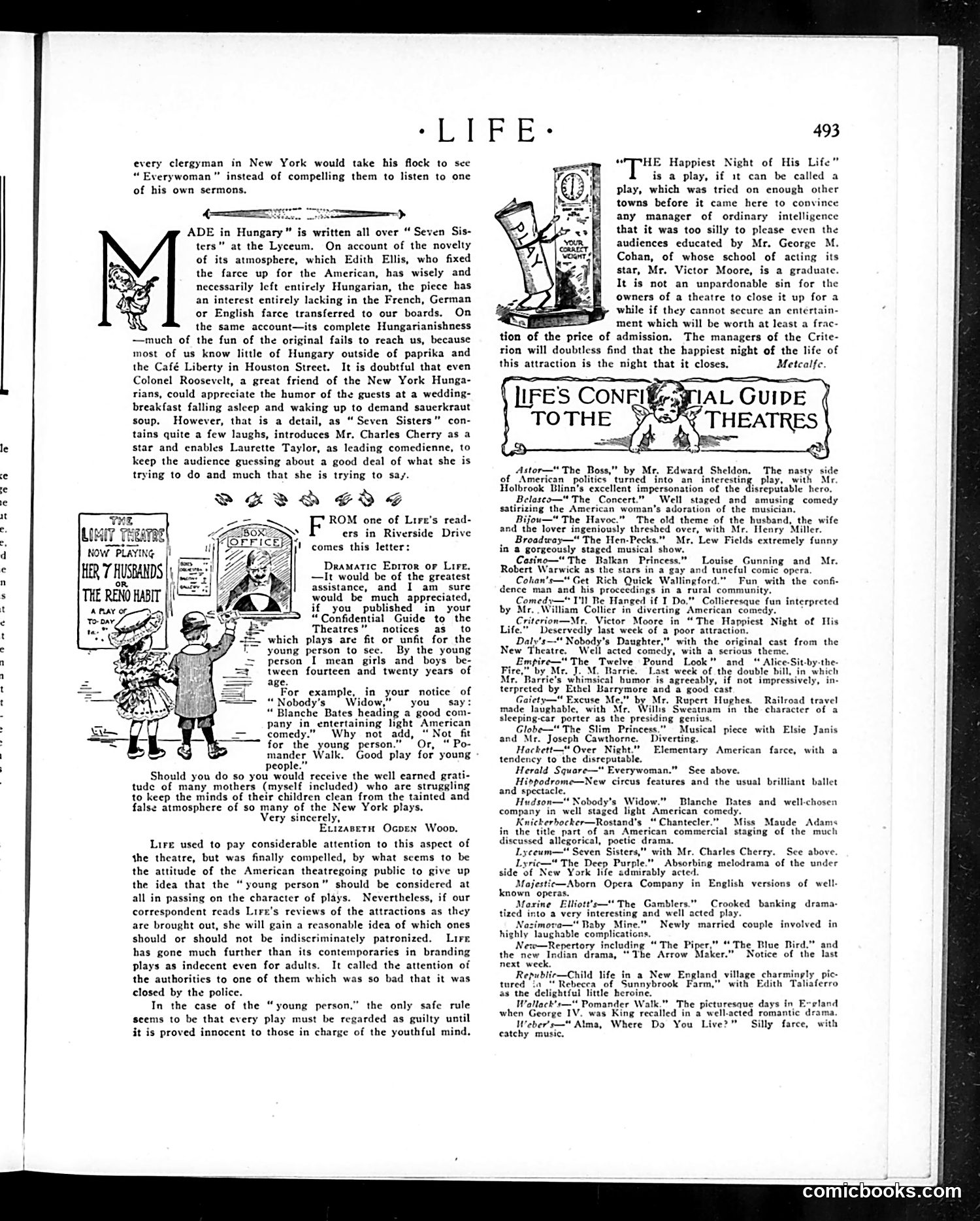
This page from *Life* magazine contains theater reviews and a reader's letter about theatrical content standards. **The Letter and Response:** Elizabeth Ogden Wood writes complaining that *Life* should label plays as unsuitable for young people (ages 14-20). She cites their review of "Nobody's Widow" as an example—it describes entertainment without warning of moral content. *Life* responds that they've tried this approach but American audiences don't care; they've stopped assuming "young persons" need protection. However, they note they've gone further than competitors in flagging indecent plays and even reported one to authorities that was subsequently closed. **The Theater Reviews:** The page includes advertisements and brief reviews of current productions, including "Made in Hungary," "Seven Sisters," and "The Happiest Night of His Life." **The Satire:** The cartoon advertisement mockingly lists plays ("Her 7 Husbands," "The Reno Habit") with questionable morality, contrasting with the earnest parental concern expressed in Wood's letter about protecting youth from theatrical "taint."
📄 Transcribed text from this page (OCR, searchable)
Machine-transcribed from the original scan — historical spelling and the odd misread are preserved.
NOW PLAYING *LTP ER every clergyman in New York would take his flock to sce “Everywoman” instead of compelling them to listen to one of his own sermons. ae > ADE in Hungary” is written all over “ Seven Sis- ters" at the Lyceum, On account of the novelty of its atmosphere, which Edith Ellis, who fixed the farce up for the American, has wisely and necessarily left entirely Hungarian, the piece has an interest entirely lacking in the French, German or English farce transferred to our boards, On the same account—its complete Hungarianishness —much of the fun of the original fails to reach us, because most of us know little of Hungary outside of paprika and the Café Liberty in Houston Strect. It is doubtful that even Colonel Roosevelt, a great friend of the New York Hunga- rians, could appreciate the humor of the guests at a wedding- breakfast falling asleep and waking up to demand sauerkraut soup. However, that is a detail, as “Seven Sisters” con- tains quite a few laughs, introduces Mr. Charles Cherry as a star and enables Laurette Taylor, as leading comedienne, to keep the audience guessing about a good deal of what she is trying to do and much that she is trying to say. EG ROM one of Lire’s read- ers in Riverside Drive comes this letter: HER 7 HUSBANDS | S2==3!| 7 —Rvodid‘ba af the geestes ance, and I am_ sure rs assi: THE RENO HABIT would be’ much appreciated, ante a oa a if you published in your “Confidential Guide to the Theatres” notices as to which plays are fit or unfit for the young person to see. By the young person I mean girls and boys be- tween fourteen and twenty years of age. For example, in your notice of “Nobody's Wido you say: “ Blanche Bates heading a good com- pany in entertaining light American comedy.” Why not add, “ Not fit for the young person.” ‘Or, ‘ Po- mander Walk. Good play for young people.” i Should you do so you would receive the well earned grati- tude of many mothers (myself included) who are struggling to keep the minds of their children clean from the tainted and false atmosphere of so many of the New York plays. Very sincerely, Euizasetn Ocpen Woop. Lire used to pay considerable attention to this aspect of the theatre, but was finally compelled, by what scems to be the attitude of the American theatregoing public to give up the idea that the “young person” should be considered at all in passing on the character of plays. Nevertheless, if our correspondent reads Lire's reviews of the attractions as they are brought out, she will gain a reasonable idea of which ones should or should not be indiscriminately patronized. Lire has gone much further than its contemporaries in branding plays as indecent even for adults. It called the attention of the authorities to one of them which was so bad that it was closed by the police. In the case of the “young person,” the only safe rule seems to be that every play must be regarded as guilty until it is proved innocent to those in charge of the youthful mind. 493 “HE Happiest Night of His Life” is a play, if it can be called a play, which was tried on enough other towns before it came here to convince any manager of ordinary intelligence that it was too silly to please even the audiences educated by Mr. George M. Cohan, of whose school of acting its star, Mr. Victor Moore, is a graduate. It is not an unpardonable sin for the owners of a theatre to close it up for a while if they cannot secure an entertain- ment which will be worth at least a frac- tion of the price of admission, The managers of the Crite- rion will doubtless find that the happiest night of the life of this attraction is the night that it closes. Metcalfe. Astor—" The Boss,” by Mr. Edward Sheldo of “American politics’ turned into an interestin Holbrook Blinn’s excellent impersonation of the disrepuiable hero. Belasco—" The Concert.” Well staged and amusing comedy satirizing the American woman's adoration of the musician. Bijou—" The Havoc." The old theme of the husband, the wife and the lover ingeniously threshed over, with Mr. Henry Miller. _ Broadway—" The Hen-Pecks.” Mr. Lew Fields extremely funny in a gorgeously staged musical show. Casino—“ The Balkan Princess.” Louise Gunning and Mr. Robert Warwick as the stars in a gay and tuneful comic opera. Cohan's—"Get Rich Quick Wallingford.” Fun with the confi- dence man and his proceedings in a rural community. Comedy—" I'll Re Hanged if I Do." Collieresque fun interpreted by Mr. William Collier in diverting American comedy. Criterion—Mr. Victor Moore in “The Happiest Life.” Deservedly last week of a poor attraction. ,_ Daly's—-"* Nobody's Daughter,” with the original cast from the New Theatre. Well acted comedy, with a serious theme. Empire—" The Twelve Pound Look" and “ Alice-Sit-by-the- Fire,” by Mr. J. M. Marrie. Last week of the double bill, in which Mr, Rarrie's whimsical humor is agreeably, if not impressively, in- terpreted by Ethel Barrymore and a good cast Gaiety—" Excuse Me,” by Mr. Rupert Hughes. Railroad travel made laughable, with Mr. Wills Sweatnam in the character of a sleeping-car porter as the presiding gen Globe—" The Slim Princess.” Musical piece with Elsie Janis and Mr. Joseph Cawthorne. Diverting. Heckett—" Over Night.” Elementary American farce, with a tendency to the disreputable. Herald Square—" Everywoman.” See above. Hirpodrome—New circus features and the usual brilliant ballet and spectacl Hudson—" Nobody’s Widow.” Blanche Mates and well-chosen company in well staged li merican comedy. Knickerhocker—Rostand’s “Chantecler.” Miss Maude Adams in the title part of an American commercial staging of the much discussed allegorical, poetic drama. Lyceum—" Seven Sisters,” with Mr. Charles Cherry. See above. Lyric— The Deep Purple." Absorbing melodrama of the under side of New York life admirably acted. Majestic—Aborn Opera Company in English versions of well: known operas. Maxine Elliott’s— The Gamblers.” Crooked banking drama- tized into a very interesting and well acted play. Nozimova—" Raby Mine.” Newly married couple involved in highly laughable complications, New—Repertory including “The Piper, the new Indian drama, “The Arrow Maker.” next week. Republic—Child life in a New England, village charmingly pic- tured in" Rebecea of Sunnybrook Farm,” with Edith Taliaferro as the delightful little heroine. Wallack"s—" Pomander Walk.” The picturesque days in E~rland when George IV. was King recailed in a well-acted romantic drama, Weber's—" Alma, Where Do You Live?” Silly farce, with catchy music. The nasty side play, with Mr ight of His “The Blue Rird.” and Notice of the last comicbooks.com