
Life, 1911-03-09 · page 32 of 44
Life — March 9, 1911 — page 32: what you’re looking at
What you’re looking at
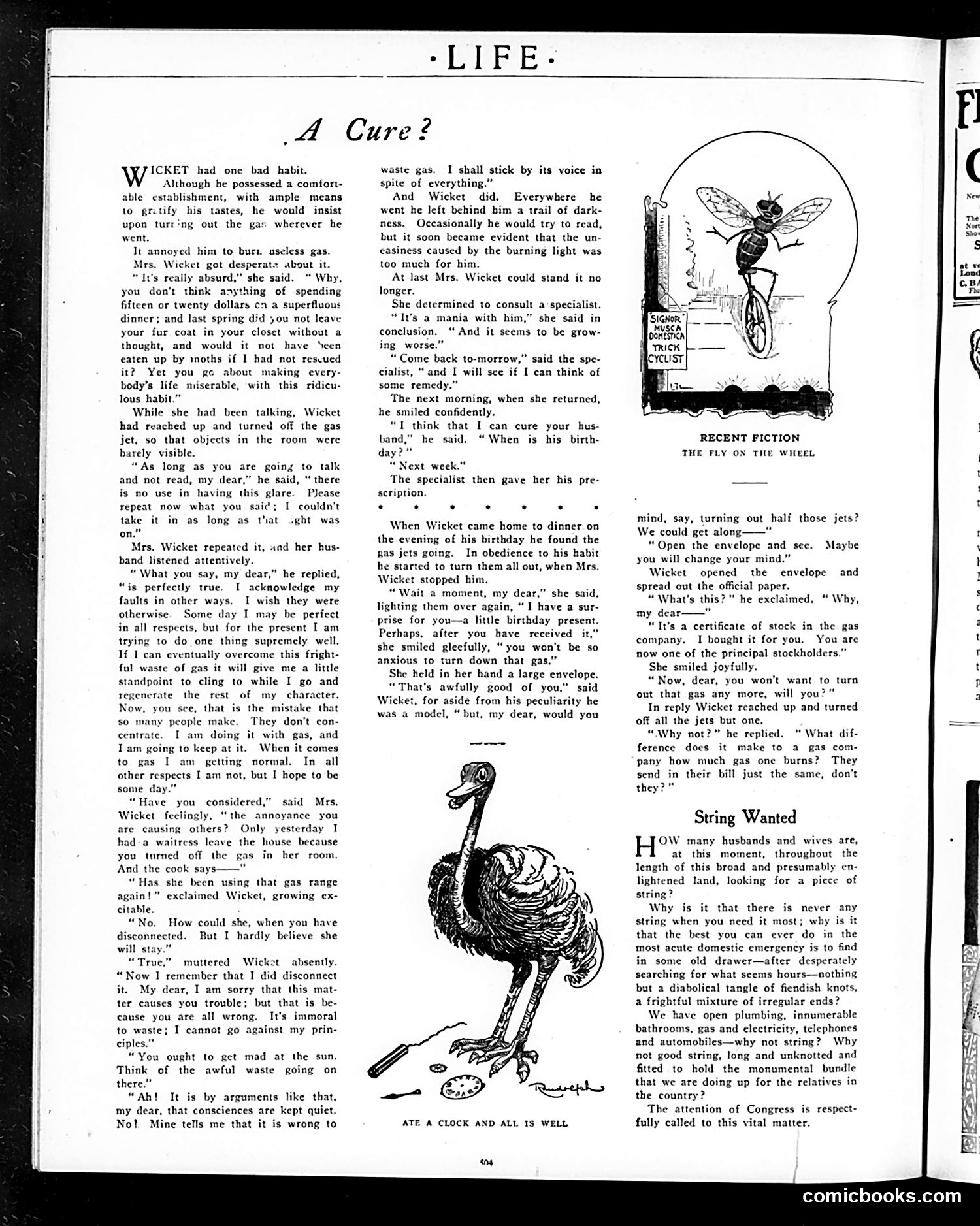
This domestic comedy satirizes obsessive frugality and single-minded self-improvement. Mr. Wicket compulsively turns off gas lights everywhere, wasteful behavior he's determined to eliminate through sheer willpower—despite annoying his wife, servants, and guests by leaving them in darkness. The satire targets two things: first, Wicket's absurd prioritization (he'll spend lavishly on dinners but agonizes over gas), and second, his sanctimonious self-righteousness about this one "moral" habit while ignoring broader character flaws. His wife consults a specialist, suggesting his behavior borders on mental illness. The punch line (partially cut off) appears to involve a birthday "cure"—likely her forcing him to confront his obsession by having the lights deliberately on. The cartoon mocks rigid, eccentric penny-pinching and the Victorian tendency toward moralistic self-flagellation over trivial matters while ignoring genuine problems.
📄 Transcribed text from this page (OCR, searchable)
Machine-transcribed from the original scan — historical spelling and the odd misread are preserved.
-LIFE- 4 Cure? ICKET had one bad habit. Although he possessed a comfort- able establishment, with ample means to gritify his tastes, he would insist upon turring out the gar wherever he went, It annoyed him to burt. useless gas. Mrs. Wicket got desperate about it. “I's really absurd,” she said. “ Why, you don’t think anything of spending fifteen or twenty dollars cn a superfluous dinner; and last spring did you not leave your fur coat in your closet without a thought, and would it not have ‘een eaten up by inoths if I had not rescued it? Yet you go about making every- body’s life miserable, with this ridicu- lous habit.” While she had been talking, Wicket had reached up and turned off the gas jet, so that objects in the room were barely visible. “As long as you are going to talk and not read, my dear,” he said, “ there is no use in having this glare. Please repeat now what you sai’; I couldn't take it in as long as iat ught was on.” Mrs. Wicket repeated it, and her hus- band listened attentively. “What you say, my dear,” he replied, is perfectly true. I acknowledge my faults in other ways. I wish they were otherwise. Some day I may be perfect in all respects, but for the present I am trying to do one thing supremely well. If I can eventually overcome this fright- ful waste of gas it will give me a little standpoint to cling to while I go and regenerate the rest of my character. Now, you sce, that is the mistake that so many people make. They don't con- centrate. I am doing it with gas, and Iam going to keep at it. When it comes to gas I am getting normal. In all other respects I am not, but I hope to be some day.” “Have you considered,” said Mrs. Wicket feelingly, “the annoyance you are causing others? Only yesterday I had-a waitress leave the house because you turned off the gas in her room. And the cook says——” “Has she been using that gas range again!” exclaimed Wicket, growing ex- citable. “No. How could she, when you have disconnected. But I hardly believe she will stay.” True,” muttered Wicket absently. “Now I remember that I did disconnect it. My dear, I am sorry that this mat- ter causes you trouble; but that is be- cause you are all wrong. It’s immoral to waste; I cannot go against my prin- ciples.” “You ought to get mad at the sun. Think of the awful waste going on there.” “Ah! It is by arguments like that, my dear, that consciences are kept quiet. Nol Mine tells me that it is wrong to waste gas. I shall stick by its voice in spite of everything.” And Wicket did. Everywhere he went he left behind bim a trail of dark- ness. Occasionally he would try to read, but it soon became evident that the un- easiness caused by the burning light was too much for him. At last Mrs. Wicket could stand it no longer. She determined to consult a-specialist. “It's a mania with him,” she said in conclusion, “And it scems to be grow- ing worse. “ Come back to-morrow,” said the spe- cialist, “and I will see if I can think of some remedy.” The next morning, when she returned, he smiled confidently. “I think that I can cure your hus- he said. “When is his birth- day?” “Next week.” The specialist then gave her his pre- scription . 8 © © © «© « When Wicket came home to dinner on the evening of his birthday he found the gas jets going. In obedience to his habit he started to turn them all out, when Mrs. Wicket stopped him. “Wait a moment, my dear,” she said, lighting them over again, “I have a sur- prise for you—a little birthday present. Perhaps, after you have received it,” she smiled gleefully, “you won't be so anxious to turn down that gas.” She held in her hand a large envelope. “That's awfully good of you,” said Wicket, for aside from his peculiarity he was a model, “but, my dear, would you ATE A CLOCK AND ALL IS WELL RECENT FICTION THE FLY ON THE WHEEL mind, say, turning out half those jets? We could get along——" “Open the envelope and sec. Maybe you will change your mind.” Wicket opened the envelope and spread out the official paper. What's this?” he exclaimed. “ Why, my dear—' “It's a certificate of stock in the gas company. I bought it for you. You are now one of the principal stockholders.” She smiled joyfully. Now, dear, you won't want to turn out that gas any more, will you?” In reply Wicket reached up and turned off all the jets but one. “Why not?” he replied. “ What dif- ference does it make to a gas com- pany how much gas one burns? They send in their bill just the same, don’t they?” String Wanted OW many husbands and wives are, at this moment, throughout the length of this broad and presumably en- lightened land, looking for a piece of string? Why is it that there is never any string when you need it most; why is it that the best you can ever do in the most acute domestic emergency is to find in some old drawer—after desperately searching for what seems hours—nothing but a diabolical tangle of fiendish knots, a frightful mixture of irregular ends? We have open plumbing, innumerable bathrooms, gas and electricity, telephones and automobiles—why not string? Why not good string, long and unknotted and fitted to hold the monumental bundle that we are doing up for the relatives in the country? The attention of Congress is respect- fully called to this vital matter. comicbooks.com