
Life, 1911-03-09 · page 17 of 44
Life — March 9, 1911 — page 17: what you’re looking at
What you’re looking at
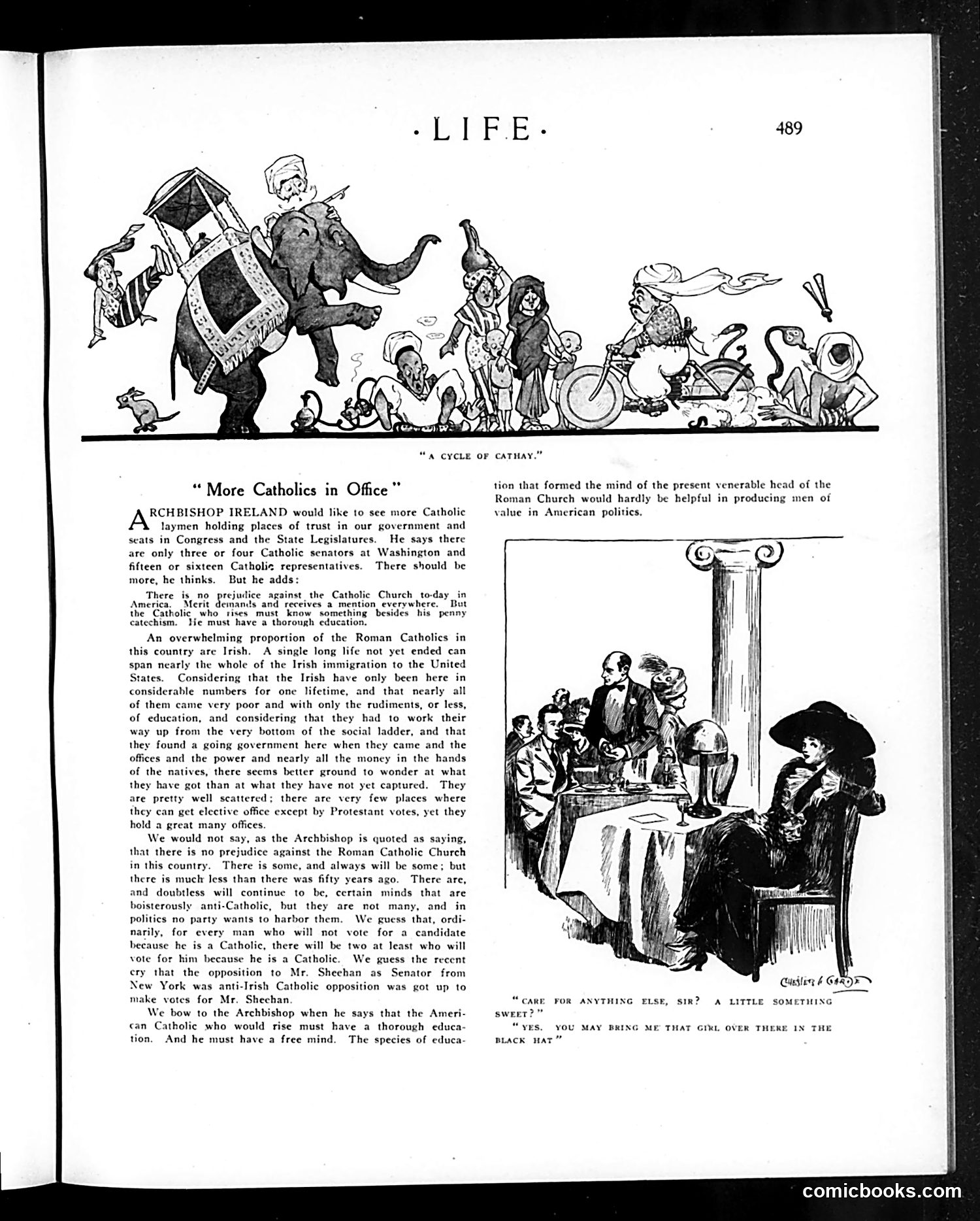
This *Life* page addresses Catholic representation in American government through Archbishop Ireland's advocacy. The top cartoon, "A Cycle of Cathay," satirizes the Irish Catholic immigrant experience—depicting arrival by elephant (exotic/foreign imagery), children, poverty, and struggle progressing toward integration. The main article argues Irish Catholics deserve more political office given their social climb from poverty, though it acknowledges some anti-Catholic prejudice persists. Notably, it criticizes the Pope's education as unsuitable for American politics—a pointed jab at Vatican influence. The bottom cartoon depicts a servant or attendant offering a girl "in the black hat" to a seated gentleman, likely satirizing either sexual exploitation or the vulnerability of poor (possibly immigrant) women in service positions—contrasting sharply with the article's claims of Irish Catholic advancement and respectability. Together, the page presents simultaneous uplift narrative and darker social realities facing Catholic immigrants.
📄 Transcribed text from this page (OCR, searchable)
Machine-transcribed from the original scan — historical spelling and the odd misread are preserved.
“4 CYCLE OF CATHAY.” “More Catholics in Office” RCHBISHOP IRELAND would like to see more Catholic laymen holding places of trust in our government and seats in Congress and the State Legislatures. He says there are only three or four Catholic senators at Washington and fifteen or sixteen Catholic representatives. There should be more, he thinks. But he adds: There is no prejudice against the Catholic Church to-day in America, Merit demands and receives a mention everywhere, But the Catholic who rises must know something be les his penny catechism. Jie must have a thorough education. An overwhelming proportion of the Roman Catholics in this country are Irish. A single long life not yet ended can span nearly the whole of the Irish immigration to the United States. Considering that the Irish have only been here in considerable numbers for one lifetime, and that nearly all of them came very poor and with only the rudiments, or less, of education, and considering that they had to work their way up from the very bottom of the social ladder, and that they found a going government here when they came and the offices and the power and nearly all the money in the hands of the natives, there seems better ground to wonder at what they have got than at what they have not yet captured. They are pretty well scattered; there are very few places where they can get elective office except by Protestant votes, yet they hold a great many offices. We would not say, as the Archbishop is quoted as saying, that there is no prejudice against the Roman Catholic Church in this country. There is some, and always will be some; but there is muck less than there was fifty years ago. There are, and doubtless will continue to be, certain minds that are boisterously anti-Catholic, but they are not many, and in politics no party wants to harbor them. We guess that, ordi- narily, for every man who will not vote for a candidate because he is a Catholic, there will be two at least who will vote for him because he is a Catholic. We guess the recent cry that the opposition to Mr. Shechan as Senator from New York was anti-Irish Catholic opposition was got up to make votes for Mr. Shechan We bow to the Archbishop when he says that the Ameri- can Catholic who would rise must have a thorough educa- tion. And he must have a free mind. The species of educa- tion that formed the mind of the present venerable head of the Roman Church would hardly be helpful in producing men of value in American politics. “CARE FOR ANYTHING ELSE, SIR? sweet?” “YES, YOU MAY BRING ME THAT GIKL OVER THERE IN THE BLACK MAT” A LITTLE SOMETHING comicbooks.com