
Life, 1911-03-09 · page 24 of 44
Life — March 9, 1911 — page 24: what you’re looking at
A restored page from Life, 1911-03-09. Page through the whole issue in the reader above.
📄 Transcribed text from this page (OCR, searchable)
Machine-transcribed from the original scan — historical spelling and the odd misread are preserved.
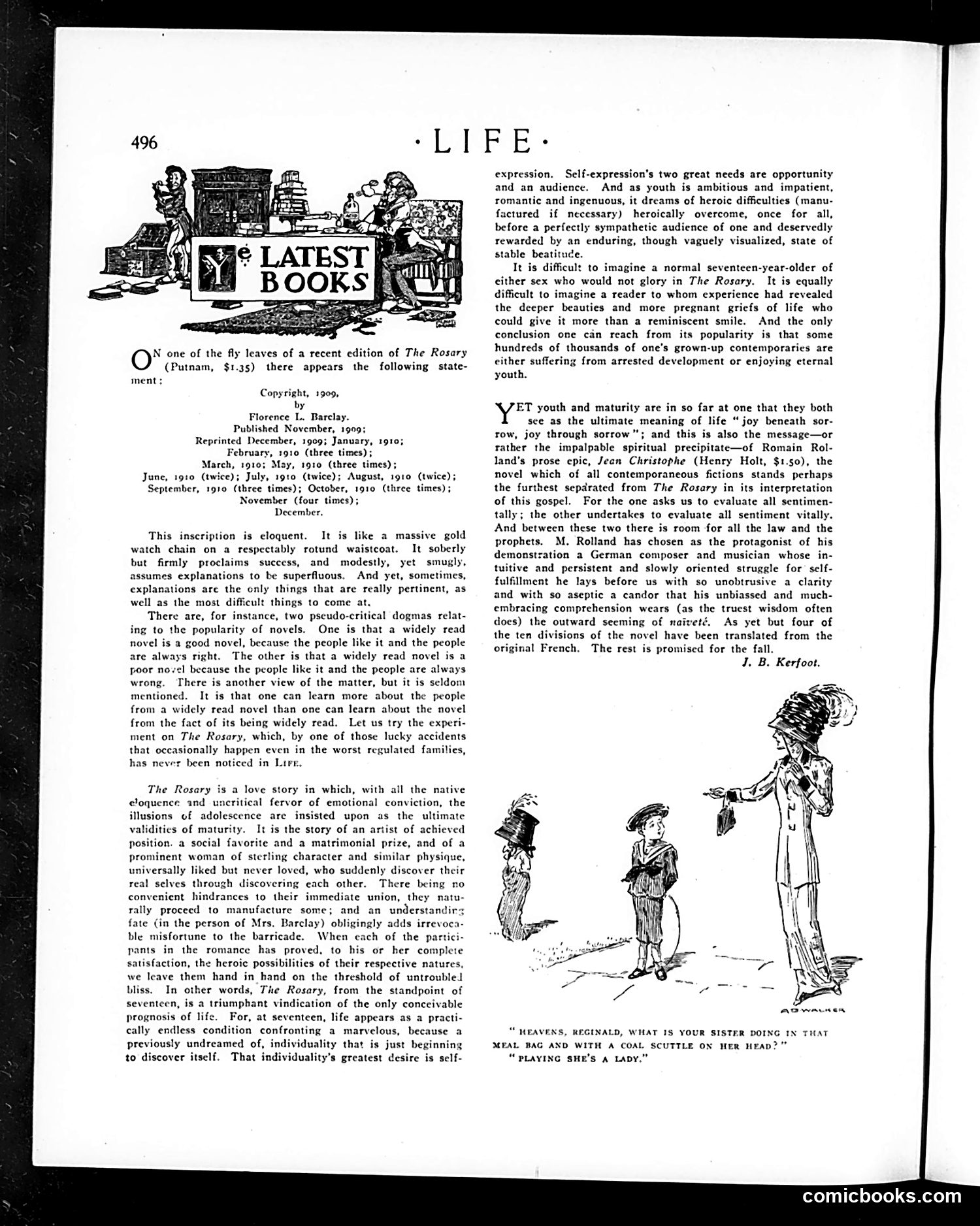
© DASF*E, N one of the fly leaves of a recent edition of The Rosary (Putnam, $1.35) there appears the following state- Copyright, 1909, by Florence L. Barclay. Published November, 1999; Reprinted December, 1909; January, 1910; February, 1910 (three times) ; March, 1910; May, 1910 (three times); June, 1910 (twice); July, 1910 (twice); August, 1910 (twice); September, 1910 (three times); October, 1910 (three times); November (four times); December. This inscription is eloquent. It is like a massive gold watch chain on a respectably rotund waistcoat. It soberly but firmly proclaims success, and modestly, yet smugly, assumes explanations to be superfluous. And yet, sometimes, explanations are the only things that are really pertinent, as well as the most difficult things to come at. There are, for instance, two pscudo-critical dogmas relat- ing to the popularity of novels. One is that a widely read novel is a good novel, because the people like it and the people are always right. The other is that a widely read novel is a poor novel because the people like it and the people are always wrong. There is another view of the matter, but it is seldom mentioned. It is that one can learn more about the people from a widely read novel than one can learn about the novel from the fact of its being widely read. Let us try the experi- ment on The Rosary, which, by one of those lucky accidents that occasionally happen even in the worst regulated families, has never been noticed in Li The Rosary is a love story in which, with ail the native eloquence and uncritical fervor of emotional conviction, the illusions of adolescence are insisted upon as the ultimate validities of maturity. It is the story of an artist of achieved position. a social favorite and a matrimonial prize, and of a prominent woman of sterling character and similar physique, universally liked but never loved, who suddenly discover their real selves through discovering each other. There being no convenient hindrances to their immediate union, they natu- rally proceed to manufacture some; and an understandir; fate (in the person of Mrs. Barclay) obligingly adds irrevos ble misfortune to the barricade. When cach of the partici- pants in the romance has proved, to his or her complete satisfaction, the heroic possibilities of their respective natures, we leave them hand in hand on the threshold of untroubled bliss. In other words, The Rosary, from the standpoint of seventeen, is a triumphant vindication of the only conceivable prognosis of life. For, at seventeen, life appears as a practi- cally endless condition confronting a marvelous, because a previously undreamed of, individuality that is just beginning to discover itself. That individuality’s greatest desire is self- expression. Self-expression’s two great needs are opportunity and an audience. And as youth is ambitious and impatient, romantic and ingenuous, it dreams of heroic difficulties (manu- factured if necessary) heroically overcome, once for all, before a perfectly sympathetic audience of one and deservedly rewarded by an enduring, though vaguely visualized, state of stable beatituce. It is difficult to imagine a normal seventeen-year-older of cither sex who would not glory in The Rosary. It is equally difficult to imagine a reader to whom experience had revealed the deeper beauties and more pregnant gricfs of life who could give it more than a reminiscent smile. And the only conclusion one can reach from its popularity is that some hundreds of thousands of one’s grown-up contemporaries are cither suffering from arrested development or enjoying eternal youth. ET youth and maturity are in so far at one that they both sce as the ultimate meaning of life “joy beneath sor- row, joy through sorrow”; and this is also the message—or rather the impalpable spiritual precipitate—of Romain Rol- land's prose epic, Jean Christophe (Henry Holt, $1.50), the novel which of all contemporaneous fictions stands perhaps the furthest sepdrated from The Rosary in its interpretation of this gospel. For the one asks us to evaluate all sentimen- tally; the other undertakes to evaluate all sentiment vitally. And between these two there is room for all the law and the prophets. M. Rolland has chosen as the protagonist of his demonstration a German composer and musician whose in- tuitive and persistent and slowly oriented struggle for self- fulfillment he lays before us with so unobtrusive a clarity and with so aseptic a candor that his unbiassed and much- embracing comprehension wears (as the truest wisdom often does) the outward seeming of naiveté. As yet but four of the ten divisions of the novel have been translated from the original French, The rest is promised for the fall. J. B. Kerfoot. Ao wanes “WEAVENS, REGINALD, WHAT IS YOUR SISTER DOING IN THAT MEAL BAG AND WITH A COAL SCUTTLE ON MER HEAD?" “ PLAYING SHE'S A LADY. comicbooks.com