
Life, 1911-03-09 · page 10 of 44
Life — March 9, 1911 — page 10: what you’re looking at
What you’re looking at
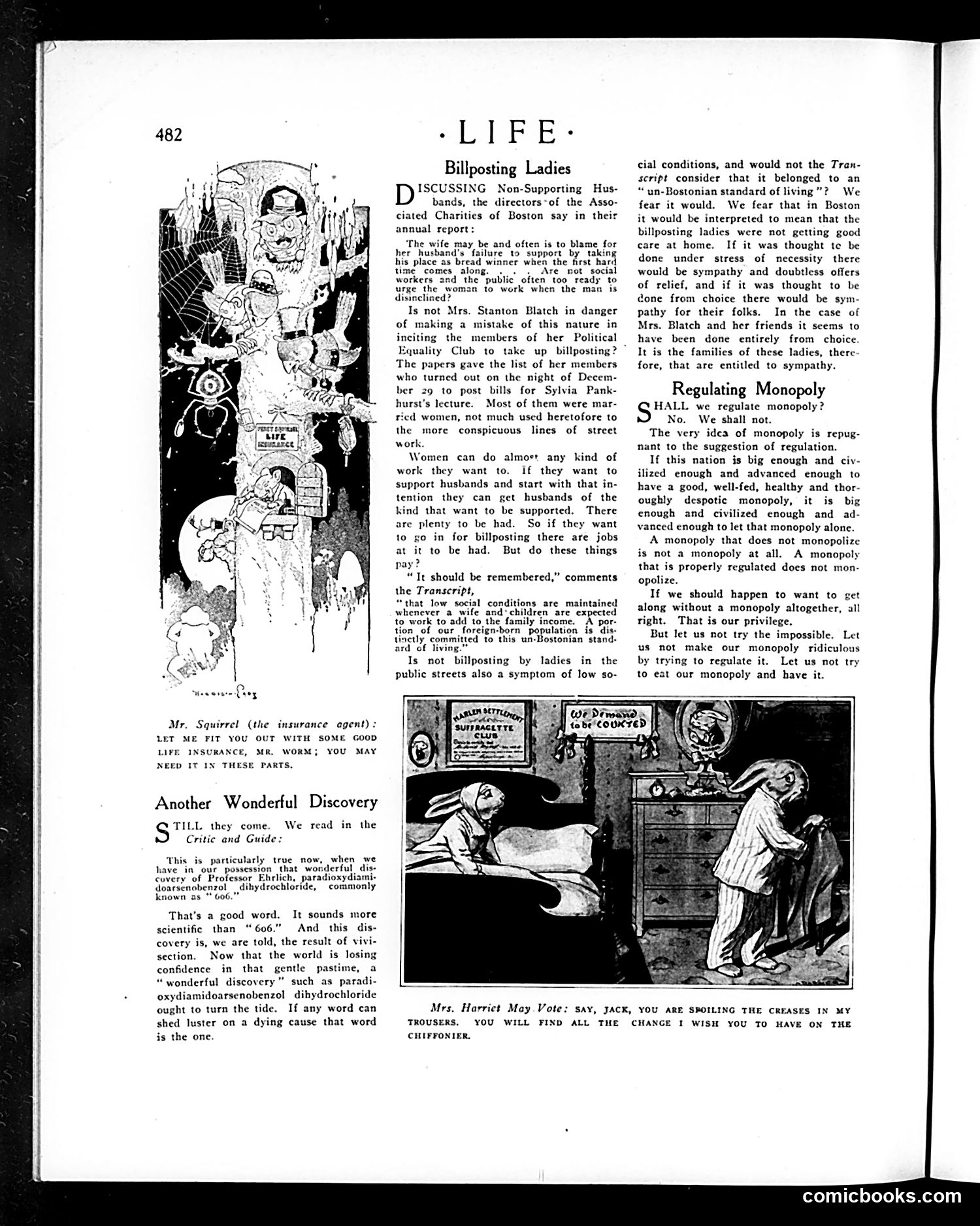
This page contains three distinct pieces of satire: 1. **"Billposting Ladies"** (left): A cartoon critiquing wives of non-supporting husbands who post bills publicly to shame their partners into providing income. The illustration shows a woman confronting her deadbeat husband, satirizing both marital financial disputes and public shaming tactics. 2. **"Regulating Monopoly"** (center): A debate piece questioning whether monopolies should be regulated. It argues that poorly-regulated monopolies are problematic, but suggests satirically that making regulation ridiculous might be preferable to actual enforcement—a tongue-in-cheek commentary on ineffective regulation. 3. **"Another Wonderful Discovery"** (bottom): Mocks scientific pretension by highlighting a made-up medical term ("paradoxydiamiodaesohobenzol dihydrochloride") to criticize how pseudoscientific language obscures simple truths.
📄 Transcribed text from this page (OCR, searchable)
Machine-transcribed from the original scan — historical spelling and the odd misread are preserved.
Q Wen snare (deg Mr. Squirrel (the insurance agent LET ME FIT YOU OUT WITH some GooD LIPE INSURANCE, MR. WORM; YOU MAY NEED IT IN THESE PARTS. Another Wonderful Discovery TILL they come. We read in the Critic and Guide: ‘This is particularly true now, when we have in our possession that wonderful dis- covery of Professor Ehrlich, paradioxydiami- doarsenobenzol dihydrochloride, commonly known as “606.” That's a good word. It sounds more scientific than “606.” And this dis- covery is, we are told, the result of viv section. Now that the world is losing confidence in that gentle pastime, a “wonderful discovery” such as paradi- oxydiamidoarsenobenzol dihydrochloride ought to turn the tide. If any word can shed luster on a dying cause that word is the one. ell PoE Billposting Ladies ISCUSSING Non-Supporting Hus- bands, the directors of the Asso- ciated Charities of Boston say in their annual report: ‘The wife may be and often is to blame for her husband's failure to support by taking his place as bread winner when the first hard time comes along. . . . Are not social workers and the public often too ready to urge the woman to work when the man is, disinclined? Is not Mrs. Stanton Blatch in danger of making a mistake of this nature in inciting the members of her Political Equality Club to take up billposting? The papers gave the list of her members who turned out on the night of Decem- ber 29 to post bills for Sylvia Pank- hurst’s lecture. Most of them were mar- ricd women, not much used heretofore to the more conspicuous lines of street work. Women can do almost any kind of work they want to. if they want to support husbands and start with that in- tention they can get husbands of the kind that want to be supported. There are plenty to be had. So if they want to go in for billposting there are jobs But do these things at it to be had. pay? “Tt should be remembered,” comments the Transcript, “that low social conditions are maintained whenever a wife and*children are expected to work to add to the family income. A por- tion of our foreign-born population is dis- tinctly committed to this un-Bostonian stand- ard of living.” Is not billposting by ladies in the public streets also a symptom of low so- cial conditions, and would not the Tran- script consider that it belonged to an “un-Bostonian standard of living”? We fear it would. We fear that in Boston it would be interpreted to mean that the billposting ladies were not getting good care at home. If it was thought te be done under stress of necessity there would be sympathy and doubtless offers of relief, and if it was thought to be done from choice there would be sym- pathy for their folks. In the case of Mrs. Blatch and her friends it seems to have been done entirely from choice. It is the families of these ladies, there fore, that are entitled to sympathy. Regulating Monopoly HALL we regulate monopoly? No. We shall not. The very idea of monopoly is repug- nant to the suggestion of regulation. If this nation is big enough and civ- ilized enough and advanced enough to have a good, well-fed, healthy and thor- oughly despotic monopoly, it is big enough and civilized enough and ad- vanced enough to let that monopoly alone. A monopoly that does not monopolize is not a monopoly at all. A monopoly that is properly regulated does not mon- opolize. If we should happen to want to get along without a monopoly altogether, all right. That is our privilege. But let us not try the impossible. Let us not make our monopoly ridiculoy by trying to regulate it. Let us not try to eat our monopoly and have Mrs. Harriet May Vot ‘TROUSERS, YOU WILL FIND CHIFFONIER. ALL THE SAY, JACK, YOU ARE SPOILING THE CREASES IN MY CHANGE I WISH YOU TO HAVE ON THE comicbooks.com