
Life, 1911-03-09 · page 8 of 44
Life — March 9, 1911 — page 8: what you’re looking at
What you’re looking at
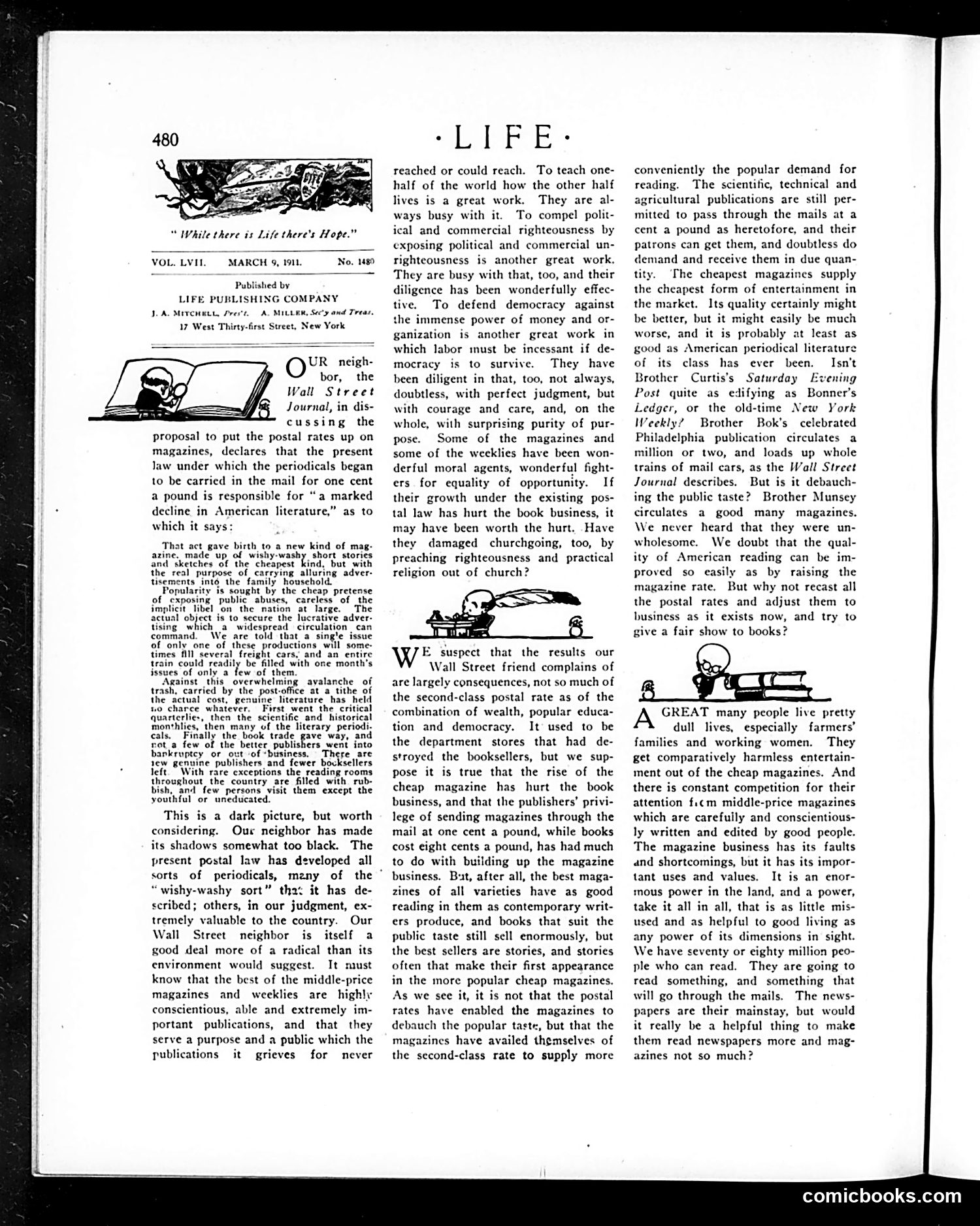
This page contains editorial text (no political cartoon visible) discussing the impact of U.S. postal rates on the magazine publishing industry. The author argues that cheap magazine postage has paradoxically *hurt* the book business by flooding the market with inexpensive periodicals, reducing demand for books. The piece critiques both the postal system and magazine publishers themselves for exploiting low second-class rates. It defends middle-class magazines as "highly conscientious" while acknowledging they've damaged the publishing ecosystem. The author suggests recalibrating postal rates to support books over magazines, framing this as necessary to preserve American reading quality and democratic literacy—a progressive-era concern about commercial versus intellectual value.
📄 Transcribed text from this page (OCR, searchable)
Machine-transcribed from the original scan — historical spelling and the odd misread are preserved.
“ While there is Life there's Hope. VOL. LVII, — MARCH 9, 1911. No. 1489 Published by LIFE PUBLISHING COMPANY Sec'y and Treas, jew York JA. MITOMELE, Prete, A. MILL 17 West Thirty-first Street, UR neigh- bor, the Wall Street Journal, in dis- cussing the proposal to put the postal rates up on magazines, declares that the present law under which the periodicals began to be carried in the mail for one cent a pound is responsible for “a marked decline in American literature,” as to which it says: That act gave birth to a new kind of mag: azine, made up of wishy-washy, short stories and sketches of the cheapest kind, but with the real purpose of carrying alluring adver- tisements into the family household. Popularity is sought by the cheap pretense of exposing public abuses, careless of the implicit libel on the nation at large. The actual object is to secure the lucrative adver- tising which a widespread circulation can command. We are told that_a sing'e issue of only one of these productions will some- times fill several freight cars, and an entire train could readily be filled with one month's issues of only a few of them. Against. this overwhelming avalanche of trash, carried by the post-office at a tithe of the actual cost, genuine literature has held uo charce whatever, First went the critical quarterlies, then the scientific and historical monthlies, ‘then many of the literary periodi. cals. Finally the book trade gave way, and rot a few of the better publishers went into bankruptcy or out ‘of -business. There are aew genuine publishers and fewer bovksellers left.” With rare exceptions the reading rooms throughout the country are filled with rub- bish, and few persons visit them except the youthful or uneducated. This is a dark picture, but worth considering. Our neighbor has made its shadows somewhat too black. The present postal law has developed all sorts of periodicals, “wishy-washy sort” that it has de- scribed; others, in our judgment, ex- tremely valuable to the country. Our Wall Street neighbor is itself a good deal more of a radical than its environment would suggest. It niust know that the best of the middle-price magazines and weeklies are hh conscientious, able and extremely im- portant publications, and that they serve a purpose and a public which the publications it grieves for never meny of the © WE UPCE * reached or could reach. To teach one- half of the world how the other half lives is a great work. They are al- ways busy with it. To compel polit- ical and commercial righteousness by exposing political and commercial un- righteousness is another great work. They are busy with that, too, and their diligence has been wonderfully effec- tive. To defend democracy against the immense power of money and or- ganization is another great work in which labor must be incessant if de- mocracy is to survive. They have been diligent in that, too, not always, doubtless, with perfect judgment, but with courage and care, and, on the whole, with surprising purity of pur- pose. Some of the magazines and some of the weeklies have been won- derful moral agents, wonderful fight- ers for equality of opportunity. If their growth under the existing pos- tal law has hurt the book business, it may have been worth the hurt. Have they damaged churchgoing, too, by preaching righteousness and practical religion out of church? E suspect that the results our Wall Street friend complains of are largely consequences, not so much of the second-class postal rate as of the combination of wealth, popular educa- tion and democracy. It used to be the department stores that had de- stroyed the booksellers, but we sup- pose it is true that the rise of the cheap magazine has hurt the book business, and that the publishers’ privi- lege of sending magazines through the mail at one cent a pound, while books cost eight cents a pound, has had much to do with building up the magazine business. But, after all, the best maga- zines of all varieties have as good reading in them as contemporary writ- ers produce, and books that suit the public taste still sell enormously, but the best sellers are stories, and stories often that make their first appearance in the more popular cheap magazines. As we see it, it is not that the postal rates have enabled the magazines to debauch the popular taste, but that the magazines have availed themselves of the second-class rate to supply more conveniently the popular demand for reading. The scientific, technical and agricultural publications are still per- mitted to pass through the mails at a cent a pound as heretofore, and their patrons can get them, and doubtless do demand and receive them in due quan- tity. The cheapest magazines supply the cheapest form of entertainment in the market. Its quality certainly might be better, but it might easily be much worse, and it is probably at least as good as American periodical literature of its class has ever been. Isn't Brother Curtis’s Saturday Evening Post quite as edifying as Bonner’s Ledger, or the old-time New York Weekly? Brother Bok’s celebrated Philadelphia publication circulates a million or two, and loads up whole trains of mail cars, as the Wall Street Journal describes. But is it debauch- ing the public taste? Brother Munsey circulates a good many magazines. We never heard that they were un- wholesome. We doubt that the qual- ity of American reading can be im- proved so easily as by raising the magazine rate. But why not recast all the postal rates and adjust them to business as it exists now, and try to give a fair show to books? A GREAT many people live pretty dull lives, especially farmers’ families and working women. They get comparatively harmless entertain- ment out of the cheap magazines. And there is constant competition for their attention ficm middle-price magazines which are carefully and conscientious- ly written and edited by good people. The magazine business has its faults and shortcomings, but it has its impor- tant uses and values. It is an enor- mous power in the land, and a power, take it all in all, that is as little mis- used and as helpful to good living as any power of its dimensions in sight. We have seventy or eighty million peo- ple who can read. They are going to read something, and something that will go through the mails. The news- papers are their mainstay, but would it really be a helpful thing to make them read newspapers more and mag- azines not so much? comicbooks.com