
Life, 1911-03-09 · page 20 of 44
Life — March 9, 1911 — page 20: what you’re looking at
What you’re looking at
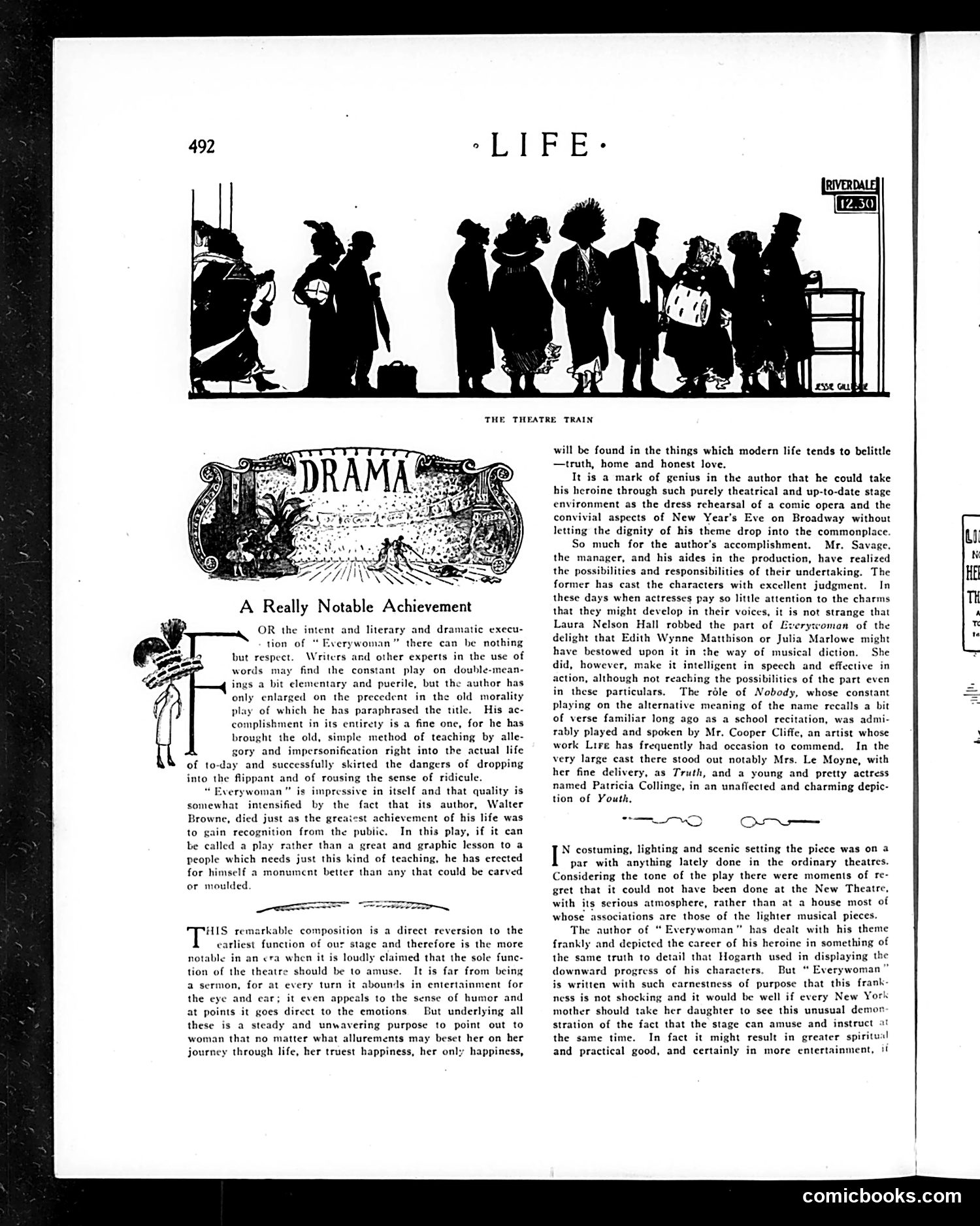
This page reviews **"Everywoman,"** a morality play by Walter Browne (who died before its premiere success). The silhouette at top depicts theater-goers boarding a "theatre train"—a metaphorical reference to attending this production. The review praises the play as a modern adaptation of classical morality plays, using allegory and personified characters (like "Nobody" and "Truth") to teach lessons about life. The author notes this approach was considered old-fashioned in an era demanding pure entertainment, yet Browne successfully navigates Broadway settings (comic opera rehearsals, New Year's Eve) without losing the play's moral dignity. The review credits the production's cast, particularly praising Cooper Cliffe's performance and noting Laura Nelson Hall's adequate but uninspired lead performance. It celebrates the production's scenic design and costuming as excellent, while lamenting the piece wasn't staged at the more prestigious New Theatre venue.
📄 Transcribed text from this page (OCR, searchable)
Machine-transcribed from the original scan — historical spelling and the odd misread are preserved.
THE THEATRE TRAIN A Raally Notable Achievement OR the intent and literary and dramatic execu tion of “ Everywoman” there can be nothing but respect. Writers and other experts in the use of words may find the constant play on double-mean- ings a bit elementary and puerile, but the author has only enlarged on the precedent in the old morality play of which he has paraphrased the title. His ac- complishment in its entirety is a fine one, for he has brought the old, simple method of teaching by alle- gory and impersonification right into the actual life of to-day and successfully skirted the dangers of dropping into the flippant and of rousing the sense of ridicule. “ Everywoman” is impressive in itself and that quality is somewhat intensified by the fact that its author, Walter Browne, died just as the greaizst achievement of his life was to gain recognition from the pubiic. In this play, if it can be called a play rather than a great and graphic lesson to a people which needs just this kind of teaching, he has erected for himself a monument better than any that could be carved or moulded Tus remarkable composition is a direct reversion to the catliest function of our stage and therefore is the more notable in an era when it is loudly claimed that the sole func- tion of the theatre should be to amuse. It is far from being a sermon, for at every turn it abounds in entertainment for the eye and car; it even appeals to the sense of humor and at points it goes direct to the emotions But underlying all these is a steady and unwavering purpose to point out to woman that no matter what allurements may beset her on her journey through life, her truest happiness, her only happiness, will be found in the things which modern life tends to belittle —truth, home and honest love. It is a mark of genius in the author that he could take his heroine through such purely theatrical and up-to-date stage environment as the dress rehearsal of a comic opera and the convivial aspects of New Year's Eve on Broadway without letting the dignity of his theme drop into the commonplace. So much for the author’s accomplishment. Mr. Savage, the manager, and his aides in the production, have realized the possibilities and responsibilities of their undertaking. The former has cast the characters with excellent judgment. In these days when actresses pay so little attention to the charms that they might develop in their voices, it is not strange that Laura Nelson Hall robbed the part of erywoman of the delight that Edith Wynne Matthison or Julia Marlowe might have bestowed upon it in the way of musical diction. She did, however, make it intelligent in speech and effective in action, although not reaching the possibilities of the part even in these particulars. The rdle of Nobody, whose constant playing on the alternative meaning of the name recalls a bit of verse familiar long ago as a school recitation, was admi- rably played and spoken by Mr. Cooper Cliffe, an artist whose work Lire has frequently had occasion to commend, In the very large cast there stood out notably Mrs. Le Moyne, with her fine delivery, as Truth, and a young and pretty actress named Patricia Collinge, in an unaffected and charming depic- tion of Youth, “SOOO IX costuming, lighting and scenic setting the piece was on a par with anything lately done in the ordinary theatres. Considering the tone of the play there were moments of re- gret that it could not have been done at the New Theatre, with its serious atmosphere, rather than at a house most of whose associations are those of the lighter musical pieces. The author of “Everywoman” has dealt with his theme frankly and depicted the career of his heroine in something of the same truth to detail that Hogarth used in displaying the downward progress of his characters, But “ Everywoman” is written with such carnestness of purpose that this frank- ness is not shocking and it would be well if every New York mother should take her daughter to see this unusual demon stration of the fact that the stage can amuse and instruct at the same time. In fact it might result in greater spiritual and practical good, and certainly in more entertainment, ii comicbooks.com