
A complete issue · 56 pages · 1910
Life — June 2, 1910
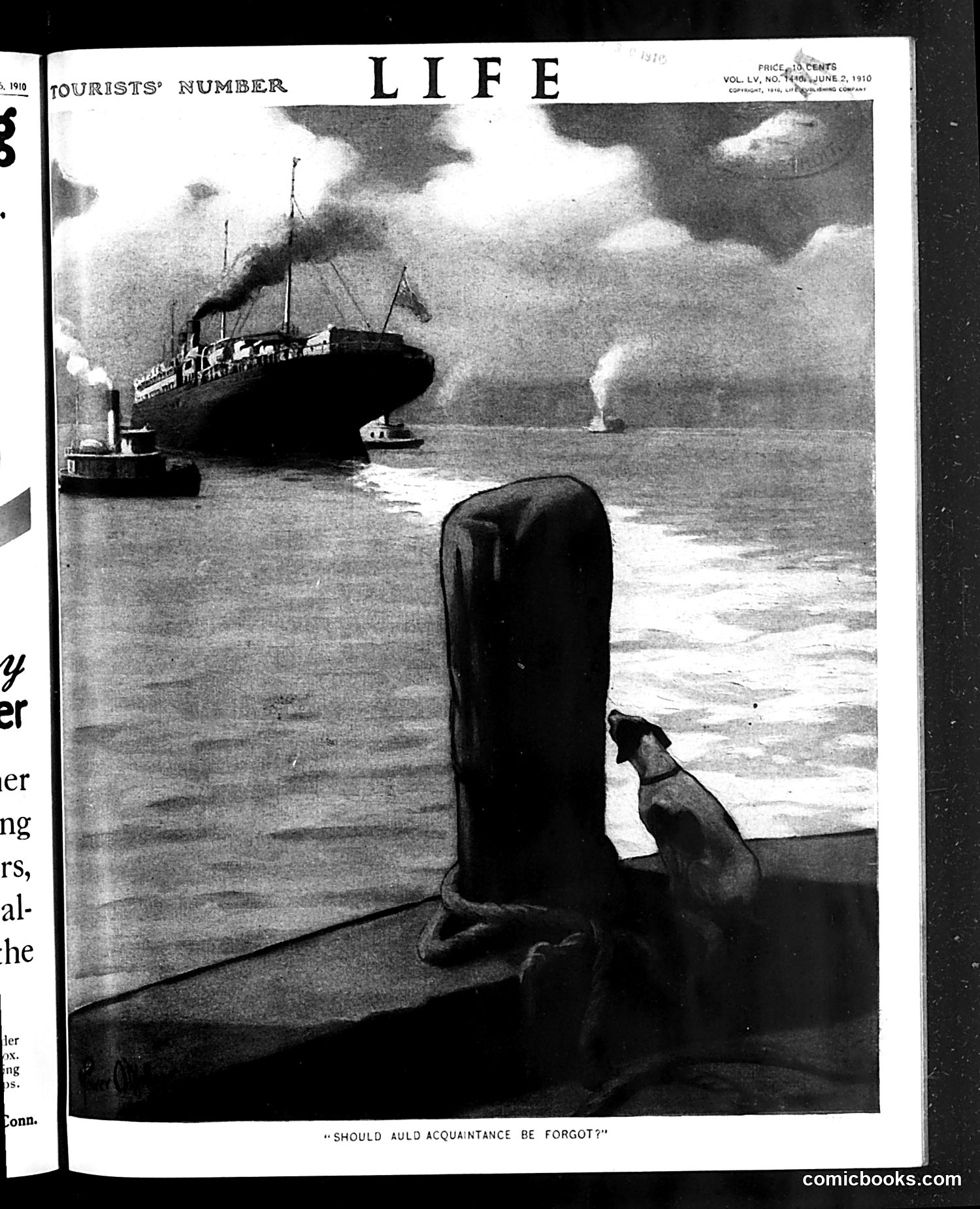
This 1910 *Life* cartoon depicts a figure in the foreground watching a large steamship depart across the water, with the caption quoting Robert Burns's famous Scottish song "Auld Lang Syne" ("Should old acquaintance be forgot?"). The image likely comments on departure, separation, or the end of a relationship—whether personal, political, or diplomatic. The wistful tone suggests nostalgia or regret about parting ways with someone or something significant. Without additional context identifying the specific figure or vessel, the cartoon appears to use the romantic melancholy of Burns's song to satirize either a notable departure or the severing of ties during this era, possibly related to political figures or international relations of 1910.
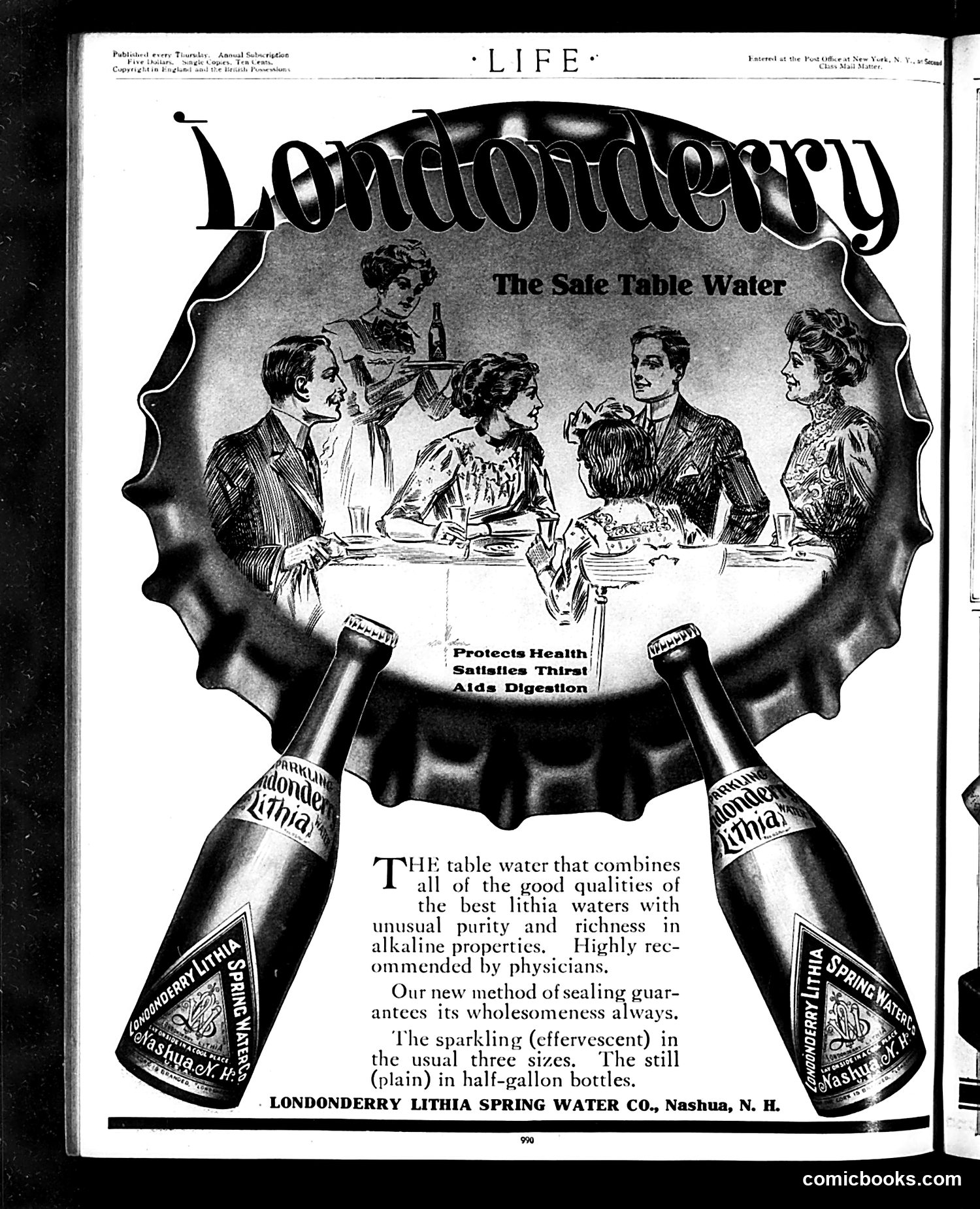
This is a **product advertisement**, not political satire. It promotes "The Safe Table Water" from Londonderry Lithia Spring Water Co. of Nashua, New Hampshire. The image depicts an elegant dinner scene with well-dressed diners seated at a table, framed within a stylized bottle shape. Two actual product bottles flank the scene below. The advertisement emphasizes health benefits—claiming the water "Protects Health," "Satisfies Thirst," and "Aids Digestion." The copy describes it as combining "good qualities of the best lithia waters with unusual purity and richness in alkaline properties," recommended by physicians. The sparkling water came in three sizes: two effervescent (carbonated) versions and one still version in half-gallon bottles. This reflects early 20th-century marketing of mineral waters as medicinal tonics.
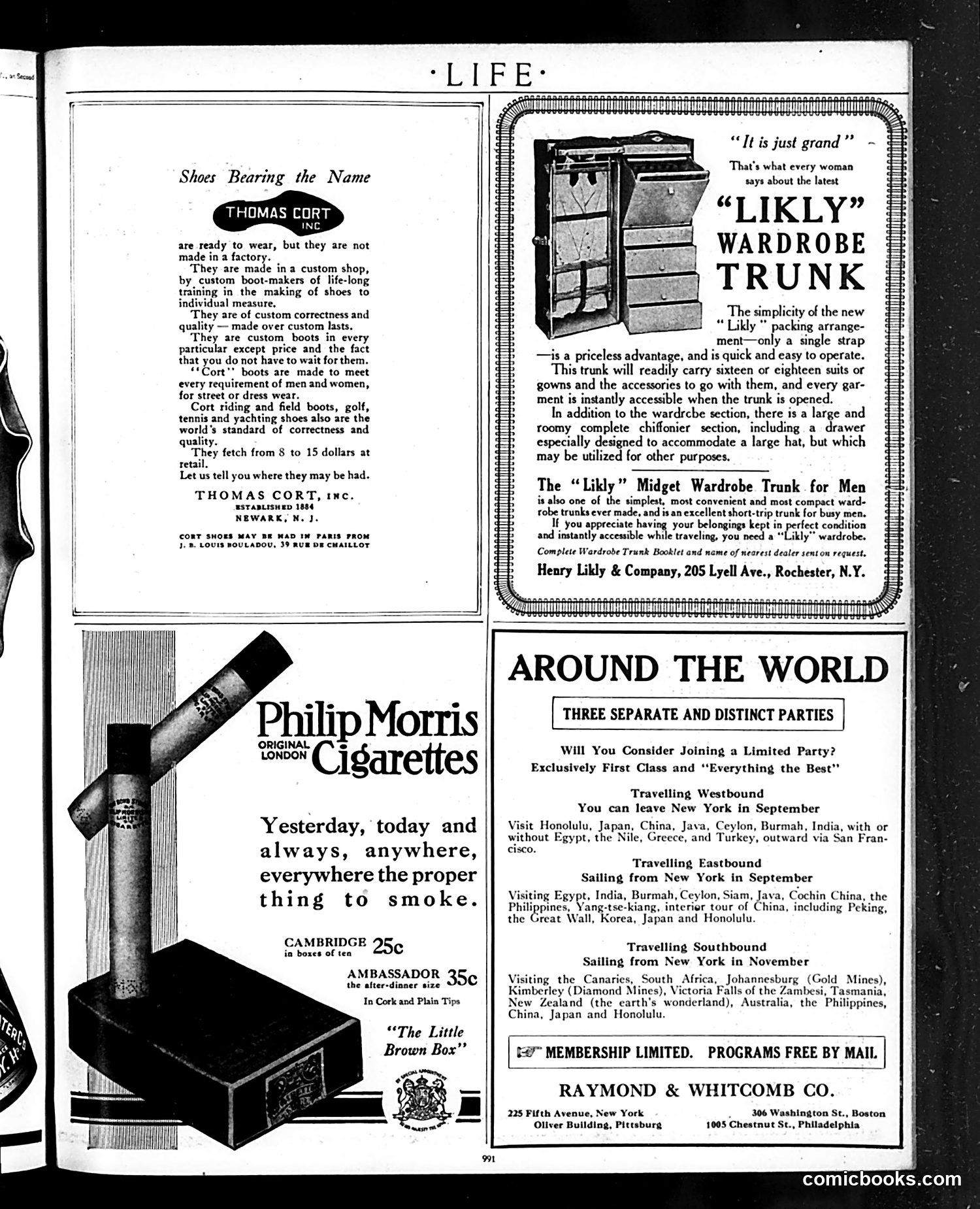
This page contains **primarily advertisements** rather than satirical cartoons. The visible ads are: 1. **Thomas Cort shoes** — promoting custom-made boots for men, emphasizing quality and durability 2. **Philip Morris cigarettes** — advertising their Cambridge (25¢) and Ambassador (35¢) sizes, with the slogan "Yesterday, today and always, anywhere, everywhere the proper thing to smoke" 3. **Likly Wardrobe Trunk** — promoting a new trunk design for travelers with organized compartments 4. **Around the World travel parties** — Raymond & Whitcomb Co. advertising three distinct touring routes (westbound, eastbound, southbound) visiting destinations like Japan, Egypt, India, and Australia There are **no identifiable political cartoons or caricatures** on this page. It's a straightforward advertising section typical of Life magazine's revenue model.
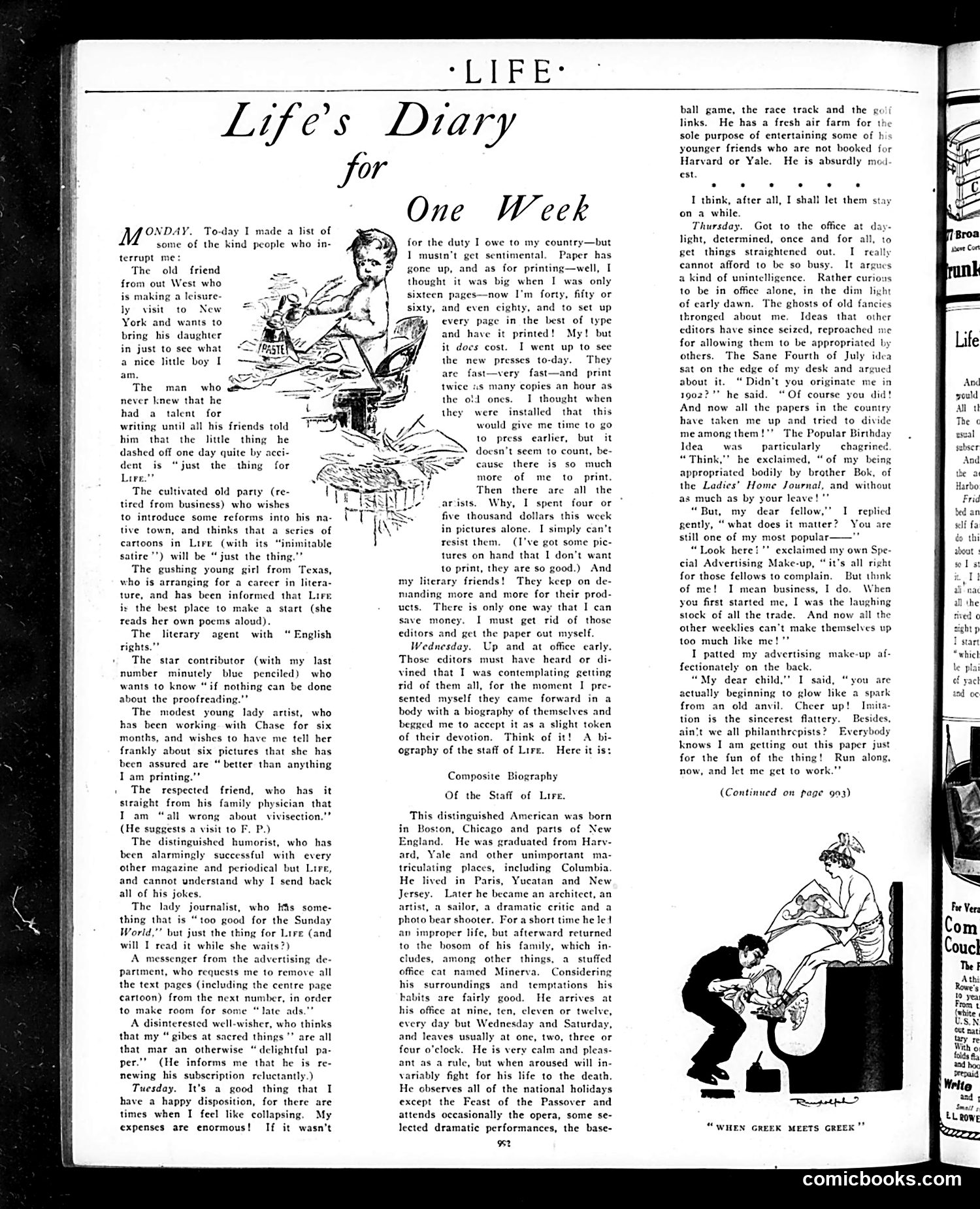
This is a satirical column documenting a week in the life of Life magazine's editor. The main cartoon at bottom, captioned "WHEN GREEK MEETS GREEK," appears to show two figures in a confrontational stance—likely depicting a business or editorial dispute, possibly involving advertising or content decisions. The text describes various workplace frustrations: dealing with demanding contributors, managing cartoonists and writers, handling advertising department requests, and navigating office politics. The satire targets the tension between editorial integrity and commercial pressures—a recurring theme in early 20th-century magazine publishing. The "Greek meets Greek" reference is an idiom meaning conflict between equals or worthy opponents, suggesting internal magazine conflicts or competitive publishing dynamics of the era.
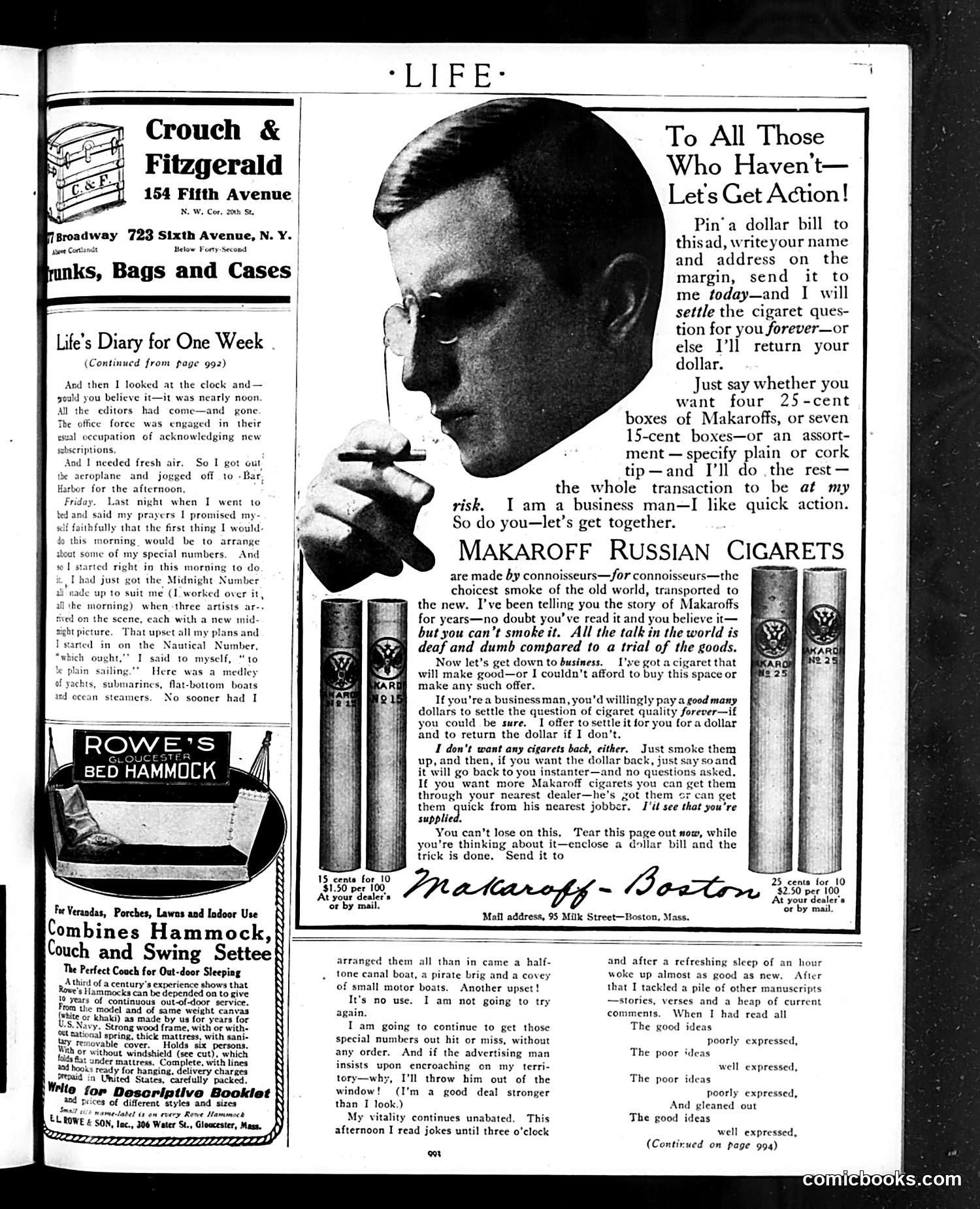
This page is primarily a **Makaroff Russian Cigarettes advertisement**, not political satire. The large central image shows a man's profile smoking a cigarette, accompanying promotional copy. The ad uses a marketing gimmick: readers are invited to send a dollar bill with their name and address. The advertiser claims they'll "settle the cigarette question" by sending samples—either four 25-cent boxes or seven 15-cent boxes—at the advertiser's risk. The pitch emphasizes quick business action and appeals to consumer curiosity. The surrounding content includes unrelated ads (Crouch & Fitzgerald luggage, Rowe's Bed Hammock) and the continuation of "Life's Diary for One Week" (a personal essay). There is no political cartoon or satirical commentary visible on this page.
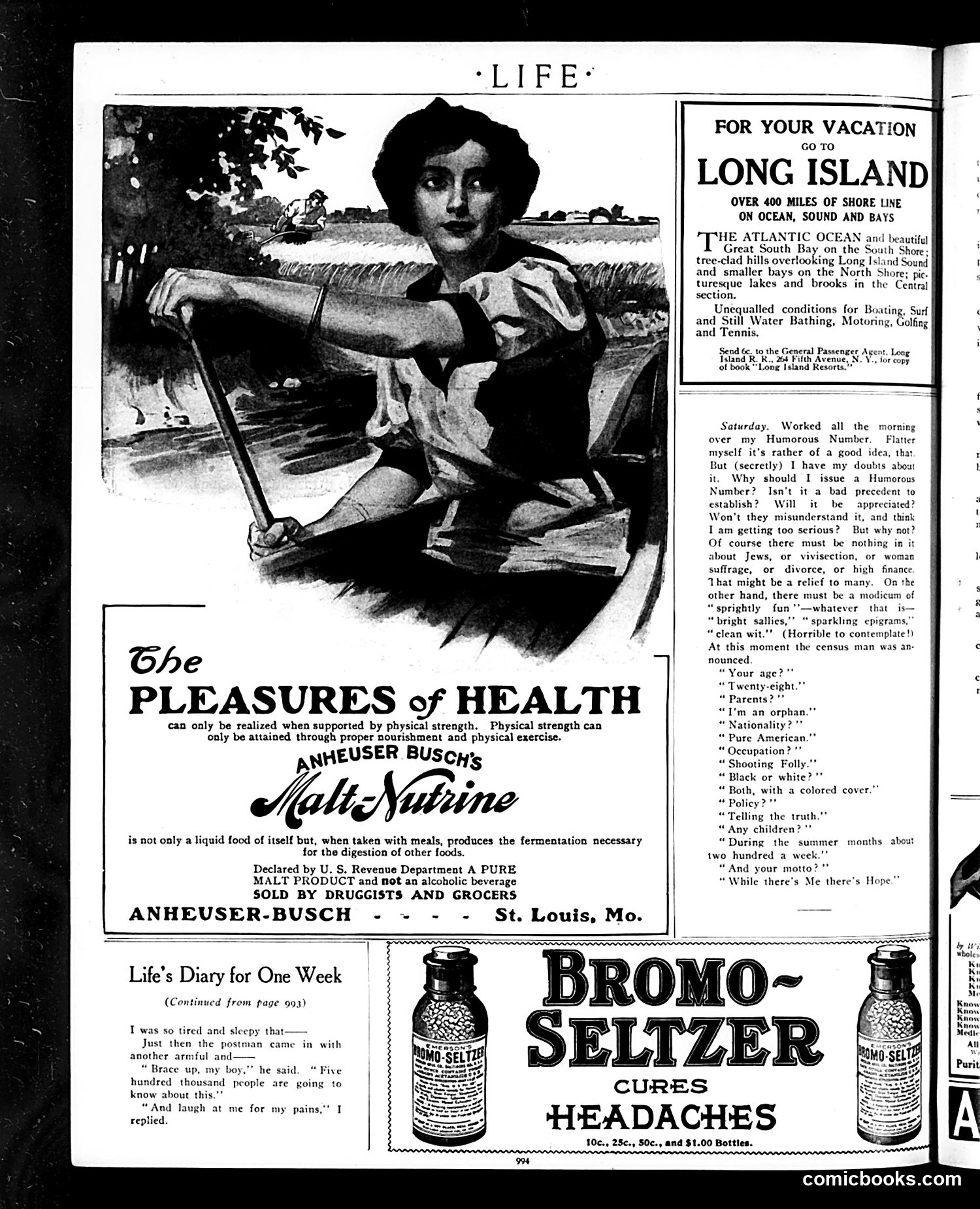
This page is primarily **advertising rather than editorial content**. The dominant advertisement features Anheuser-Busch's "Malt-Nutrine," a malt extract product marketed as a health supplement for "proper nourishment and physical exercise." The product's prominent placement alongside health messaging reflects early 20th-century marketing that positioned malt beverages as medicinal tonics. A secondary advertisement promotes Bromo-Seltzer for headaches. The page includes a brief "Life's Diary for One Week" narrative snippet about receiving mail, and a Long Island vacation advertisement. The woman pictured appears as generic lifestyle imagery typical of the era rather than caricature or satire. Overall, this represents standard magazine advertising content of the period rather than satirical commentary.
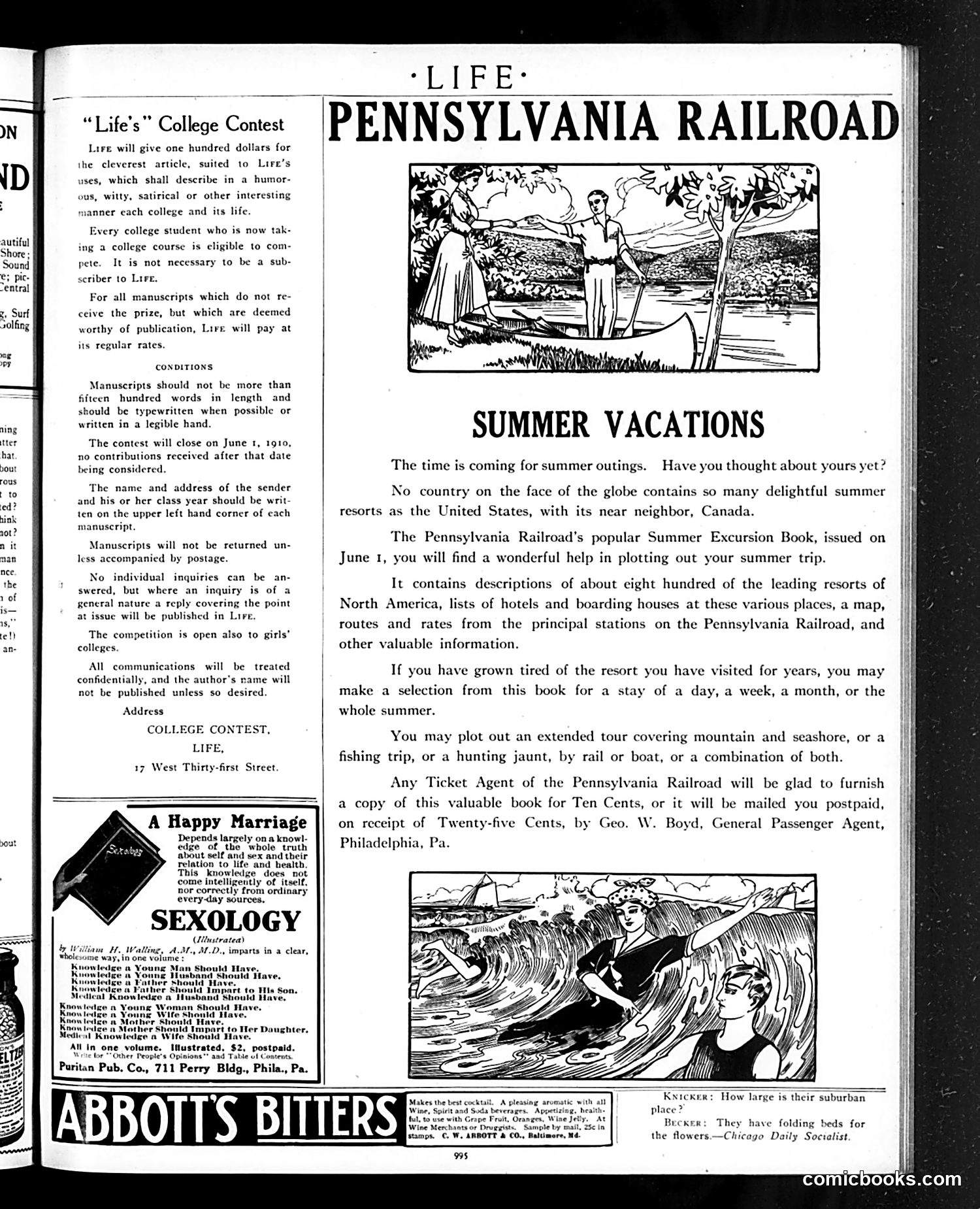
This page is primarily **advertising and promotional content** rather than political satire. The main feature is a **Pennsylvania Railroad advertisement** for summer vacations, with two scenic woodcut illustrations showing leisure activities (boating, countryside recreation). The text promotes the railroad's "Summer Excursion Book" offering resort information across North America. The left column contains a **Life magazine college writing contest** announcement and advertisements for unrelated products: a "Sexology" book (promising intimate knowledge for newlyweds), and Abbott's Bitters (a medicinal tonic). There is **no significant political cartoon or satire** on this page. It represents typical early 20th-century magazine content mixing editorial contests with commercial advertisements targeting middle-class leisure and consumer interests.
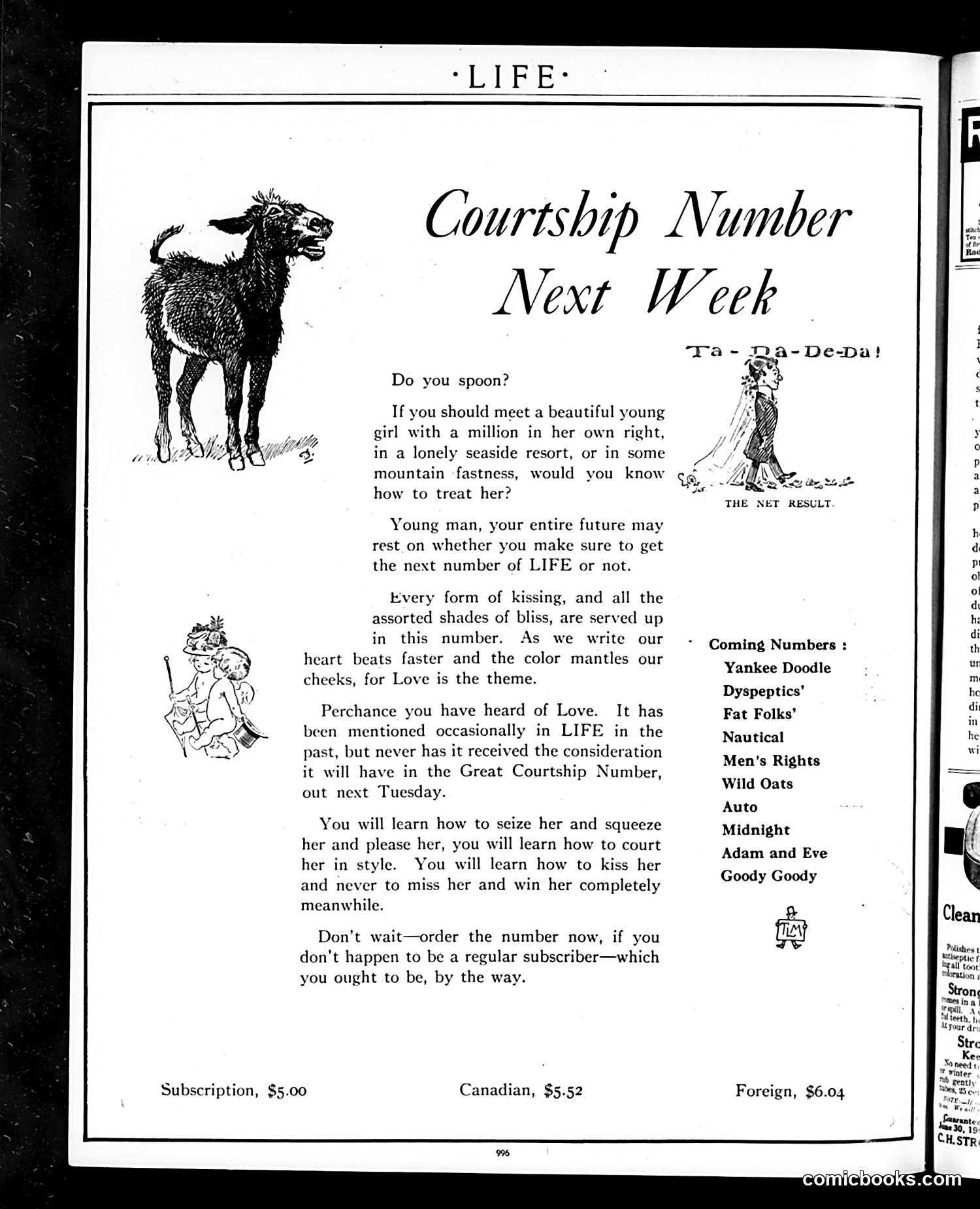
This page advertises an upcoming "Courtship Number" of *Life* magazine, using playful illustrations and copy to promote romantic content. The text addresses young men, offering advice on courtship with phrases like "Do you spoon?" (a dated term for intimate kissing/cuddling). The accompanying sketches show a dog and cherubs/cupids—generic symbols of love and romance rather than specific political references. The writing employs *Life*'s characteristic satirical tone, mixing practical dating advice with gentle mockery of courtship conventions. The "Coming Numbers" list mentions themes like "Yankee Doodle" and "Fat Folks'"—likely referring to special thematic issues. This is primarily a subscription promotion emphasizing romantic content as entertainment, typical of *Life*'s satirical approach to social behavior.
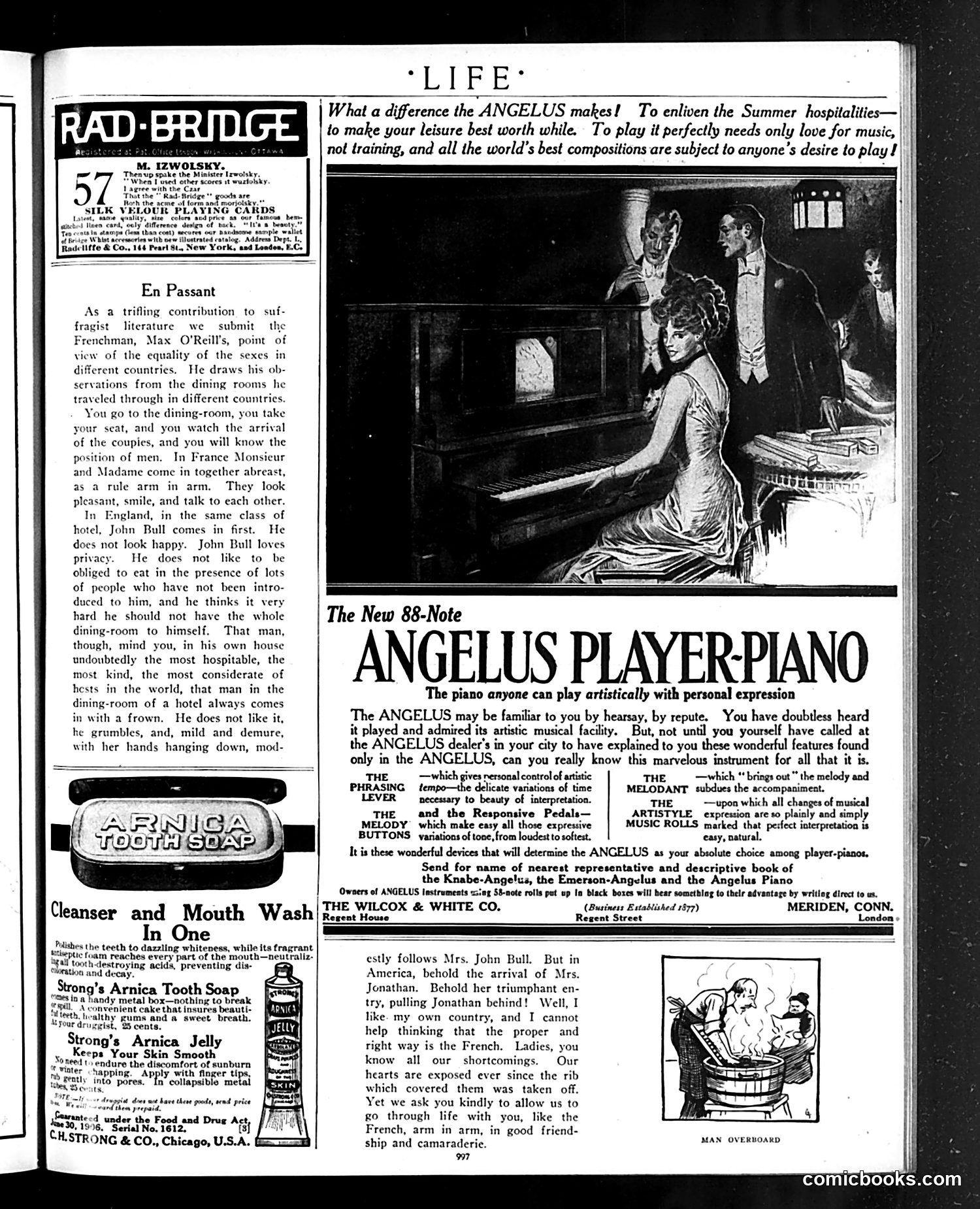
This page is primarily **advertising** for the Angelus Player-Piano, with a secondary editorial piece titled "En Passant." The main content features a satirical illustration showing well-dressed diners in a hotel dining room, accompanying text by French observer Max O'Rell. His commentary mocks the social awkwardness of different nationalities at dinner: French couples are affectionate, English gentleman John Bull dislikes public dining, and Americans lack proper decorum. The piece gently ridicules cultural differences in dining etiquette and comportment. The Angelus ad emphasizes that their player-piano requires no musical training—anyone can play "perfectly" and masterfully. The appeal targets Summer hospitality venues and leisure activities, suggesting democratized access to cultural refinement through mechanical means.
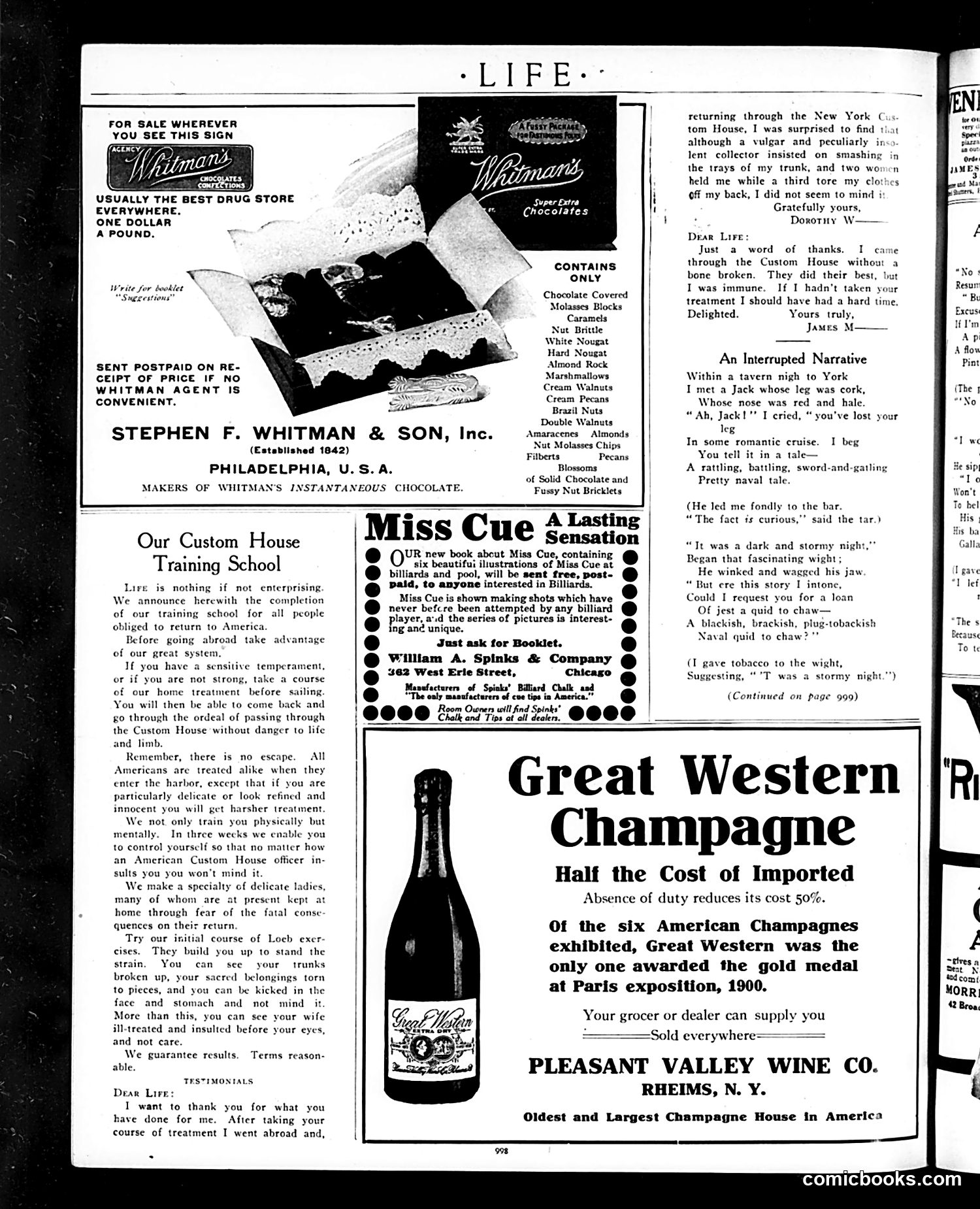
This page is primarily **advertising and advice content** rather than political satire. The main elements include: 1. **Whitman's Chocolates ad** - A product advertisement for chocolate assortments 2. **"Our Custom House Training School"** - An advice column warning American travelers about dangerous practices at foreign customs houses, apparently offering training to help people smuggle items safely 3. **"Miss Cue" billiards advertisement** - Promoting instructional materials for pool players 4. **"Great Western Champagne" ad** - Marketing American-made champagne as cheaper than imports, claiming it won a gold medal at the 1900 Paris Exposition The page reflects early 20th-century consumer culture and contains reader testimonials. The customs house column humorously acknowledges illegal smuggling as commonplace, suggesting this was openly discussed in period publications.
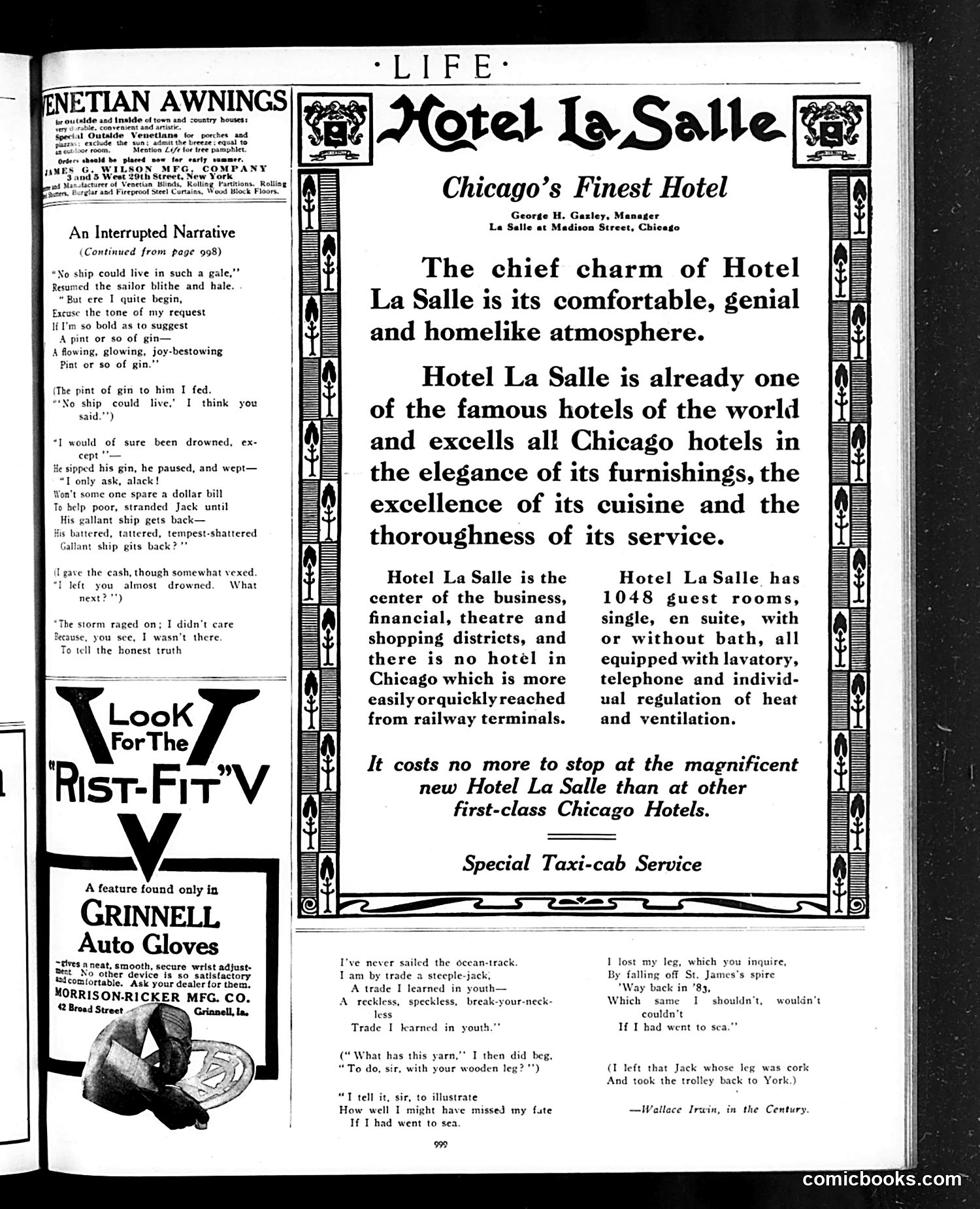
This page is primarily **advertising**, not satire or political commentary. The main content features a large **Hotel La Salle advertisement** for Chicago, emphasizing its central location, 1048 guest rooms, elegant furnishings, and competitive pricing. The ad includes a poem excerpt continuing "An Interrupted Narrative" about a sailor. On the left side is a **Grinnell Auto Gloves advertisement** showing a wrist adjustment device, marketed to dealers. Below that is a **Venetian Awnings advertisement** for residential use. The page represents typical **Life magazine content from this era**—mixing literary serialization with commercial advertising. There is no political cartoon or satirical commentary to analyze here; it's a straightforward commercial page from an older periodical.
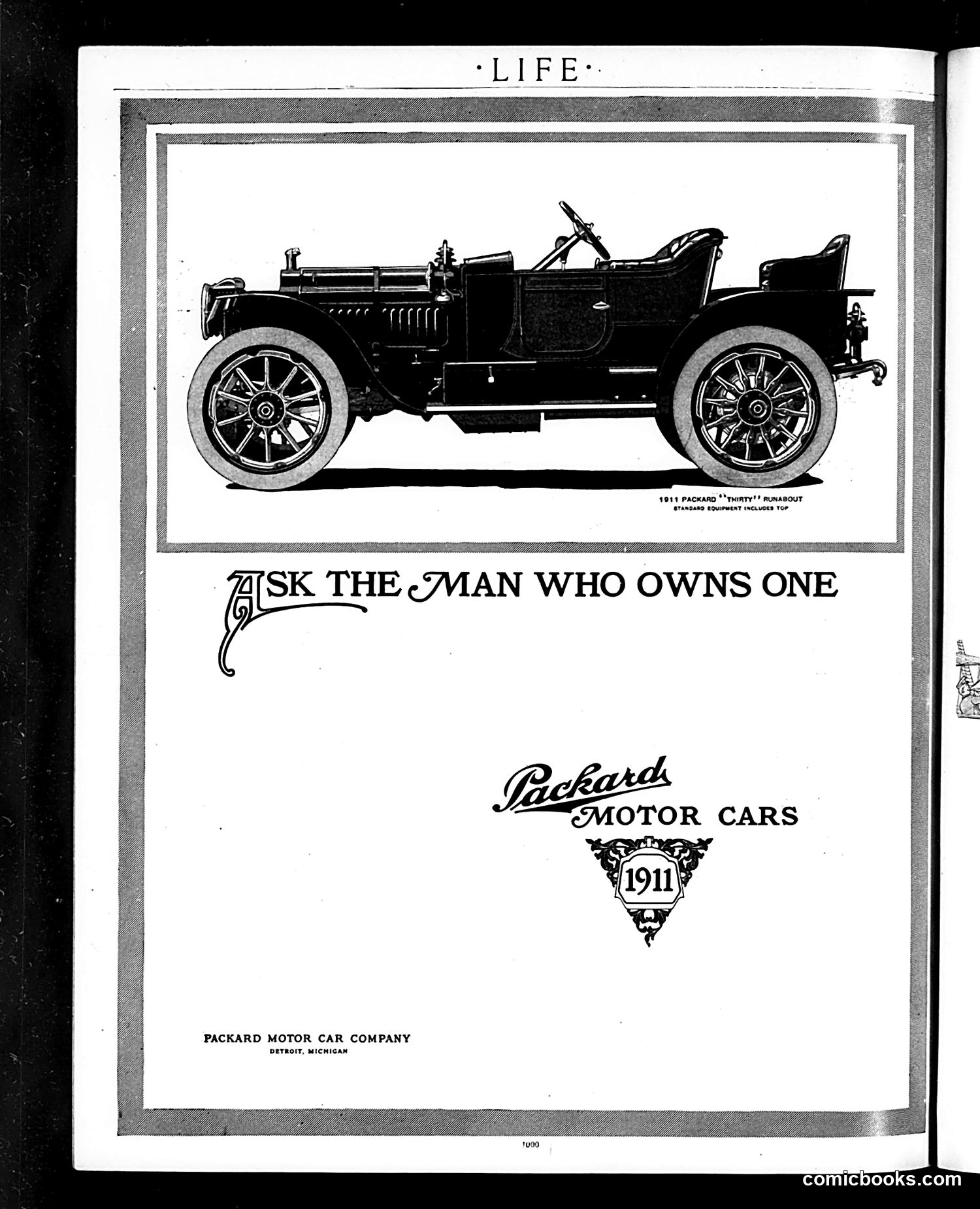
This is primarily a **full-page advertisement**, not a satirical cartoon. It appeared in *Life* magazine in 1911 and promotes the **Packard Motor Car Company** of Detroit, Michigan. The ad features a detailed technical illustration of a 1911 Packard "Thirty" Runabout with the tagline "Ask the Man Who Owns One." This phrase was Packard's actual advertising slogan, positioning the vehicle as quality merchandise endorsed by satisfied customers. The layout—with the car's side profile prominently displayed and the manufacturer's ornate badge below—reflects early 20th-century luxury automobile marketing. There is **no political satire or cartoon content** on this page; it is straightforward commercial advertising typical of *Life*'s revenue model during that era.
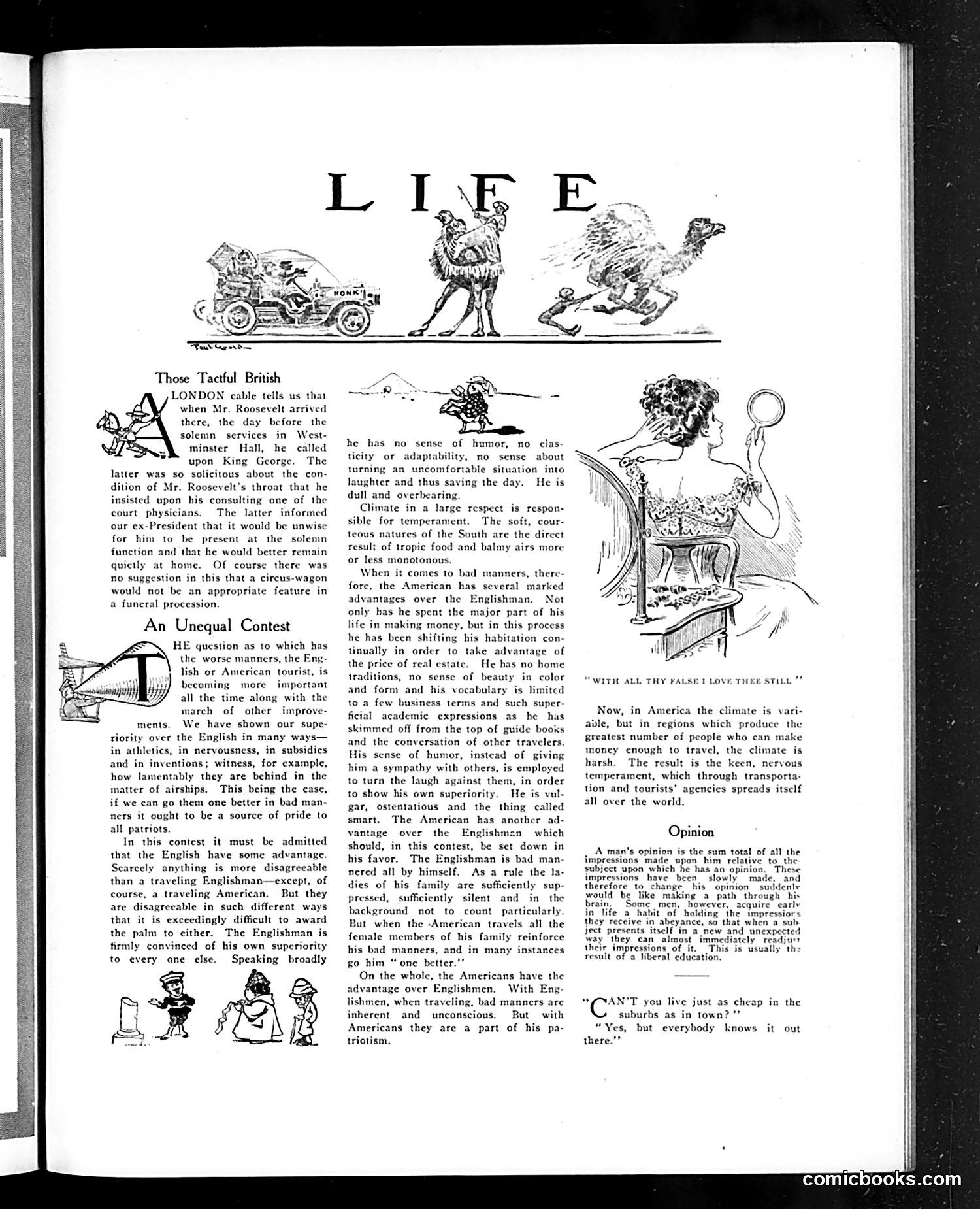
This page compares English and American tourists' manners and behavior abroad. The top illustration shows a sequence: a British tourist in a motorcar, a camel driver, and someone running—likely depicting the "unequal contest" addressed below. "An Unequal Contest" argues that English tourists possess inherent superiority in athletics, performances, and inventions. However, the text ironically critiques English tourists as having bad manners when traveling, appearing "arrogant" and "ostentatious." The counterargument notes Americans have advantages: patriotism and generally better conduct abroad. English tourists allegedly treat themselves as superior to locals and family members, while Americans, though sometimes crude, maintain democratic courtesy. The piece satirizes both nationalities' travel pretensions while suggesting Americans' informal egalitarianism actually makes better tourists than British class consciousness.
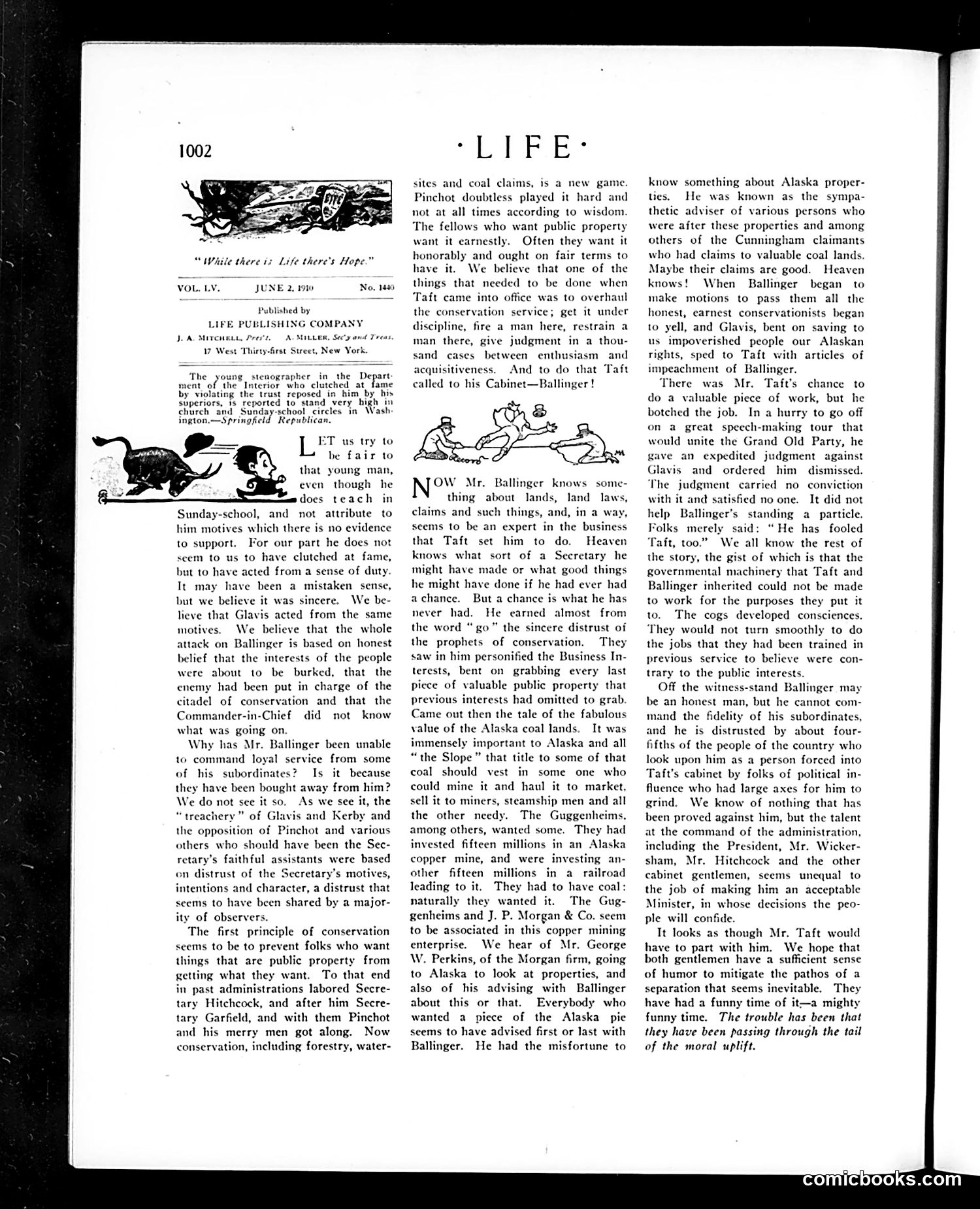
This page satirizes the Ballinger-Pinchot conservation controversy, a major scandal of President Taft's administration. The text defends Secretary of the Interior Richard Ballinger against accusations of corruption regarding Alaska coal lands. The article argues that Ballinger's subordinates—including Louis Glavis and Gifford Pinchot (former chief forester)—acted from honest conviction that Ballinger favored business interests over conservation, not from disloyalty or bribery. It acknowledges Pinchot "played it hard" but suggests Taft needed to overhaul the conservation service upon taking office. The cartoon (top-left) shows what appears to be a dog chasing or attacking a figure, likely representing the relentless public attacks on Ballinger, satirizing how his reputation was "clutched at" by critics. The piece expresses frustration that Ballinger never received fair treatment, having earned "sincere distrust" from conservationists who viewed him as representing business interests—particularly the Guggenheims' Alaska copper and coal operations.
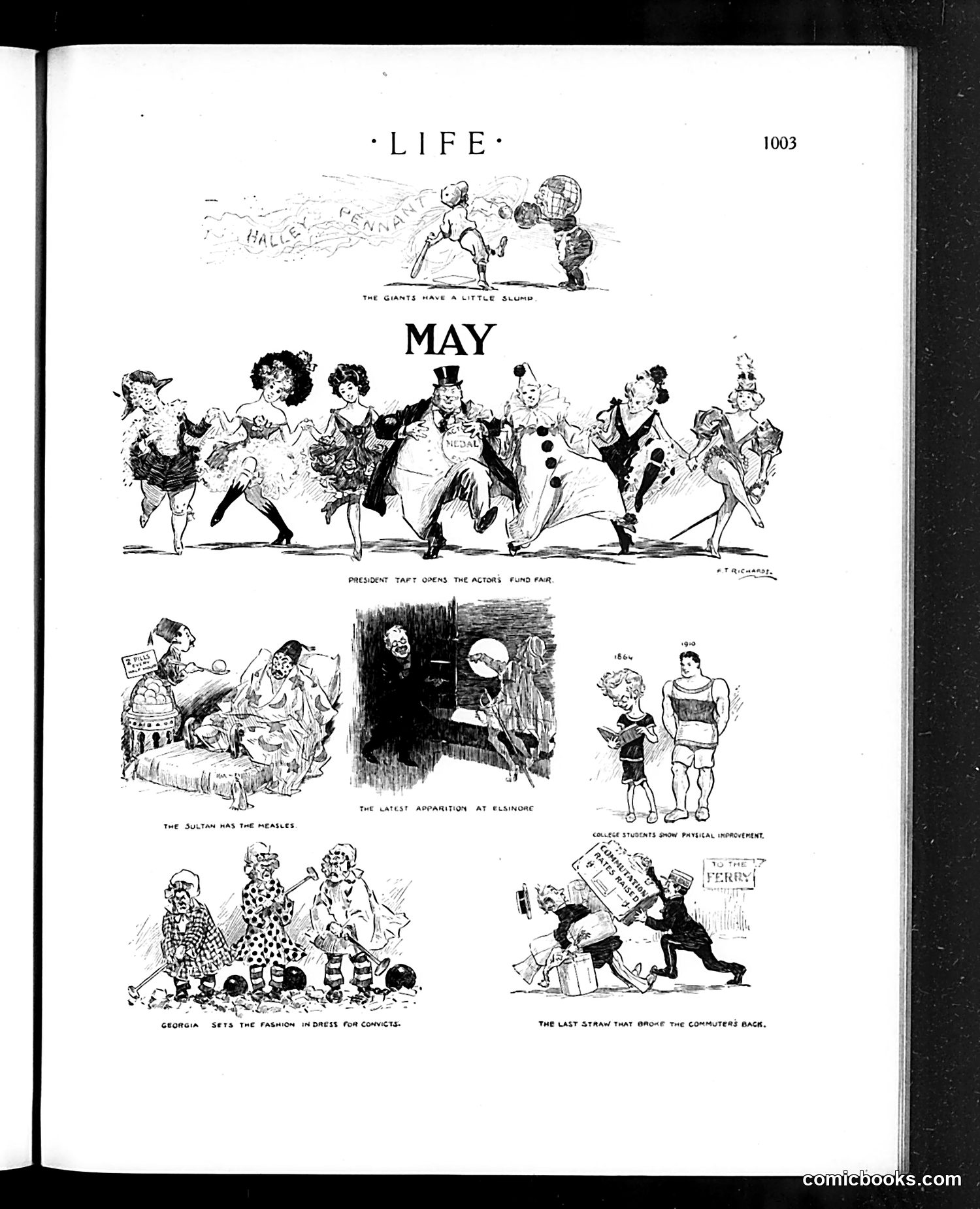
This page contains six political cartoons satirizing contemporary American issues: 1. **President Taft Opens Actors Fund Fair** - Shows Taft (identifiable by his distinctive round figure and top hat) among entertainers, likely mocking his public appearances or the event's frivolity. 2. **The Sultan Has the Measles** - References Ottoman Empire politics, possibly commenting on Turkish government instability. 3. **The Latest Apparition at Elsinore** - A ghost reference (Elsinore from *Hamlet*), meaning unclear without additional context. 4. **College Students Show Physical Improvement** - Compares young men's athletic development, possibly satirizing educational priorities. 5. **Georgia Sets Fashion in Dress for Convicts** - Mocks Georgia's prison clothing policies, suggesting they're absurdly fashionable or inhumane. 6. **The Last Straw That Broke the Commuters' Back** - Depicts overwhelmed commuters, satirizing transportation frustrations or overcrowding. The cartoons reflect early-1900s American concerns: politics, international affairs, education, criminal justice, and urban infrastructure.
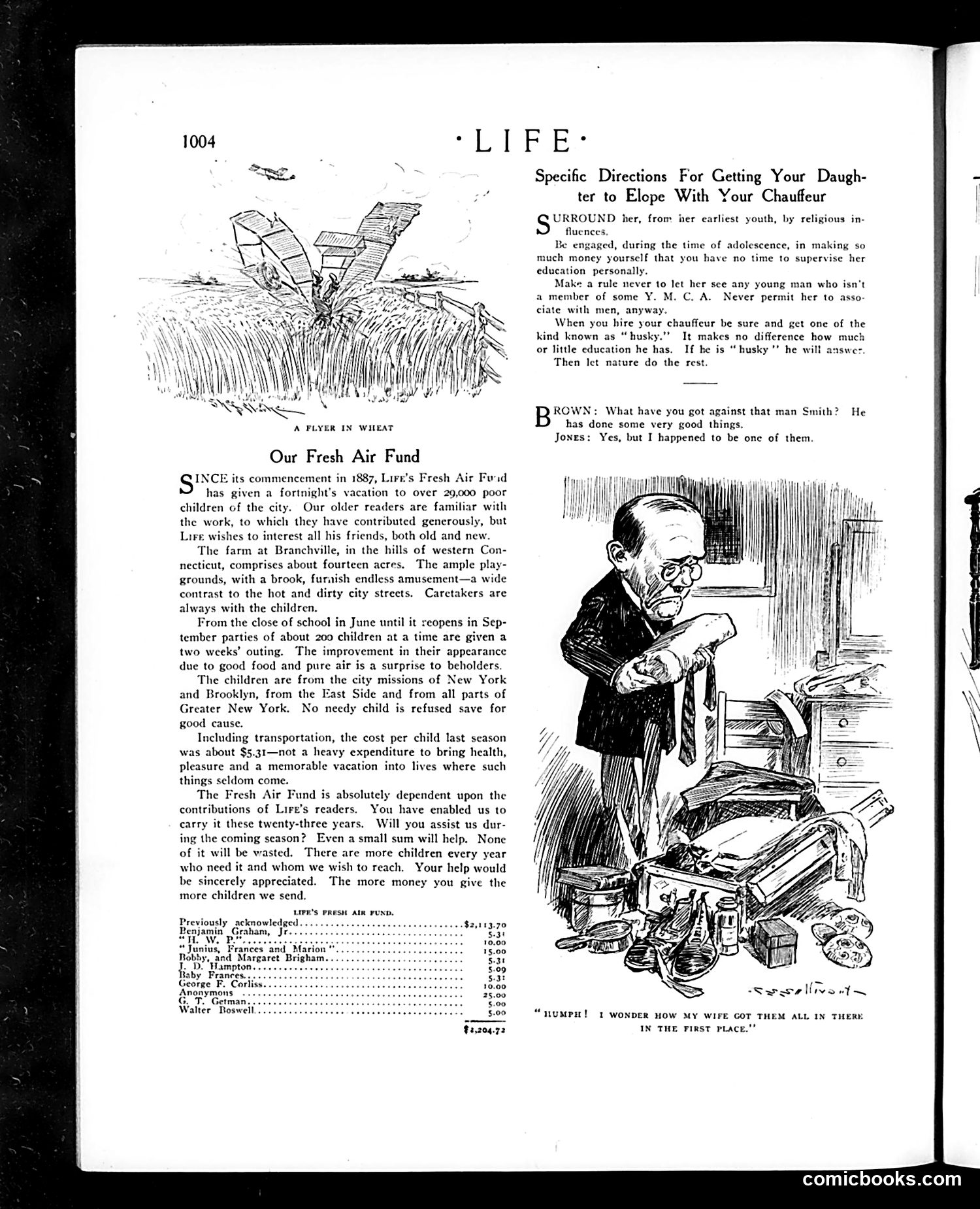
This page contains two distinct pieces of satire: **"Our Fresh Air Fund"** (left): A genuine charitable appeal describing Life magazine's real program since 1887 sending poor urban children from New York/Brooklyn to a Connecticut farm for vacations. The text emphasizes moral uplift through nature and fresh air—reflecting Progressive Era values about improving poor children's health and character. **"Specific Directions For Getting Your Daughter to Elope With Your Chauffeur"** (right): Satirical advice mocking wealthy, negligent parents. The joke targets the era's class anxieties: overbearing fathers who obsessively control daughters' social lives yet hire working-class chauffeurs without vetting them. The satire suggests that such restriction combined with proximity to an attractive "husky" chauffeur inevitably leads to elopement—ironic punishment for parental hypocrisy. **The cartoon** shows a man surrounded by his wife's possessions, bewildered about how she fit them all in one space—marital humor about women's shopping habits. The page juxtaposes earnest charity with class-based social satire typical of Life's content.
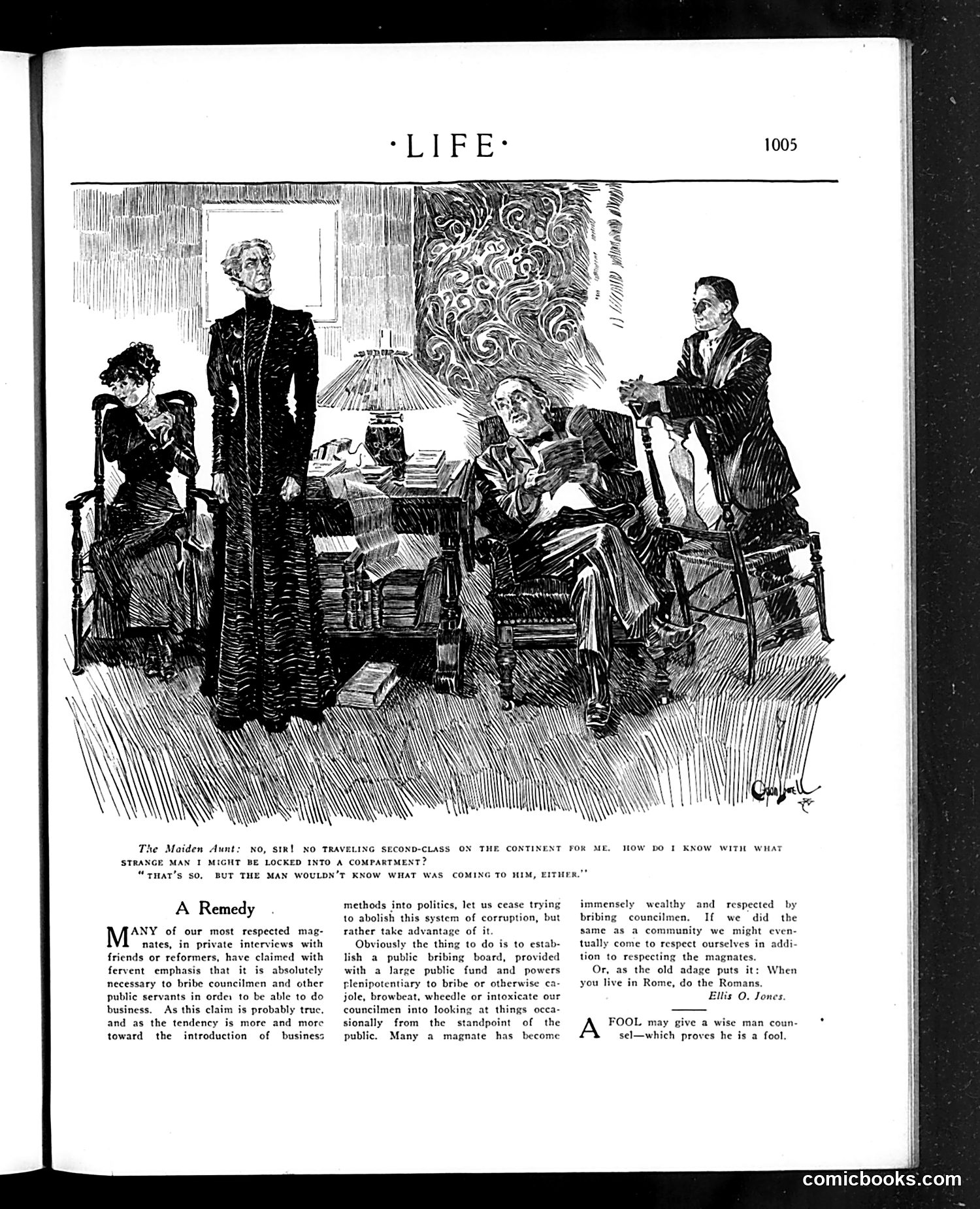
**The Cartoon:** The top illustration depicts a Victorian-era "Maiden Aunt" refusing second-class train travel in Europe, fearing she might be "locked into a compartment" with a strange man—a joke about propriety and female anxieties about unchaperoned travel. **"A Remedy" Article:** This is satirical political commentary. The author argues that since wealthy businessmen claim bribing public officials is "necessary" to conduct business, society should stop pretending corruption is wrong. Instead, he sarcastically proposes establishing an *official* "public bribing board" funded by taxpayers to systematically bribe city councilmen—turning private corruption into transparent public policy. **The Point:** The satire mocks both corrupt magnates who justify bribery as inevitable and reform efforts that ignore systemic corruption. By pushing the logic to absurd extremes (legitimizing bribery as public practice), the author exposes the hypocrisy of accepting corruption while maintaining moral pretense. The closing Latin reference ("When in Rome...") reinforces the cynical message.
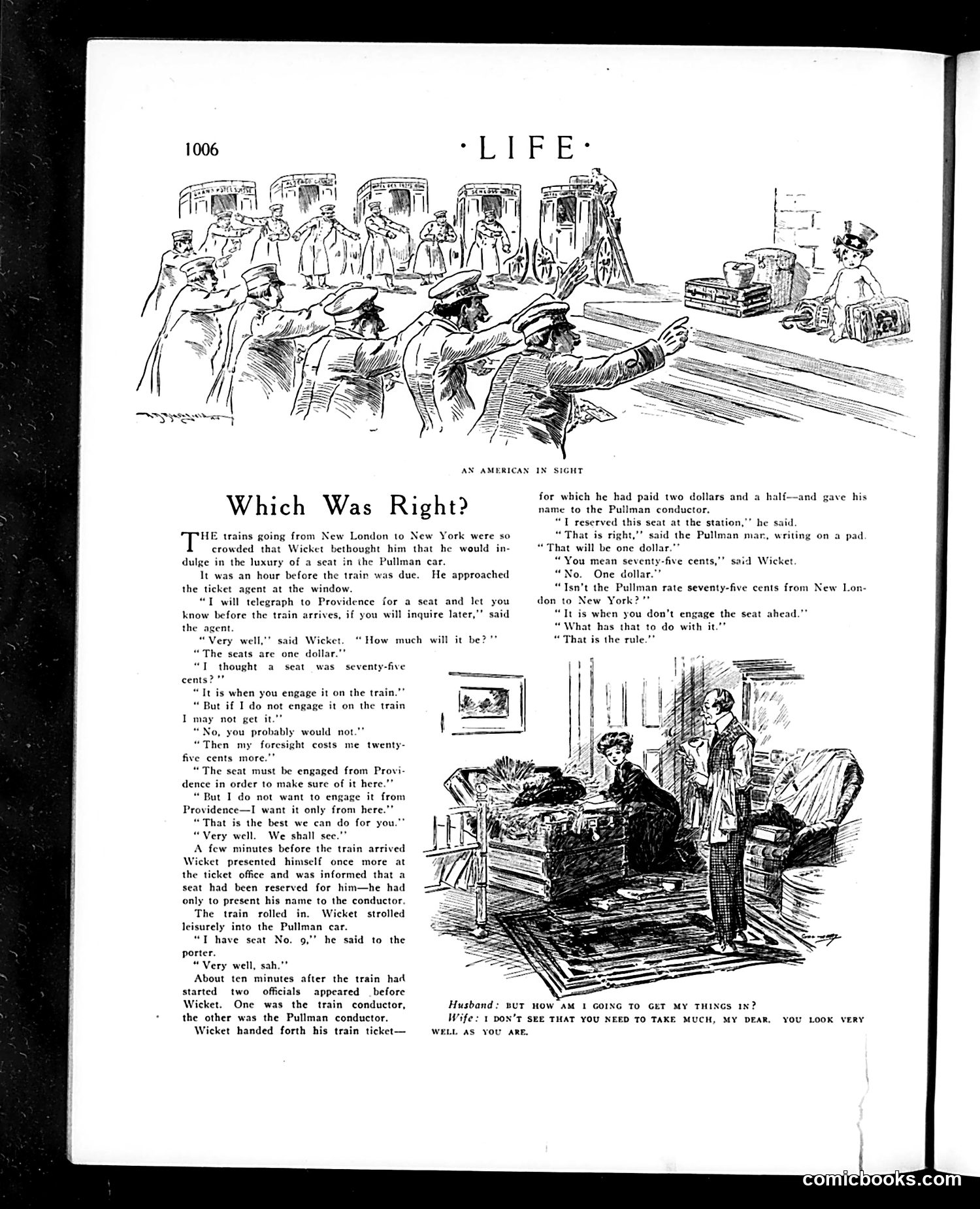
This satirical story mocks arbitrary corporate pricing and rule-making. The protagonist "Wicket" attempts to purchase a Pullman car seat (luxury railroad seating) from New London to New York for a fixed rate of seventy-five cents. However, he encounters contradictory pricing: the ticket agent charges one dollar for advance reservations but claims seats cost seventy-five cents if booked on the train itself. When Wicket reserves ahead to guarantee a seat, he's then charged the higher rate anyway. The Pullman conductor invokes "the rule" without logical justification—the surcharge supposedly applies because he reserved in advance, making the rule self-contradictory and punitive to careful planning. The accompanying domestic cartoon (lower right) offers ironic commentary: a wife suggests her husband won't need much luggage, implying financial hardship from such nickel-and-diming practices. The satire targets the absurdity of corporate bureaucracy and unreasonable fee structures that punish consumers regardless of their choices.
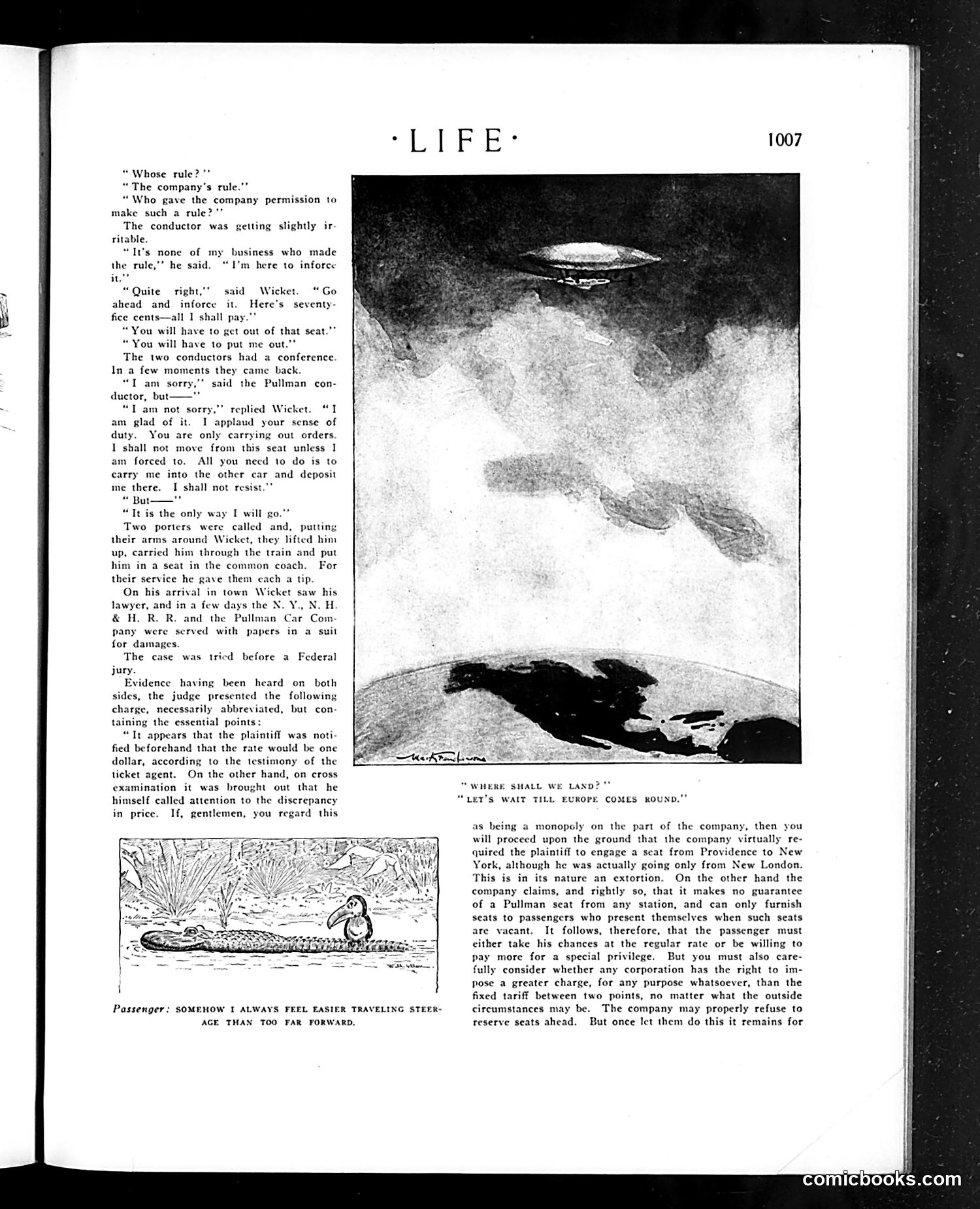
This page satirizes **railroad company overreach and monopolistic practices** in the early 20th century. The main narrative concerns a passenger named Wicket who challenges a Pullman Car Company conductor's arbitrary rule requiring payment for a seat upgrade. The satire targets corporate abuse of power: when Wicket refuses to pay an extra 75 cents for a seat he believes should cost one dollar, the company physically removes him to a cheaper car rather than negotiate. Wicket then sues, framing this as extortion—charging inflated rates for seats allegedly "unavailable" unless passengers pay premiums. The judge's charge to the jury presents the core complaint: companies monopolistically control seat allocation and exploit passengers by claiming seats aren't guaranteed, then charging excessive premiums for what should be standard service at fixed tariffs. The cartoon below (showing a passenger preferring steerage to forward cabins) reinforces the theme: even the cheapest accommodations feel safer than dealing with corporate manipulation. This reflects Progressive Era concerns about **unchecked corporate monopolies** overcharging captive customers.
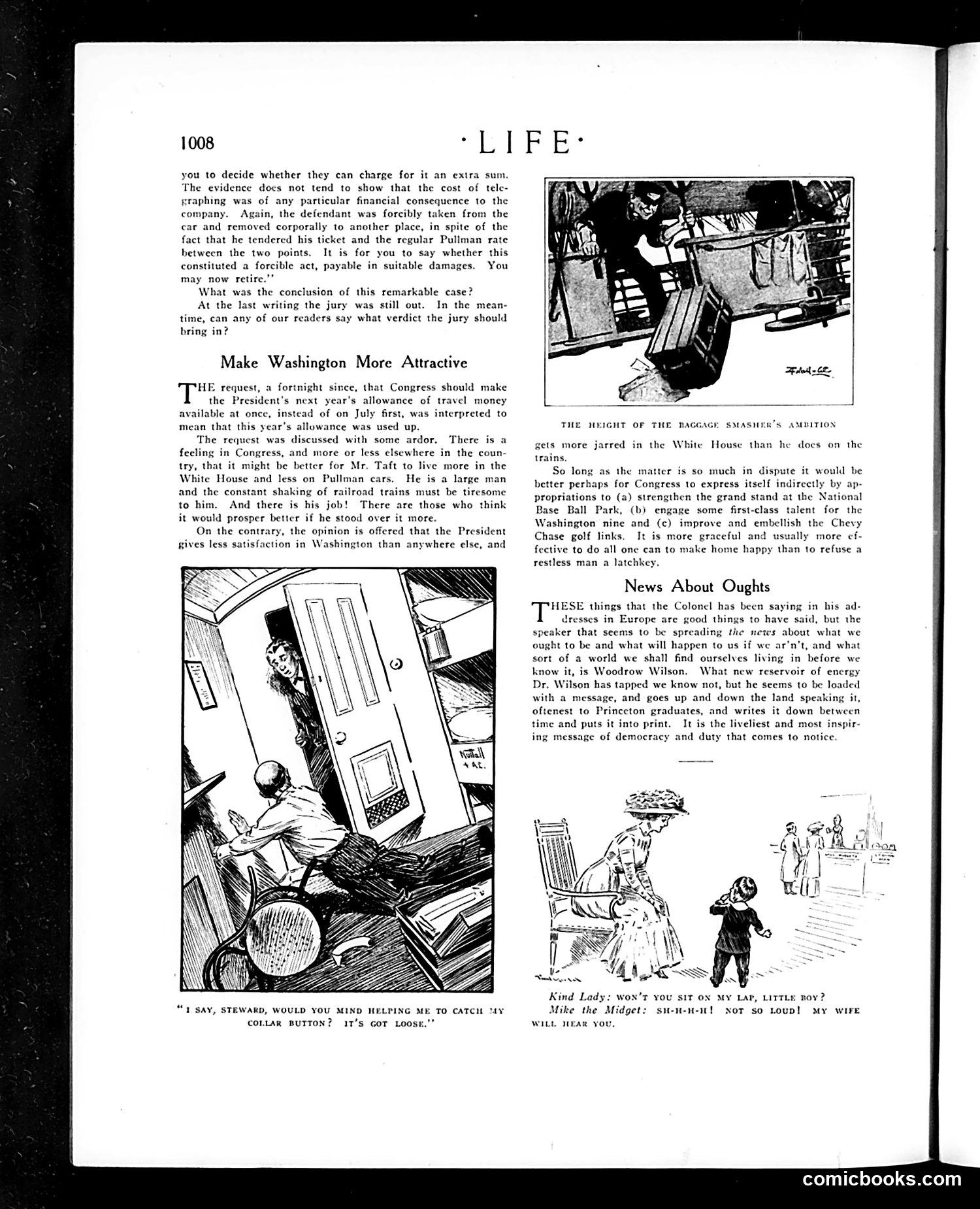
This 1908 *Life* page contains political satire about President William Howard Taft. The main article criticizes Taft's frequent travel on Pullman railroad cars, suggesting Congress should instead fund Washington attractions—a baseball stadium, a winning team, and golf links—to keep him in the capital where he belongs. The satire implies Taft is an absentee president who neglects his duties. The "News About Oughts" section praises Theodore Roosevelt's European speeches and contrasts them with Woodrow Wilson's domestic speaking tour, presenting Wilson as a energetic voice on democracy and duty—likely positioning him as a future presidential alternative. The cartoons illustrate domestic mishaps: a steward losing a collar button and a "Kind Lady" with "Mike the Midget," a reference to midget performers popular in vaudeville entertainment of that era.
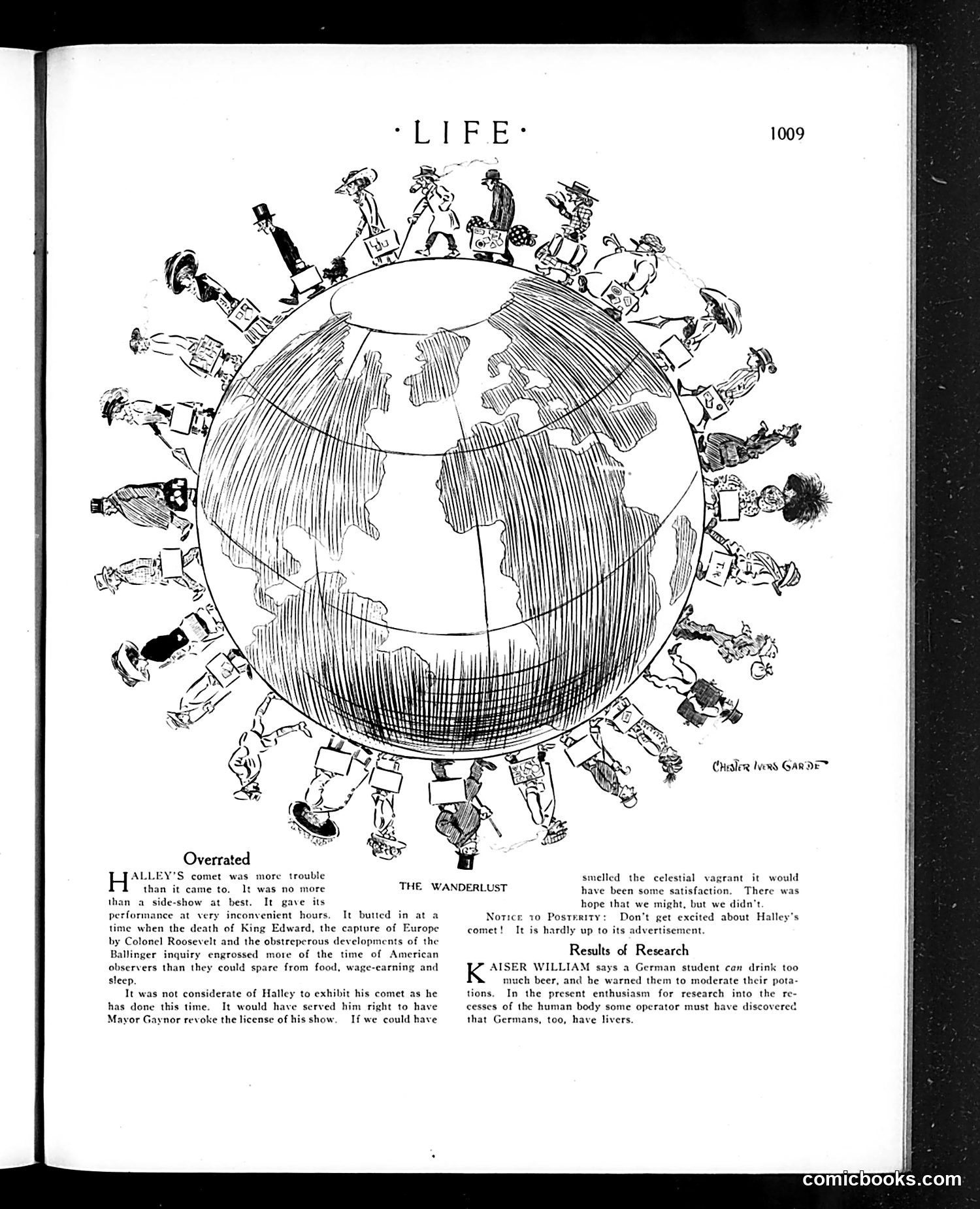
This page contains two satirical pieces from early 20th-century America: **"Overrated" (Main Cartoon):** A globe surrounded by figures represents how Halley's Comet (which appeared in 1910) failed to impress Americans. The text mocks the comet's inconvenient timing, overshadowed by major events: King Edward VII's death, Theodore Roosevelt's political activities, and the Ballinger scandal. The satire suggests the comet was overhyped—Life's editors humorously propose Mayor Gaynor should revoke its "license" for disappointing the public. **"Results of Research" (Bottom):** A joke about German beer-drinking and livers. It implies German researchers have "discovered" that Germans possess livers—a backhanded comment on both German scientific research and stereotypes about German alcohol consumption. Both pieces reflect American attitudes circa 1910: skepticism toward overstated phenomena and ethnic stereotyping presented as humor.
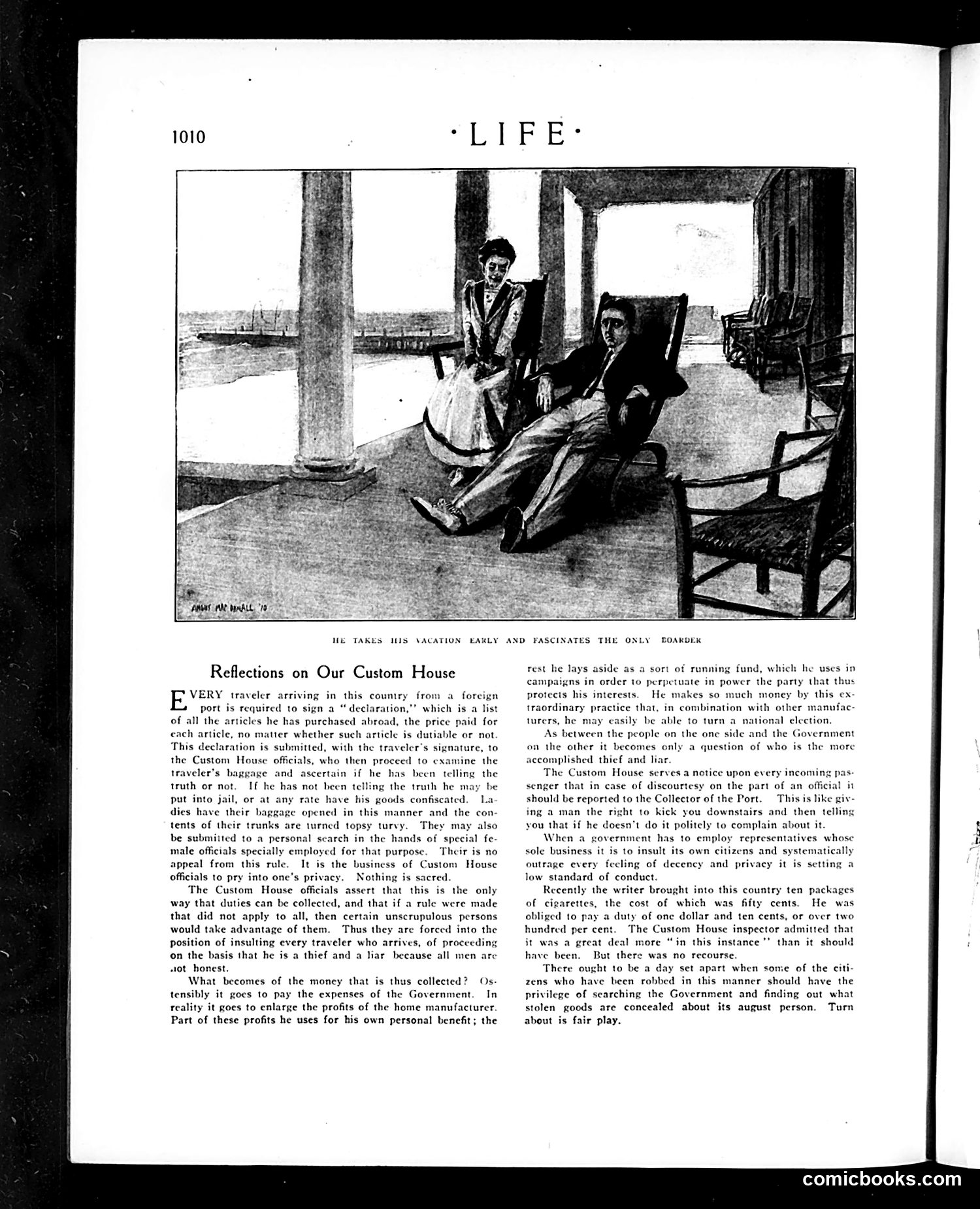
This is satirical editorial commentary, not a cartoon. The illustration shows a man relaxing while a woman stands—captioned "He takes his vacation early and fascinates the only boarder," suggesting customs officials avoid their duties. The text argues that U.S. Customs House practices are tyrannical and corrupt. Travelers must declare purchases and submit to searches under threat of jail or confiscation. The author contends: 1. **Intrusion**: Officials treat all travelers as thieves and liars, violating privacy 2. **Economic corruption**: Tariff money enriches manufacturers who use profits to influence elections 3. **Double standard**: Citizens can report rude officials to the Collector, but have no real recourse—like complaining after being kicked downstairs 4. **Hypocrisy**: The author paid $1.10 duty on fifty-cent cigarettes (over 200%), which the inspector admitted was excessive but unchangeable The satire's climax: citizens should have the right to search government officials for "stolen goods" in return—"turn about is fair play." The piece attacks protectionist tariffs and government overreach as systematic robbery of the public.
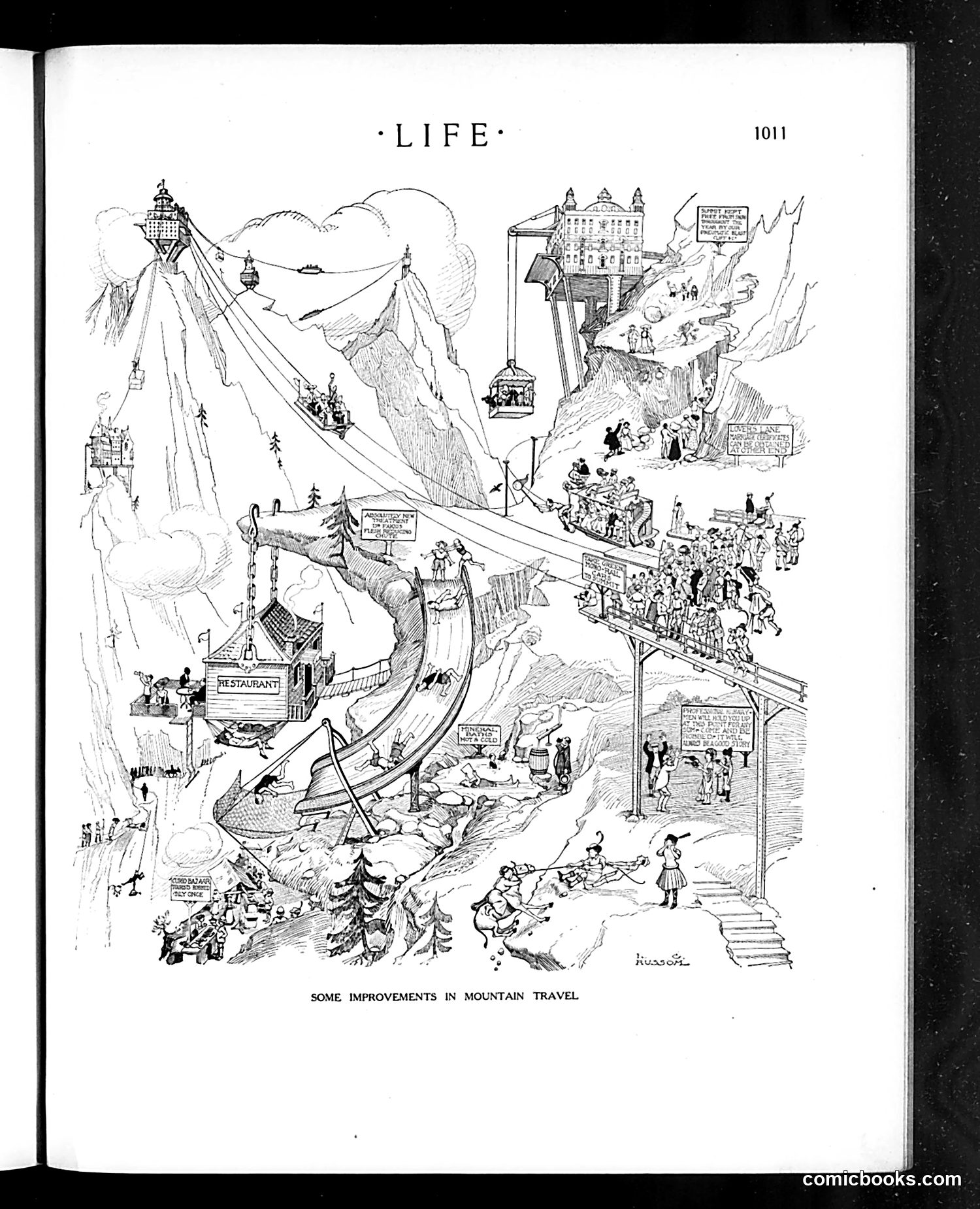
This is a satirical cartoon depicting fantastical solutions to the challenges of mountain tourism and transportation. The drawing shows an elaborate, whimsical landscape with multiple modern conveniences absurdly integrated into alpine terrain: cable cars, elevators, slides, and what appears to be a restaurant and hotel built into the mountainside. The satire critiques the increasing commercialization and "improvement" of natural mountain landscapes in the early 20th century. Rather than experiencing mountains as wilderness, tourists are being offered mechanized conveniences and hospitality services that transform the alpine environment into an amusement park. The crowded scenes of visitors using these contraptions suggest both the humor of human determination to avoid physical exertion and commentary on how modern development was reshaping natural spaces for leisure and profit.
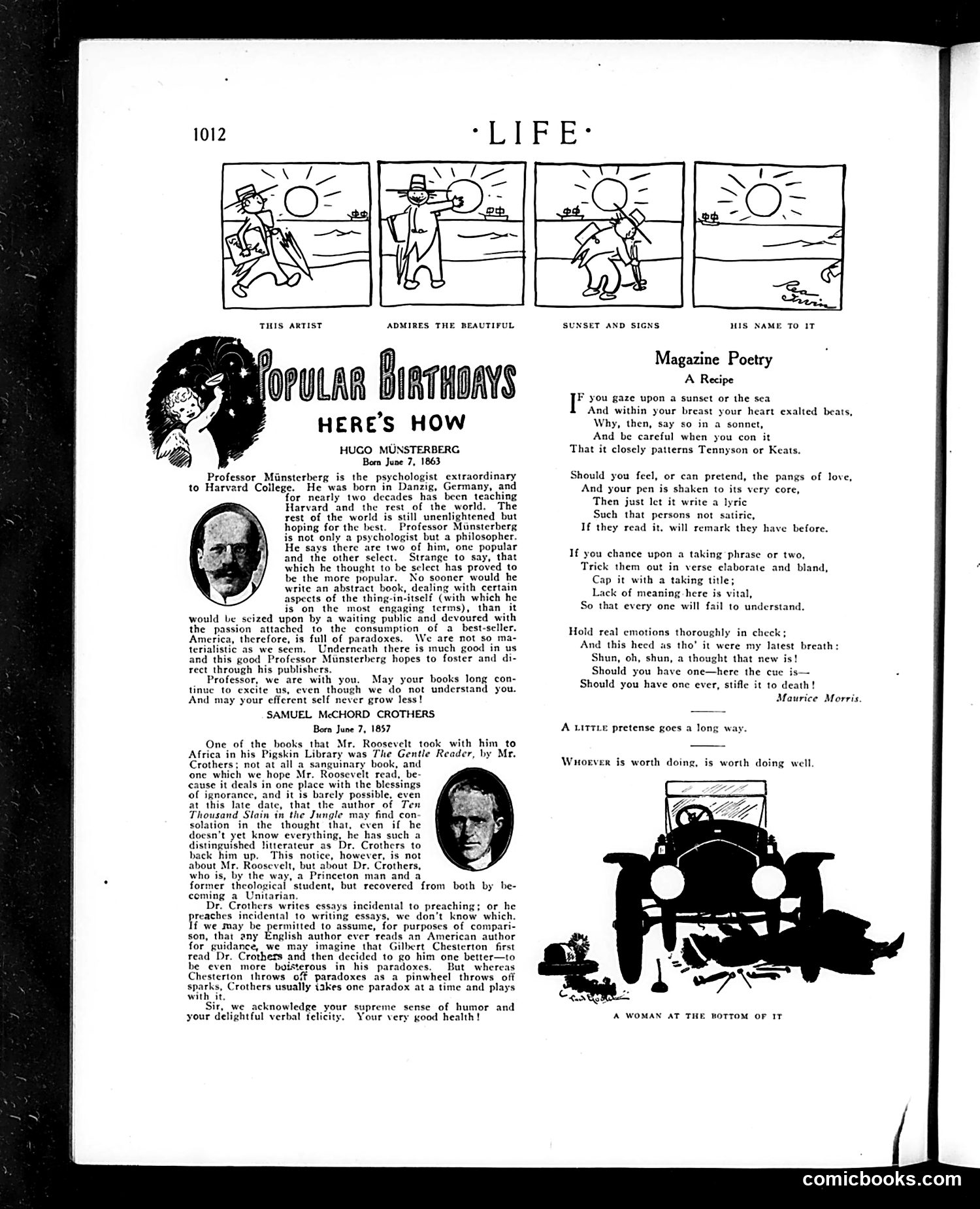
This Life magazine page (page 1012) contains three distinct content sections: **Top Comic Strip**: A four-panel wordless cartoon depicting a man's progression from admiring a sunset, to striking various poses, to ultimately signing his name to it—satirizing pretentious artistic self-aggrandizement. **Biographical Features**: Profiles of two intellectuals born June 7 (in different years)—Harvard psychologist Hugo Münsterberg and essayist Samuel McCord Crothers. The text gently mocks their popularity despite being obscure: Münsterberg writes abstract philosophy that somehow becomes bestsellers; Crothers writes paradoxes influenced by (or influencing) G.K. Chesterton. The humor lies in praising their success while admitting not understanding them. **"Magazine Poetry: A Recipe"**: A satirical poem by Maurice Morris ridiculing sentimental magazine verse. It advises aspiring poets to imitate Tennyson/Keats, feign emotion, use elaborate but meaningless language, and—crucially—suppress any original thought. The final stanza's punch line warns: kill any genuinely new idea before it emerges. Together, these pieces mock early-20th-century American intellectual pretension and derivative artistic expression.
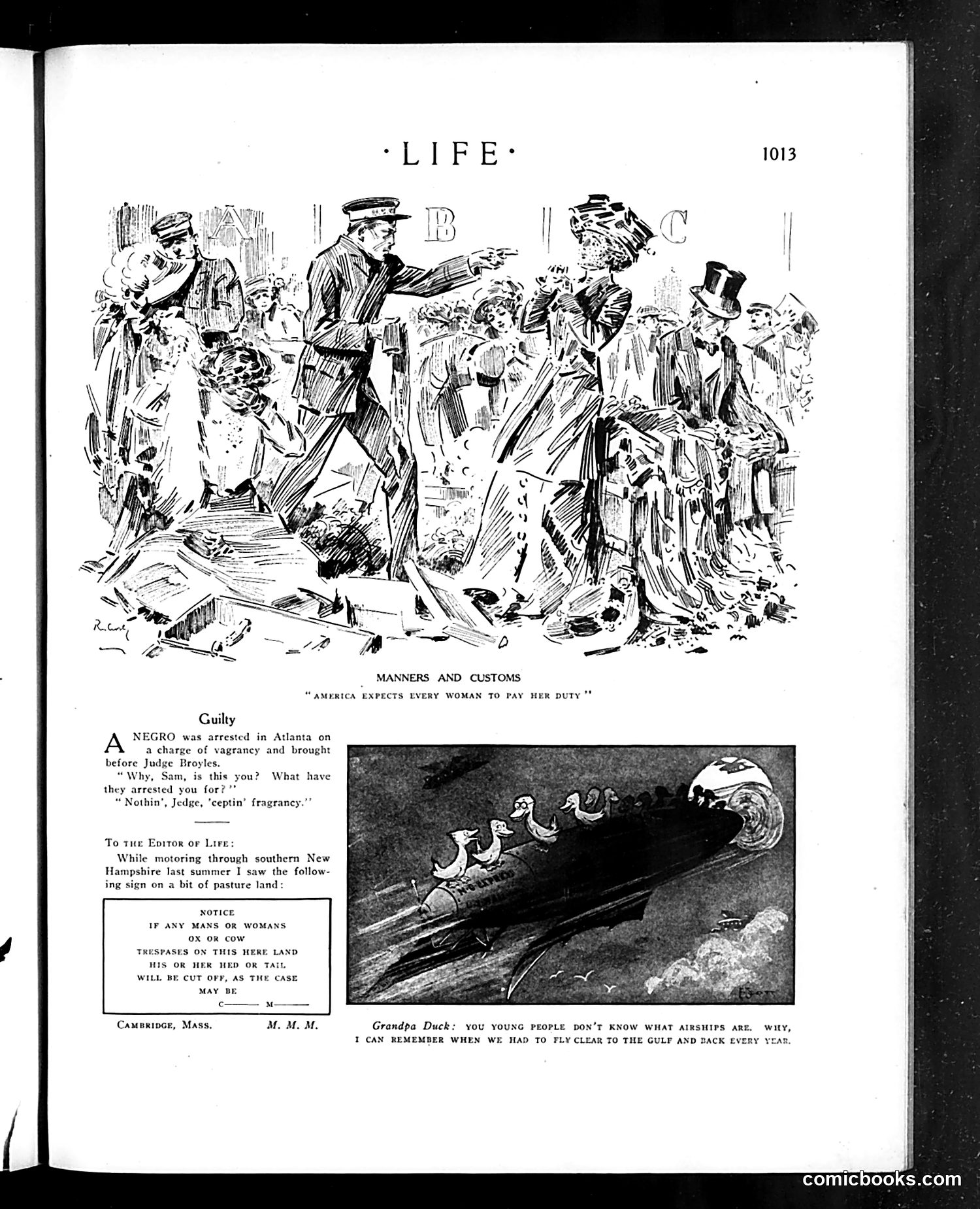
This page contains three separate satirical pieces: **Top Cartoon**: Titled "Manners and Customs," it depicts a chaotic street scene with well-dressed figures engaged in confrontation, likely satirizing social etiquette or class conflicts of the era. The caption "America expects every woman to pay her duty" appears to mock Victorian social expectations placed on women. **"Guilty" Anecdote**: A brief joke about a Black man arrested in Atlanta on a "vagrancy" charge, who claims he's guilty only of "fragrancy" (fragrance/smell). This reflects the racist legal system of the Jim Crow South, where vagrancy laws were weaponized against Black citizens. The joke's humor relies on the character's dialect and apparent innocence. **Rural Sign & Airship Anecdote**: Two reader submissions—one describing absurd rural property signage, another an old man's nostalgic rambling about early aviation. Both mock rural dialect and behavior, and generational differences. The page collectively satirizes American social hierarchies, regional attitudes, and changing times.
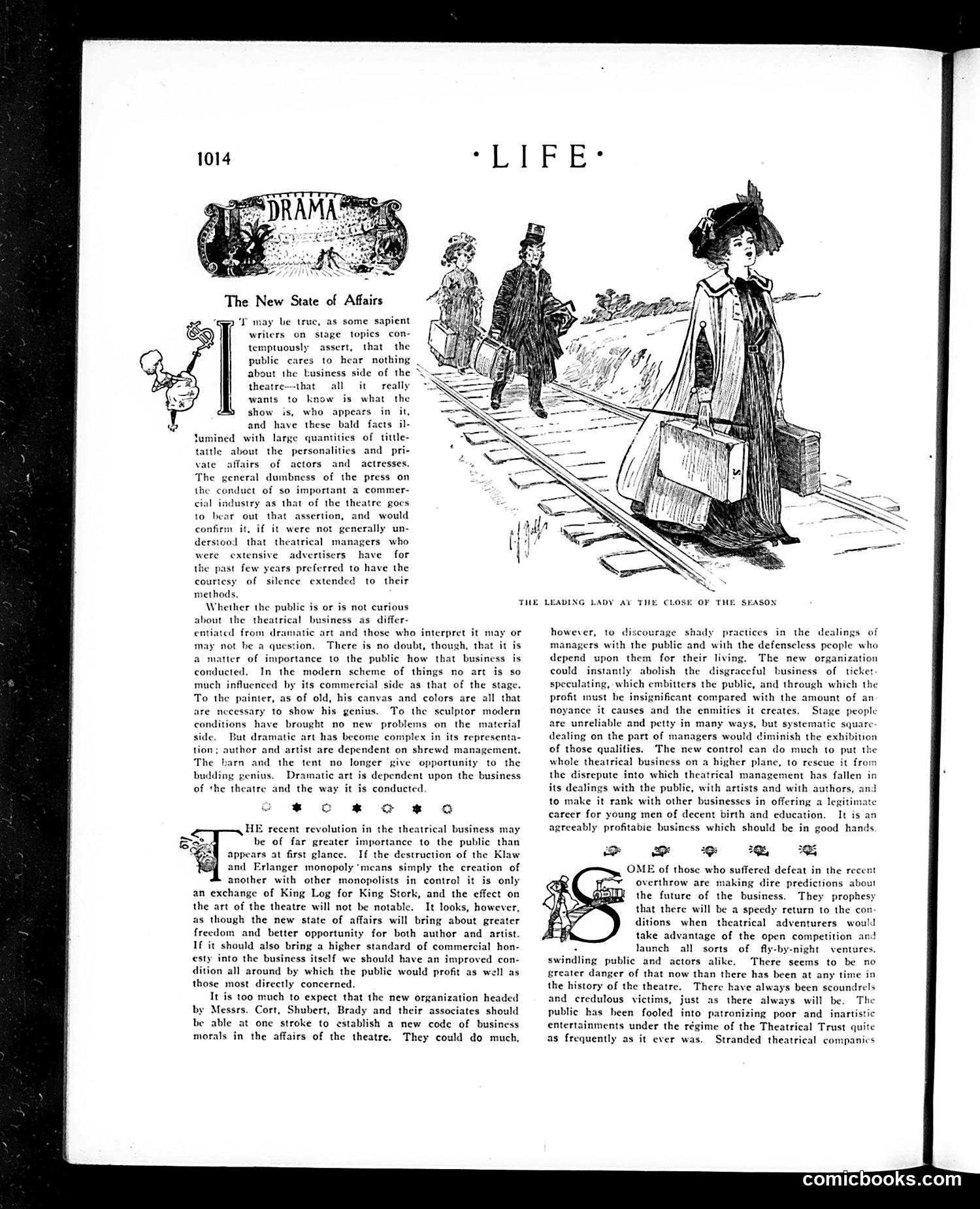
This editorial discusses the recent breakup of the Klaw and Erlanger theatrical monopoly by competitors including Messrs. Cort, Shubert, and Brady. The accompanying illustration shows a fashionably dressed "leading lady" exhausted at season's end, likely symbolizing the theater industry itself worn down by corrupt practices. The article argues that while the public cares mainly about shows and actors' gossip, the *business* of theater matters critically. It criticizes theatrical managers' historical preference for advertising-based silence over accountability, and warns against simply replacing one monopoly with another ("King Log for King Stork"). The piece hopes the new organization will reform notorious abuses: ticket speculation, unreliable casting practices, and exploitation of defenseless performers and authors. The satire's point: theater's artistic reputation depends on honest commercial practices, not just star power.
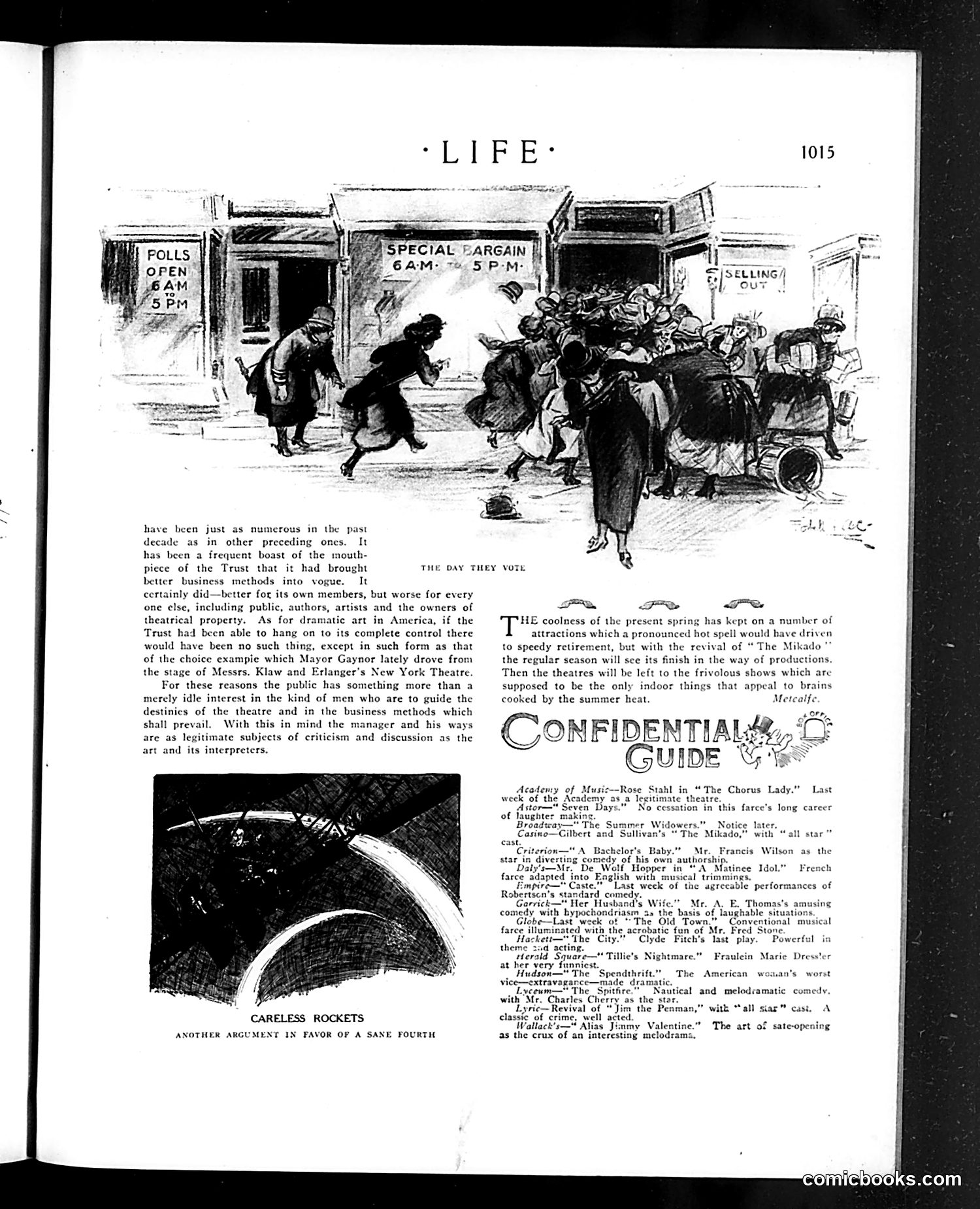
This cartoon satirizes the theatrical monopoly controlled by the "Trust" (the Theatrical Syndicate led by Klaw and Erlanger). The image shows a crowd of theatrical workers—stage hands, performers, and theater employees—swarming toward a polling place marked "Special Bargain" and "Selling Out," depicting them as desperate bargain-hunters. The accompanying text criticizes the Trust's control over American theater, arguing their "better business methods" benefited only themselves while harming public, artists, and theater owners. The cartoon's central joke: when theater workers finally get to "vote" (presumably on labor conditions or theater policy), they'll find only predatory deals—the Trust treating their political voice as just another cheap commodity to exploit. The satirical "Confidential Guide" below lists current theatrical productions, providing context for why theater workers needed representation against monopolistic control.
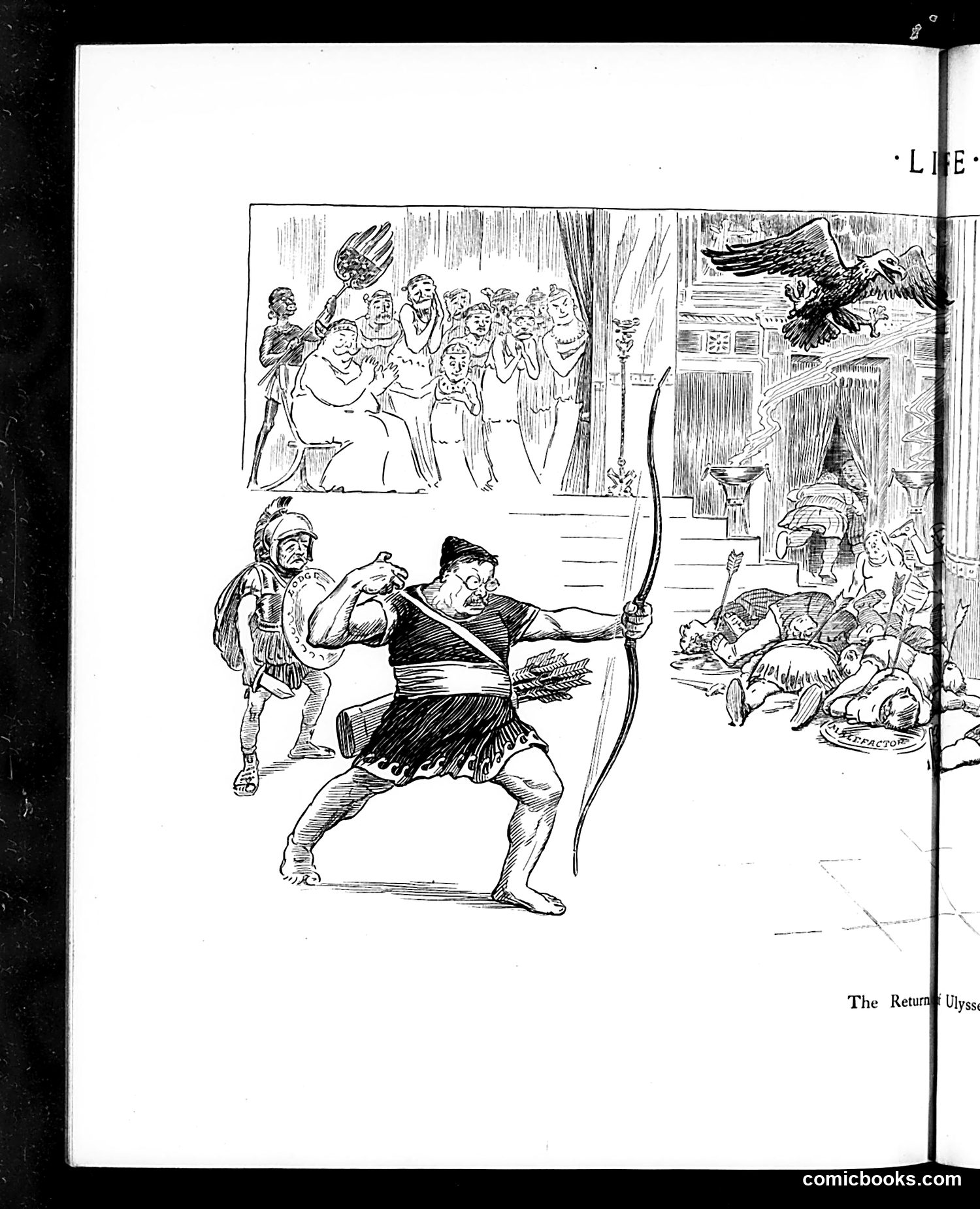
This illustration depicts a scene from Homer's *Odyssey*, showing Ulysses drawing his bow while suitors and attendants observe from the background. The classical subject matter—Ulysses's famous test of strength upon returning home—serves as the central image. The engraving style and composition suggest this is a serious literary illustration rather than political satire. The caption "The Return of Ulysses" indicates the page illustrates classical mythology rather than contemporary events. Without additional context or text from surrounding pages, the specific satirical intent remains unclear. The page may be part of a larger article discussing classical literature, or it could use the mythological narrative as an allegory for contemporary political or social events—a common practice in *Life* magazine—but the evidence here is insufficient to determine which.
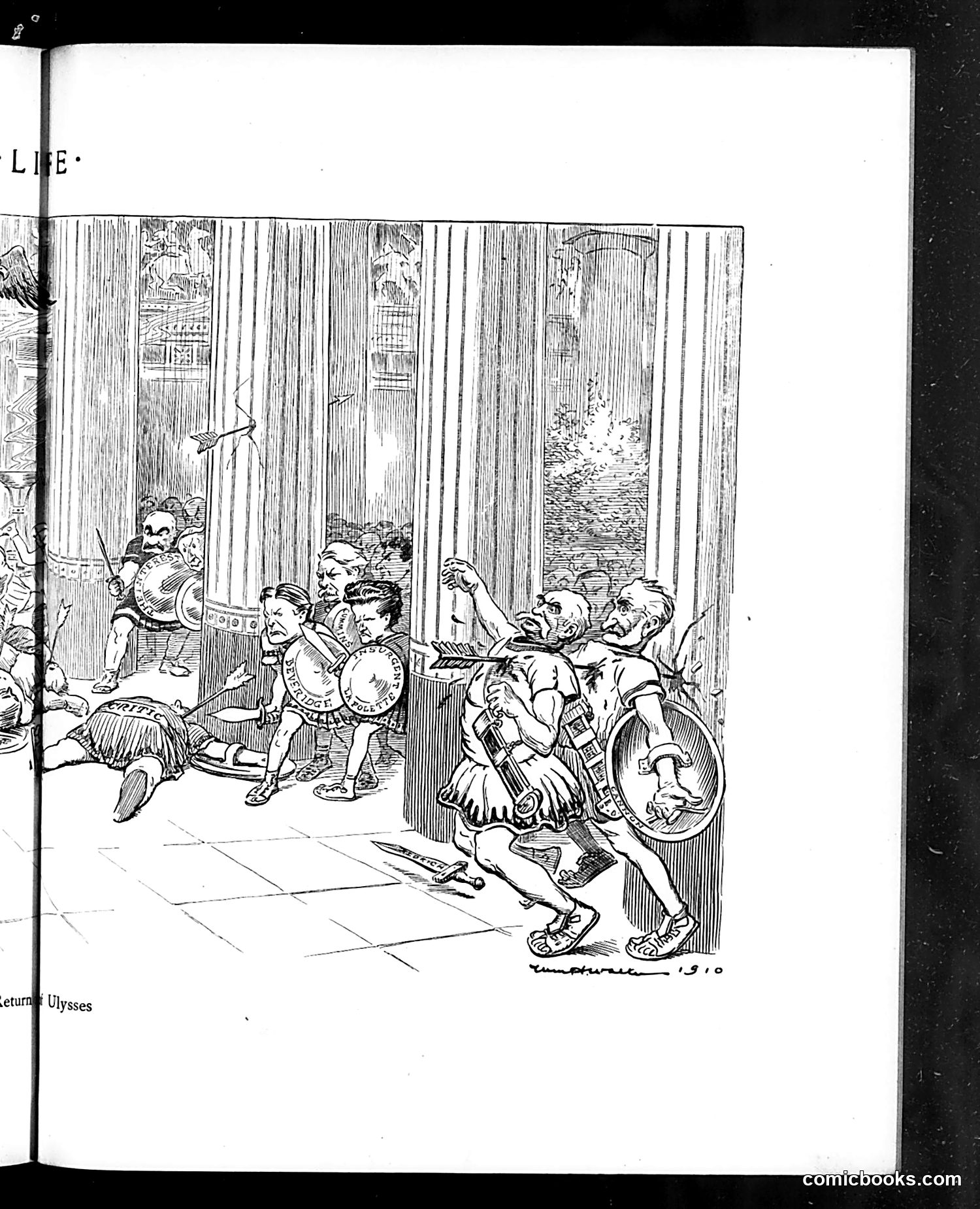
This illustration from *Life* magazine shows what appears to be a classical or mythological scene set in a columned hall. The figures are drawn in an exaggerated, caricatured style typical of early 20th-century satirical art. Multiple figures appear to be engaged in some kind of performance or spectacle, with some holding what look like shields or circular objects. The page is titled "LIFE" at top left, and text at bottom references "Return of Ulysses," suggesting this depicts a scene from Homer's *Odyssey*. The style and composition suggest this is satirical commentary, though without clearer OCR text or additional context, the specific political or social targets of the satire remain unclear. The exaggerated physiques and poses suggest mockery of particular contemporary figures or behaviors.
This page from *Life* magazine presents literary criticism and book reviews, not political satire. The main content discusses Stephen French Whitman's novel *Predestined*, praising it as evidence that the author possesses both natural talent ("born") and developed craft ("made")—a rarity among contemporary American novelists. The critic argues that American fiction often treats writing as requiring no technical preparation, unlike other arts. Whitman distinguishes himself by combining personal vision with disciplined study of French prose masters while maintaining his individuality. The "Confidential Book Guide" lists contemporary novels with brief descriptions. The page represents *Life's* role as a sophisticated literary journal offering serious critical commentary alongside lighter satirical content—typical of early 20th-century American magazines that served educated, middle-class readers interested in both social commentary and cultural criticism.
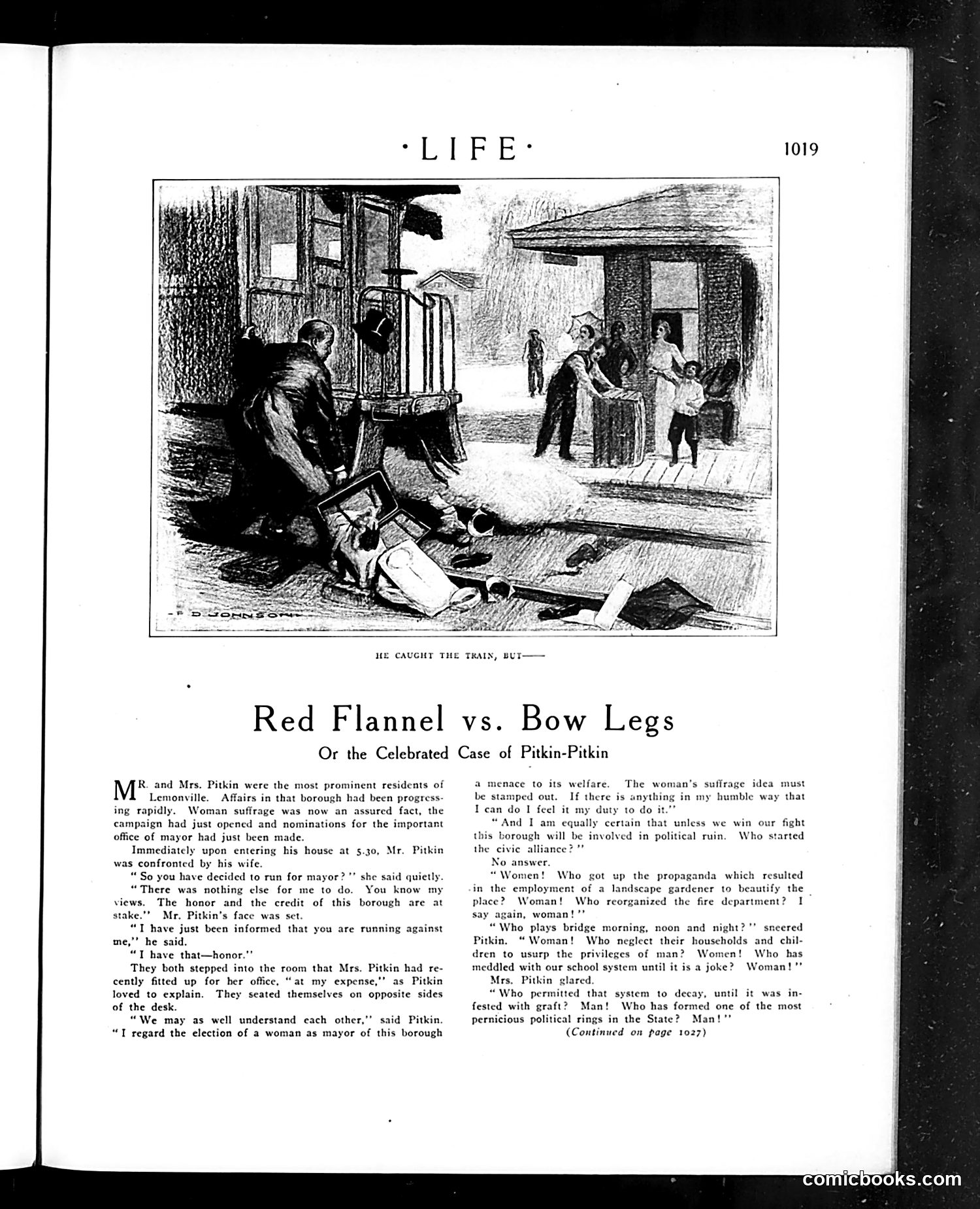
This is a satirical story about gender politics in a fictional borough called Lemonville, published after women's suffrage became "an assured fact" (likely referring to the 19th Amendment, ratified in 1920). Mr. and Mrs. Pitkin are running against each other for mayor. He opposes a woman as mayor as a "menace to welfare"; she counters by listing women's civic accomplishments (beautification, fire department reorganization) while he accuses women of neglecting homes and meddling with schools. He responds by blaming men for systemic decay, graft, and political corruption. The cartoon above depicts a street scene with figures and scattered objects, captioned "HE CAUGHT THE TRAIN, BUT——" (the implication being his escape from domestic/political conflict). The satire mocks anti-suffrage arguments by having both spouses expose each other's contradictions, suggesting that both genders had legitimate grievances about governance and that women's political participation was inevitable and defensible.
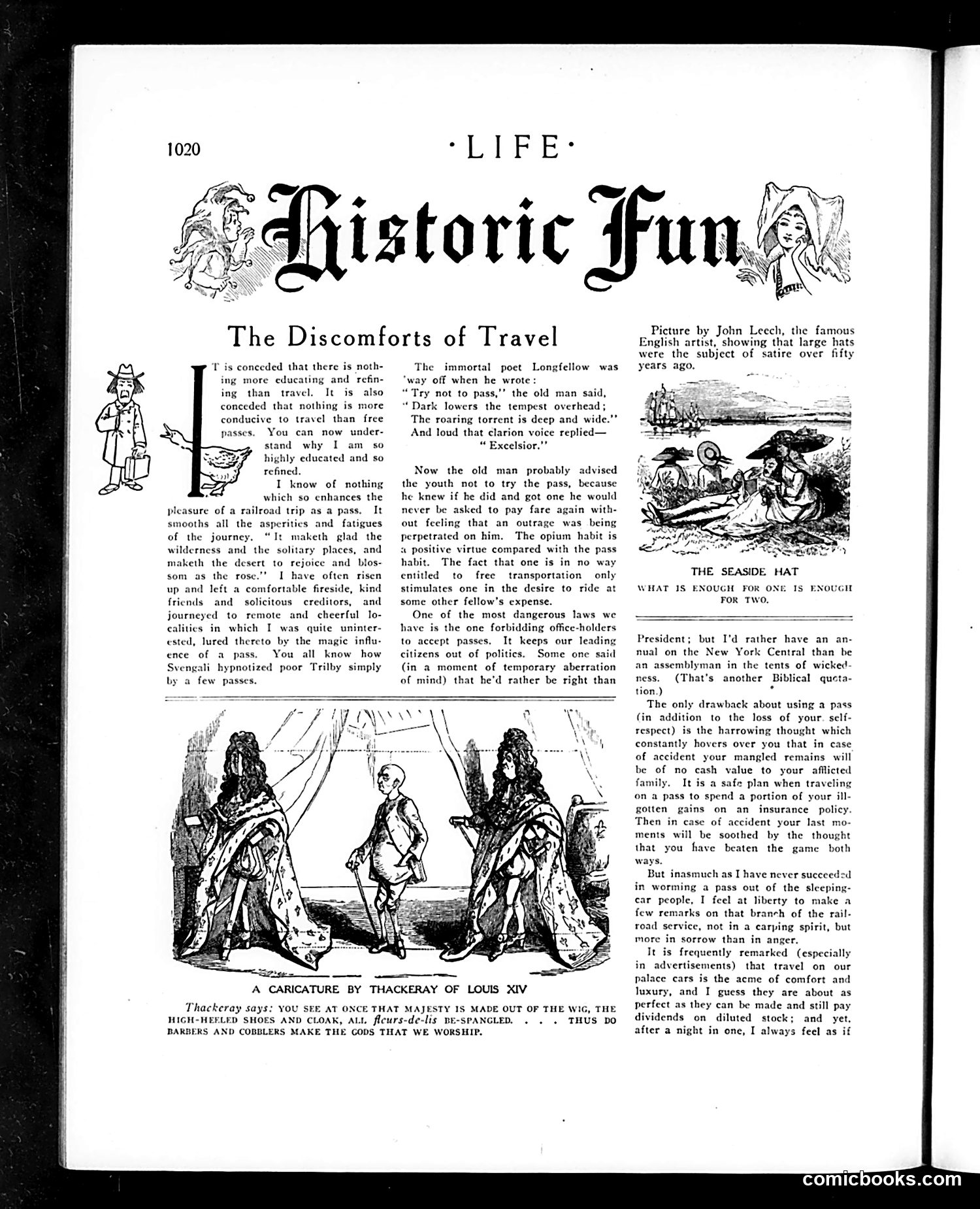
This satirical piece mocks the American practice of railroad passes—free travel vouchers given to politicians and influential citizens. The author argues that while passes are highly desirable (he humorously credits them with his own "education and refinement"), they create moral hazard: recipients feel entitled to free rides and lose self-respect. The satire targets two things: first, the corrupting nature of perks that make citizens feel they deserve something without earning it (comparing pass addiction to opium); second, laws forbidding officeholders from accepting passes, which the author suggests keeps honest politicians OUT of office—implying that corrupt politicians willing to accept bribes are actually preferable. The Thackeray and Leech illustrations are historical examples of satirical art about excessive fashion and appearance, providing visual precedent for Life's own satirical approach.
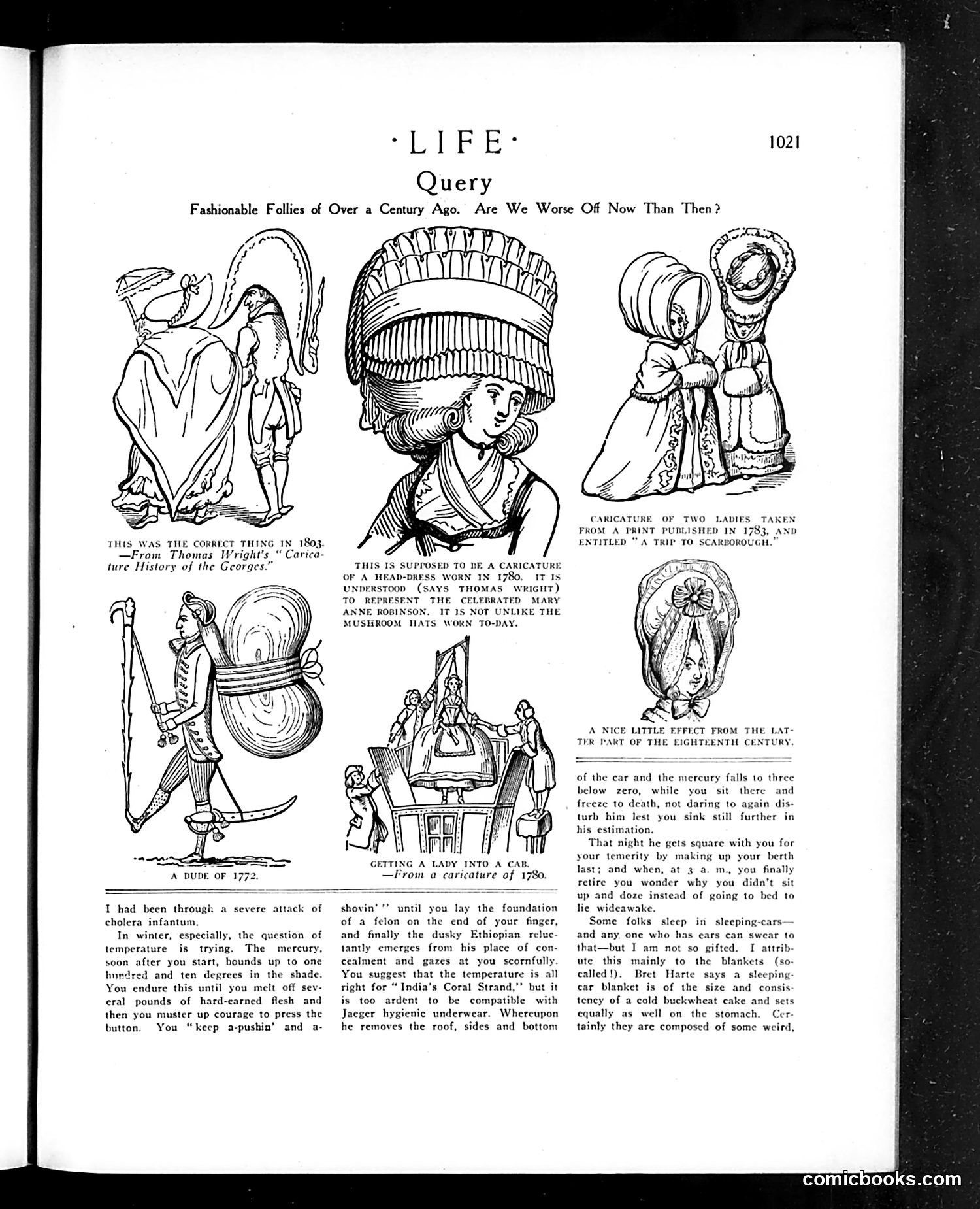
This *Life* magazine page compares fashionable absurdities across centuries to ask: "Are We Worse Off Now Than Then?" **The Historical Caricatures** show 1770s-1780s fashion follies: impossibly tall head-dresses (one allegedly depicting actress Mary Anne Robinson), women squeezed into carriages, and exaggerated wigs. The text notes these styles were genuinely mocked in their time. **The Modern Parallel** is the accompanying essay about train travel discomfort—a contemporary (early 1900s) complaint about overheated railway cars, uncooperative porters, and inadequate blankets. The satirical point: humans have always endured fashion and comfort absurdities. Yesterday's ridiculous hairstyles equal today's uncomfortable transportation and poor sleeping conditions. **The Satire's Message**: Rather than progress, each era simply exchanges one set of inconveniences for another. We mock our ancestors' vanity, yet tolerate our own petty miseries with equal stubbornness.
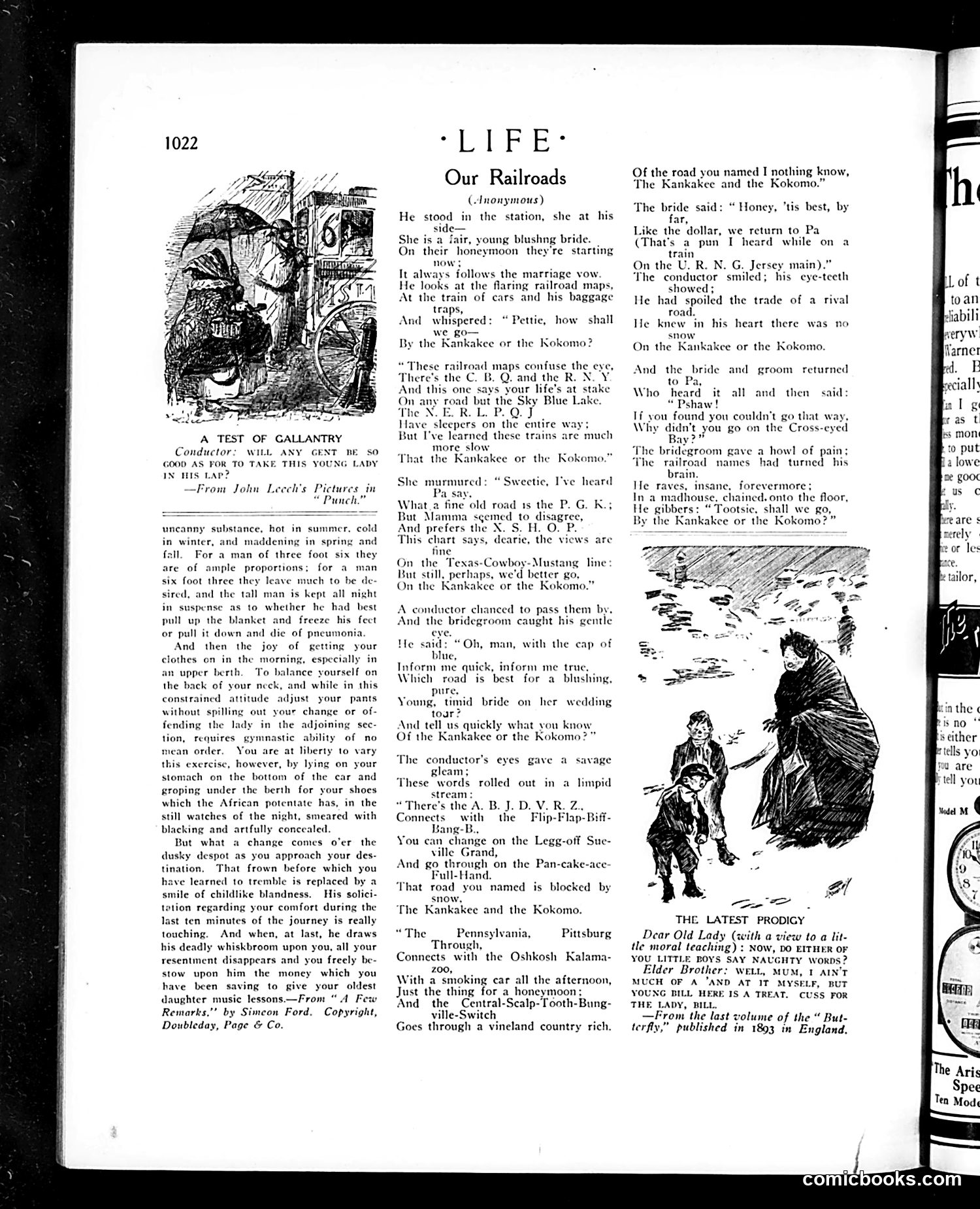
This anonymous poem mocks the bewildering complexity of America's railroad system in the late 19th century. A newly married couple seeks travel advice, but the conductor's response—listing nonsensical, tongue-twisting railroad names (the "Flip-Flap-Biff-Bang-B," "Pan-cake-ace-Full-Hand," etc.)—satirizes how American railroads had become incomprehensibly fragmented. The joke: after the conductor's elaborate, circular answer, the bride simply decides to return to her father's house instead. The satire targets the railroad industry's failure to provide clear, coherent service due to excessive competition and confusing interconnections between countless small lines. The absurd names emphasize how inaccessible and frustrating the system had become for ordinary passengers.
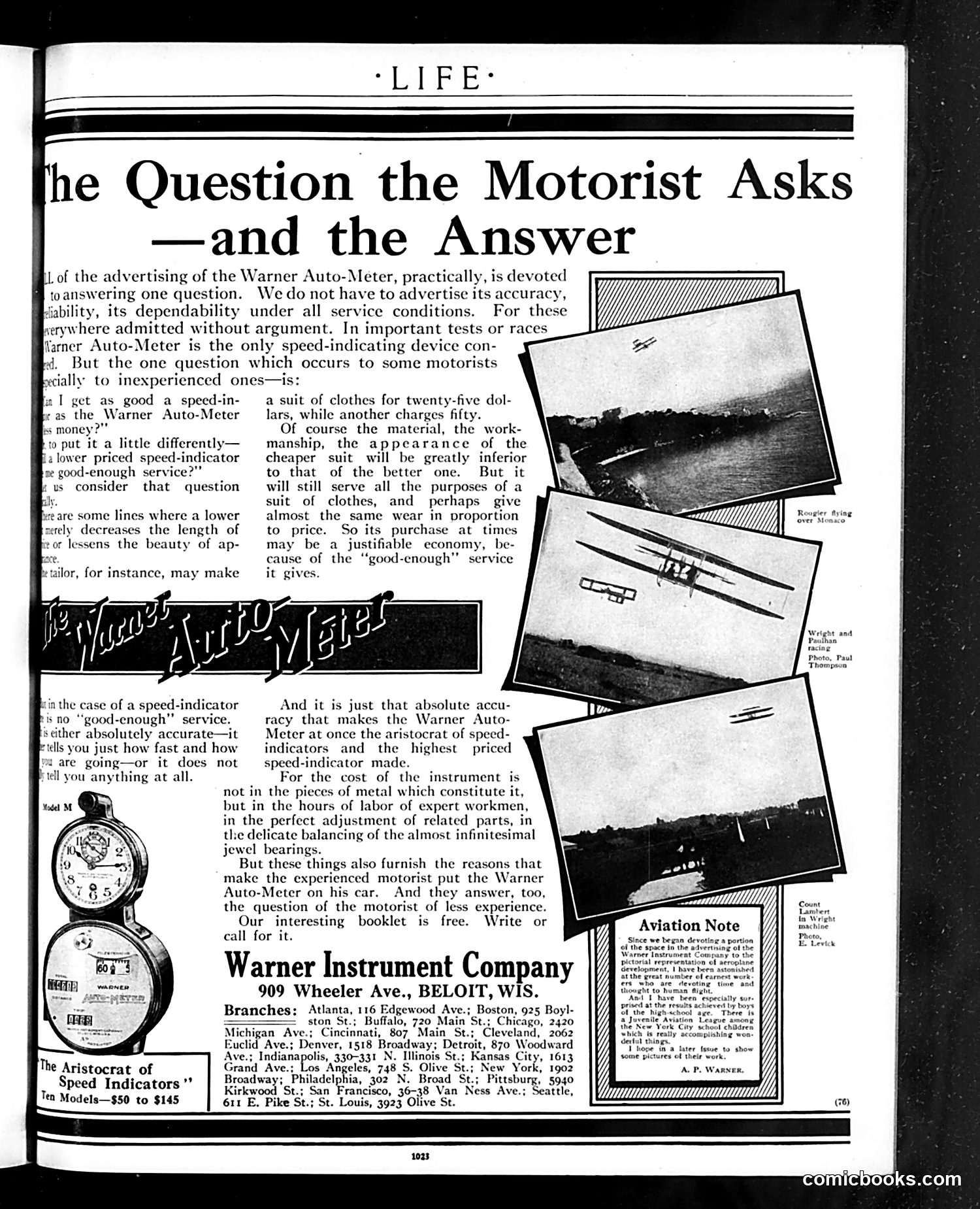
This is primarily a **product advertisement**, not satire or political commentary. It addresses a genuine consumer question of the era: why pay more for a speedometer when cheaper versions exist? The ad uses an analogy—comparing speed indicators to suits of clothing at different price points—to argue that while cheaper options may seem adequate ("good-enough"), the Warner Auto-Meter's superior accuracy justifies its higher cost. The text emphasizes that the price reflects expert labor and precision engineering (jewel bearings, delicate adjustments), not just metal components. The accompanying photographs show the device in use during what appears to be aviation or racing contexts, establishing credibility through real-world application. This reflects early automotive consumer culture, when speedometers were still relatively new technology and motorists genuinely debated whether precision instruments warranted premium pricing. The "Life" magazine placement suggests this targeted affluent readers who could afford quality goods.
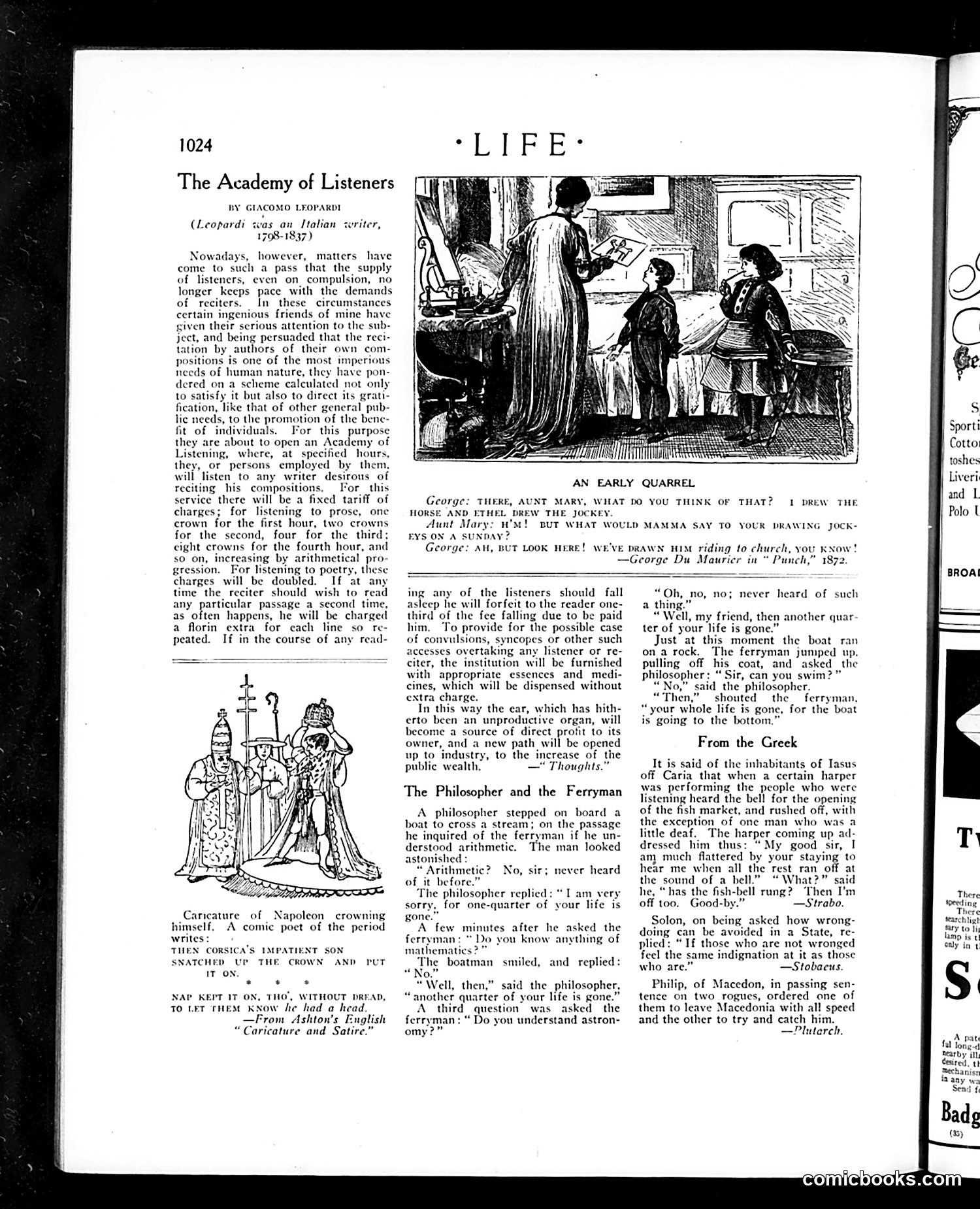
This page contains three satirical pieces mocking pretension and impracticality: **"The Academy of Listeners"** (main article): Leopardi's 18th-century satire proposes a business scheme where writers pay audiences to listen to their compositions—a joke about the shortage of willing listeners for tedious readings. Fees escalate arithmetically, with charges for repeated passages and compensation to readers if listeners fall asleep. It satirizes both authors' desperation for audiences and the commodification of art. **"An Early Quarrel"** (illustration, top right): A Du Maurier cartoon showing children arguing about drawing a jockey on Sunday, with one claiming the horse was drawn separately and they're "riding to church." It humorously captures Victorian anxieties about Sabbath observance—drawing secular subjects on Sunday was considered sinful. **"The Philosopher and the Ferryman"** (bottom): A fable where an arrogant philosopher lectures an uneducated ferryman about wasting his life lacking arithmetic, mathematics, and astronomy. When the boat hits a rock, the ferryman asks if he can swim—revealing that practical survival skills matter more than abstract knowledge. It deflates intellectual pretension.
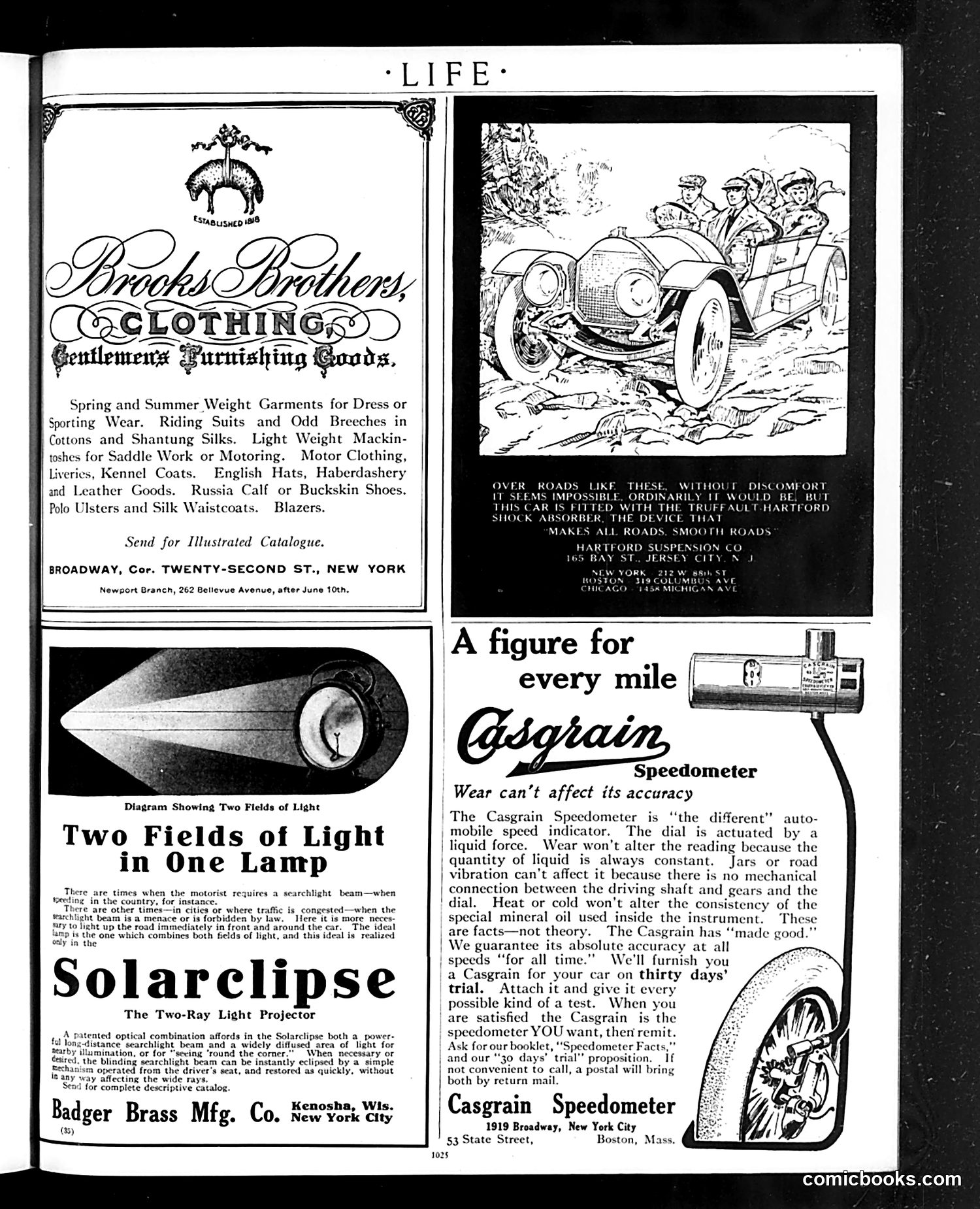
This page is primarily **automobile advertising**, not satire or political commentary. It contains four separate ads from the early 1900s automotive era: 1. **Brooks Brothers** clothing ad—selling motorist-specific wear ("Motor Clothing," "Polo Ulsters") 2. **Truffault-Hartford shock absorber**—featuring an illustration of an early car navigating rough roads, advertising suspension technology as a comfort innovation 3. **Solareclipse lamp**—promoting dual-beam headlights that could switch between searchlight and diffused modes for different driving conditions 4. **Casgrain Speedometer**—marketing a liquid-filled speedometer claiming accuracy unaffected by vibration or wear The implicit theme: early automobiles faced real comfort and technical challenges (rough roads, inadequate lighting, mechanical unreliability). These ads target wealthy motorists by positioning products as solutions to driving's practical problems. The ads reflect a period when motoring was still novel, expensive, and mechanically challenging.
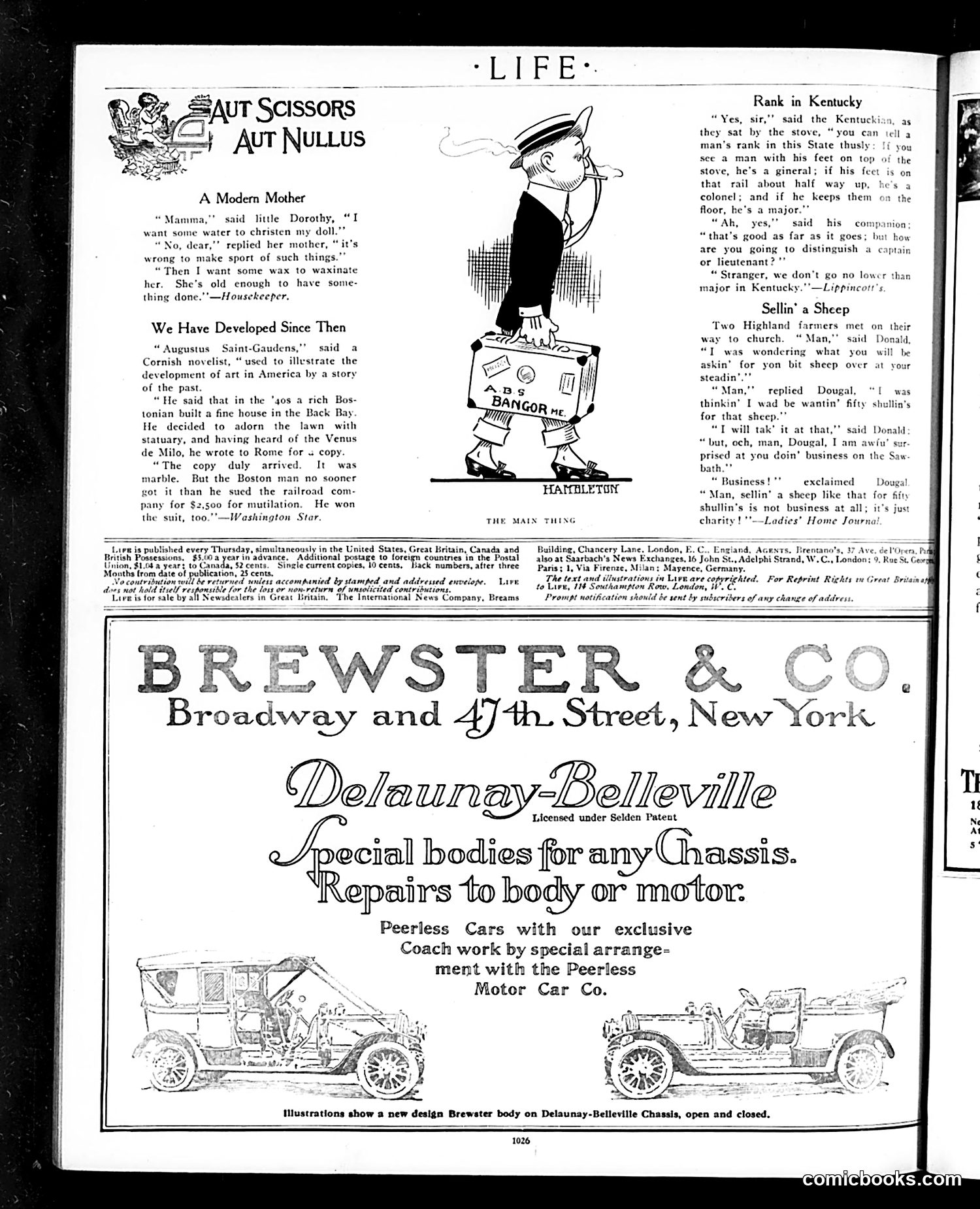
This page contains three separate satirical pieces: **"Rank in Kentucky"** mocks Southern class hierarchy through a Kentuckian's humorous explanation: a man's social status is determined by where his feet rest on a stove—generals have feet on top, colonels on a rail halfway up, majors on the floor. The joke satirizes both the absurdity of rigid class distinctions and stereotypes about Kentucky culture. **"We Have Developed Since Then"** recounts a Gilded Age anecdote about a wealthy Bostonian who ordered a Venus de Milo copy from Rome, then sued the railroad for $2,500 when it arrived damaged. The satire critiques American wealthy industrialists' pretension to European high culture and their litigious nature. **"Sellin' a Sheep"** presents a Scottish dialect joke where one farmer considers selling sheep at fifty shillings not "business" but "charity"—implying the price is generously low. It's gentle humor about rural values and haggling. The page is primarily advertising (Brewster & Co. automobiles) below these brief comic pieces.
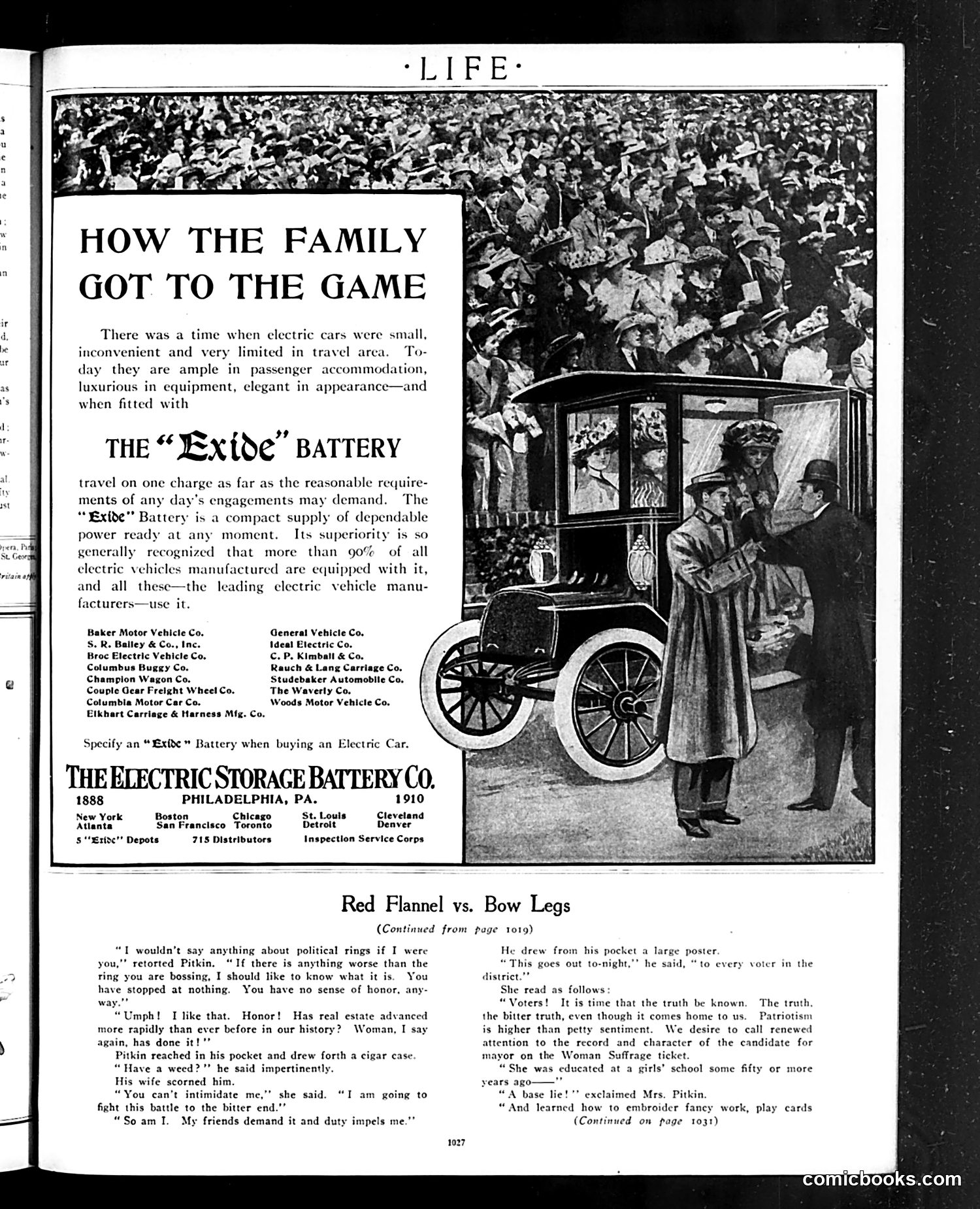
**Advertisement Section:** The upper half is a full-page ad for "Exide" batteries used in electric vehicles. The illustration shows a well-dressed family arriving at what appears to be a baseball game in an electric car, with crowds visible in the stadium background. The ad emphasizes that electric cars—once limited and inconvenient—now offer luxury, range, and reliable power via Exide batteries. It lists major manufacturers (Baker, Studebaker, etc.) using this technology, reflecting the era when electric vehicles competed seriously with gasoline cars before the Model T's dominance. **Story Section:** Below is a continuation of "Red Flannel vs. Bow Legs," a serialized story about marital conflict. A husband and wife (the Pitkins) are feuding over politics and a mayoral campaign. The husband, apparently a political operative, prepares a smear poster attacking his wife's candidate—a woman suffragist—by mocking her education and domestic skills. The satire targets both machine politics and emerging women's suffrage movement tensions.
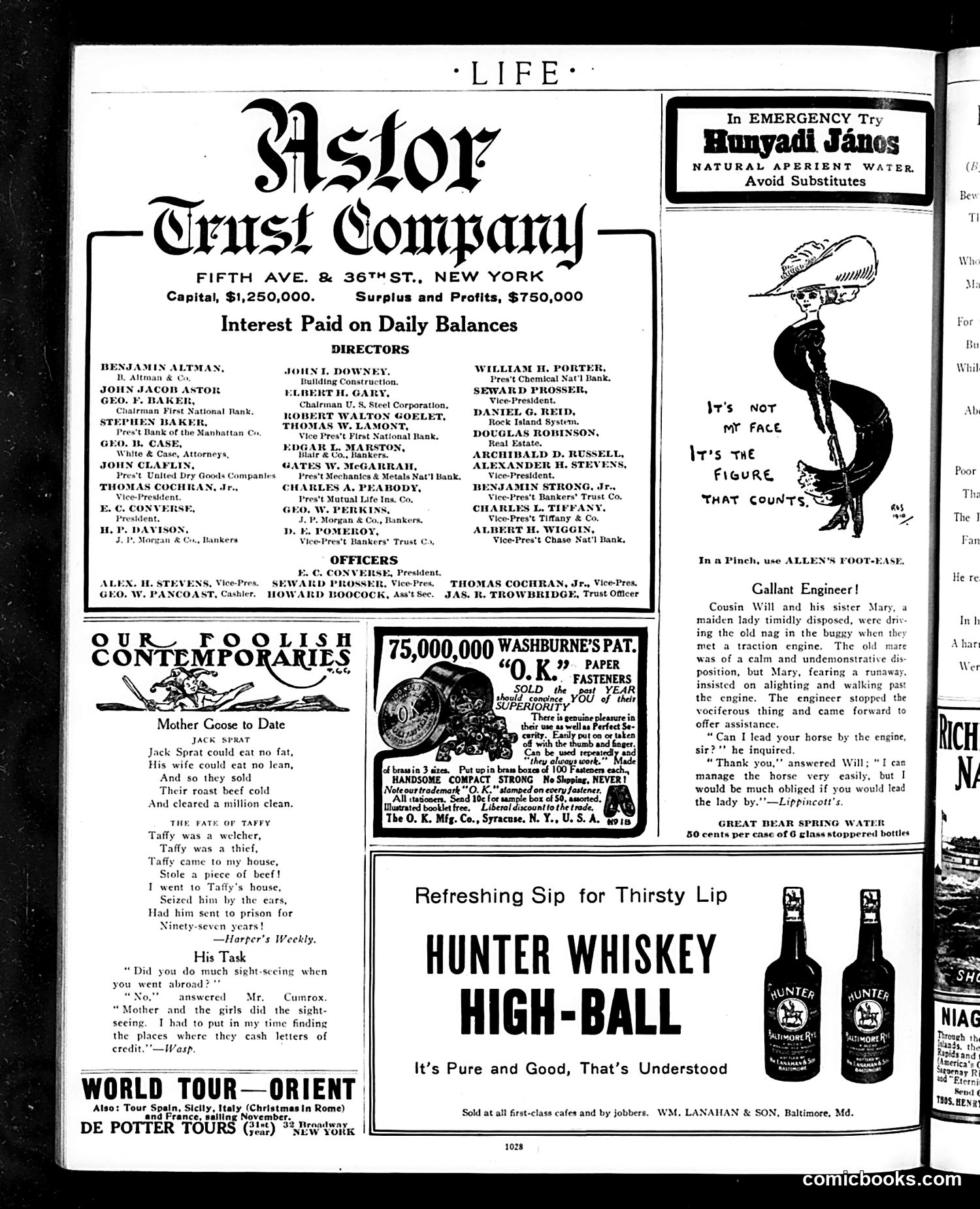
This is primarily an **advertising and light humor page** from Life magazine, not a political cartoon. The page features: **Main Content:** - Bank advertisement (Astor Trust Company) listing wealthy directors - Updated "Mother Goose" nursery rhyme parodies satirizing modern greed (Jack Sprat sells roast beef for profit; Taffy is a criminal "welcher") - Short humorous anecdotes about American wealthy travelers and social types - A cartoon illustration of a fashionable woman with the caption "It's not my face / It's the figure / That counts"—mocking vanity and corseted fashion **Advertisements:** Multiple product pitches for whiskey, patent fasteners, aperient water, and tourist tours—typical period marketing. **Overall Point:** The humor targets American materialism, wealth-obsession among the upper classes, and contemporary social pretensions. The "Mother Goose" rewrites are the sharpest satire, suggesting that modern commercialism has corrupted even children's literature. This reflects turn-of-the-century anxiety about rising consumerism and the nouveaux riches.
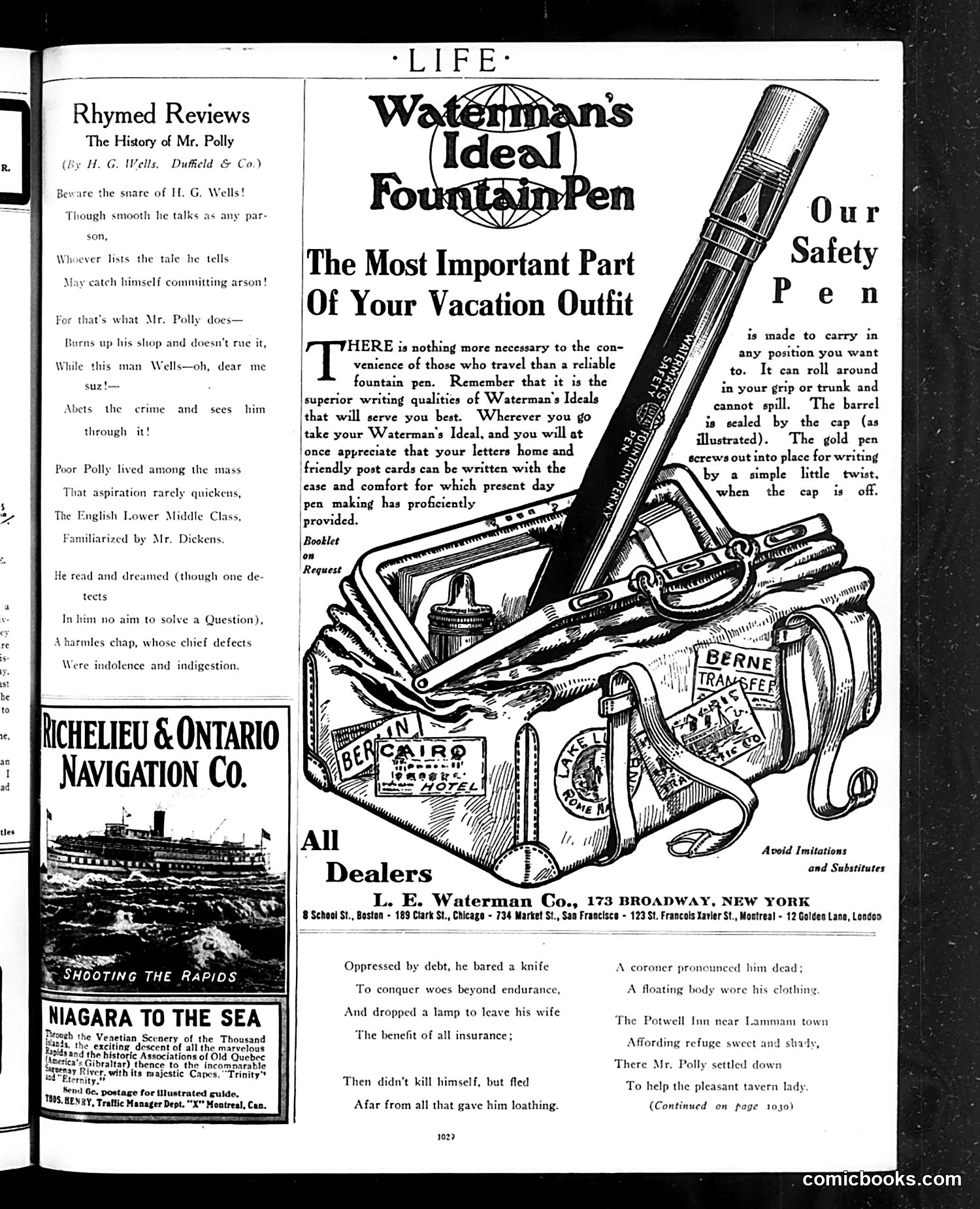
This page contains **a literary review and advertisements**, not political cartoons. The **"Rhymed Reviews"** section satirizes H.G. Wells's novel *The History of Mr. Polly* (1910). The reviewer humorously warns readers that Wells's smooth writing seduces them into sympathizing with Mr. Polly—a lower-middle-class Englishman—who commits arson by burning his shop. The satire suggests Wells manipulates readers into endorsing criminality through his narrative charm. The review summarizes Polly's plot: a mediocre man, inspired by literature and dreams, attempts suicide-by-arson to benefit his wife through insurance, but instead flees and finds happiness at a country inn with its proprietor. **The advertisements** promote the Waterman's Ideal fountain pen (emphasizing its leak-proof safety features for travelers) and the Richelieu & Ontario Navigation Company's scenic cruise route. The page reflects early 20th-century literary debate about whether fiction should inspire or enable immoral behavior.
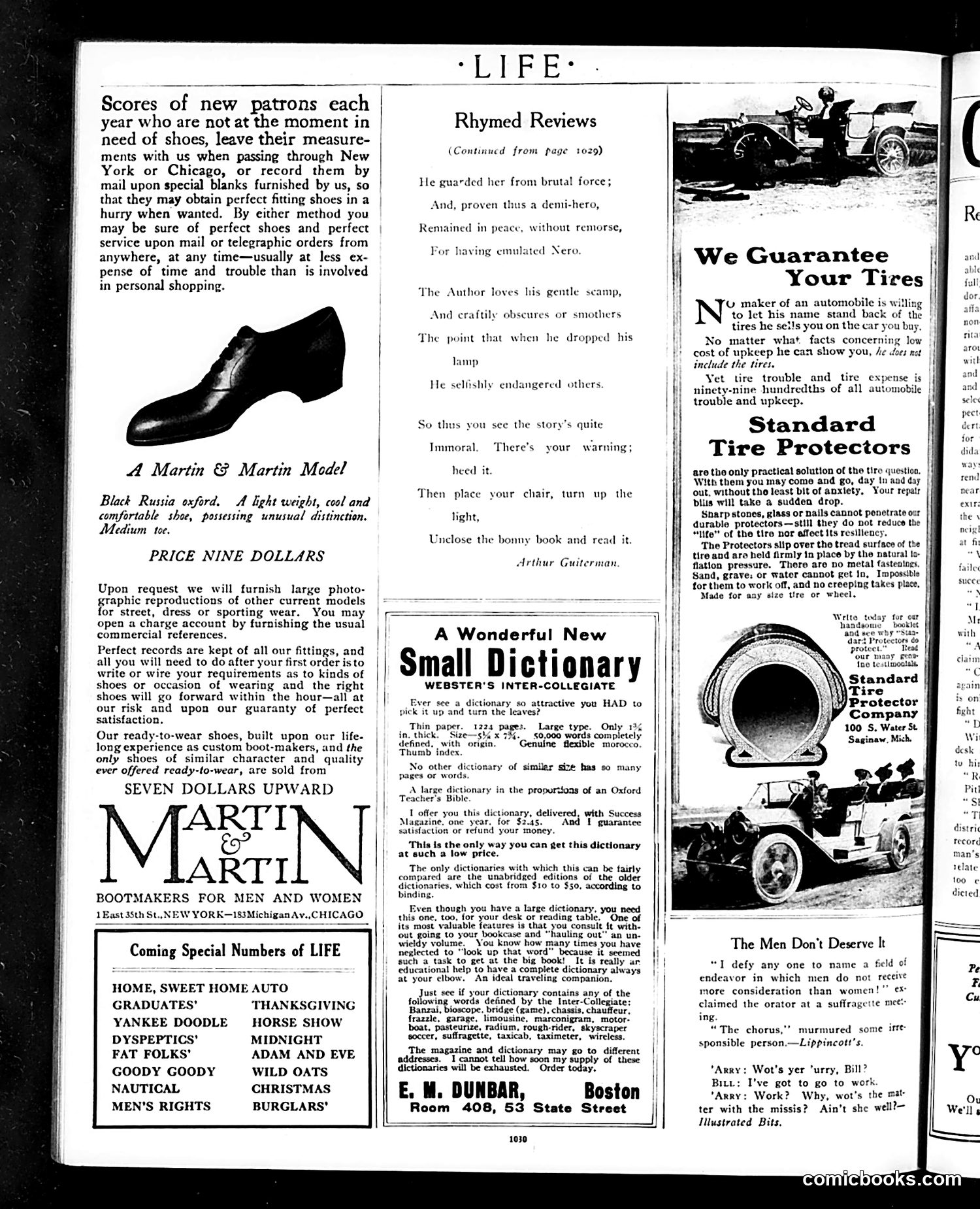
This page is primarily **advertising and literary content**, not political cartoons. The main elements are: **Advertisements:** - Martin & Martin bootmakers (left): promoting mail-order custom shoes at $9+ - Webster's Inter-Collegiate Dictionary (center): selling a compact dictionary bundled with Success Magazine for $2.43 - Standard Tire Protectors (right): promoting tire protection devices **Literary Content:** - "Rhymed Reviews" by Arthur Guiterman critiques a story (source unclear) where an author creates a "gentle scamp" character who selfishly endangered others by dropping a lamp. Guiterman satirizes the author's moral obscuring of the protagonist's recklessness—noting the immoral lesson this provides readers. **Context for modern readers:** Early 20th-century Life magazines mixed satire, humor, and advertising. This page reflects the era's mail-order commerce expansion and the literary criticism conventions of period magazines. The tire protector ad shows early automotive accessory marketing.
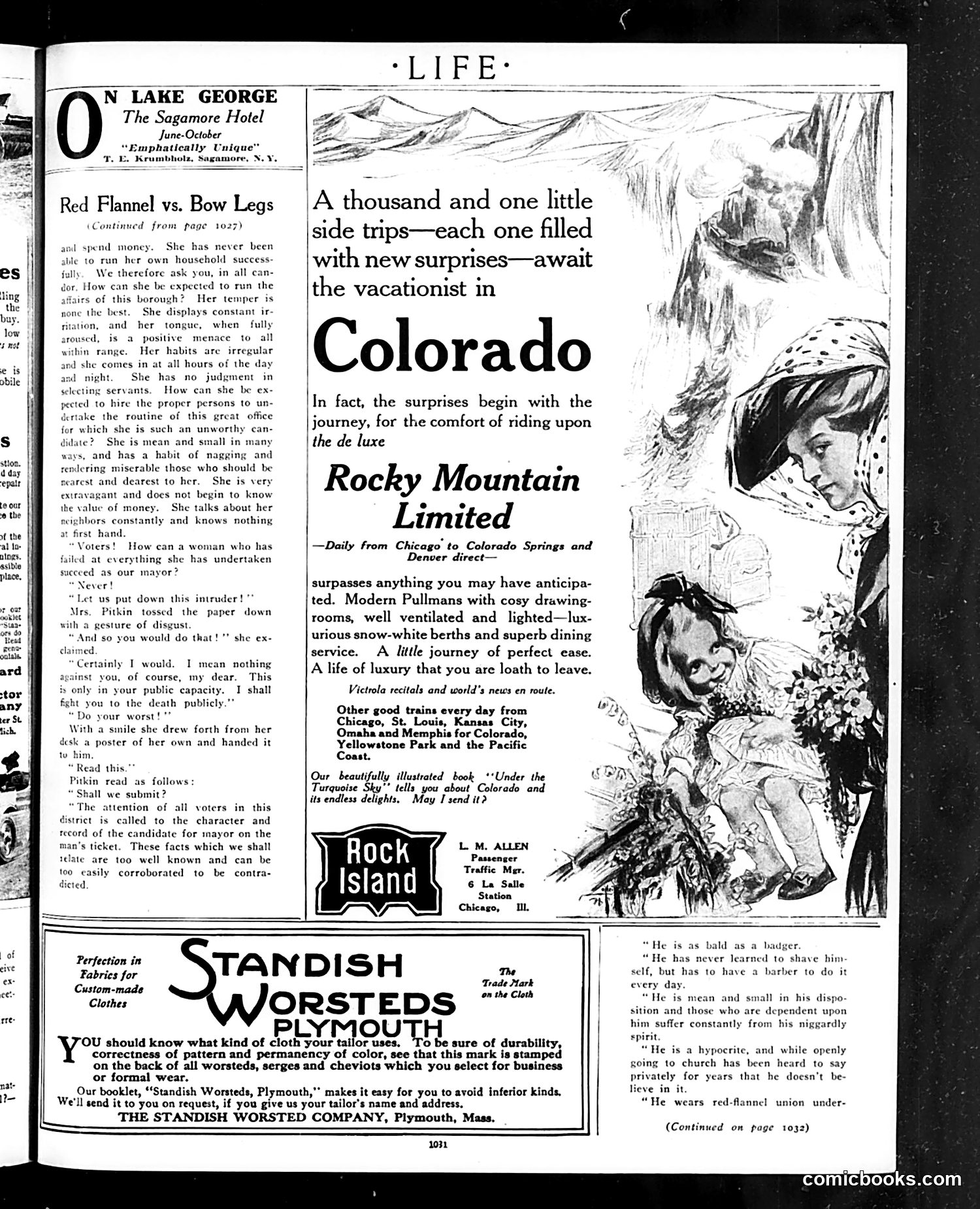
This page primarily contains **advertisements and a serialized story**, not political cartoons. The main content is "Red Flannel vs. Bow Legs," a continuing domestic satire about a political dispute between Mr. and Mrs. Pitkin. Mrs. Pitkin wants to run for mayor, but her husband opposes her candidacy, arguing women are unfit for office—citing her poor household management, temperament, and supposed lack of judgment. Mrs. Pitkin responds by posting a counter-attack on her husband's character, listing his personal flaws (baldness, laziness, hypocrisy). **The satire:** This piece ridicules anti-suffrage arguments by showing how absurd similar character attacks would be if applied to men seeking office. By mirroring gendered criticisms, it highlights the double standard in denying women political participation based on personal qualities rather than policy competence. The page also features railroad and clothing advertisements typical of 1911 *Life* magazine.
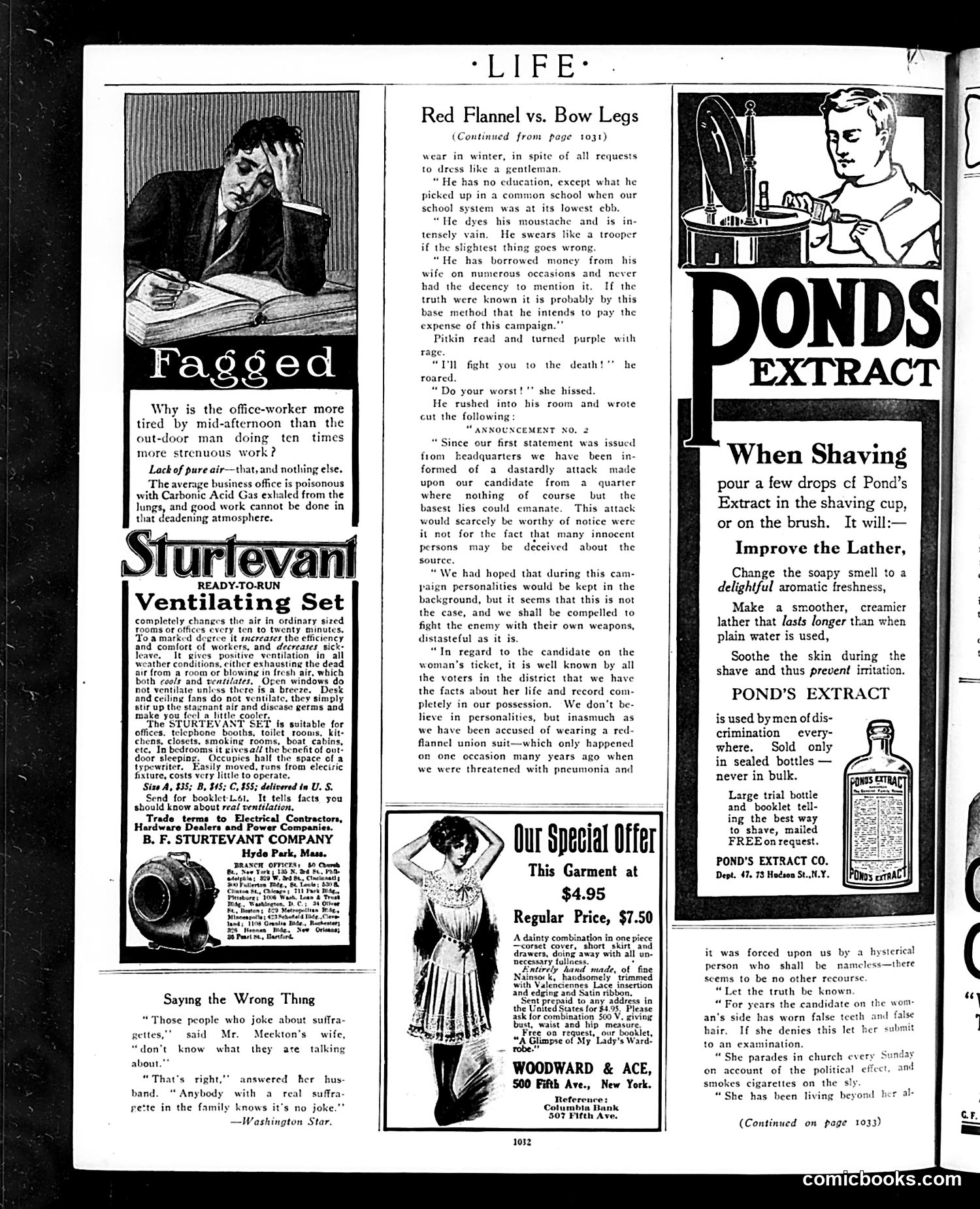
This page contains political satire and period advertisements from an early 20th-century *Life* magazine. The main content is a serialized story ("Red Flannel vs. Bow Legs") depicting a campaign scandal. A candidate's opponent publicly attacks him, claiming he wears red-flannel underwear and has borrowed money from his wife. The candidate responds furiously with his own "announcement," threatening to expose damaging information about his female opponent on the opposing ticket, including details about her appearance and personal life. The satire mocks dirty campaign tactics and personal character attacks in politics. The "red flannel" detail appears designed to humiliate through association with working-class poverty, while the candidate's threat to expose his female opponent's flaws suggests gender-based ridicule was considered fair political warfare. Supporting advertisements (Sturtevant ventilation systems, Pond's Extract shaving product, and a women's garment) are typical period commercial content. The page also includes a brief humorous anecdote about suffragettes.
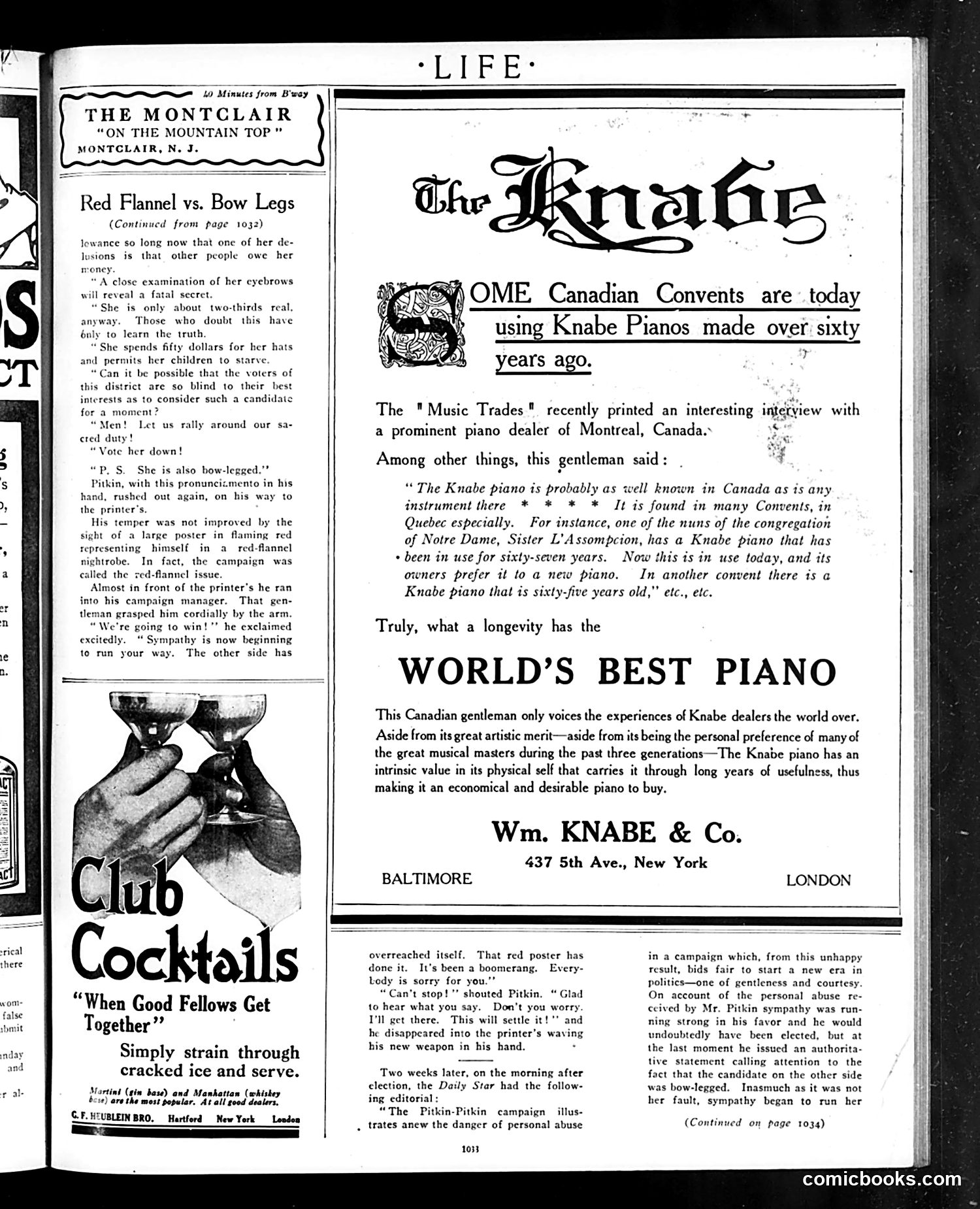
This page satirizes a political campaign centered on personal attacks rather than substantive issues. The story follows candidate Pitkin, whose opponent launches a vicious campaign featuring a red-flannel nightrobe poster mocking his appearance. The satire's point: the attack backfires. Initial sympathy for Pitkin grows as voters recognize the ugliness of personal abuse in politics. However, Pitkin himself then undermines this moral high ground by attacking his opponent's physical appearance ("bow-legged"), reversing the sympathy back to her. The concluding editorial (continued on page 1034) emphasizes the "danger of personal abuse" in campaigns—suggesting Life's critique of mud-slinging politics generally. The Knabe piano advertisement on the right appears incidental to the actual satirical content, typical of magazine layout from this era.
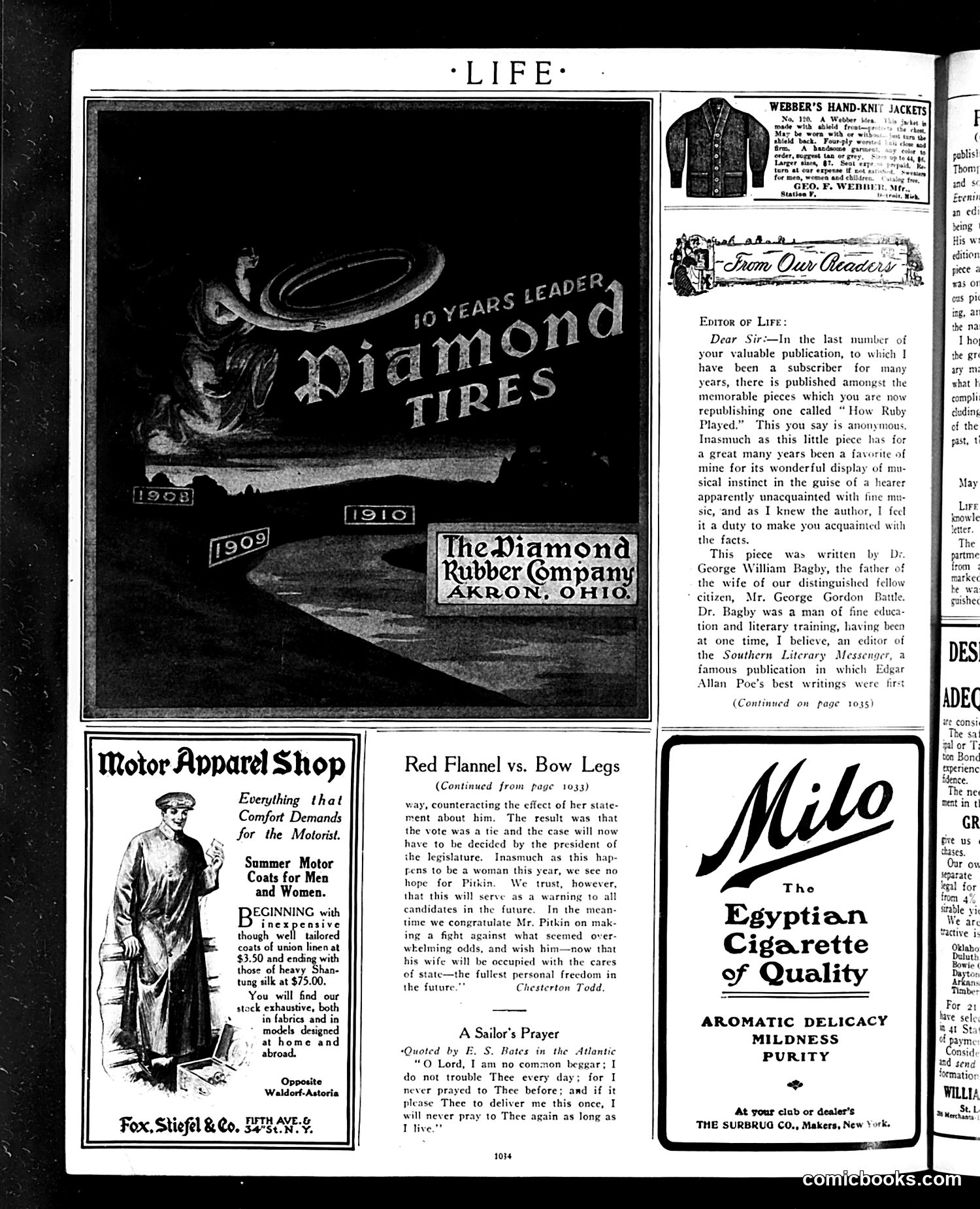
This page is primarily **advertising and reader correspondence**, not political satire. The dominant feature is a Diamond Rubber Company tire advertisement (top left) celebrating "50 years leader" status, with dates 1909-1910-1908 showing the company's longevity. Below are three smaller ads: Motor Apparel Shop (summer coats for motorists), Milo Egyptian cigarettes, and Webber's hand-knit jackets. The editorial content includes a "From Our Readers" section where a subscriber identifies the anonymous author of a previously published piece called "How Ruby Played" as Dr. George William Bagby. There's also a humorous piece titled "Red Flannel vs. Bow Legs" about a legislative dispute and "A Sailor's Prayer." **No political cartoon or satire is present on this page.** It represents typical early-1910s magazine content mixing advertisements with light humor and reader engagement.
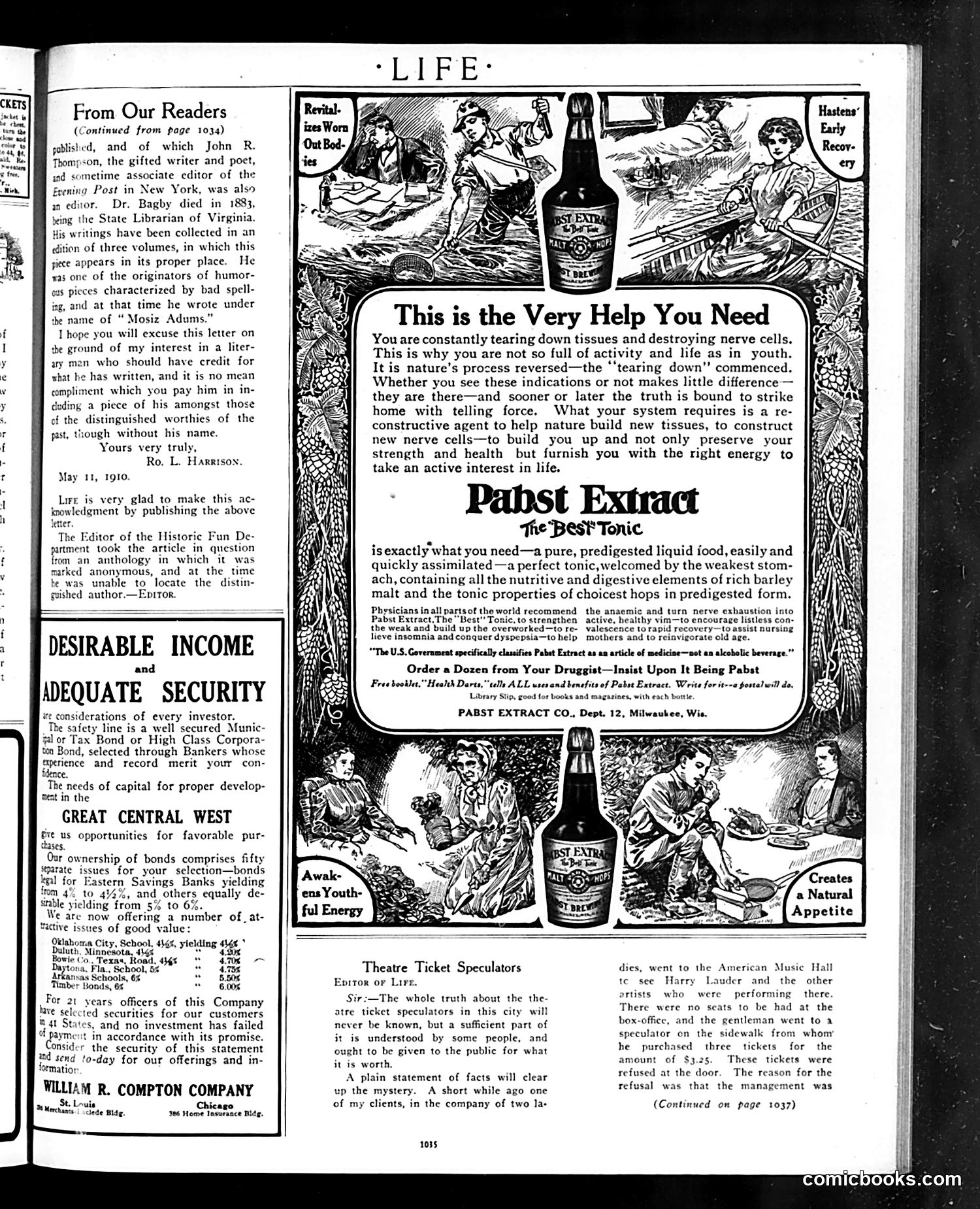
This page is primarily **advertising and reader correspondence**, not political satire. The main content includes: 1. **"From Our Readers"**: A letter crediting Dr. George W. Bagby, a 19th-century Virginia writer, for humorous pieces previously published anonymously under the pseudonym "Mosiz Adams." The editor acknowledges the oversight. 2. **Pabst Extract Advertisement** (center): A large ad for a patent medicine claiming to rebuild tissues and nerve cells. The imagery shows people in various states of exhaustion and recovery. The U.S. Government classified this product as "medicine" (not a beverage), exploiting a legal loophole—this was during Prohibition's buildup. The ad's pseudo-scientific language about "tearing down" and "building up" tissues is typical of early-1900s snake-oil marketing. 3. **Financial Advertisements**: Bond offerings from the Great Central West and William B. Compton Company, targeting conservative investors seeking "desirable income" and "adequate security." The page reflects early-20th-century advertising practices: dubious health claims, legal gray areas in product classification, and appeals to investor anxiety.
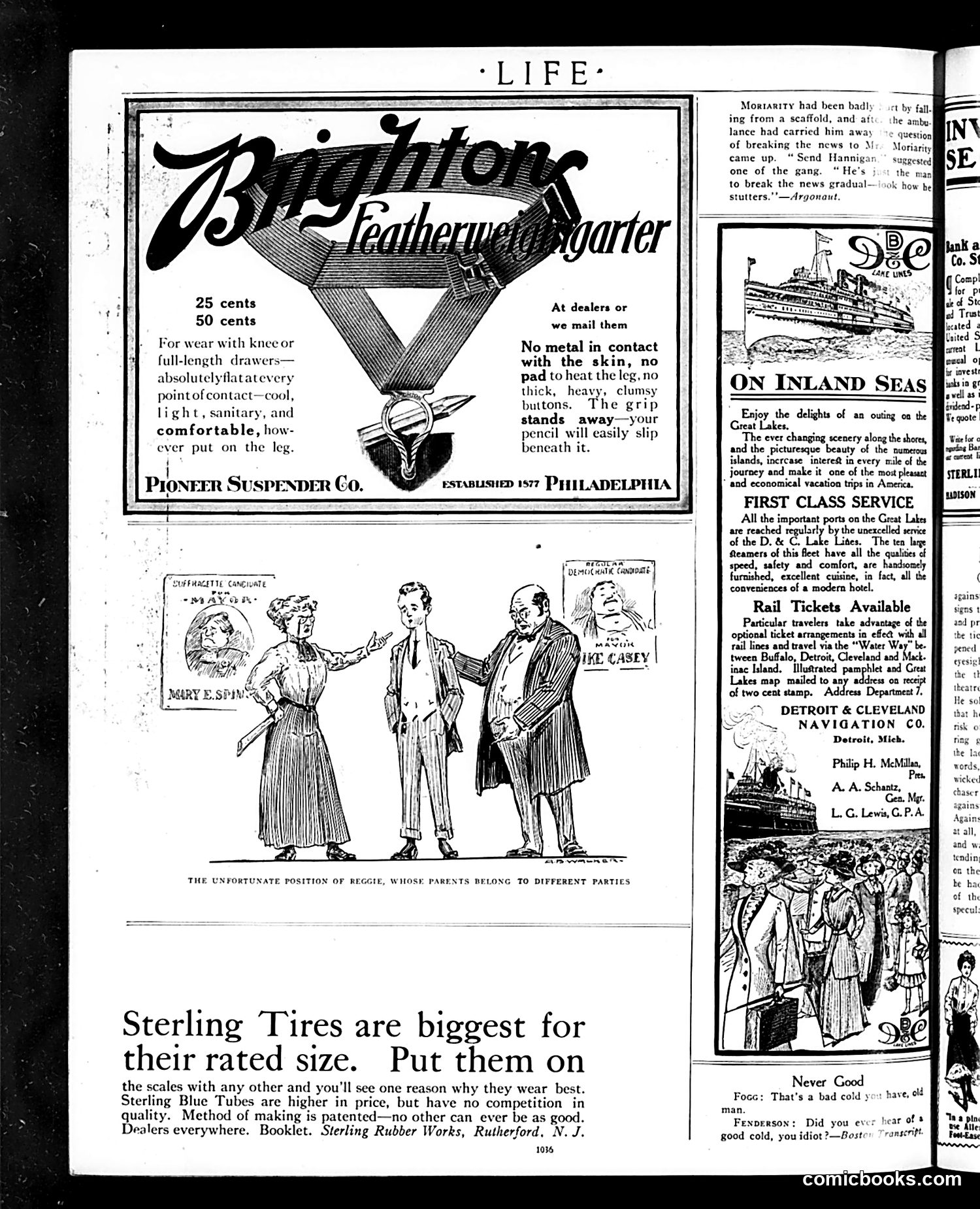
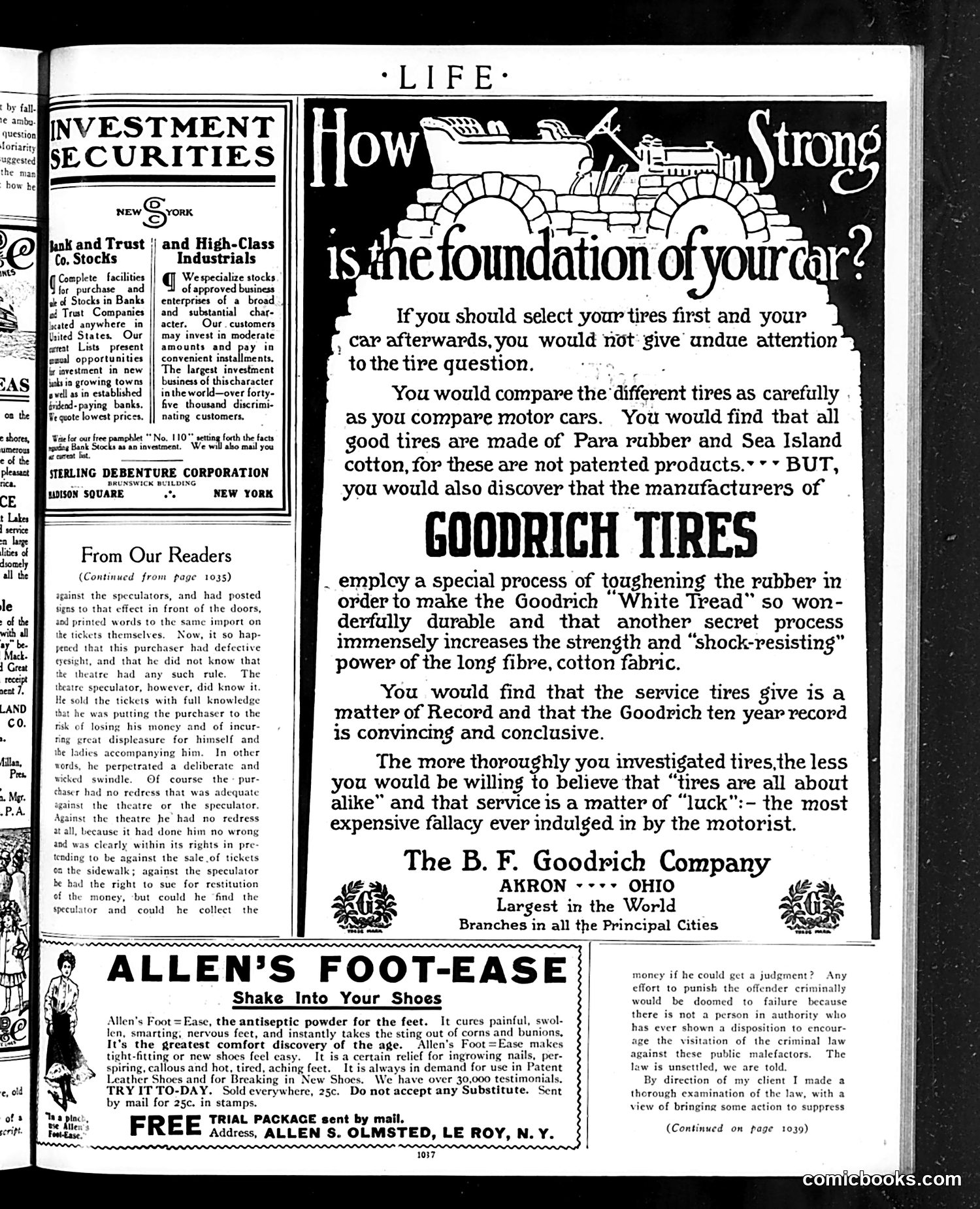
This page is primarily **advertising**, not political satire. It contains three main advertisements: 1. **Investment Securities** (left): Financial firms offering stocks and trust company investments—standard early 1900s banking ads. 2. **Goodrich Tires** (center/main): An extended advertisement arguing that tire quality matters as much as car quality. It emphasizes Goodrich's secret rubber-toughening process and ten-year service record, attempting to convince motorists that "tires are all about alike" is a false economy. This reflects early automobile-era competition over tire reliability. 3. **Allen's Foot-Ease** (bottom): An antiseptic powder advertisement claiming to cure corns, bunions, and foot pain—a common patent medicine pitch from this era. There is also a brief reader letter criticizing ticket scalpers at theaters, but it's editorial content, not satire. The page reflects 1910s consumer culture: nascent automobile anxiety, dubious medical claims, and financial investment pitches.
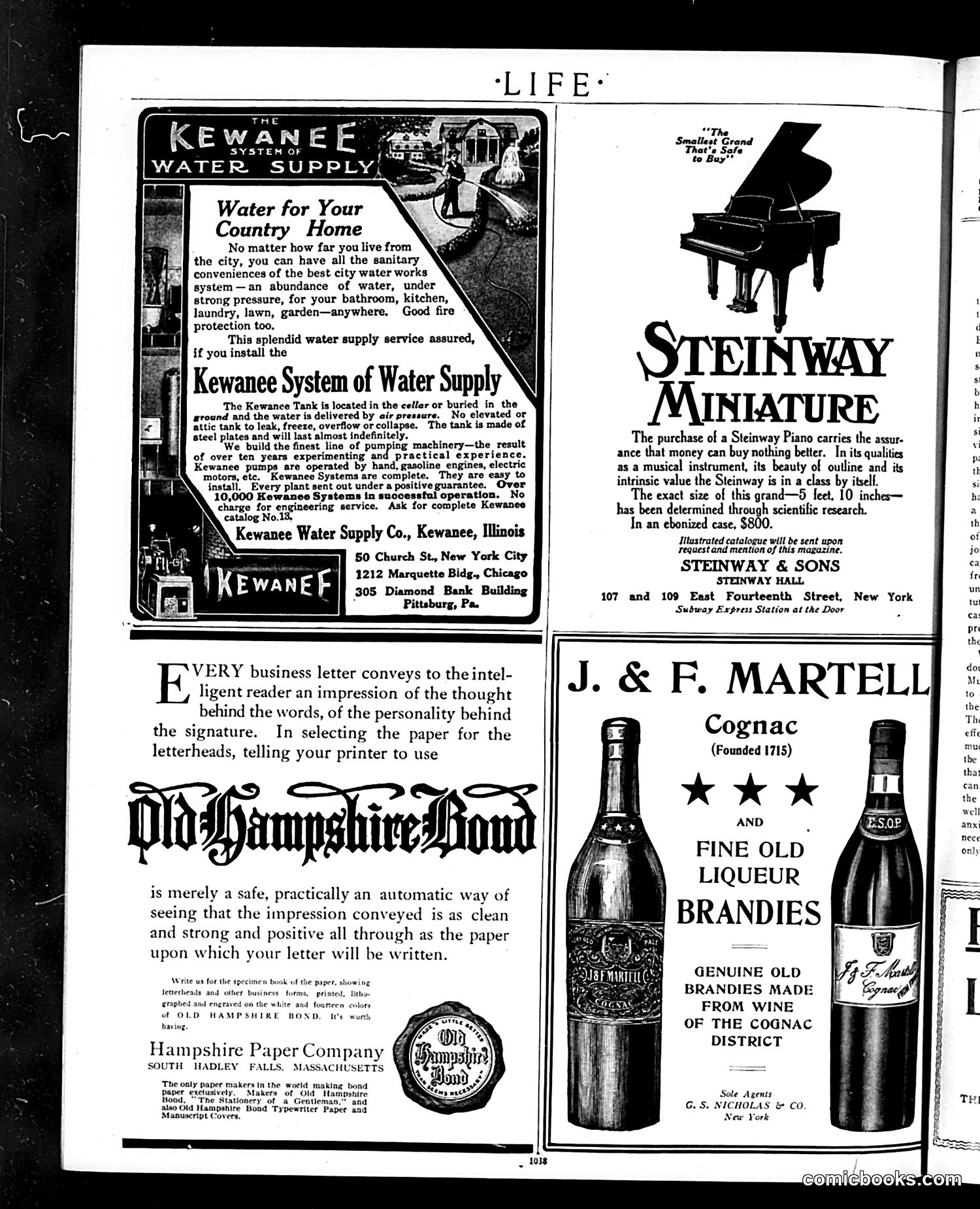
This page contains no political cartoons or satire. It is a standard **advertising page** from Life magazine, consisting entirely of commercial advertisements for consumer and luxury products typical of the early 20th century. The ads promote: - **Kewanee Water Supply systems** for rural homes - **Steinway Pianos** (a luxury musical instrument) - **Hampshire Bond paper** for business letterheads - **J. & F. Martell Cognac** (brandy and liqueurs) The Hampshire Bond ad uses rhetorical language about how quality paper conveys professionalism and personality in business correspondence—standard marketing approach of the era. There is no satirical commentary, no political commentary, and no caricatured figures. This is purely commercial content aimed at affluent readers.
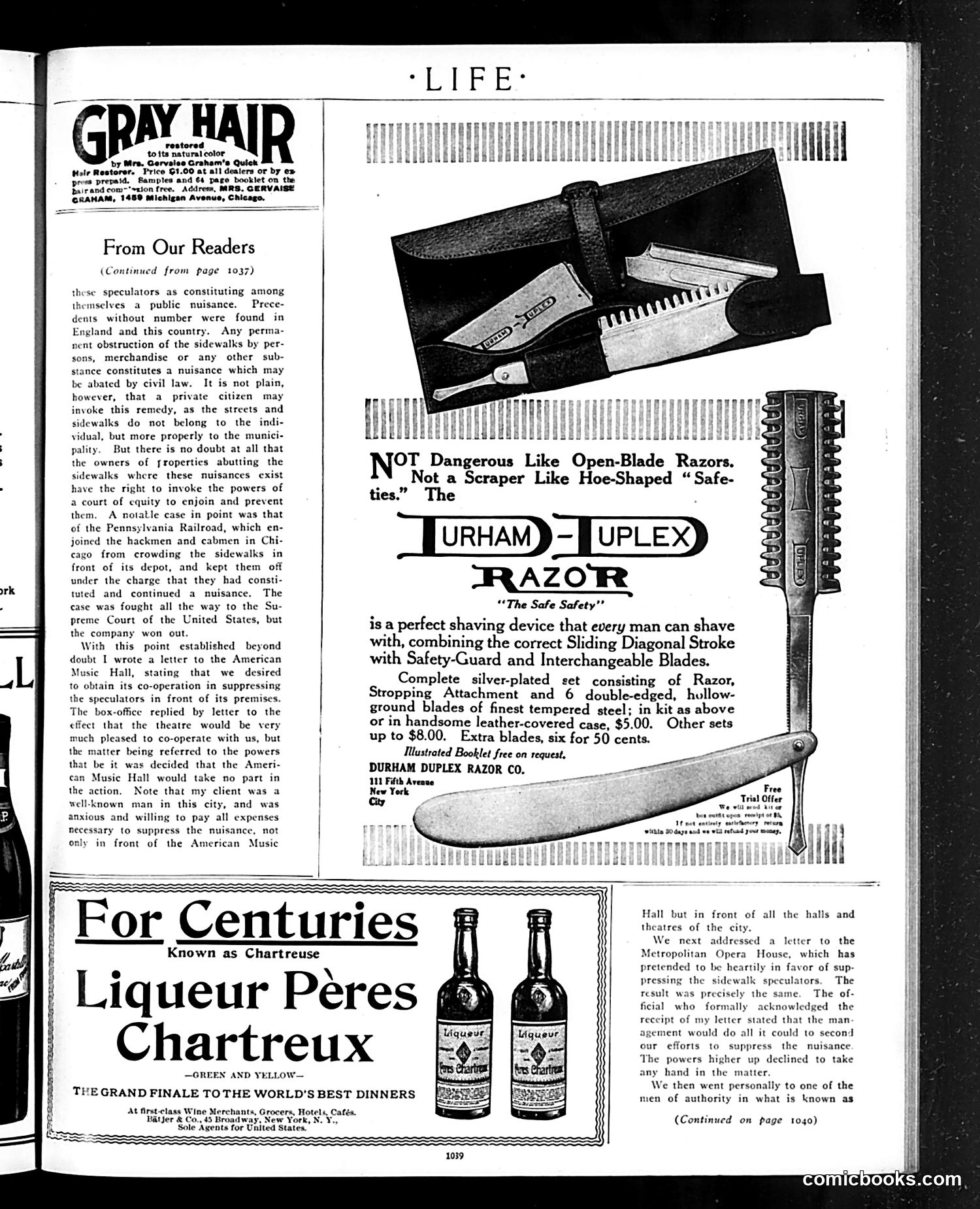
This page combines reader letters, advertisements, and editorial content typical of Life magazine's format. **The Main Content:** The "From Our Readers" section discusses a civic dispute about sidewalk speculators (street vendors/hustlers) obstructing public spaces in front of theaters and concert halls. A reader describes attempting to invoke legal remedies against this nuisance, citing precedent from a Pennsylvania Railroad case. Despite efforts to get cooperation from the American Music Hall and Metropolitan Opera House to suppress the problem, both institutions refused to take action, citing that "powers higher up" declined involvement. **The Satire:** The implicit criticism is directed at wealthy cultural institutions (major theaters/opera house) that claim to support civic order but refuse to use their influence or property rights to actually address street-level public nuisances when it requires them to take action. **Advertisements:** The page also features vintage ads for Gray Hair restorer, Durham-Duplex safety razors, and Chartreuse liqueur—typical period products with minimal connection to the editorial content. The page reflects early 20th-century concerns about urban disorder and institutional hypocrisy.
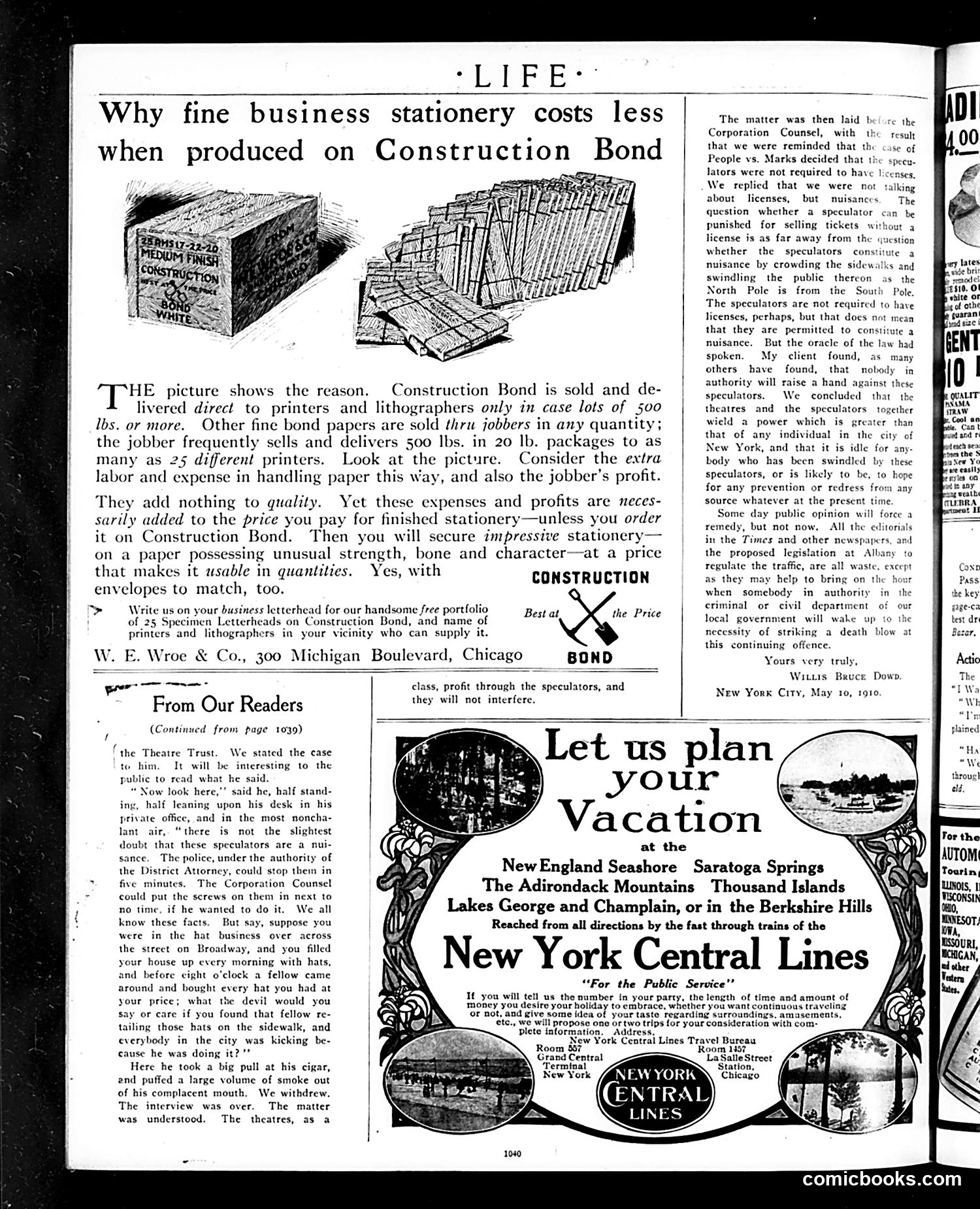
This page contains **two distinct pieces**: ## Main Article: Construction Bond Stationery Advertisement A commercial pitch (with satirical framing) explaining why ordering stationery directly from Construction Bond costs less than through traditional jobbers. The text argues that middlemen add unnecessary labor costs and profit margins without improving quality. This is straightforward advertising dressed in educational language—not political satire. ## "From Our Readers" Letter A more substantive piece: Willis Bruce Dowd writes to *Life* about **ticket scalpers at New York theaters** (dated May 10, 1910). He describes how speculators buy theater tickets in bulk and resell them at inflated prices, and how the city's legal system fails to stop this practice. Despite complaints to authorities, no remedy exists because the "Theatre Trust" (likely the theatrical monopoly controlling venues) and speculators wield too much power. The letter criticizes both the speculators' "nuisance" and government's inability or unwillingness to enforce regulation—a reform-minded complaint about unchecked private-sector exploitation typical of the Progressive Era.
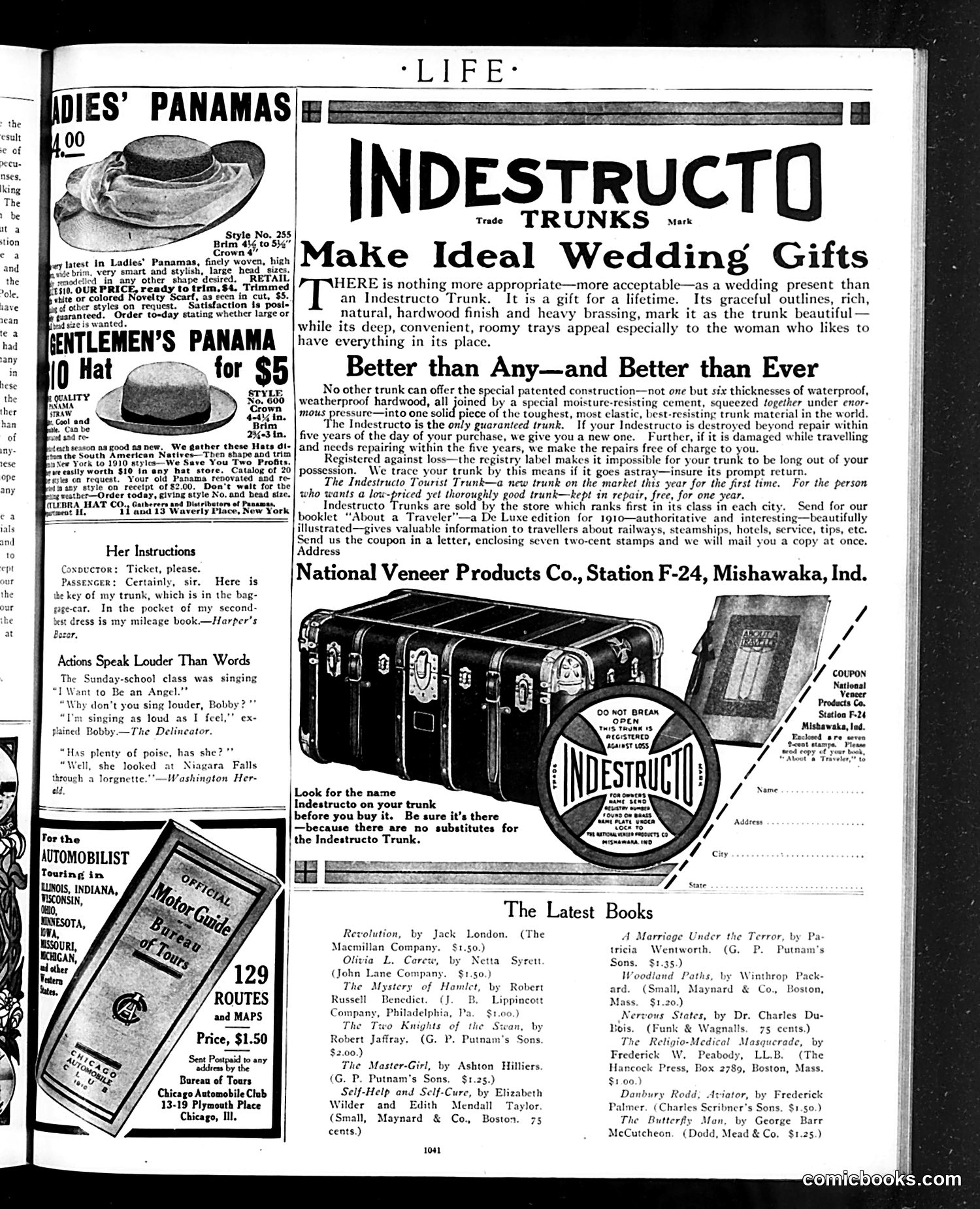
This page is primarily **advertising and book listings**, not political satire or comics. The main content features: 1. **Product advertisements**: Ladies' and gentlemen's Panama hats, an "Official Motor Guide" for automobile touring, and a prominent **Indestructo Trunk advertisement** marketed as an ideal wedding gift. 2. **Humorous anecdotes** (brief, non-satirical jokes): "Her Instructions" about a passenger and conductor, "Actions Speak Louder Than Words" about a Sunday school boy singing, and "Has plenty of poise" about a woman viewing Niagara Falls through a lorgnette—typical light humor of the era. 3. **Book listings**: Contemporary titles including works on revolution, mystery, and self-help. There is no political cartoon or social satire visible. This appears to be a standard 1911 *Life* magazine page mixing consumer advertising with genteel domestic humor—typical of the magazine's format during this period.
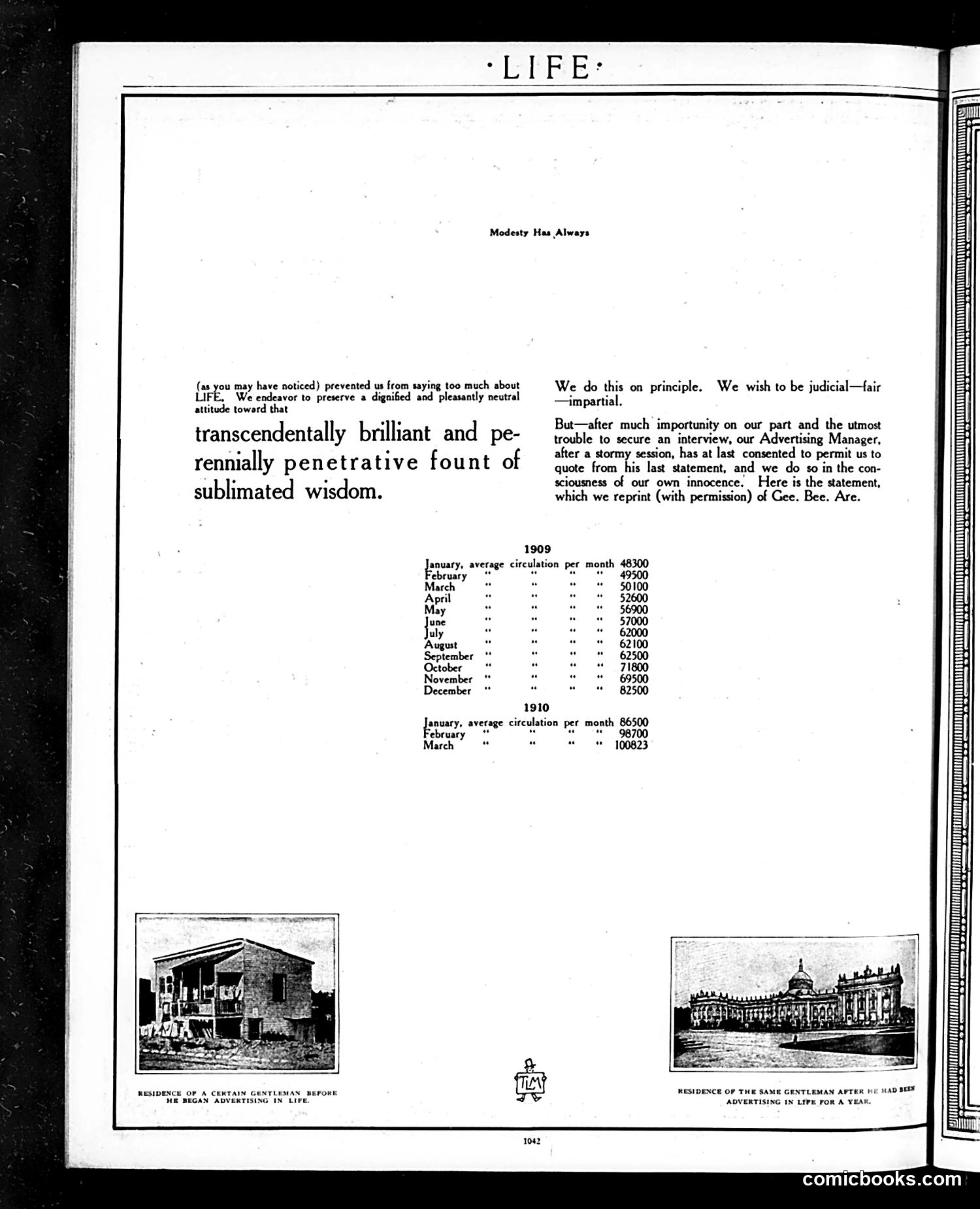
This page is **Life magazine's self-advertisement**, not political satire. The magazine humorously claims editorial modesty prevents them from praising themselves—then does exactly that, calling themselves a "transcendentally brilliant and perennially penetrative fount of sublimated wisdom." The joke escalates when Life's Advertising Manager, reluctantly interviewed, provides circulation figures (1909-1910) showing dramatic growth, and two photographs as "evidence": a modest cottage labeled the residence of "a certain gentleman" *before* advertising in Life, versus an impressive mansion-like estate *after* one year of Life advertising. The obvious implication: advertising in Life magazine brought such prosperity that this gentleman upgraded from a simple house to a grand residence. It's self-promoting satire—Life ironically exaggerates advertising's transformative power while appearing falsely modest about their own importance.
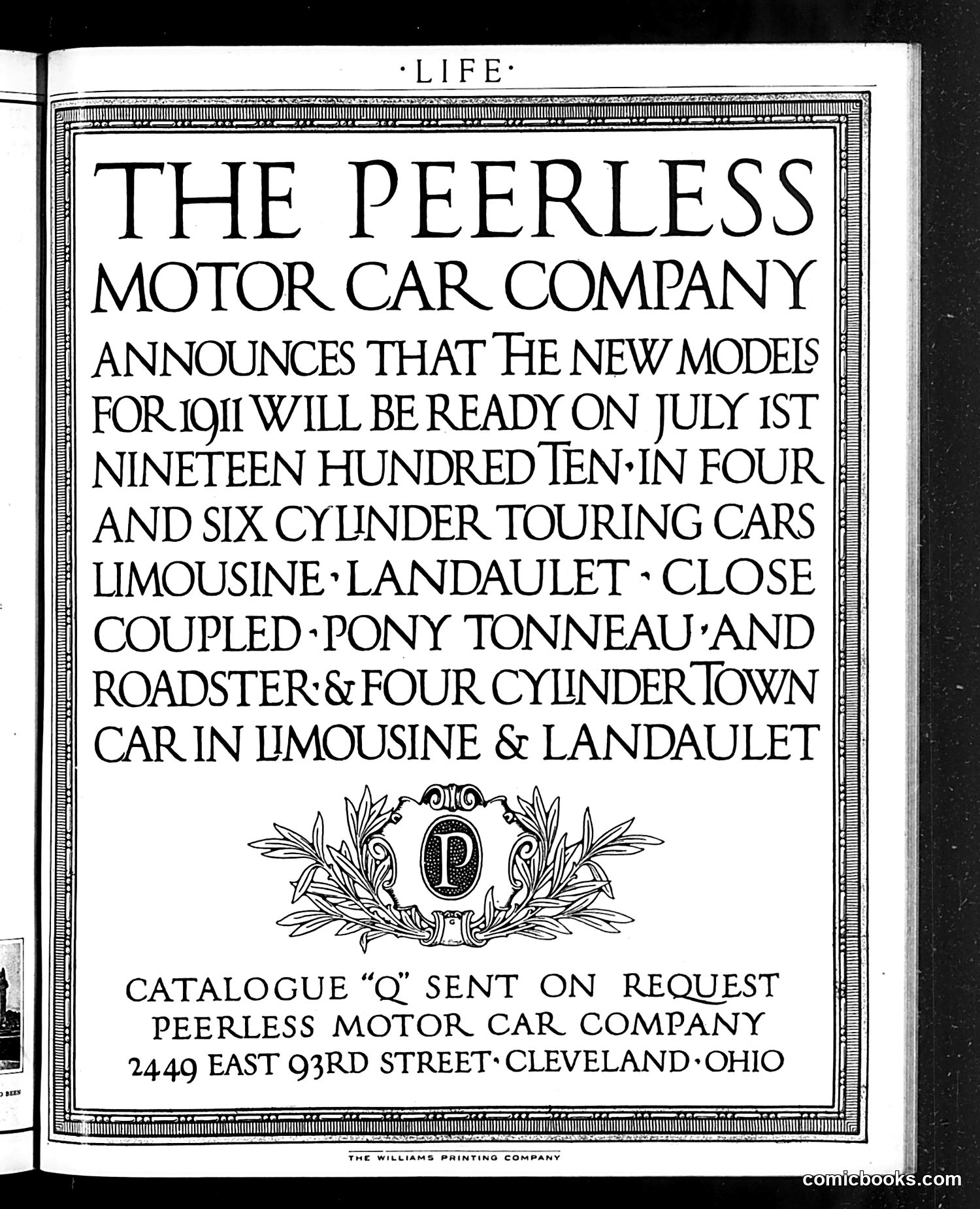
This is a **straightforward advertisement**, not a cartoon or satire. The Peerless Motor Car Company announces new 1911 automobile models available July 1st, listing six body styles: four and six-cylinder touring cars, limousine, landaulet, close-coupled pony tonneau, roadster, and a four-cylinder town car. The decorative "P" emblem and ornate border reflect early 1900s advertising design conventions. The company's Cleveland, Ohio address and offer of "Catalogue Q on request" are typical direct-mail marketing tactics of the era. There is no political satire, caricature, or social commentary visible—simply a manufacturer promoting their latest vehicle lineup to Life magazine's affluent readership.
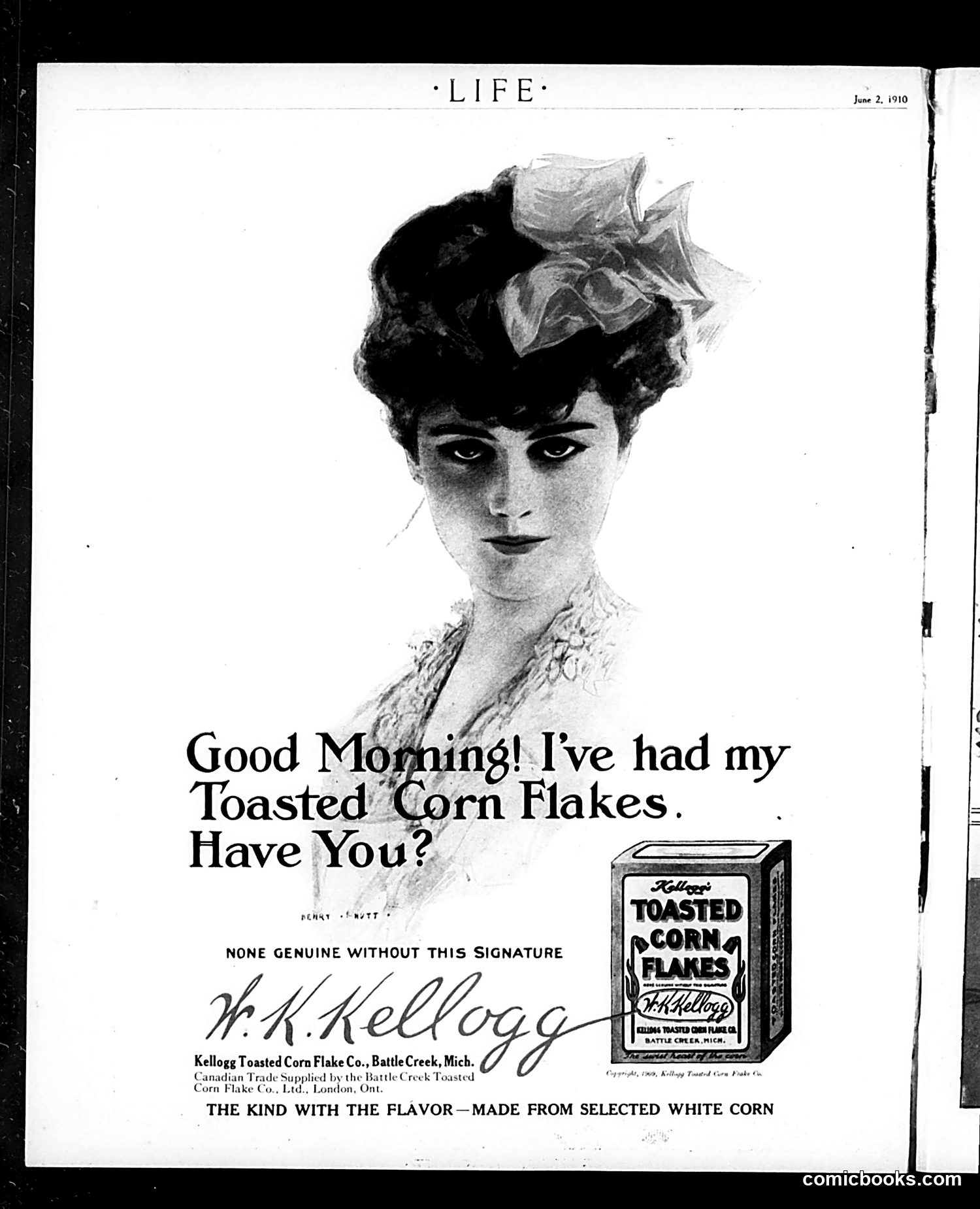
This is a **Kellogg's Toasted Corn Flakes advertisement**, not a political cartoon. It features an elegantly dressed woman with an elaborate upswept hairstyle and bow, typical of early 1900s fashion. She addresses the reader with "Good Morning! I've had my Toasted Corn Flakes. Have You?" — a direct appeal suggesting the product is part of refined, modern living. The advertisement emphasizes authenticity ("None Genuine Without This Signature") and highlights that the cereal is "made from selected white corn." This was an early mass-market breakfast cereal advertisement targeting educated, middle-class consumers. The sophisticated illustration was designed to associate the product with gentility and modernity during the emerging consumer culture era.