
Life, 1910-06-02 · page 31 of 56
Life — June 2, 1910 — page 31: what you’re looking at
What you’re looking at
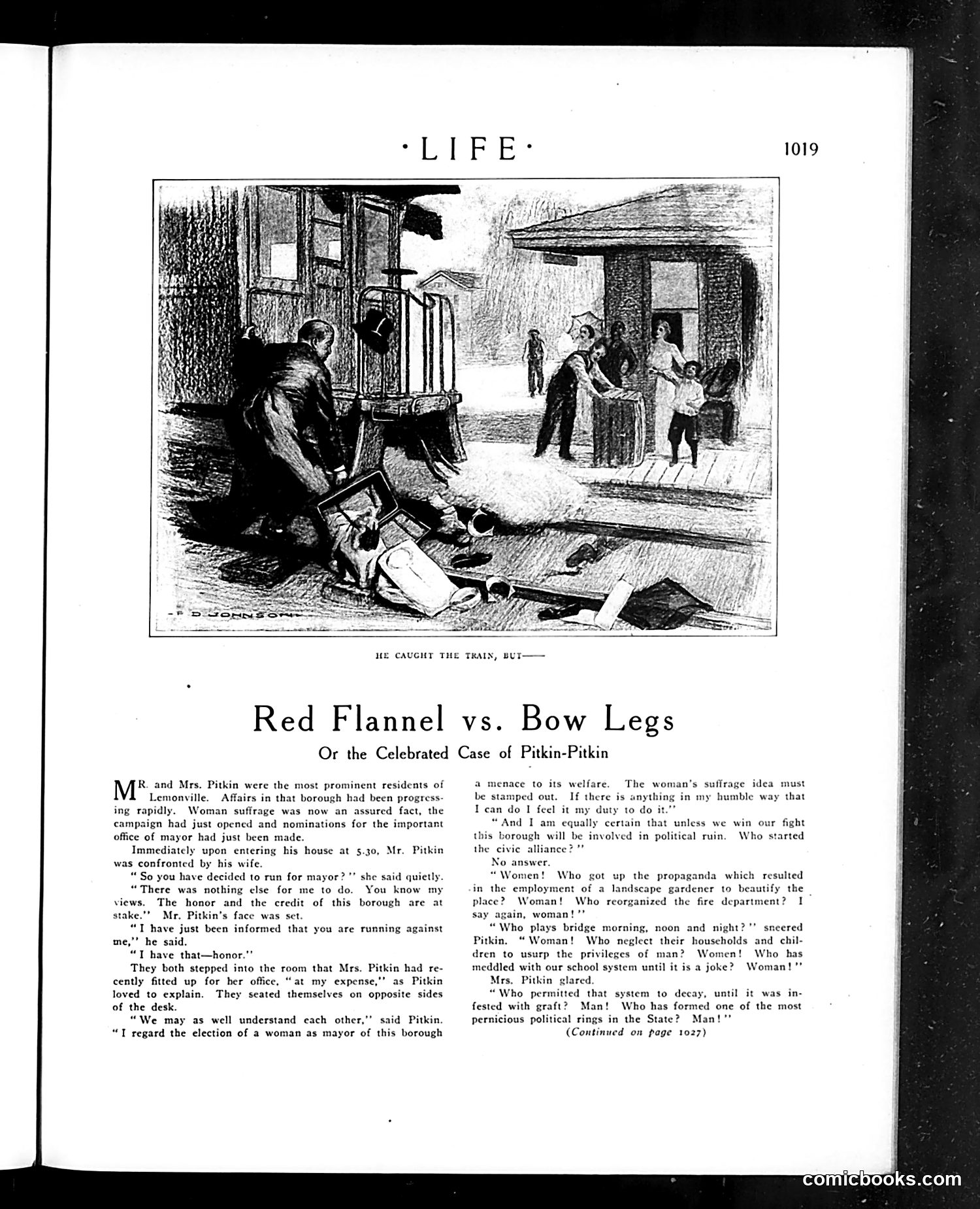
This is a satirical story about gender politics in a fictional borough called Lemonville, published after women's suffrage became "an assured fact" (likely referring to the 19th Amendment, ratified in 1920). Mr. and Mrs. Pitkin are running against each other for mayor. He opposes a woman as mayor as a "menace to welfare"; she counters by listing women's civic accomplishments (beautification, fire department reorganization) while he accuses women of neglecting homes and meddling with schools. He responds by blaming men for systemic decay, graft, and political corruption. The cartoon above depicts a street scene with figures and scattered objects, captioned "HE CAUGHT THE TRAIN, BUT——" (the implication being his escape from domestic/political conflict). The satire mocks anti-suffrage arguments by having both spouses expose each other's contradictions, suggesting that both genders had legitimate grievances about governance and that women's political participation was inevitable and defensible.
📄 Transcribed text from this page (OCR, searchable)
Machine-transcribed from the original scan — historical spelling and the odd misread are preserved.
ME CAUGHT THE TRAIN, BUT—— Red Flannel vs. Bow Legs Or the Celebrated Case of Pitkin-Pitkin R. and Mrs. Pitkin were the most prominent residents of Lemonville. Affairs in that borough had been progress- ing rapidly. Woman suffrage was now an assured fact, the campaign had just opened and nominations for the important office of mayor had just been made. Immediately upon entering his house at 5.30, Mr. was confronted by his wife. “So you have decided to run for mayor?" she said quietly. “There was nothing clse for me to do. You know my The honor and the credit of this borough are at .” Mr. Pitkin’s face was se T have just been informed me,” he s “T have that—honoi They both stepped into the room that Mrs. Pit cently fitted up for her office, “at my expense," loved to explain. They seated themselves on opposite sides of the desk. “We may as well understand cach other,” said Pitkin. “T regard the election of a woman as mayor of this borough Pitkin hat you are running against The woman's suffrage idea must in my humble way that a menace to its welfare. be stamped out. If there is anythi Ican do I feel it my duty to do “And I am equally certain that unless we win our fight this borough will be involved in political ruin. Who started the civic alliance? ’" No answer. “Women! Who got up the propaganda which resulted in the employment of a landscape gardener to beautify the place? Woman! Who reorganized the fire department? I say again, woman!’" “Who plays bridge morning, noon and night?" sneered Pitkin. “Woman! Who neglect their households and chil- dren to usurp the privileges of man? Women! Who has meddled with our school system until it is a joke? Woman!" Mrs. Pitkin glared. “Who permitted that system to decay, until it was in- fested with graft? Man! Who has formed one of the most pernicious political rings in the State? Man!" (Continued on page 1027) Ccomicbooks.com