
Life, 1910-06-02 · page 30 of 56
Life — June 2, 1910 — page 30: what you’re looking at
What you’re looking at
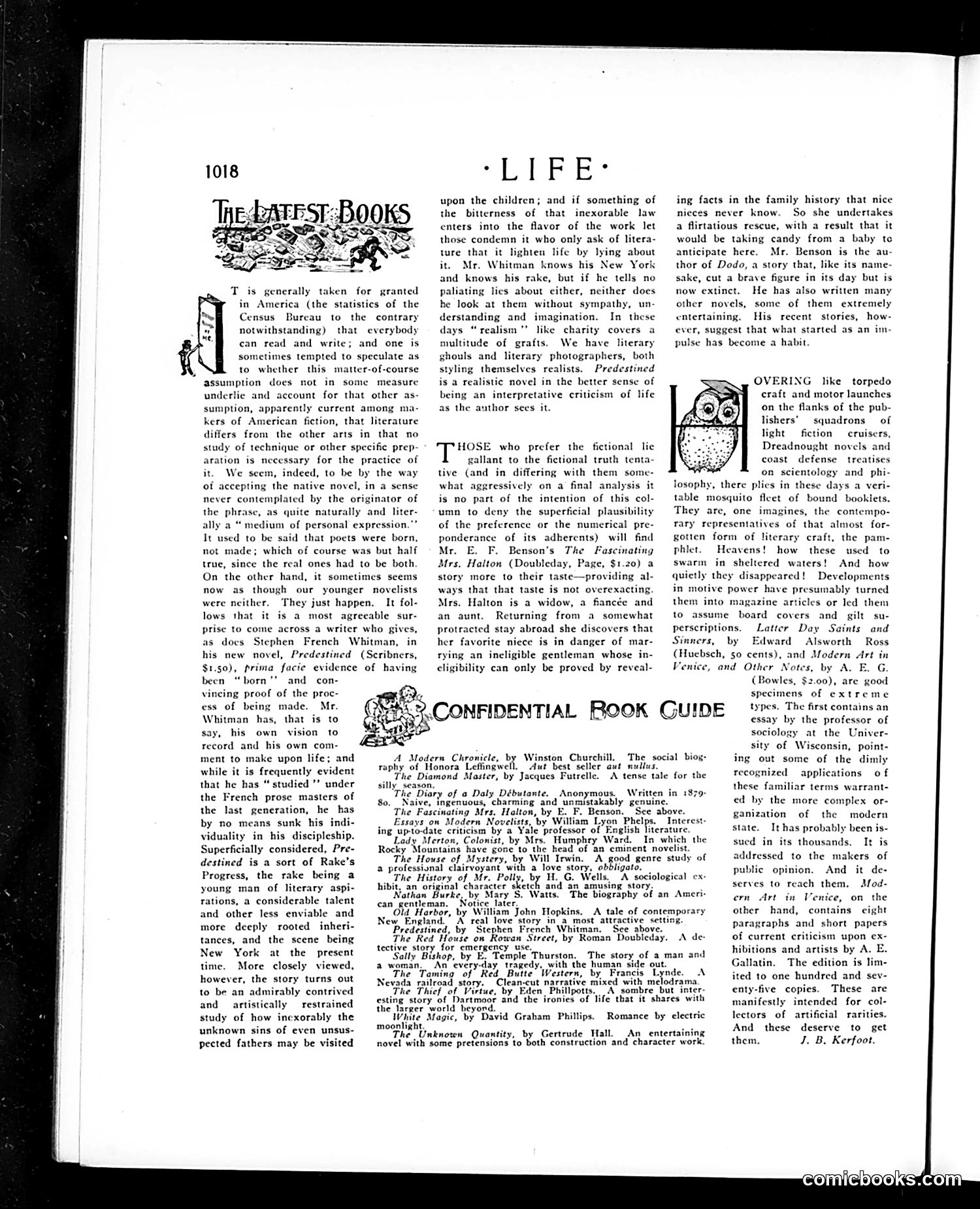
This page from *Life* magazine presents literary criticism and book reviews, not political satire. The main content discusses Stephen French Whitman's novel *Predestined*, praising it as evidence that the author possesses both natural talent ("born") and developed craft ("made")—a rarity among contemporary American novelists. The critic argues that American fiction often treats writing as requiring no technical preparation, unlike other arts. Whitman distinguishes himself by combining personal vision with disciplined study of French prose masters while maintaining his individuality. The "Confidential Book Guide" lists contemporary novels with brief descriptions. The page represents *Life's* role as a sophisticated literary journal offering serious critical commentary alongside lighter satirical content—typical of early 20th-century American magazines that served educated, middle-class readers interested in both social commentary and cultural criticism.
📄 Transcribed text from this page (OCR, searchable)
Machine-transcribed from the original scan — historical spelling and the odd misread are preserved.
T is generally taken for granted merica (the statistics of the in 2 Census Bureau to the contrary notwithstanding) that everybody can read and write; and one is sometimes tempted to speculate as to whether this matter-of-course assumption docs not in some measure underlie and account for that other as- sumption, apparently current among ma- kers of American fiction, that literature differs from the other arts in that no study of technique or other specific prep- aration is necessary for the practice of it. We seem, indeed, to be by the way of accepting the native novel, in a sense never contemplated by the originator of the phrase, as quite naturally and lite ally a“ medium of personal expression.’ It used to be said that poets were born, not made; which of course was but half true, since the real ones had to be both On the other hand, it sometimes seems now as though our younger novelists were neither. They just happen. Itt fol- lows that it is a most agreeable sur- prise to come across a writer who gives, 3 docs Stephen French Whitman, in his new novel, Predestined (Scribners, $1.50), prima facie evidence of having been “born’’ and con- vineing proof of the proc- ess of being made. Mr. ee Whitman has, that is to . ‘ say, his own vision to sd record and his own com- ment to make upon life; and A while it is frequently evident that he has “ studied’? under the French prose masters of 4 80. the last generation, he has by no means sunk his indi viduality in his discipleship. Superficially considered, Pre- destined is a sort of Rake’s Progress, the rake being a young man of literary aspi- rations, a considerable talent and other less enviable and more deeply rooted inheri- tances, and the scene being Modern Chr: raphy of Honora Leffingwell. The Diamond Master, by Jacques Futrelle. silly season, The Diary of a Daly Débutante. Naive, ingenuous, charming and unmistakably genuine. The Fascinating Mrs. Halton, by E. F. Benson, Essays on Modern Novelists, by William Lyon Phel ing up-to-date criticism by a Yale professor of Lady Merton, Colonist, by Mrs. Humphry Ward. Rocky Mountains have gone to the head of an eminent novelist. The House of Mystery, by Will Irwin. a professignal clairvoyant ‘with a love story, obbligato. The History of Mr. Polly, by hibit, an original character sketc Nathan Burke, by Mary S. Watts. can gentleman. 1 ‘Old Harbor, by William John Hopkins. A real love story in a most attractive sett New England. See above. Predestined, by Stephen French Whitman. The Red House on Rowan Street, by Roman Doubleday. ‘LEP E* upon the children; and if something of the bitterness of that inexorable law enters into the flavor of the work let those condemn it who only ask of litera- ture that it lighten life by lying about it. Mr. Whitman knows his New York and knows his rake, but if he tells no paliating lics about cither, neither does he look at them without sympathy, un- derstanding and imagination. In these days “realism” like charity covers a multitude of grafts. We have literary ghouls and literary photographers, both styling themselves realists. Predestined is a realistic novel in the better sense of being an interpretative criticism of life as the author sees it. HOSE who prefer the fictional lie gallant to the fictional truth tenta- tive (and in differing with them some- what aggressively on a final analysis it is no part of the intention of this col- umn to deny the superficial plausibility of the preference or the numerical pre- ponderance of its adherents) will find Mr. E. F. Benson’s The Fascinating irs. Halton (Doubleday, Page, $1.20) a story more to their taste—providing al- ways that that taste is not overexacting. Mrs. Halton is a widow, a fiancée and an aunt. Returning from a somewhat protracted stay abroad she discovers that her favorite niece is in danger of mar- rying an incligible gentleman whose in- cligibility can only be proved by reveal- le, by Winston Churchill. ‘Aut best seller aut Anonymous. glish HG. Wells. Notice later. CONFIDENTIAL ROOK GUIDE ‘The social biog: ts. A tense tale for the Written in 1879 Sce above. Fiter ature, In which the ‘A good genre study of ‘A. sociological ex and an amusing story. . ‘The biography of an Ameri- A tale of contemporary ing facts in the family history that nice nicces never know. So she undertakes a flirtatious rescue, with a result that it would be taking candy from a baby te anticipate here, Mr. Benson is the au- thor of Dodo, a story that, like its name- sake, cut a brave figure in its day but is now extinct. He has also written many other novels, some of them extremely entertaining. His recent stories, how- ever, suggest that what started as an im- pulse has become a habit. OVERING like torpedo craft and motor launches ks of the pub- squadrons of light fiction cruisers, Dreadnought novels and coast defense treatises on scientology and phi- losophy, there plies in these days a veri- able mosquito flcet of bound bookiets. They are, one imagines, the contempo- rary representatives of that almost for- gotten form of literary craft, the pam- phlet. Heavens! how these used to swarm in sheltered waters! And how quietly they disappeared! Developments in motive power have presumably turned them into magazine articles or led them to assume board covers and gilt perscriptions. Latter Day Saints and Sinners, by Edward Alsworth Ross (Huebsch, 50 cents), and Modern Art in Venice, and Other Notes, by A. E. G (Bowles, $2.00), are good specimens of extreme types. The first contains an ay by the professor of at the Univer- sity of Wisconsin, point- ing out some of the dimly recognized applications 0 f these familiar terms warrant- ed by the more complex or- ganization of the modern state. It has probably been is- sued in its thousands. It is addressed to the makers of public opinion. And it de- serves to reach them. Mod- crn Art in Venice, on the other hand, contains eight paragraphs and short papers of current criticism upon ex- hibitions and artists by A su- Interest A de ce VE tective story for emergency use, New York at the present ‘Sally Bishop, by Es Temple Thurston. ‘The story of a man and hibition s EL time. More closely viewed, a woman, “An everyday tztgedy, wit the human side gut") Gallatin. The edition lim- fe Taming of Red Butte Western, by Francis Lynde. ji . . however, the story turns out Nevada railroad. story. Clean-cut narrative mixed with melodrama ited to one hundred and sev to be an admirably contrived “The Thicf of Virtue, by Eden Phillpotts, A sombre but inter- enty-five copies. These are and artistically restrained UNE sory, of, Dartmoor and the ironies of life that it shares with manifestly intended for col- study of how inexorably the Witte Magic, by David Graham Phillips, Romance by electric lectors of artificial rarities. a ai ; " — moonfight . d the ' unknown sins of even unsus The Unknown Quantity, by Gertrude Hall. An entertaining And these deserve to get them. J. B. Kerfoot. pected fathers may be visited novel with some pretensions to both construction and character work.