
Life, 1910-06-02 · page 18 of 56
Life — June 2, 1910 — page 18: what you’re looking at
What you’re looking at
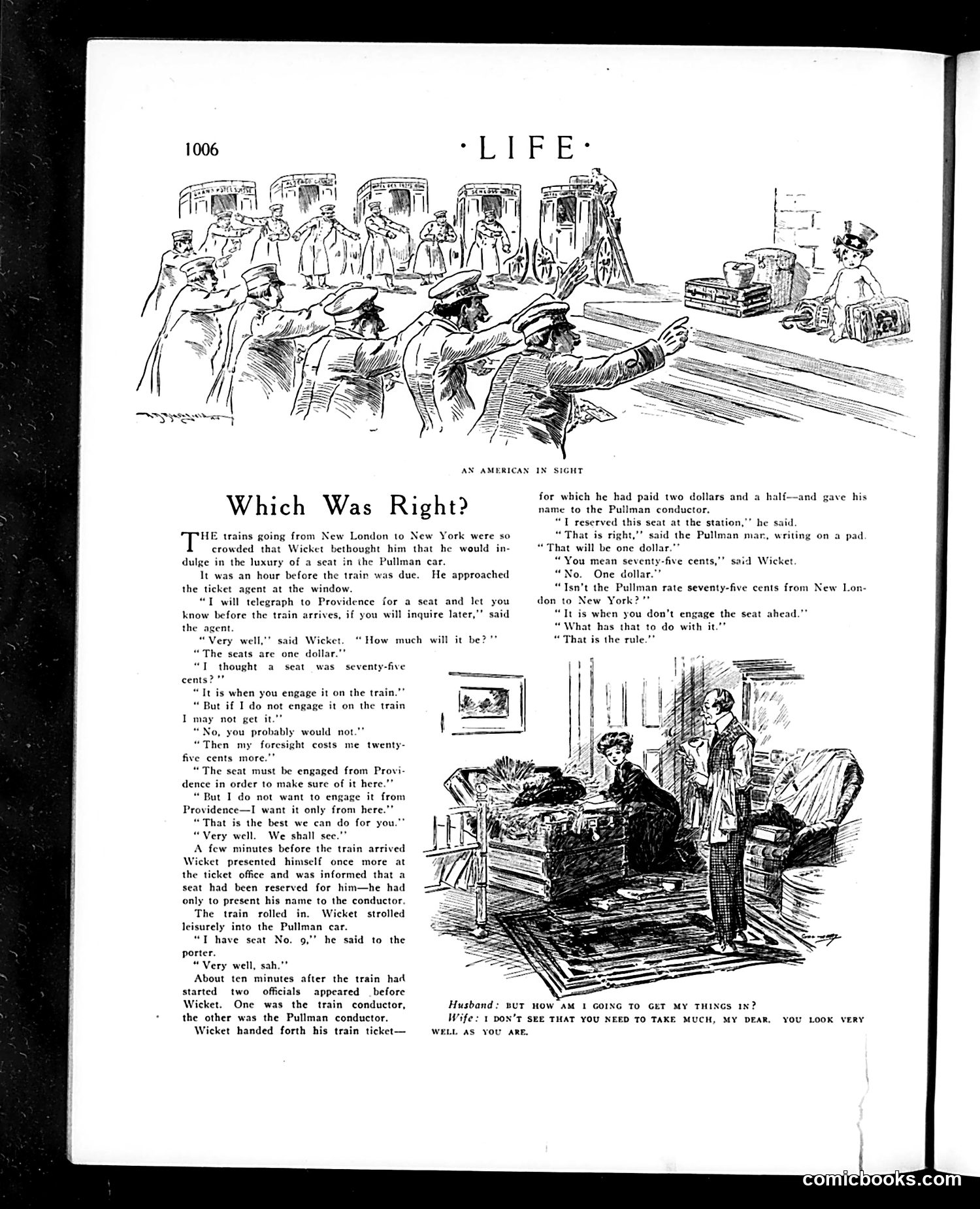
This satirical story mocks arbitrary corporate pricing and rule-making. The protagonist "Wicket" attempts to purchase a Pullman car seat (luxury railroad seating) from New London to New York for a fixed rate of seventy-five cents. However, he encounters contradictory pricing: the ticket agent charges one dollar for advance reservations but claims seats cost seventy-five cents if booked on the train itself. When Wicket reserves ahead to guarantee a seat, he's then charged the higher rate anyway. The Pullman conductor invokes "the rule" without logical justification—the surcharge supposedly applies because he reserved in advance, making the rule self-contradictory and punitive to careful planning. The accompanying domestic cartoon (lower right) offers ironic commentary: a wife suggests her husband won't need much luggage, implying financial hardship from such nickel-and-diming practices. The satire targets the absurdity of corporate bureaucracy and unreasonable fee structures that punish consumers regardless of their choices.
📄 Transcribed text from this page (OCR, searchable)
Machine-transcribed from the original scan — historical spelling and the odd misread are preserved.
moet} AN AMERICAN Which Was Right? HE trains going from New London to New York were so crowded that Wicket bethought him that he would in- dulge in the luxury of a seat in the Pullman car. It was an hour before the train was due. He approached the ticket agent at the window. “T will telegraph to Providence for a seat and let you know before the train arrives, if you will inquire later,"’ said Very well,’’ sa “How much will it be?" “The seats are one dollar.’ “T thought a seat was cents? "* “It is when you engage it on the train.” “ But if I do not engage it on the train I may not get it.” “No, you probably would not." “Then my foresight costs me twenty- five cents more.” “The seat must be engaged from Provi- dence in order to make sure of it here.” “But I do not want to engage it f Providence—I want it only from here “That is the best we can do for you.” “Very well. We shall see."” A few minutes before the train arrived Wicket presented himself once more at the ticket office and was informed that a seat had been reserved for him—he had only to present his name to the conductor. The train rolled in. Wicket strolled leisurely into the Pullman car. “T have seat No. 9,"" he said to the porter. “Very well, sah.’” About ten minutes after the train had started two officials appeared _ before Wicket. One was the train conductor, the other was the Pullman conductor. Wicket handed forth his train ticket— seventy-five WELL AS YOU ARE. IN SIGHT for which he had paid two dollars and a half—and gave his © to the Pullman conductor. “T reserved this seat at the station,’’ he said “That is right,’” said the Pullman mar, writing on a pad “That will be one dollar.”” “You mean seventy-five cents,” said Wicket “No. One dollar. “Isn't the Pullman rate seventy-five cents from New Lon- don to New York?” “It is when you don’t engage the seat ahead.” “What has that to do with it.” “That is the rule.” nai Husband: wut HOW AM 1 GOING TO GET MY THINGS IN? Wife: 1 DON’T SEE THAT YOU NEED TO TAKE MUCH, MY DEAR. YoU LOOK VERY