
Life, 1910-06-02 · page 36 of 56
Life — June 2, 1910 — page 36: what you’re looking at
What you’re looking at
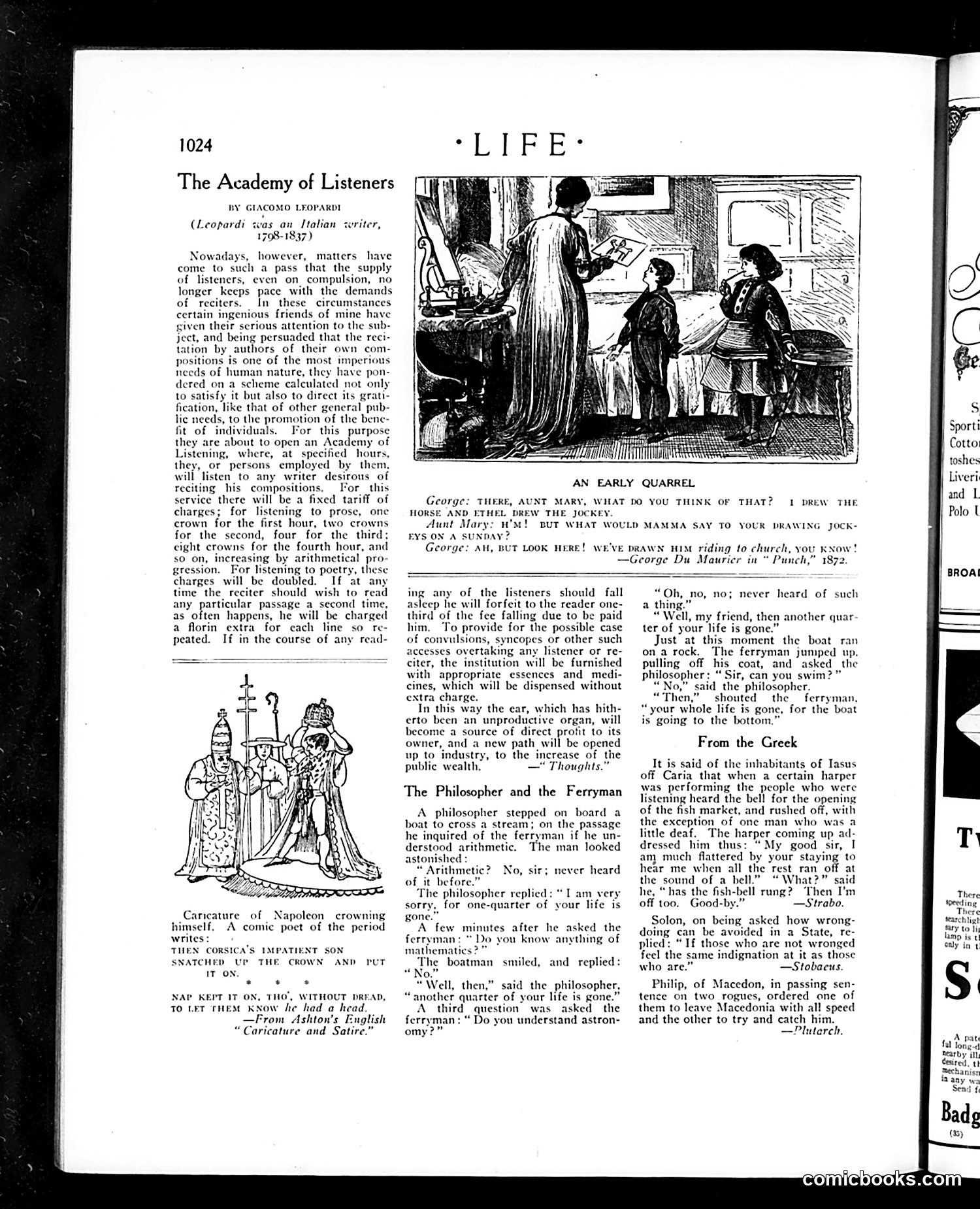
This page contains three satirical pieces mocking pretension and impracticality: **"The Academy of Listeners"** (main article): Leopardi's 18th-century satire proposes a business scheme where writers pay audiences to listen to their compositions—a joke about the shortage of willing listeners for tedious readings. Fees escalate arithmetically, with charges for repeated passages and compensation to readers if listeners fall asleep. It satirizes both authors' desperation for audiences and the commodification of art. **"An Early Quarrel"** (illustration, top right): A Du Maurier cartoon showing children arguing about drawing a jockey on Sunday, with one claiming the horse was drawn separately and they're "riding to church." It humorously captures Victorian anxieties about Sabbath observance—drawing secular subjects on Sunday was considered sinful. **"The Philosopher and the Ferryman"** (bottom): A fable where an arrogant philosopher lectures an uneducated ferryman about wasting his life lacking arithmetic, mathematics, and astronomy. When the boat hits a rock, the ferryman asks if he can swim—revealing that practical survival skills matter more than abstract knowledge. It deflates intellectual pretension.
📄 Transcribed text from this page (OCR, searchable)
Machine-transcribed from the original scan — historical spelling and the odd misread are preserved.
1024 The Academy of Listeners BY GIACOMO LEOPARDI (Leopardi was an Italian writer, 1798-1837) Nowadays, however, matters have come to such a pass that the supply of listeners, even on compulsion, no longer keeps pace with the demands of reciters. In these circumstan certain ingenious friends of mine given their serious attention to the sub- ject, and being persuaded that the reci- tation by authors of their own com- positions is one of the most imperious needs of human nature, they have pon- dered on a scheme calculated not only to satisfy it but also to direct its grati- fication, like that of other general pub- lic needs, to the promotion of the bene- fit of individuals. For this purpose they are about to open an Academy of Listening, where, at specified hours, they, or persons employed by them, will listen to any writer desirous of reciting his compositions. For this service there will be a fixed tariff of charges; for listening to prose, one crown for the first hour, two crowns for the second, four for the third; cight crowns for the fourth hour, and so on, increasing by arithmetical’ pro- gression. For listening to poetry, these charges will be doubled. If at any time the reciter should wish to read any particular passage a second time, as often happens, he will be charged a florin extra for cach line so. re- peated. If in the course of any read- Caricature of Napoleon crowning himself. A comic poet of the period writes: THEN CORSICA’S IMPATIENT SON SNATCHED UP THE CROWN AND PUT IT oN, NAP KEPT IT ON, THO’, WITHOUT DREAD, TO LET THEM KNOW he had a head. From Ashton’s English “Caricature and Satire.” AN EARLY QUARREL George: THERE, AUNT MARY, WHAT DO YOU THINK OF THAT? 1 DREW THE HORSE AND ETHEL DREW THE JOCKEY, Aunt Mary: wm! BUT WHAT WOULD MAMMA SAY TO YOUR DRAWING JOCK- EYS ON A SUNDAY? George: AM, BUT LOOK HERE! WE nit riding to church, you KNow! Du Maurier in * Punch,” 187 ing any of the listeners should fall asleep he will forfeit to the reader one- third of the fee falling due to be paid him. To provide for the possible case of convulsions, syncopes or other such cesses overtaking any listener or re- citer, the institution will be furnished with appropriate essences and medi- cines, which will be dispensed without extra charge. In this way the ear, which has hith erto been an unproductive organ, will become a source of direct profit to its owner, and a new path will be opened up to industry, to the increase of the public wealth. —“ Thoughts.” The Philosopher and the Ferryman A philosopher stepped on board a boat to cross a stream; on the passage he inquired of the ferryman if he un- derstood arithmetic. The man looked astonished : “ Arithmetic? No, sir; never heard of it before.” The philosopher replied: “I am very sorry, for one-quarter of your life is gone A few minutes after he asked the ferryman: “Do you know anything of mathema * The boatman smiled, and replied: “No.” “Well, then,” said the philosopher, “another quarter of your life is gone.” A third question’ was asked the ferryman: “ Do you understand astron- omy?” “Oh, no, no; never heard of such a thing.” “Well, my friend, then another quar ter of your life is gone.” Just at this moment the boat ran ona rock. The ferryman jumped up. pulling off his coat, and asked the philosopher: “ Sir, can you swim?” “No,” said the philosopher. “Then,” shouted the ferryman, “your whole life is gone, for the boat is going to the bottom.” From the Greek It is said of the inhabitants of Tasus off Caria that when a certain harper was performing the people who were listening heard the bell for the opening of the fish market, and rushed off, with the exception of one man who was a little deaf. The harper coming up ad- dressed him thus: “My good sir, am much flattered by your staying to hear me when all the rest ran off at the sound of a bell.” “ What?” said he, “has the fish-bell rung? Then I’m off too. Good-by.” —Strabo. Solon, on being asked how wrong- doing can be avoided in a State, re- plied: “If those who are not wronged feel the same indignation at it as those who are.” —Stobacus. Phi of Macedon, in passing sen- tence on two rogues, ordered one of them to leave Macedonia with all speed and the other to try and catch him. —Pluterch. Sporti Cotto tosh Liveri td L Polo L fal Toda