
Life, 1910-06-02 · page 24 of 56
Life — June 2, 1910 — page 24: what you’re looking at
What you’re looking at
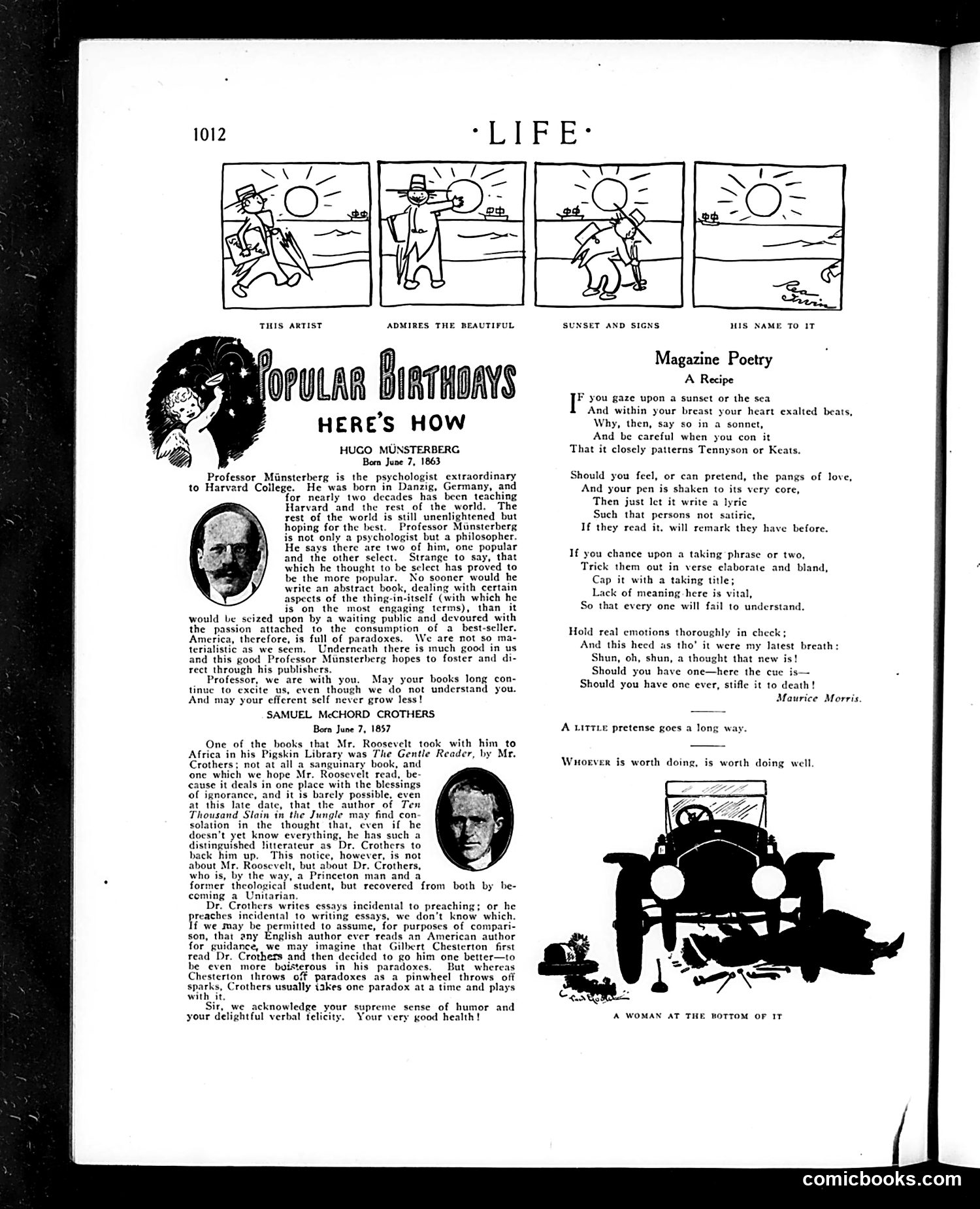
This Life magazine page (page 1012) contains three distinct content sections: **Top Comic Strip**: A four-panel wordless cartoon depicting a man's progression from admiring a sunset, to striking various poses, to ultimately signing his name to it—satirizing pretentious artistic self-aggrandizement. **Biographical Features**: Profiles of two intellectuals born June 7 (in different years)—Harvard psychologist Hugo Münsterberg and essayist Samuel McCord Crothers. The text gently mocks their popularity despite being obscure: Münsterberg writes abstract philosophy that somehow becomes bestsellers; Crothers writes paradoxes influenced by (or influencing) G.K. Chesterton. The humor lies in praising their success while admitting not understanding them. **"Magazine Poetry: A Recipe"**: A satirical poem by Maurice Morris ridiculing sentimental magazine verse. It advises aspiring poets to imitate Tennyson/Keats, feign emotion, use elaborate but meaningless language, and—crucially—suppress any original thought. The final stanza's punch line warns: kill any genuinely new idea before it emerges. Together, these pieces mock early-20th-century American intellectual pretension and derivative artistic expression.
📄 Transcribed text from this page (OCR, searchable)
Machine-transcribed from the original scan — historical spelling and the odd misread are preserved.
ADMIRES THE BEAUTIFUL HERE’S HOW HUGO MUNSTERBERG Born June 7, 1863 Professor_Minsterberg is the psychologist. extraordinary to Harvard College. He was born in Danzig, Germany, and for nearly two decades has been teaching Harvard and the rest of the world. The rest of the world is still unenlightened but hoping for the best. Professor Minsterberg, is not only a psychologist but a philosopher. He says there are two of him, one popular and the other select. Strange to say, that which he thought to be select has proved to be the more popular. No sooner would he write an abstract book, dealing with certain aspects of the thing-in-itself (with which he is on the most engaging terms), than it would be seized upon by a waiting public and devoured with the passion attached to the consumption of a best-seller. America, therefore, is full of paradoxes. We are not so ma- terialistic as we seem. Underneath there is much good in us and this good Professor Munsterberg hopes to foster and di- rect through his publishers. Professor, we are with you, May your books long con- tinue to excite us, even though we do not understand you. And may your efferent self never grow less! SAMUEL McCHORD CROTHERS Born June 7, 1857 One of the books that Mr. Roosevelt took with him to Africa in his Pigskin Library was The Gentle Reader, by Mr. Crothers; not at all a sanguinary book, and one which we hope Mr. Roosevelt read, be- cause it deals in one place with the blessings of ignorance, and it is barely possible, even at this late ‘date, that the author of Ten Thousand Slain tn the Jungle may find con solation in the thought that, even if he docsn’t yet know everything, he has such a distinguished litterateur as Dr. Crothers to hack him up. This notice, however, is not about Mr. Roosevelt, but about Dr. Crothers, who is, by the way, a Princeton man and a former theological ‘student, but recovered from both by be- coming a Unitarian. Dr. Crothers writes essays incidental to preaching; or he preaches incidental to writing essays, we don’t know which, f we may be permitted to assume, for purposes of compari son, that any English author ever reads an American author for’ guidance, we may imagine that Gilbert Chesterton first read Dr. Crothers and then decided to go him one better—to be even more boisterous in his paradoxes. But whereas Chesterton throws off paradoxes as a pinwheel throws off sparks, Crothers usually (akes one paradox at a time and plays with, it. Sir, we acknowledge your supreme sense of humor and your delightful verbal felicity. Your very good health! SUNSET AND SIGNS MIS NAME TO IT Magazine Poetry A Recipe F you gaze upon a sunset or the sea And within your breast your heart exalted beats, Why, then, say so in a sonnet, And be careful when you con it That it closely patterns Tennyson or Keats. Should you feel, or can pretend, the pangs of love, And your pen is shaken to its very core, Then just let it write a lyric Such that persons not satiric, If they read it, will remark they have before. If you chance upon a taking phrase or two, Trick them out in verse elaborate and bland, Cap it with a taking title; Lack of meaning-here is vital, So that every one will fail to understand. Hold real emotions thoroughly in check And this heed as tho’ it were my latest breath: Shun, oh, shun, a thought that new is! Should you have one—here the cue is— Should you have one ever, stifle it to death! Maurice Morris. A LITTLE pretense goes a long way. Whoever is worth doing, is worth doing well. A WOMAN AT THE noTTOM OF IT comicbooks.com