
Life, 1910-06-02 · page 26 of 56
Life — June 2, 1910 — page 26: what you’re looking at
What you’re looking at
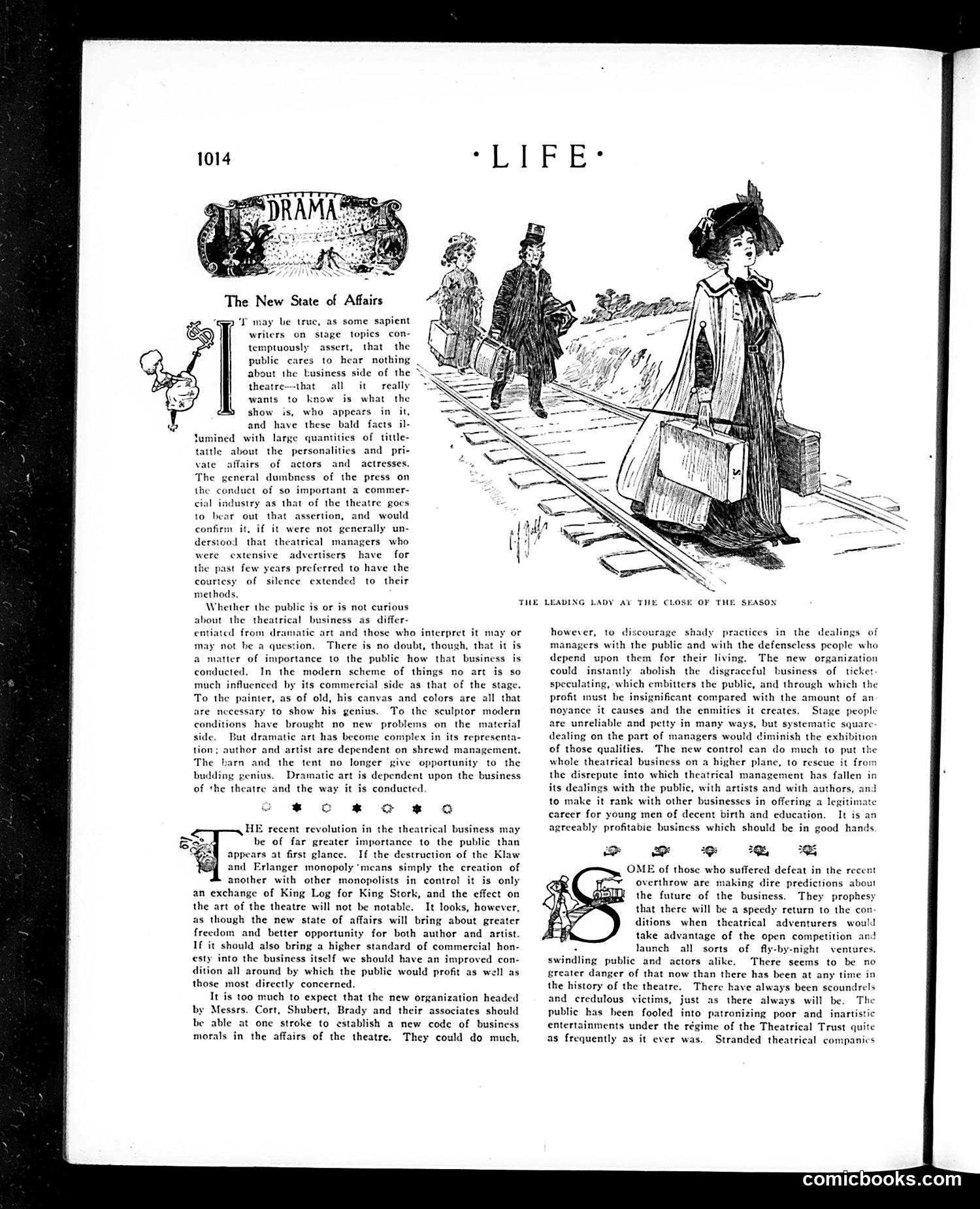
This editorial discusses the recent breakup of the Klaw and Erlanger theatrical monopoly by competitors including Messrs. Cort, Shubert, and Brady. The accompanying illustration shows a fashionably dressed "leading lady" exhausted at season's end, likely symbolizing the theater industry itself worn down by corrupt practices. The article argues that while the public cares mainly about shows and actors' gossip, the *business* of theater matters critically. It criticizes theatrical managers' historical preference for advertising-based silence over accountability, and warns against simply replacing one monopoly with another ("King Log for King Stork"). The piece hopes the new organization will reform notorious abuses: ticket speculation, unreliable casting practices, and exploitation of defenseless performers and authors. The satire's point: theater's artistic reputation depends on honest commercial practices, not just star power.
📄 Transcribed text from this page (OCR, searchable)
Machine-transcribed from the original scan — historical spelling and the odd misread are preserved.
The New State of Affairs ‘TY may be truc, as some sapient writers on stage topics con- temptuously assert, that the public cares to hear nothing . about the business side of the theatre--that all it really wants to know is what the show is, who appears in it, and have these bald facts il- tumined with large quantities of tittle- tattle about the personalities and pri- vate affairs of actors and actresses. The general dumbness of the press on the conduct of so important a commer- cial industry as that of the theatre goes to bear out that assertion, and would confirm it, if it were not generally un- derstood that theatrical managers who were extensive advertisers have for the past few years preferred to have the courtesy of silence extended to their methods. Whether the public is or is not curious about the theatrical business as differ- en d from di ic art and those who interpret it may or may not be a question, There is no doubt, though, that it is a matter of importance to the public how that business is conducted. In the modern scheme of things no art is so much influenced by its commercial side as that of the stage. To the painter, as of old, his canvas and colors are all that ¢ necessary to show his genius. To the sculptor modern conditions have brought no new problems on the material side. But dramatic art has become complex in its representa- tion; author and artist are dependent on shrewd management. The barn and the tent no longer give opportunity to the budding genius. Dramatic art is dependent upon the business of the theatre and the way it is conducted * coc *e Go *€ OG HE recent revolution in the theatrical business may be of far greater importance to the public than Appears at first glance. If the destruction of the Klaw and Erlanger monopoly ‘means simply the creation of another with other monopolists in control it is only an exchange of King Log for King Stork, and the effect on the art of the theatre will not be notable. It looks, however, as though the new state of affairs will bring about greater freedom and better opportunity for both author and artist. If it should also bring a higher standard of commercial hon- esty into the business itself we should have an improved con- dition all around by which the public would profit as well as those most directly concerned. It is too much to expect that the new organization headed by Messrs. Cort, Shubert, Brady and their associates should be able at one stroke to establish a new code of business morals in the affairs of the theatre. They could do much, THE LEADING LADY AY THE CLOSE OF THE SEASON however, to discourage shady practices in the dealings of managers with the public and with the defenseless people who depend upon them for their living. The new organization could instantly abolish the disgraceful business of ticket speculating, which embitters the public, and through which the profit must he insignificant compared with the amount of noyance it causes and the enmities it creates. Stage people are unreliable and petty in many ways, but systematic square dealing on the part of managers would diminish the exhibition of those qualities. The new control can do much to put whole theatrical business on a higher plane, to rescue it fr the disrepute into which theatrical management has fallen in its dealings with the public, with artists and with authors, and to make it rank with other businesses in offering a legitimate career for young men of decent birth and education. It is an agreeably profitabic business which should be in good hands og oo OME of those who suffered defeat in the recent overthrow are making dire predictions about the future of the business. They prophesy that there will be a speedy return to the con ditions when theatrical adventurers would take advantage of the open competition and 5 launch all sorts of fly-by-night ventures. swindling public and actors alike. There seems to be no greater danger of that now than there has been at any time i the history of the theatre. There have always been scoundr and credulous victims, just as there always will be. Th public has heen fooled into patronizing poor and. inartistic entertainments under the régime of the Theatrical Trust quite as frequently as it ever was. Stranded theatrical companics comicbooks.com