
Life, 1910-06-02 · page 27 of 56
Life — June 2, 1910 — page 27: what you’re looking at
What you’re looking at
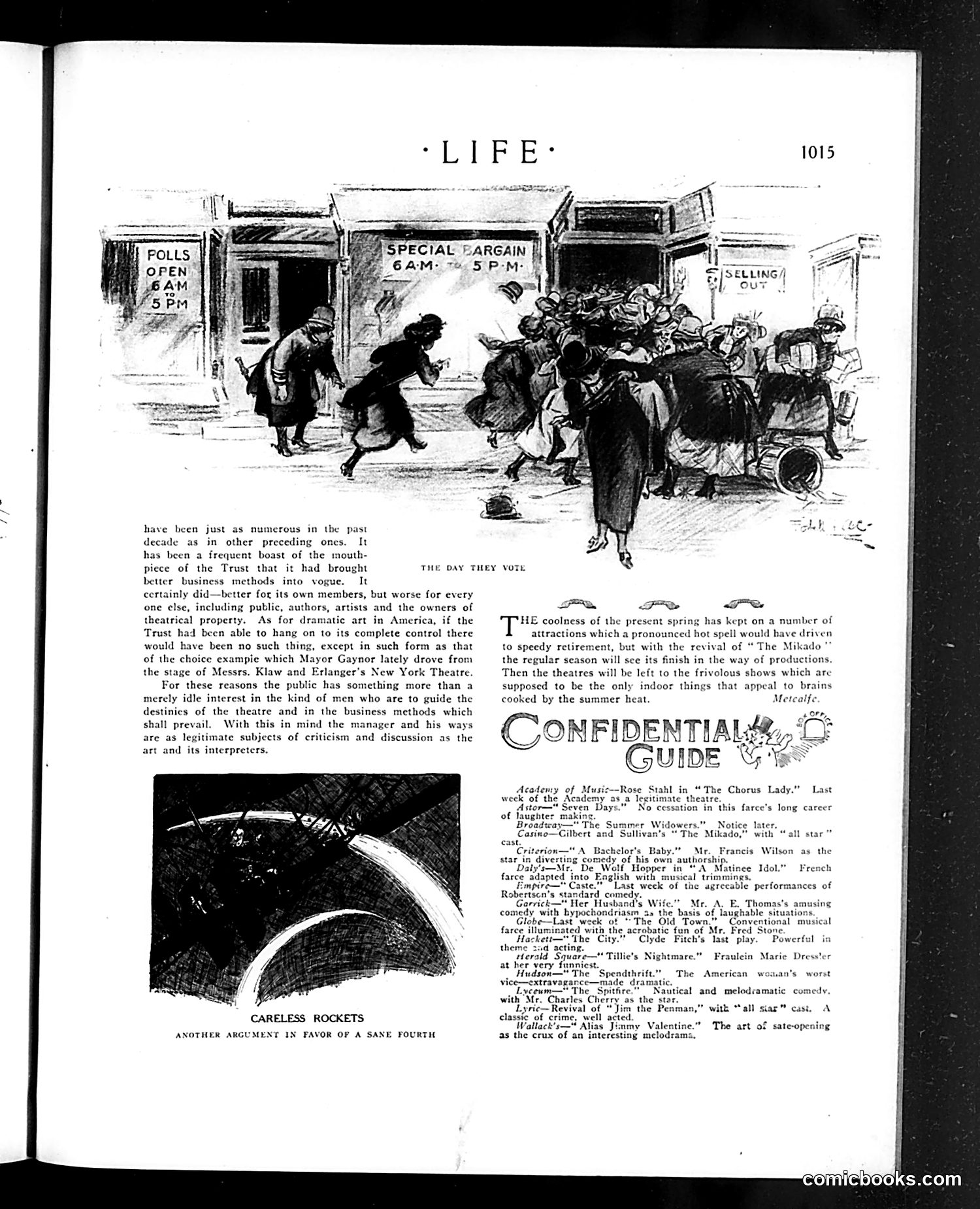
This cartoon satirizes the theatrical monopoly controlled by the "Trust" (the Theatrical Syndicate led by Klaw and Erlanger). The image shows a crowd of theatrical workers—stage hands, performers, and theater employees—swarming toward a polling place marked "Special Bargain" and "Selling Out," depicting them as desperate bargain-hunters. The accompanying text criticizes the Trust's control over American theater, arguing their "better business methods" benefited only themselves while harming public, artists, and theater owners. The cartoon's central joke: when theater workers finally get to "vote" (presumably on labor conditions or theater policy), they'll find only predatory deals—the Trust treating their political voice as just another cheap commodity to exploit. The satirical "Confidential Guide" below lists current theatrical productions, providing context for why theater workers needed representation against monopolistic control.
📄 Transcribed text from this page (OCR, searchable)
Machine-transcribed from the original scan — historical spelling and the odd misread are preserved.
PECIAL BARGAIN "M- 72.5 P-M- have been just as numerous in the past decade as in other preceding oncs. It has been a frequent boast of the mouth- piece of the Trust that it had brought THE DAY THEY VOTE better business methods into vogue. It certainly did—better for its own members, but worse for every one else, including public, authors, ai ts and the owners of theatrical property. As for dramatic art in America, if the Trust had been able to hang on to its complete control there would have been no such thing, except in such form as that of the choice exampie which Mayor Gaynor lately drove from the stage of Messrs. Klaw and Erlanger’s New York Theatre. For these reasons the public has something more than a merely idle interest in the kind of men who are to guide the destinies of the theatre and in the business methods which shall prevail. With this in mind the manager and his ways are as legitimate subjects of criticism and discussion as the art and its interpreters. CARELESS ROCKETS ANOTHER ARGUMENT IN FAVOR OF A SANE FOURTIC HE coolness of the present spring has kept on a number of attractions which a pronounced hot spell would have driven to speedy retirement, but with the revival of “The Mikado" the regular season will sce its finish in the way of productions. Then the theatres will be left to the frivolous shows which arc appeal to brains Metcalfe supposed to be the only indoor thi cooked by the summer heat. sorn, ONFIDENTIALM,, ‘CO C GUIDE a Acaden: hl in “The Chorus Lady.” Last week of the Acaden imate theatre. No cessation in this farce’s long career of laughter Broadwa: 'b + Widowers.” Notice late: cilbert and Sullivan's “The Mikado,” with “all star” A Bachelor's. Baby.” Mr. Francis Wilson as the comedy of his own authorship. Mr. De Wolf Hopper in M apted into English with musical trim Empire—" Caste.” Last week of the agreeable performances of Robertscn’s standard comedy. Garrick—" Her Husband's Wife.” Mr. A. E, Thomas's amusing comedy with bypochondriasm as the basis of iaughable situa Globe—Last week of “The Old Town.” Convent farce illuminated with the acrobatic fun of Mr. Fred $ Hackett—"‘the City.” Clyde Fitch's last play theme sad acting. Herald Square—“ Tillie's Nightmare. at her very funniest. Hudson—" The Spendthrift."| The American woan’s worst vice—extravagance—made dramatic. Lyceum—" The Spitfire.” Nautical and melodcamatic comedy. with Mr. Charles Cherry as the Lyric— Revival of “Jim the Penman,” with “all siar" casi. A classic of crime, well acted. Wallack's—“ Alias Jimmy Valentin as the crux of an interesting melodrama, Powerful " Fraulein Marie Dres: The art of sate-openi