
Life, 1910-06-02 · page 35 of 56
Life — June 2, 1910 — page 35: what you’re looking at
What you’re looking at
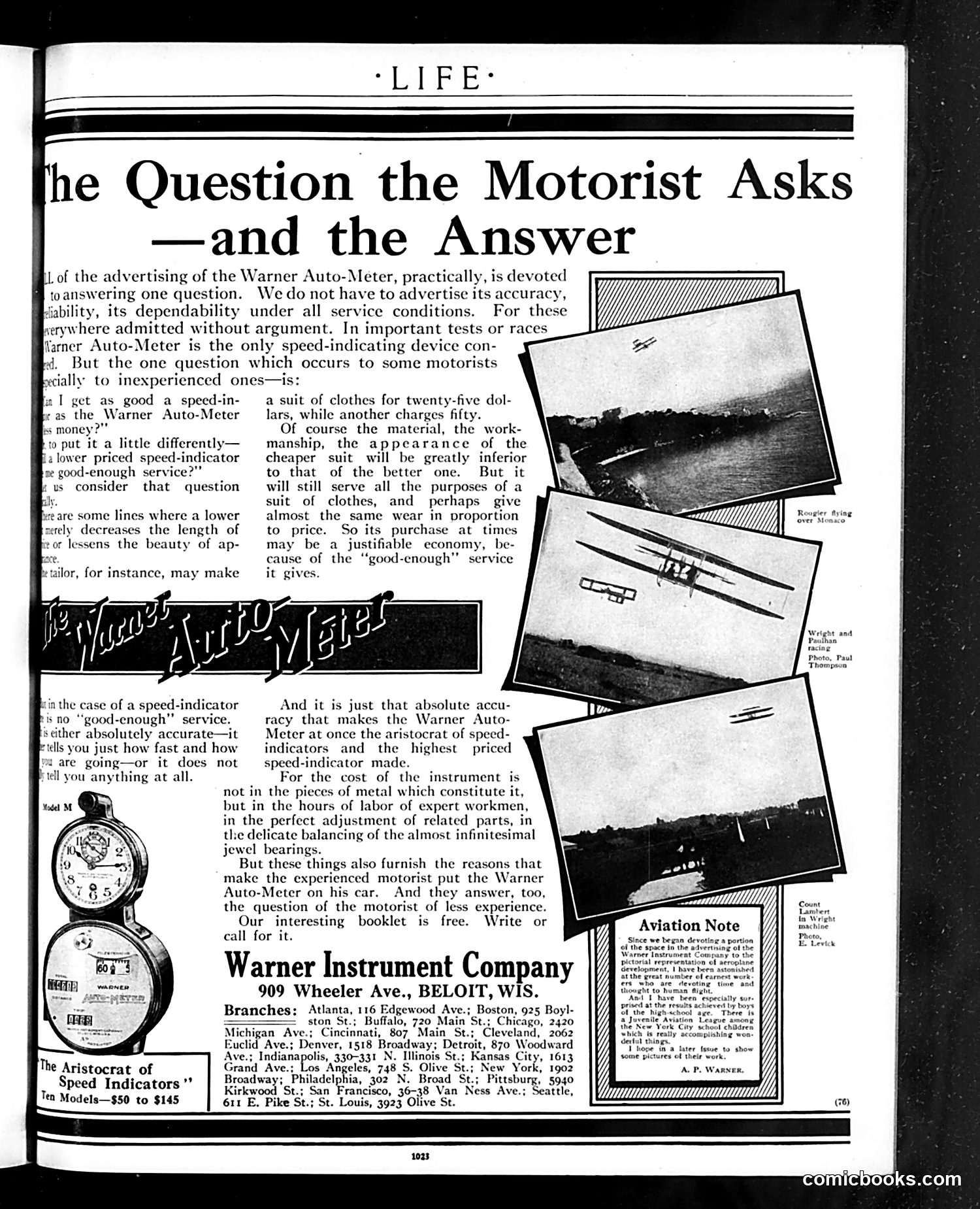
This is primarily a **product advertisement**, not satire or political commentary. It addresses a genuine consumer question of the era: why pay more for a speedometer when cheaper versions exist? The ad uses an analogy—comparing speed indicators to suits of clothing at different price points—to argue that while cheaper options may seem adequate ("good-enough"), the Warner Auto-Meter's superior accuracy justifies its higher cost. The text emphasizes that the price reflects expert labor and precision engineering (jewel bearings, delicate adjustments), not just metal components. The accompanying photographs show the device in use during what appears to be aviation or racing contexts, establishing credibility through real-world application. This reflects early automotive consumer culture, when speedometers were still relatively new technology and motorists genuinely debated whether precision instruments warranted premium pricing. The "Life" magazine placement suggests this targeted affluent readers who could afford quality goods.
📄 Transcribed text from this page (OCR, searchable)
Machine-transcribed from the original scan — historical spelling and the odd misread are preserved.
LAP Ee he Question the Motorist Asks —and the Answer .of the advertising of the Warner Auto-Meter, practically, is devoted @ toanswering one question. We do not have to advertise its accuracy, y Y LLL ability, its dependability under all service conditions. For these herywhere admitted without argument. In important tests or races Varner Auto-Meter is the only speed-indicating device con- . But the one question which occurs to some motorists cally to inexperienced ones—is: iz | get as good a speed-in- x as the. Warner Auto-Meter ss money’? to put it a little differently— alower priced speed-indicator good-enough service?” s consider that question are some lines where a lower decreases the length of lessens the beauty of ap- ilor, for instance, may make ofa speed - indi no “‘good-enough”’ ser ither absolutely acc urate—it you just how fast and how 2 are going—or it does not you anything at all. a suit of clothes for twenty-five dol- lars, while another charges fifty. Of course the material, the work- manship, the appearance of the cheaper suit will be greatly inferior to that of the better one. But it will still serve all the purposes of a suit of clothes, and perhaps give almost the same wear in proportion to price. So its purchase at times y be a justifiable economy, be cause of the ‘“‘good-enough” servic: And it is just that absolute accu- racy that makes the Warner Auto- Meter at once the aristocrat of speed- indicators and the highest priced speed-indicator made. For the cost of the instrument is not in the pieces of metal which constitute it, but in the hours of labor of expert workmen, in the perfect adjustment of related parts, in the delicate balancing of the almost infinitesimal jewel bearings. But these things also furnish the reasons that make the experienced motorist put the Warner Auto-Meter on his car. And they answer, too, the question of the motorist of less experience. Our interesting booklet is free. Write or call for it. Warner Instrument Company 909 Wheeler Ave., BELOIT, WIS. ve ; Boston, 925 Boyl- ; Buffalo, 720 Main’St.; Chicago, 2420 Cincinnati, 807 ‘Main St. land, 2062 ve. 5 ve 518 Broad ; Detroit, 870 Woodward , ; Indianapolis, 330-331 N. Il inois St.; Kansas City, 1613, The Aristocrat of 3 Ave.; Los Angeles, 748 S. Olive St.; New York, 1902 peed Indicators” vi Philadelphia, 302 N. Broad St.; Pittsburg, 5940 Ten M irkwood 'St.; San Francisco, 36-38 Van Ness Ave.; Seattle, & Models—$50 to $145 611 E. Pike St.; St. Louis, 3923 Olive St. (eee | +—_—__—_ LLL vill Z Comicbooks.com