
Life, 1910-06-02 · page 13 of 56
Life — June 2, 1910 — page 13: what you’re looking at
What you’re looking at
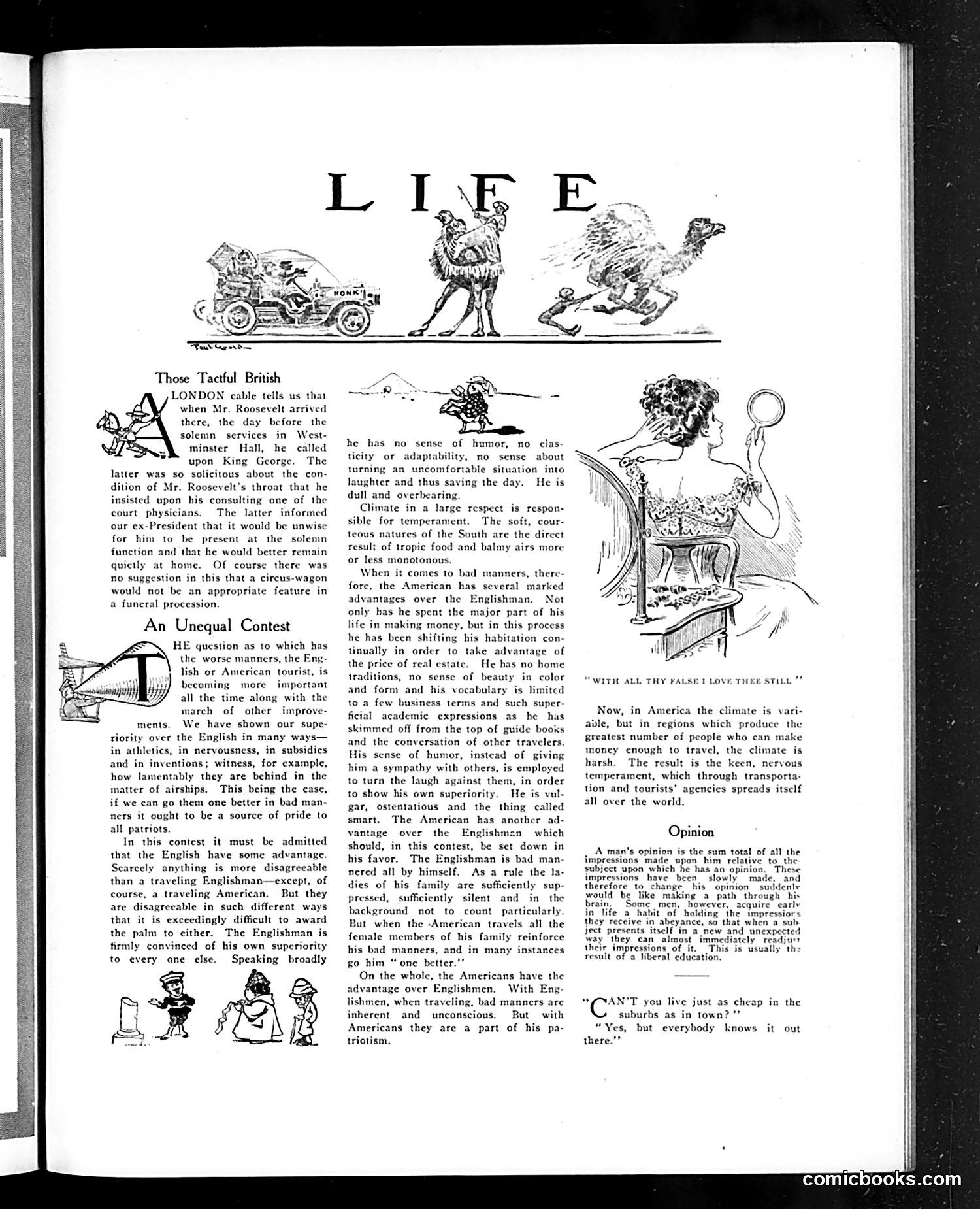
This page compares English and American tourists' manners and behavior abroad. The top illustration shows a sequence: a British tourist in a motorcar, a camel driver, and someone running—likely depicting the "unequal contest" addressed below. "An Unequal Contest" argues that English tourists possess inherent superiority in athletics, performances, and inventions. However, the text ironically critiques English tourists as having bad manners when traveling, appearing "arrogant" and "ostentatious." The counterargument notes Americans have advantages: patriotism and generally better conduct abroad. English tourists allegedly treat themselves as superior to locals and family members, while Americans, though sometimes crude, maintain democratic courtesy. The piece satirizes both nationalities' travel pretensions while suggesting Americans' informal egalitarianism actually makes better tourists than British class consciousness.
📄 Transcribed text from this page (OCR, searchable)
Machine-transcribed from the original scan — historical spelling and the odd misread are preserved.
Those Tactful British LONDON cable tells us that when Mr, Roosevelt arrived there, the day before the solemn services in West- minster Hall, he called upon King George. The latter was $0 Solicitous about the con- dition of Mr. Roosevelt's throat that he insisted upon his consulting one of the court physicians. The latter informed our ex-President that it would be unwise for him to be present at the solemn function and that he would better remain quietly at home. Of course there w no suggestion in this that a circus: would not be an appropriate feature in a funeral procession. An Unequal Contest aN HE question as to which has the worse manners, the Eng lish or American tourist, is becoming more important all the time along with the march of other improve- ments. We have shown our supe- riority over the English in many ways— in athletics, in nervousness, in subsidies and in inventions; witness, for example, how lamentably they are behind in the matter of airships. This being the case, if we can go them one better in bad man- ners it ought to be a source of pride to all patriots. In this contest it must be admitted that the English have some advantage. Scarcely anything is more disagreeable than a traveling Englishman—except, of course, a traveling American. But they are disagreeable in such different ways that it is exceedingly difficult to award the palm to either. The Englishman is firmly convinced of his own supcriority to every one clse. Speaking broadly he has no sense of humor, no clas- ticity or adaptability, no sense about turning an uncomfortable situation into laughter and thus saving the day. He is dull and overbearing. Climate in a large respect is respon- sible for temperament. The soft, cour- teous natures of the South are the direct result of tropic food and balmy airs more or less monotonous. When it comes to bad manners, there- fore, the American has several marked advantages over the Englishman. Not only has he spent the major part of his life in making money, but in this process he has been shifting his habitation con- tinually in order to take advantage of the price of real estate. He has no home traditions, no sense of beauty in color and form and his vocabulary is limited to a few business terms and such super- ficial academic expressions as he has skimmed off from the top of guide books and the conversation of other travelers. His sense of humor, instead of giving him a sympathy with others, is employed to turn the laugh against them, in order to show his own superiority. He is vul- gar, ostentatious and the thing called smart. The American has another ad- vantage over the Englishman which should, in this contest, be set down in his favor. The Englishman is bad man- nered all by himself. As a rule the la- dies of his family are sufficiently sup- pressed, sufficiently silent and in the background not to count particularly. But when the -American travels all the female members of his family reinforce his bad manners, and in many instances go him “one better.”” On the whole, the Americans have the advantage over Englishmen. With Eng- lishmen, when traveling, bad manners are inherent and unconscious. But with Americans they are a part of his pa- triotism, “WITH ALL THY FALSE 1 LOVE THEE STILL Now, in America the climate is vari- able, but in regions which produce the greatest number of people who can make money enough to travel, the climate is harsh, The result is the keen, nervous temperament, which through transporta tion and tourists’ agencies spreads itself all over the world. Opinion __A man’s opinion is the sum total of all the impressions made upon him relative to_the subject upon which he has an opi These impressions have been. slowly and therefore to change his opinion sudden would be like making a path through brain, Some men, however, acquire. ¢ in life a habit of holding the impressiors they receive in abeyance, so that when a sub. ject presents itself in a new and unexpected way they can almost immediately readjuet their impressions of it. This is usually th: result of a liberal education, “QPAN'T you live just as cheap in the suburbs as in town?" “Yes, but everybody knows it there. out comicbooks.com