
Life, 1910-06-02 · page 22 of 56
Life — June 2, 1910 — page 22: what you’re looking at
What you’re looking at
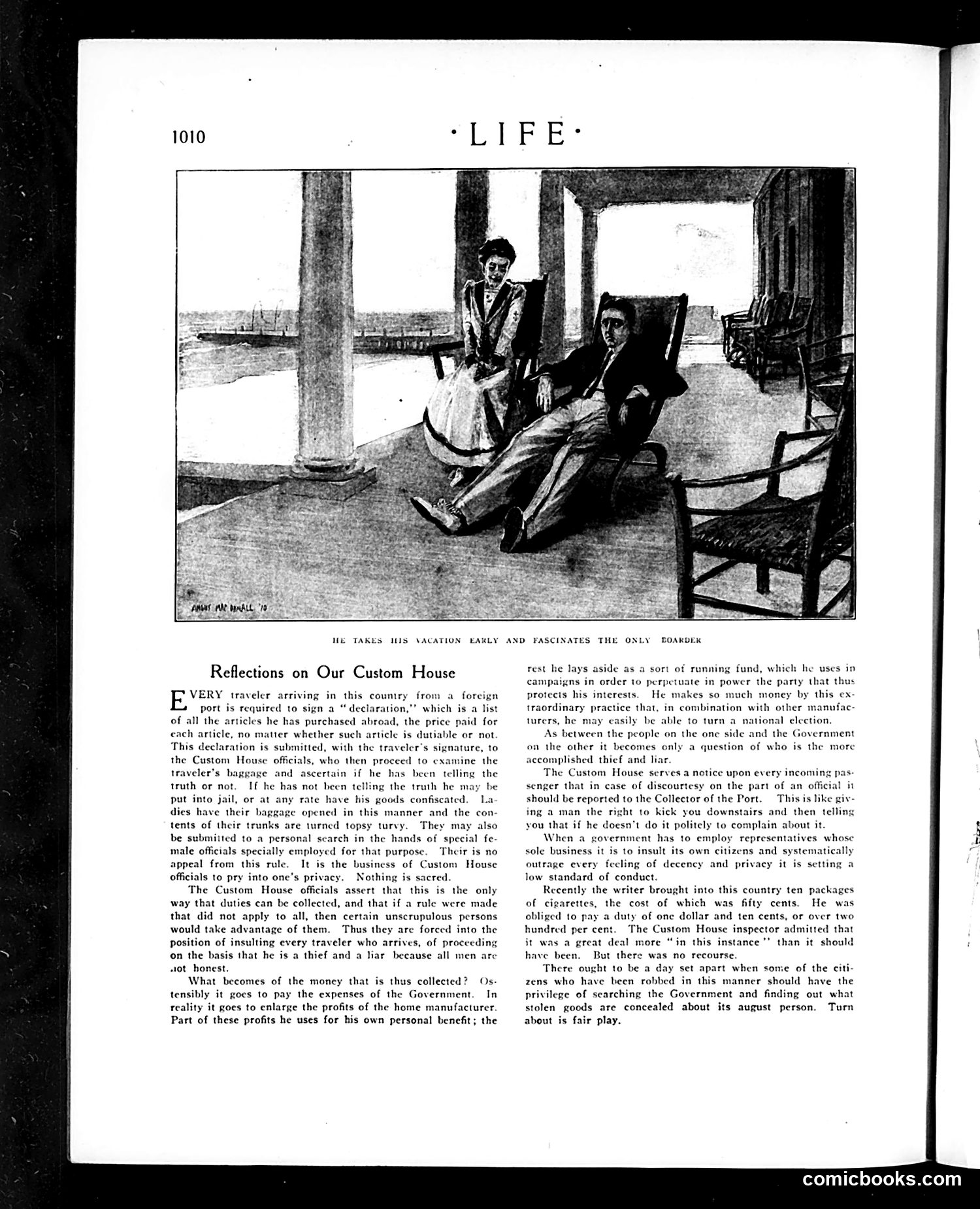
This is satirical editorial commentary, not a cartoon. The illustration shows a man relaxing while a woman stands—captioned "He takes his vacation early and fascinates the only boarder," suggesting customs officials avoid their duties. The text argues that U.S. Customs House practices are tyrannical and corrupt. Travelers must declare purchases and submit to searches under threat of jail or confiscation. The author contends: 1. **Intrusion**: Officials treat all travelers as thieves and liars, violating privacy 2. **Economic corruption**: Tariff money enriches manufacturers who use profits to influence elections 3. **Double standard**: Citizens can report rude officials to the Collector, but have no real recourse—like complaining after being kicked downstairs 4. **Hypocrisy**: The author paid $1.10 duty on fifty-cent cigarettes (over 200%), which the inspector admitted was excessive but unchangeable The satire's climax: citizens should have the right to search government officials for "stolen goods" in return—"turn about is fair play." The piece attacks protectionist tariffs and government overreach as systematic robbery of the public.
📄 Transcribed text from this page (OCR, searchable)
Machine-transcribed from the original scan — historical spelling and the odd misread are preserved.
ME TAKES MIS VACATION EAKLY Reflections on Our Custom House Y traveler arriving in this country from a foreign port is required to sign a “declaration,”’ which is a list of all the articles he has purchased abroad, the price paid for cach article, no matter whether such article is dutiable or not This declaration is submitted, with the traveler's signature, to the Custom House officials, who then proceed to examine the traveler's baggage and ascertain if he has been telling the truth or not. If he has not been telling the truth he may be put into jail, or at any rate have his goods confiscated. La dies have their baggage opened in this manner and the con- tents of their trunks are turned topsy turvy. They may a be submitted to a personal search in the hands of special fe- male officials specially employed for that purpose. Their is no appeal from this rule. It is the business of Custom House officials to pry into one's privacy. Nothing is sacred. The Custom House officials assert that this is the only way that duties can be collected, and that if a rule were made that did not apply to all, then certain unscrupulous persons would take advantage of them. Thus they are forced into the position of insulting every traveler who arrives, of proceeding on the basis that he is a thief and a liar because all men are stot_honest. What becomes of the money that is thus collected? Os. tensibly it goes to pay the expenses of the Government. In reality it goes to enlarge the profits of the home manufacturer Part of these profits he uses for his own personal benefit ; the AND FASCINATES THE ONLY BDOAKDEK rest he lays aside as a sort of running fund, which he uses in campaigns in order to perpetuate in power the party that thus protects his interests. He makes so much money by this ex: traordinary practice that, in combination with other manufac- turers, he may easily be able to turn a national election. As between the people on the one side and the Government on the other it becomes only a question of who is the more accomplished thief and li. The Custom House serves a notice upon every incoming pas- senger that in case of discourtesy on the part of an official it should be reported to the Collector of the Port. This is like giv- ing a man the right to kick you downstairs and then telling you that if he doesn’t do it politely to complain about it. When a government has to employ representatives whose sole business it is to insult its own citizens and systematically outrage every feeling of decency and privacy it is setting a low standard of conduct. Recently the writer brought into this country ten packages of cigarettes, the cost of which was fifty cents. He was obliged to pay a duty of one dollar and ten cents, or over two hundred per ce: The Custom House inspector admitted that it was a great deal more “jin this instance ’’ than it should have been. But there was no recourse. There ought to be a day set apart when some of the citi zens who have been robbed in this manner should have the privilege of searching the Government and finding out what stolen goods are concealed about its august person. Turn about is fair play. comicbooks.com