
Life, 1910-06-02 · page 33 of 56
Life — June 2, 1910 — page 33: what you’re looking at
What you’re looking at
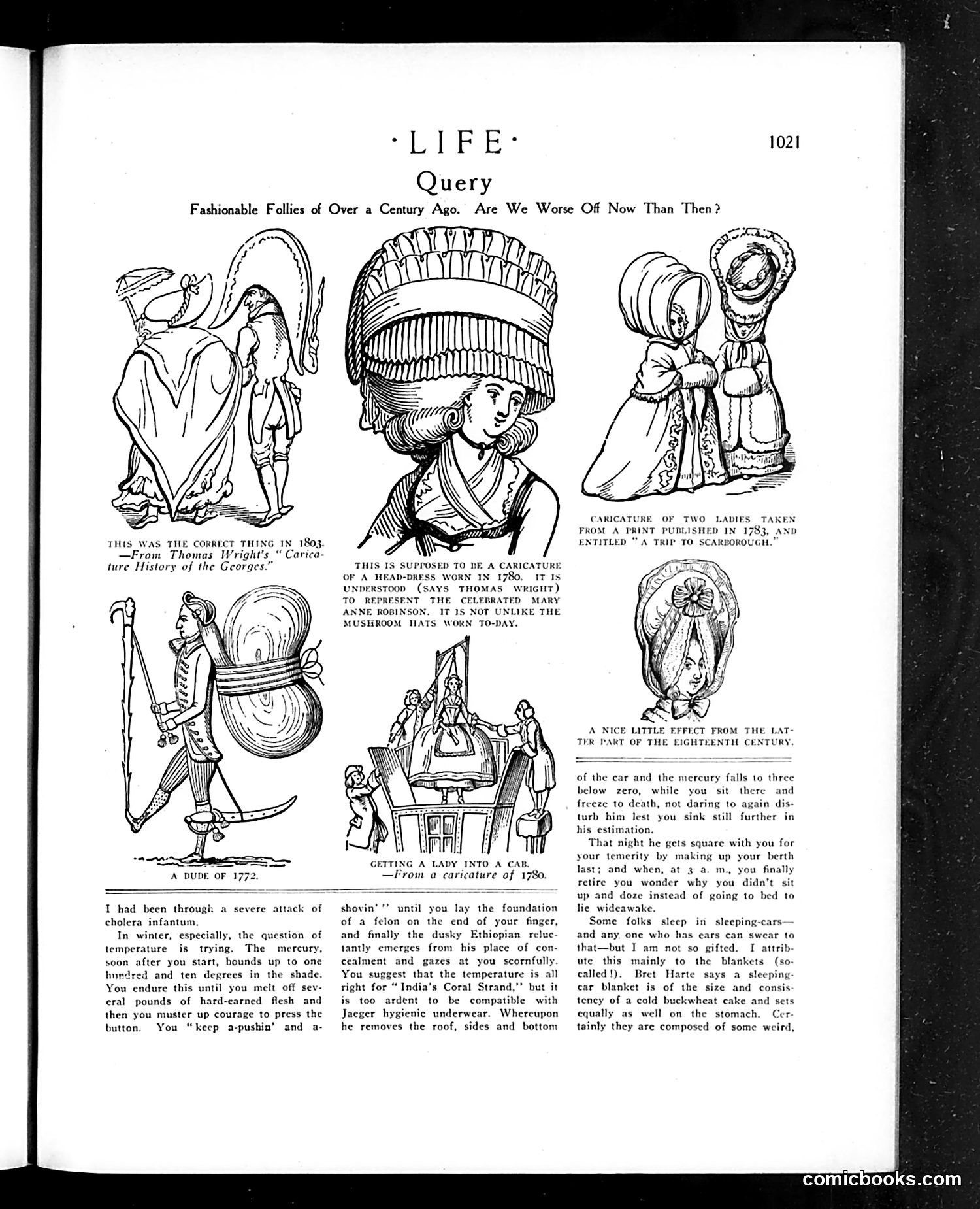
This *Life* magazine page compares fashionable absurdities across centuries to ask: "Are We Worse Off Now Than Then?" **The Historical Caricatures** show 1770s-1780s fashion follies: impossibly tall head-dresses (one allegedly depicting actress Mary Anne Robinson), women squeezed into carriages, and exaggerated wigs. The text notes these styles were genuinely mocked in their time. **The Modern Parallel** is the accompanying essay about train travel discomfort—a contemporary (early 1900s) complaint about overheated railway cars, uncooperative porters, and inadequate blankets. The satirical point: humans have always endured fashion and comfort absurdities. Yesterday's ridiculous hairstyles equal today's uncomfortable transportation and poor sleeping conditions. **The Satire's Message**: Rather than progress, each era simply exchanges one set of inconveniences for another. We mock our ancestors' vanity, yet tolerate our own petty miseries with equal stubbornness.
📄 Transcribed text from this page (OCR, searchable)
Machine-transcribed from the original scan — historical spelling and the odd misread are preserved.
‘LIFE: Query Fashionable Follies of Over a Century Ago. Are We Worse Off Now Than Then ? CARICATURE OF TWO LADIES TAKEN FROM A PRINT PUBLISHED IN 1783, AND THIS WAS THE CORRECT TH. ENTITLED “A TRIP TO SCARBOROUGH. —From Thomas Wright ture History of the Georges.” “ Carica- THIS IS SUPPOSED TO BE A CARICATURE OF A HEAD-DRESS WORN IN 1780, IT IS UNDERSTOOD (SAYS THOMAS WRIGHT) TO REPRESENT THE CELEBRATED MARY ANNE ROBINSON, IT 18 NOT UNLIKE THE A DUDE OF 1772. MUSHROOM HATS WORN TO-DAY. GETTING A LADY INTO A CAR. —From a caricature of 1780. I had been through a severe attack of cholera infantum. In winter, especially, the question of temperature is trying. The mercury, soon after you start, bounds up to one hundred and ten degrees in the shade. You endure this until you melt off sev- eral pounds of hard-earned flesh and then you muster up courage to press the button. You “keep a-pushin’ and a- shovin’’’ until you lay the foundation of a felon on the end of your finger, and finally the dusky Ethiopian reluc- tantly emerges from his place of con- cealment and gazes at you scornfully. You suggest that the temperature is all right for “ India’s Coral Strand,” but it is too ardent to be compatible with Jaeger hygienic underwear. Whereupon he removes the roof, sides and bottom A NICE LITTLE EFFECT FROM THE LAT- TER PART OF THE EIGHTEENTH CENTURY. of the car and the mercury falls 10 three below zero, while you sit there and freeze to death, not daring to again dis- turb him lest you sink still further in his estimation. That night he gets square with you for your temerity by making up your berth last; and when, at 3 a. m., you finally retire you wonder why you didn’t sit up and doze instead of going to bed to lie wideawake. Some folks sleep in sleeping-cars. and any one who has ears can swear to that—but I am not so gifted. I attrib: ute this mainly to the blankets (so- called!). Bret Harte says a sleeping car blanket is of the size and consis tency of a cold buckwheat cake and sets equally as well on the stomach. Cer- tainly they are composed of some weird, comicbooks.com