
Life, 1910-06-02 · page 14 of 56
Life — June 2, 1910 — page 14: what you’re looking at
What you’re looking at
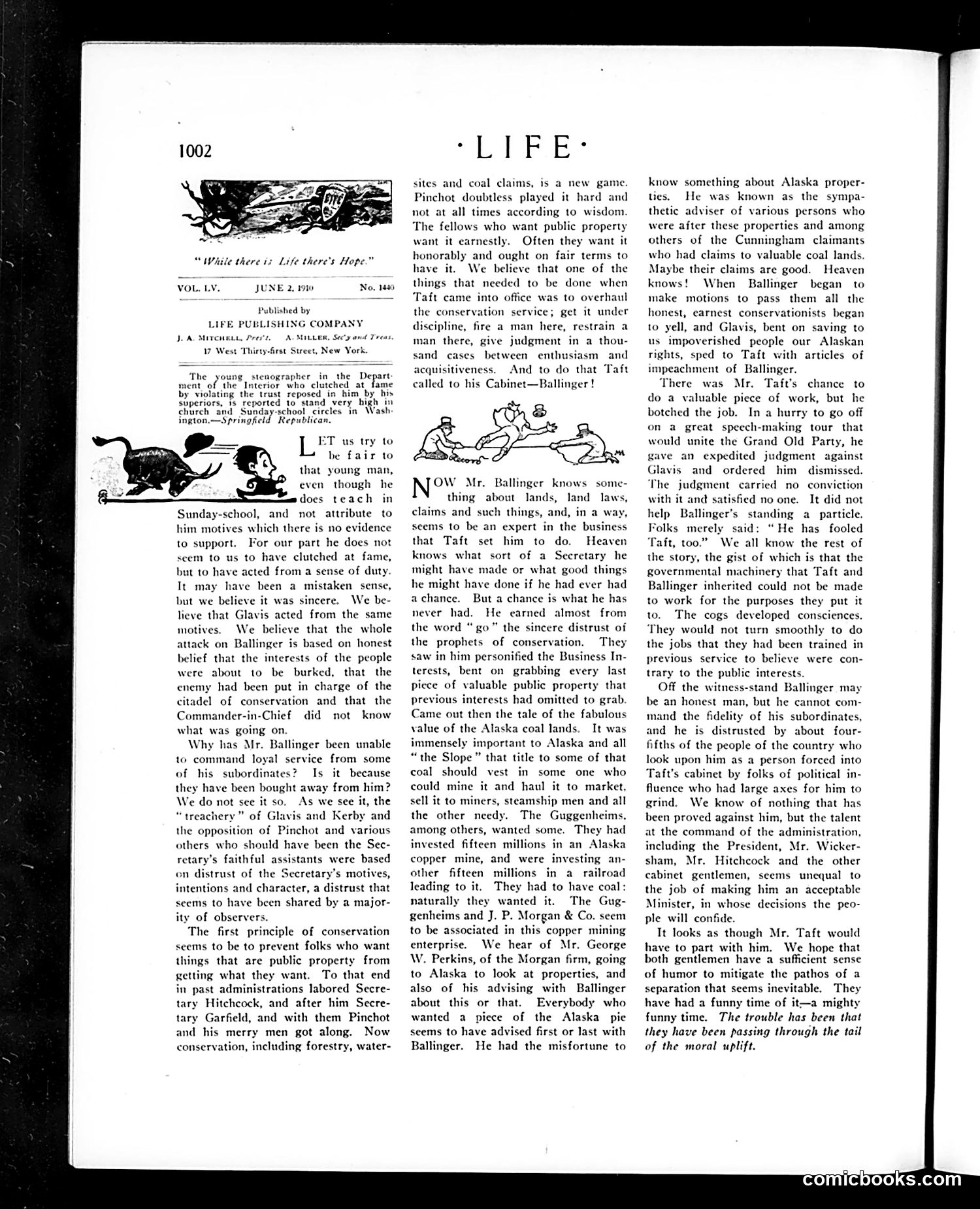
This page satirizes the Ballinger-Pinchot conservation controversy, a major scandal of President Taft's administration. The text defends Secretary of the Interior Richard Ballinger against accusations of corruption regarding Alaska coal lands. The article argues that Ballinger's subordinates—including Louis Glavis and Gifford Pinchot (former chief forester)—acted from honest conviction that Ballinger favored business interests over conservation, not from disloyalty or bribery. It acknowledges Pinchot "played it hard" but suggests Taft needed to overhaul the conservation service upon taking office. The cartoon (top-left) shows what appears to be a dog chasing or attacking a figure, likely representing the relentless public attacks on Ballinger, satirizing how his reputation was "clutched at" by critics. The piece expresses frustration that Ballinger never received fair treatment, having earned "sincere distrust" from conservationists who viewed him as representing business interests—particularly the Guggenheims' Alaska copper and coal operations.
📄 Transcribed text from this page (OCR, searchable)
Machine-transcribed from the original scan — historical spelling and the odd misread are preserved.
“While there iz Life there's Hope.” VOL. LY. JUNE 2, 1910 ublished by LIFE PUBLISHING COMPANY JA MITCHELL, Pres A MILLER, Sec'y and Treas W West Thirty-first Street, New York. ‘The tenographer in the Depart mento Interior who clutched at fame by violating the trust reposed in him by his superiors, 18 reported to stand very high in church and Sunday-school circles in Wash ington.—Springfeld Republica’ ET us try to be fair to that young man, even though he does teach in Sunday-school, and not attribute to him motives which there is no evidence to support. For our part he does not seem to us to have clutched at fame, but to have acted from a sense of duty It may have been a mistaken sense, but we believe it was sincere. We be- lieve that Glavis acted from the same motives. We believe that the whole attack on Ballinger is based on honest belief that the interests of the people were about to be burked, that the enemy had been put in charge of the citadel of conservation and that the Commander-in-Chief did not know what was going on. Why has Mr. Ballinger been unable to command loyal service from some of his subordinates? Is it because they have been bought away from him? We do not see it so. As we see it, the “treachery” of Glavis and Kerby and the opposition of Pinchot and various others who should have been the Sec- retary’s faithful assistants were based on distrust of the Secretary’s motives, intentions and character, a distrust that seems to have been shared by a major- ity of observers. The first principle of conservation seems to be to prevent folks who want things that are public property from getting what they want. To that end in past administrations labored Secre- tary Hitchcock, and after him Secre- tary Garfield, and with them Pinchot and his merry men got along. Now conservation, including forestry, water- “1 PB sites and coal claims, is a new game. Pinchot doubtless played it hard and not at all times according to wisdom. The fellows who want public property want it earnestly. Often they want it honorably and ought on fair terms to have it. We believe that one of the things that needed to be done when Taft came into office was to overhaul the conservation service; get it under discipline, fire a man here, restrain a man there, give judgment in a thou- between enthusiasm and acquisitiveness. And to do that Taft called to his Cabinet—Ballinger ! sand cases OW Mr. Ballinger knows some- thing about lands, land law claims and such things, and, in a way, scems to be an expert in the business that Taft set him to do. Heaven knows what sort of a Sceretary he might have made or what good things he might have done if he had ever had achance. But a chance is what he has never had. He earned almost from the word “go” the sincere distrust of the prophets of conservation. They saw in him personified the Business In- terests, bent on grabbing every last piece of valuable public property that previous interests had omitted to grab Came out then the tale of the fabulous value of the Alaska coal lands. It was immensely important to Alaska and all “the Slope” that title to some of that coal should vest in some one who could mine it and haul it to market, sell it to miners, steamship men and all the other needy. The Guggenheims, among others, wanted some. They had invested fifteen millions in an Alaska copper mine, and were investing an- other fifteen millions in a railroad leading to it. They had to have coal: naturally they wanted it. The Gug- genheims and J. P. Morgan & Co. seem to be associated in this copper mining enterprise. We hear of Mr. George W. Perkins, of the Morgan firm, going to Alaska to look at properties, and also of his advising with Ballinger about this or that. Everybody who wanted a piece of the Alaska pie scems to have advised first or last with Ballinger. He had the misfortune to know something about Alaska proper- He was known as the sympa- thetic adviser of various persons who were after these properties and among others of the Cunningham claimants who had claims to valuable coal lands. Maybe their claims are good. Heaven knows! When Ballinger began to make motions to pass them all the honest, earnest conservationists began to yell, and Glavis, bent on saving to us impoverished people our Alaskan rights, sped to Taft with articles of impeachment of Ballinger. There was Mr. Taft's chance to do a valuable piece of work, but he botched the job. In a hurry to go off on a great speech-making tour that would unite the Grand Old Party, he gave an expedited judgment against Glavis and ordered him dismissed. The judgment carried no conviction with it and satisfied no one. It did not help Ballinger’s standing a_ particle. Folks merely said: “He has fooled Taft, too.” We all know the rest of the story, the gist of which is that the governmental machinery that Taft and Ballinger inherited could not be made to work for the purposes they put it to. The cogs developed consciences. They would not turn smoothly to do the jobs that they had been trained in previous service to believe were con- trary to the public interests. Off the witness-stand Ballinger may be an honest man, but he cannot com- mand the fidelity of his subordinates, and he is distrusted by about four- fifths of the people of the country who look upon him as a person forced into Taft's cabinet by folks of political in- fluence who had large axes for him to grind. We know of nothing that has been proved against him, but the talent at the command of the administration, including the President, Mr. Wicker- sham, Mr. Hitchcock and the other cabinet gentlemen, seems unequal to the job of making him an acceptable Minister, in whose decisions the peo- ple will confide. It looks as though Mr. Taft would have to part with him. We hope that both gentlemen have a sufficient sense of humor to mitigate the pathos of a separation that seems inevitable. They have had a funny time of it—a mighty funny time. The trouble has been that they have been passing through the tail of the moral uplift. ties. books.com