
A complete issue · 44 pages · 1910
Life — April 14, 1910
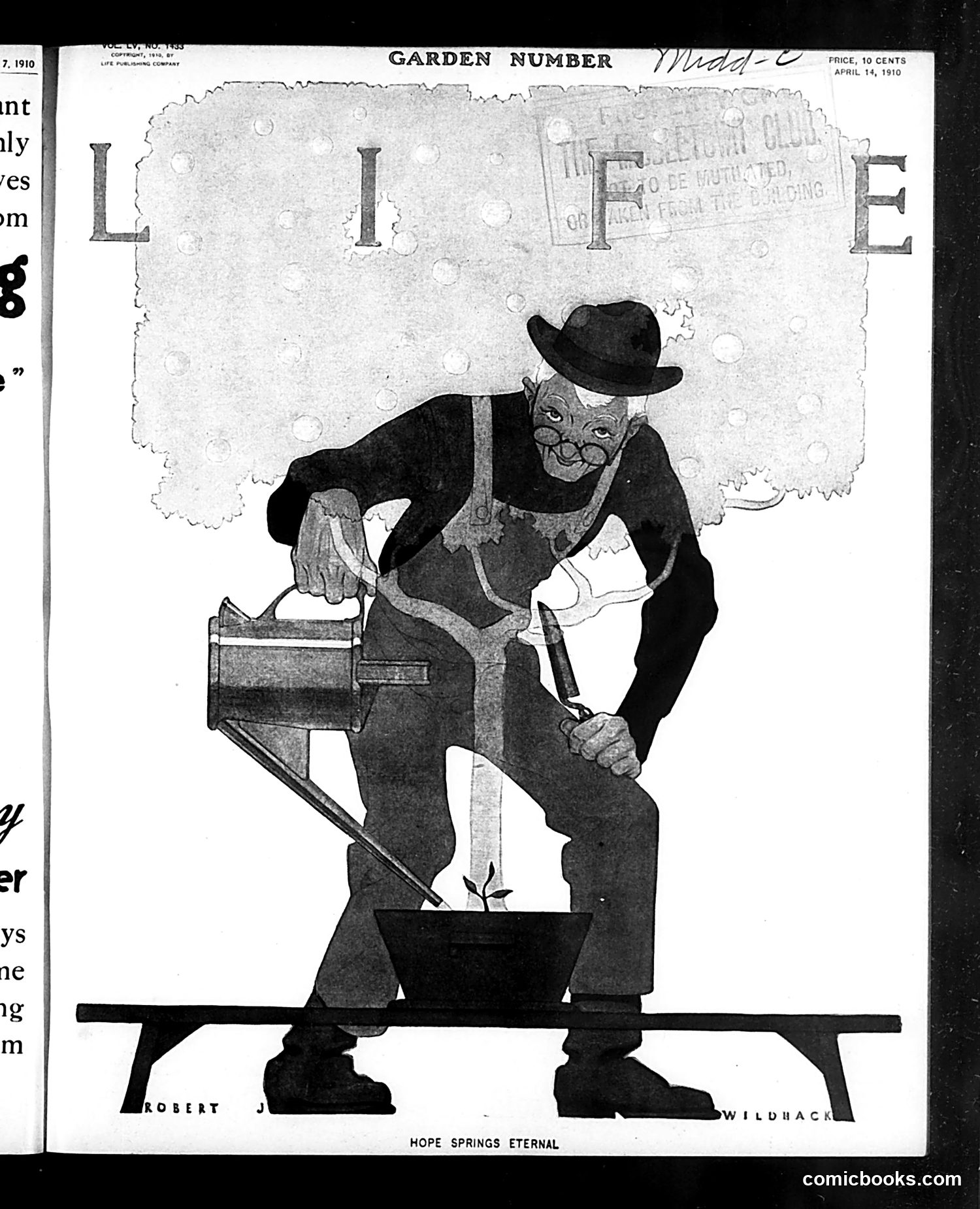
This cover depicts a caricatured gardener planting something in soil, with the title "LIFE" and subtitle "HOPE SPRINGS ETERNAL." The artist is credited as Robert J. Wildhack. The image appears to be satirizing optimism or naive hope. The exaggerated facial features and hunched posture suggest mockery of someone engaging in futile or absurd effort. "Hope springs eternal" is a literary reference suggesting perpetual, possibly irrational optimism despite repeated disappointments. Without additional context from the magazine's interior pages, the specific target of satire remains unclear—it could reference political policies, economic schemes, or social movements of 1910. The gardening metaphor likely critiques someone attempting to cultivate success from unlikely or barren ground.
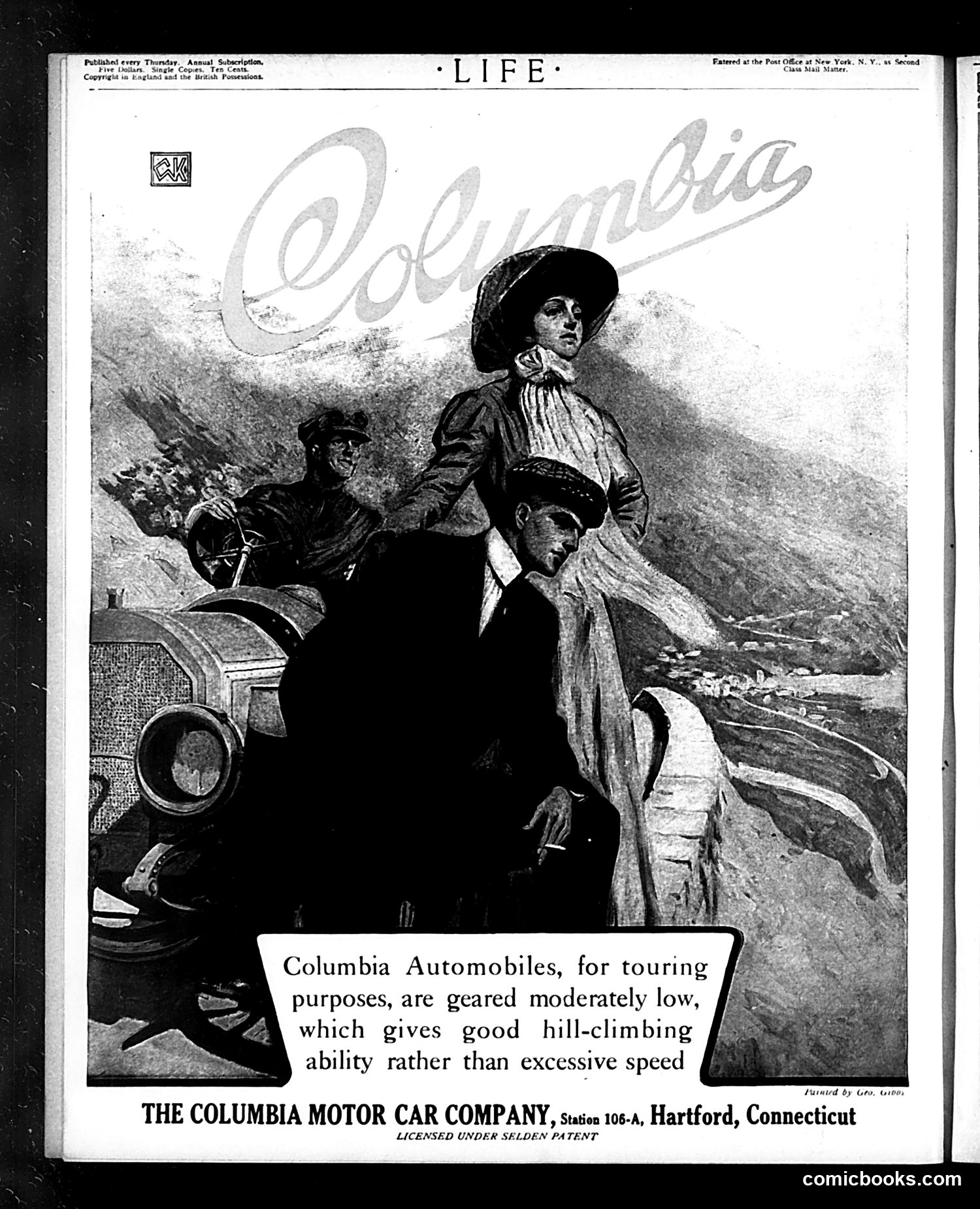
This is primarily a **Columbia Motor Car Company advertisement**, not political satire. The image depicts an elegantly dressed woman in a wide-brimmed hat and fashionable coat standing beside a Columbia automobile, with a male chauffeur visible in the vehicle and mountainous scenery behind. The advertisement's text emphasizes that Columbia automobiles feature moderate gear ratios, prioritizing hill-climbing ability over excessive speed—a practical selling point for early 1900s vehicles when good road infrastructure was limited. The styling and composition suggest this targets affluent, leisure-oriented consumers (note the woman's fashionable dress and touring context). There is no discernible political or social satire—this is straightforward commercial messaging from Hartford, Connecticut.
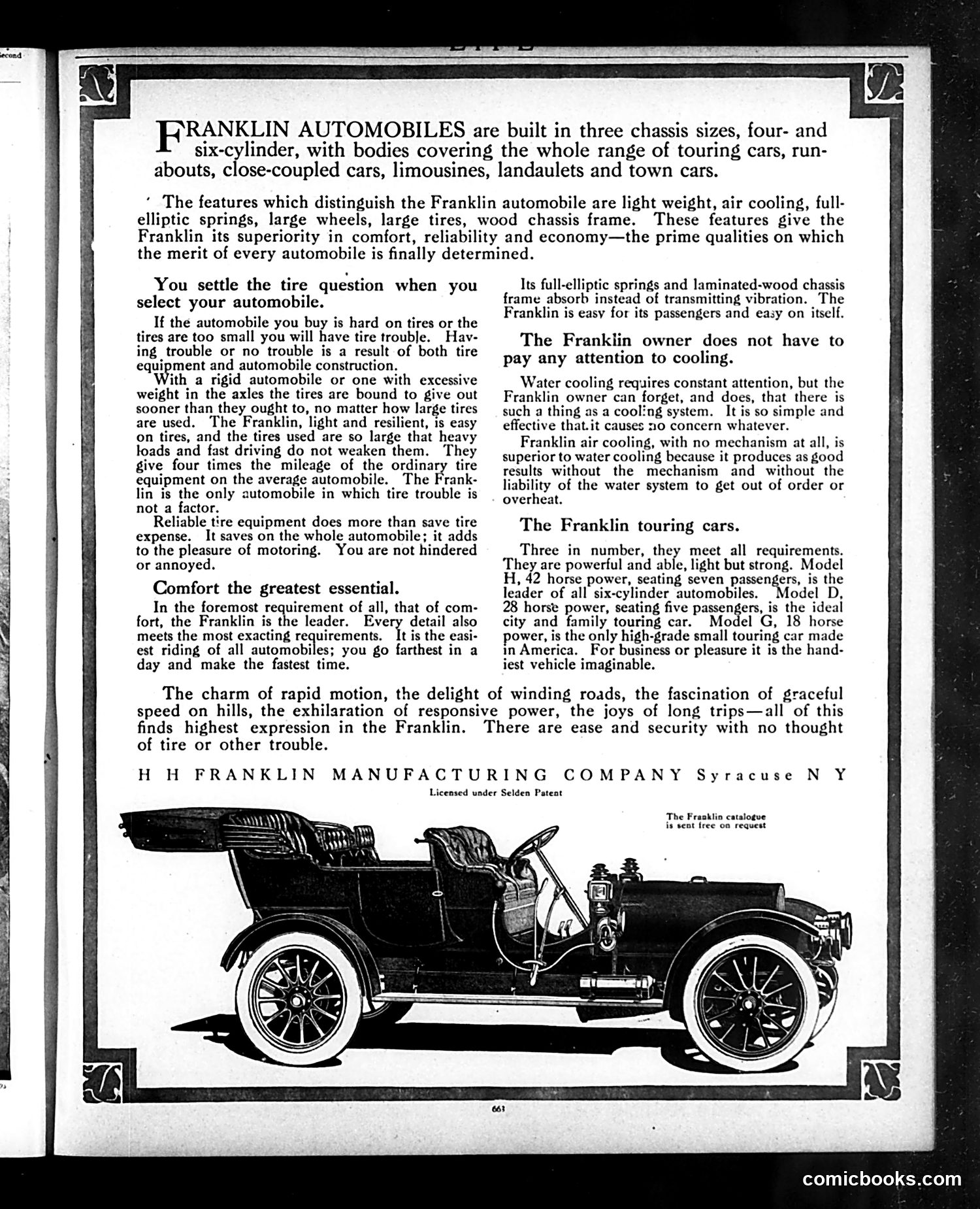
This is **not a political cartoon or satirical content**—it's a straightforward automobile advertisement for Franklin automobiles, published in *Life* magazine. The page promotes Franklin's key selling points: light weight, air cooling (rather than water cooling), full-elliptic springs, and wood chassis frames. The text emphasizes comfort, reliability, and economy. Three touring car models are mentioned: Models H, D, and G. The illustration shows a side-view technical drawing of an open-air touring car typical of the early automobile era, displaying the vehicle's construction and design. This represents ordinary commercial advertising rather than editorial satire or political commentary. The Franklin Manufacturing Company was based in Syracuse, New York, and this ad reflects early-20th-century automotive marketing.
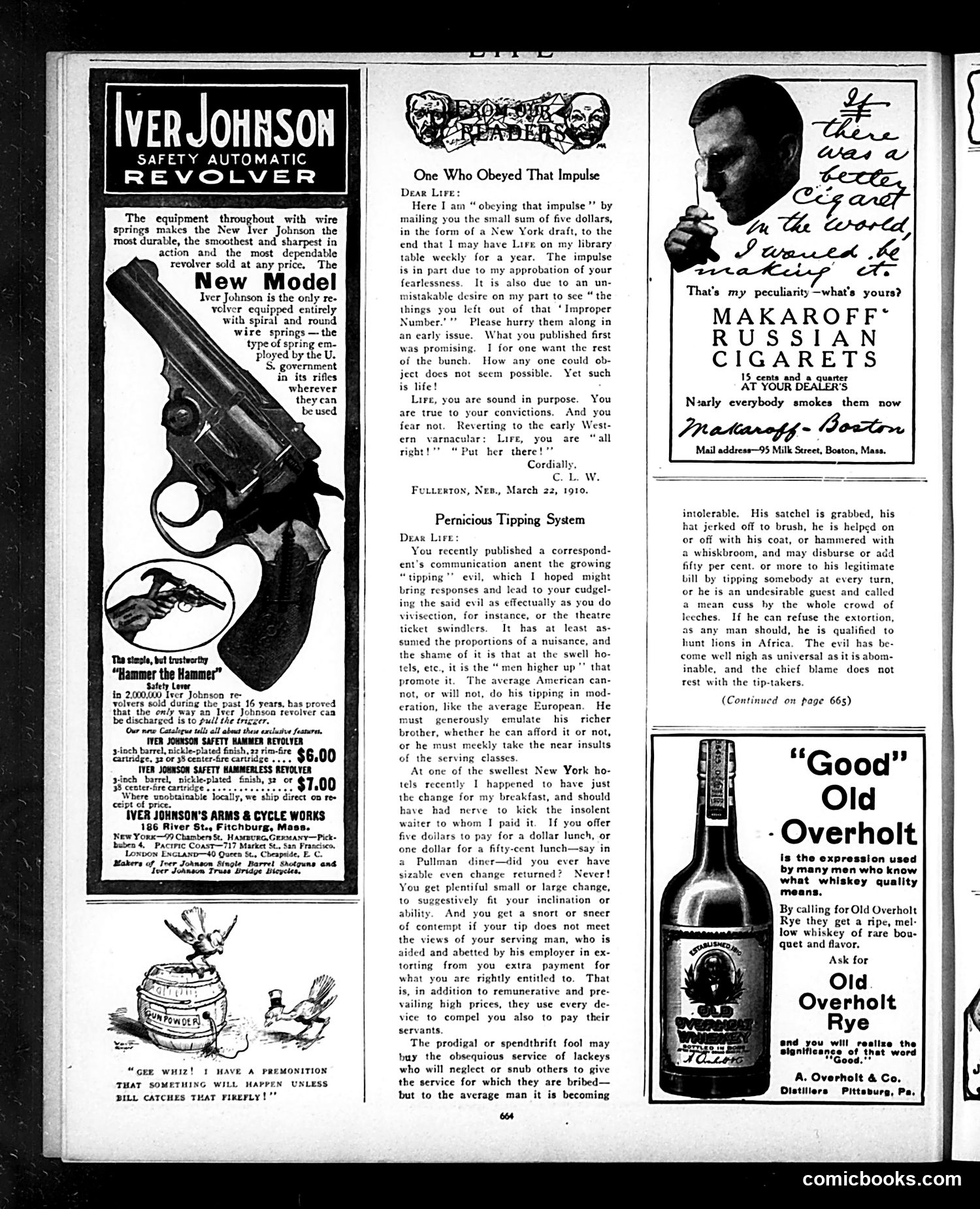
This page is primarily **advertising**, not political satire. The main content includes: 1. **Iver Johnson Revolver ad** (left): Promotes a new revolver model, emphasizing durability and reliability for civilian use. 2. **Letter to the Editor** (center): A reader responds to Life's coverage of "tipping culture," arguing Americans should embrace modest tipping practices rather than excessive amounts. The writer criticizes both over-tipping and under-tipping as social problems. 3. **Makaroff Russian Cigarettes ad** (upper right): A lifestyle advertisement featuring a man with a cigarette, suggesting the brand's popularity. 4. **Old Overholt Rye Whiskey ad** (lower right): A liquor advertisement emphasizing quality whiskey. The page reflects early 20th-century consumer culture and social etiquette concerns, with minimal satirical content.
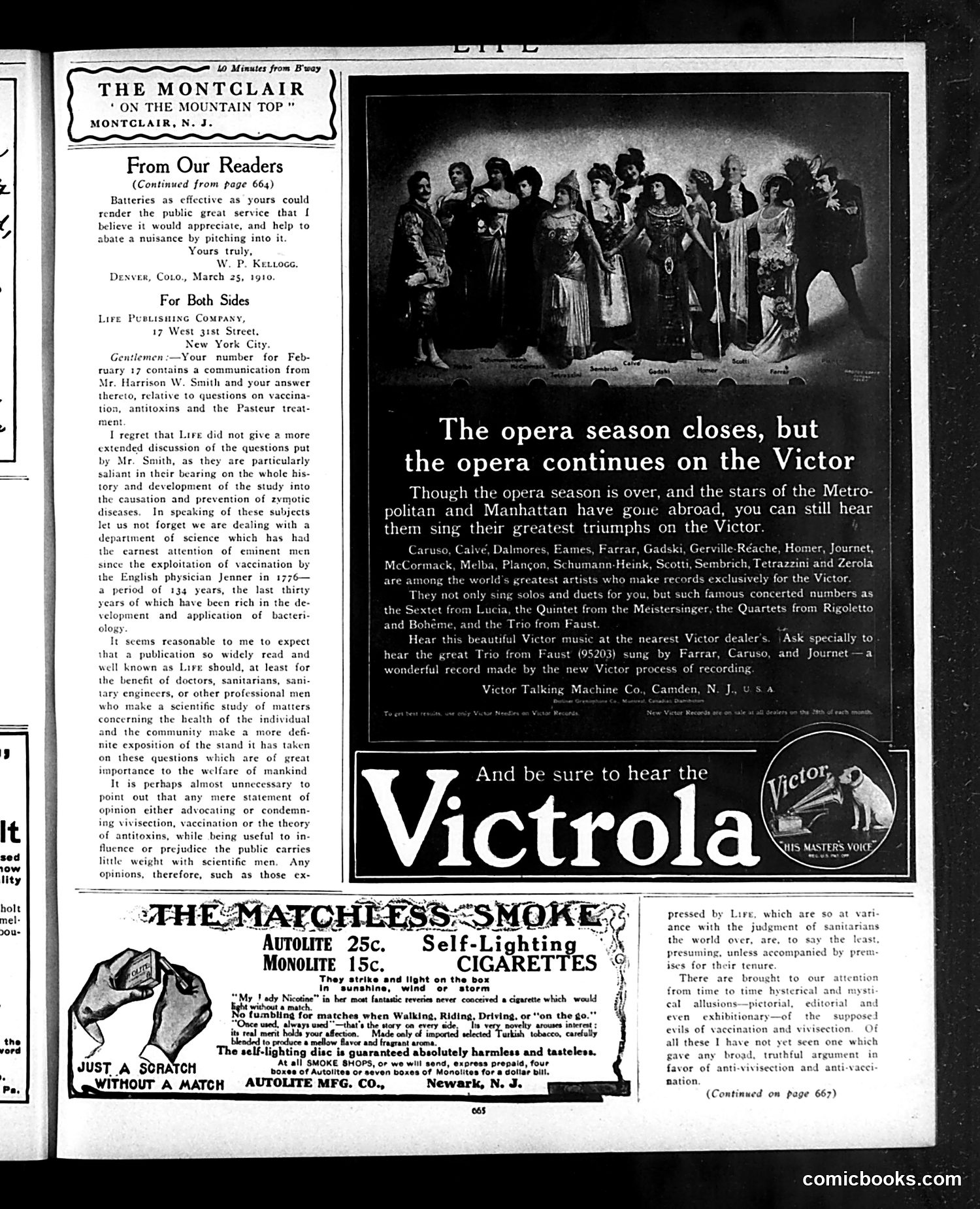
This page is primarily **advertising and entertainment content** rather than political satire. The main features are: 1. **Victrola advertisement** (center): Promotes Victor Records' opera catalog, listing famous singers (Caruso, Melba, Homer, etc.). It's marketing recorded music as an alternative to live opera now that "the opera season closes." 2. **The Matchless Smoke advertisement** (bottom): Promotes Autolite and Monolite cigarettes as "self-lighting" products that work "in sunshine, wind or storm" without needing matches. The tagline emphasizes convenience for people "Walking, Riding, Driving, or 'on the go.'" 3. **Reader letter** (left): Discusses vaccination and antitoxins in response to earlier magazine content. The page reflects early 20th-century consumer culture, marketing emerging technologies (recorded music, self-lighting cigarettes) to modern, mobile Americans.
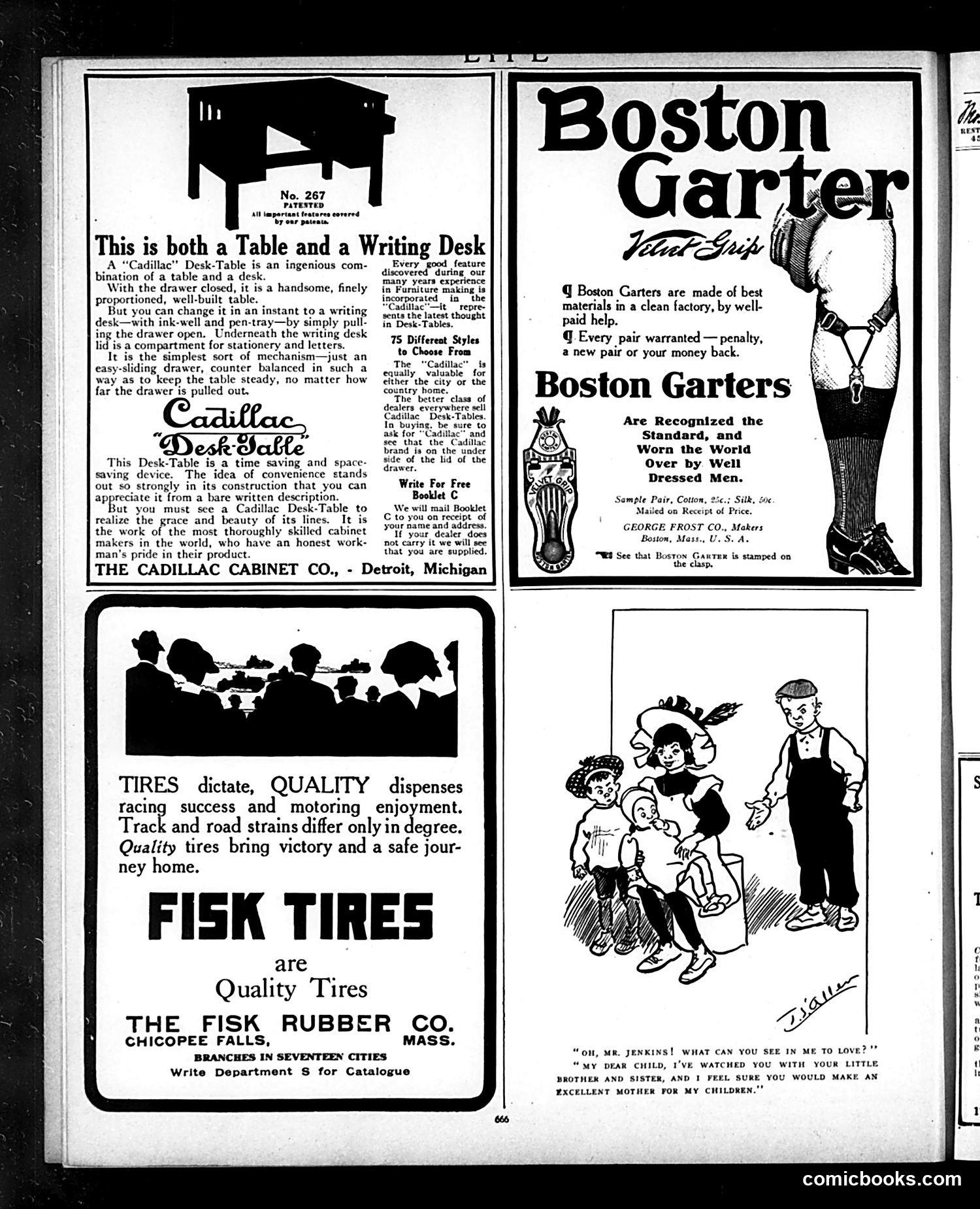
This page is primarily **advertising, not satire or political commentary**. It contains three ads: 1. **Cadillac Desk-Table** (top left): A furniture advertisement for a convertible desk that transforms into a writing surface. 2. **Boston Garters** (top right): An ad for men's garters, emphasizing quality and that they're "worn the world over by well dressed men." 3. **Fisk Tires** (bottom left): A tire advertisement using the slogan "Quality Tires," with a silhouette of racing spectators. 4. **Bottom right**: A domestic scene showing a man with children and a woman, captioned with Mr. Jenkins praising the woman as a potential mother figure—a sentimental family-focused advertisement (product unclear from visible text). No political cartoons or satire appear on this page.
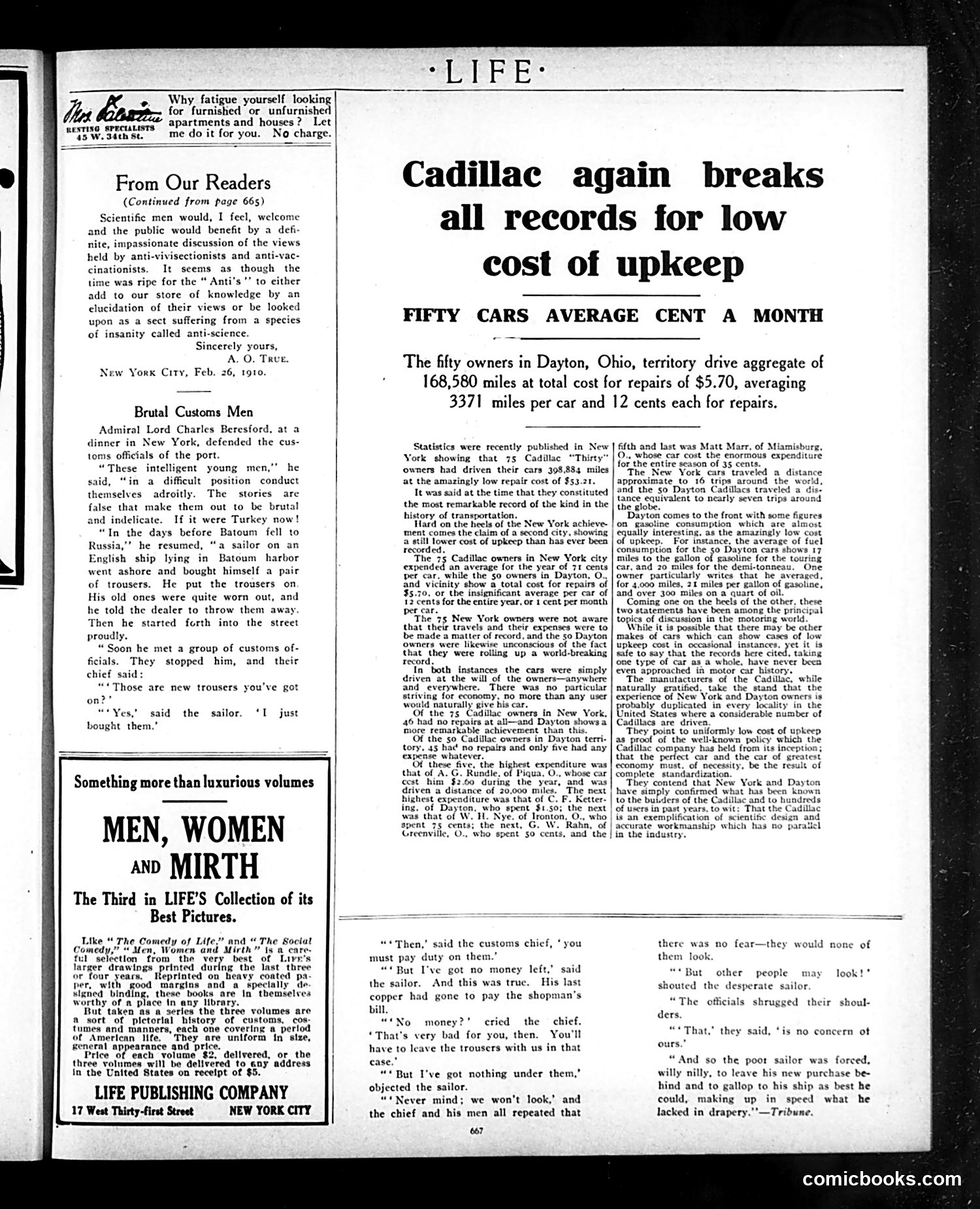
This page contains no political cartoon. Instead, it features: 1. **"From Our Readers"** — A letters column where a New York scientist advocates for public discussion of anti-vivisection views, and another reader criticizes customs officials as "brutal" after witnessing them confiscate a sailor's newly purchased trousers. 2. **Main Article** — "Cadillac again breaks all records for low cost of upkeep," documenting that 50 Cadillac owners in Dayton, Ohio averaged just 12 cents per car monthly in repairs, establishing the brand's reliability claim. 3. **Advertisement** — For Life Publishing Company promoting "Men, Women and Mirth," the third volume in their picture collection series. The page is primarily informational and promotional rather than satirical.
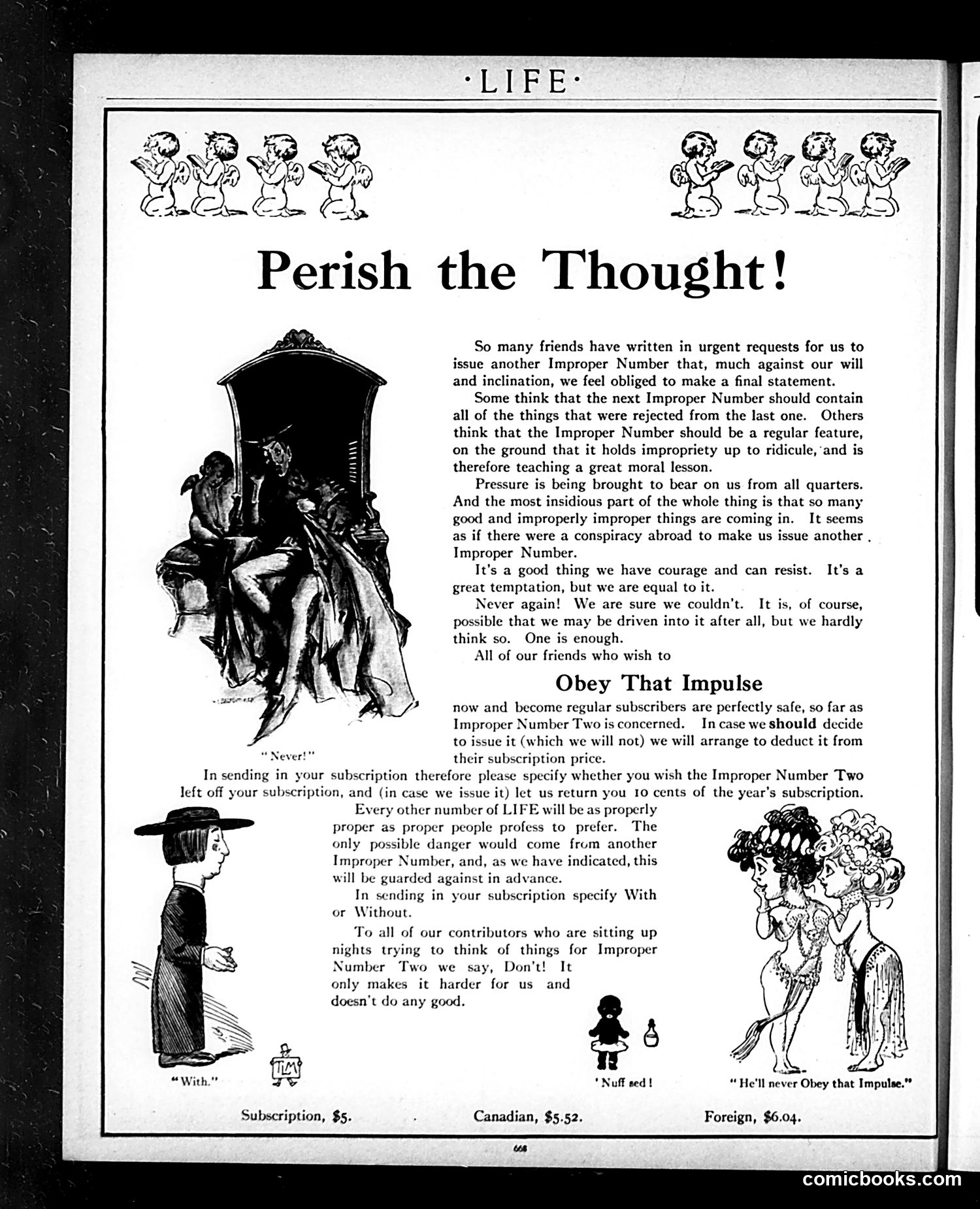
This page is primarily an **editorial statement, not satire**, addressing subscriber pressure on the magazine to publish another "Improper Number." The editors firmly reject this demand, arguing one such issue was sufficient. They acknowledge the temptation but declare they have "courage and can resist." The illustrated figures reinforce the message: a figure labeled **"With"** (presumably representing compliance with pressure), contrasted with **"Nuff sed!"** (enough said) and a woman captioned **"He'll never Obey that Impulse"** (resisting impropriety). The editors invite subscribers to either accept their position or unsubscribe, offering a refund if they proceed without a second improper issue. **Context**: "Improper Numbers" were LIFE's risqué, humor-focused special issues that pushed contemporary decency boundaries—apparently popular but controversial with some readers.
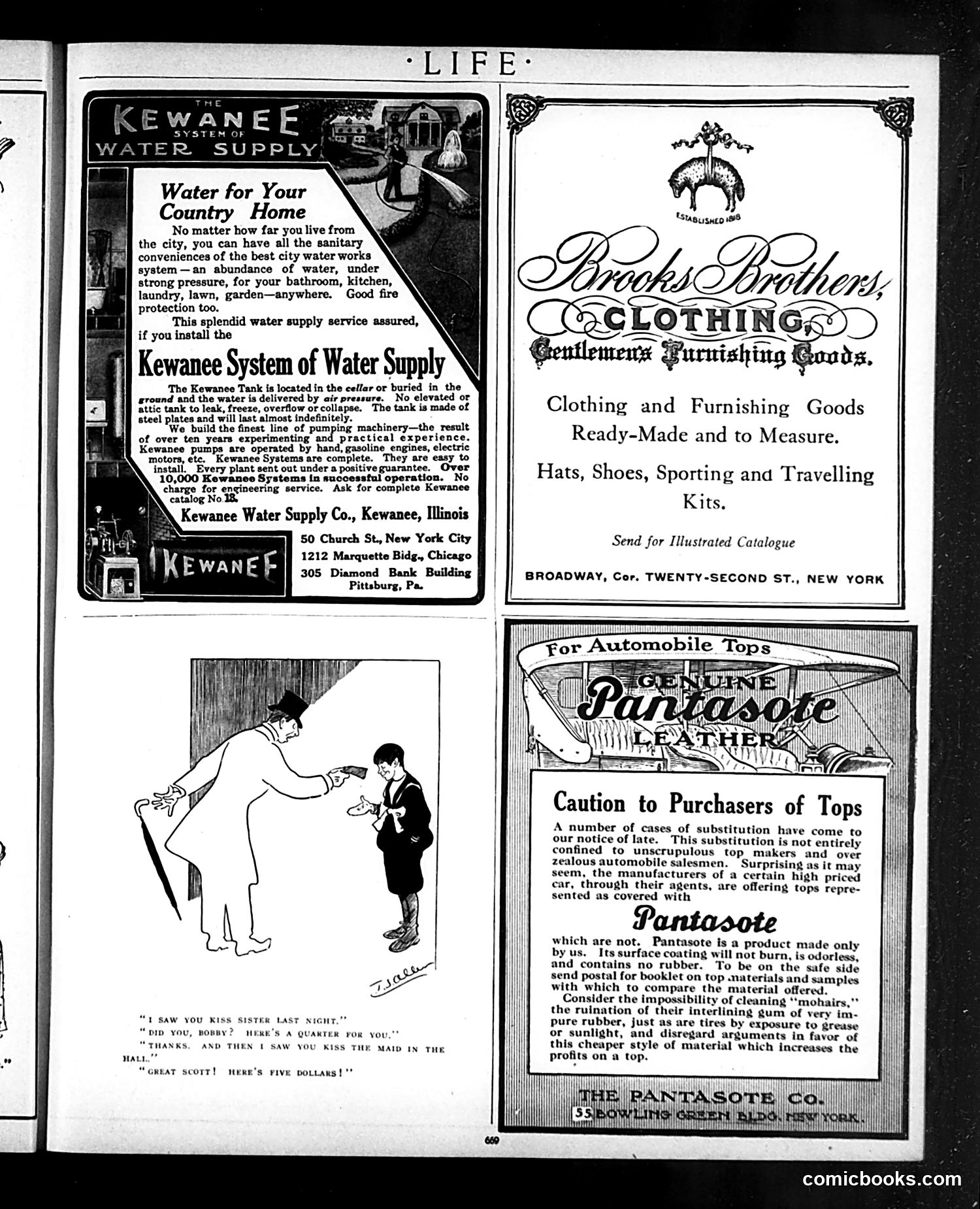
This is primarily a **LIFE magazine advertisement page** (page 660), containing three commercial ads rather than editorial cartoons. The single cartoon depicts a humorous domestic scene: a woman in a hat appears to be physically striking a small boy while recounting nighttime activities. The dialogue suggests she caught them kissing ("I saw you kiss sister last night") and is punishing the boy, who claims his actions were innocent ("Did you, Bobby? Here's a quarter for you!"). The humor relies on the absurdity of the woman's contradictory responses—threatening punishment while rewarding him with money. The remaining content advertises the **Kewanee Water Supply system**, **Brooks Brothers clothing**, and **Pantasote automobile leather tops**. Without visible publication date or cartoonist signature, the cartoon's exact historical context remains unclear, though it reflects early 20th-century attitudes toward domestic discipline and courtship etiquette.
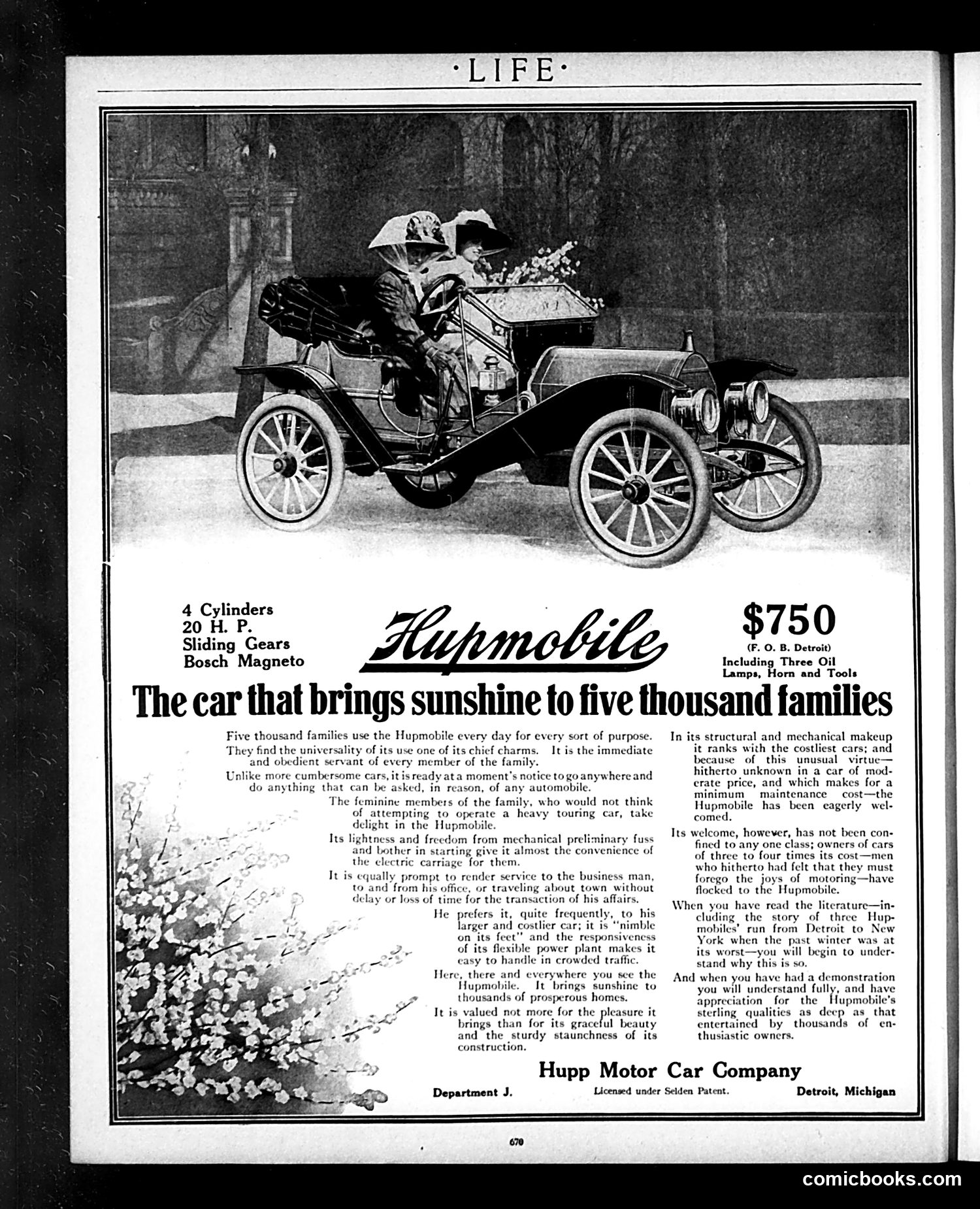
This is a **product advertisement**, not political satire. It promotes the Hupmobile automobile manufactured by the Hupp Motor Car Company of Detroit, Michigan. The ad features an early 1910s touring car with two elegantly dressed passengers. The tagline—"The car that brings sunshine to five thousand families"—uses aspirational language typical of period advertising, suggesting the vehicle democratizes luxury and leisure. Key selling points listed include 4 cylinders, 20 horsepower, sliding gears, and a $750 price (relatively affordable for the era). The ad emphasizes the car's reliability, ease of handling in traffic, low maintenance, and appeal to both families and businessmen. There is **no political satire or social commentary** here—just straightforward early automotive marketing.
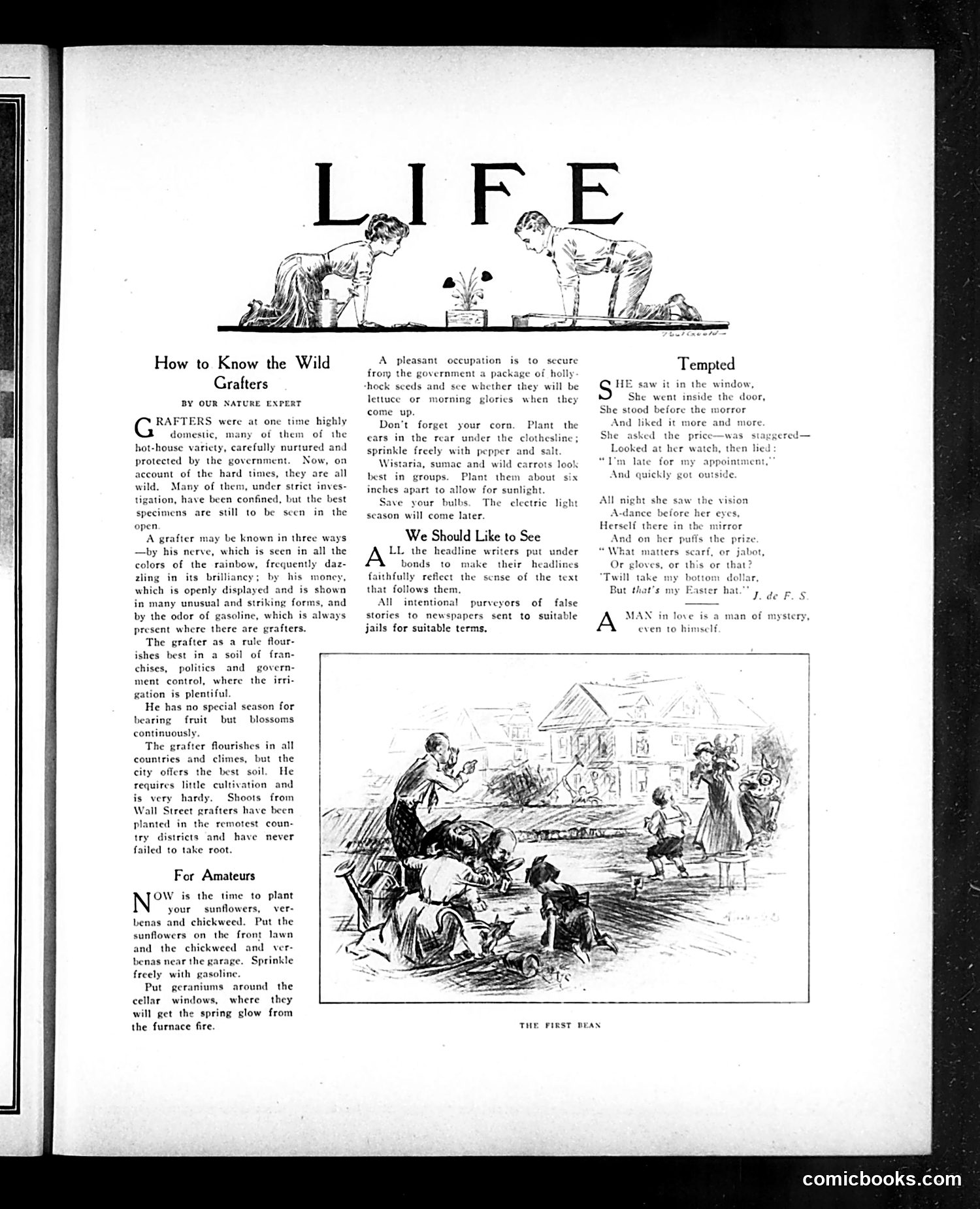
This page contains practical gardening and nature advice rather than political satire. The main sections include: **"How to Know the Wild Grafters"** — educational content about grafting plants, describing how grafters were "carefully nurtured" specimens that should be preserved. **"We Should Like to See"** — a brief section criticizing newspaper headline writers for sensationalism and false stories. **"For Amateurs"** — spring gardening tips for planting sunflowers, sweet peas, and other flowers. **The illustration** titled "The First Peas" depicts children discovering or harvesting pea plants in a domestic garden setting. This appears to be a straightforward lifestyle/home-and-garden feature rather than political or social satire, typical of Life magazine's broader content mix during this era.
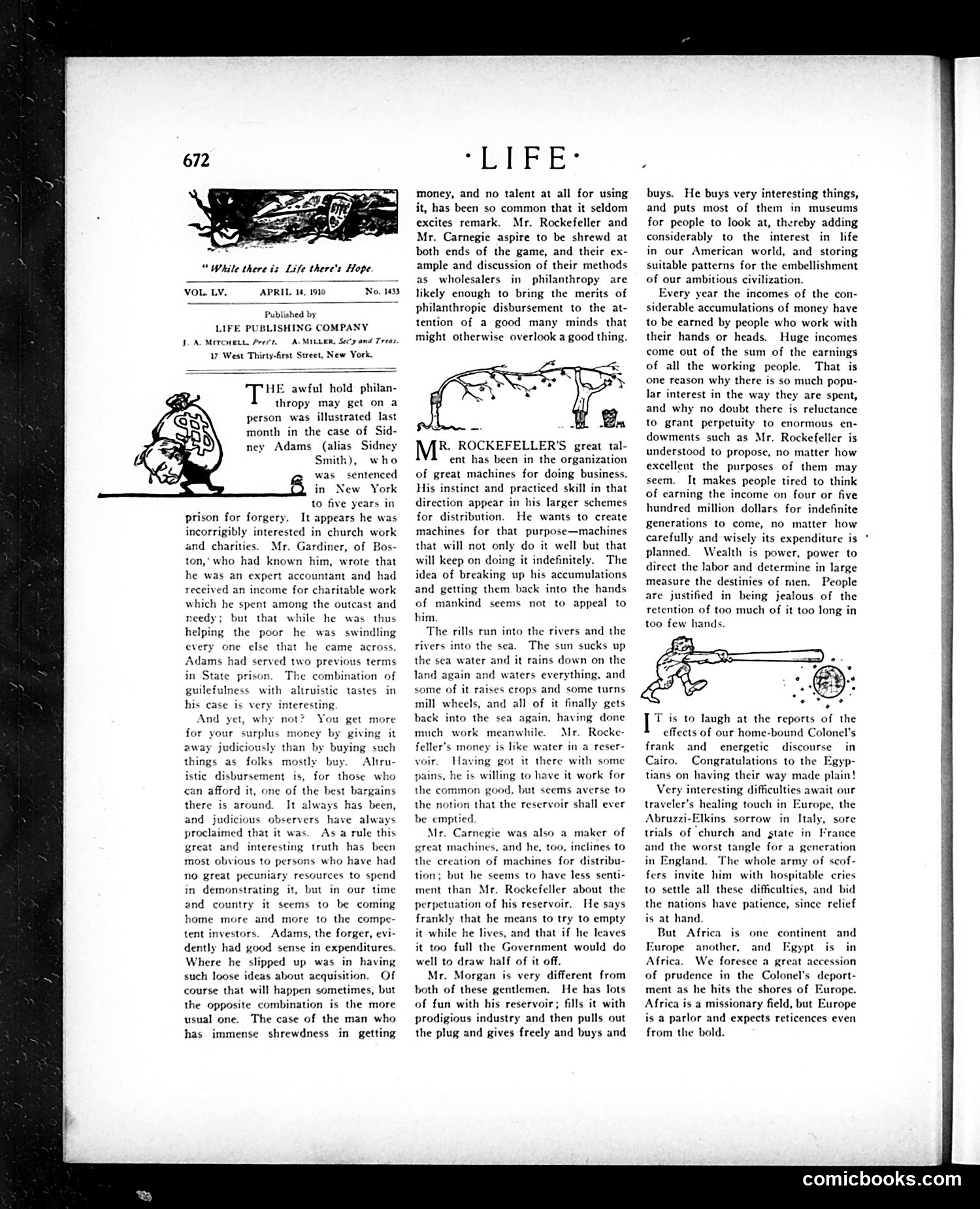
This page contains two editorial cartoons addressing philanthropy and wealth distribution. The main text criticizes the vast fortunes accumulated by industrialists like **Rockefeller** and **Carnegie**, noting their attempts to justify enormous endowments as benefiting society. The cartoons satirize this philanthropy: one depicts a figure seemingly overwhelmed or trapped by money/systems, while another shows someone struggling with abundance—likely critiquing how the wealthy claim their charitable giving addresses poverty they created through labor exploitation. The author questions whether perpetual endowments truly help workers, arguing that directing wealth distribution during one's lifetime would be more honest than posthumous charity. The satire suggests philanthropy serves the wealthy's ego more than genuine social need.
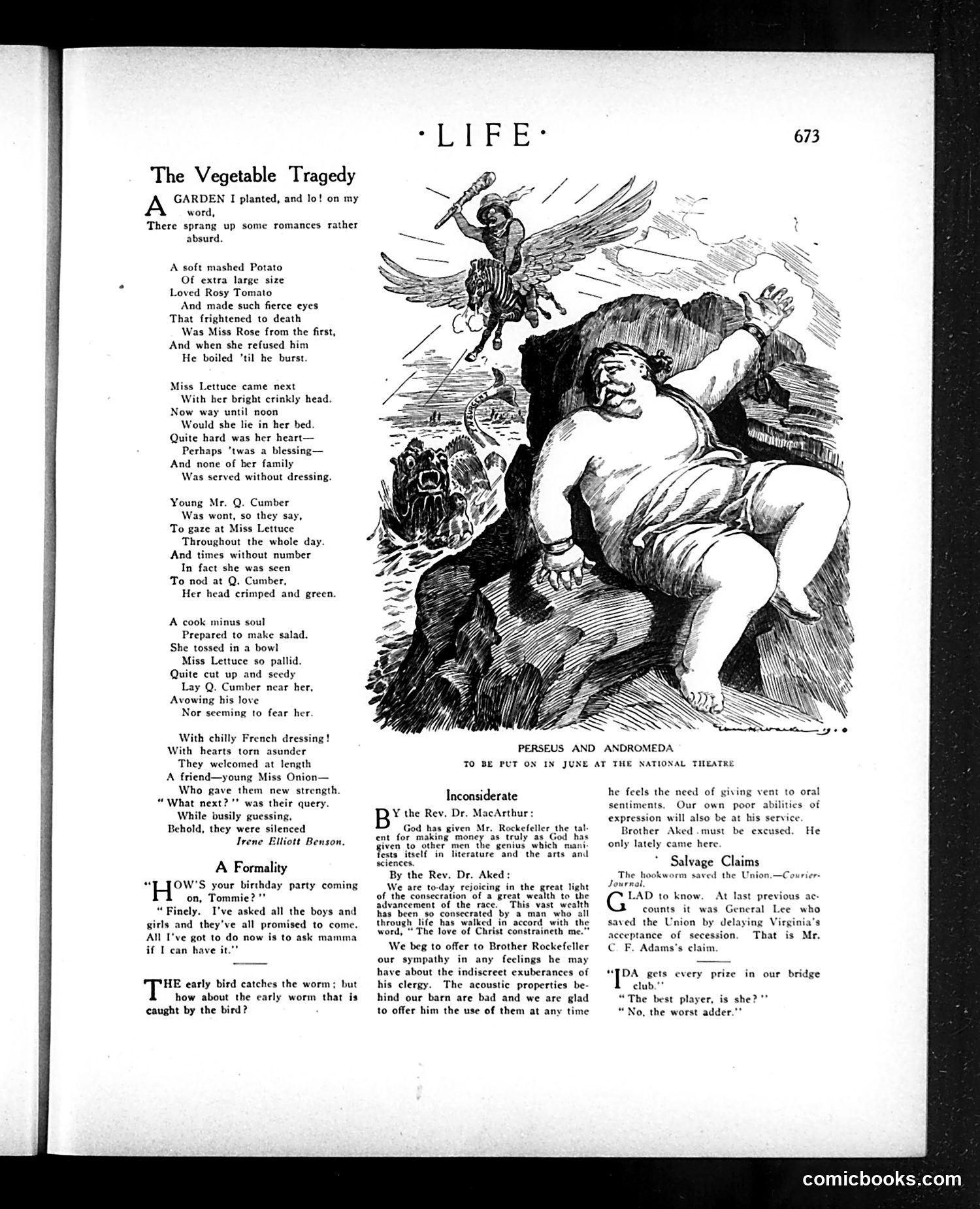
The main illustration is titled "Perseus and Andromeda to be put on in June at the National Theatre." It depicts a classical mythological scene: a muscular male figure (Perseus) rescues a female figure (Andromeda) from a sea monster, shown in dramatic action poses. The page contains several satirical poems and short pieces mocking various social types: a pretentious potato, a vain lettuce, and a jealous cucumber—all personified vegetables with exaggerated human flaws. The humor relies on anthropomorphizing produce to ridicule human vanity and social pretension. The bottom sections include brief satirical commentaries on topics like a debutante party and bridge club gossip, typical of Life's social satire targeting upper-class conventions and behavior.
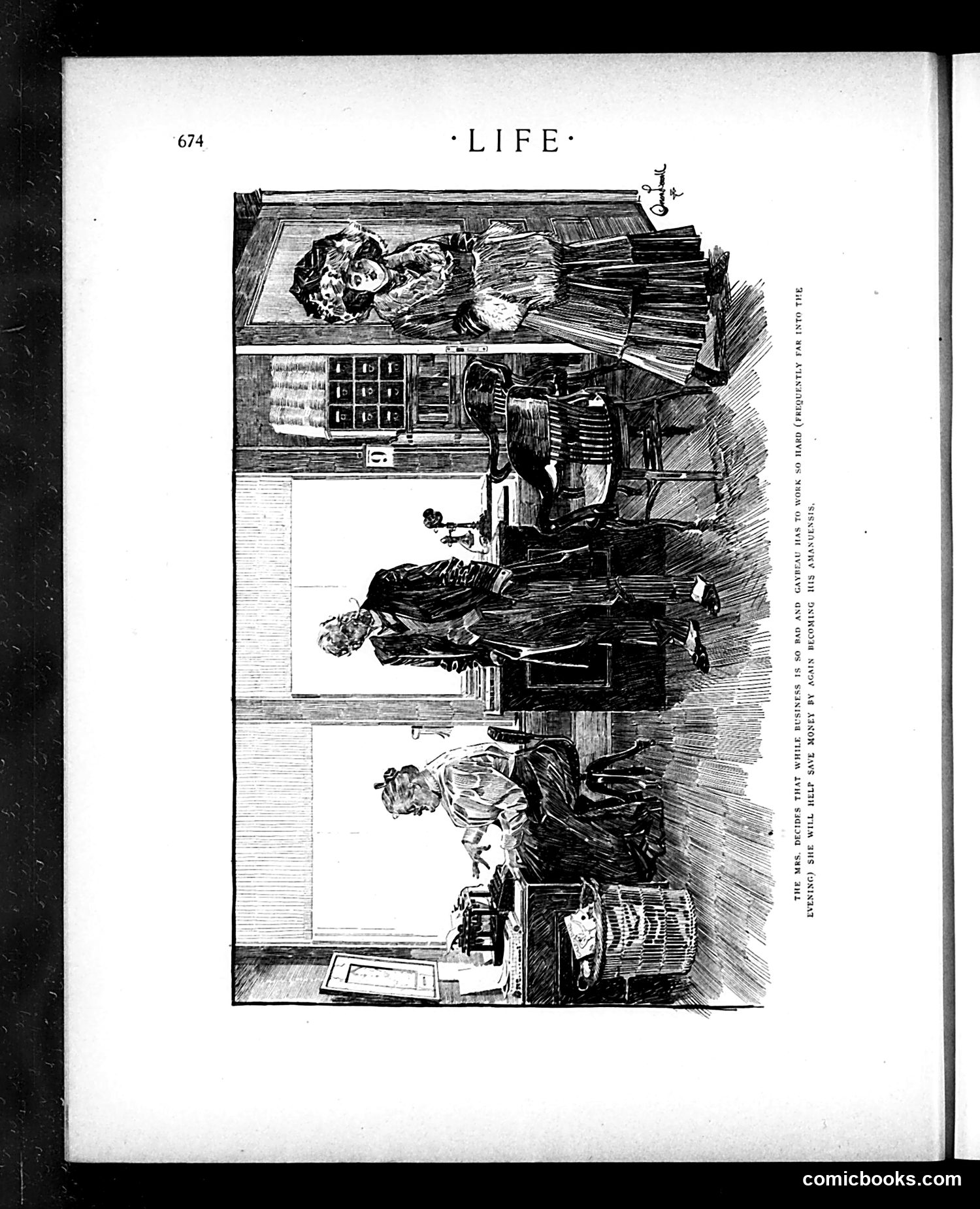
This page from *Life* magazine appears to be a satirical illustration about domestic labor and gender roles. The image—shown rotated—depicts what seems to be a woman doing housework or cleaning, with various household items and furnishings visible in the room. The OCR'd text fragments ("work so hard," "the Mrs. decides that") suggest commentary on women's domestic responsibilities. The satire likely criticizes either the burden of housework on wives or the expectation that women handle all household labor. However, the fragmentary OCR text and rotated image orientation make it difficult to identify specific historical figures or pinpoint the exact satirical target. The cartoon appears to address gender roles and domestic expectations common to early-to-mid 20th century American social commentary.
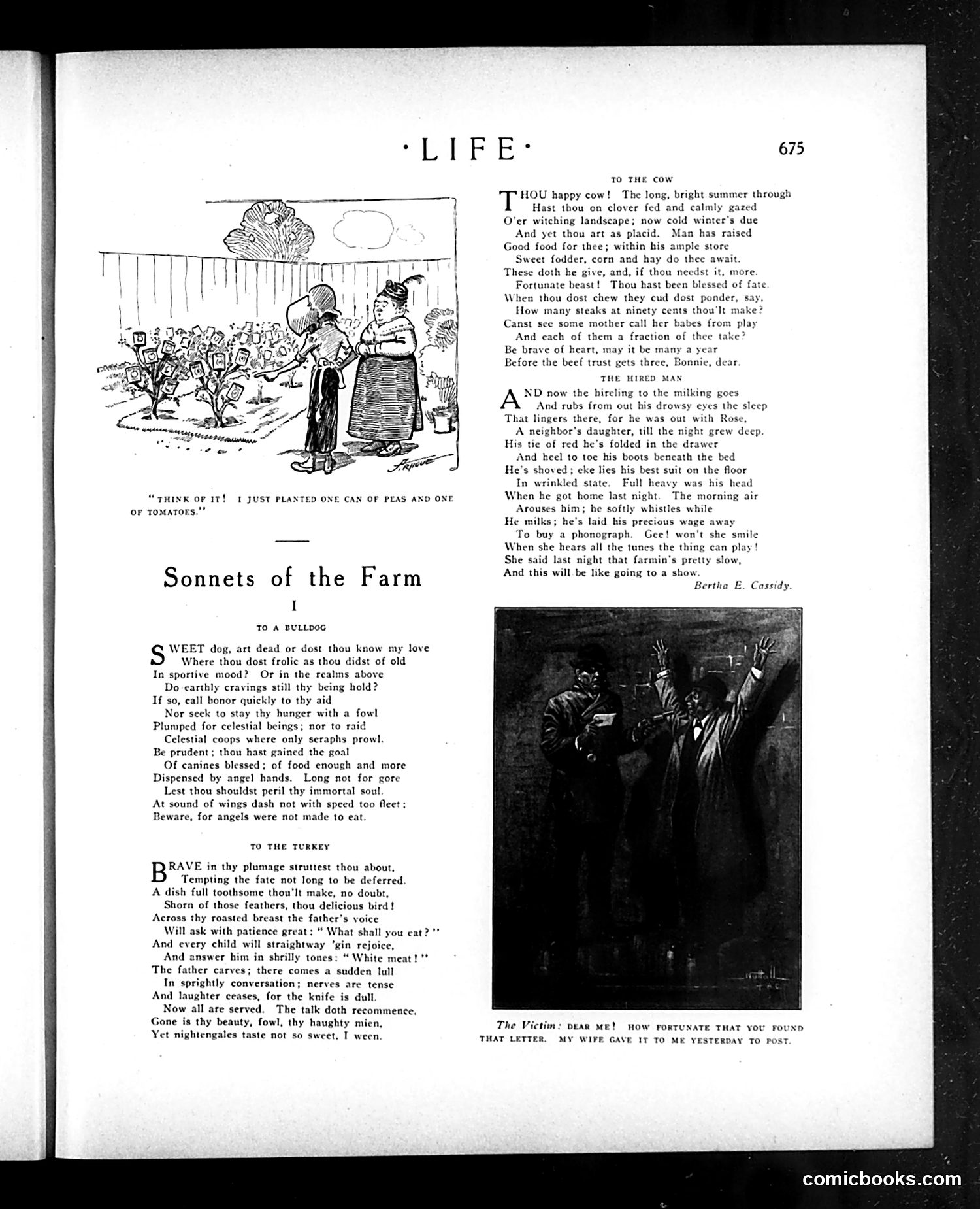
This page contains satirical verse about farm life and animals, typical of Life magazine's humorous social commentary. **"To the Cow"** mocks the beef trust monopoly—a major political issue of the early 1900s. The poem ironically addresses a cow contentedly eating, asking whether she realizes she'll become ninety-cent steaks and how many families depend on her meat. The joke critiques the trust's control over meat prices while feigning sympathy for the oblivious cow. **"The Hired Man"** satirizes rural youth attracted to modern entertainment. A farmhand exhausted from courting his neighbor's daughter squanders his wages on a phonograph (record player), tempting his girlfriend away from "farming's pretty slow" existence. It mocks both rural life's tedium and consumer culture's appeal. The remaining sonnets mock animals' fates: a bulldog warned against heavenly misconduct, and a turkey facing Thanksgiving slaughter. The cartoon caption jokes about planting canned vegetables rather than seeds—mocking urban ignorance of farming. **The photograph** shows an unidentified victim discovering a lost letter, illustrating the era's melodramatic "letter" plot device.
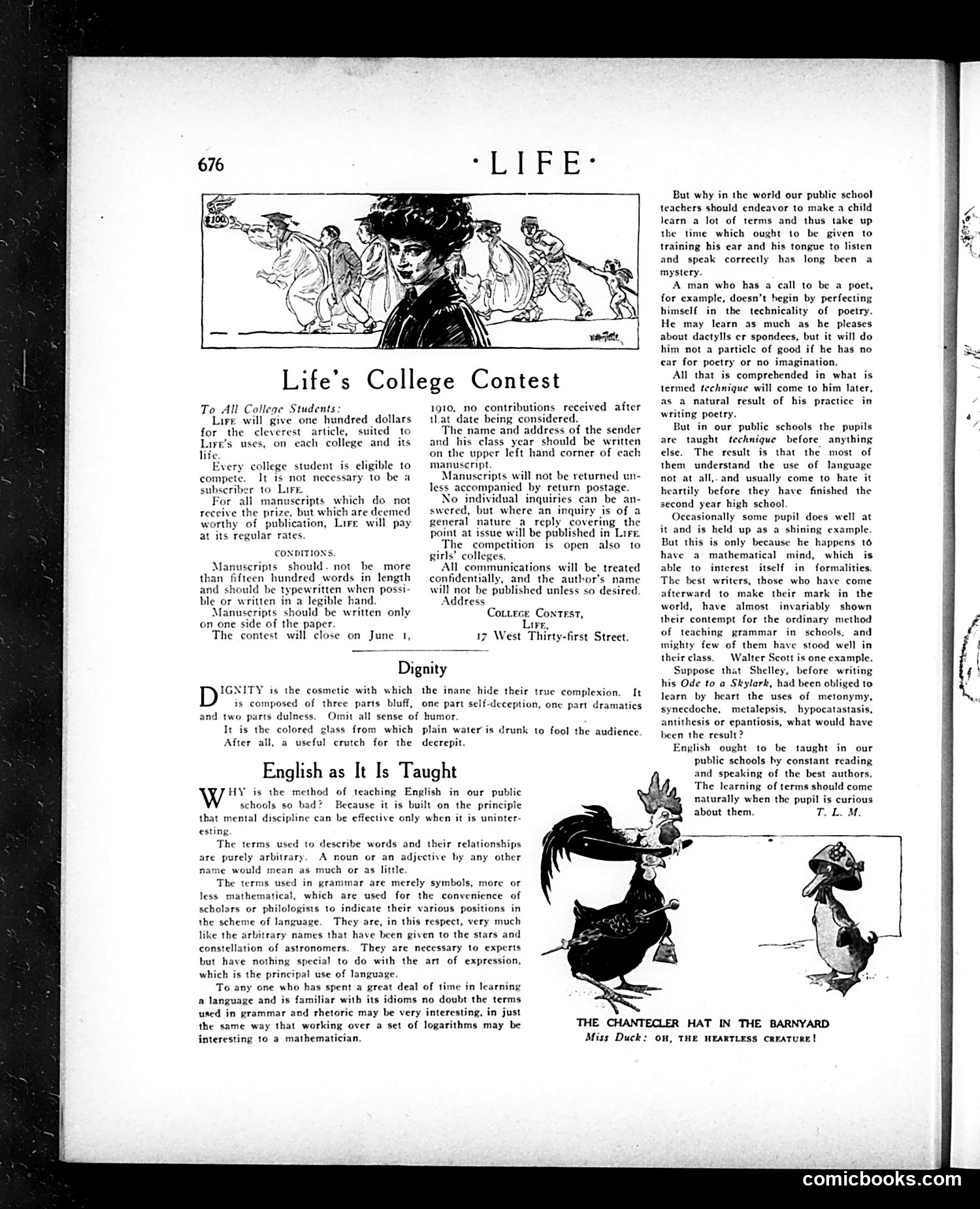
This page from *Life* magazine (circa 1910) contains three distinct sections: **Life's College Contest** announces a $100 writing competition for college students to submit articles about their respective colleges. Standard submission rules apply. **"Dignity"** is a brief satirical definition, defining dignity as a cosmetic concealing mediocrity—"composed of three parts bluff, one part self-deception, one part dramatics"—a jab at pretentious social performance. **"English as It Is Taught"** critiques American public school pedagogy, arguing teachers over-emphasize grammar terminology (dactylls, spondees, metonymy) when they should prioritize reading and speaking well. The author cites examples like Shelley and Walter Scott, who succeeded despite poor grades in formal English instruction. The piece satirizes rigid pedagogical methods that prioritize "technique" over genuine language mastery and imagination, ultimately making students hate English rather than love it. The cartoon illustrates the contest announcement; the bottom illustration shows a hen in a barnyard—its caption suggests the topic of classroom instruction itself deserves ridicule.
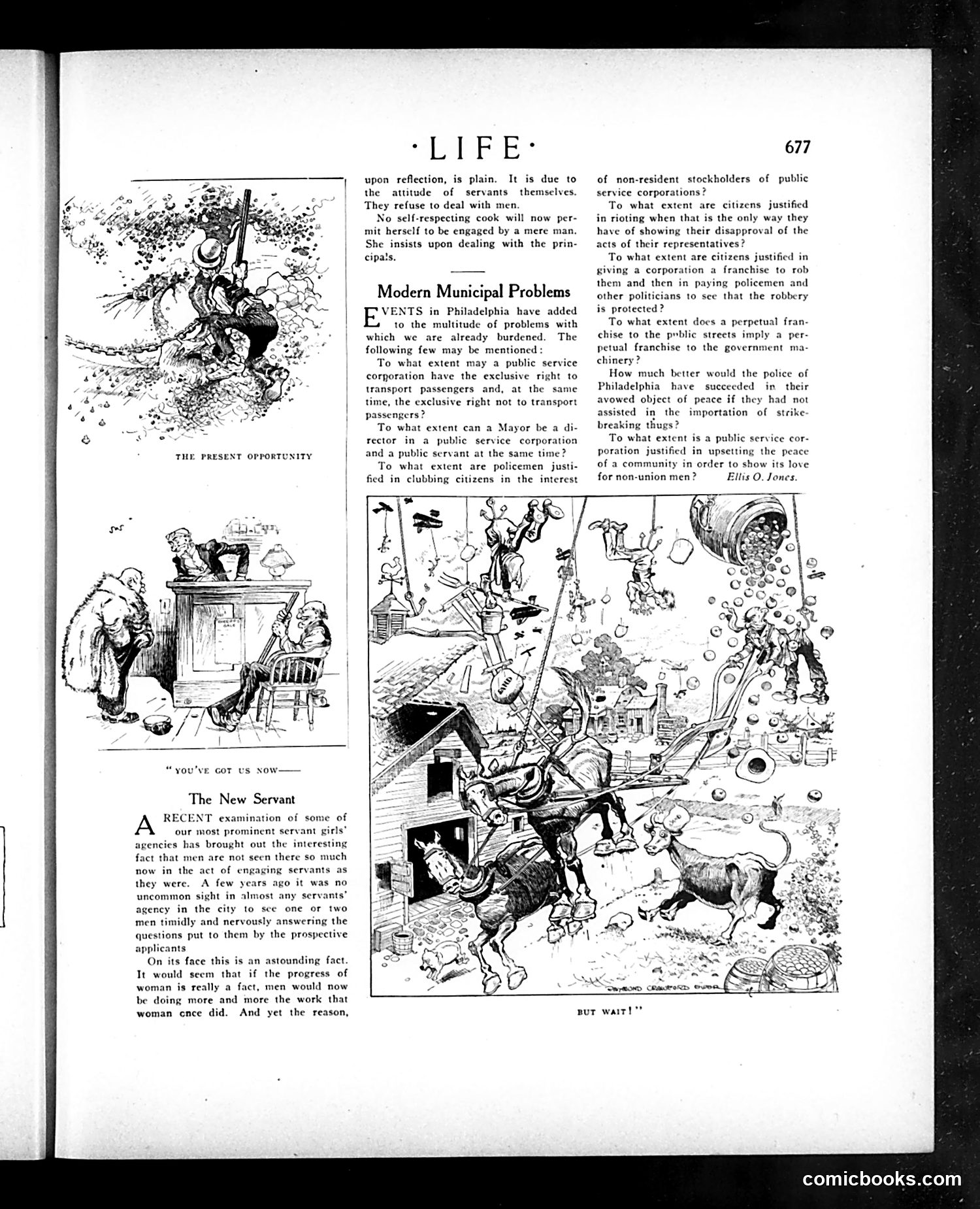
**The New Servant cartoon** satirizes changing gender dynamics in domestic employment. The text notes that male employers no longer visit servant agencies to hire help—female servants now refuse to be engaged by men, insisting on dealing with female principals instead. The joke critiques this as absurd: if women's progress is real, shouldn't men now do "women's work"? The satire mocks both the servants' newfound assertiveness and the notion that gender roles should simply reverse. **The Municipal Problems section** lists rhetorical questions about Philadelphia's public service corporations, likely following labor unrest or transit strikes. It satirizes contradictions: corporations claim exclusive transport rights while refusing service; mayors serving dual roles; police protecting strikebreakers; and governments enforcing franchises that exploit citizens. The satire targets corporate corruption and government complicity in protecting business interests over public welfare. Both pieces critique emerging social tensions in early 20th-century America.
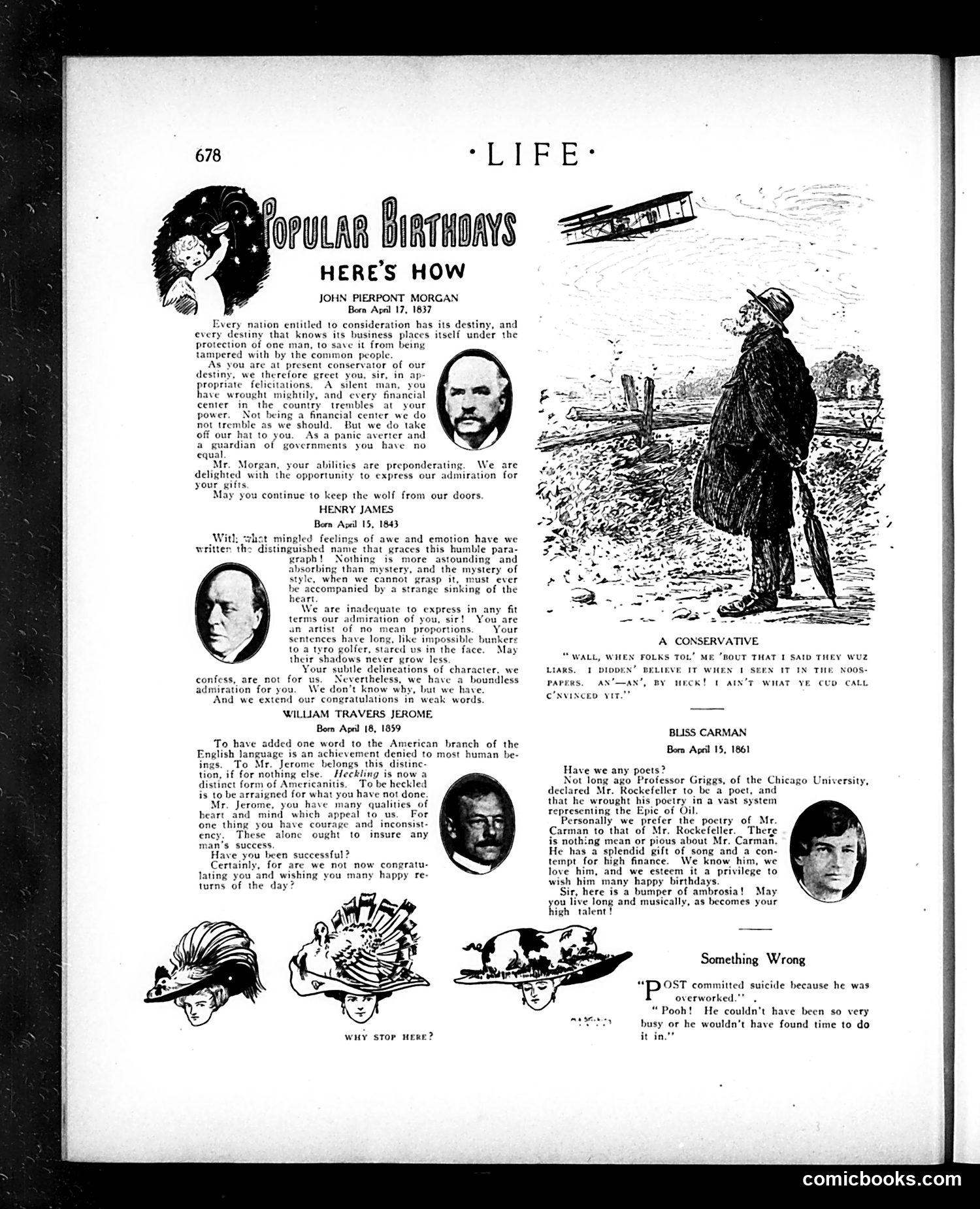
This page celebrates the birthdays of prominent American figures with satirical "tributes." The main content includes mock-serious congratulations to **J.P. Morgan** (the powerful banker), **Henry James** (novelist), **William Travers Jerome** (lawyer/politician known for "heckling"), and **Bliss Carman** (poet). The satire works through exaggerated praise of their accomplishments while subtly mocking their influence and pretensions. Morgan is ironically praised as a "panic averter" controlling national destiny; James's impenetrable prose is compared to impossible golf bunkers. The cartoon "A Conservative" satirizes rural skepticism—a farmer doubts news reports until seeing them in print, yet remains unconvinced anyway, suggesting how misinformation spreads even through "authoritative" sources. The final joke critiques overwork culture: a man who committed suicide supposedly wasn't busy enough to have actually done it—dark humor questioning societal pressures.
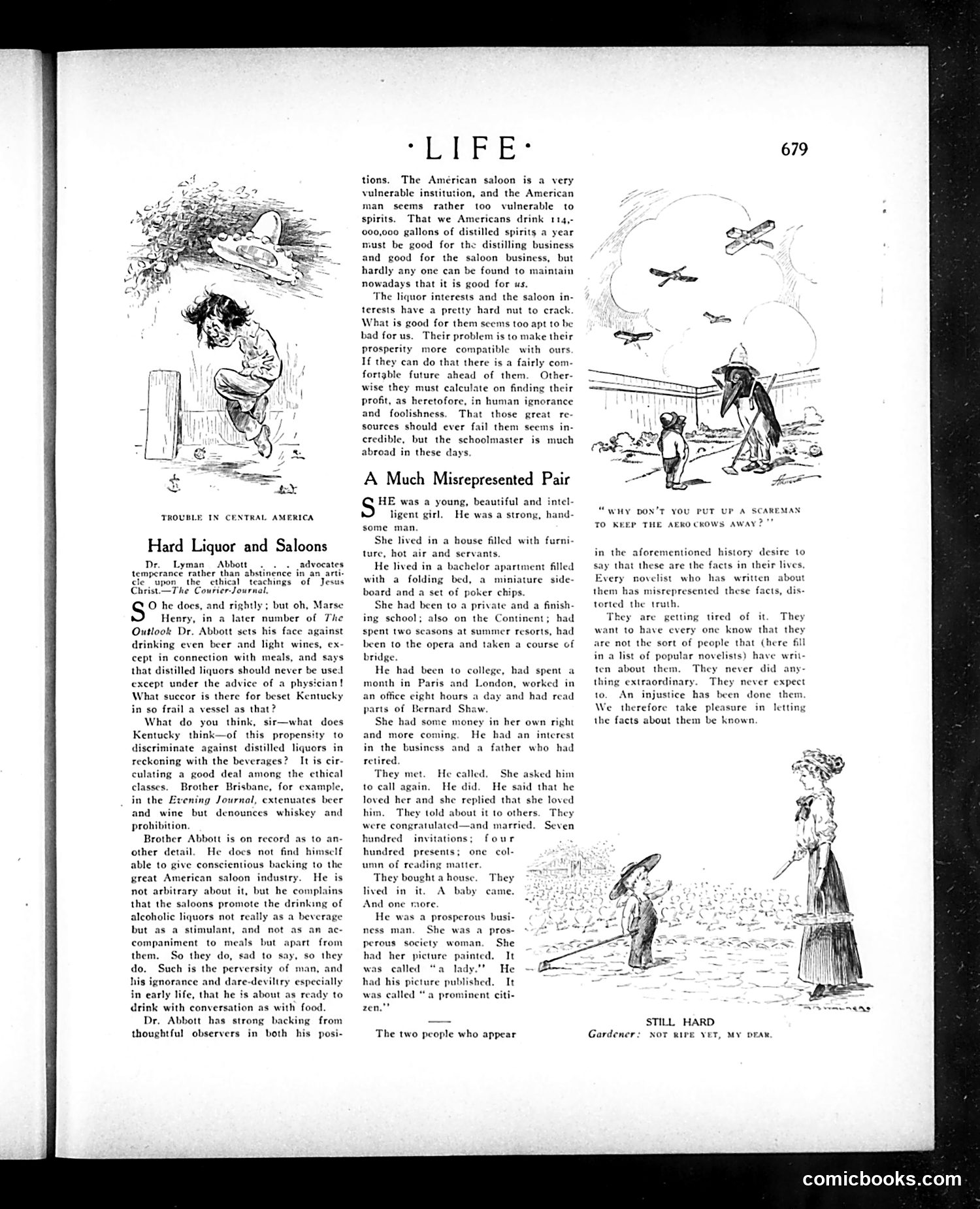
This page satirizes two distinct topics: **Left section**: Critiques the temperance movement's inconsistency. Dr. Lyman Abbott advocates "temperance" (moderation) in Jesus's teachings but then opposes distilled liquors entirely—except medicinally. The satire targets this hypocrisy and the "ethical classes" who distinguish between beer/wine (acceptable) and whiskey (condemned). Life mocks their contradictions while acknowledging the real problem: Americans drink 114 million gallons of distilled spirits yearly, benefiting saloon owners but harming society. The humor lies in pointing out the liquor industry's impossible position—their profit depends on human "ignorance and foolishness." **Right section**: "A Much Misrepresented Pair" depicts a wealthy, educated woman and a professional man who marry after meeting. The satire gently mocks their vastly different backgrounds (her finishing schools and leisure; his office work) yet identical social outcomes—they become prosperous, respectable, and produce children. The title suggests society misrepresents their union as unusual when such marriages were increasingly common among the American middle/upper classes.
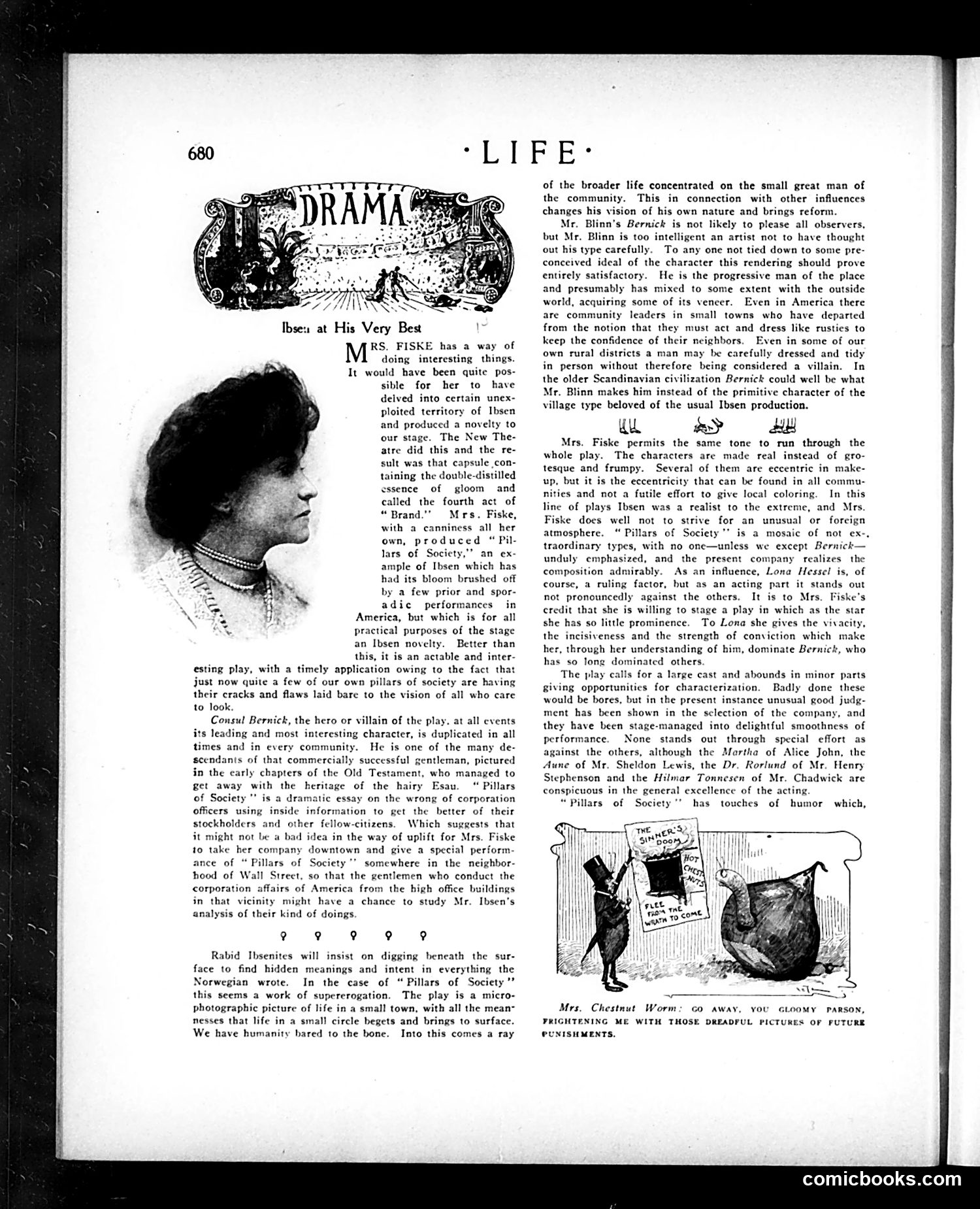
This page reviews Mrs. Fiske's production of Henrik Ibsen's *Pillars of Society*, praising her intelligent staging. The critic notes the play's timeliness: it exposes corporate corruption through Consul Bernick, a morally compromised businessman who uses insider information against stockholders—a pointed reference to contemporary American business scandals. The review suggests Mrs. Fiske perform the play on Wall Street so corporate officers might learn from Ibsen's critique of their own conduct. The accompanying cartoon (bottom right) shows "Mrs. Chestnut Worm" fleeing "dreadful pictures of future punishments," likely satirizing censorship debates or moral reformers' anxiety about theater's influence. The critic defends the actors' realistic portrayals against rigid Ibsenite interpretations, arguing characters needn't be primitive or grotesque to be authentic—a subtle push for modernized staging of classical drama.
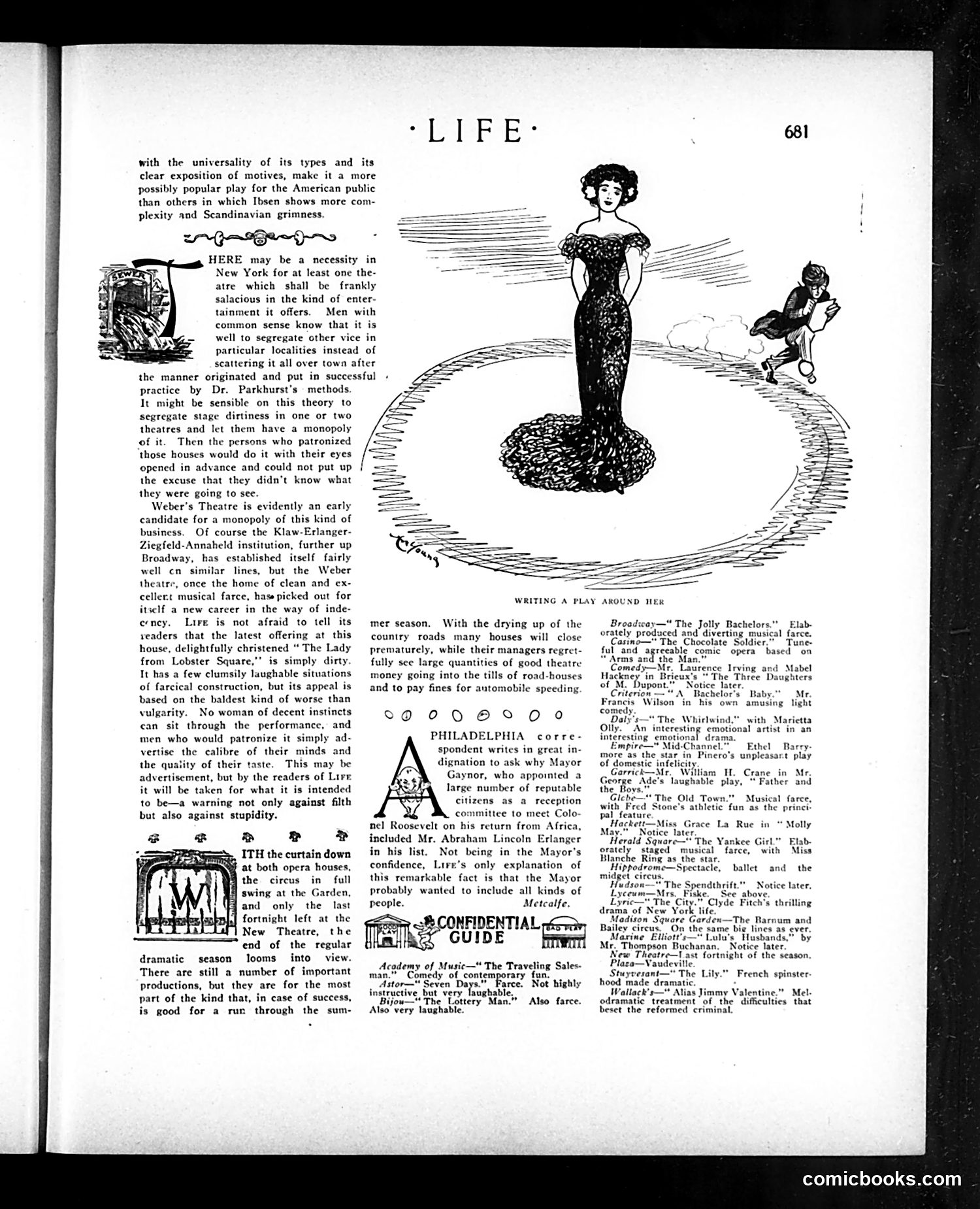
This page critiques moral standards in New York theater around 1909. The main illustration, "Writing a Play Around Her," depicts a woman as the literal foundation of a theatrical production—a visual pun on how salacious entertainment exploits female bodies for profit. The text attacks Weber's Theatre for staging "The Lady from Lobster Square," condemning it as obscene rather than clever. Life argues such "dirty" farce appeals only to men of poor taste and warns decent women away. The author proposes segregating indecent theaters (like designated vice districts) rather than scattering "stage dirtiness" throughout Broadway. A secondary note mocks Mayor Gaynor for including theatrical impresario Abraham Lincoln Erlanger on a reception committee for Colonel Roosevelt's return from Africa—suggesting Erlanger's questionable character makes him unsuitable company for such an honor, though Life concedes the Mayor may simply have wanted "all kinds of people" represented.
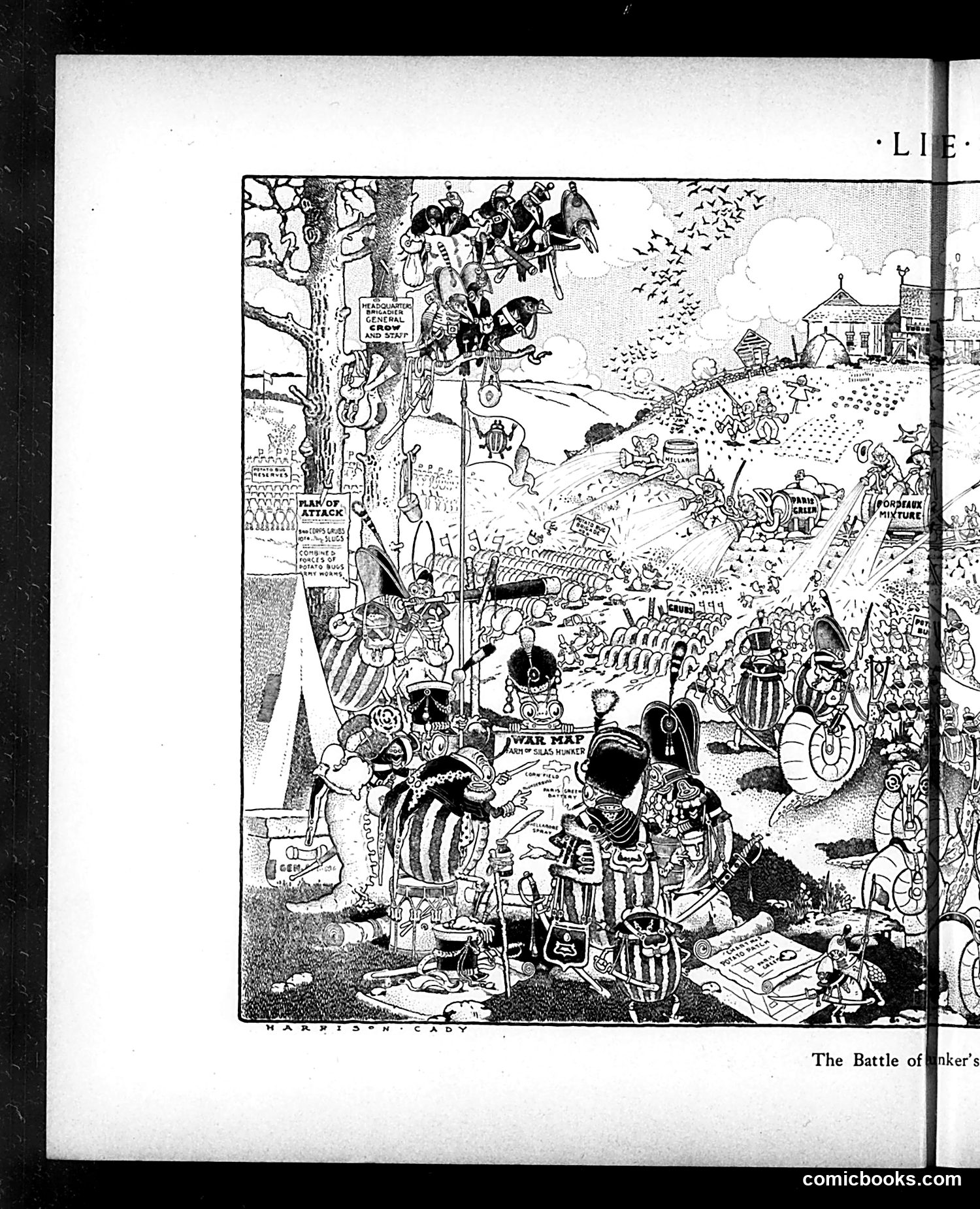
This is a densely detailed satirical illustration titled "The Battle of Banker's" (likely referring to Bunker Hill). The cartoon depicts a chaotic battle scene with multiple armies, fortifications, and military equipment. Various labels visible throughout reference military tactics and formations. The satirical intent appears to mock military incompetence or bureaucratic confusion—typical of Life magazine's political humor. The crowded composition with numerous labeled elements suggests commentary on the confusion and disorder of warfare or perhaps critiques of specific historical military blunders. However, without clearer visibility of individual figure labels or the specific historical context, the exact political figures being caricatured and the precise event being satirized remain unclear from this reproduction.
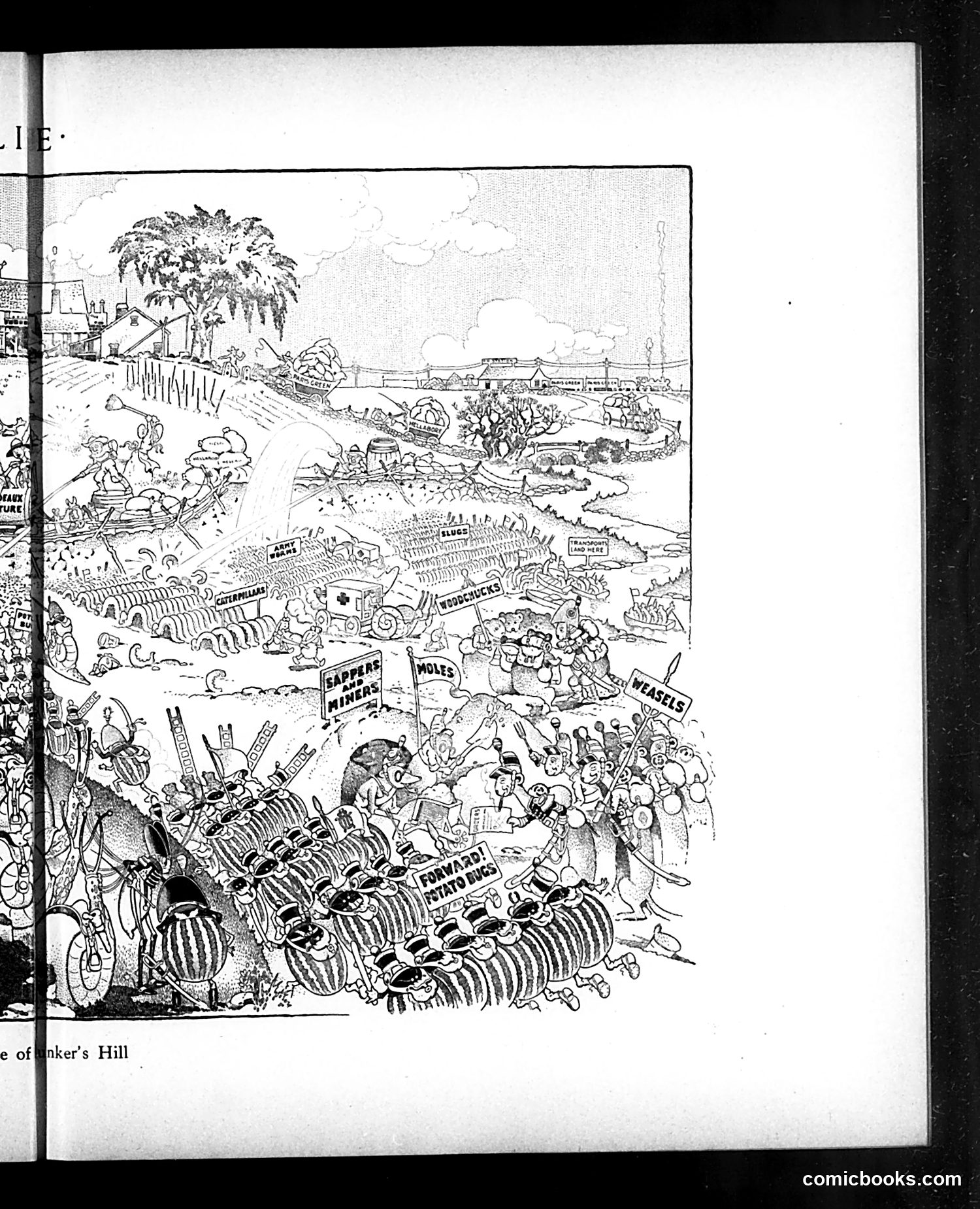
This is a satirical illustration depicting a chaotic rural agricultural scene, likely from the early 20th century. The cartoon shows farmers and various agricultural pests/problems in a single landscape. Visible labels include "SAFE MINING," "MOLES," "WEASELS," "GRASSHOPPERS," and "FORM INTO RINGS"—suggesting commentary on farming challenges and pest control methods. The scene appears to satirize the complexity and frustration of agricultural life, with multiple simultaneous threats to crops and livestock. The densely packed composition with numerous figures emphasizes the overwhelming nature of farming difficulties. The title references "Bunker's Hill," possibly evoking Revolutionary War imagery to add patriotic or historical irony to the farmers' "battles" against nature. Without clearer text or date context, the specific political reference remains unclear.
This page critiques the literary fashion for "unhappy endings" in modern fiction, particularly as popularized by contemporary authors like Winston Churchill. The author argues that while the unhappy ending represents fiction's discovery of new interpretive possibilities, it has become superficially adopted by mediocre writers who mistake bleakness for profundity. The opening epigram—a woman who finds immorality in unhappy endings—satirizes readers who uncritically embrace artistic novelty. The author contends that fiction's true value lies in providing imaginative "completeness," traditionally achieved through hopeful resolutions (the "Harvest Home"). The proliferation of shallow novels using unhappy endings merely to seem artistically serious represents a misunderstanding of why tragic conclusions work in genuinely accomplished literature. The "Confidential Book Guide" lists contemporary novels exemplifying both quality and fashionable gloom, mocking the indiscriminate enthusiasm for this trend among modern readers.
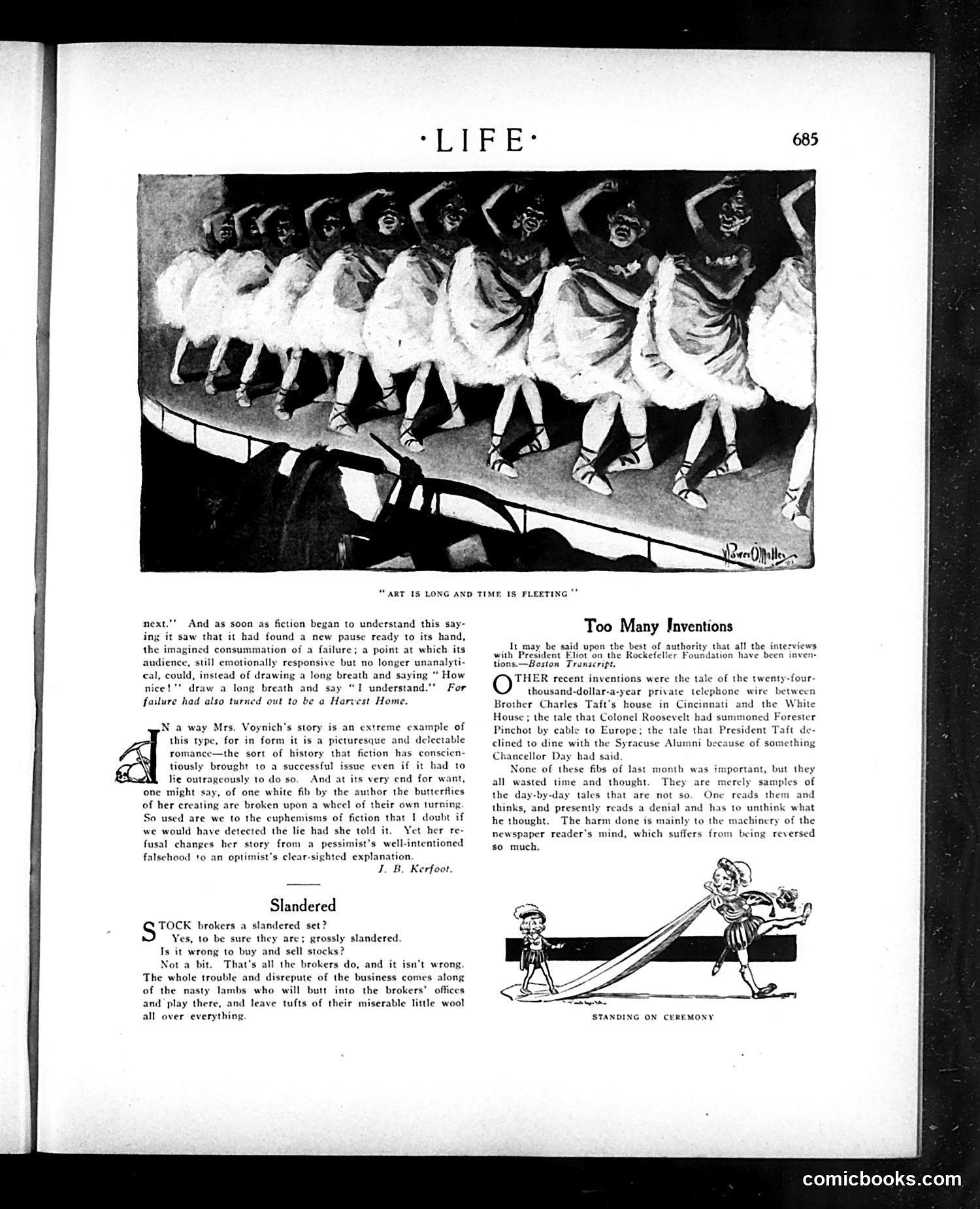
**Top Cartoon ("Art Is Long and Time Is Fleeting"):** A line of chorus girls in white tutus and dark masks performs on stage, viewed from behind an orchestra pit. The satirical point appears to critique theatrical sentimentality or artifice—the masked, synchronized performers suggest manufactured emotion rather than genuine artistry. **"Too Many Inventions" Article:** This criticizes newspapers for publishing unverified stories about prominent figures, including President Taft, Theodore Roosevelt, and Forester Pinchot. The author argues these minor fabrications waste readers' mental energy through the cycle of reading, then later reading denials. The satire targets not the brokers or politicians themselves, but journalists who create and spread false narratives. **"Slandered" Section:** A brief defense of stock brokers, arguing their profession itself isn't disreputable—rather, it's the inexperienced speculators ("nasty lambs") who enter broker offices and cause problems that damage the profession's reputation. The page reflects Progressive Era concerns about media reliability and financial market ethics.
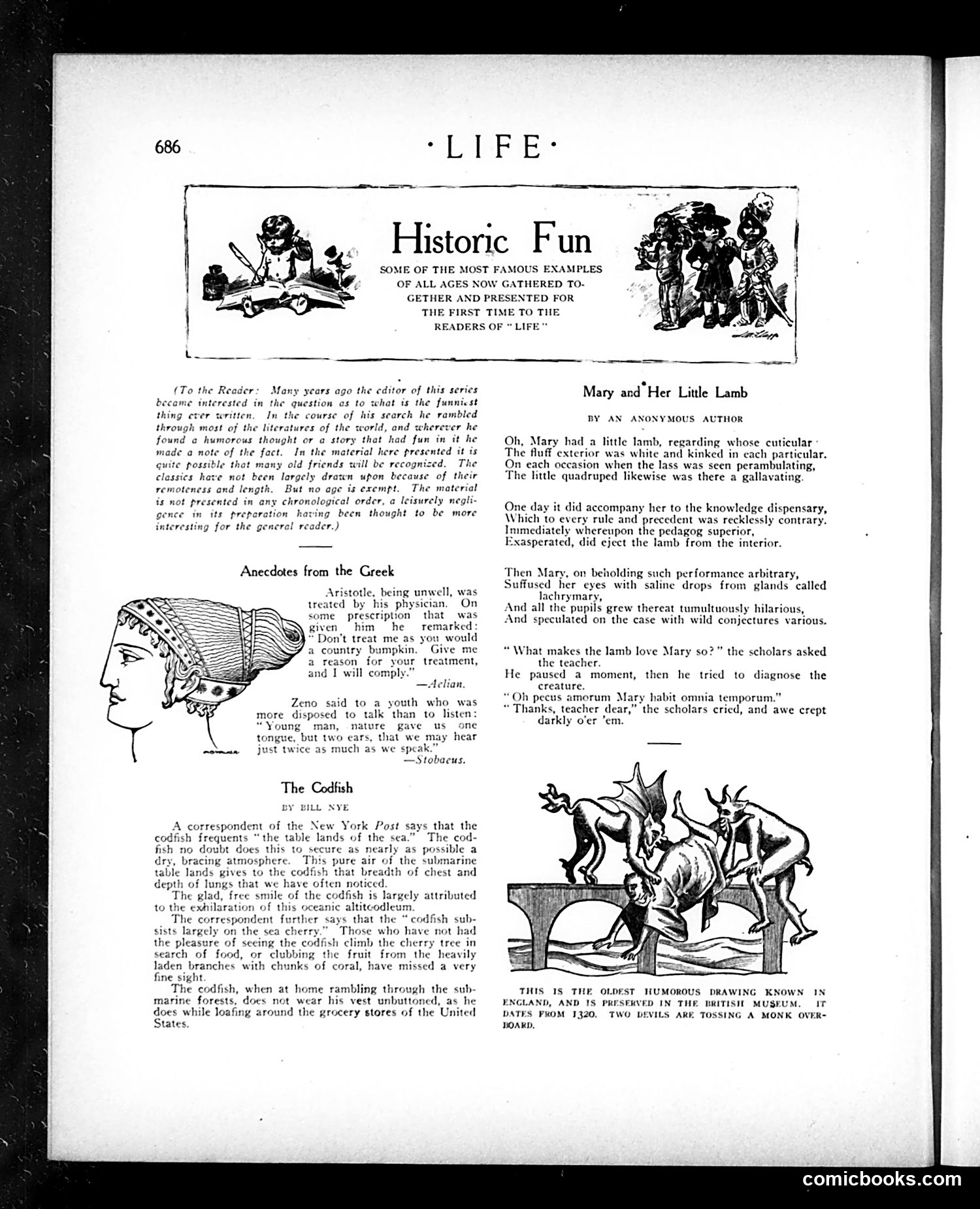
This *Life* magazine page presents a "Historic Fun" compilation—humorous anecdotes and literary pieces from various historical periods, framed as notable examples of wit across ages. The content includes classical Greek anecdotes (Aristotle's pragmatism, Zeno's philosophy about listening), Bill Nye's satirical essay on codfish (mocking pseudo-scientific observations about fish behavior), and a deliberately overwrought mock-heroic retelling of "Mary Had a Little Lamb" in inflated, Latin-peppered language—apparently parodying pompous academic writing. The page concludes with a medieval woodcut (dated 1320, preserved in the British Museum) depicting devils tossing a monk overboard—described as "the oldest humorous drawing known in England." The collection's organizing principle appears to be demonstrating that humor transcends time periods, from ancient Greece through the medieval period to contemporary American satire.
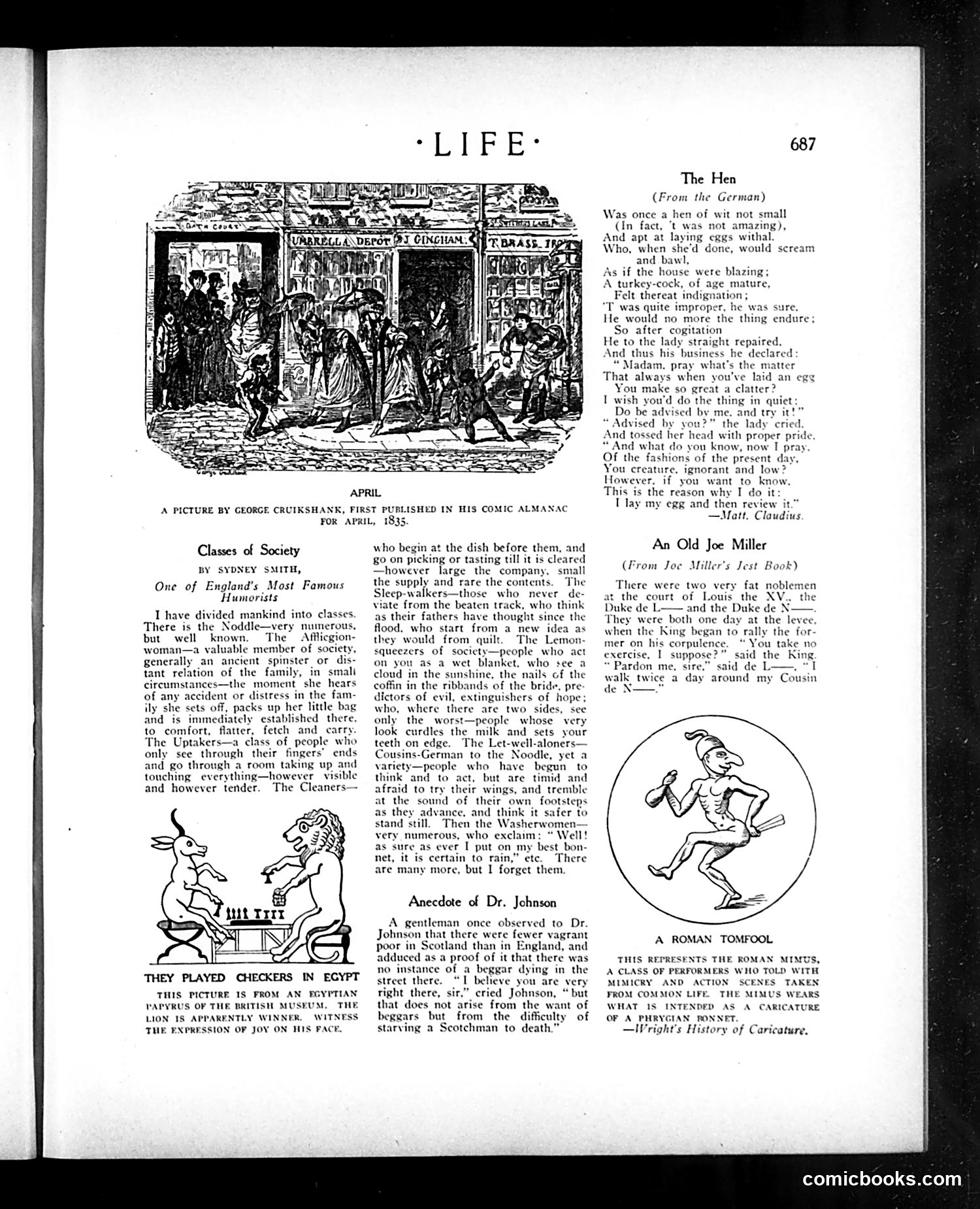
This *Life* magazine page (1835) presents three satirical pieces mocking social types and follies: **"Classes of Society"** by Sydney Smith categorizes ridiculous personality types—the "Noddle" (fool), the "Affliction-woman" (busybody relative), the "Lemon-squeezers" (pessimists who ruin joy), and others. The satire targets recognizable social stereotypes of Victorian England. **The Egyptian checkers image** is a humorous visual gag: ancient Egyptian tomb art depicting animals playing checkers, captioned to suggest the lion's smug expression shows it's winning. **"The Hen"** is a translated German poem where a hen loudly announces egg-laying, and a prudish turkey-cock complains about her noise. She retorts that she reviews her work—satirizing vanity and the clash between propriety and self-satisfaction. **"An Old Joe Miller"** references a famous 18th-century jokebook; here, a fat nobleman at King Louis XV's court claims he takes "no exercise," implying his obesity is his own fault. The page combines literary satire, visual humor, and social commentary typical of *Life*'s satirical tradition.
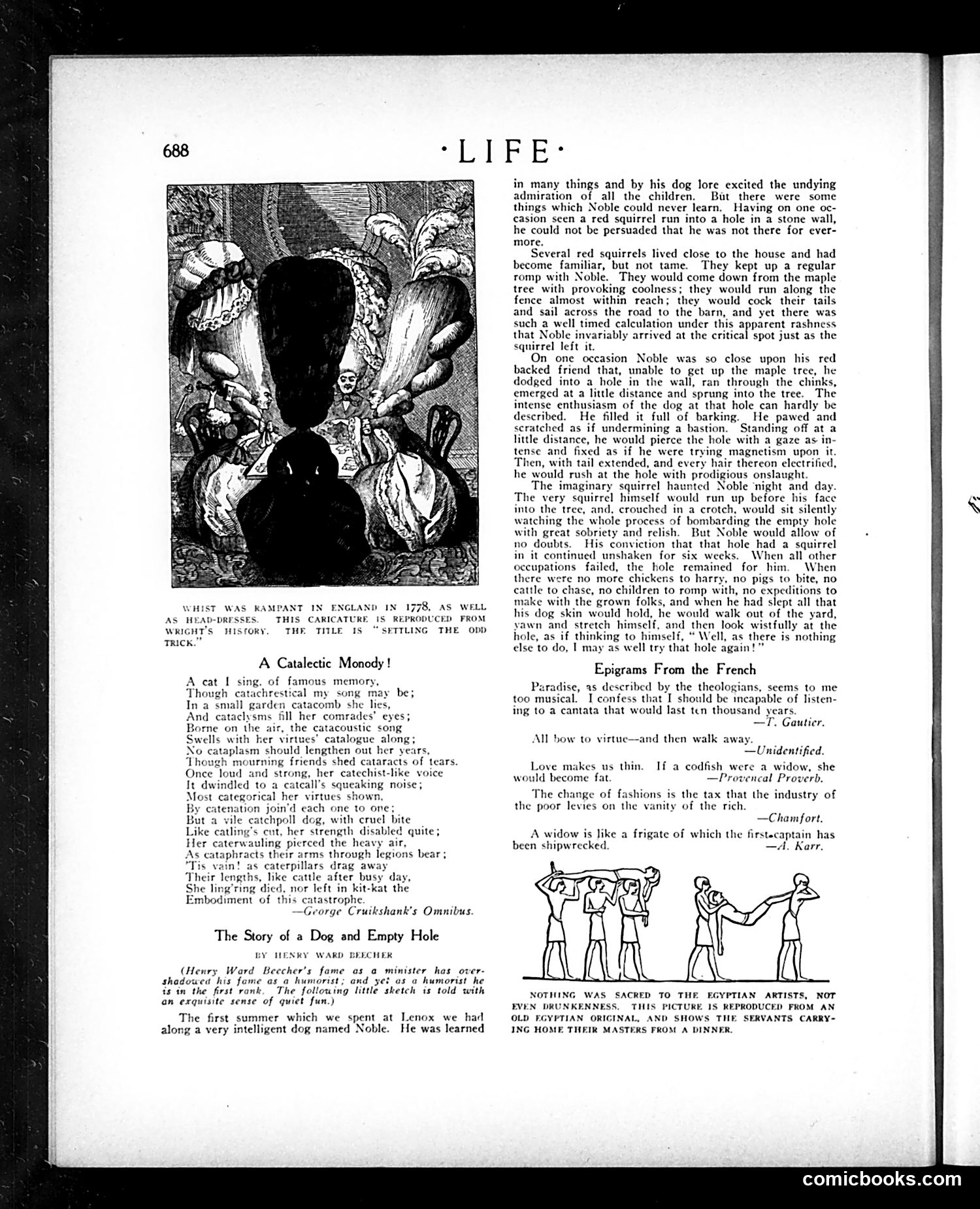
This page from *Life* magazine contains **no political cartoons**, despite the header reference to an 18th-century caricature. The main content is literary: **"Settling the Odd Trick"** is a reproduction of a 1778 English caricature mocking fashion—specifically the exaggerated hairstyles and the card game whist that were popular among the English gentry during that period. **"A Catalectic Monody"** is a humorous poem about a deceased cat, employing wordplay with words beginning in "cata-" (catastrophe, catacomb, etc.)—a literary joke rather than satire. **"The Story of a Dog and Empty Hole"** by Henry Ward Beecher is a humorous anecdote about a dog's obsessive but futile pursuit of a squirrel. The piece gently satirizes human stubbornness and fixed ideas by illustrating how a dog becomes absolutely convinced a squirrel remains in an empty hole, unable to be dissuaded by evidence. The page is primarily **literary humor and entertainment**, not political commentary.
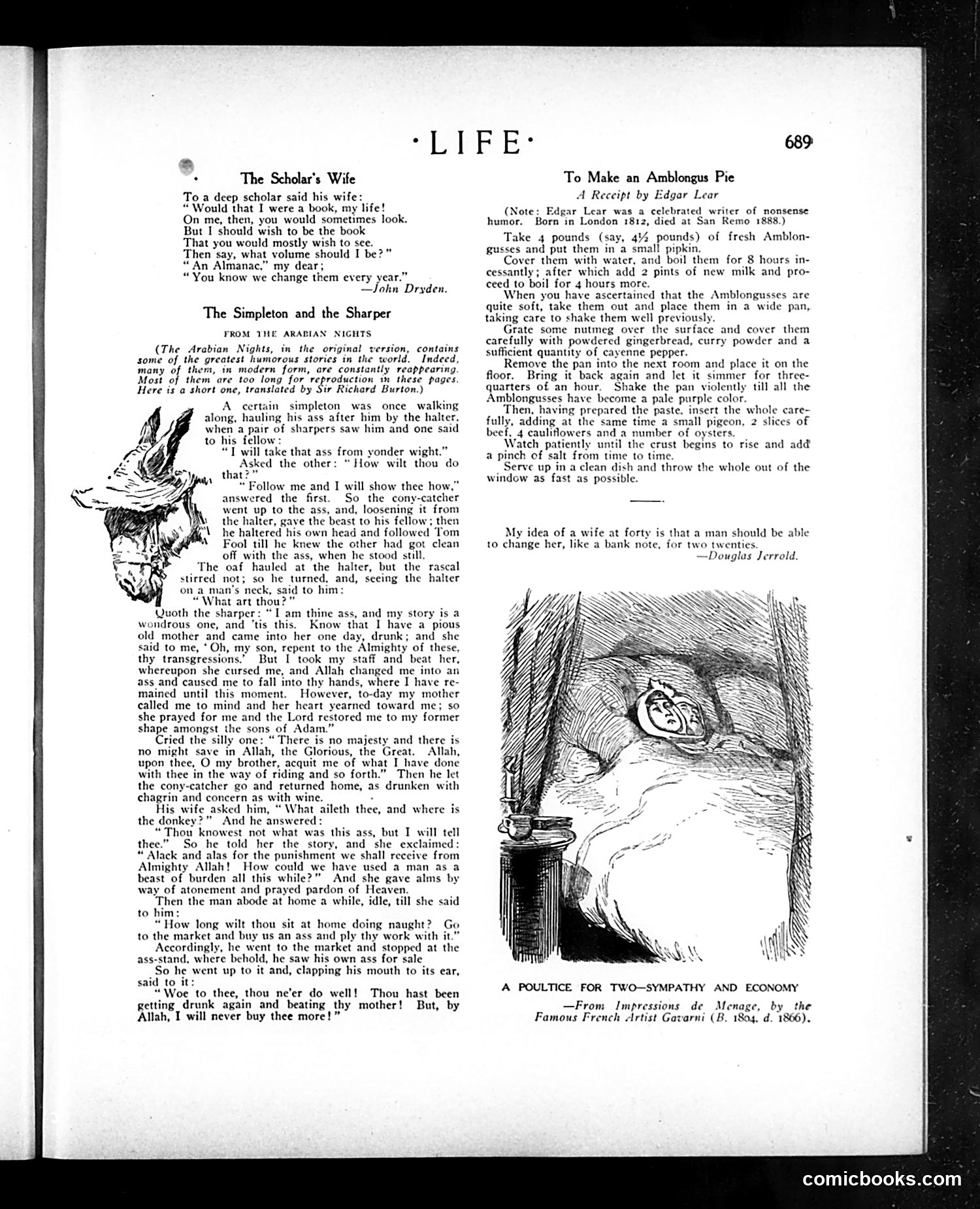
This page contains three separate humorous pieces from *Life* magazine: 1. **"The Scholar's Wife"** — A brief Dryden poem joking that a husband wishes his wife were an almanac because "we change them every year" — satirizing both scholarly neglect of wives and the disposability women faced in marriage. 2. **"The Simpleton and the Sharper"** — An Arabian Nights tale (with illustration) about con artists who steal a man's donkey by substituting one of their own wearing a halter, then convincing the fool he's been cursed and transformed into a man. The joke satirizes gullibility and superstition. 3. **"To Make an Amblongus Pie"** — A nonsense recipe by Edward Lear (note the text misspells him "Edgar") featuring a fictional creature ("Amblongusses"), parodying overly-detailed Victorian recipe writing through absurdist humor. All three pieces use satire and wordplay typical of 19th-century *Life*'s humor: mocking human folly, marital dynamics, and literary conventions.
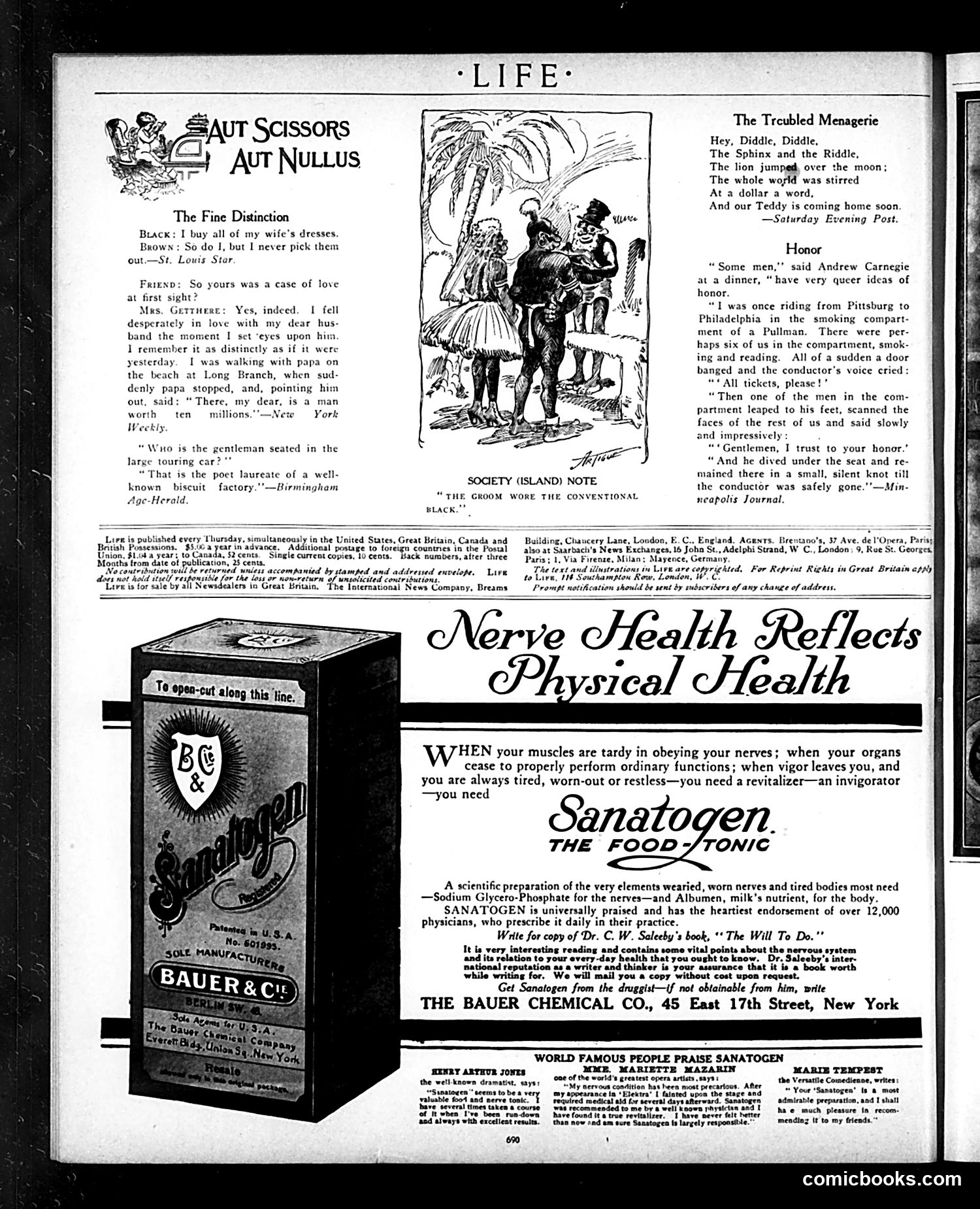
This page contains three distinct elements: **"Aut Scissors, Aut Nullus" Cartoon Section**: Brief humorous anecdotes about marriage and social etiquette. The jokes contrast men's attitudes toward purchasing wives' dresses and reveal social expectations about courtship and honor among gentlemen. **"The Troubled Menagerie"**: A satirical poem referencing Theodore Roosevelt's return from Africa (evident from "our Teddy is coming home soon"). It mocks press sensationalism by comparing newsworthy events to nursery rhyme absurdities, with the phrase "a dollar a word" criticizing expensive newspaper coverage. **"Honor" Anecdote**: Andrew Carnegie recounts a Pullman train story illustrating hypocrisy—a man appeals to fellow passengers' honor to avoid ticket inspection, then hides beneath a seat. This satirizes the disconnect between professed moral principles and actual behavior. The page also features a **Sanatogen advertisement**, a patent medicine tonic marketed as a nerve/energy restorer, endorsed by physicians—typical of early 20th-century medical marketing before FDA regulations.
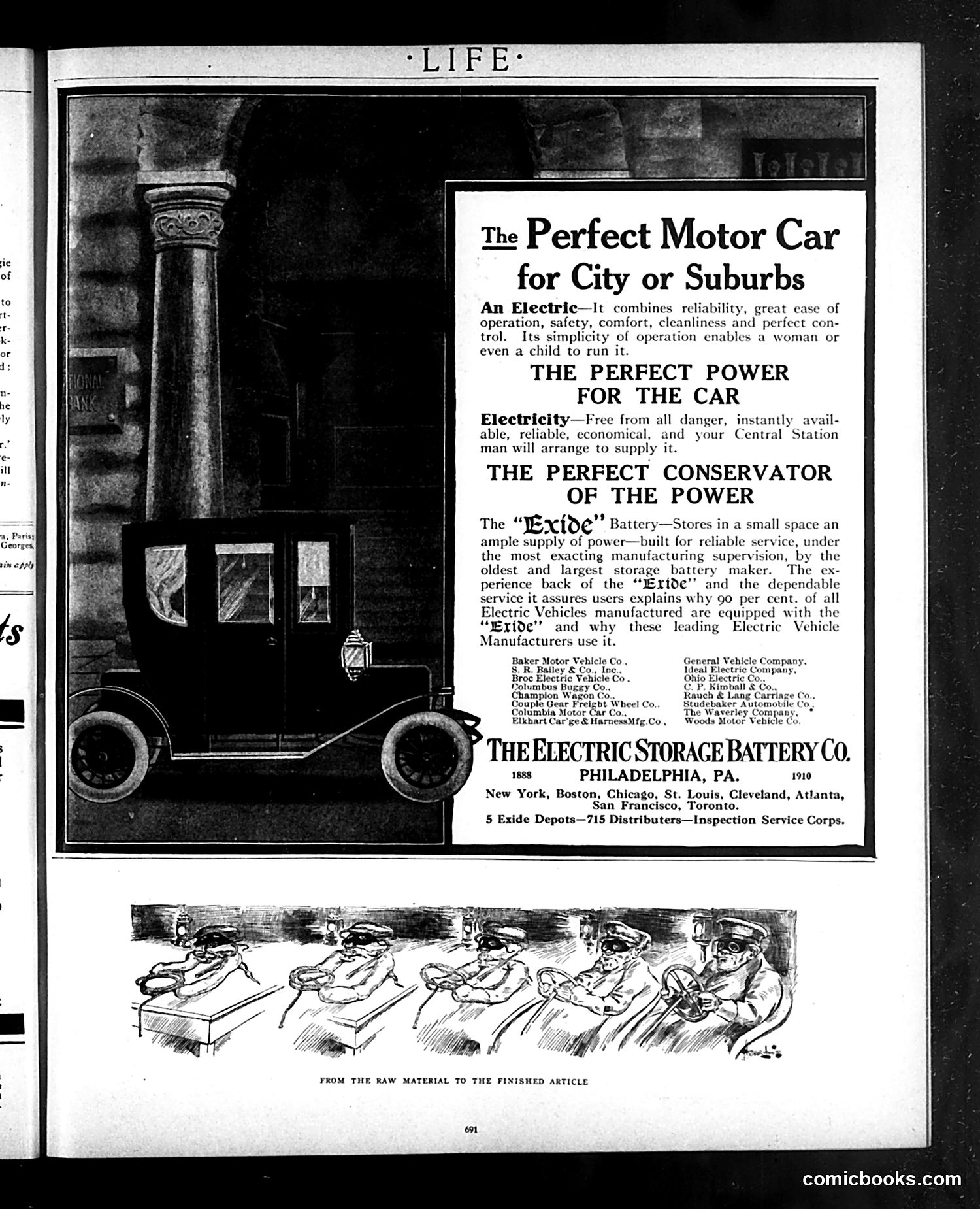
This is primarily an **advertisement for electric automobiles and Exide batteries**, not satire. The page promotes electric cars as ideal for urban driving, emphasizing their reliability, safety, and ease of operation—notably that "a woman or even a child" could operate one. The small cartoon at the bottom, captioned "From the Raw Material to the Finished Article," appears to show manufacturing processes in a playful sequential format. **Historical context for modern readers:** This ad reflects a genuine moment (circa 1910) when electric vehicles were considered serious competitors to gasoline cars. Electrics were indeed cleaner and easier to operate than temperamental gas engines requiring hand-cranking. The era would soon shift toward gasoline dominance, making this advertisement a curiosity of automotive history rather than satire. The patronizing reference to women drivers reflects period attitudes but was genuinely marketed as a selling point for electrics' user-friendliness.
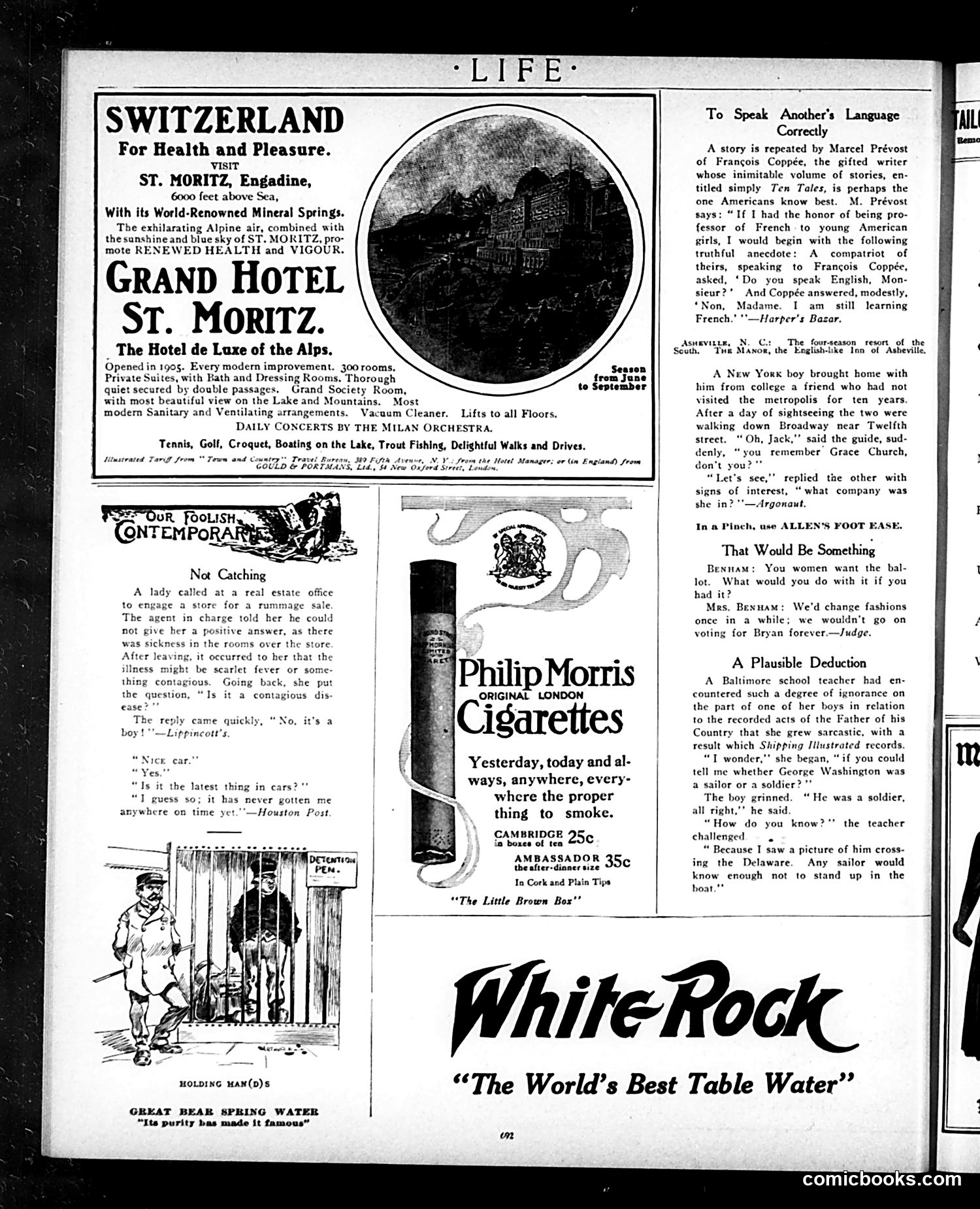
This page is primarily **advertising and light humor**, not political satire. The content includes: **Main Advertisement**: Grand Hotel St. Moritz in Switzerland dominates the upper left, promoting Alpine health benefits and luxury amenities. **Cartoons/Humor Pieces**: - "Our Foolish Contemporary — Not Catching": A brief joke about a real estate agent's evasive answer regarding contagious illness in rental rooms. - "Holding Man(s)": A cartoon of a soldier at what appears to be a detention pen. **Short Stories/Jokes**: Several anecdotes, including one about a New York boy showing a visiting friend Broadway landmarks, and a teacher's sarcastic exchange with an ignorant student about George Washington (the boy deduces Washington was a soldier because he's pictured standing in a boat—a joke about poor historical reasoning). **Advertisements**: Philip Morris cigarettes and White Rock table water dominate the lower half. The humor is gentle and domestic rather than politically pointed—typical of *Life* magazine's lighter content mixed with advertising.
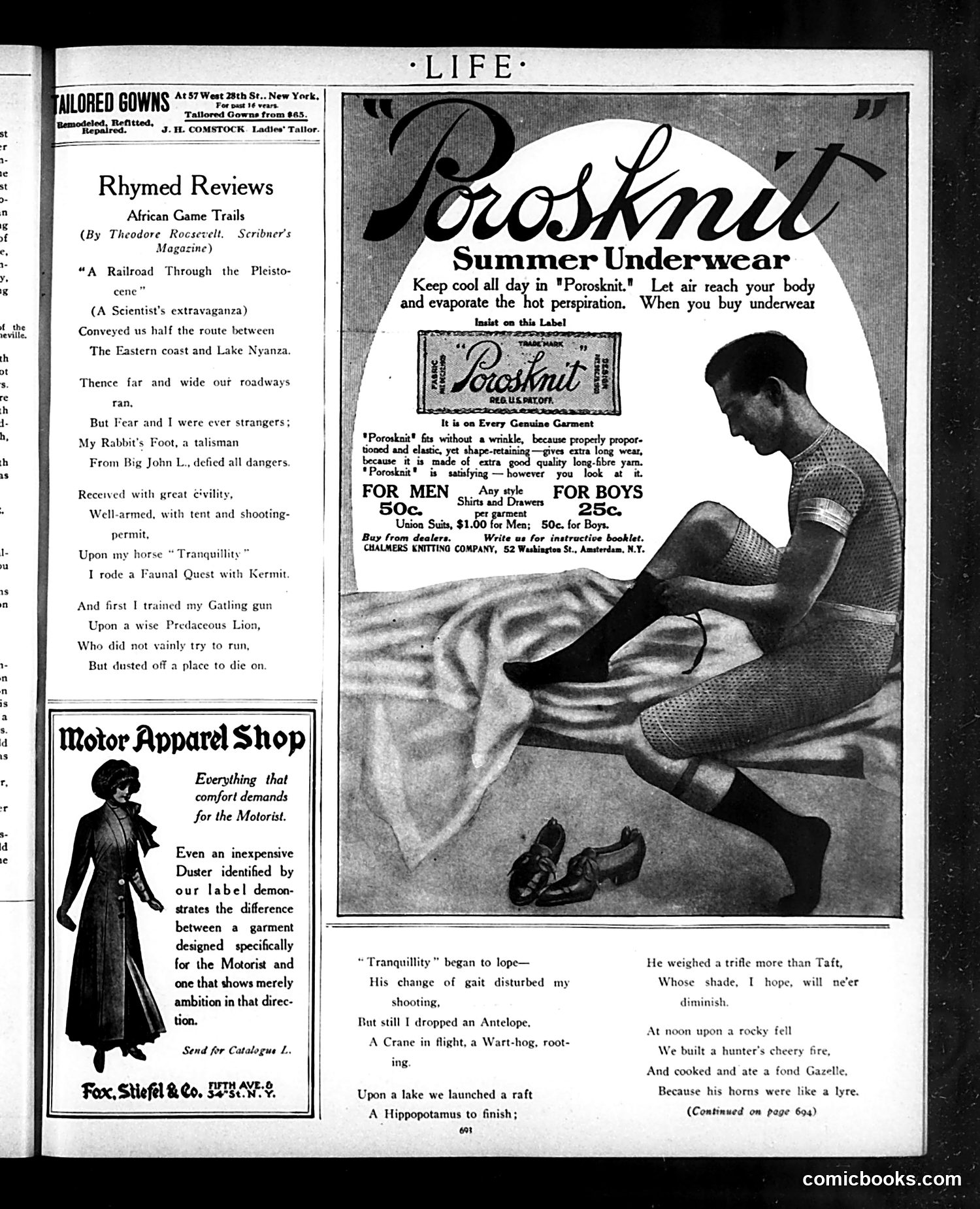
This page satirizes **Theodore Roosevelt's African hunting expedition** (documented in his book *African Game Trails*). The "Rhymed Review" is a mock-heroic poem mocking Roosevelt's 1909-1910 safari. The satire targets Roosevelt's self-aggrandizing account: he's portrayed as a trigger-happy hunter who effortlessly kills lions, antelopes, cranes, warthogs, and hippopotamuses while riding a horse named "Tranquility." The joke compares the hippo's weight to President **William Howard Taft** (his successor, whom Roosevelt had grown to dislike), suggesting Roosevelt was boastfully shooting everything in sight. The poem ridicules both Roosevelt's adventurism and his self-mythologizing narrative style—presenting his African hunt as an impossible feat of masculine prowess. The references to his "Rabbit's Foot" talisman and hunting with his son Kermit add personal, domestic humor to undercut the grand adventure narrative. The page also contains period advertising for women's tailored clothing and men's summer underwear, typical of Life magazine's mixed editorial-commercial format.
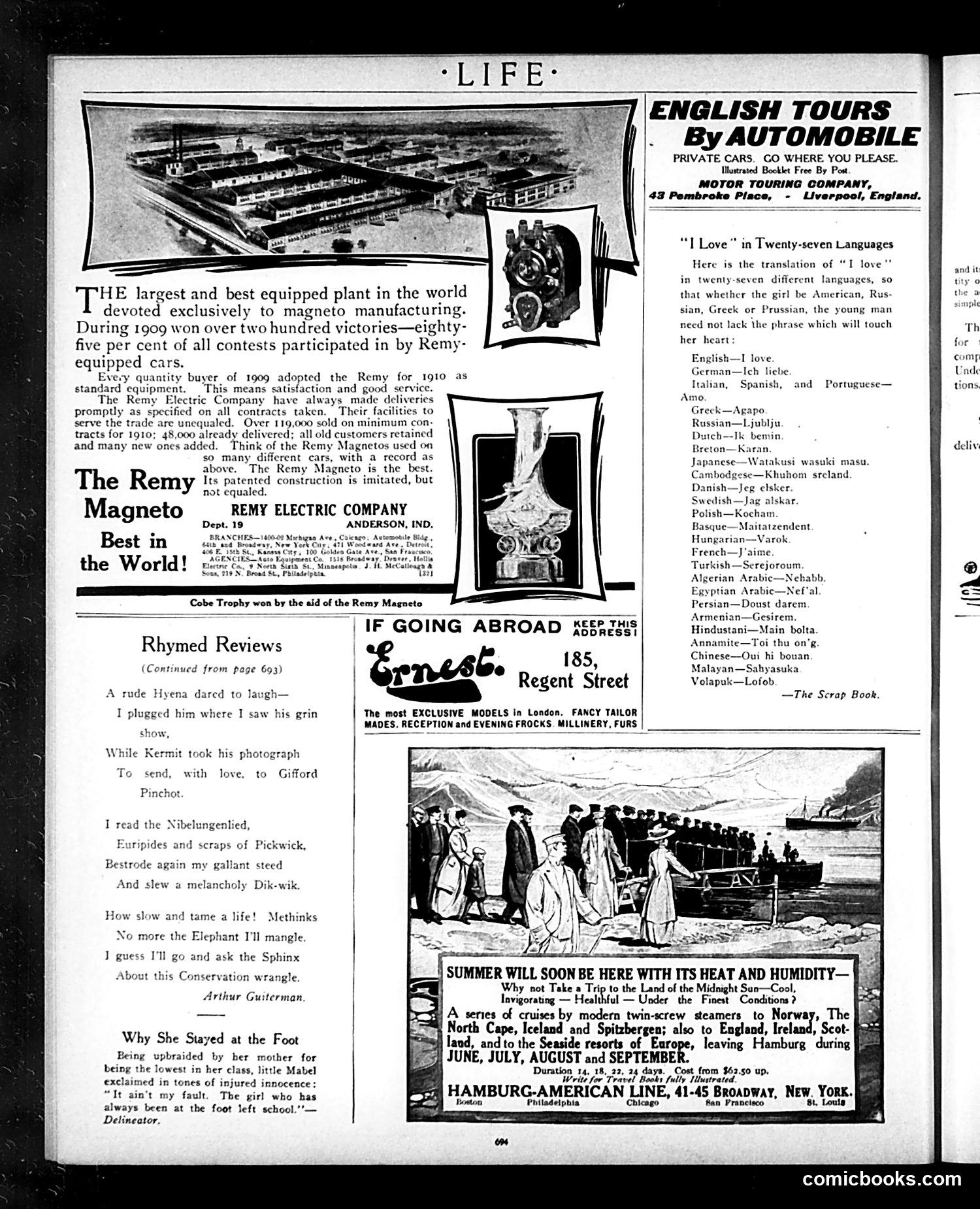
This page is primarily **advertising and light content**, not political satire. The main feature is a linguistic curiosity: a list translating "I love" into 27 languages, presented as practical romantic guidance for young men courting women of various nationalities. It reflects early 20th-century assumptions about courtship and globalization. The page includes advertisements for **Remy Electric magnetos** (automobile parts), **English automobile tours**, **Hamburg-American steamship cruises**, and **London fashion**—all targeting affluent travelers. A secondary feature, "Rhymed Reviews" by Arthur Guiterman, contains light verse about hunting and conservation, referencing **Theodore Roosevelt's son Kermit** and **Gifford Pinchot** (Roosevelt's conservation ally). This is contemporary gossip rather than satire—noting the younger Roosevelt's African hunting expedition. The content reflects **prewar cosmopolitanism** and the leisure interests of the wealthy.
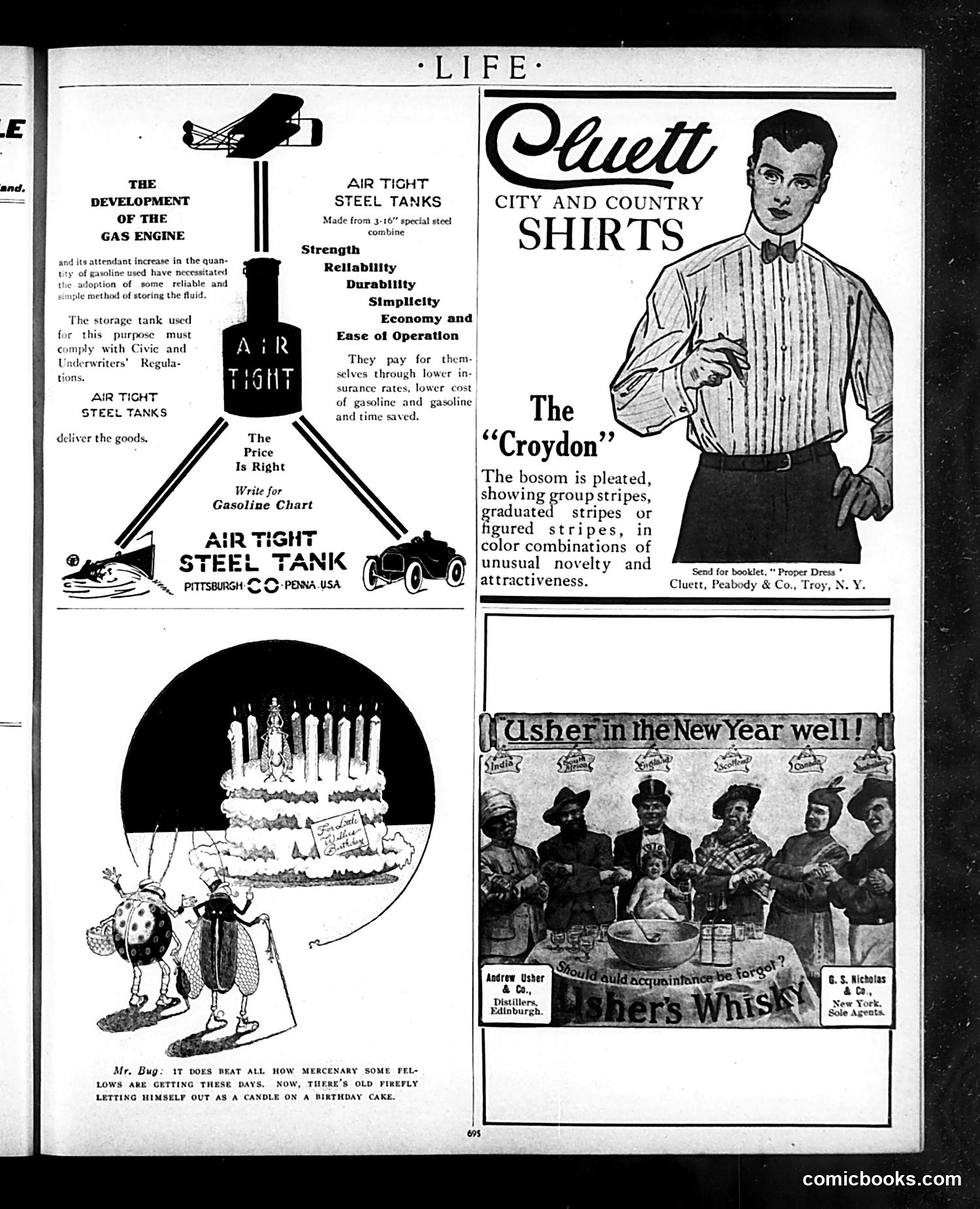
This page contains primarily **advertisements** rather than editorial cartoons. The main content includes: 1. **Air Tight Steel Tanks advertisement** (left): Promotes industrial storage tanks for gasoline, emphasizing safety compliance with insurance regulations—reflecting early 20th-century concerns about fuel storage as automobiles proliferated. 2. **Cluett Shirts advertisement** (right): Markets the "Croydon" dress shirt with decorative pleating and stripes, targeting middle-class men concerned with proper appearance. 3. **Usher's Whisky advertisement** (bottom right): A New Year's themed ad showing figures in costume around a punch bowl, with the caption "Usher in the New Year well!" 4. **"Mr. Bug" cartoon** (bottom left): A brief joke about a firefly using itself as a birthday candle—a light visual pun unrelated to political content. The page reflects early-1900s consumer culture with no apparent political satire, representing typical Life magazine advertising content of the era.
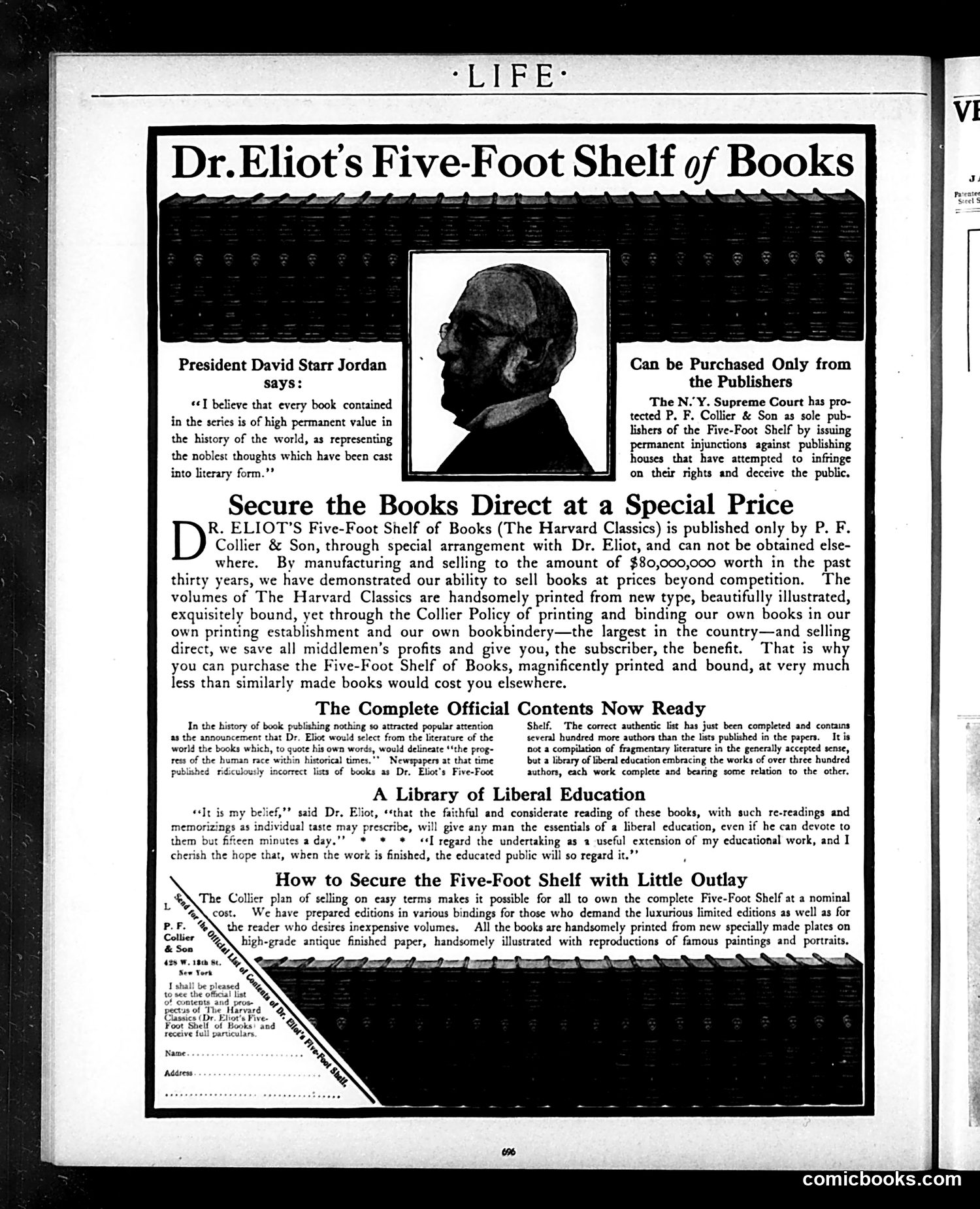
This is primarily a **publisher advertisement**, not satire or political commentary. P. F. Collier & Son promotes "The Harvard Classics"—a curated book collection assembled by Harvard president **Dr. Charles W. Eliot** (pictured). The ad emphasizes that Collier & Son holds **exclusive publishing rights** protected by New York Supreme Court injunction against competitors. This legal protection is highlighted as a selling point. The appeal targets middle-class readers seeking "liberal education" through a manageable collection. Collier claims competitive advantage through vertical integration (owning their own printing and binding facilities), allowing direct sales at lower prices than "similarly made books." Dr. Eliot's endorsement quotes stress the collection's cultural importance and accessibility—suggesting that reading these books, even briefly daily, provides essential education. The "five-foot shelf" concept—a complete liberal education occupying minimal space—was genuinely innovative marketing for the era.
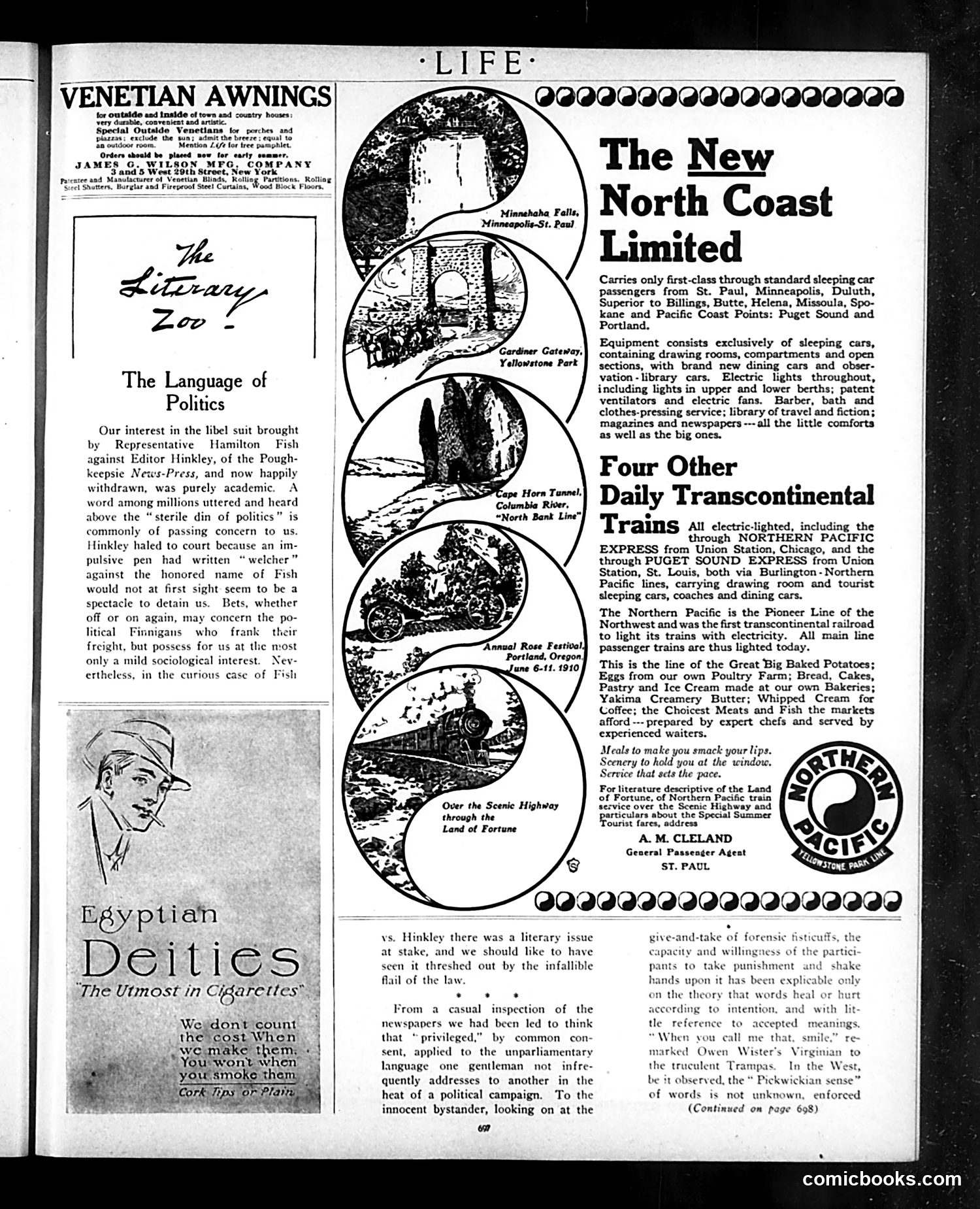
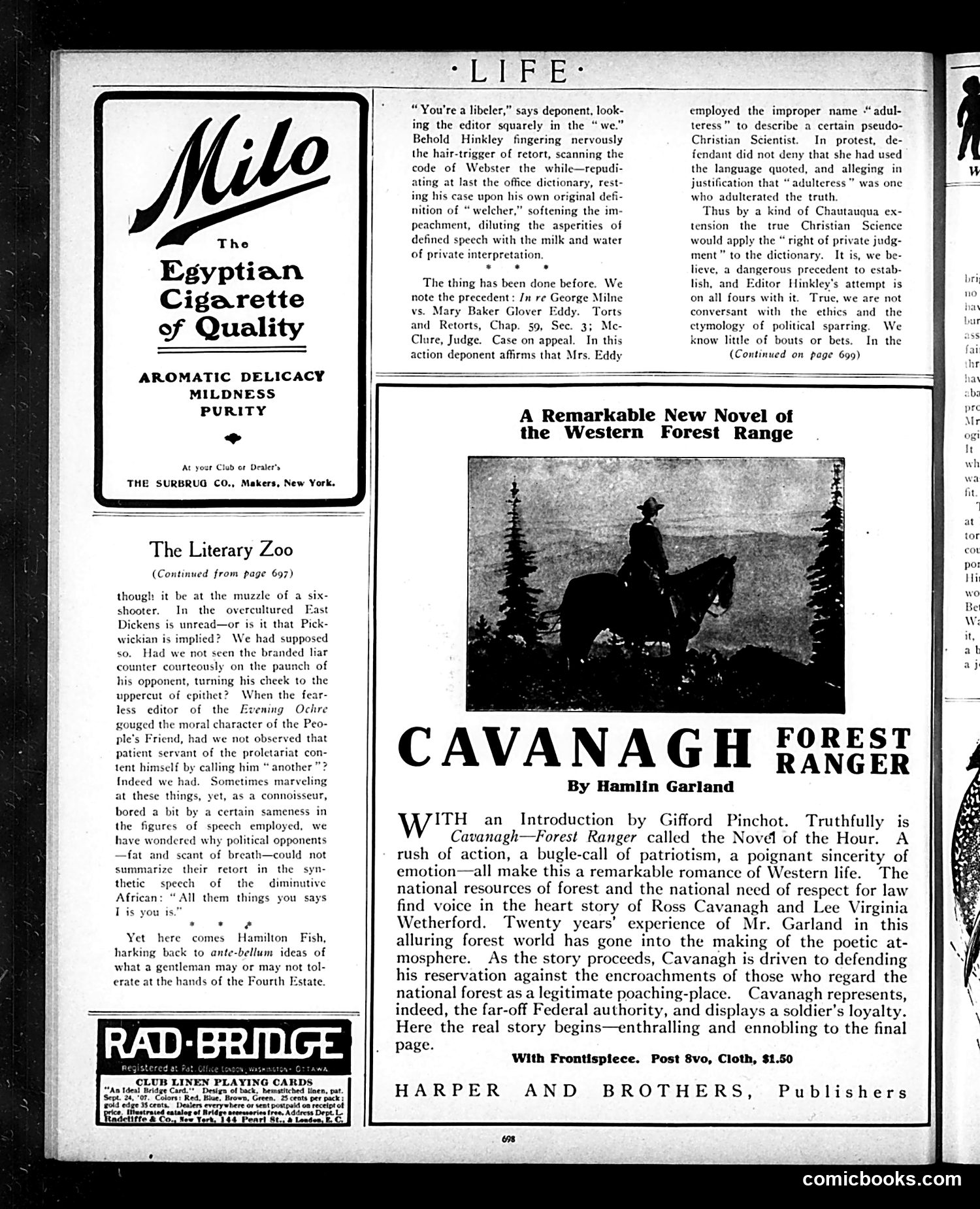
This page primarily contains a satirical article (continued from page 697) about standards of journalistic conduct and personal attack. The unnamed author critiques Editor Hinkley for redefining the word "welcher" to avoid being sued for libel, comparing this to a Christian Scientist defendant who redefined "adulteress" to mean "one who adulterated the truth." The satire's target appears to be **Hamilton Fish** (referenced in the final paragraph), a prominent late-19th-century politician and son of Secretary of State Hamilton Fish. The author mocks Fish for expecting "ante-bellum ideas of what a gentleman may or may not tolerate" from newspapers—suggesting Fish represents old-fashioned notions of honor incompatible with aggressive modern journalism. The piece satirizes how both editors and their targets manipulate language to escape legal consequences, questioning whether political opponents should resort to such semantic gymnastics rather than direct rhetoric. The rest of the page contains period advertisements and a book announcement for *Cavanagh Forest Ranger* by Hamlin Garland.
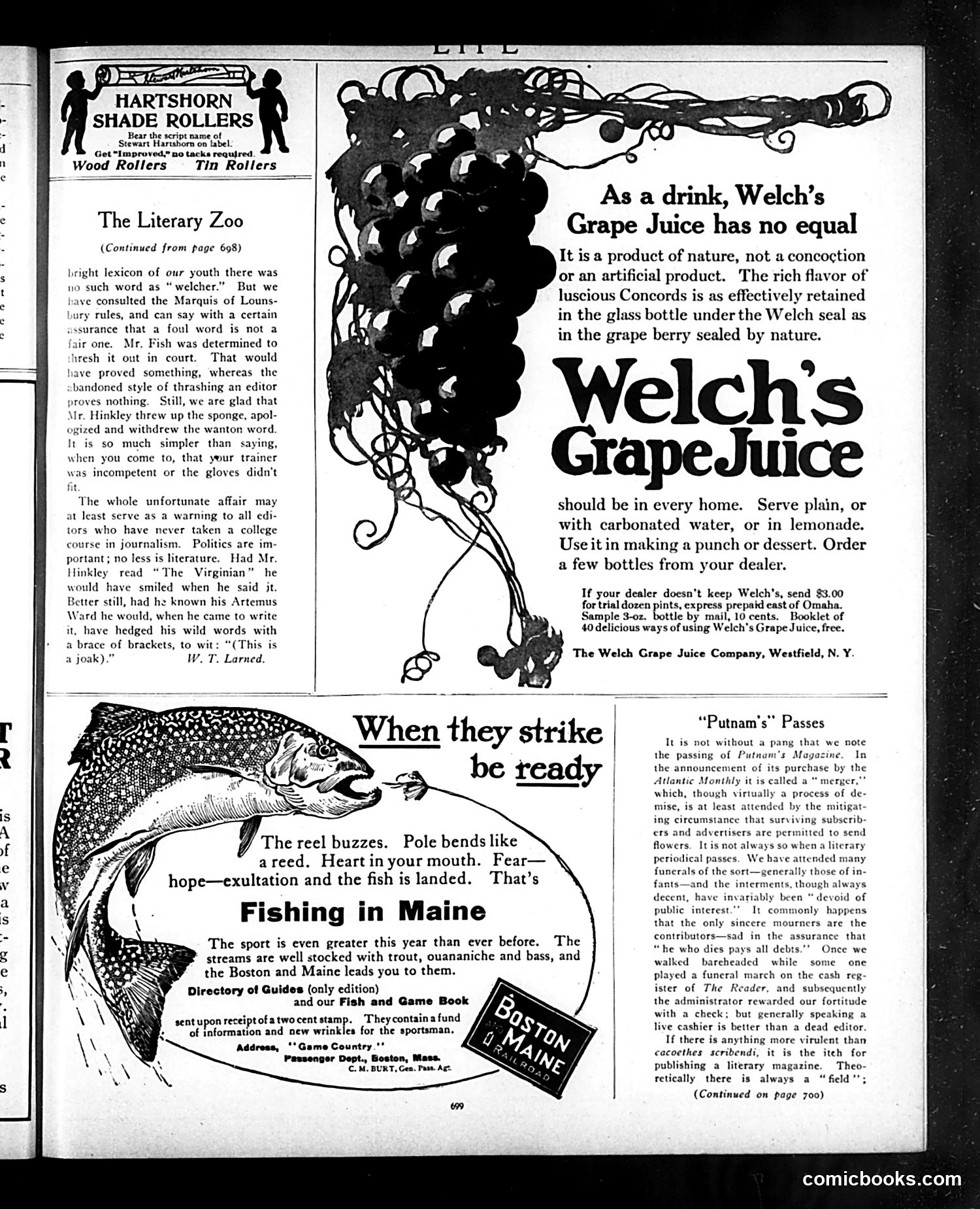
This page from *Life* magazine contains a satirical essay about a dispute between editors. The main piece discusses a conflict where an editor (Mr. Hinkley) sued another man (Mr. Fish) over the use of the word "welcher" (someone who reneges on a debt). The satire mocks both parties—Fish for bringing the suit and Hinkley for initially using rough language, then backing down ("threw up the sponge"). The author uses this incident to critique editors generally, suggesting they lack education (advising they read *The Virginian* and Artemus Ward for perspective). The piece argues that editors should understand literature and politics better before engaging in public disputes. The page is primarily filled with period advertisements (Welch's Grape Juice, shade rollers, fishing guides) with the literary commentary occupying roughly half the space. A brief note mourns *Putnam's Magazine*'s acquisition by *Atlantic Monthly*, treating it humorously as a "death" of the publication.
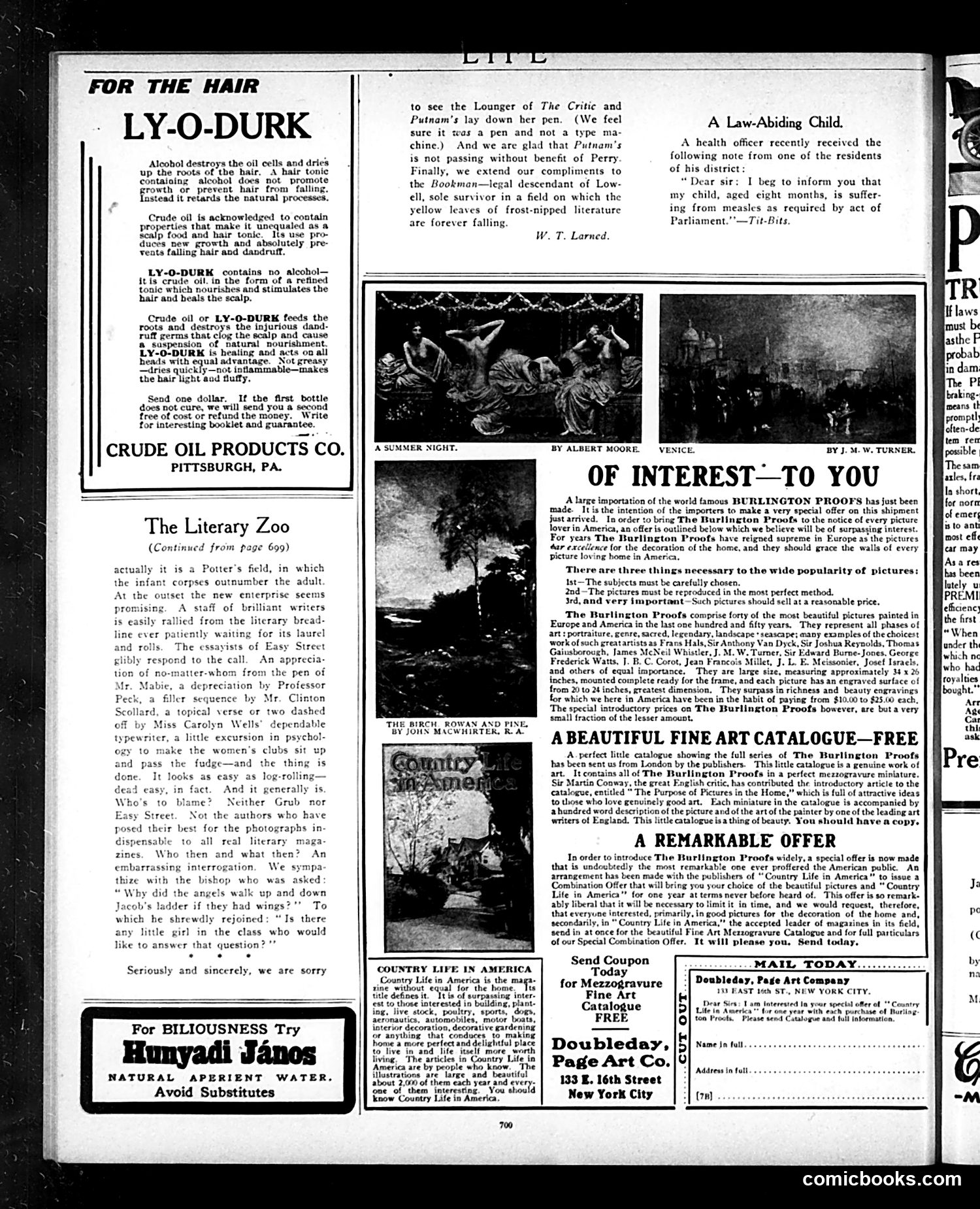
This page is primarily **advertisements and literary content**, not political cartoons. The main text discusses "The Literary Zoo," a satirical essay about magazine publishing by W.T. Larned. It mocks the literary magazine industry as a "Potter's field" where unsuccessful writers publish, comparing it to a burial ground for creative corpses. The piece critiques how magazines easily recruit writers from the "literary bread-line" and notes the irony that while talented contributors exist, the magazines themselves mysteriously fail. A small humor piece, "A Law-Abiding Child," quotes a parent informing a health officer their infant has measles "as required by act of Parliament"—mocking British legal bureaucracy through absurdist humor. The page is otherwise dominated by **product advertisements** (Ly-O-Durk hair tonic, Hunyadi Janos water) and promotional material for **Country Life in America** magazine and art catalogues. Three landscape paintings are featured as illustrations. There are no political cartoons per se on this page.
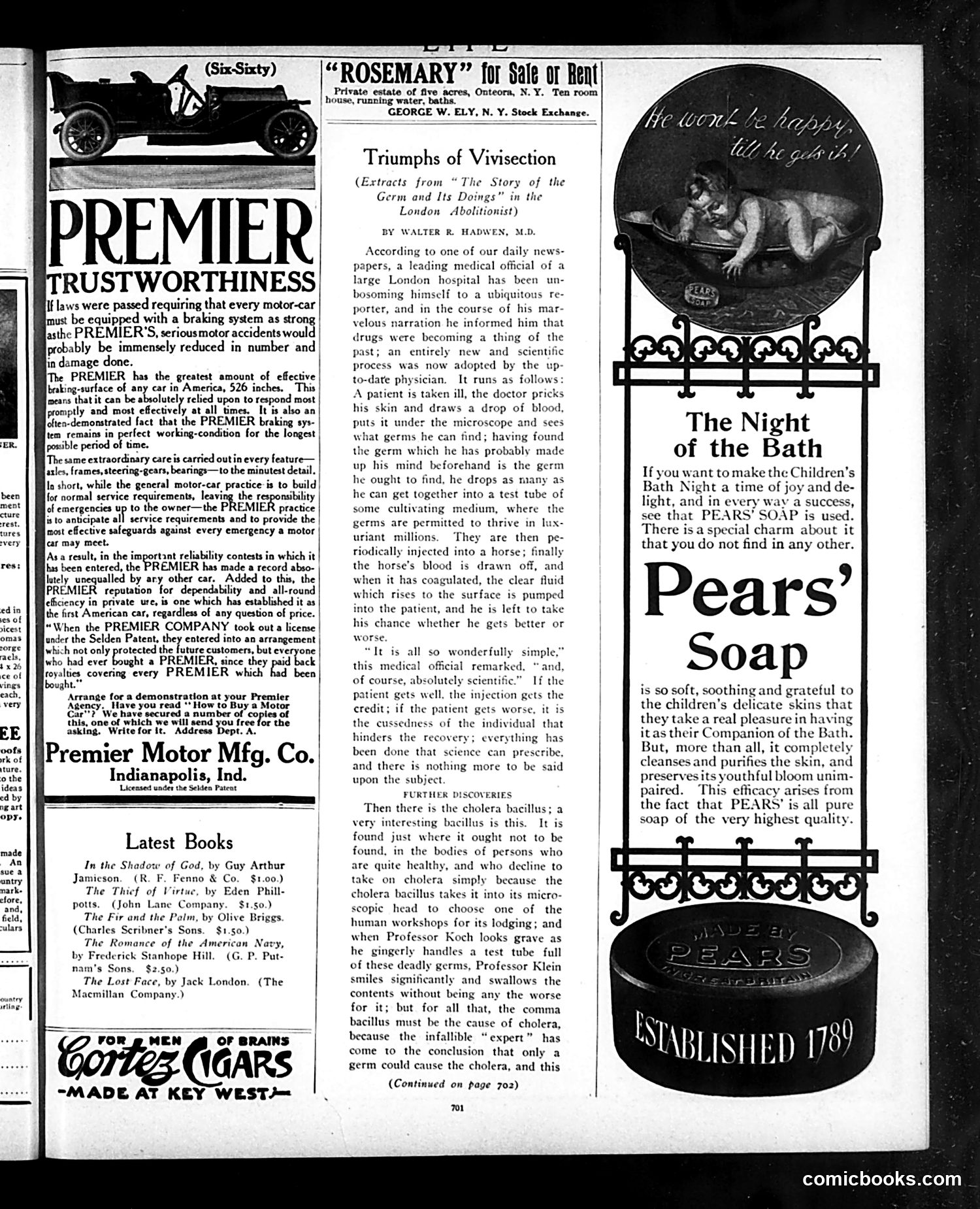
This page is primarily **advertisements and book reviews**, not political satire or editorial cartoons. The main content includes: **Premier Motor Company ad** (left): Promotes the Premier automobile's superior braking system, claiming 526 inches of braking surface—the greatest of any American car. The ad emphasizes safety and reliability, noting the company licensed the Selden Patent, protecting both current and past customers. **"Triumphs of Vivisection" article** (center): By Dr. Walter R. Hadwen, this appears to be anti-vivisection advocacy (animal testing criticism). It describes a doctor's method of extracting patient blood, culturing germs under microscopes, then injecting them into horses to develop serums—apparently criticizing this experimental medical practice. **Pears' Soap ad** (right): Marketing the soap as gentle for children's skin, established 1789. The page also lists recent book releases and cigars advertisement. There is **no political cartoon** visible—this is a standard commercial/editorial magazine page from the early 1900s.
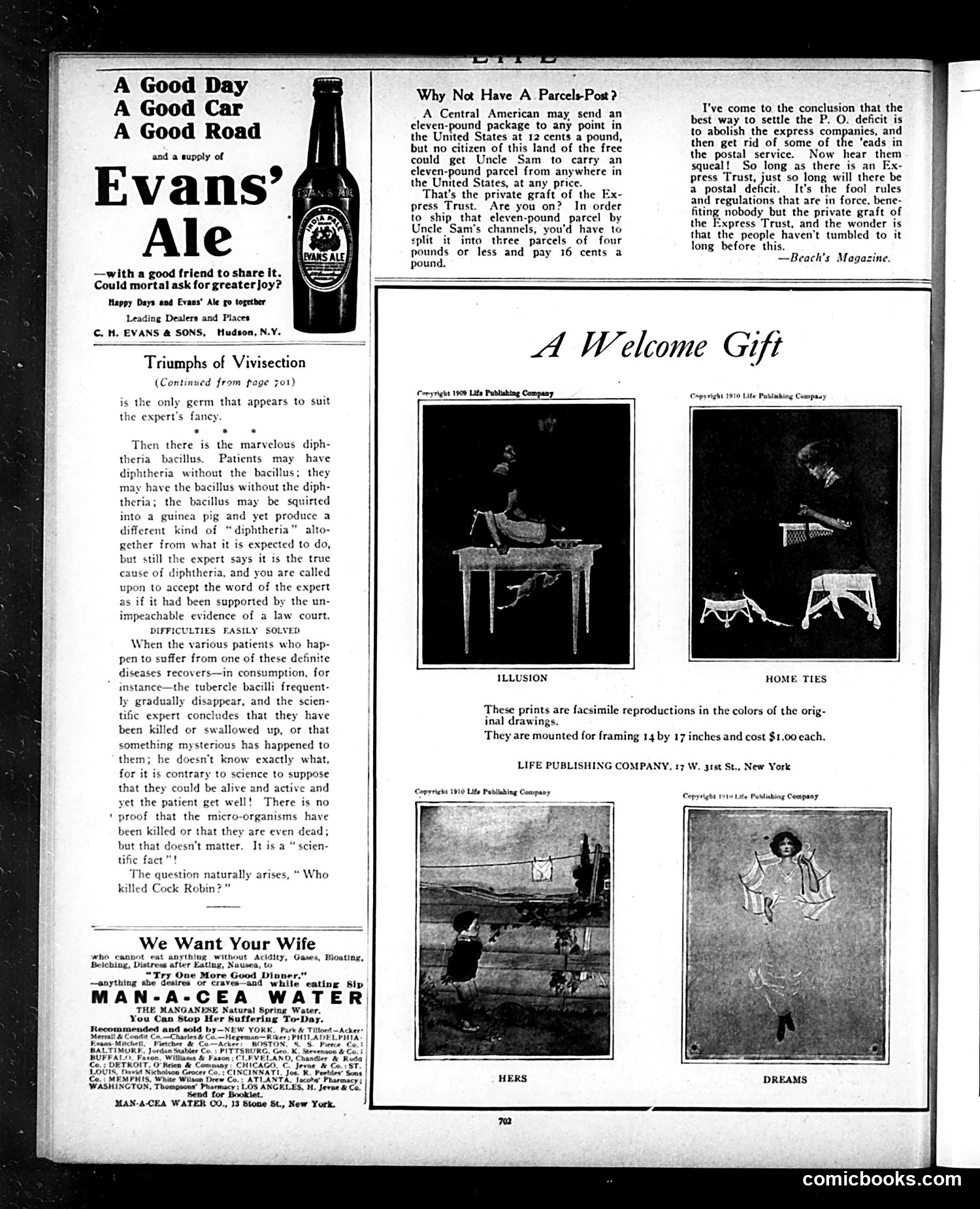
This brief editorial satire criticizes the absence of a U.S. parcel post system. The piece notes the irony that Central American countries can ship eleven-pound packages domestically for 12 cents per pound, yet American citizens cannot use their own postal service for the same purpose. Instead, they're forced to split parcels into smaller pieces and pay 16 cents per pound through private express companies. The satire targets both the inefficiency of the U.S. postal system and the profit-driven "express Trust" (likely referring to monopolistic express delivery companies) that benefits from this gap. The author suggests that establishing a federal parcel post would solve the post office's financial deficit while breaking the private companies' stranglehold on package delivery. This reflects genuine Progressive Era debates over postal reform—a parcel post system was eventually established in 1913.
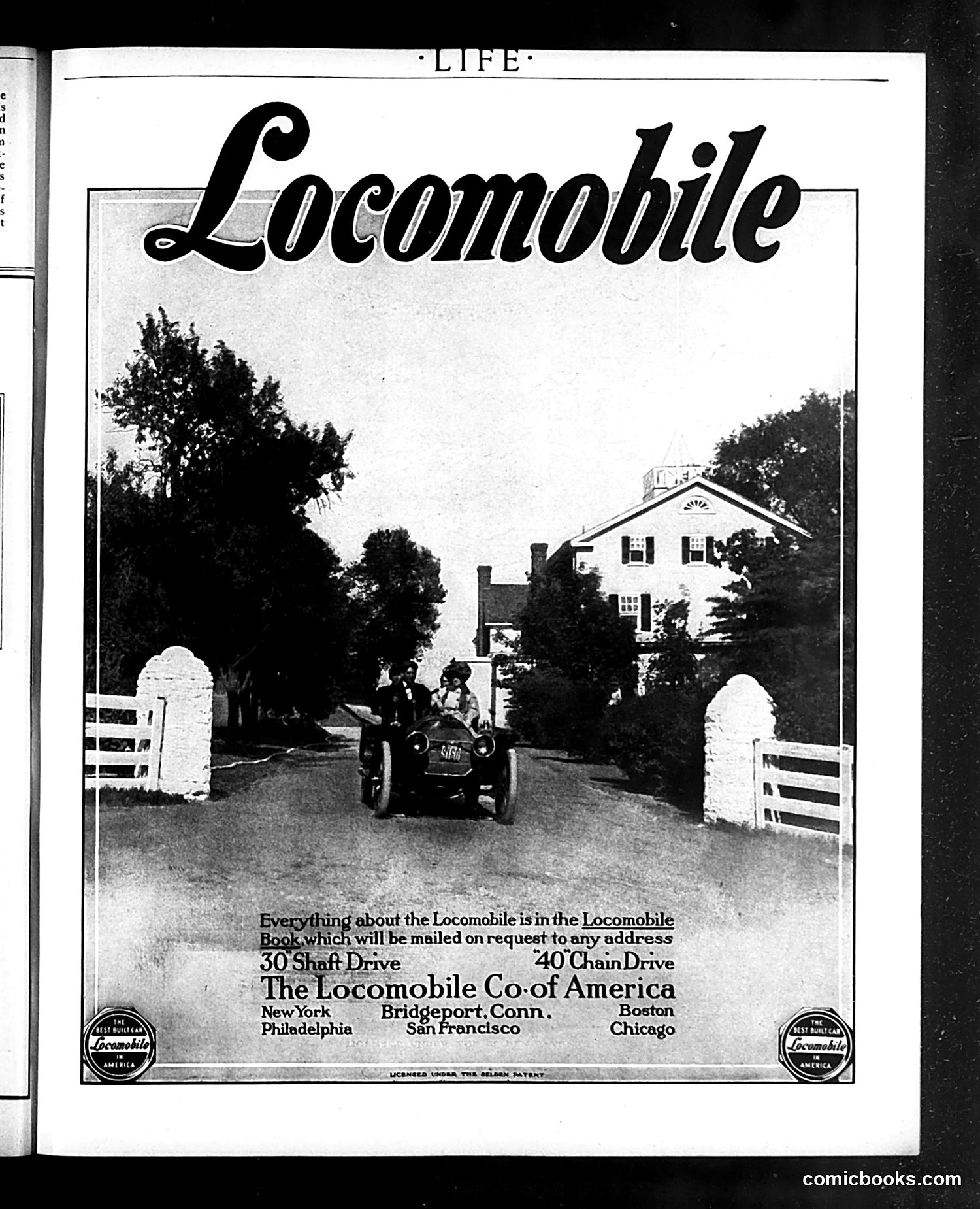
This is a full-page advertisement for the Locomobile automobile, not a political cartoon or satire. The image shows an early motor car (appearing to be from the 1910s-1920s era based on its design) driving through an elegant residential driveway flanked by white gates, with a substantial house visible in the background. The ad emphasizes luxury and prestige—the Locomobile was a high-end vehicle. The text promotes a "Locomobile Book" available upon request and lists The Locomobile Co. of America's offices across major American cities (New York, Philadelphia, Boston, Chicago, San Francisco, Bridgeport). This is purely commercial advertising designed to appeal to wealthy consumers seeking status through automobile ownership.
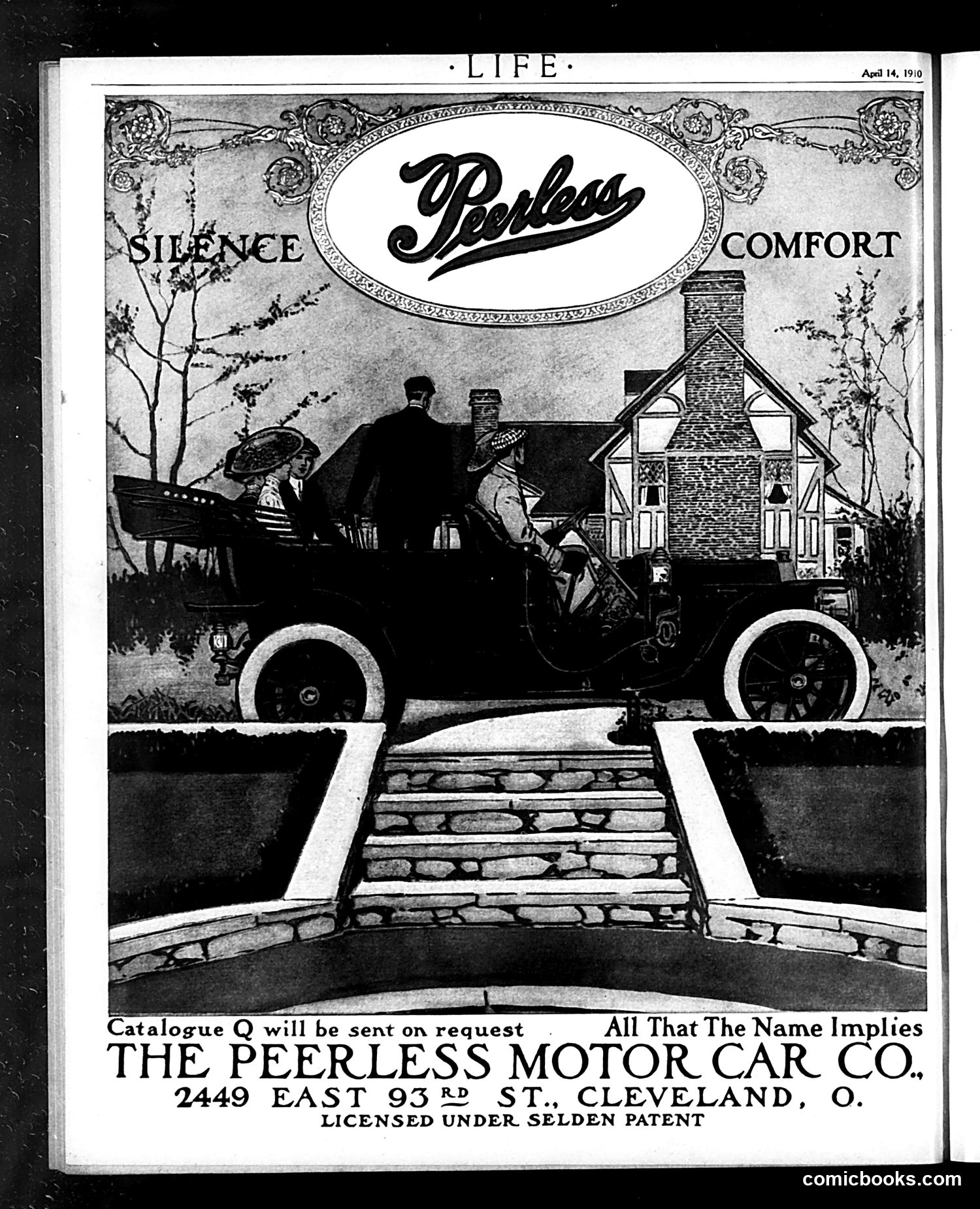
This is a **car advertisement, not satire**—specifically for the Peerless Motor Car Company of Cleveland, Ohio, dated April 14, 1910. The image depicts an early automobile with well-dressed passengers driving past a cottage, emphasizing the car's association with leisure, comfort, and domestic tranquility. The words "SILENCE" and "COMFORT" frame the scene, highlighting the vehicle's selling points to affluent buyers. The "Selden Patent" reference was legally significant: the Selden patent controlled early automobile manufacturing rights in America, creating licensing requirements for manufacturers. This advertisement asserts legitimacy by noting Peerless operated "under Selden patent." The tagline "All That The Name Implies" suggests the Peerless brand promised quality and refinement. This is straightforward commercial messaging targeting the wealthy automobile market of the 1910s, not political commentary.