
Life, 1910-04-14 · page 20 of 44
Life — April 14, 1910 — page 20: what you’re looking at
What you’re looking at
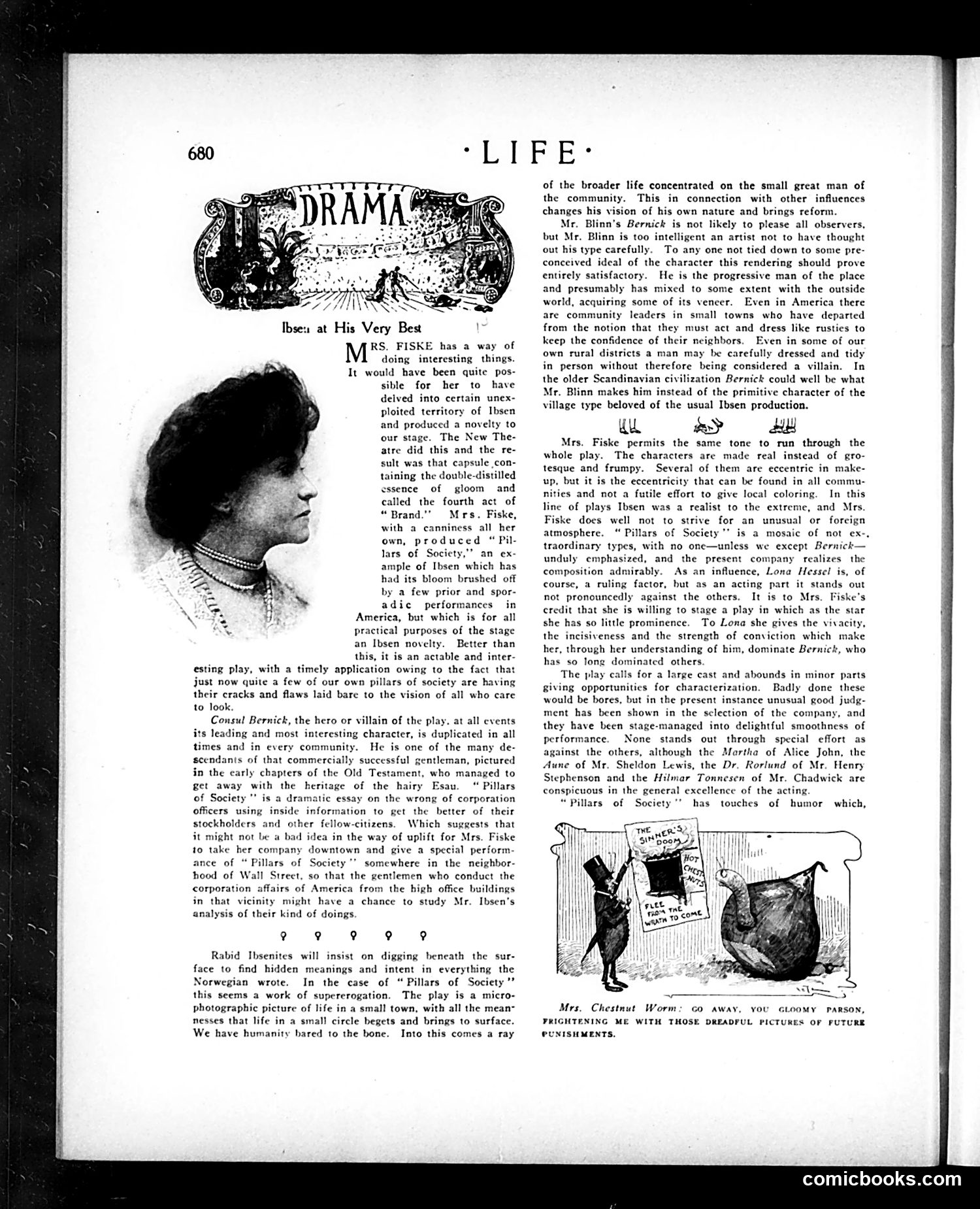
This page reviews Mrs. Fiske's production of Henrik Ibsen's *Pillars of Society*, praising her intelligent staging. The critic notes the play's timeliness: it exposes corporate corruption through Consul Bernick, a morally compromised businessman who uses insider information against stockholders—a pointed reference to contemporary American business scandals. The review suggests Mrs. Fiske perform the play on Wall Street so corporate officers might learn from Ibsen's critique of their own conduct. The accompanying cartoon (bottom right) shows "Mrs. Chestnut Worm" fleeing "dreadful pictures of future punishments," likely satirizing censorship debates or moral reformers' anxiety about theater's influence. The critic defends the actors' realistic portrayals against rigid Ibsenite interpretations, arguing characters needn't be primitive or grotesque to be authentic—a subtle push for modernized staging of classical drama.
📄 Transcribed text from this page (OCR, searchable)
Machine-transcribed from the original scan — historical spelling and the odd misread are preserved.
*ETP E* TIAA Ise at His Very Best RS. FISKE has a way of doing interesting things. It would have been quite pos- sible for her to have delved into certain unex- ploited territory of Ibsen and produced a novelty to our stage. The New The- atre did this and the re- sult was that capsule con- taining the double-distilled essence of gloom and called the fourth act of “Brand.” Mrs. Fiske, with a canniness all her own, produced “Pil- lars of Society," an ex- ample of Ibsen which has had its bloom brushed off by a few prior and spor- adic performances in America, but which is for all practical purposes of the stage an Ibsen novelty. Better than this, it is an actable and inter- esting play, with a timely application owing to the fact that just now quite a few of our own pillars of society are having their cracks and flaws laid bare to the vision of all who care to look. Consul Bernick, the hero or villain of the play. at all events its leading and most interesting character, is duplicated in all times and in every community. He is one of the many de- scendanis of that commercially successful gentleman, pictured in the early chapters of the Old Testament, who managed to get away with the heritage of the hairy Esau. “ Pillars of Society "is a dramatic essay on the wrong of corporation officers using inside information to get the better of their stockholders and other fellow-citizens. Which suggests that it might not be a bad idea in the way of uplift for Mrs. Fiske to take her company downtown and give a special perform- ance of “Pillars of Society” somewhere in the neighbor- hood of Wall Street, so that the gentlemen who conduct the corporation affairs of America from the high office buildings in that vicinity might have a chance to study Mr. Ibsen's analysis of their kind of doings. ? g g 9 9 Rabid Ibsenites will insist on digging beneath the sur- face to find hidden meanings and intent in everything the Norwegian wrote. In the case of “Pillars of Society’ this seems a work of supererogation. The play is a micro- photographic picture of life in a small town, with all the mean- nesses that life in a small circle begets and brings to surface. We have humanity bared to the bone. Into this comes a ray of the broader life concentrated on the small great man of the community. This in connection with other influences changes his vision of his own nature and brings reform. Mr. Blinn’s Bernick is not likely to please all observers, but Mr. Blinn is too intelligent an artist not to have thought out his type carefully. To any one not tied down to some pre- conceived ideal of the character this rendering should prove entirely satisfactory. He is the progressive man of the place and presumably has mixed to some extent with the outside world, acquiring some of its vencer. Even in America there are community leaders in small towns who have departed from the notion that they must act and dress like rusties to keep the confidence of their neighbors. Even in some of our own rural districts a man may be carefully dressed and tidy in person without therefore being considered a villain. In the older Scandinavian civilization Bernick could well be what Mr. Blinn makes him instead of the primitive character of the village type beloved of the usual Ibsen production. Mrs. Fiske permits the same tone to run through the whole play. The characters are made real instead of gro- tesque and frumpy. Several of them are eccentric in make- up, but it is the eccentricity that can be found in all commu- nities and not a futile effort to give local coloring. In this line of plays Ibsen was a realist to the extreme, and Mrs. Fiske docs well not to strive for an unusual or forcign atmosphere. Pillars of Society’ is a mosaic of not ex-, traordinary types, with no one—unless we except Bernick— unduly emphasized, and the present company realizes the composition admirably. As an influence, Lona Hessel is, of course, a ruling factor, but as an acting part it stands out not pronouncedly against the others. It is to Mrs. Fiske’s credit that she is willing to stage a play in which as the star she has so little prominence. To Lona she gives the vivacity, incisiveness and the strength of conviction which make her, through her understanding of him, dominate Bernick, who has so long dominated others. The play calls for a large cast and abounds in minor parts giving opportunities for characterization. Badly done these would be bores, but in the present instance unusual good judg- ment has been shown in the sclection of the company, and they have been stage-managed into delightful smoothness of performance. None stands out through special effort as against the others, although the Martha of Alice John, the Aune of Mr. Sheldon Lewis, the Dr. Rorlund of Mr. Henry Stephenson and the Hilmar Tonnesen of Mr. Chadwick are conspicuous in the general excellence of the acting. “Pillars of Society ’’ has touches of humor which, Mrs. Chestnut Worm: co away, ¥ GLOOMY PARSON, FRIGMTENING ME WITH THOSE DREADFUL PICTURES OF FUTURE PUNISHMENTS. comicbooks.com