
Life, 1910-04-14 · page 21 of 44
Life — April 14, 1910 — page 21: what you’re looking at
What you’re looking at
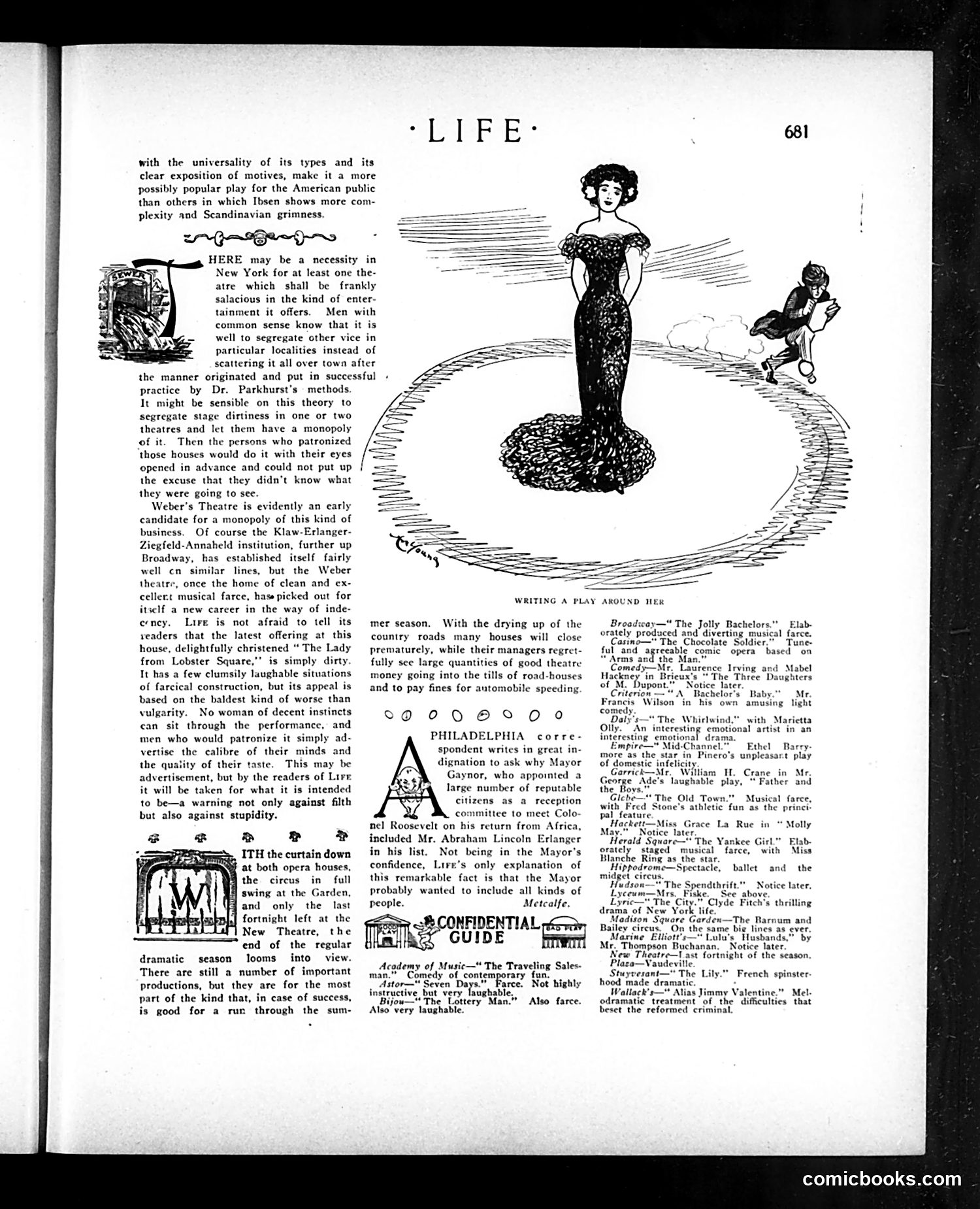
This page critiques moral standards in New York theater around 1909. The main illustration, "Writing a Play Around Her," depicts a woman as the literal foundation of a theatrical production—a visual pun on how salacious entertainment exploits female bodies for profit. The text attacks Weber's Theatre for staging "The Lady from Lobster Square," condemning it as obscene rather than clever. Life argues such "dirty" farce appeals only to men of poor taste and warns decent women away. The author proposes segregating indecent theaters (like designated vice districts) rather than scattering "stage dirtiness" throughout Broadway. A secondary note mocks Mayor Gaynor for including theatrical impresario Abraham Lincoln Erlanger on a reception committee for Colonel Roosevelt's return from Africa—suggesting Erlanger's questionable character makes him unsuitable company for such an honor, though Life concedes the Mayor may simply have wanted "all kinds of people" represented.
📄 Transcribed text from this page (OCR, searchable)
Machine-transcribed from the original scan — historical spelling and the odd misread are preserved.
with the universality of its types and its clear exposition of motives, make it a more possibly popular play for the American public than others in which Ibsen shows more com- plexity and Scandinavian grimness. OG HERE may be a necessity in New York for at least one the- atre which shall be frankly salacious in the kind of enter- tainment it offers. Men with common sense know that it is well to segregate other vice in particular localities instead of scattering it all over town after the manner originated and put in successful practice by Dr. Parkhurst’s methods. It might be sensible on this theory to segregate stage dirtiness in one or two theatres and let them have a monopoly of it. Then the persons who patronized those houses would do it with their eyes opened in advance and could not put up the excuse that they didn’t know what they were going to see Weber's Theatre is evidently an early candidate for a monopoly of this kind of business. Of course the Klaw-Erlanger- Ziegfeld-Annaheld institution, further up Broadway, has established itself fairly well cn similar but the Weber theatre, once the home of clean and ex- cellert musical farce, has picked out for itself a new career in the way of inde- erney. Lire is not afraid to tell its veaders that the latest offering at this house, delightfully christened “ The Lady from Lobster Square,’’ is simply dirty. It has a few clumsily laughable situations of farcical construction, but its appeal is based on the baldest kind of worse than vulgarity. No woman of decent instincts can sit through the performance, and men who would patronize it simply ad- vertise the calibre of their minds and the quality of their taste. This may be advertisement, but by the readers of Lire it will be taken for what it is intended to be—a warning not only against filth but also against stupidity. ® Ld ® ITH the curtain down at both opera houses, the circus in full f swing at the Garden, and only the last fortnight left at the New Theatre, the end of the regular dramatic season looms into view. There are still a number of important productions, but they are for the most part of the kind that, in case of success, is good for a run through the sum- lines, WRITING A PLAY mer season. With the drying up of the country roads many houses will close prematurely, while their managers regret- fully see large quantities of good theatre money going into the tills of road-houses and to pay fines for automobile speeding. caq00 O89 00 PHILADELPHIA corre- spondent writes in great in- dignation to ask why Mayor Gaynor, who appointed a large number of reputable citizens as a reception committee to meet Colo- nel Roosevelt on his return from Africa, included Mr. Abraham Lincoln Erlanger in his list. Not being in the Mayor's confidence, Lire’s only explanation of this remarkable fact is that the Mayor probably wanted to include all kinds of people. Metcalfe. SS CONFIDENTIAL ety” GUIDE Academy of Music— The Traveling Sales- man.” Comedy of contemporary fan. Astor—" Seven Days.” Farce. Not highly instructive, but very laughable, Bijou— The Lottery Man.” Also farce. Also very laughable. AROUND HER Broadiway—" The Jolly Bachelors.” orately produced and diverting al farce. Casino—" The Chocolate Soldier.” Tune- ful and agreeable comic opera based on “Arms and the Man.” Comedy—Mr. Laurer in Brew upon Criterion A Francis Wilson in comedy Daly"s—" The Whirlwind,” Olly. “An interesting emotional artist in an interesting emotional drama. ‘mpire—" Mid-Channel.” Ethel Barry: more as the star in Pinero’s unpleasant play of domestic infelicity _Garrick—Mr. William H. Crane in Mr. George Ade’s laughable play, "Father and the Boys.” ‘Glebe—"* The Old. Town with Fred pal feature Hackett—Miss Grace La Rue in May.” “Notice later Herald Square—" The Yankee orately staged musical farce, Blanche Ring as the star. Hippodrome—Spectacle, midget circus. Hudson—" The Spendthrift.” Notice later, Lyceum—Mrs. Fiske. See above. Lyric—* The City.” Clyde Fitch's thrilling drama of New York life. Madison Square Garden—The Barnum and Bailey circus. On the same big lines as ever. Marine Elliott’s—* Lulu’s Husbands,” by Mr. Thompson Buchanan. Notice later. New Theatre—l ast fortnight of the season, Plaza—Vaudeville. Stuyvesant—" The Lily. hood made dramati Wallack’s—"* Alias Jimmy Valentine.” Mel- odramatic treatment of the difficulties that beset the reformed criminal, Elab- Irving and Mabel “The Three Daughters Notice later. Bachelor's Mr. his own light Baby.” amusing with Marietta ¢ 7 Musical farce, Stone's athletic fun as the princi- * Molly " Elab- with Miss ballet and the French spinster. comicbooks.com