
Life, 1910-04-14 · page 24 of 44
Life — April 14, 1910 — page 24: what you’re looking at
What you’re looking at
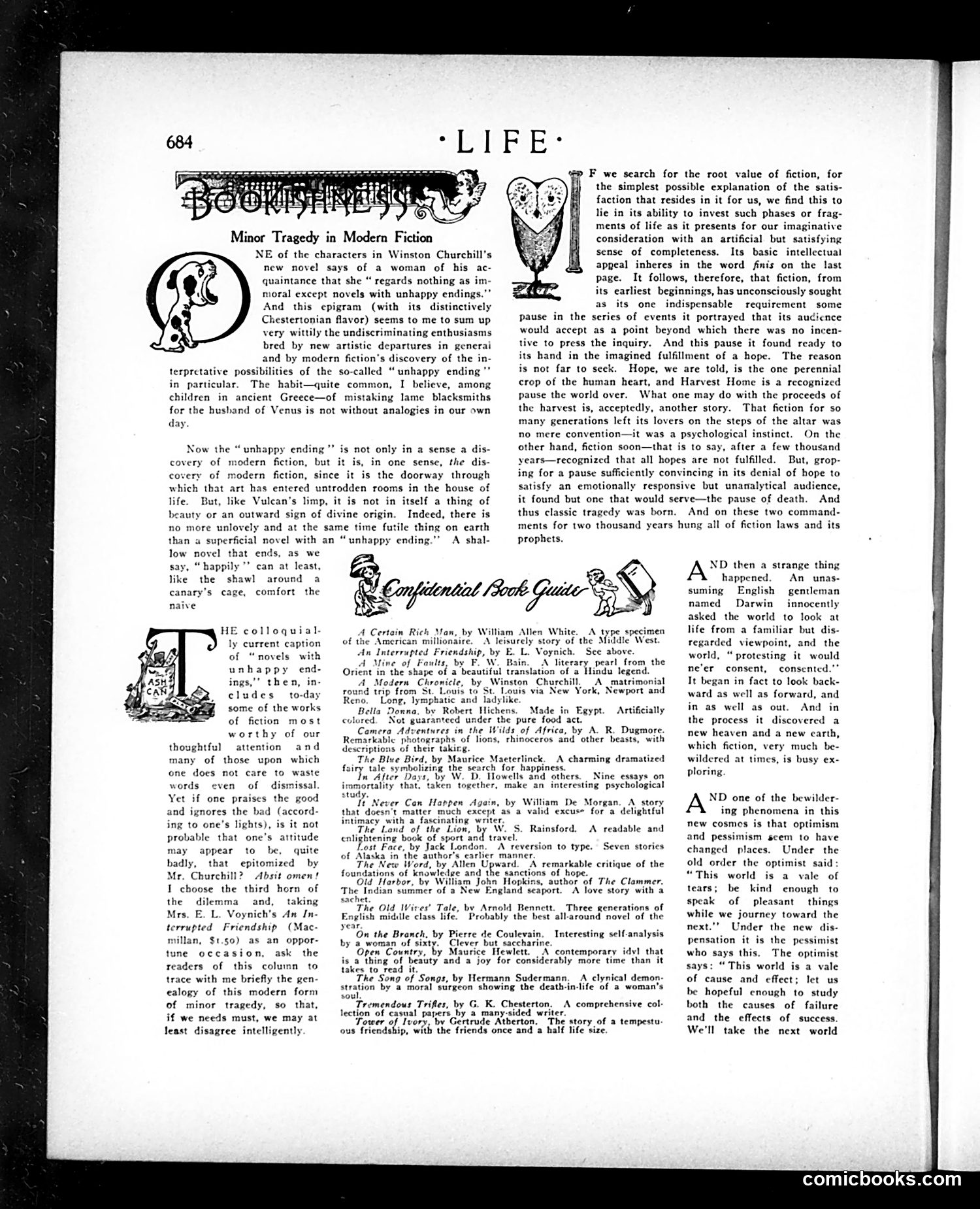
This page critiques the literary fashion for "unhappy endings" in modern fiction, particularly as popularized by contemporary authors like Winston Churchill. The author argues that while the unhappy ending represents fiction's discovery of new interpretive possibilities, it has become superficially adopted by mediocre writers who mistake bleakness for profundity. The opening epigram—a woman who finds immorality in unhappy endings—satirizes readers who uncritically embrace artistic novelty. The author contends that fiction's true value lies in providing imaginative "completeness," traditionally achieved through hopeful resolutions (the "Harvest Home"). The proliferation of shallow novels using unhappy endings merely to seem artistically serious represents a misunderstanding of why tragic conclusions work in genuinely accomplished literature. The "Confidential Book Guide" lists contemporary novels exemplifying both quality and fashionable gloom, mocking the indiscriminate enthusiasm for this trend among modern readers.
📄 Transcribed text from this page (OCR, searchable)
Machine-transcribed from the original scan — historical spelling and the odd misread are preserved.
/ © Minor Tragedy in Modern Fiction NE of the characters in Winston Churchill's new novel says of a woman of his ac- quaintance that she “' regards nothing as im- moral except novels with unhappy endings.” And this epigram (with its distinctively Chestertonian flavor) seems to me to sum up very wittily the undiscriminating enthusiasms bred by new artistic departures in general and by modern fiction’s discovery of the in- terpretative possibilities of the so-called “unhappy ending” in particular. The habit—quite common, I believe, among children in ancient Greece—of mistaking lame blacksmiths for the husband of Venus is not without analogies in our own day Now the “unhappy ending” is not only in a sense a dis- covery of modern fiction, but it is, in one sense, the dis- covery of modern fiction, since it is the doorway through which that art has entered untrodden rooms in the house of life. But, like Vulcan’s limp, it is not in itself a thing of beauty or an outward sign of divine origin. Indeed, there is no more unlovely and at the same time futile thing on earth than a superficial novel with an “unhappy ending."” A shal- low novel that ends, as we happily” can at least, the shawl around a canary’s cage, comfort the naive HE colloquial. ly current caption of the American millionaire of “novels with An Interrupted Friendshi unhappy end- ings,’ cludes to-day some of the works of fiction most worthy of our thoughtful attention and many of those upon which round tr Remarkable p! descriptions of their takirg. words even of dismissal Yet if one praises the good immortality that. study. 4 Certain Rich Man, by William Allen White. At \ leisurely story of the M by E. L. Voynich. A Mine of Faults, by F. W. Bai Orient in the shape of a beautiful translation of a Hindu legend. then, in A. Modern Chronicle, by Winston Churchill from St. Louis to St Reno. Long, lymphatic and ladylike Bella Donna, by Robert Hichens. 5 colored. Not guaranteed under the pure food act. the process it discovered a Camera Adventures in the Wilds of Africa, by A. R. Dugmore. graphs of lions, rhinoceros and other beasts, with Louis via New York, Newport and The Blve Bird. by Maurice Marterlinck fairy tale symbolizing the search for happiness. one does not care to waste Fn ajter Days, by W. D, Howells Ree others aken together, make an interesting psychological It Never Can Happen Again, by William De Morgan. A story F we search for the root value of fiction, for the simplest possible explanation of the satis- faction that resides in it for us, we find this to lie in its ability to invest such phases or frag- ments of life as it presents for our imaginative consideration with an artificial but satisfying sense of completeness. Its basic intellectual appeal inheres in the word finis on the last page. It follows, therefore, that fiction, from its earliest beginnings, has unconsciously sought as its one indispensable requirement some pause in the series of events it portrayed that its audience would accept as a point beyond which there was no incen- tive to press the inquiry. And this pause it found ready to its hand in the imagined fulfillment of a hope. The reason is not far to seek. Hope, we are told, is the one perennial crop of the human heart, and Harvest Home is a recognized pause the world over. What one may do with the proceeds of the harvest is, acceptedly, another story. That fiction for so many generations left its lovers on the steps of the altar was no mere convention—it was a psychological instinct. On the other hand, fiction soon—that is to say, after a few thousand years—recognized that all hopes are not fulfilled. But, grop- ing for a pause sufficiently convincing in its denial of hope to satisfy an emotionally responsive but unanalytical audience, it found but one that would serve—the pause of death, And thus classic tragedy was born. And on these two command- ments for two thousand years hung all of fiction laws and its prophets. ND then a strange thing happened. An unas- suming English gentleman named Darwin innocently asked the world to look at life from a familiar but di regarded viewpoint, and the world, “ protesting it would ne'er consent, consented. It began in fact to look back- ward as well as forward, and in as well as out. And in specimen le West See above. A literary pearl from the A matrimonial Made in Egypt. Artificially new heaven and a new carth, which fiction, very much be- wildered at times, is busy ex- ploring A charming dramatized Nine essays on A ND one of the bewilder- and ignores the bad (accord- ing to one’s lights), is it not probable that one’s attitude may appear to be, quite badly, that epitomized by Mr. Churchill? Absit omen! I choose the third horn of the dilemma and, taking Mrs. E. L. Voynich's An In- terrupted Friendship (Mac- millan, $1.50) as an oppor- tune occasion, ask the readers of 1! coluinn to trace with me briefly the gen- ealogy of this modern form of minor tragedy, so that, if we needs must, we may at least disagree intelligently that doesn't matter much except’as a valid excuse for a delightful intimacy with a fascinating writer The Land of the Lion, by W. S. Rainsford. colightening book of sport and travel Lost Face, by Jack London. A reversion to type. Seven stories of Nlaska in the author's earlier manner, The New Word, by Allen Upward. A remarkable critique of the foundations of knowledge and the sanctions of hope. ‘Old Harbor, by William John Hopkins, author of The Clammer. The Indian summer of a New England seaport. A love story with a sachet The Old Wires’ Tale, by Arnold Bennett. Three generations of English midille class life. Probably the best all-around novel of the year, On the Branch. by Pierre de Coulevain by a woman of sixty. Clever but sacchari Open Country, by Maurice Hewlett. A contemporary idv! that is a thing of beauty and a joy for considerably more time than it takes to read it. The Song of Songs, by Hermann Sudermann. A clynical demon- stration by @ moral surgeon showing the death-in-life of » woman's Tremendous Trifles, by G. K. Chesterton. A comprehensive col- lection of casual papers by a many-sided writer. Tower of Ivory, by Gertrude Atherton. The story of a tempestu ous friendship, with the friends once and a half life size, A readable and Interesting self-analysis ing phenomena in this new cosmos is that optimism and pessimism scem to have changed places. Under the old order the optimist said: “This world is a vale of tears; be kind enough to speak of pleasant things while we journey toward the next."" Under the new dis- pensation it is the pessimist who says this. The optimist says: “This world is a vale of cause and effect; let us be hopeful enough to study both the causes of failure and the effects of success. We'll take the next world comicbooks.com