
Life, 1910-04-14 · page 19 of 44
Life — April 14, 1910 — page 19: what you’re looking at
What you’re looking at
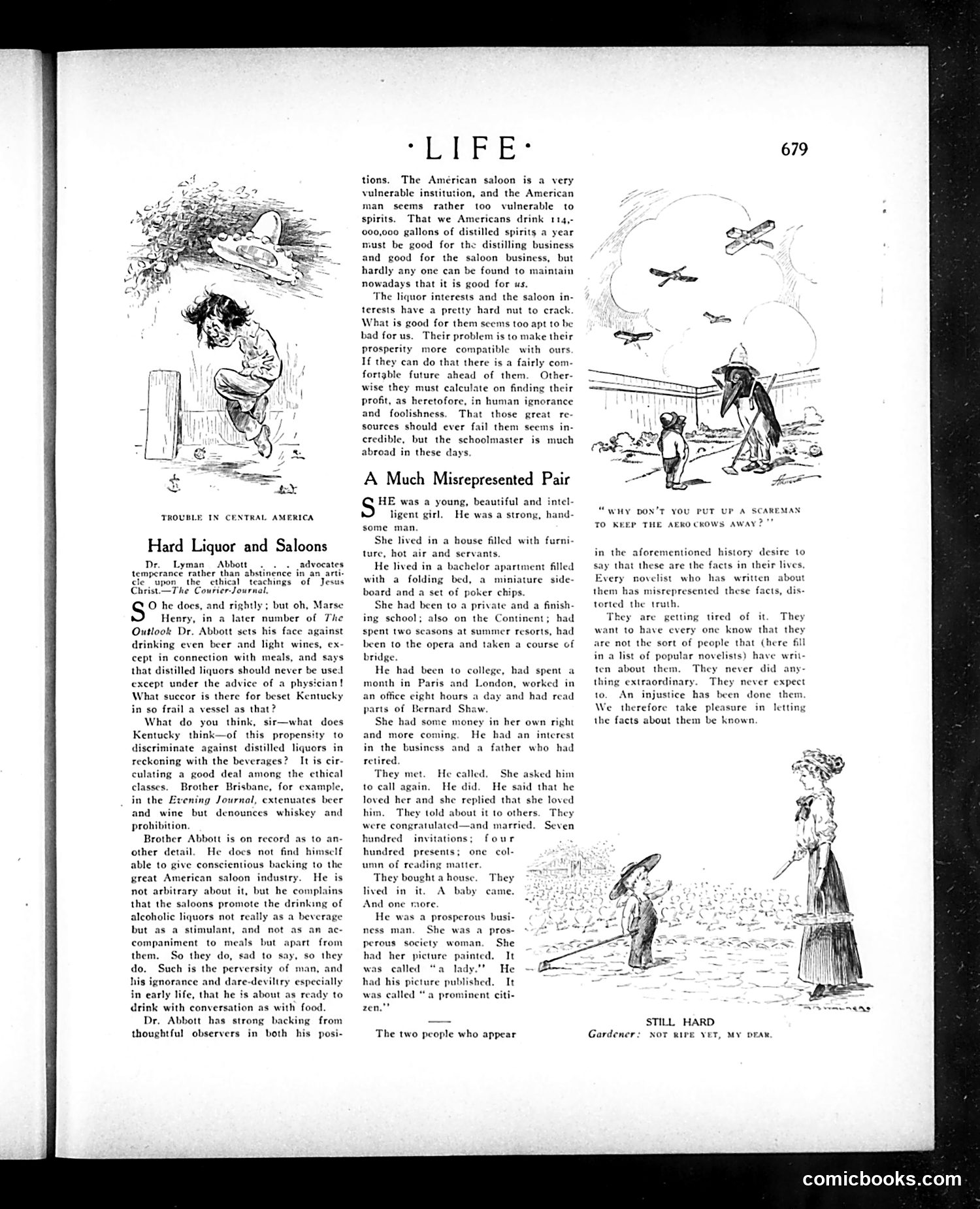
This page satirizes two distinct topics: **Left section**: Critiques the temperance movement's inconsistency. Dr. Lyman Abbott advocates "temperance" (moderation) in Jesus's teachings but then opposes distilled liquors entirely—except medicinally. The satire targets this hypocrisy and the "ethical classes" who distinguish between beer/wine (acceptable) and whiskey (condemned). Life mocks their contradictions while acknowledging the real problem: Americans drink 114 million gallons of distilled spirits yearly, benefiting saloon owners but harming society. The humor lies in pointing out the liquor industry's impossible position—their profit depends on human "ignorance and foolishness." **Right section**: "A Much Misrepresented Pair" depicts a wealthy, educated woman and a professional man who marry after meeting. The satire gently mocks their vastly different backgrounds (her finishing schools and leisure; his office work) yet identical social outcomes—they become prosperous, respectable, and produce children. The title suggests society misrepresents their union as unusual when such marriages were increasingly common among the American middle/upper classes.
📄 Transcribed text from this page (OCR, searchable)
Machine-transcribed from the original scan — historical spelling and the odd misread are preserved.
TROUBLE IN CENTRAL AMERICA Hard Liquor and Saloons Dr. Lyman Abbott «=. ,advocates temperance rather than abstinence in an_arti- cle upon. the ethical teachings of Jesus Christ.—The Courier-Journal. O he does, and rightly; but oh, Marse Henry, in a later number of The Outlook Dr. Abbott sets his face against drinking even beer and light wines, ex- cept in connection with meals, and say that distilled liquors should never be used except under the advice of a physician! What succor is there for beset Kentucky in so frail a vessel as that? What do you think, sir—what does Kentucky think—of this propensity to discriminate against distilled liquors in reckoning with the beverages? It is cir- culating a good deal among the ethical classes. Brother Brisbane, for example, in the Evening Journal, extenuates beer and wine but denounces whiskey and prohibition Brother Abbott is on record as to an- other detail, He docs not find himself able to give conscientious backing to the great American saloon industry. He is not arbitrary about it, but he complains that the saloons promote the drinking of alcoholic liquors not really as a beverage but as a stimulant, and not companiment to meals but them. So they do, sad to say, so they do. Such is the perversity of man, and his ignorance and dare-deviltry especially in early life, that he is about as ready to drink with conversation as with food. Dr. Abbott has strong backing from thoughtful observers in both his posi- as an ac- apart from ‘El ES tions. The Américan saloon is a very vulnerable institution, and the American man seems rather too vulnerable to spirits. That we Americans drink 114,- 000,000 gallons of distilled spirits a year must be good for the distilling business and good for the saloon business, but hardly any one can be found to maintain nowadays that it is good for us. The liquor interests and the saloon in- terests have a pretty hard nut to crack. What is good for them scems too apt to be bad for us. Their problem is to make their prosperity more compatible with ours. If they can do that there is a fairly com- fortgble future ahead of them. Other- wise they must calculate on finding their profit, as heretofore, in human ignorance and foolishness. That those great re- sources should ever fail them seems in- credible, but the schoolmaster is much abroad in these days A Much Misrepresented Pair HE was a young, beautiful and i ligent girl. He was a strong, h some man, She lived in a house filled with furni ture, hot air and servants. He lived in a bachelor apartment filled with a folding bed, a miniature board and a set of poker chips. She had been to a private and a finish- ing school; also on the Continent; had spent two Seasons at summer resorts, had side- been to the opera and taken a course of bridge. He had been to college, had spent a month in Paris and London, worked in an office cight hours a day and had read parts of Bernard Shaw. She had some money in her own right and more coming. He had an interest in the business and a father who had retired. They met. He called 1 him to call again. He did. He said that he loved her and she replied that she loved They Seven She as! hin They told about it to others. were congratulated—and married. hundred invitations; four hundred presents ; umn of reading matter. one col- They bought a house. lived in it. A’ baby And one more. He was a prosperous busi- They came, ness man. She was a pros- perous society woman. She had her picture painted. It was called “a lad He had his picture published. It was called “a prominent citi- zen,"" The two people who appear “WHY DON’T YOU PUT UP A SCAREMAN TO KEEP THE AERO CKOWS AWAY in the aforementioned history desire to say that these are the facts in their lives. who has written about very novelist them has misrepresented these facts, dis- torted the truth, They are getting tired of it. They want to have every one know that they are not the sort of people that (here fill in a list of popular novelists) have writ- ten about them. They any- thing extraordinary. to. An injustice has been done them We therefore take pleasure in letting the facts about them be known never did They never expect STILL HARD Gardener: NOT RITE VET, MY DEAK. comicbooks.com