
Life, 1910-04-14 · page 16 of 44
Life — April 14, 1910 — page 16: what you’re looking at
What you’re looking at
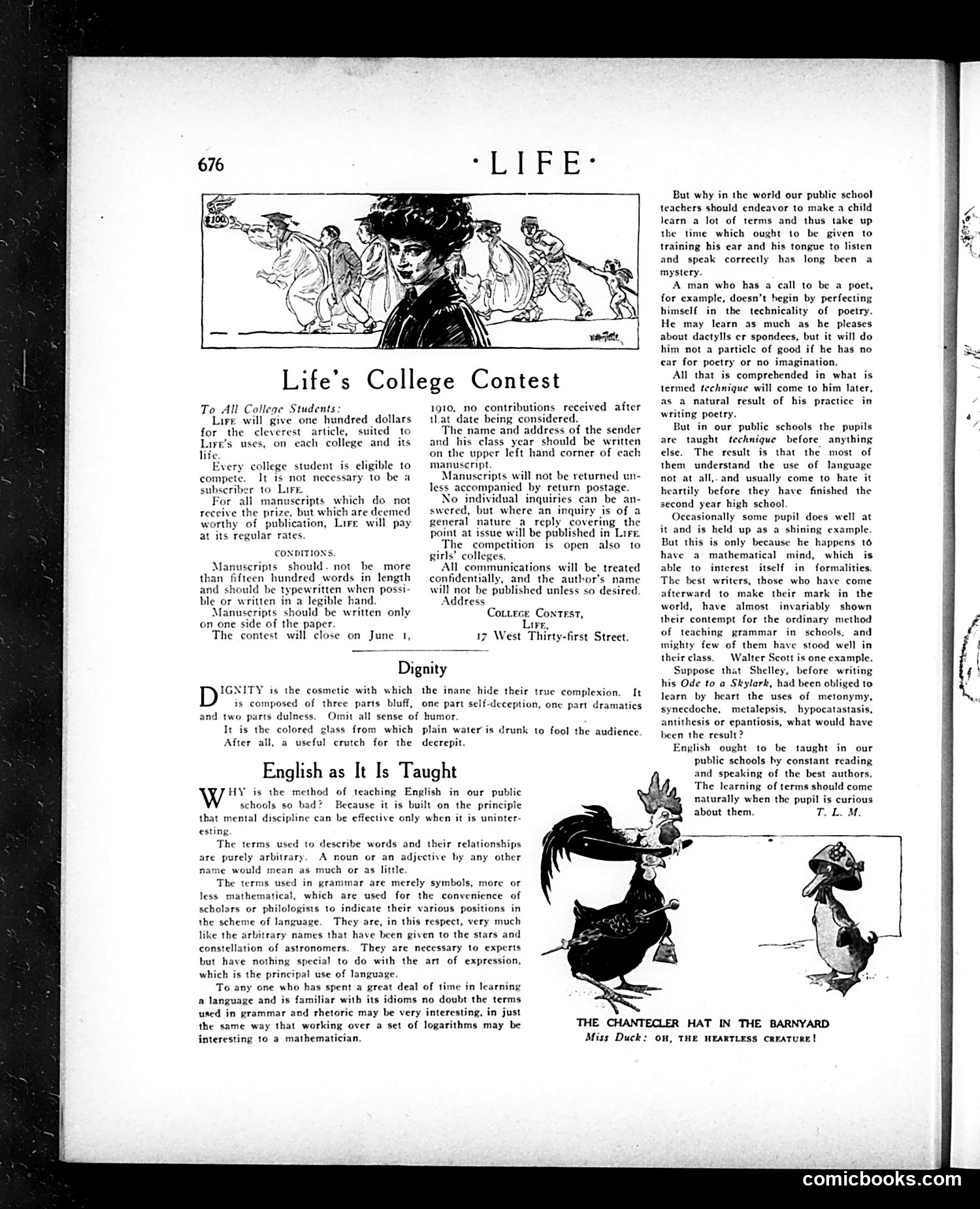
This page from *Life* magazine (circa 1910) contains three distinct sections: **Life's College Contest** announces a $100 writing competition for college students to submit articles about their respective colleges. Standard submission rules apply. **"Dignity"** is a brief satirical definition, defining dignity as a cosmetic concealing mediocrity—"composed of three parts bluff, one part self-deception, one part dramatics"—a jab at pretentious social performance. **"English as It Is Taught"** critiques American public school pedagogy, arguing teachers over-emphasize grammar terminology (dactylls, spondees, metonymy) when they should prioritize reading and speaking well. The author cites examples like Shelley and Walter Scott, who succeeded despite poor grades in formal English instruction. The piece satirizes rigid pedagogical methods that prioritize "technique" over genuine language mastery and imagination, ultimately making students hate English rather than love it. The cartoon illustrates the contest announcement; the bottom illustration shows a hen in a barnyard—its caption suggests the topic of classroom instruction itself deserves ridicule.
📄 Transcribed text from this page (OCR, searchable)
Machine-transcribed from the original scan — historical spelling and the odd misread are preserved.
Life’s College Contest To All College Students: Lirt will give one hundred dollars for the cleverest article, suited to Lire’s uses, on each college and its life. Every college student is eligible to compete. It is not necessary to be a subscriber to Lire. ‘or all manuscripts which do not receive the prize, but which are deemed worthy of publication, Lire will pay at its regular rates. conpitions Manuscripts should. not be more than fifteen hundred words in length and should be typewritten when possi ble or written in a legible hand. Manuscripts should be written only on one side of the paper. The contest will close on June 1, Dignity 1910, no contributions received after tlat date being considered. The name and address of the sender and his class year should be written on the upper left hand corner of each manuscript Manuscripts will not be returned un- less accompanied by return postage. No individual inquiries can be an- swered, but where an inquiry is of a general nature a reply covering the point at issue will be published in Lire. The competition is open also to girls’ colleges. All communications will be treated confidentially, and the author's name will not be published unless so desired. Address Cottece Contest, 17 West Thirty-first Street. IGNITY is the cosmetic with which the inane hide their truc complexion. It is composed of three parts bluff, one part self-deception, one part dramatics Omit all sense of humor. and two parts dulness. It is the colored glass from which After all, a useful crutch for the in water is drunk to fool the audience. decrepit. English as It Is Taught HY is the method of teaching English in our public But why in the world our public school teachers should endeavor to make a child learn a lot of terms and thus take up © time which ought to be given to training his ear and his tongue to listen and speak correctly has long been a mystery. ‘A man who has a call to be a poet, for example, doesn’t hegin by perfecting himself in the technicality of poetry. He may learn as much as he pleases about dactylls er spondees, but it will do him not a particle of good if he has no car for poetry or no imagination. All that is comprehended in what is termed technique will come to him later, aS a natural result of his practice in writing poetry. But in our public schools the pupils are taught technique before anything else. The result is that the most of them understand the use of language not at all,.and usually come to bate it heartily before they have finished the second year high school Occasionally some pupil does well at it and is held up as a shining example. But this is only because he happens 16 have a mathematical mind, which is able to interest itself in formalities. The best writers, those who have come afterward to make their mark in the world, have almost invariably shown their contempt for the ordinary method of teaching grammar in schools, and mighty few of them have stood well in their class. Walter Scott is one example. Suppose that Shelley, before writing his Ode to a Skylark, had been obliged to arn by heart the uses of metonymy, necdoche, metalepsis, hypocatastasis, antithesis or epantiosis, what would have been the result? English ought to be taught in our public schools hy constant reading and speaking of the best authors. The learning of terms should come naturally when the pupil is curious schools so bad? Because it is built on the principle that mental discipline can be effective only when it is uninter- esting The terms used to describe words and their relationships are purely arbitrary. A noun or an adjective by any other name would mean as much or as little. The terms used in grammar are merely symbols, more or less mathematical, which are used for the convenience of scholars or philologists to indicate their various positions in the scheme of language. They are, in this respect, very much like the arbitrary names that have been given to the stars and constellation of astronomers. They are necessary to experts but have nothing special to do with the art of expression, which is the principal use of language. To any one who has spent a great deal of time in learning a language and is familiar with its idioms no doubt the terms used in grammar and rhetoric may be very interesting, in just the same way that working over a set of logarithms may be interesting to a mathematician. about them. T. L. M. THE CHANTECLER HAT IN THE BARNYARD Miss Duck: on, THE HEARTLESS CREATURE! comicbooks.com