
Life, 1910-04-14 · page 12 of 44
Life — April 14, 1910 — page 12: what you’re looking at
What you’re looking at
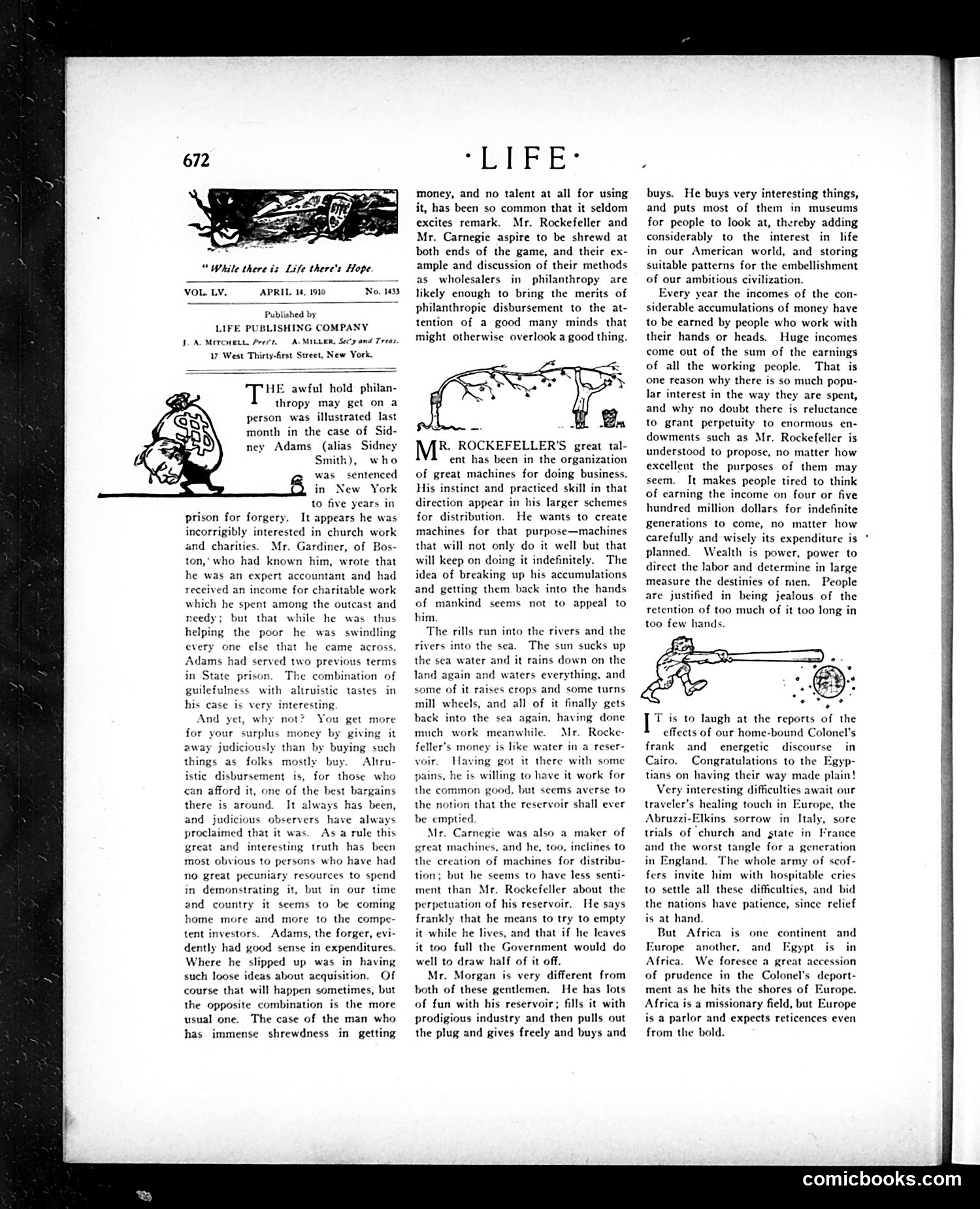
This page contains two editorial cartoons addressing philanthropy and wealth distribution. The main text criticizes the vast fortunes accumulated by industrialists like **Rockefeller** and **Carnegie**, noting their attempts to justify enormous endowments as benefiting society. The cartoons satirize this philanthropy: one depicts a figure seemingly overwhelmed or trapped by money/systems, while another shows someone struggling with abundance—likely critiquing how the wealthy claim their charitable giving addresses poverty they created through labor exploitation. The author questions whether perpetual endowments truly help workers, arguing that directing wealth distribution during one's lifetime would be more honest than posthumous charity. The satire suggests philanthropy serves the wealthy's ego more than genuine social need.
📄 Transcribed text from this page (OCR, searchable)
Machine-transcribed from the original scan — historical spelling and the odd misread are preserved.
“While there is Life there's Hope. No. 1433 VOL. Lv. APRIL 14, 1910 Published by LIFE PUBLISHING COMPANY A. MILLER, Sec’y and Treat New York. JOA. Mrrowmnt, Prem. 17 West Thirty-first Street, HE awful hold philan- thropy may get on a person was illustrated last month in the case of Sid- ney Adams (alias Sidney Smith), who was sentenced in New York to five years in prison for forgery. It appears he was incorrigibly interested in church work and charities. Mr. Gardiner, of Bos- ton,’ who had known him, wrote that he was an expert accountant and had received an income for charitable work which he spent among the outcast and needy; but that while he thus helping the poor he was swindling every one else that he came across. Adams had served two previous terms in State prison. The combination of guilefulness with altruistic tastes in his case is very interesting And yet, why not? You get more for your surplus money by giving it away judiciously than by buying such things as folks mostly Altru- istic disbursement is, for those who can afford it, one of the best bargains there is around. It always has been, and judicious observers have always proclaimed that it was. As a rule this great and interesting truth has been most obvious to persons who have had no great pecuniary resources to spend in demonstrating it, but in our time and country it seems to be coming home more and more to the compe tent investors. Adams, the forger, evi- dently had good sense in expenditures. Where he slipped up was in having such loose ideas about acquisition. Of course that will happen sometimes, but the opposite combination is the more usual one. The case of the man who has immense shrewdness in getting was buy. oo Ol oil el money, and no talent at all for using it, has been so common that it seldom excites remark. Mr. Rockefeller and Mr. Carnegie aspire to be shrewd at both ends of the game, and their ex- ample and discussion of their methods as wholesalers in philanthropy are likely enough to bring the merits of philanthropic disbursement to the at- tention of a good many minds that might otherwise overlook a good thing. R. ROCKEFELLER'’S great tal- ent has been in the organization of great machines for doing business. His instinct and practiced skill in that direction appear in his larger schemes for distribution. He wants to create machines for that purpose—machines that will not only do it well but that will keep on doing it indefinitely. The idea of breaking up his accumulations and getting them back into the hands of mankind seems not to appeal to him. The rills run into the rivers and the rivers into the sea. The sun sucks up the sea water and it rains down on the land again and waters everything, and some of it raises crops and some turns mill wheels, and all of it finally gets back into the sea again, having done much work meanwhile. Mr. Rocke- feller’s money is like water in a reser- voir. Having got it there with some pains, he is willing to have it work for the common good. but seems averse to the notion that the reservoir shall ever be emptied Mr. Carnegie was also a maker of gre machines, and he, too, inclines to the creation of machines for distribu- tion; but he seems to have less senti- ment than Mr. Rockefeller about the perpetuation of his reservoir. He says frankly that he means to try to empty it while he lives, and that if he leaves it too full the Government would do well to draw half of it off. Mr. Morgan is very different from both of these gentlemen. He has lots of fun with his reservoir; fills it with prodigious industry and then pulls out the plug and gives freely and buys and buys. He buys very interesting things, and puts most of them in museums for people to look at, thereby adding considerably to the interest in life in our American world, and storing suitable patterns for the embellishment of our ambitious civilization. Every year the incomes of the con- siderable accumulations of money have to be earned by people who work with their hands or heads. Huge incomes come out of the sum of the earnings of all the working people. That is one reason why there is so much popu- lar interest in the way they are spent, and why no doubt there is reluctance to grant perpetuity to enormous en- dowments such as Mr. Rockefeller is understood to propose, no matter how excellent the purposes of them may seem. It makes people tired to think of earning the income on four or five hundred million dollars for indefinite Generations to come, no matter how carefully and wisely its expenditure is planned. Wealth is power, power to direct the labor and determine in large measure the destinies of men. People are justified in being jealous of the retention of too much of it too long in too few hands. x [? is to laugh at the reports of the effects of our home-bound Colonel's frank and energetic discourse in Cairo. Congratulations to the Egyp- tians on having their way made plain! Very interesting difficulties await our traveler's healing touch in Europe, the Abruzzi-Elkins sorrow in Italy, sore trials of church and state in France and the worst tangle for a generation in England. The whole army of scof- fers invite him with hospitable crie to settle all these difficulties, and bid the nations have patience, since relief is at hand. But Africa is one continent and Europe another, and Egypt is in Africa. We foresce a great accession of prudence in the Colonel's deport- ment as he hits the shores of Europe. Africa is a missionary field, but Europe is a parlor and expects reticences even from the bold. comicbooks.com