
Life, 1910-04-14 · page 27 of 44
Life — April 14, 1910 — page 27: what you’re looking at
What you’re looking at
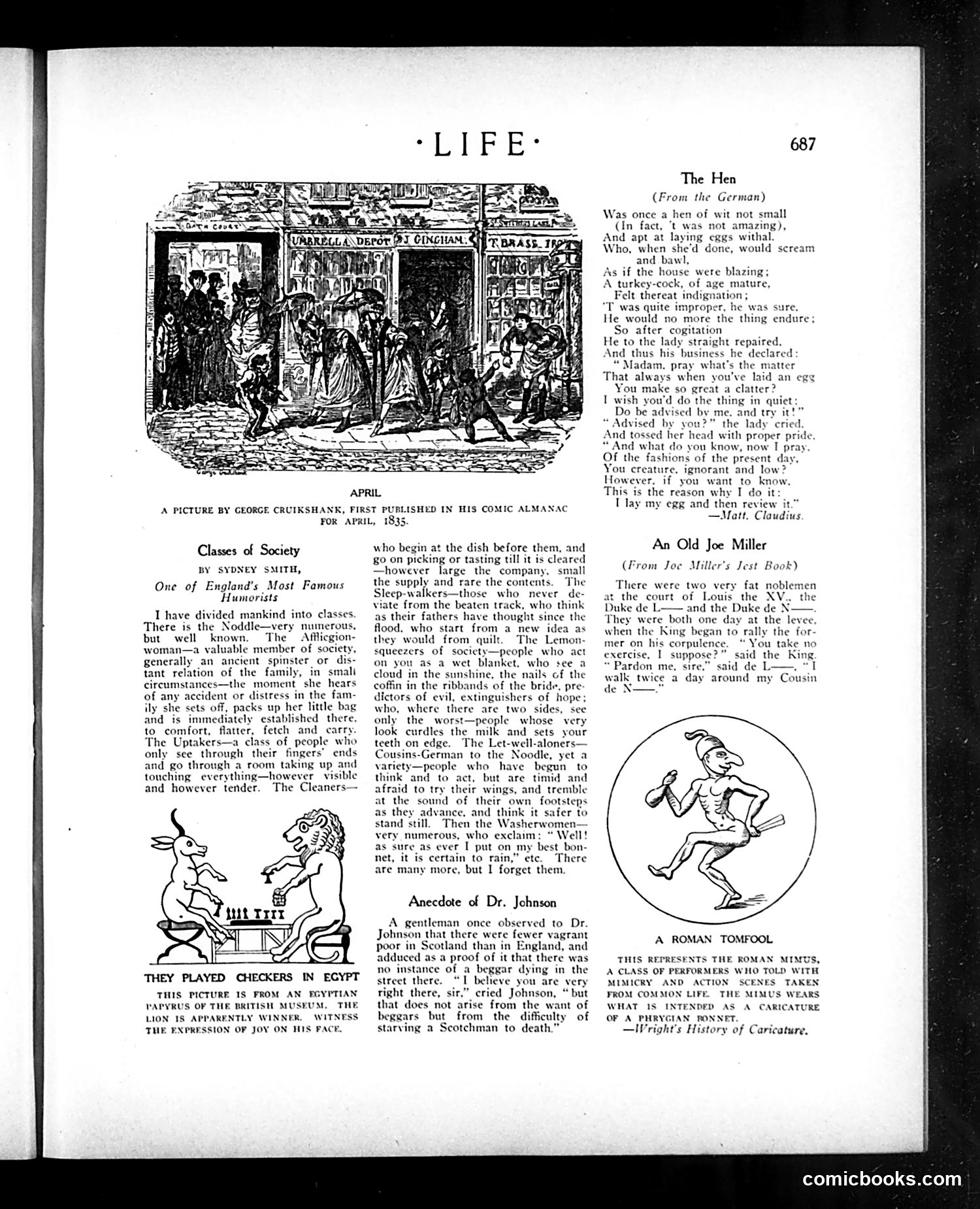
This *Life* magazine page (1835) presents three satirical pieces mocking social types and follies: **"Classes of Society"** by Sydney Smith categorizes ridiculous personality types—the "Noddle" (fool), the "Affliction-woman" (busybody relative), the "Lemon-squeezers" (pessimists who ruin joy), and others. The satire targets recognizable social stereotypes of Victorian England. **The Egyptian checkers image** is a humorous visual gag: ancient Egyptian tomb art depicting animals playing checkers, captioned to suggest the lion's smug expression shows it's winning. **"The Hen"** is a translated German poem where a hen loudly announces egg-laying, and a prudish turkey-cock complains about her noise. She retorts that she reviews her work—satirizing vanity and the clash between propriety and self-satisfaction. **"An Old Joe Miller"** references a famous 18th-century jokebook; here, a fat nobleman at King Louis XV's court claims he takes "no exercise," implying his obesity is his own fault. The page combines literary satire, visual humor, and social commentary typical of *Life*'s satirical tradition.
📄 Transcribed text from this page (OCR, searchable)
Machine-transcribed from the original scan — historical spelling and the odd misread are preserved.
A PICTURE BY GEORGE CRUIKSHANK, FIRST PUBLISHED IN HIS COMIC ALMANAC FOR APRIL, 1835. Classes of Society BY SYDNEY SMITH, One of England’s Most Famous Humorists I have divided mankind into classes. There is the Noddle—very numerous, but well known. The Afflicgion- woman—a valuable member of society, generally an ancient spinster or dis- tant relation of the family, in smali circumstances—the moment. she hears of any ident or distress in the fam- ly she sets off, packs up her little bag and is immediately established ther to comfort, flatter, fetch and carry. The Uptakers—a class of people who only see through their fingers’ ends and go through a room taking up and touching everything—however visible and however tender. The Cleaners— THEY PLAYED CHECKERS IN EGYPT THIS PICTURE IS FROM AN EGYPTIAN RUS OF THE BRITISH MUSEUM, THE LION IS APPARENTLY WINNER. WITN THE EXPRESSION OF JOY ON HIS FAC who begin at the dish before them, and go on picking or tasting till it is cleared —however large the company, small the supply and rare the contents, The Sleep-walkers—those who never de- viate from the beaten track, who think as their fathers have thought since the flood, who start from a new idea as they would from quilt. The Lemon- squeezers of society—people who act on you as a wet blanket, who see a cloud in the sunshine, the nails of the coffin in the ribbands of the bride, pre dictors of evil, extinguishers of hope: who, where there are two sides, see only the worst—people whose ‘very look curdles the milk and sets your teeth on edge. The Let-well-aloners— Cousins-German to the Noodle, yet a variety—people who have begun to think and to act, but are timid and afraid to try their wings, and tremble at the sound of their own footsteps as they advance, and think it safer to stand still, Then the Washerwomen— very numerous, who exclaim: “ Well! as sure as ever I put on my best _bon- net, it is certain to rain,” etc. There are many more, but I forget them. Anecdote of Dr. Johnson A gentleman once observed to Dr. Johnson that there were fewer vagrant poor in Scotland than in England, and adduced as a proof of it that there was no instance of a beggar dying in the street there. ou are very right there, sir.” cried Johnson, “ but that does not arise from the want of beggars but from the difficulty of starving a Scotchman to death.” The Hen (From the German) Was once a hen of wit not small (in fact, ‘t was not amazing), And apt at laying eggs withal. Who, when she'd done, would scream and bawl, As if the house were blazing; turkey-cock, of age mature, Felt thereat indignation; ‘T was quite improper, he ‘was sure. He would no more the thing endure; 0 after cogitation He to the lady straight repaired, And thus his business he dec! “Madam, pray what's the matter That always when you've laid an egg You make so great a clatte: I wish you'd do the thing in quiet Do be advised by me. and try it!” *“ Advised by you?” the lady cried And tossed her head with proper pride, “And what do you know, now I pray Of the fashions of the present day, You creature, ignorant and low However. if you want to know. This is the reason why I do it: T lay my egg and then review it.” —Matt. Claudius An Old Joe Miller (From Joe Miller's Jest Book) There were two very fat nobl the court of Louis the XV., Duke de L— and the Duke de N They were both one day at the levee, when the King began to rally the for- mer on his corpulence, “You take no exercise, I suppose?” said the King Pardon me, sire,” said de L—, “I walk, twice a day around “my Cousin A ROMAN TOMFOOL THIS REPRESENTS THE ROMAN MIMUS, A CLASS OF PERFORMERS WHO TOLD WITH MIMICRY AND ACTION SCENES TAKEN FROM COMMON LIFE. THE MIMUS WEARS WHAT 1S INTENDED AS A CARICATURE OF A PHRYGIAN BONNET. —IVright’s History of Caricature, comicbooks.com