
A complete issue · 44 pages · 1910
Life — March 24, 1910
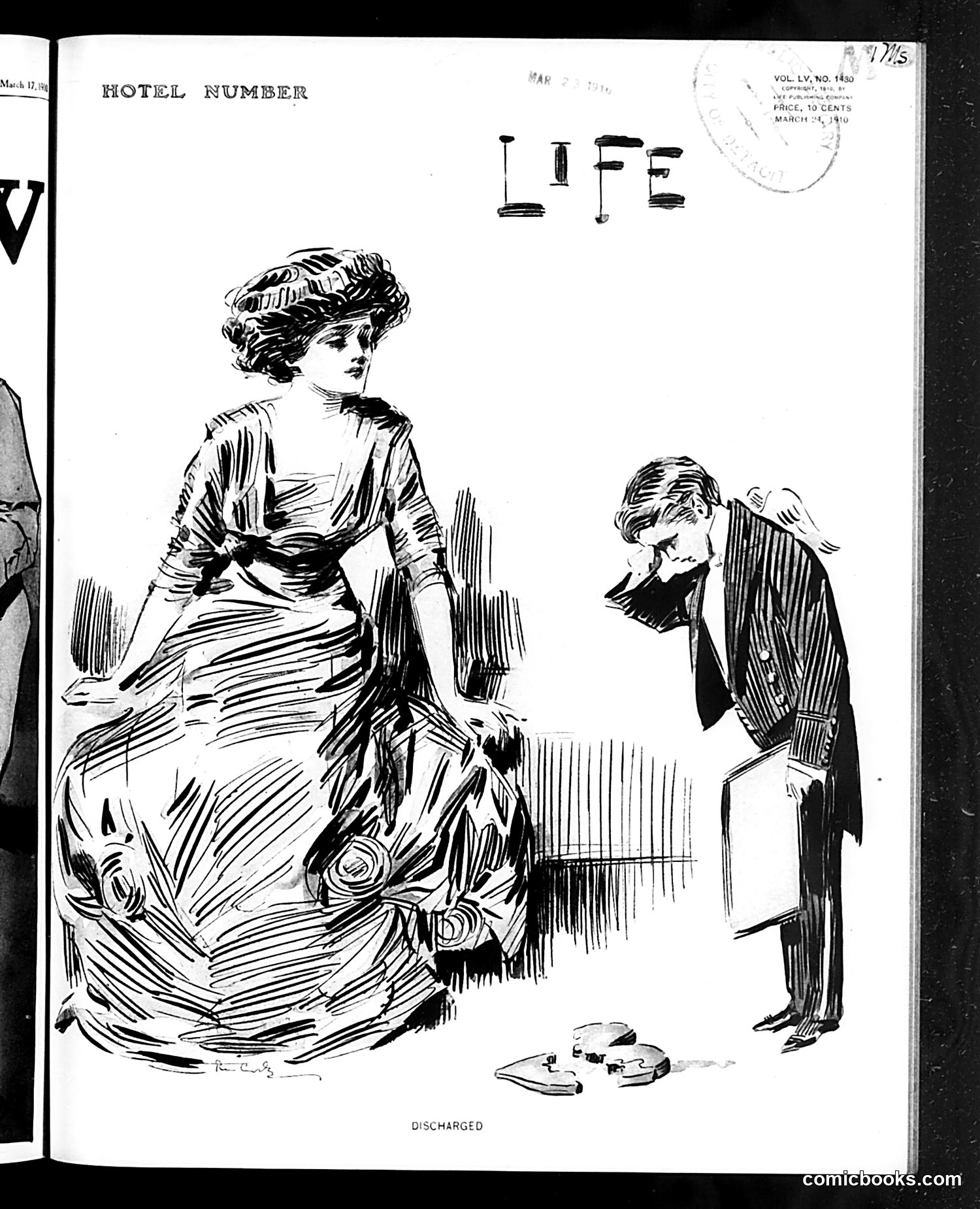
This cartoon satirizes hotel management practices, likely from the early 1910s based on the publication date visible. The image shows a well-dressed woman (possibly a hotel guest or employee) sitting elevated, while a man in formal attire bows deeply before her in a subservient position. Items scattered on the floor appear to be coins or tips. The title "DISCHARGED" suggests commentary on the hotel industry's reliance on tipping and gratuities. The exaggerated posture of the man likely mocks either: - The excessive servility expected of hotel staff toward guests - The economic desperation that forces workers into degrading positions for tips - Criticism of the tipping system itself as exploitative The satire critiques labor conditions and class dynamics in early 20th-century hospitality.
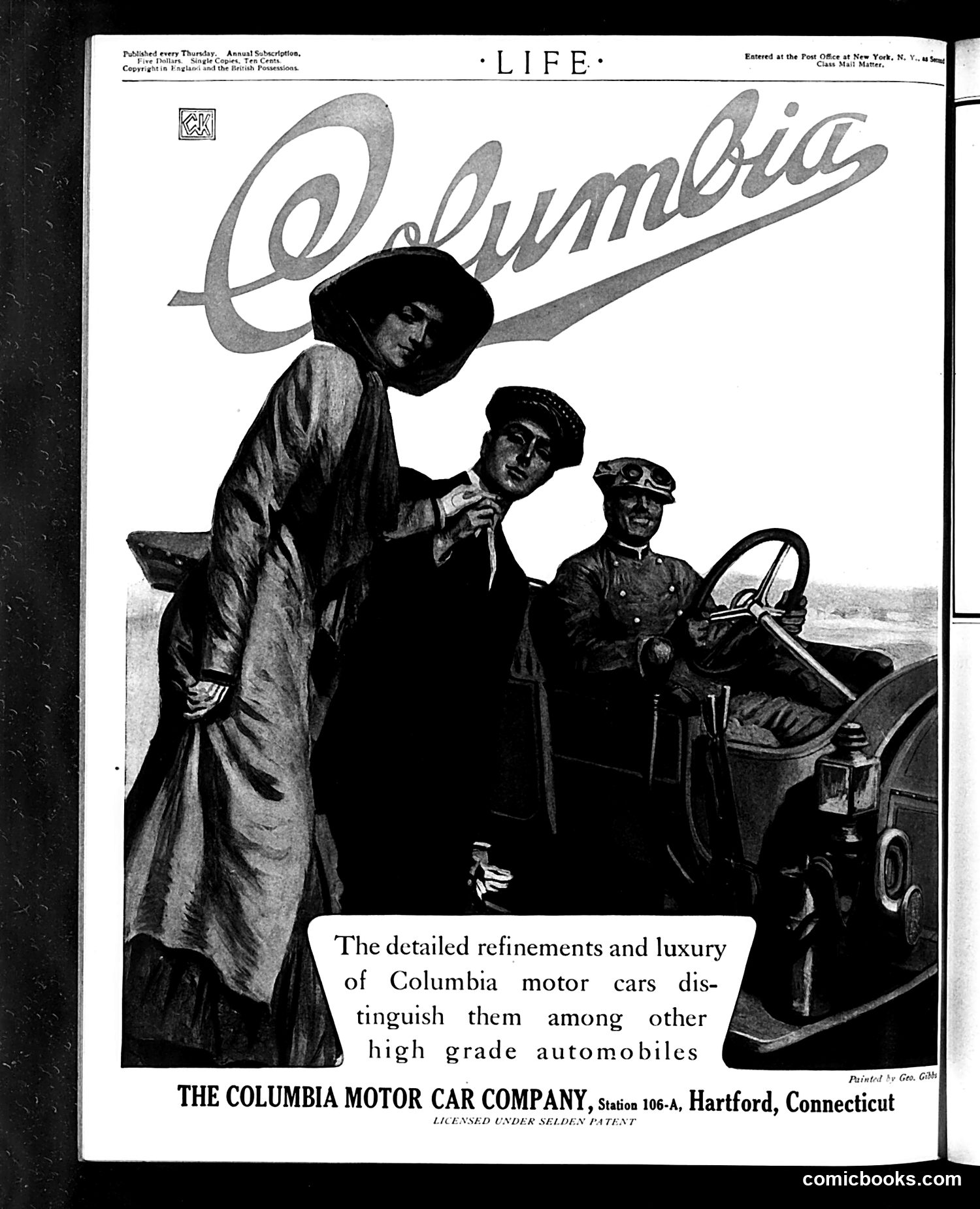
This appears to be **primarily an advertisement**, not editorial satire. The page is a Columbia Motor Car Company ad from Hartford, Connecticut, promoting their automobiles as "high grade" vehicles distinguished by "detailed refinements and luxury." The image shows three men in period clothing (likely early 1900s) examining or discussing a Columbia automobile. The styling and poses suggest this is aspirational marketing—depicting potential wealthy buyers or gentlemen evaluating the vehicle. The ad uses the prestige publication *Life* as its platform, a common strategy for luxury goods marketing in this era. There is no apparent political satire or social commentary visible—this is straightforward product promotion targeting affluent readers of the magazine.
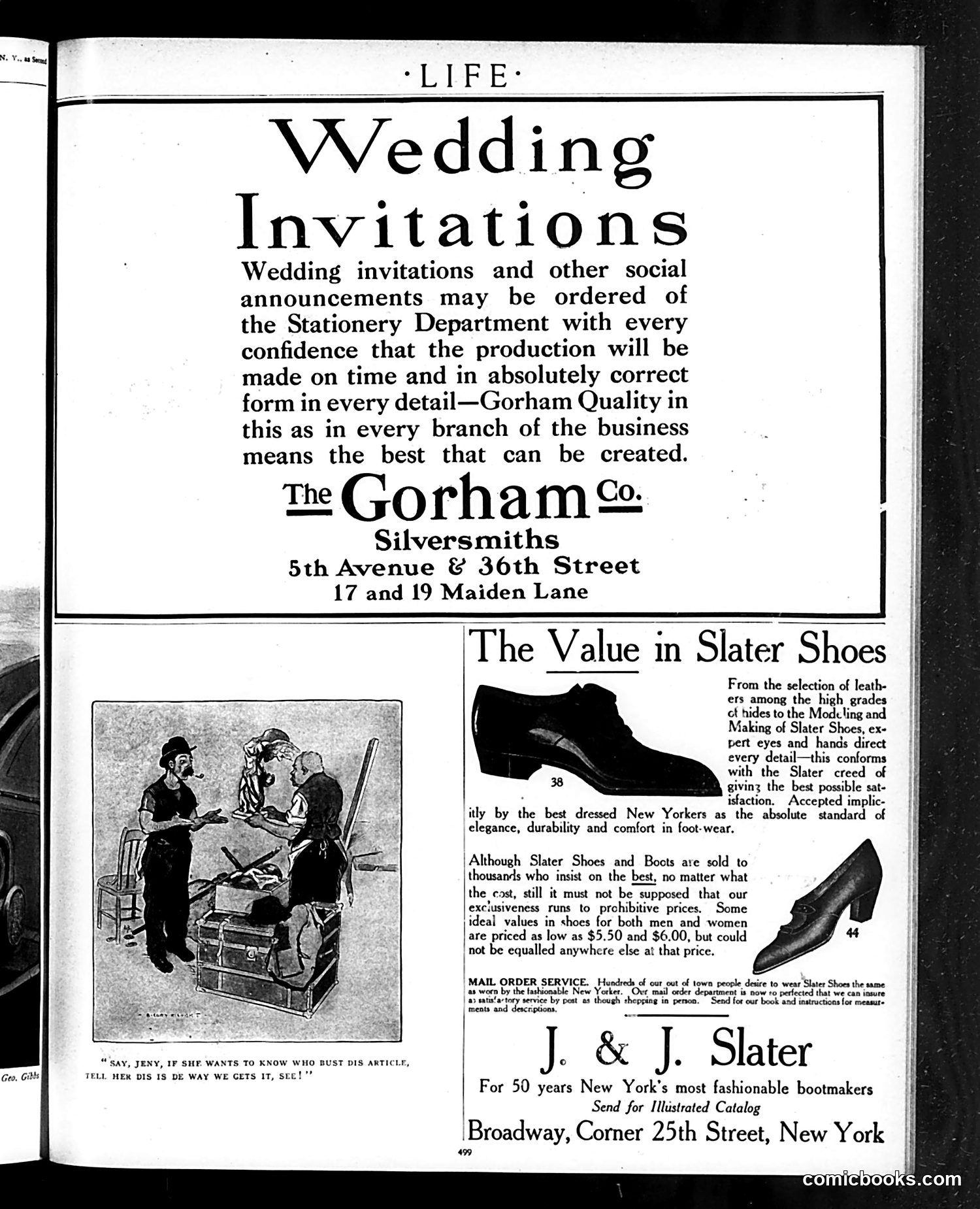
This page is primarily **advertising content** rather than satirical editorial material. The top features a **Gorham Company advertisement** for wedding invitations and stationery, emphasizing quality craftsmanship for formal social announcements. Below is a **J. & J. Slater shoe advertisement** showcasing women's footwear. The ad includes a small cartoon illustration (left) of two women in conversation, with a caption: "Say, Jenry, if she wants to know who bust his article, tell her dis is de way we gets it, see!" This appears to be casual, humorous dialogue using period working-class vernacular, though the connection to shoes is unclear—it seems disconnected from the shoe promotion itself. The page primarily serves as a commercial vehicle for luxury goods targeting affluent readers of Life magazine.
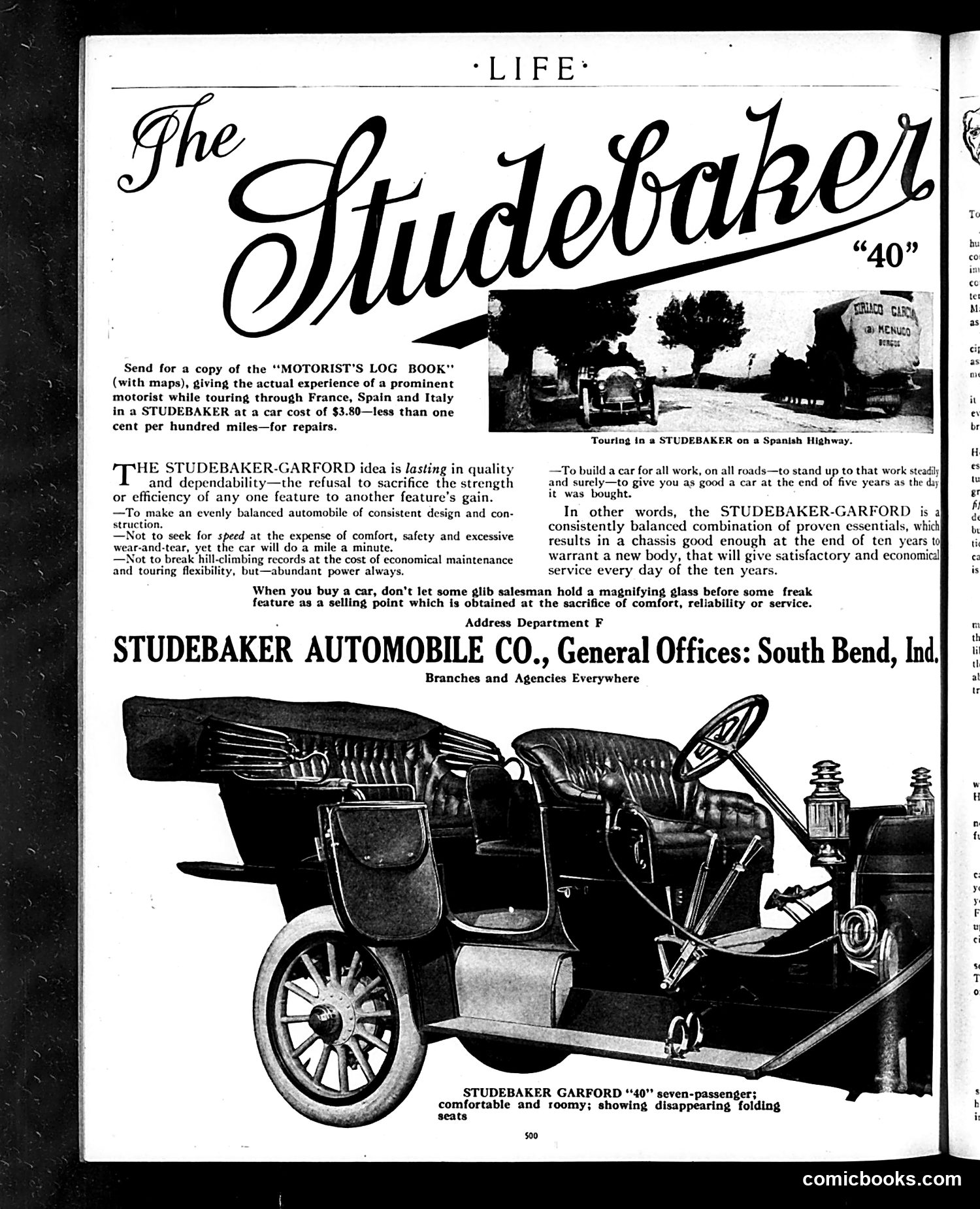
This page is primarily **advertising, not satire or political commentary**. It's a full-page advertisement for the Studebaker automobile, specifically the "40" model. The ad emphasizes the Studebaker-Garford's durability and practical design rather than speed or luxury. It includes a photograph of a touring car on a Spanish highway and a detailed illustration of the vehicle's interior, highlighting its "seven-passenger; comfortable and roomy" design with "disappearing folding seats." The marketing pitch focuses on long-term reliability—the car will supposedly provide "satisfaction and economical service every day of the ten years"—and criticizes salesmen who oversell frivolous features. There's no political content or satire present on this page.
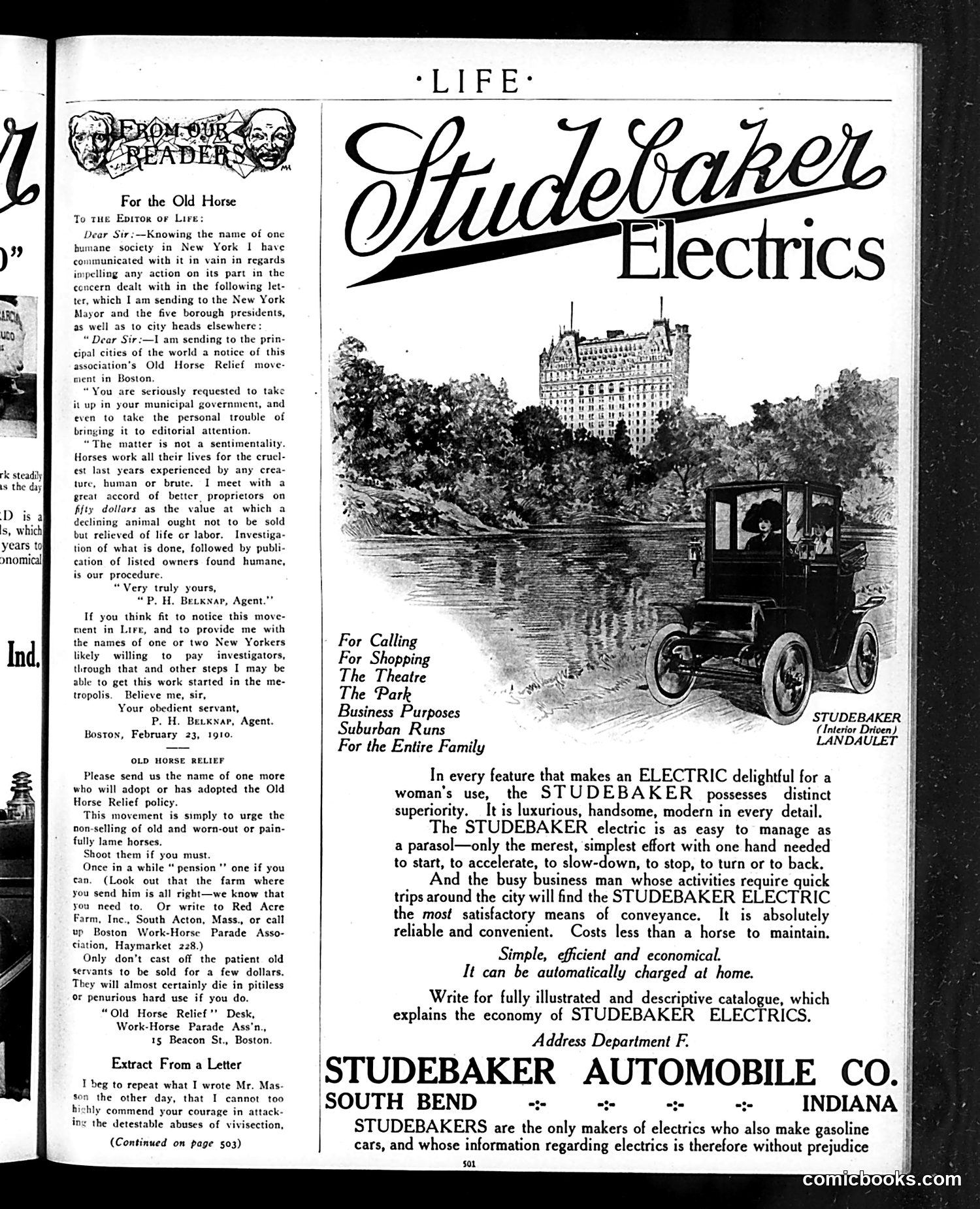
This page is **primarily advertising** for Studebaker electric automobiles, with a secondary "From Our Readers" section addressing horse welfare. The left column contains reader correspondence about the "Old Horse Relief" movement—advocates writing to New York city officials urging humane treatment of working horses. The letters reference declining horse populations and propose fifty-dollar minimum values for animals to prevent their sale to cruel owners. The right side is a full advertisement showcasing a Studebaker electric car, emphasizing it as a modern alternative for urban transportation (calling, shopping, business). The ad markets the vehicle to women particularly, highlighting ease of operation and reliability—subtly suggesting electric automobiles as replacements for horse-drawn vehicles, aligning with the contemporary animal-welfare concerns discussed in the letters section.
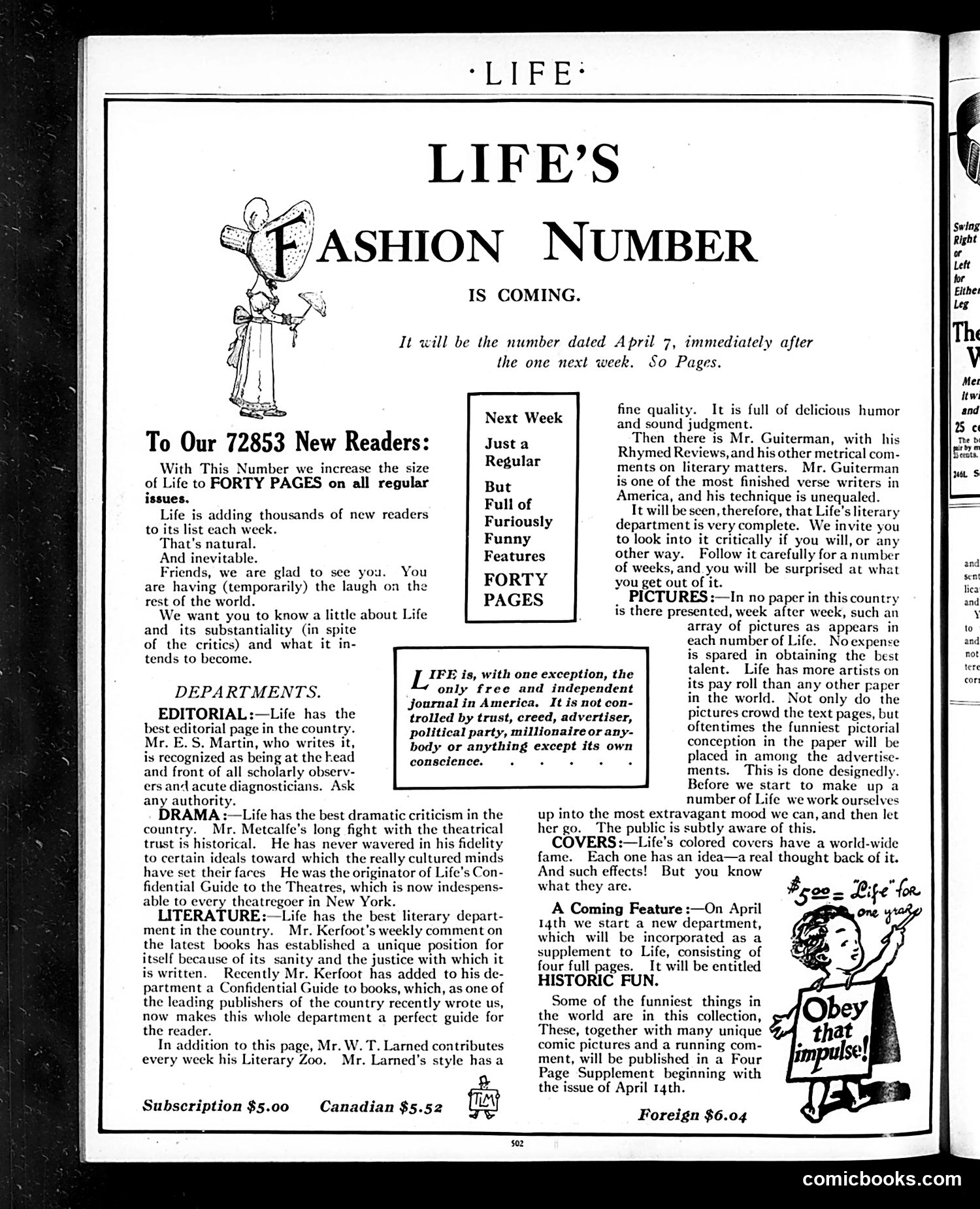
This page is primarily a promotional announcement for Life magazine's expansion, not a political cartoon. The main content announces that Life is increasing from 40 to 48 pages and adding 72,853 new readers. The decorative illustration shows a stylized female figure representing "Fashion," introducing Life's upcoming Fashion Number (dated April 7). The text emphasizes Life's editorial strengths: it claims to have the "best editorial page" and "best dramatic criticism" in America, and praises Mr. E.S. Martin's leadership and Mr. Grantland Rice's literary contributions. A boxed statement declares Life as "the only Free and independent journal in America" not controlled by external interests. This is essentially house advertising designed to attract readers and assert Life's credibility and independence during the early 20th century.
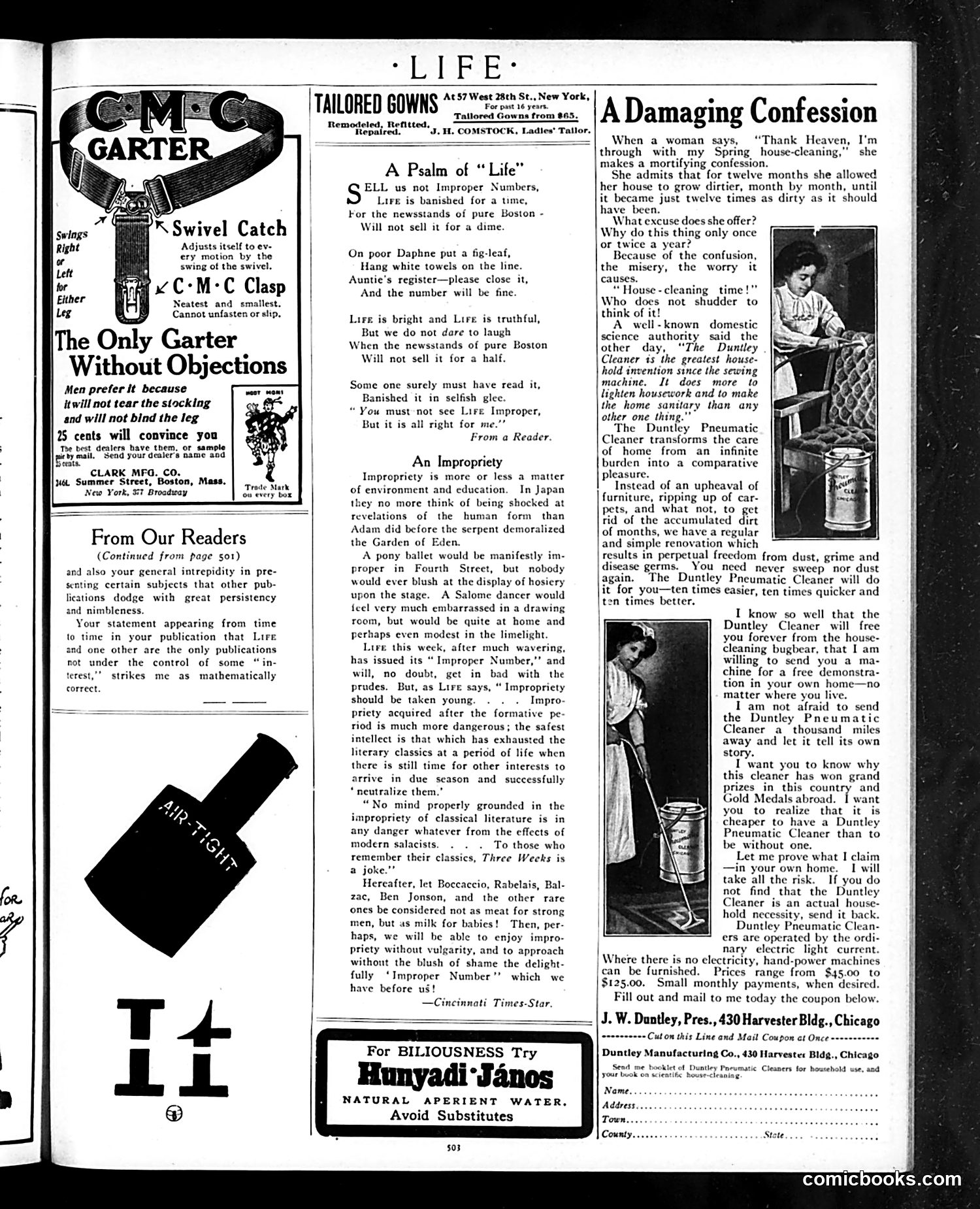
This page is primarily **advertising and reader letters**, not political satire. The main content includes: - **CMC Garter advertisement** promoting a garter that won't slip or bind - **"A Psalm of Life"** — a poem mocking the magazine *Life Improper* (a competing publication), suggesting it's lowbrow and disposable - **"From Our Readers"** — a letter defending *Life* magazine against accusations of dodging serious political topics, arguing the magazine serves important purposes - **"A Damaging Confession"** — an advertisement for Duntley Pneumatic Cleaners, featuring testimonials from satisfied customers about house-cleaning efficiency - **Hunyadi-János** advertisement for natural aperient water The page reflects early 20th-century consumer culture with product advertisements dominating the space, interspersed with editorial content defending the magazine's editorial approach.
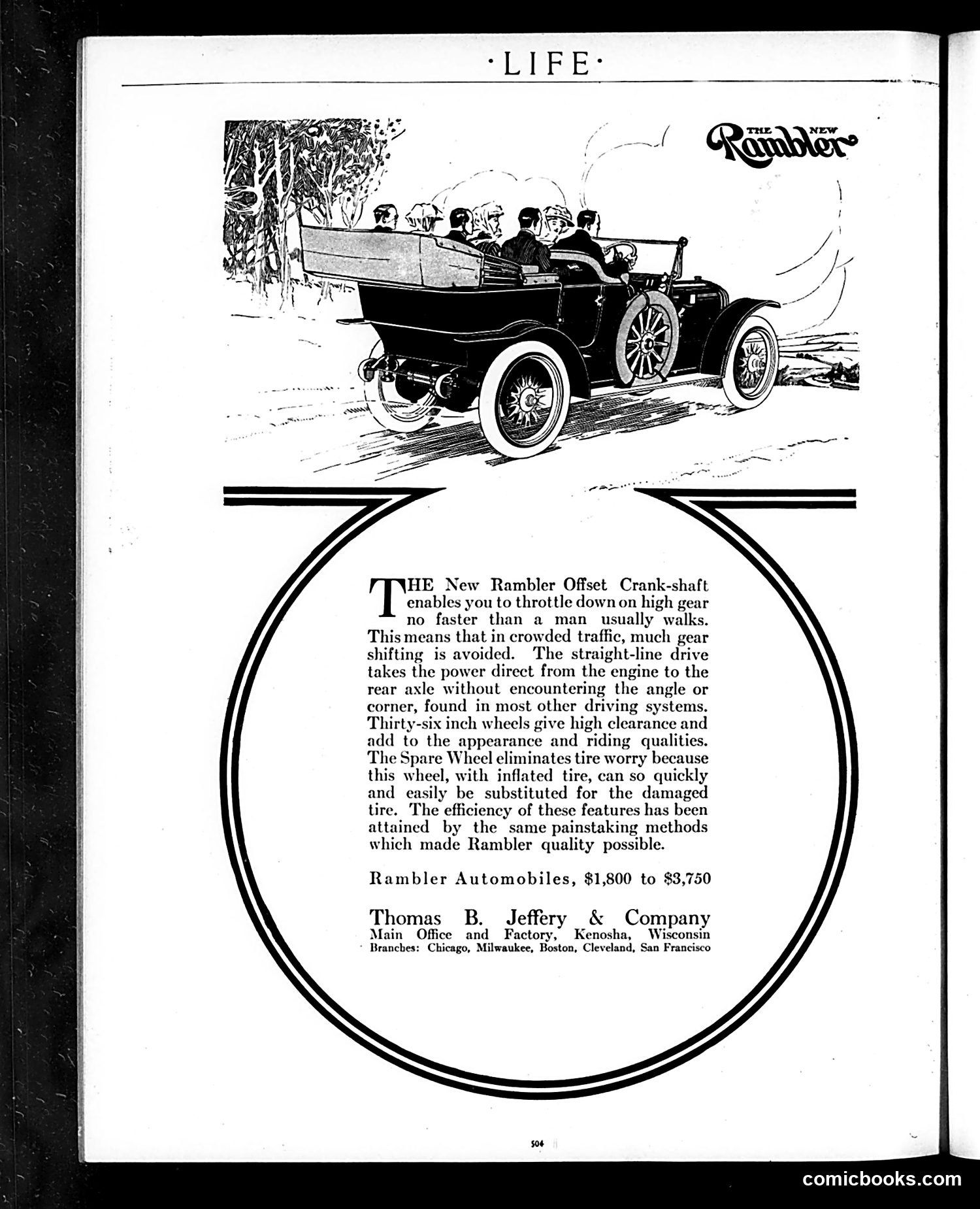
This is a **Rambler automobile advertisement**, not a political cartoon. The page features an illustration of an early 1900s motorcar carrying multiple passengers, positioned above descriptive text in a large circular frame. The ad promotes the "New Rambler Offset Crank-shaft" and highlights features like the straight-line drive system, high clearance from 36-inch wheels, and a spare wheel for convenient tire replacement. These were notable selling points for early automobiles when such features represented genuine innovations. The manufacturer, Thomas B. Jeffery & Company, based in Kenosha, Wisconsin, positioned the Rambler as a quality vehicle priced between $1,800-$3,750—substantial sums in that era. This appears to be from Life magazine's advertising section rather than editorial content.
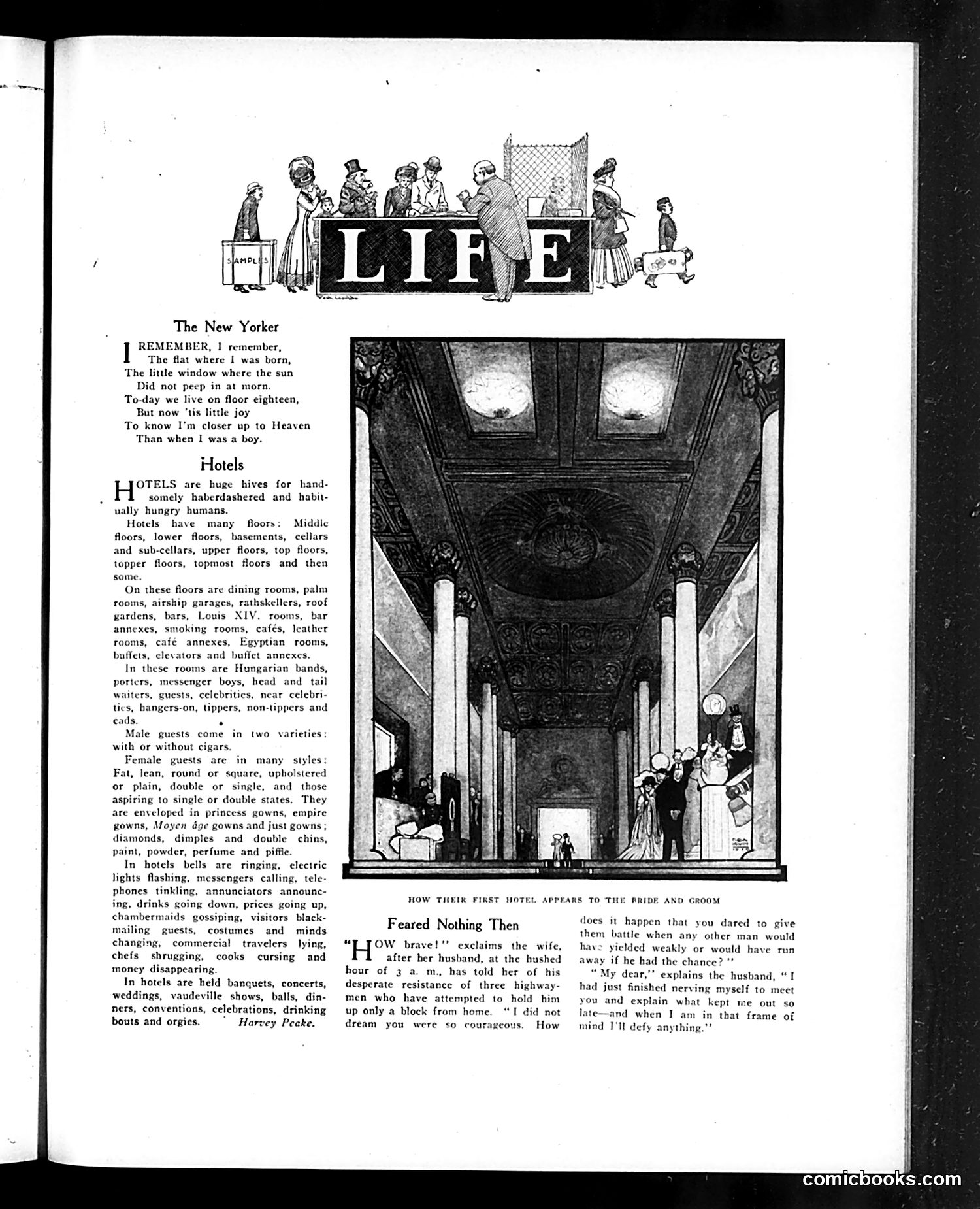
This *Life* magazine page satirizes the modern hotel experience through two pieces: **"The New Yorker" poem** nostalgically contrasts childhood (living on a low floor, closer to earth and heaven) with adult city life on the eighteenth floor—a commentary on urban vertical living and disconnection from nature. **"Hotels" essay** humorously catalogs the absurd complexity of hotel infrastructure and staff hierarchies—listing everything from "Louis XIV rooms" to "non-tippers and cads." The satirical tone mocks how hotels pretend grandeur while actually housing diverse, chaotic humanity. The accompanying illustration shows an ornate hotel lobby with well-dressed guests and staff, visually reinforcing the contrast between hotels' pretentious facades and their actual function as impersonal, bustling commercial operations catering to every social class.
This page contains editorial commentary on contemporary issues rather than cartoons. The main topics discussed are: 1. **Mr. Rockefeller's foundation** - The writer defends Rockefeller's charitable intentions against critics demanding he explain his wealth distribution plans over thirty years. 2. **Various political controversies** - Including the Glavis-Ballinger Alaska coal lands scandal, Philadelphia street-car strikes, Princeton controversies, and trade disputes with Japan over Manchuria. 3. **Social issues** - References to suffragists, taxes, and labor concerns. The small illustrations (a fence scene, a chicken) appear decorative rather than specific satirical cartoons. The piece takes a somewhat centrist stance, defending Rockefeller while acknowledging legitimate public concerns about monopolies and labor conditions.
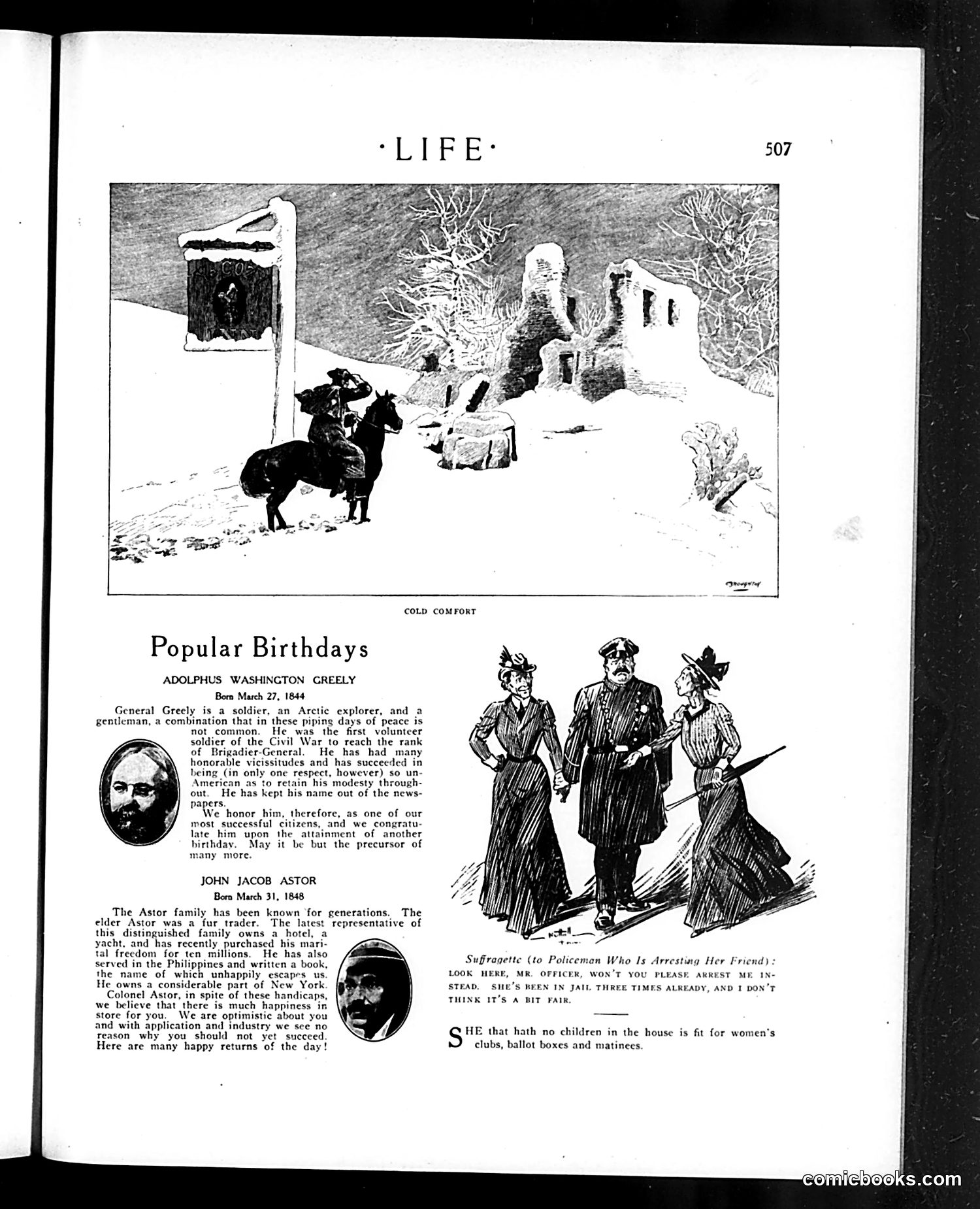
The illustration shows a cowboy on horseback approaching a remote, snow-covered outpost with a sign—a classic Western scene. The satire likely references the harsh, isolated conditions of frontier life, with the title "Cold Comfort" suggesting minimal hospitality or relief available. Below are birthday tributes to Adolphus Washington Greely (Arctic explorer and soldier) and John Jacob Astor (wealthy businessman and ship owner), presented as successful, accomplished citizens. The page's satirical comment appears to juxtapose rugged frontier hardship with civilized urban success—contrasting who "succeeds" in America. The small cartoon below mocks women's social participation, suggesting their exclusion from certain spaces reflects societal attitudes about gender and public life.
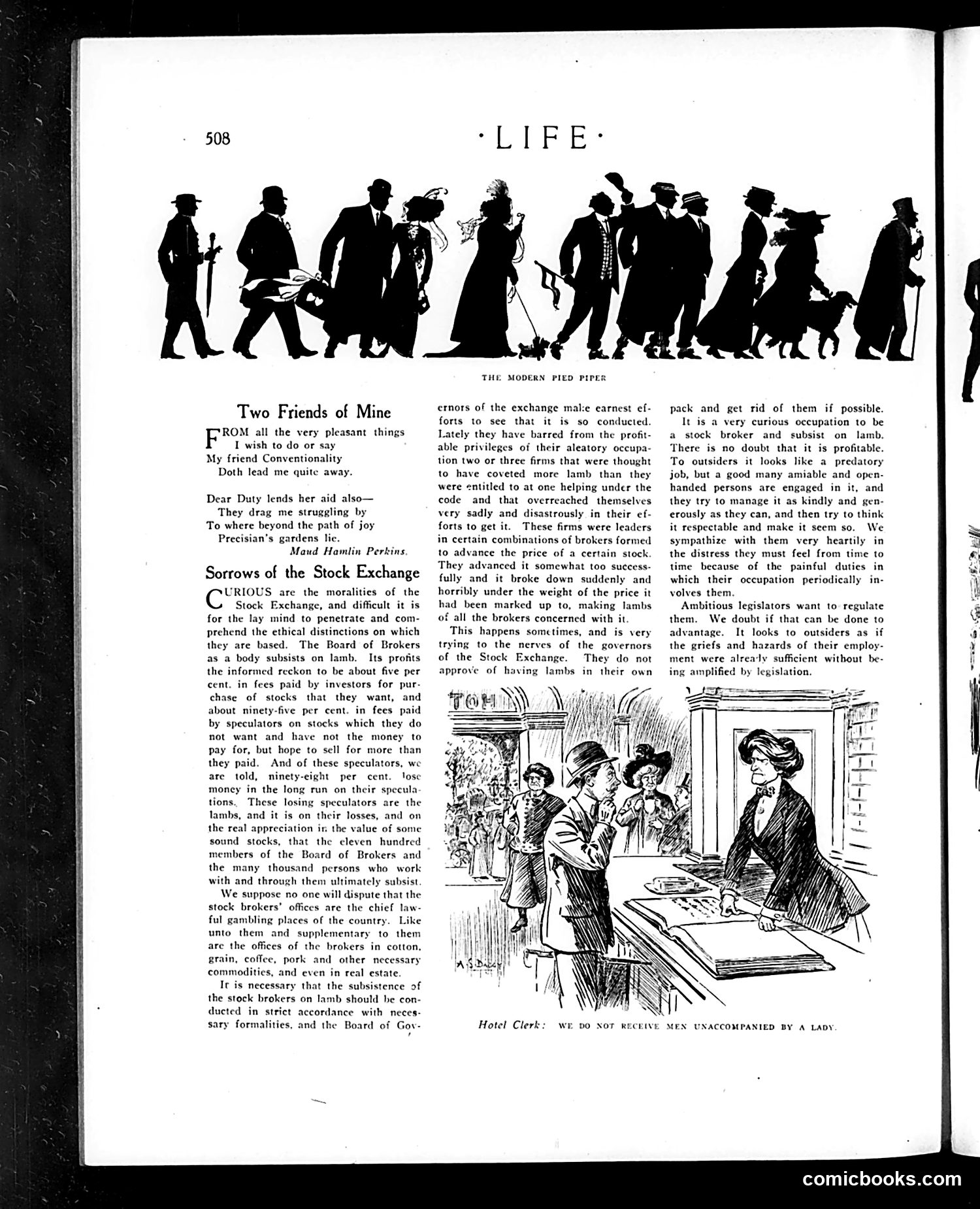
This page contains two satirical pieces about financial markets and social propriety. **"The Modern Pied Piper"** (silhouette illustration at top) appears to reference stock brokers or financial manipulators leading people, though the specific historical reference is unclear without additional context. **"Sorrows of the Stock Exchange"** discusses brokers' difficulties managing client investments, noting their losses and moral hazards—particularly their temptation to engage in improper practices to recover losses. **The cartoon below** shows a hotel clerk refusing entry to an unaccompanied man and woman, captioned "We do not receive men unaccompanied by a lady." This reverses typical period social conventions (when women needed male escorts), satirizing either changing social mores or highlighting hypocrisy around propriety standards. The page critiques both financial impropriety and social double standards of the era.
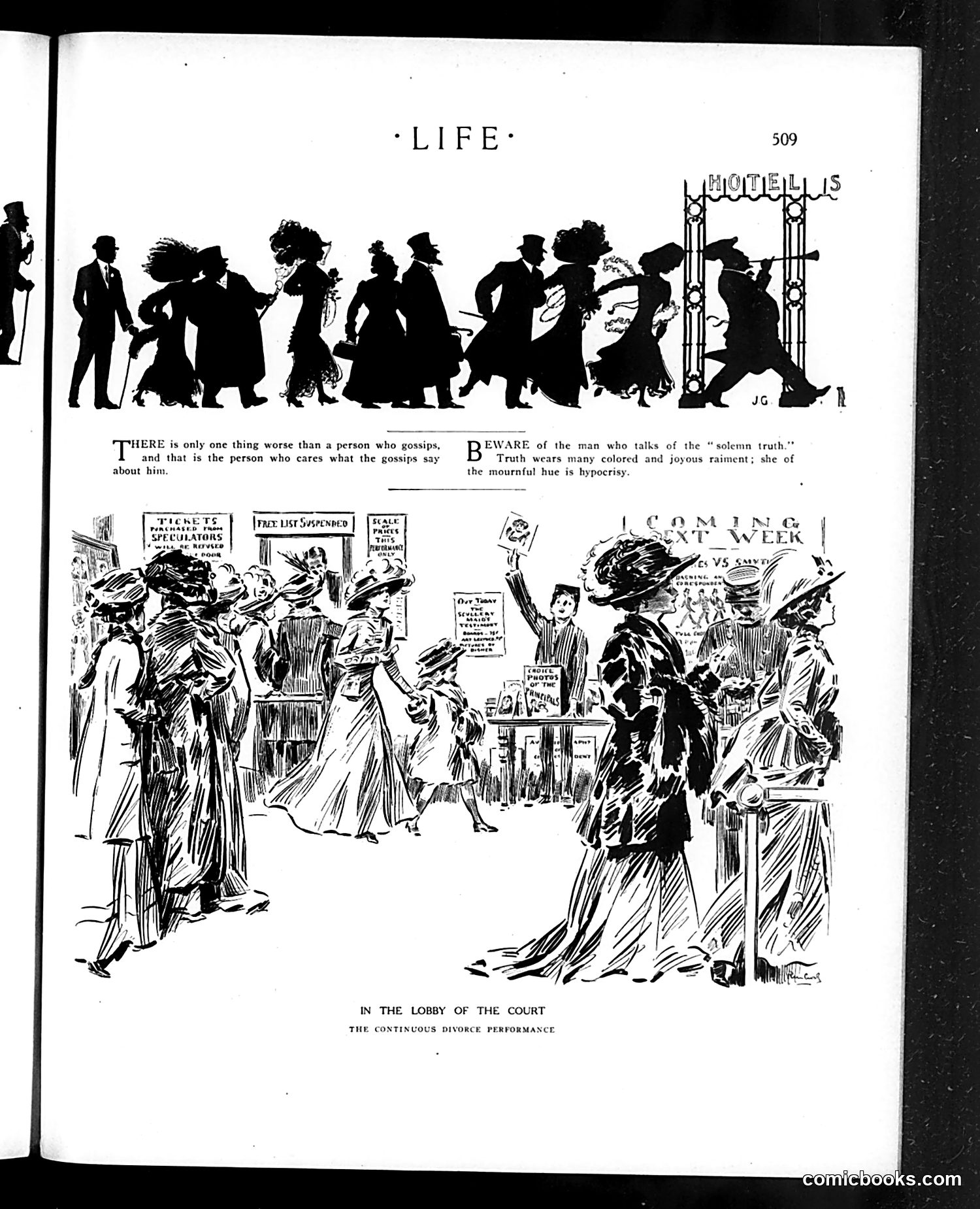
This Life magazine page (509) contains satirical commentary on gossip and hypocrisy, illustrated through two cartoons. **Top silhouette scene**: Shows people entering a hotel, with text condemning gossips while praising those who speak "solemn truth." The irony is that the gossipers themselves are hypocrites—the quote warns against trusting anyone claiming moral authority while spreading rumors. **Bottom cartoon titled "In the Lobby of the Court"**: Depicts women in a courthouse setting labeled "The Continuous Divorce Performance." This appears to satirize divorce proceedings as public spectacle, with women gossiping and spectating about marital failures. The "coming next week" poster suggests divorce is treated as entertainment. The overall message critiques 1910s-era society's fascination with scandals and divorce cases as social drama, while condemning the gossiping that fuels such interest.
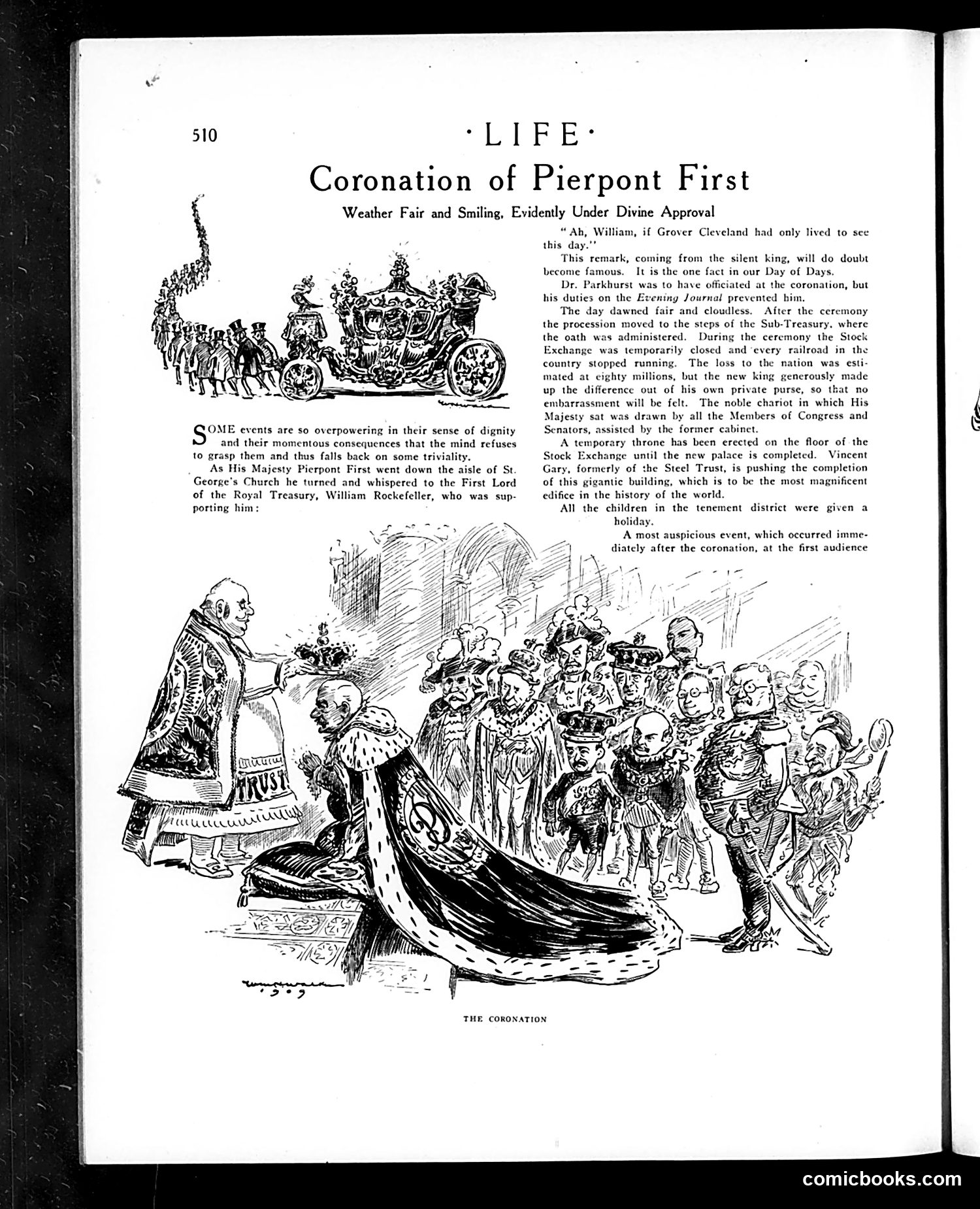
This is a scathing political cartoon mocking the immense wealth and power of **J.P. Morgan** (thinly disguised as "Pierpont First"). The satire portrays Morgan as a king being "crowned," with his brother-in-law **William Rockefeller** as supporting figure. The joke targets Morgan's dominance over American finance and politics. Key satirical points: - The Stock Exchange closing during his "coronation" and the nation losing "eighty millions" reflects how Morgan's financial decisions affected the entire economy - Congress and Senators pulling his chariot symbolizes their subservience to his wealth - The throne erected on the Stock Exchange floor suggests finance, not elected government, rules America - References to "the new palace" and treating him as literal royalty mock the oligarchic power of Gilded Age industrialists The cartoon critiques how wealthy monopolists like Morgan wielded near-governmental authority with minimal democratic accountability.
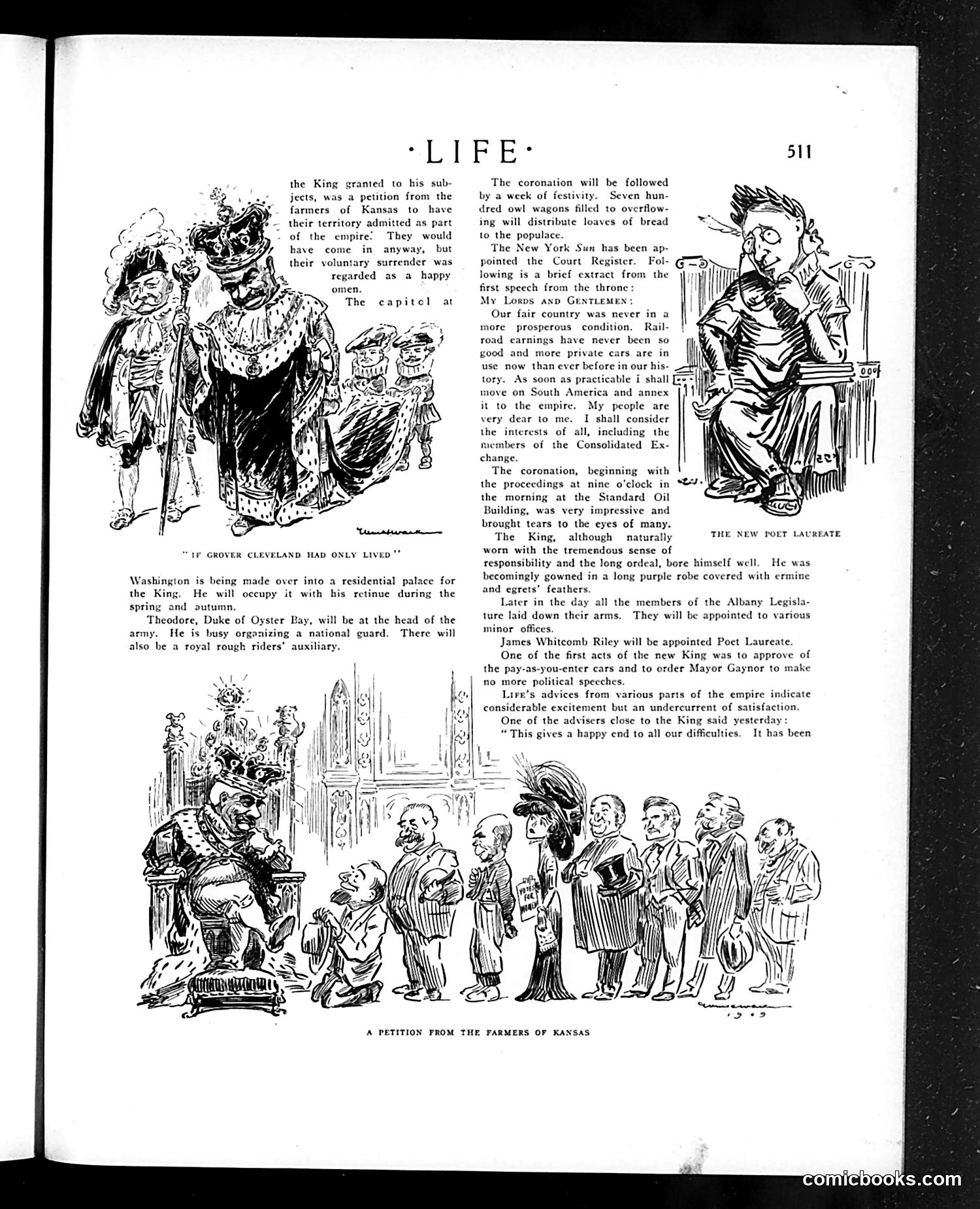
This page satirizes American political and corporate power around 1910. Life imagines the U.S. has crowned a king—likely representing President Theodore Roosevelt or plutocratic corporate interests—in a mock-heroic fantasy. The cartoons mock: - **Consolidation of power**: The "King" occupies the White House; Theodore Roosevelt ("Duke of Oyster Bay") leads a "national guard" and "rough riders' auxiliary" - **Corporate dominance**: The coronation occurs at the Standard Oil Building; the court register is the New York Sun; railroad executives receive special favor - **Imperialist ambitions**: The fictional throne pledges to annex South America - **Political suppression**: Mayor Gaynor is ordered to stop making political speeches - **Populist theater**: 700 wagons distribute bread to the masses—hollow charity masking oligarchy The bottom cartoon depicts Kansas farmers petitioning this "King," illustrating rural powerlessness against consolidated wealth and authority. The satire warns that American democracy risks becoming hereditary monarchy ruled by corporate interests.
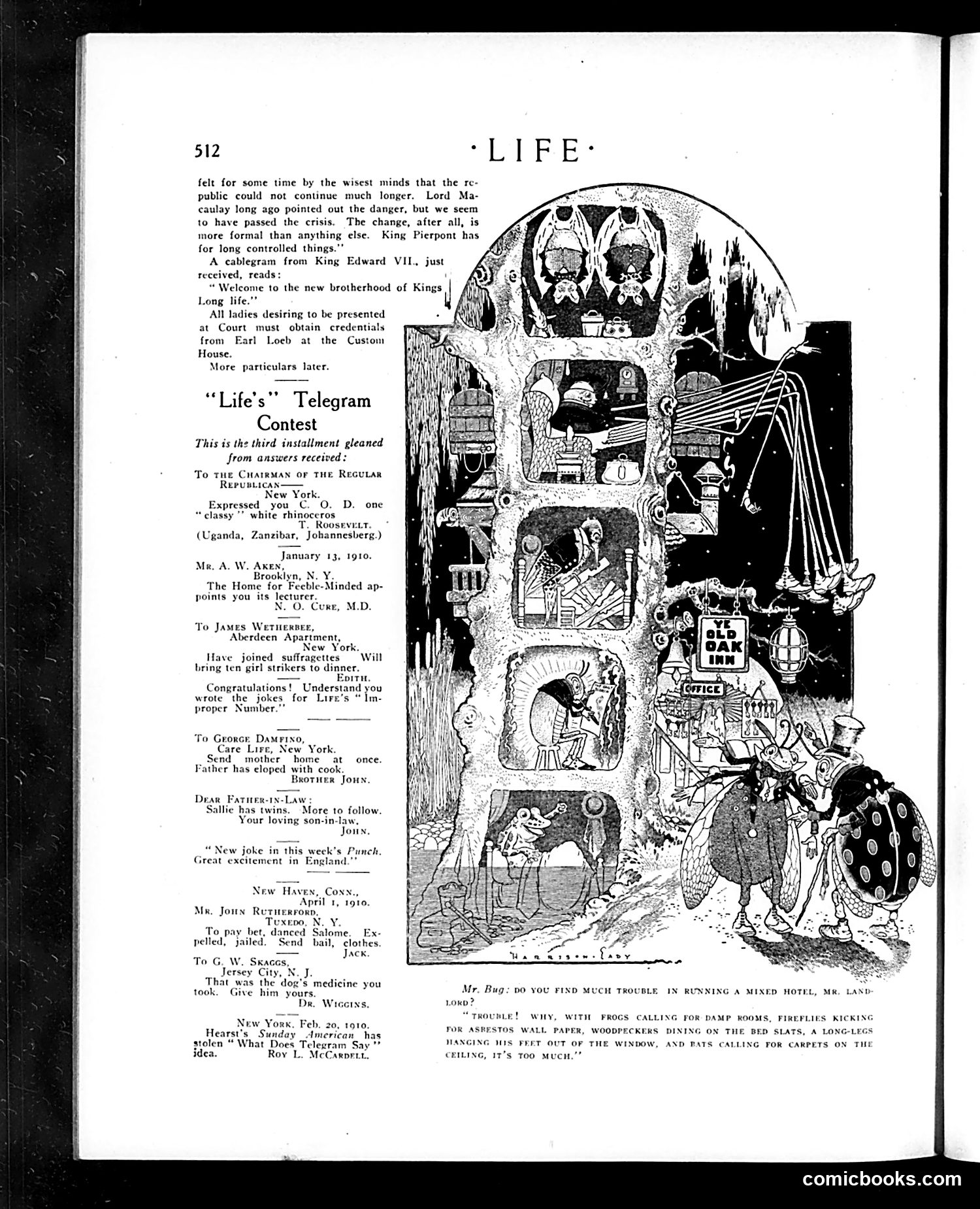
This page satirizes **J.P. Morgan's financial dominance** over American politics and business. The central joke presents Morgan as "King Pierpont"—suggesting he wielded more actual power than elected officials. A cablegram from "King Edward VII" welcomes him to a "brotherhood of Kings," treating Morgan as a monarch rather than a banker. The cartoon depicts a fantastical castle interior filled with industrial/commercial imagery, literalizing the concept of Morgan's kingdom. The satire critiques the Gilded Age reality: that wealthy industrialists like Morgan effectively controlled national policy despite republican government. The surrounding "Telegram Contest" items are unrelated reader submissions—a magazine feature typical of the era. **Context modern readers need:** Progressive-era Americans genuinely felt threatened by unchecked corporate power. This mockery reflected real anxiety about whether democratic institutions could survive Wall Street's influence.
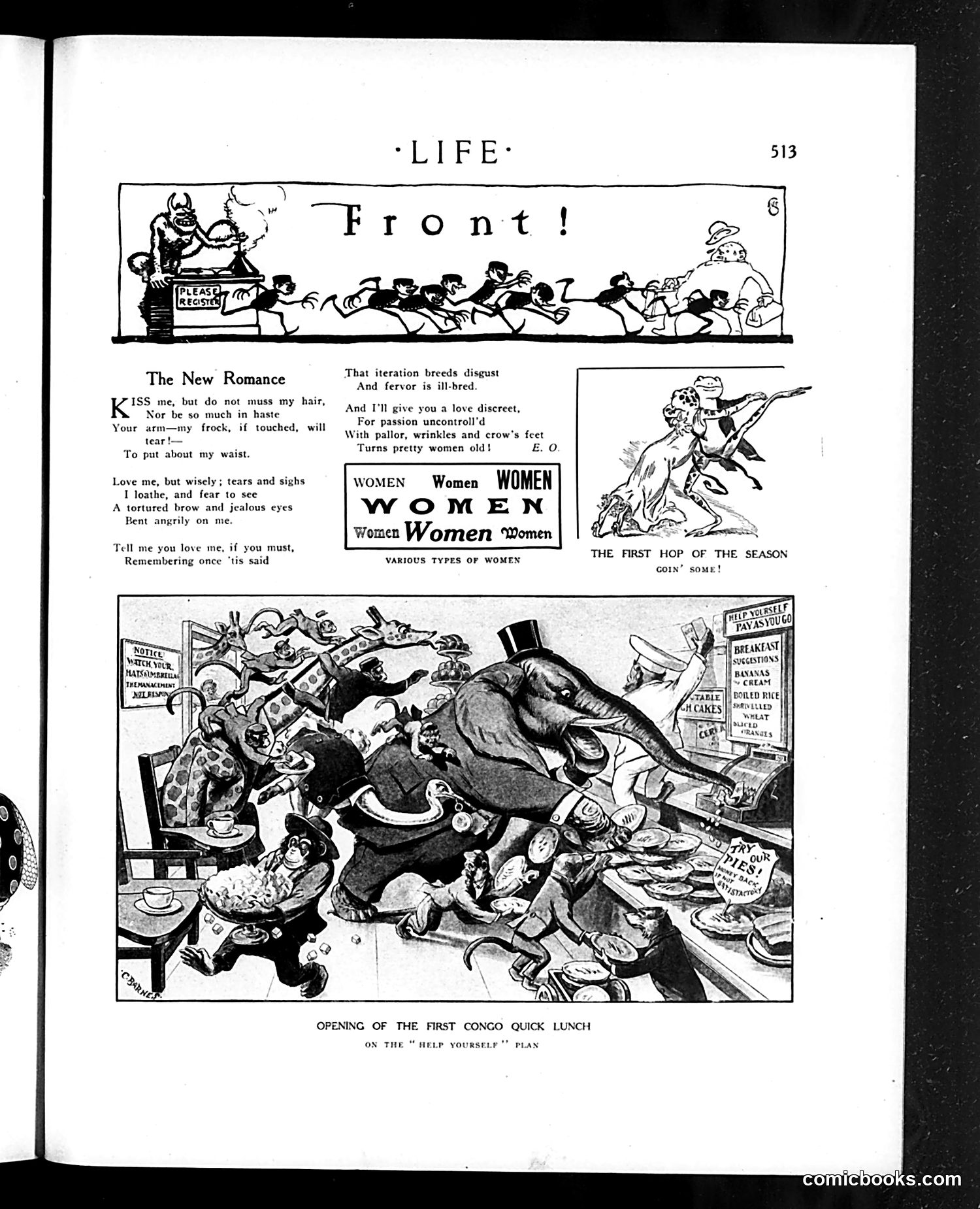
This page satirizes early 20th-century romantic attitudes and modern conveniences through contrasting imagery. **"The New Romance"** poem mocks the "new woman"—the independent, modernized female rejecting traditional romance. She demands men not muss her hair or tear her dress, dislikes emotional displays, and warns that passion causes aging ("wrinkles and crow's feet"). The satire targets how contemporary women prioritized appearance and practicality over passionate love. **The lower cartoon** depicts the "First Congo Quick Lunch" opening using a "help yourself" plan—an early self-service restaurant concept. The chaotic scene shows well-dressed diners mobbing the food service, with waitstaff overwhelmed. This satirizes both the novelty of self-service dining and perhaps anxieties about loss of formal service and decorum in modern life. Together, these pieces ridicule how rapid social change—from romance customs to dining practices—disrupted traditional Victorian norms, presenting modernity as simultaneously amusing and slightly chaotic.
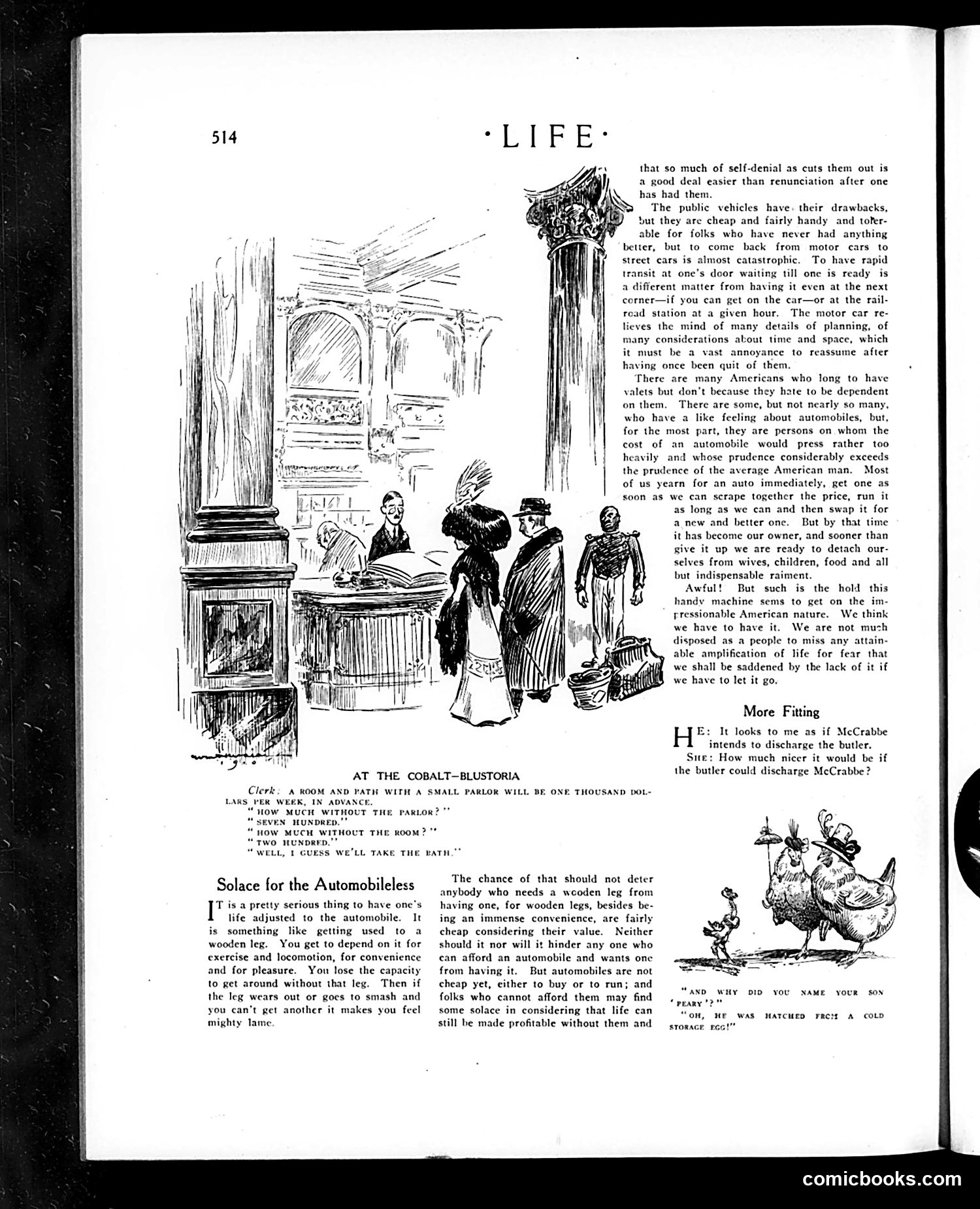
This page satirizes American attitudes toward automobiles and consumer culture in the early 20th century. **Main Articles:** The dominant text discusses how owning an automobile becomes psychologically addictive—Americans become so dependent on cars that giving them up feels worse than never having owned one. The piece argues we'll sacrifice family, food, and necessities rather than lose our vehicles, calling this "the hold this handy machine seems to get on the impressionable American nature." **Cartoons:** "At the Cobalt-Blustoria" shows a hotel clerk negotiating room prices downward, ultimately choosing just a bath—satirizing budget consciousness and declining standards. "More Fitting" depicts a butler discharge scenario, with the joke being that servants might discharge their employers instead, reversing power dynamics. "Solace for the Automobileless" compares life without a car to being disabled by a missing wooden leg—you become crippled without it. Yet the author notes automobiles aren't cheap, so the poor must find consolation that life remains "profitable" without them. The humor targets middle-class anxiety about status symbols and dependency on modern conveniences.
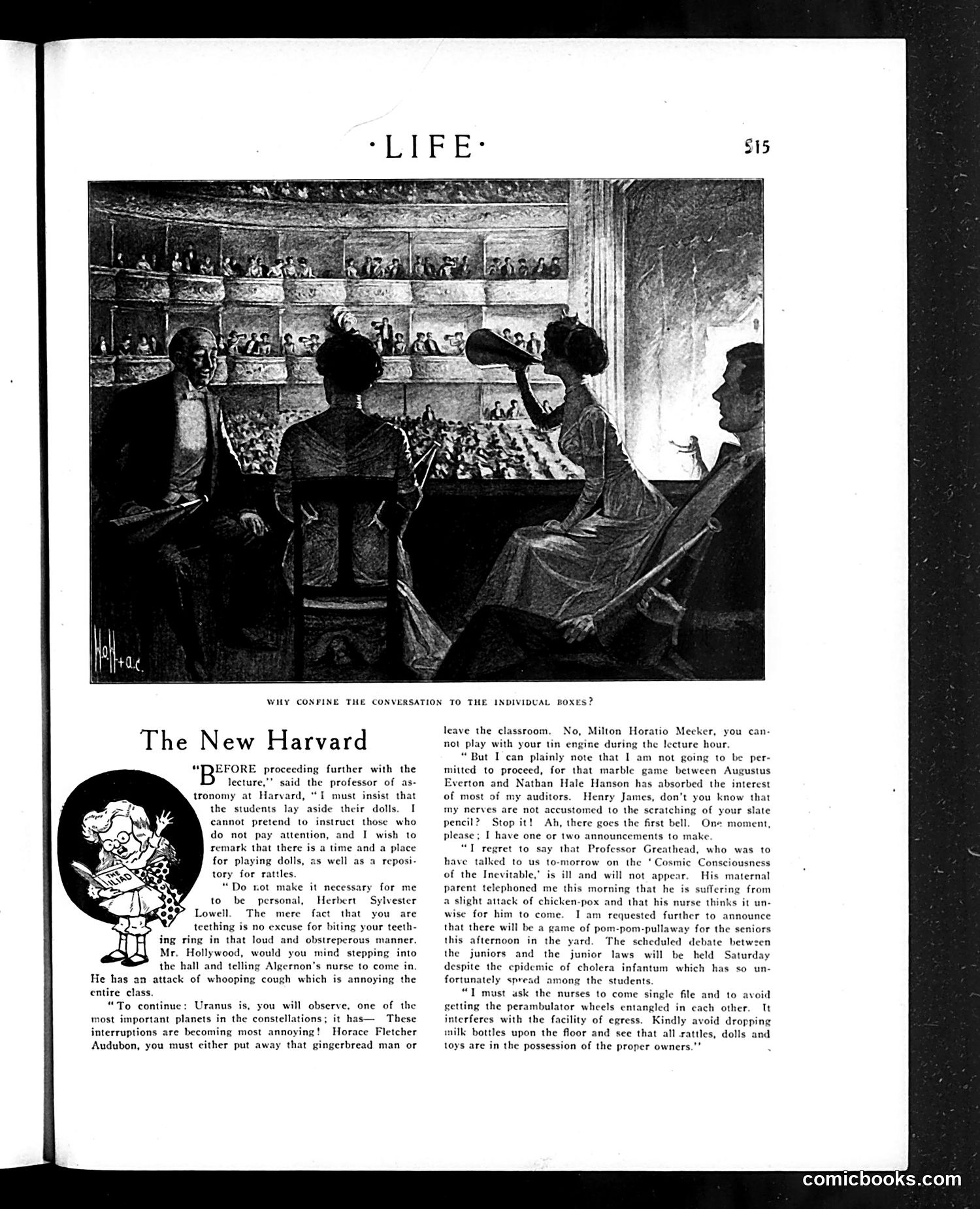
This satirical piece mocks Harvard University by depicting a lecture hall where the "students" are actually infants and toddlers—complete with nurses, perambulators, teething rings, and dolls. The professor attempts to conduct an astronomy lecture while dealing with absurd interruptions: students teething loudly, playing marbles, whooping cough, gingerbread eating, and tin engines. The joke targets Harvard's pretentiousness and intellectual self-importance. By literalizing the "infantile" nature of the student body (or perhaps criticizing their immaturity), Life satirizes elite academic institutions. The absurd formality of the professorial voice—maintaining dignified lectures amid chaos of actual babies—creates the humor. References to famous authors' names (Henry James, Horace Fletcher, Audubon) given to children amplify the satire on Harvard's self-regard.
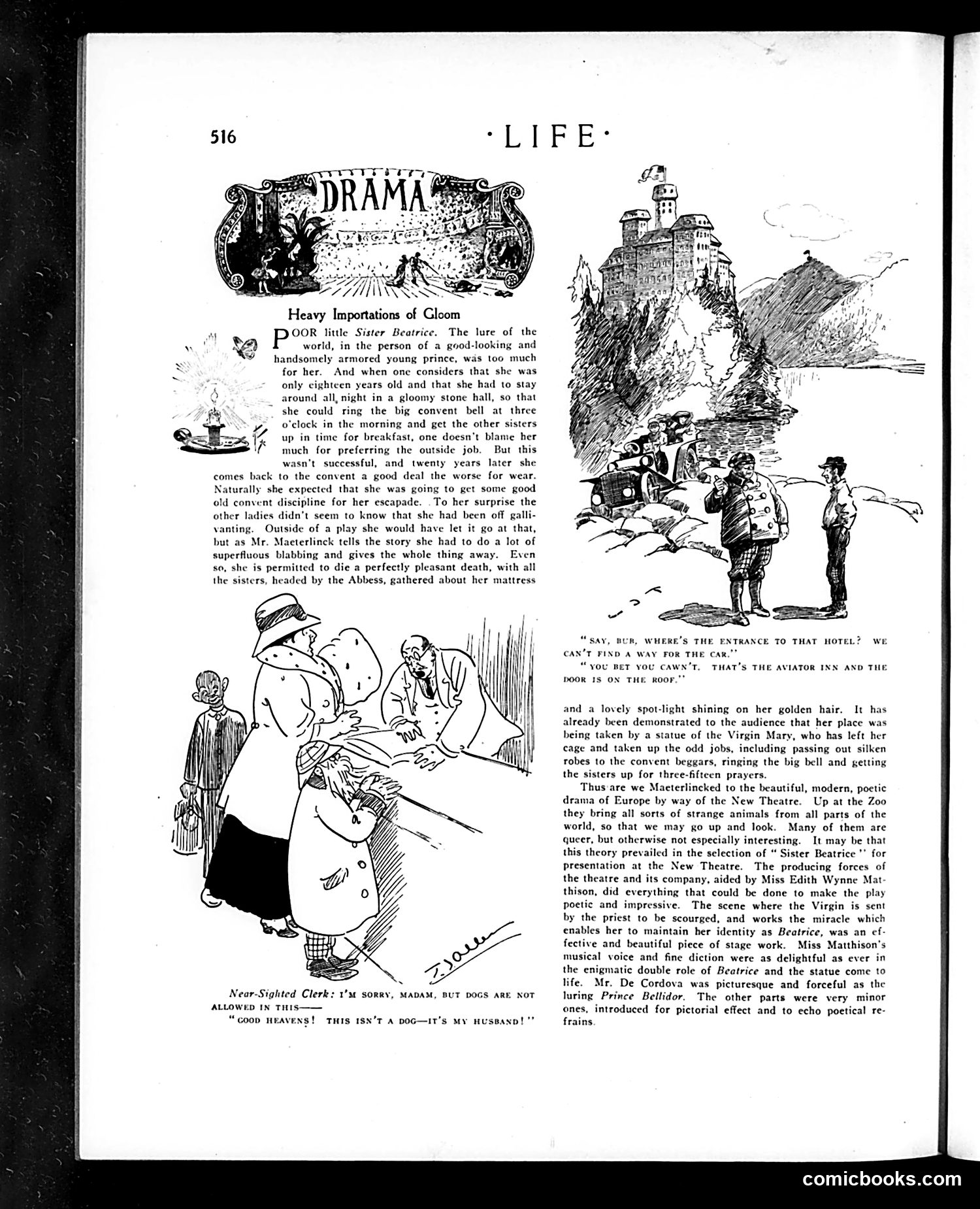
This page reviews Maurice Maeterlinck's play "Sister Beatrice" at the New Theatre. The main critique uses a zoo metaphor: just as zoos display exotic animals from around the world for curiosity rather than inherent interest, the New Theatre imports European "poetic drama" the same way—presenting something culturally prestigious but not necessarily compelling. The plot synopsis describes a nun who abandons convent life for a prince, returns twenty years later corrupted, but receives forgiveness and a pleasant death—all while a statue of the Virgin Mary mysteriously performs her duties. Three cartoon vignettes satirize unrelated modern absurdities: a near-sighted clerk denying a dog entry (claiming it's the customer's husband), drivers unable to find the Aviator Inn because "the door is on the roof," and a castle scene with lost tourists. The review praises actress Edith Wynne Matthison's performance but suggests the play itself, despite theatrical effort, remains more curiosity than art—imported Continental pretension rather than genuine drama.
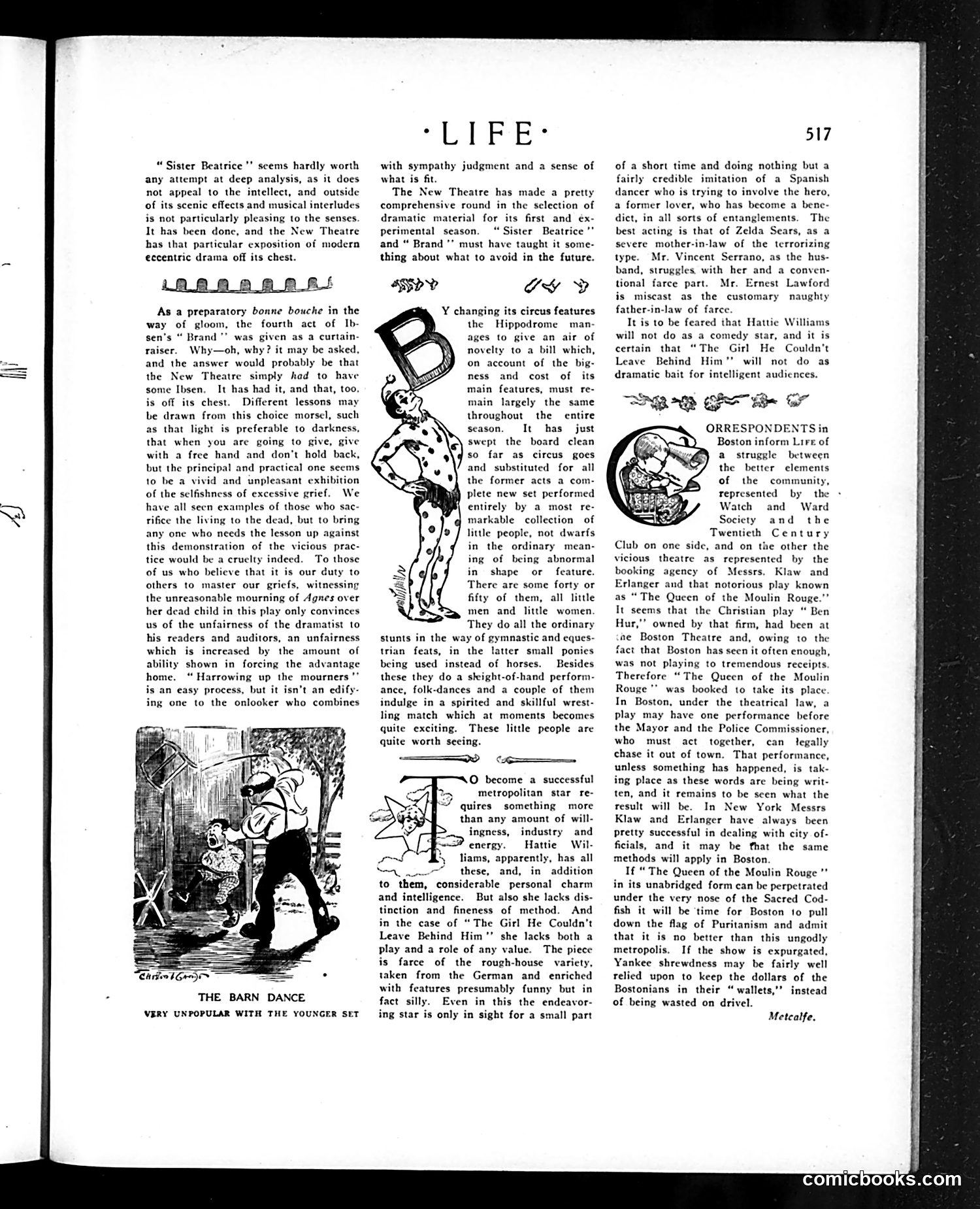
This page contains three theater reviews. The critic dismisses the New Theatre's production of "Sister Beatrice" as shallow entertainment lacking intellectual merit, though visually competent. He criticizes their programming choice of Ibsen's "Brand" as a curtain-raiser, arguing it depicts "unreasonable mourning" that punishes audiences rather than edifies them. The Hippodrome review praises their circus revamp featuring "little people" (approximately 40-50 performers of short stature, distinguished from dwarfs) performing standard gymnastics, equestrian stunts, folk-dances, and wrestling—proving entertainingly novel despite the venue's limited budget flexibility. The final review critiques actress Hattie Williams's performance in "The Girl He Couldn't Leave Behind Him," a German farce deemed silly. While acknowledging Williams possesses charm and intelligence, the critic faults her lack of "distinction and fineness of method" and notes she has minimal stage time in a mediocre vehicle.
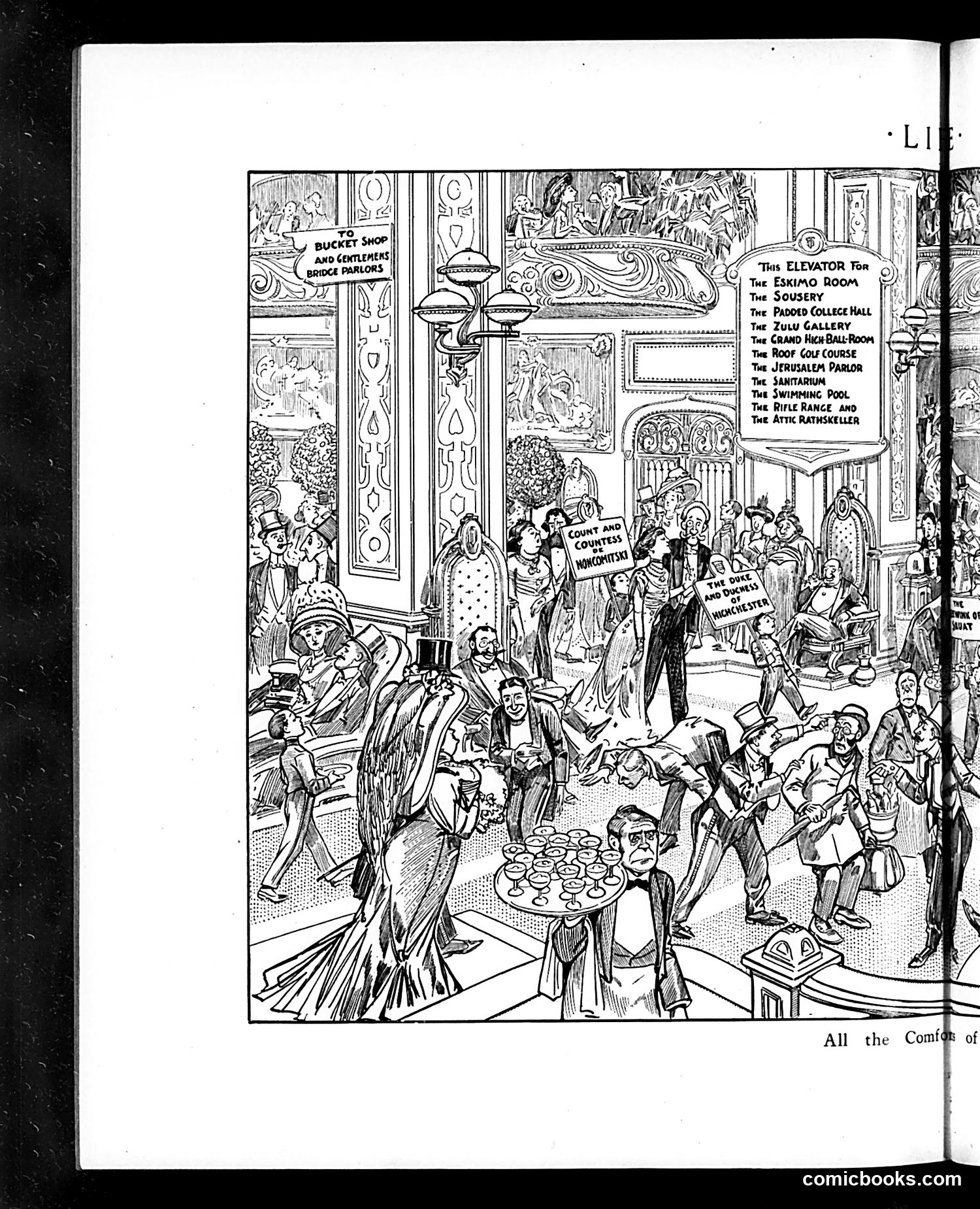
This is a satirical illustration of a luxurious hotel or building lobby. The sign in the upper left reads "BARBER SHOP AND GENTLEMEN'S SMOKING PARLORS," while an elevator directory lists amenities like "ESKIMO ROOM," "SOUVERY," "PADDED COLLEGE HALL," "ZULU GALLERY," "SWIMMING POOL," and "ATTIC RATHSKELLER." The cartoon mocks the excessive opulence and absurd amenities of upscale establishments during the Jazz Age or Roaring Twenties. The crowd of well-dressed patrons and staff creates visual chaos suggesting these elaborate facilities are both crowded and somewhat ridiculous. The specific room names—particularly "PADDED COLLEGE HALL" and ethnic-themed spaces like "ESKIMO ROOM" and "ZULU GALLERY"—appear to satirize the era's trend toward themed entertainment and racial stereotyping in fashionable venues. The overall effect critiques conspicuous consumption and pretentious leisure culture.
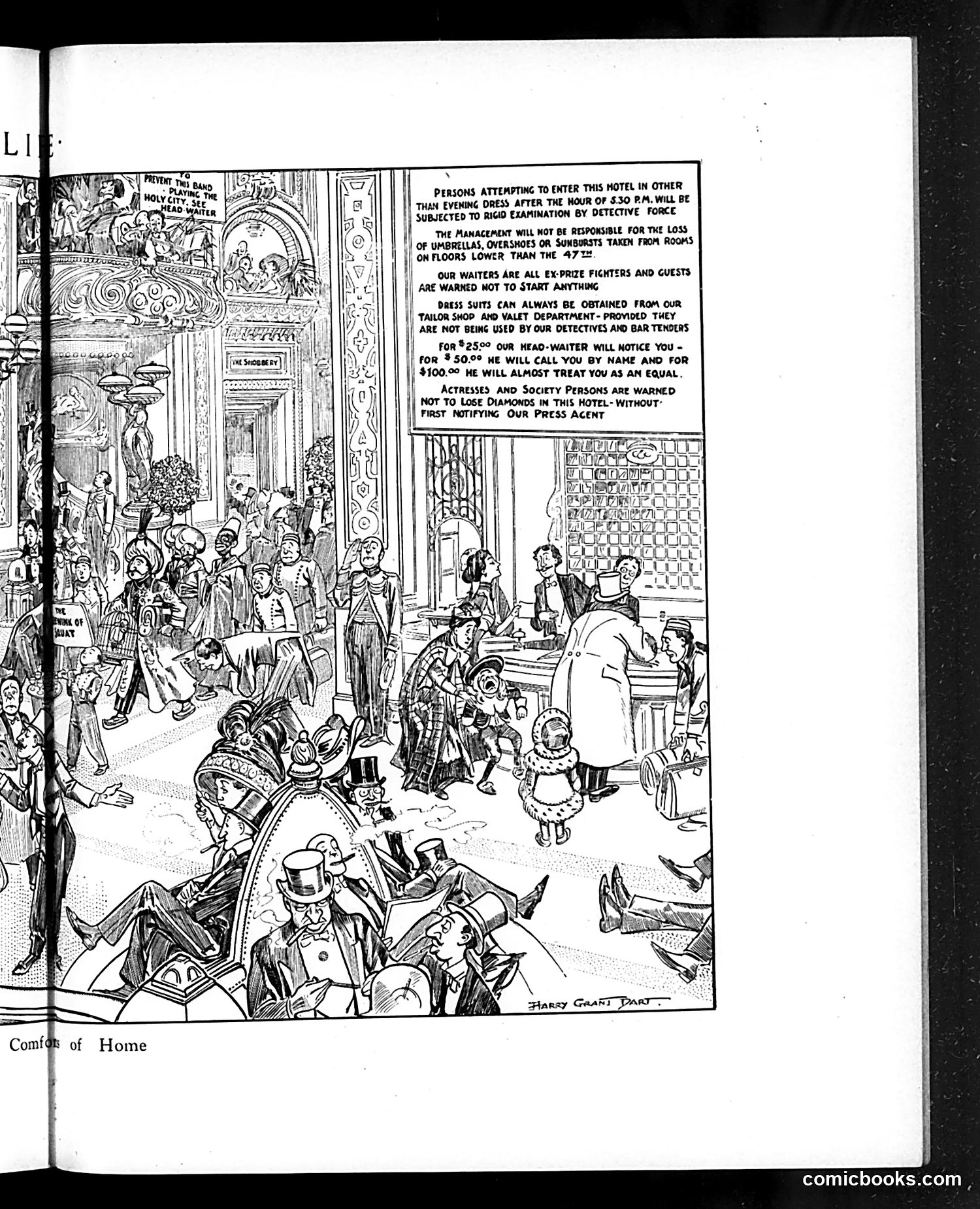
This cartoon satirizes a luxurious hotel's absurd "house rules," presented as humorous notices. The satire targets the pretension and crime associated with high-end establishments of the era. Key satirical points: - **Evening dress inspections** by detectives suggests guests are criminals or thieves requiring surveillance - **Ex-prize fighters as waiters** implies violence is expected among clientele - **Escalating fees for basic courtesy** ($25 to be noticed, $50 for your name, $100 to be treated as an equal) mocks how wealth supposedly buys respect - **Lost diamonds require press notification** - a jab at celebrities/society figures prioritizing publicity over actual theft prevention - **No responsibility for losses** despite all the security theater The crowded lobby illustration shows elegantly-dressed guests mingling amid this chaos, emphasizing the contradiction between the hotel's luxurious appearance and its crime-ridden reality. The cartoon mocks both nouveau-riche hotel culture and the moral emptiness of high society.
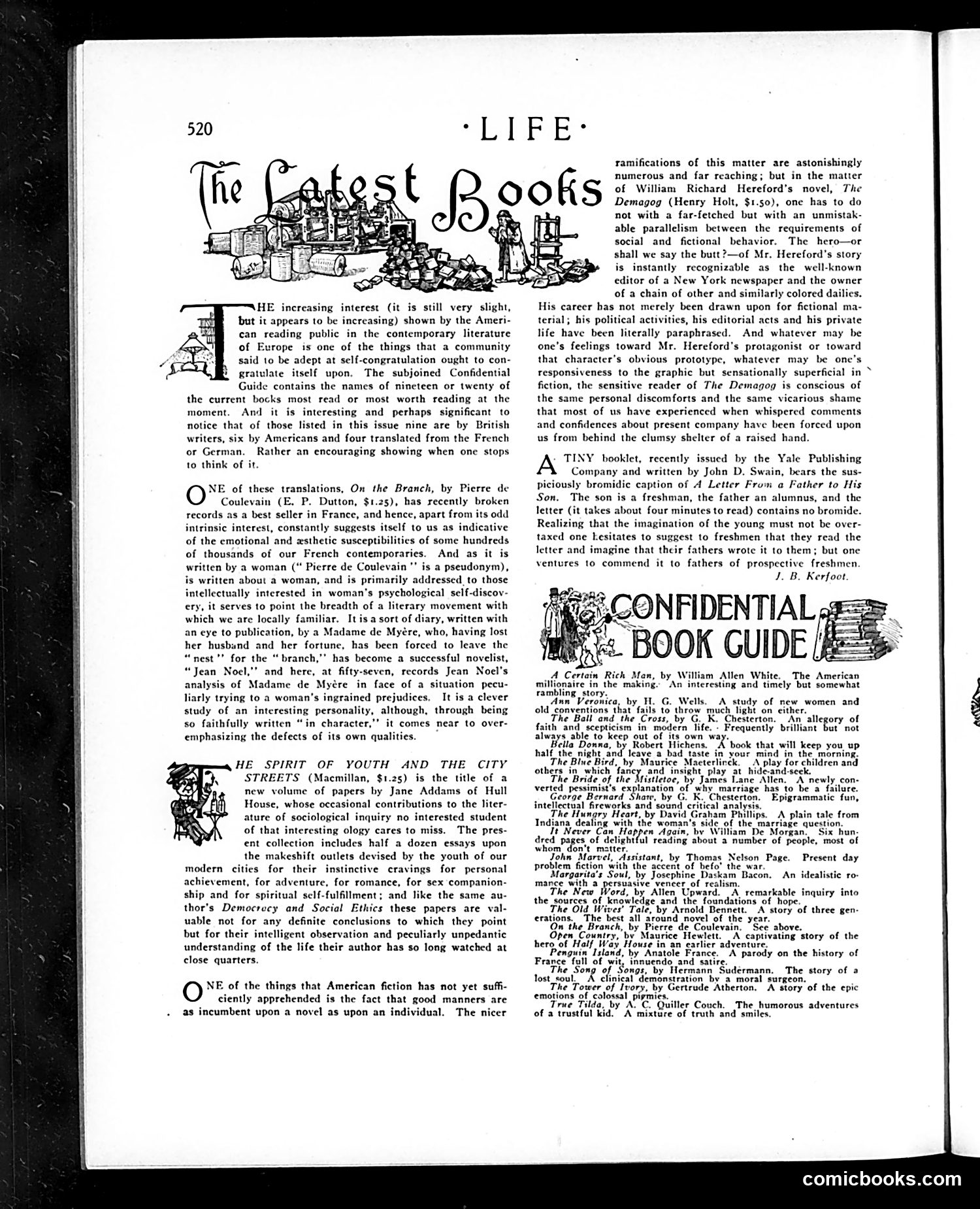
This is a book review section discussing contemporary European and American literature. The page critiques recent novels, including William Richard Hereford's *The Demagog* (Henry Holt, $1.50). The satire targets *The Demagog*, which portrays a thinly-veiled New York newspaper editor and newspaper chain owner. The reviewer criticizes the novel's lack of "good manners"—the author has not disguised his real-life subject but rather "literally paraphrased" the man's actual career, political activities, and private life. This violates fictional decorum: the character is instantly recognizable as an actual person rather than a proper fictional creation. The broader complaint is that American fiction hasn't yet learned that novels require the same courtesy as polite society—you shouldn't directly lampoon identifiable living people. The review treats this as poor literary form rather than libel, emphasizing artistic standards over legal ones.
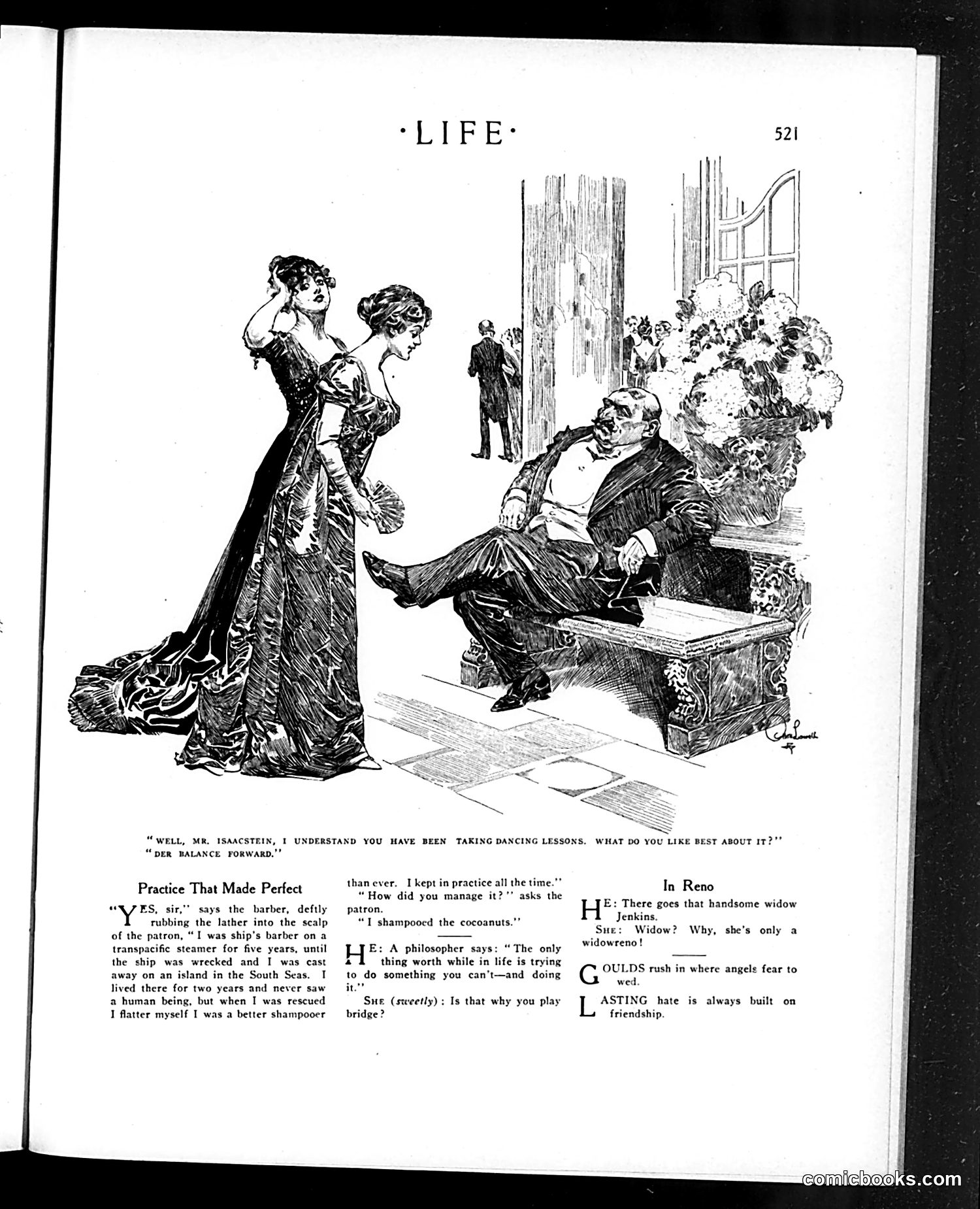
This page contains three separate satirical pieces typical of early 20th-century American humor: **Main Cartoon:** A woman instructs a man ("Mr. Isaacstein," likely a Jewish name) in dancing, with the caption mocking his balance. The humor plays on ethnic stereotypes common to the era. **"Practice That Made Perfect":** A barber's anecdote about maintaining his skills by shampooing coconuts while stranded on an island—absurdist humor mocking the notion that any practice, however silly, maintains proficiency. **Three Brief Quips:** Social commentary on modern life—philosophy about self-improvement, a dig at bridge players, and jokes about Reno (famous for divorces), widow remarriage, and how hatred stems from former intimacy. The overall tone is lighthearted social satire reflecting Jazz Age attitudes toward courtship, class, and human behavior. Ethnic humor was standard for the period, though offensive by modern standards.
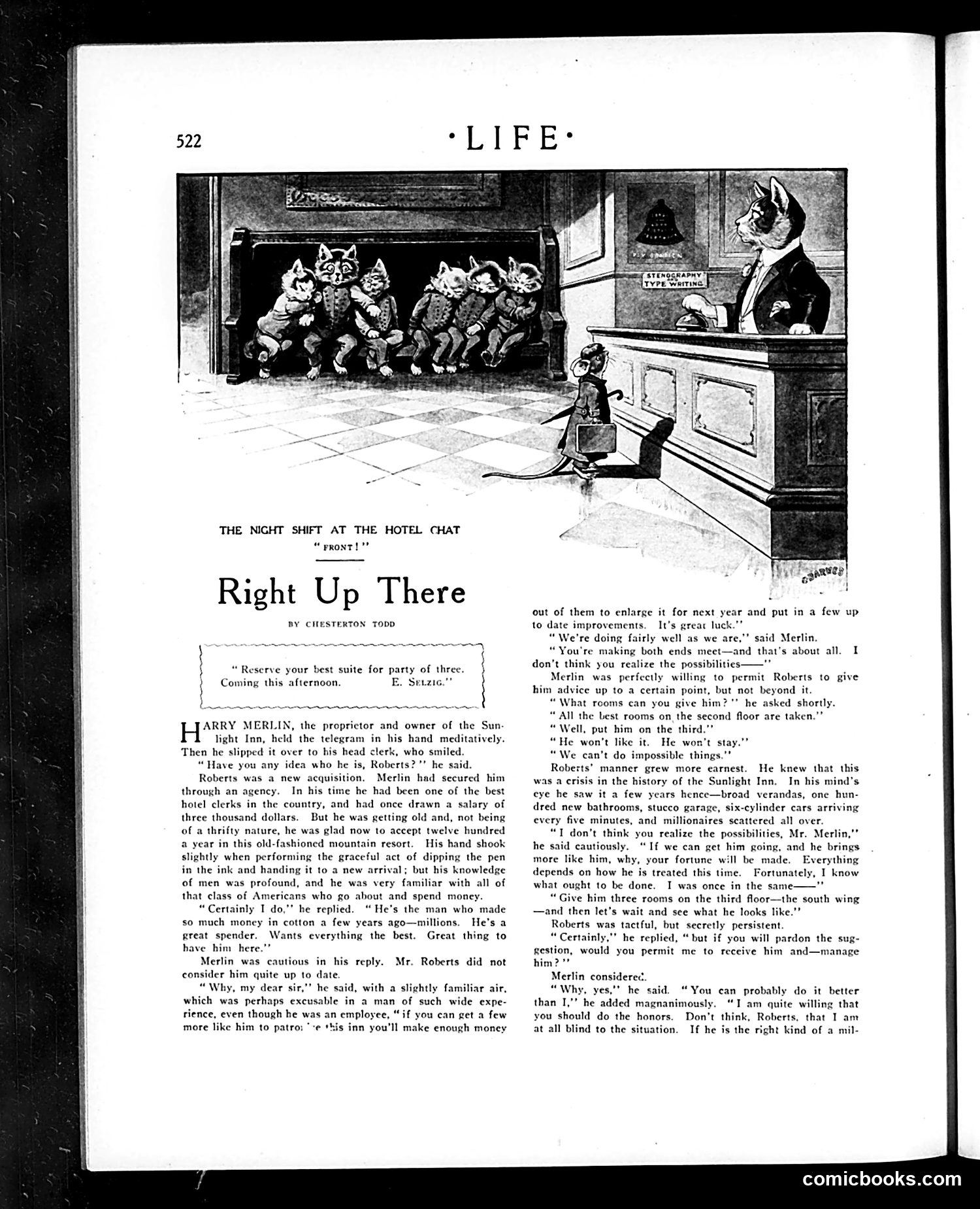
This is a humorous short story (not a political cartoon) titled "Right Up There" by Chesterton Todd, appearing in *Life* magazine. The cartoon illustration at top shows anthropomorphic cats at a hotel front desk—a visual gag unrelated to the story below. The story satirizes American wealth and class dynamics in the early 20th century. Harry Merlin, an old-fashioned innkeeper, receives a telegram from a wealthy cotton magnate requesting accommodations. His experienced head clerk, Roberts, urges Merlin to treat this rich guest lavishly, seeing him as the key to expanding the struggling mountain resort into a luxury destination attracting wealthy clientele. The satire targets both figures: Roberts's obsequious fawning over wealth and Merlin's stubborn resistance to modern business practices. The joke centers on how wealth dictates treatment and opportunity, and how a struggling business owner must compromise his pride to survive—a commentary on American capitalism's deference to money.
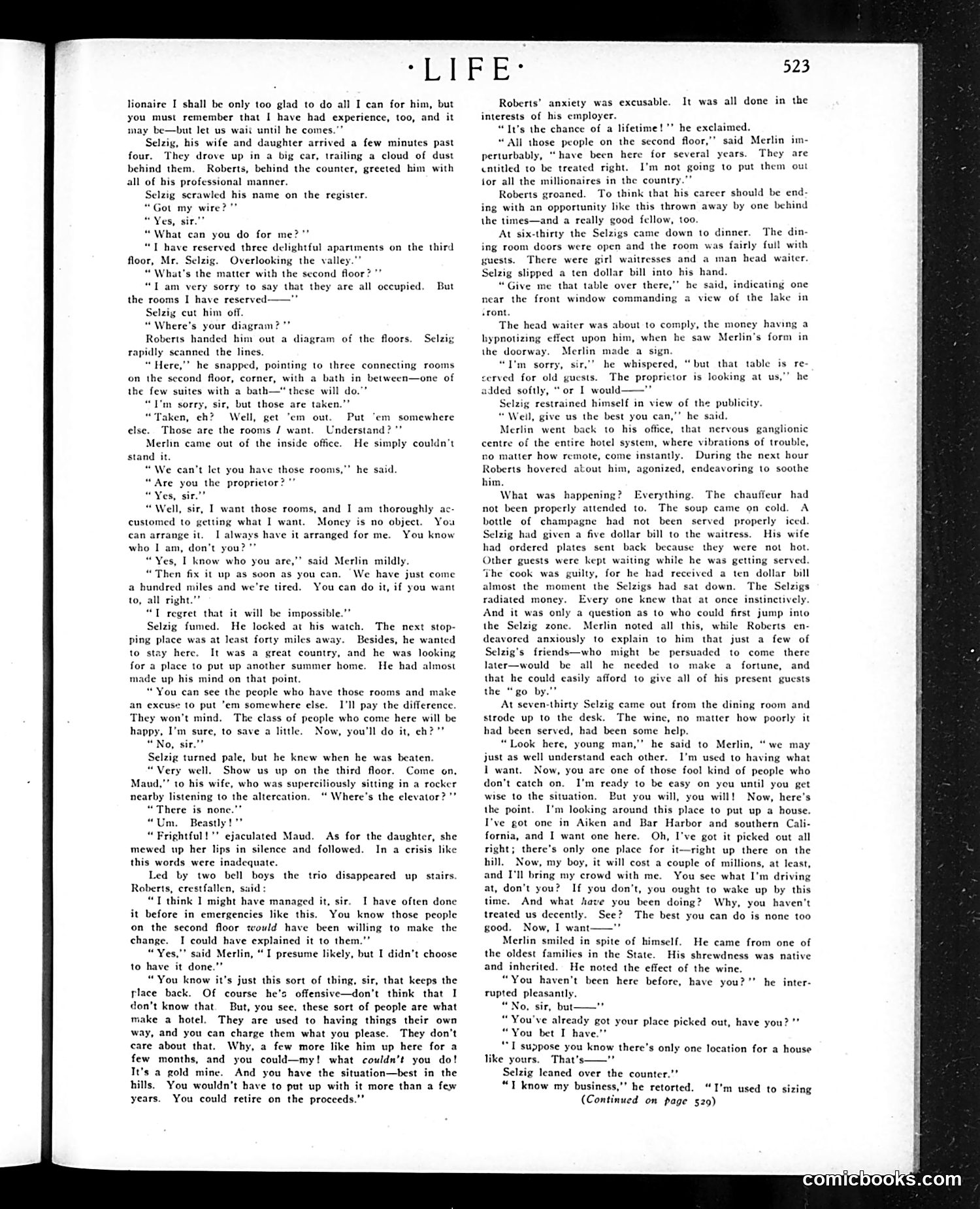
This page contains a serialized story (continued from page 529) depicting a conflict between a wealthy businessman named Selzig and Merlin, the principled proprietor of a mountain hotel. **The Social Commentary:** The narrative satirizes the era's deference to wealth and influence. Selzig arrives expecting to commandeer already-occupied rooms through money and intimidation, assuming his wealth entitles him to displace other guests. Roberts, the desk clerk, is willing to comply for profit, but Merlin—apparently the owner—refuses on principle, rejecting the premise that money should override fairness to existing guests. **The Satire:** The piece critiques both wealthy tourists' entitlement and the hospitality industry's willingness to compromise ethics for affluent clientele. Roberts's later argument that tolerating such behavior is profitable (promising retirement wealth) highlights the corrupting influence of money on moral standards. **Historical Context:** This reflects Gilded Age anxieties about nouveau riche arrogance and debates over whether commercial establishments should prioritize profit over equitable treatment of all customers.
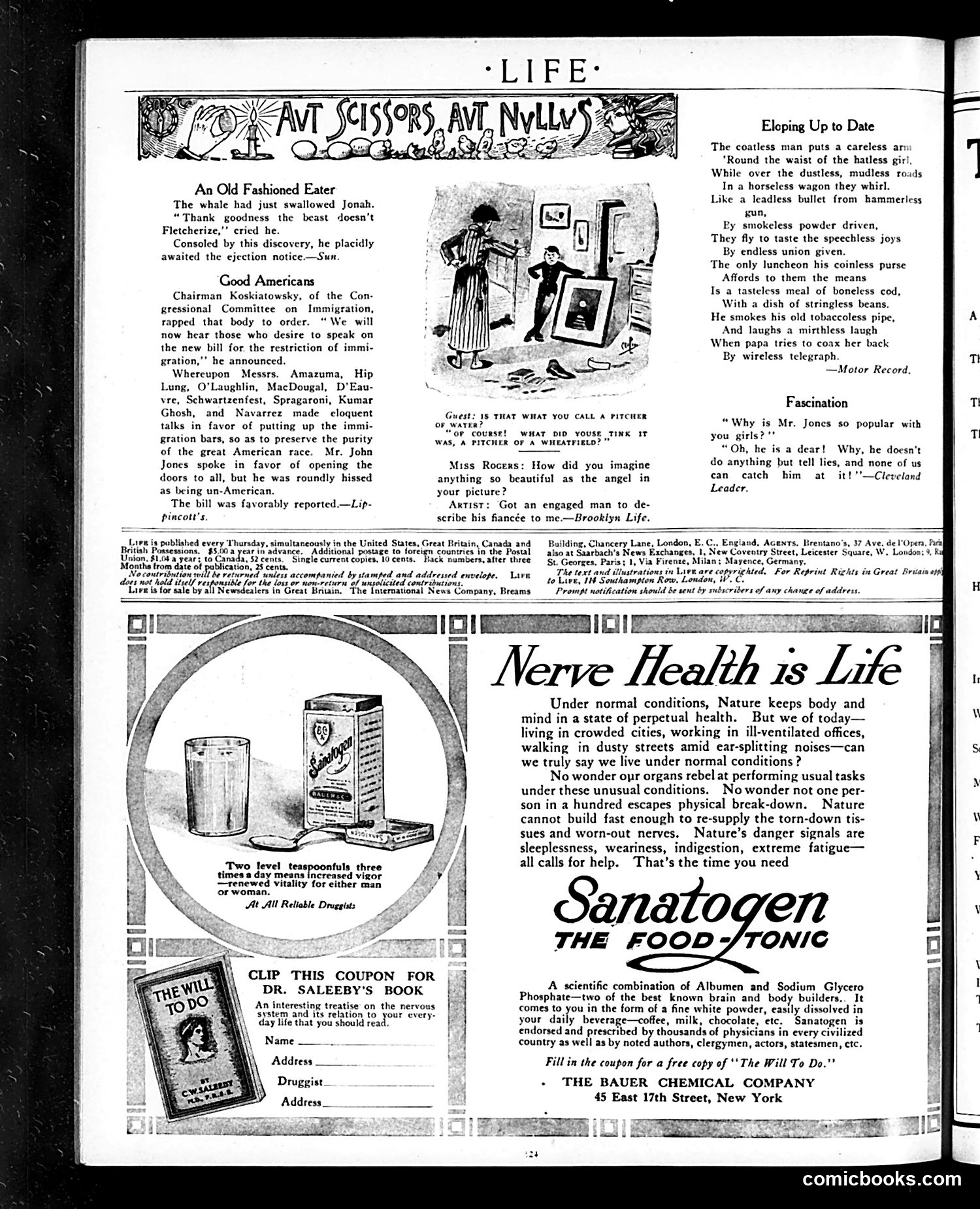
This page from Life magazine contains several satirical pieces reflecting early 20th-century American concerns: **"An Old Fashioned Eater"** jokes about "Fletcherizing"—a dietary fad where food was chewed extremely thoroughly. The reference is topical satire on trendy health practices. **"Good Americans"** satirizes immigration restriction debates. A congressional committee hears immigrant speakers with ethnic surnames (Amazuma, O'Laughlin, D'Eauvre, Spragaroni, etc.) argue *for* restricting immigration to preserve American "purity." The irony is that immigrants themselves advocate closing borders—lampooning both nativist sentiment and the absurdity of the position. **"Eloping Up to Date"** is wordplay mocking modern "less" consumer products (wireless, smokeless, horseless, etc.), applied comically to an elopement scenario. **"Fascination"** contains two brief jokes: one about mistaking wheat for water (ethnic dialect humor), another where a girl praises her boyfriend because he lies so smoothly she can't catch him—reversing typical courtship expectations. The page also advertises Sanatogen tonic for "nerve health," typical of period patent medicines.
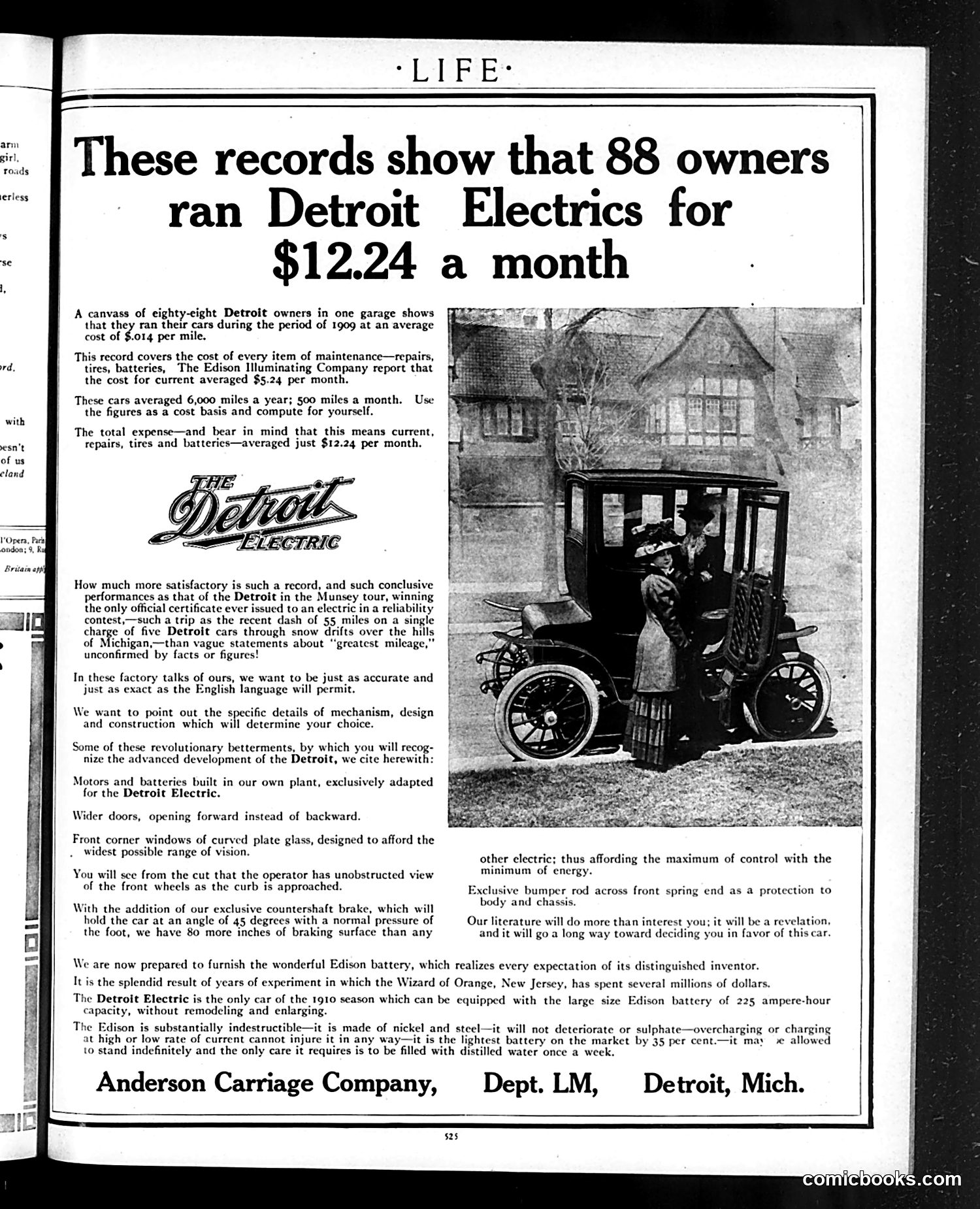
This is primarily a **product advertisement**, not satire or political commentary. The Anderson Carriage Company promotes the Detroit Electric automobile by presenting statistical evidence of low operating costs ($12.24/month based on 88 actual owners' records). The advertisement appeals to early-1900s consumers by emphasizing **reliability and economy** over vague marketing claims. It references specific achievements: winning the only official reliability certificate for an electric vehicle and a documented 55-mile winter drive through Michigan snow. The pitch highlights technical innovations (wider doors, curved windows for visibility, exclusive braking system) and notably the **Edison battery**—named for Thomas Edison ("Wizard of Orange, New Jersey")—as a revolutionary, indestructible component exclusive to Detroit Electrics. The photograph shows a well-dressed woman operating the vehicle, suggesting the car's ease of use and appeal to affluent female drivers of the era. This represents early electric vehicles' niche market before gasoline engines dominated.
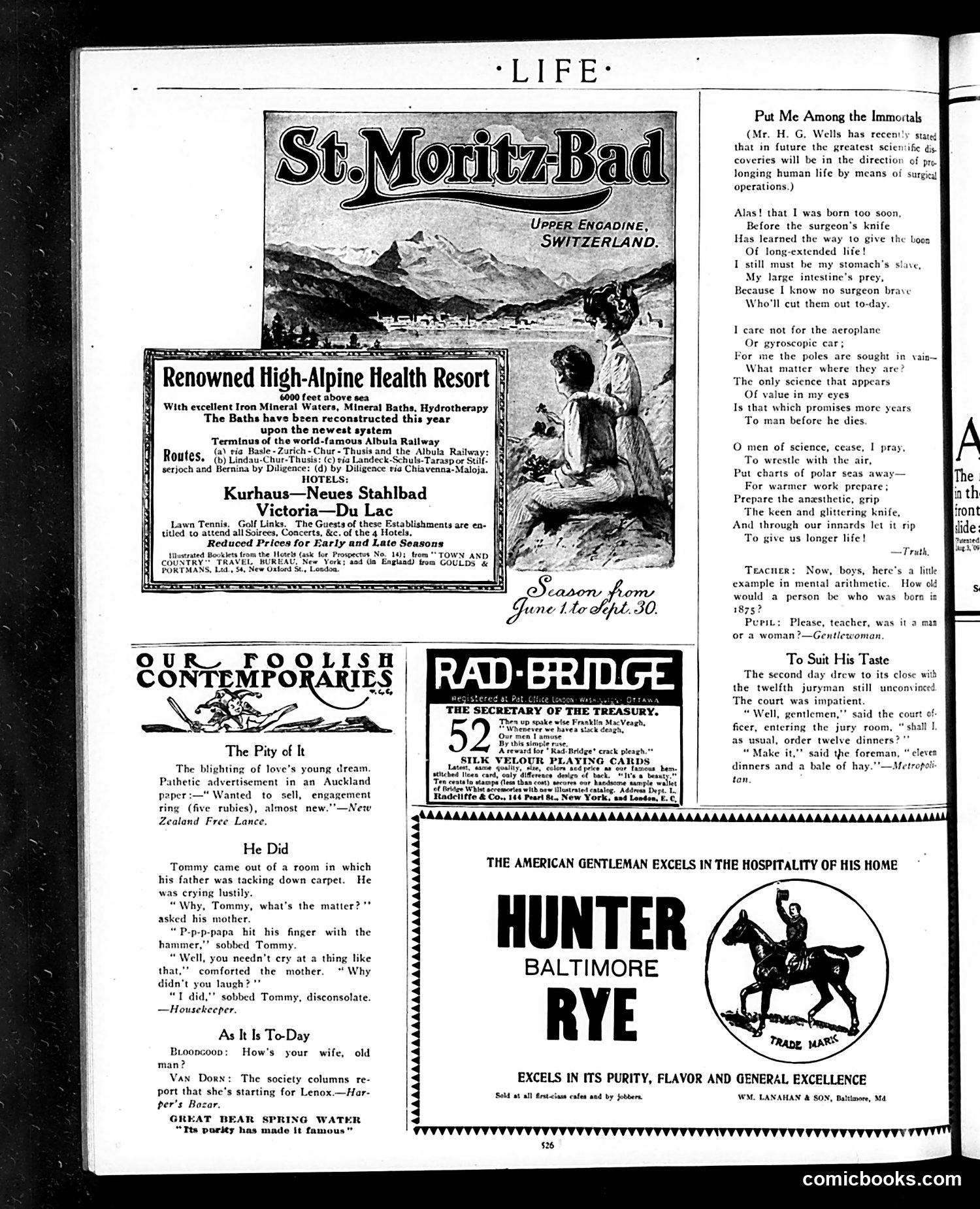
This page mixes **advertisements** with **satirical humor pieces** typical of early 20th-century Life magazine. ## Key Content: **Advertisements** dominate: St. Moritz Bad (Swiss health resort), Hunter Baltimore Rye whiskey, and playing cards. **Satirical pieces** include: - **"Put Me Among the Immortals"**: A poem mocking H.G. Wells's recent statement that future science would extend human life through surgery. The narrator humorously laments being born too soon, before surgeons could remove his stomach and intestines to grant immortality—preferring this to exploration or aviation. - **"He Did"**: A joke about a child sympathizing with his father's hammered finger. - **"As It Is To-Day"**: Social satire about a wealthy wife departing for Lenox (an exclusive Massachusetts resort). - **Classroom joke**: A student asks whether someone born in 1875 is male or female—implying women obsess over their age differently. - **Jury room joke**: A stubborn juror requests hay with his dinners, suggesting he's a donkey (obstinate fool). The page reflects early-1900s concerns about technology, class, and gender roles.
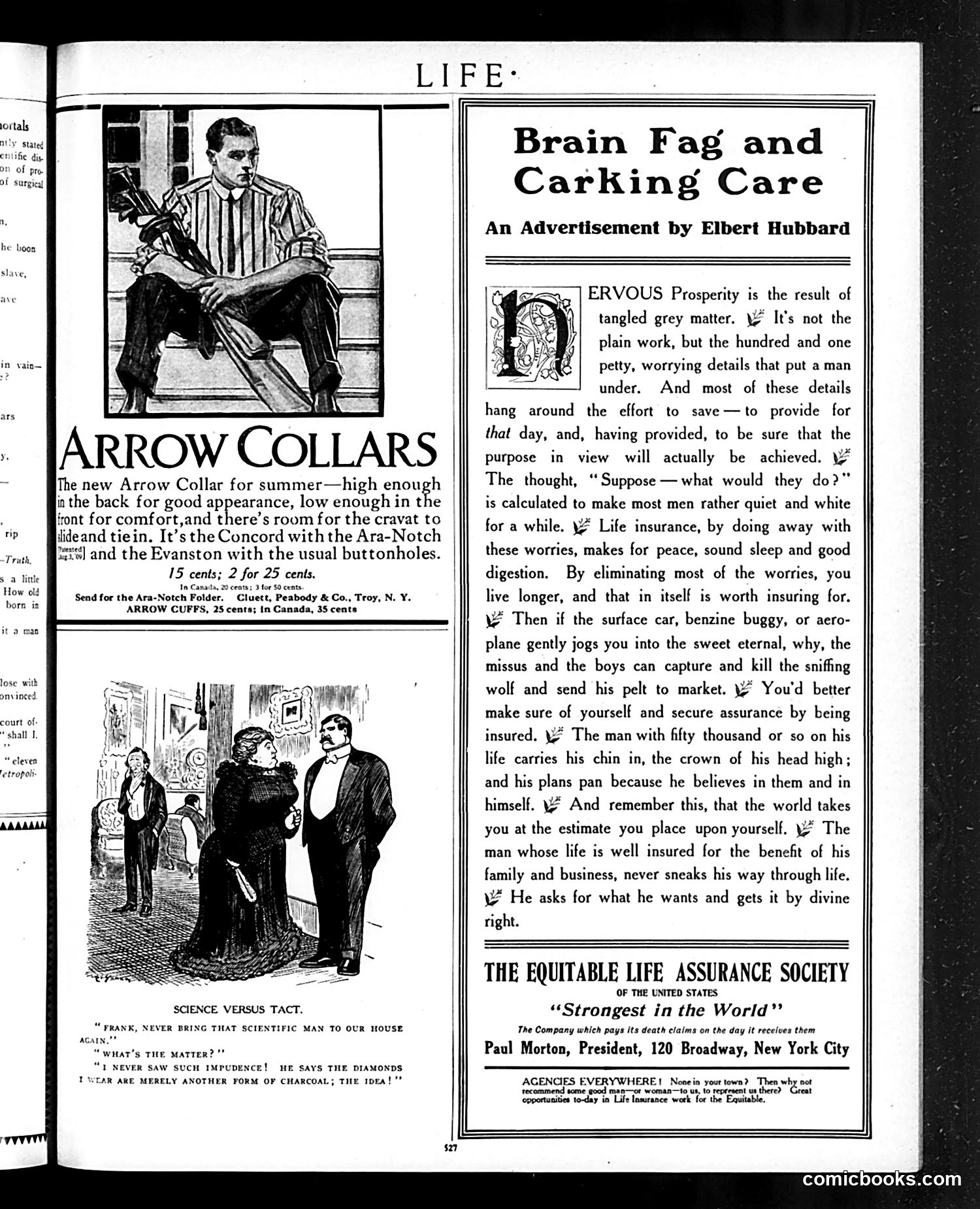
This page contains two satirical items and one major advertisement. **"Science Versus Tact" cartoon:** A domestic scene where a woman scolds her husband for bringing a "scientific man" to their home. The scientist rudely informed her that her diamonds are "merely another form of charcoal"—revealing an unflattering truth. The satire mocks both the scientist's tactless bluntness and the woman's vanity about her jewelry. It suggests the conflict between scientific fact and polite social convention. **Arrow Collars advertisement:** A straightforward fashion ad for men's collars, showing sizing options for comfort and appearance. **"Brain Fag and Carking Care" essay by Elbert Hubbard:** An advertisement for life insurance disguised as philosophical wisdom. It argues that anxiety about providing for the future causes mental exhaustion ("brain fag"), but life insurance eliminates worry, improves health, and—notably—signals confidence and success to the world. The pitch conflates financial security with personal worth and moral character.
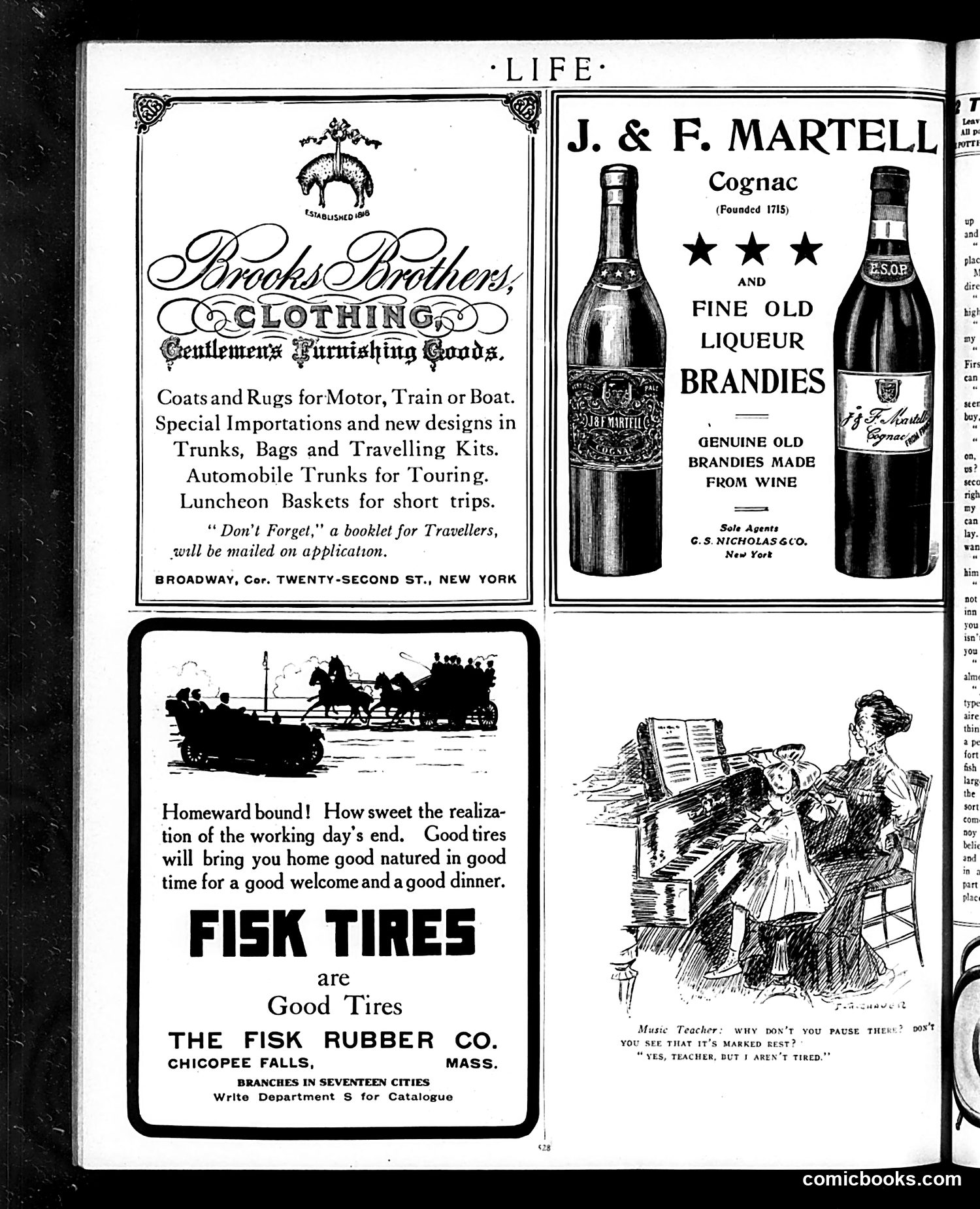
This is primarily an **advertising page** from an early 20th-century issue of *Life* magazine, featuring four distinct advertisements with minimal satirical content. The page includes ads for: - **Brooks Brothers** clothing and travel goods (Broadway, NYC) - **J. & F. Martell** cognac and brandies (founded 1715) - **Fisk Tires** (Chicopee Falls, Massachusetts) The only cartoon element is a small sketch at bottom right showing a **music lesson scene**: a teacher points to a "REST" marking in sheet music while a tired student protests, "Yes, teacher, but I aren't tired." This is gentle wordplay—the student misunderstands a musical notation (a "rest," meaning silence) as a physical rest period, missing the pun entirely. The Fisk Tires ad uses sentimental imagery of workers returning home, appealing to middle-class values about family and comfort. The overall page reflects early automotive and consumer culture advertising rather than political satire.
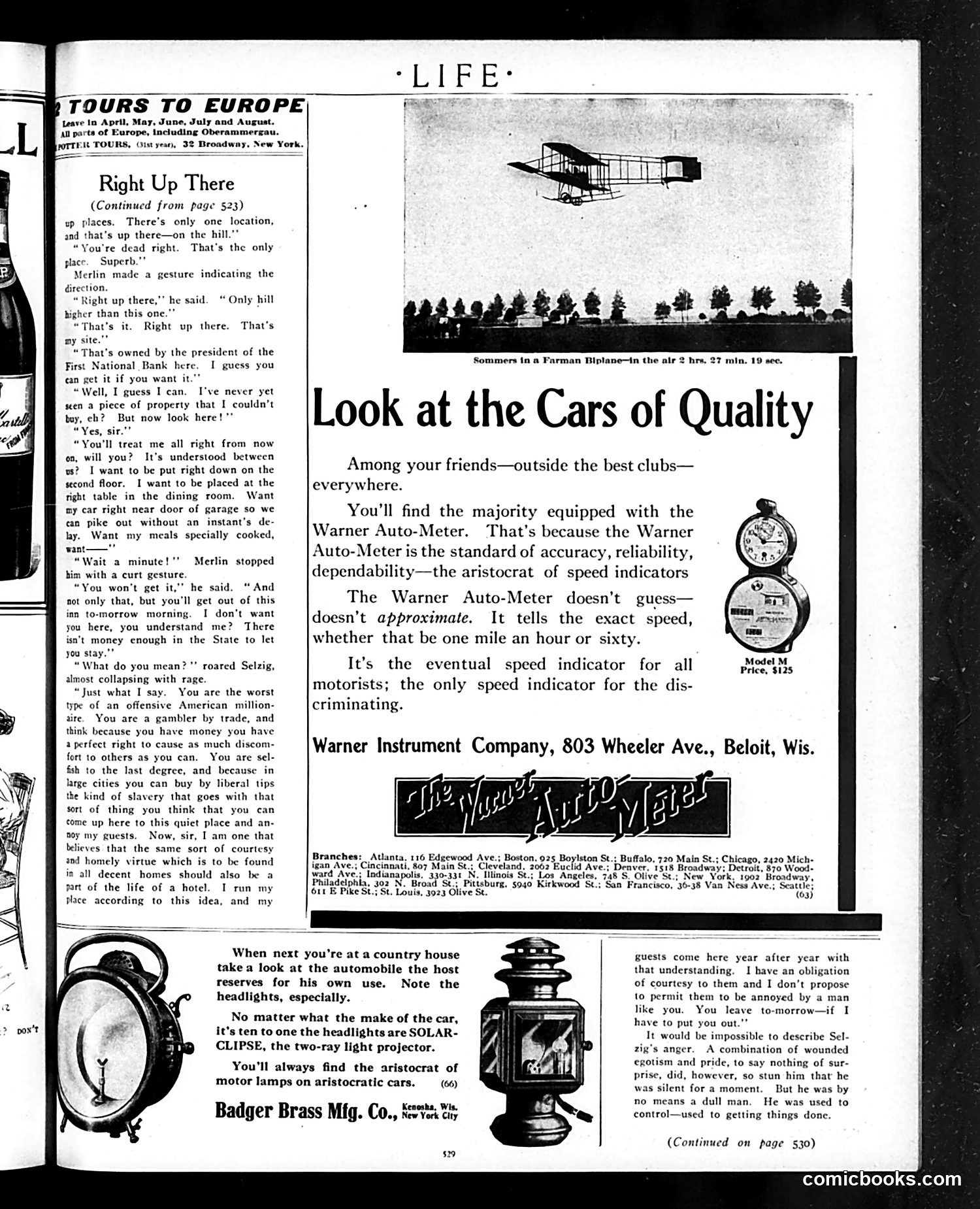
This page contains two distinct elements: **Left side:** A serialized short story titled "Right Up There" depicting a confrontation between a wealthy, demanding hotel guest (Selzig) and the hotel proprietor (Merlin). Selzig, characterized as an "offensive American millionaire" and "gambler by trade," attempts to leverage his wealth to secure special treatment—premium accommodations, dining placement, and service. Merlin refuses, delivering a moral rebuke about courtesy and virtue in "decent homes," ultimately ejecting Selzig for his arrogance. **Right side:** Advertising for Warner Auto-Meter speedometers and other automotive products (Badger Brass headlights). The ads emphasize precision and quality as markers of social distinction among "the discriminating." **The satire:** The story mocks nouveau-riche American millionaires who believe money alone entitles them to deference and special privileges. Merlin's principled refusal suggests that character and decency transcend wealth—a implicit critique of unchecked capitalist excess common to early-20th-century Life magazine satire.
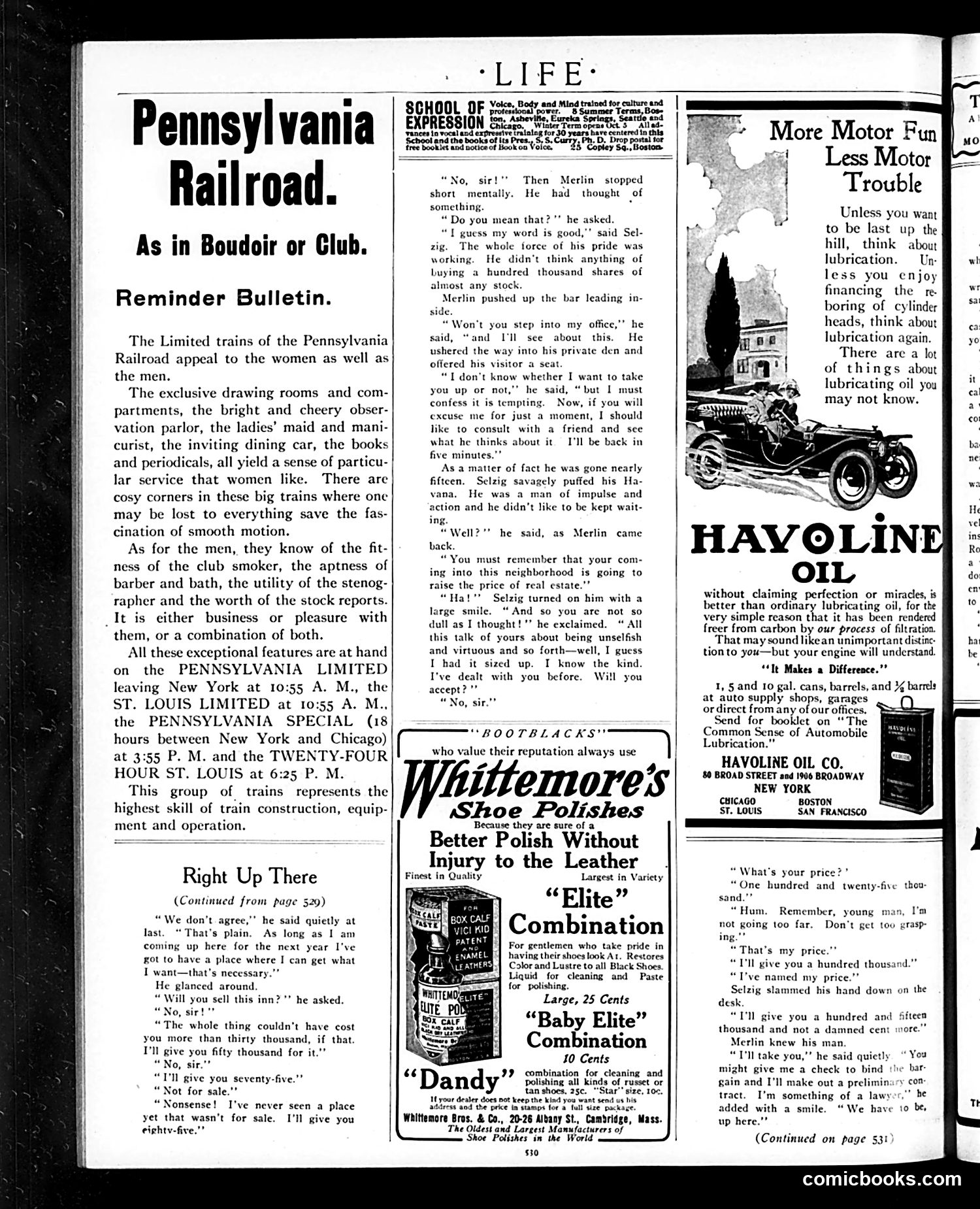
This page is primarily **advertising and serialized fiction**, not political satire or cartoons. The main content is a continuation of a story called "Right Up There" (page 529), featuring a character named Merlin and a wealthy businessman named Selzig negotiating over an inn. Selzig repeatedly raises his offer to purchase the property—from $50,000 to $85,000—but Merlin refuses, claiming it's "not for sale." The satire here is gentle: it mocks wealthy industrialists' assumption that everything has a price, and their surprise when someone refuses their money. The page also contains period advertisements for the Pennsylvania Railroad (emphasizing luxury train travel for both men and women), Havoline Oil, and Whittemore's Shoe Polishes. There are no political cartoons or caricatures. The "satire" is purely social commentary about class and wealth—a common theme in early 20th-century Life magazine humor.
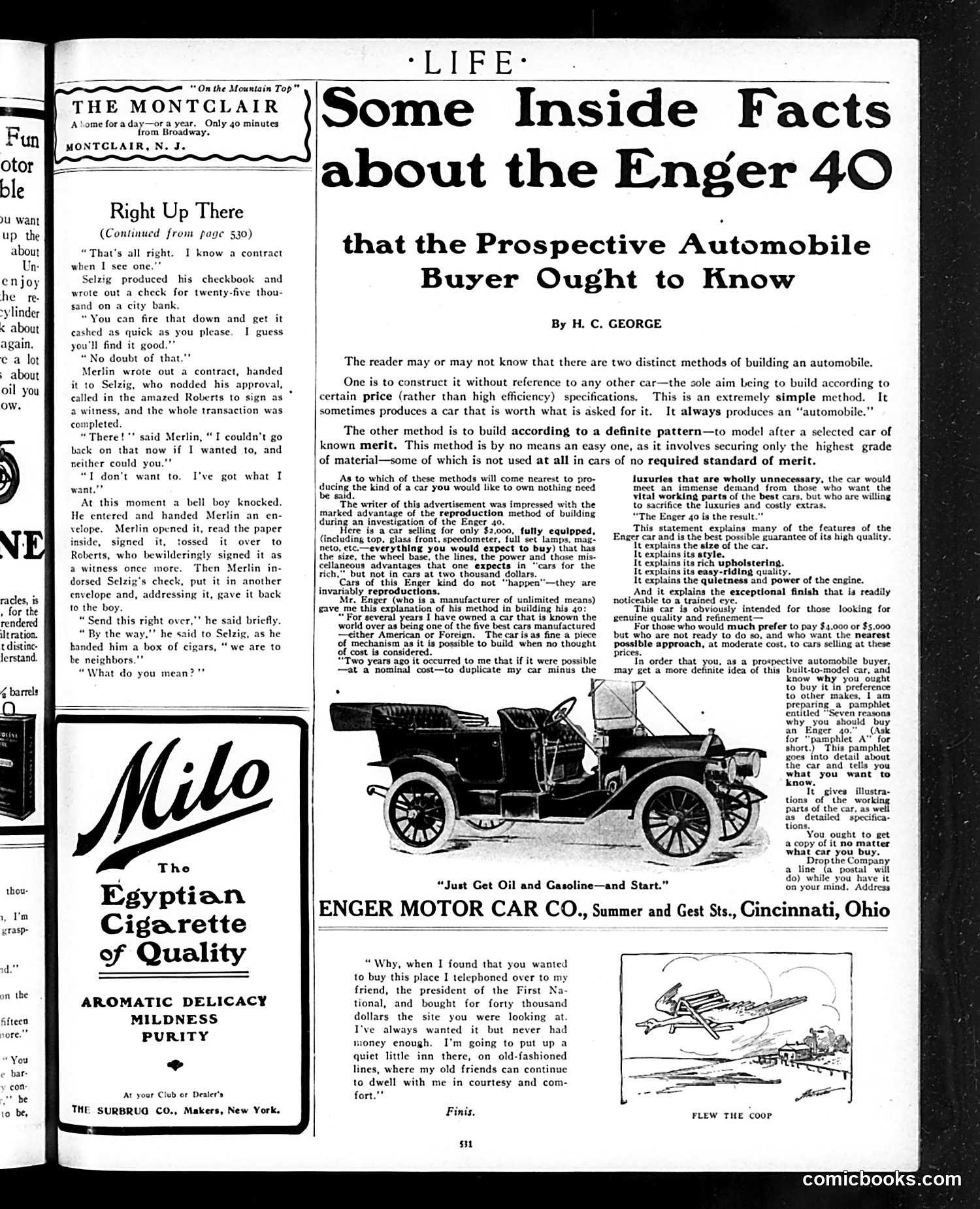
This page is primarily **advertising content**, not satire or political commentary. It features: **Main Content:** A lengthy advertorial for the Enger 40 automobile ($2,000, made in Cincinnati, Ohio). The ad emphasizes that the car is built by "reproduction"—copying an expensive luxury vehicle's design and features at lower cost, rather than designing from scratch. **Supporting Story:** "Right Up There" (continued from page 530) is a serialized fiction piece about a real estate/business deal, unrelated to the automotive content. **Side Advertisements:** Include Milo Egyptian cigarettes and The Montclair resort in New Jersey. **Historical Context:** This reflects early 1900s manufacturing philosophy—mass-producing luxury car designs affordably. The Enger company's pitch emphasizes that quality reproductions could democratize automobile ownership. The page contains no political cartoons or satire. It's a straightforward product promotion typical of Life magazine's mixed editorial-advertising format of this era.
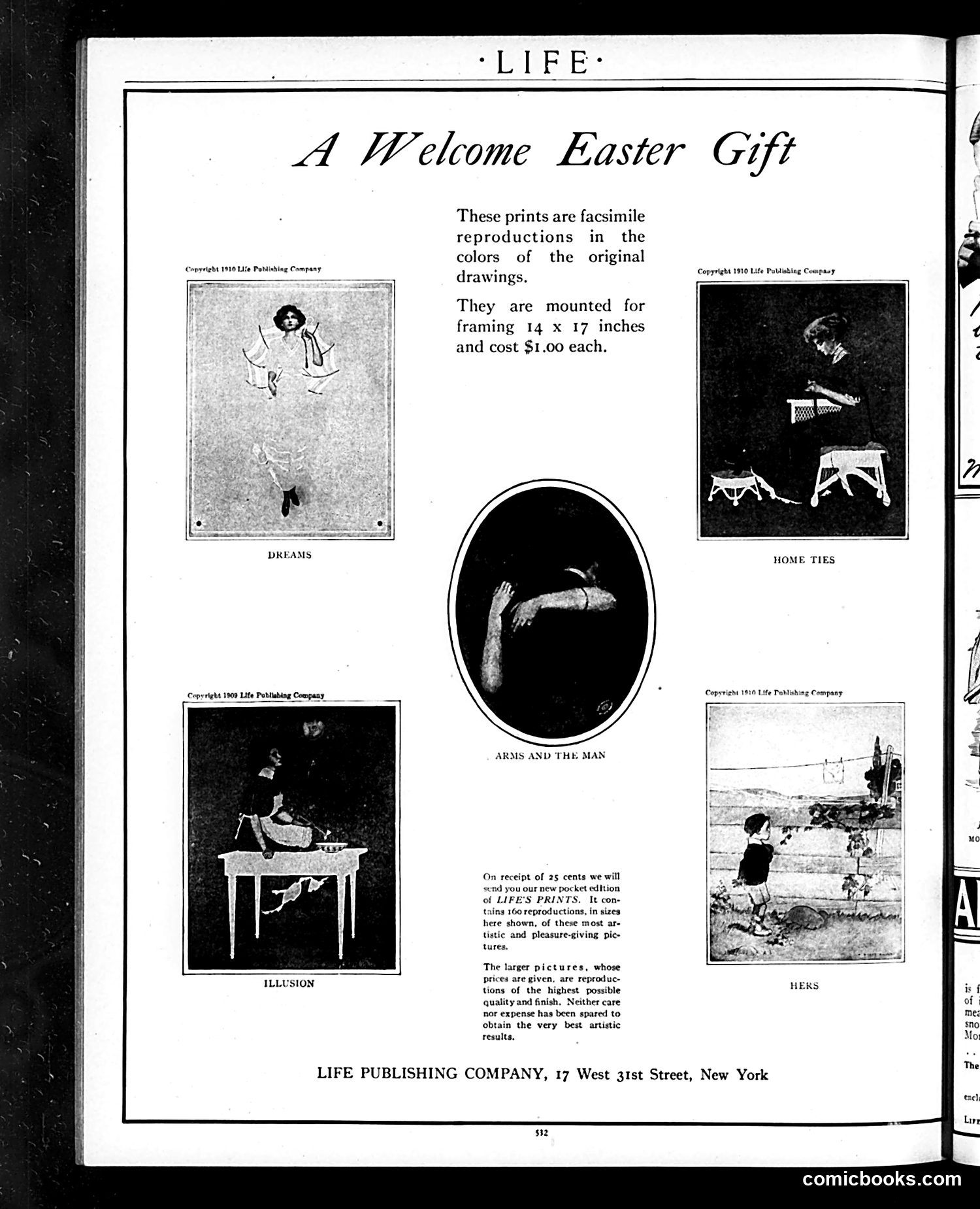
This is primarily an **advertisement** for Life Publishing Company's Easter gift offerings—framed art prints priced at $1.00 each, plus a pocket edition available for 25 cents. The page displays four titled artworks: 1. **"Dreams"** (top left): A figure floating/dreaming upward 2. **"Home Ties"** (top right): Domestic furniture and household items 3. **"Arms and the Man"** (center): A classical-style oval portrait showing an embracing couple 4. **"Illusion"** (bottom left): A figure at a table 5. **"Heks"** (bottom right): A child at what appears to be a beach or seaside These appear to be sentimental, decorative prints typical of early 1910s popular art—suitable Easter gifts emphasizing romance, domesticity, and pleasant fantasies. The advertisement emphasizes artistic quality and affordable pricing to middle-class consumers. No political satire is evident; this is straightforward commercial promotion disguised as editorial content, a common magazine practice of the era.
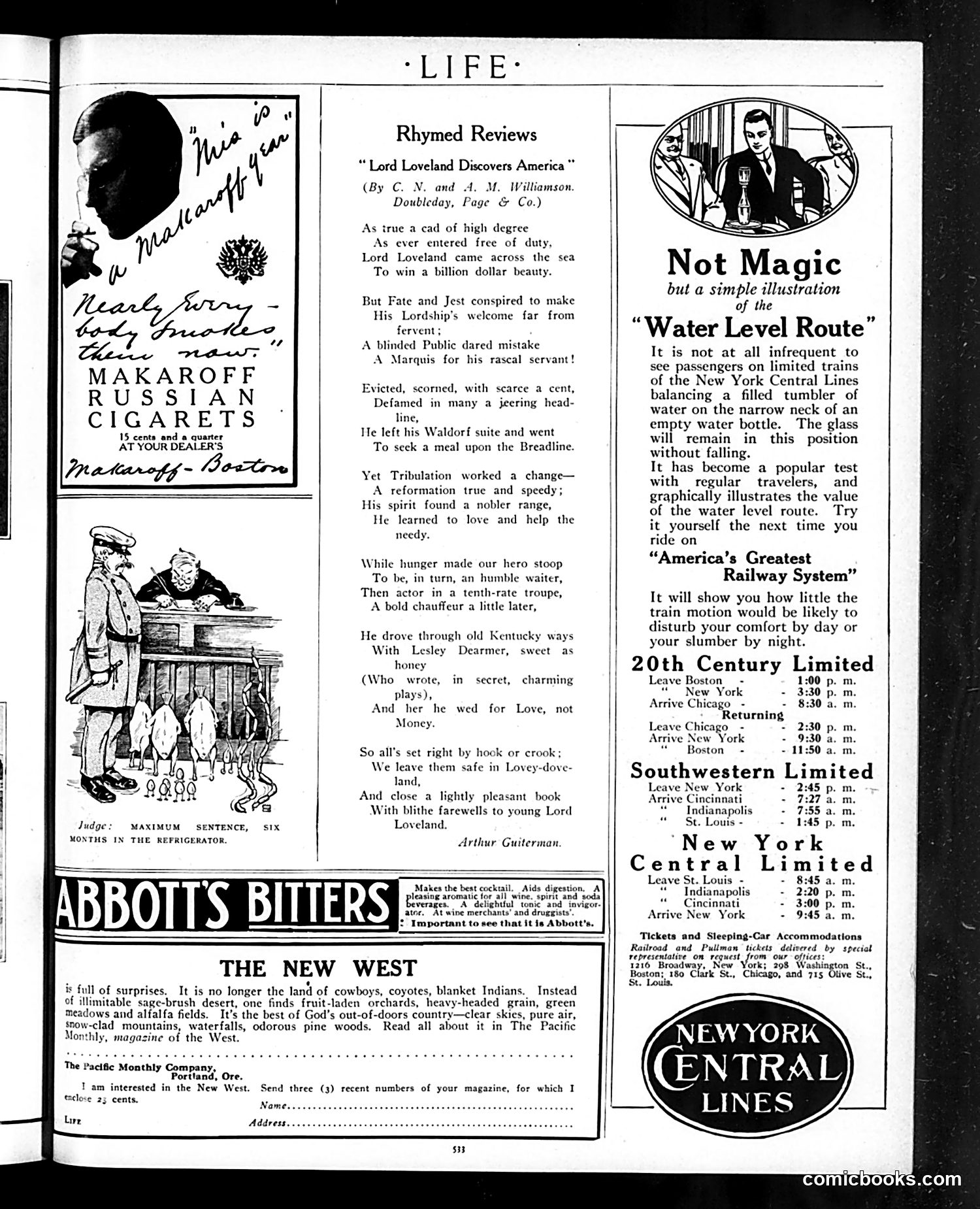
This page combines literary satire with transportation advertising, typical of early 20th-century magazines. **"Lord Loveland Discovers America"** is a rhymed book review mocking a novel about an aristocratic British cad who arrives in America to marry wealth but suffers comic reversals—mistaken for a servant, stripped of status, reduced to menial work as waiter and actor. The satire appears to lampoon both pretentious European nobility and the "comeuppance" narrative popular in American fiction. **The cartoons** illustrate the judge's quip about refrigeration punishment and a scene of humble labor. **The remaining content** consists entirely of **railroad advertisements**—New York Central Lines, 20th Century Limited, and Southwestern Limited trains—promoting their smooth rides via the "water level route" (a famous New York Central feature where a glass of water supposedly wouldn't spill). This juxtaposes genteel literary commentary with appeals to middle-class leisure travel. The page reflects advertising-driven magazine economics of the era.
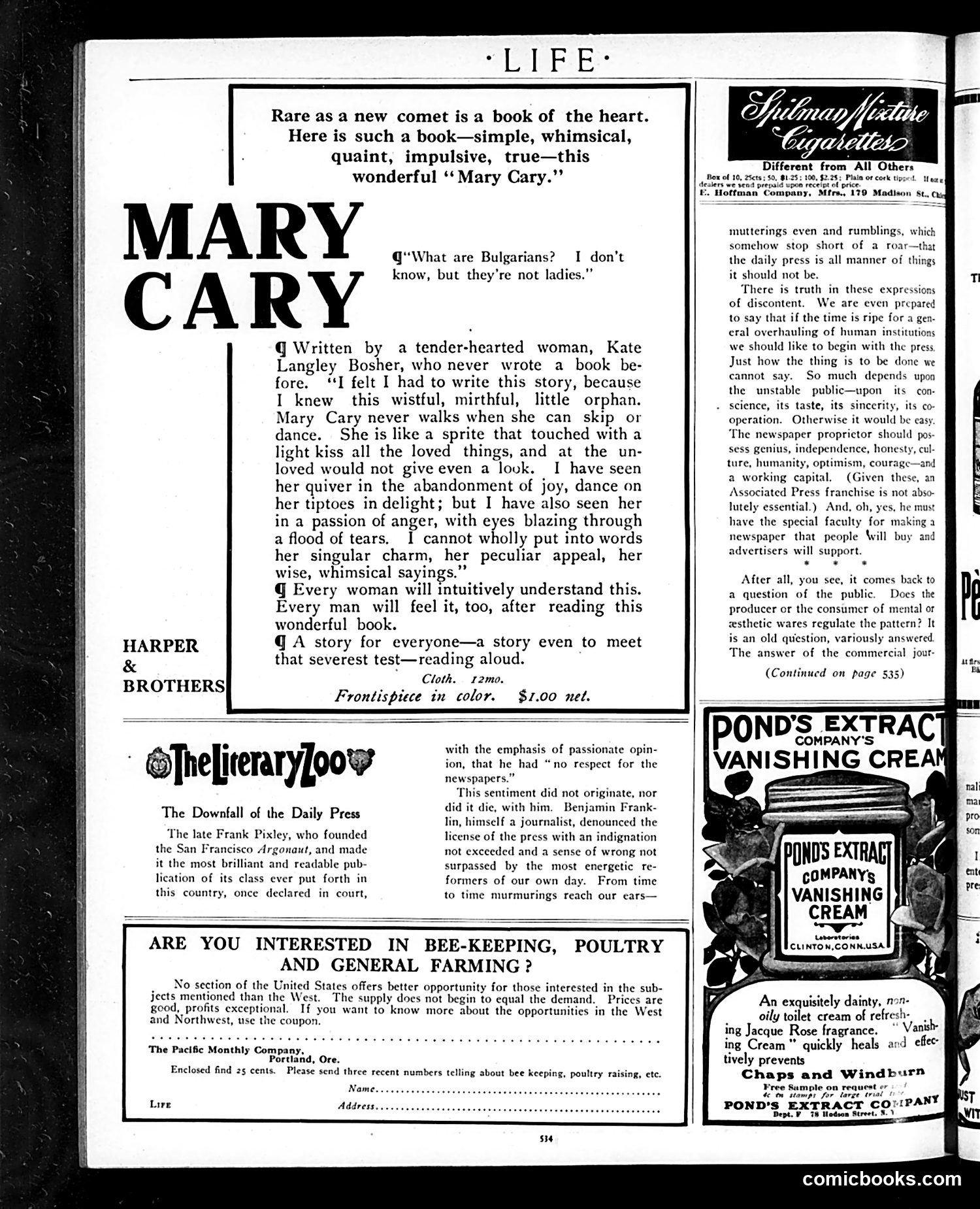
This page is primarily **book advertising and editorial content**, not political satire. The main feature is a glowing review of the novel *Mary Cary* by Kate Langley Bosher, published by Harper & Brothers. The book is promoted as a sentimental story about an orphan girl—"simple, whimsical, quaint"—appealing to women readers. The phrase "What are Bulgarians? I don't know, but they're not ladies" appears to be a quoted line from the novel itself, likely reflecting period attitudes rather than satirizing them. A secondary article titled "The Downfall of the Daily Press" critiques newspaper quality, referencing historical figures like Benjamin Franklin and Frank Pixley (San Francisco *Argonaut* founder) who complained about press standards. This is **media criticism**, not political cartooning—arguing newspapers lack integrity and depend too heavily on public taste. The page also includes period advertisements (Pond's Extract, farming opportunities) typical of *Life*'s mixed content model. **No cartoons or caricatures appear on this page.**
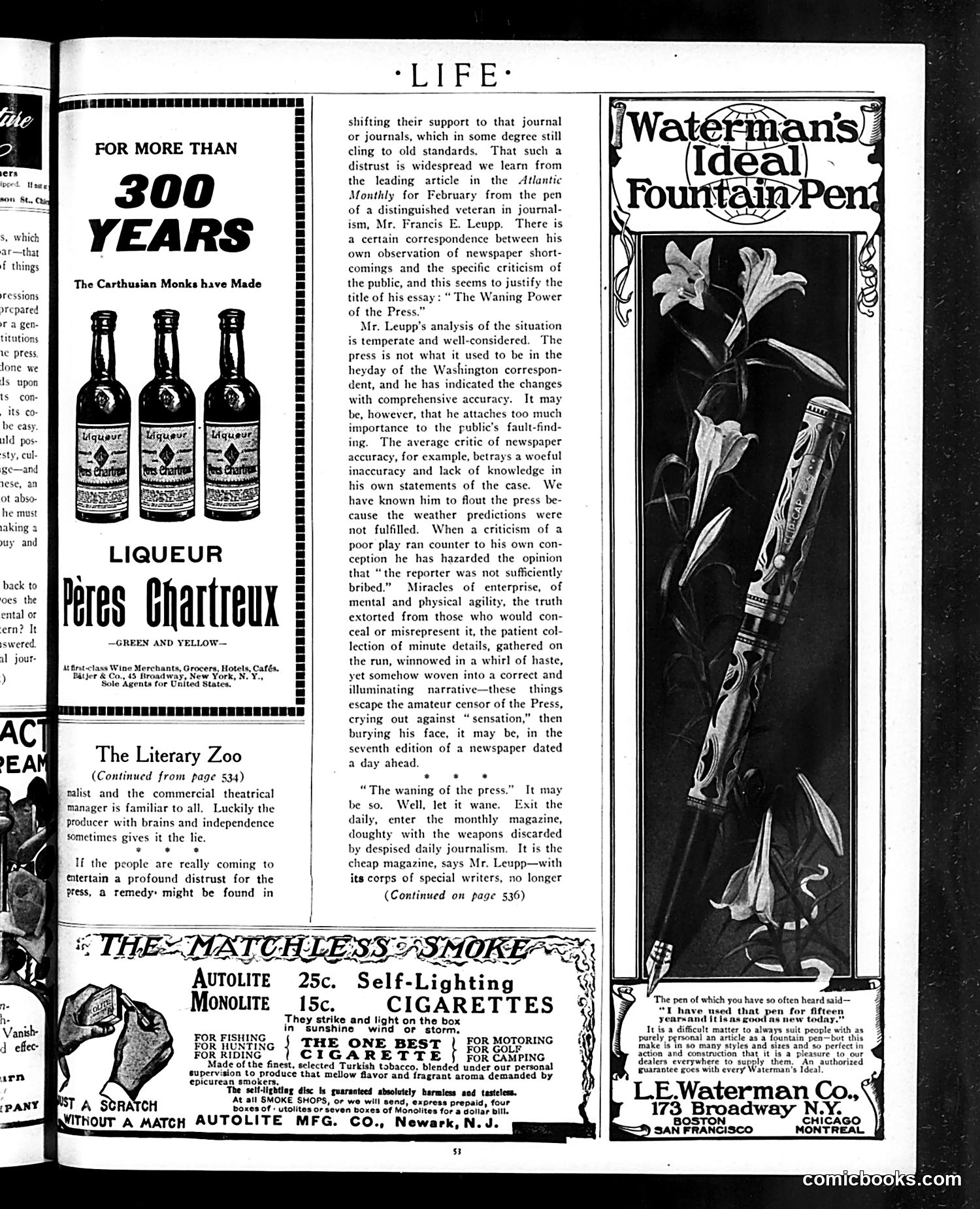
This page primarily contains **editorial commentary** on the "waning power of the press" rather than satirical cartoons. The main text discusses Francis E. Leupp's Atlantic Monthly article criticizing American newspapers for declining standards and accuracy. The piece defends journalists against amateur critics who lack understanding of reporting's complexity—noting that people complain about weather predictions or "sensation" while reading sensationalized stories themselves. The author argues newspapers perform remarkable feats of fact-gathering and narrative construction that casual readers overlook. The **advertisements** are period-typical: Carthusian Monks liqueur (300+ years old), Autolite Monolite self-lighting cigarettes, and Waterman's Ideal fountain pens. These ads exemplify early 20th-century magazine revenue—luxury goods marketed to educated readers. The page reflects contemporary debate about **press credibility and public trust**, concerns that remain relevant today.
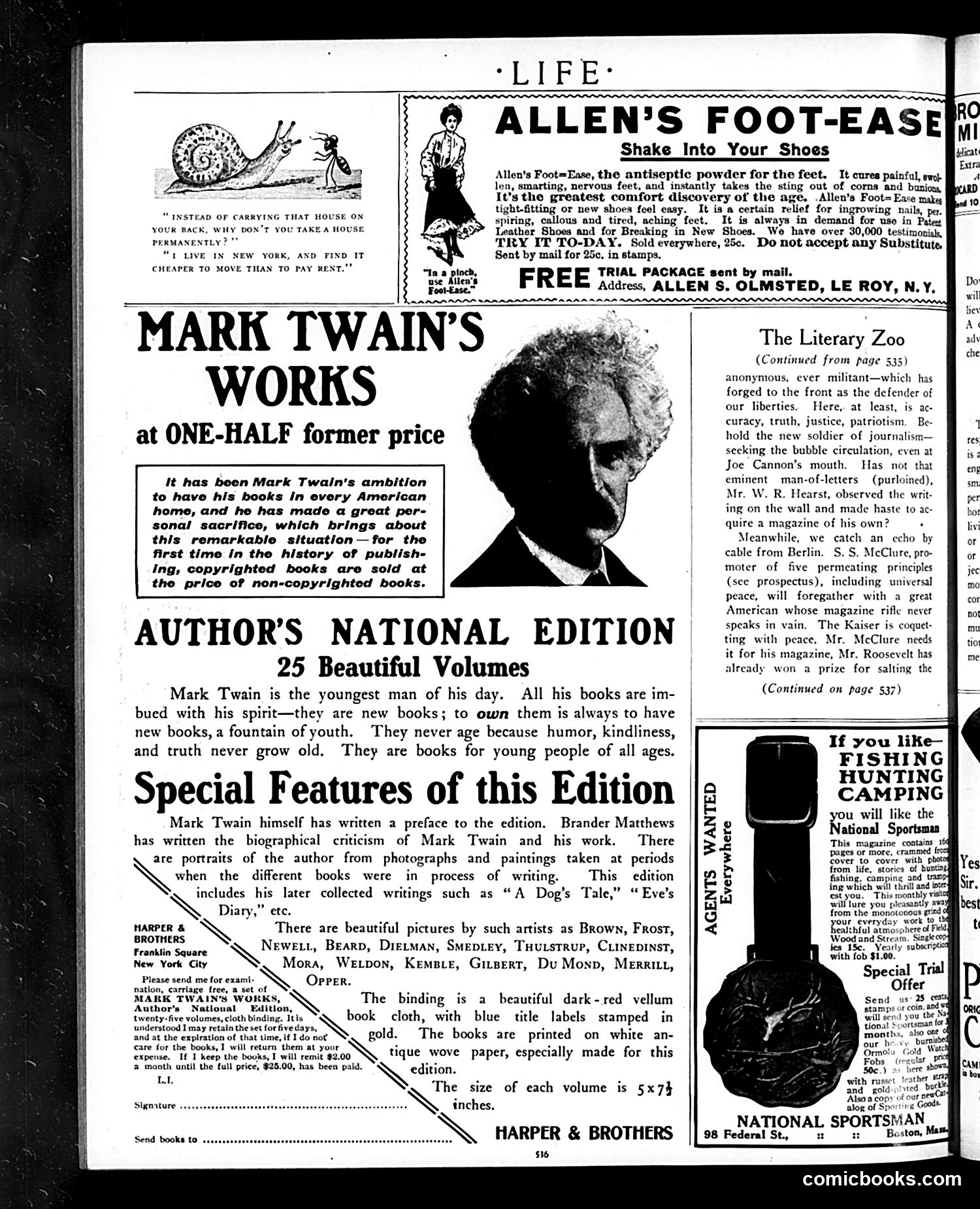
This page is primarily **advertising and publisher promotion**, not satire or political commentary. The dominant feature is a **Mark Twain book promotion** by Harper & Brothers, announcing an "Author's National Edition" of 25 volumes at half the former price. The copy claims this is historically significant—the first time copyrighted books were sold at non-copyrighted prices. The portrait shown is **Mark Twain himself**. The page also includes a small **cartoon at top left** depicting a snail, with dialogue about moving to New York being cheaper than paying rent—this is a mild joke about housing costs, not political satire. The remaining advertisements include **Allen's Foot-Ease** (a foot powder) and the **National Sportsman** magazine. There is a sidebar titled "The Literary Zoo" discussing anonymous journalists and references to figures like **Joe Cannon** and **W.R. Hearst**, but this appears to be editorial content from another article, not directly related to the page's primary advertising purpose. This is fundamentally a **commercial/promotional page**, not a political cartoon page.
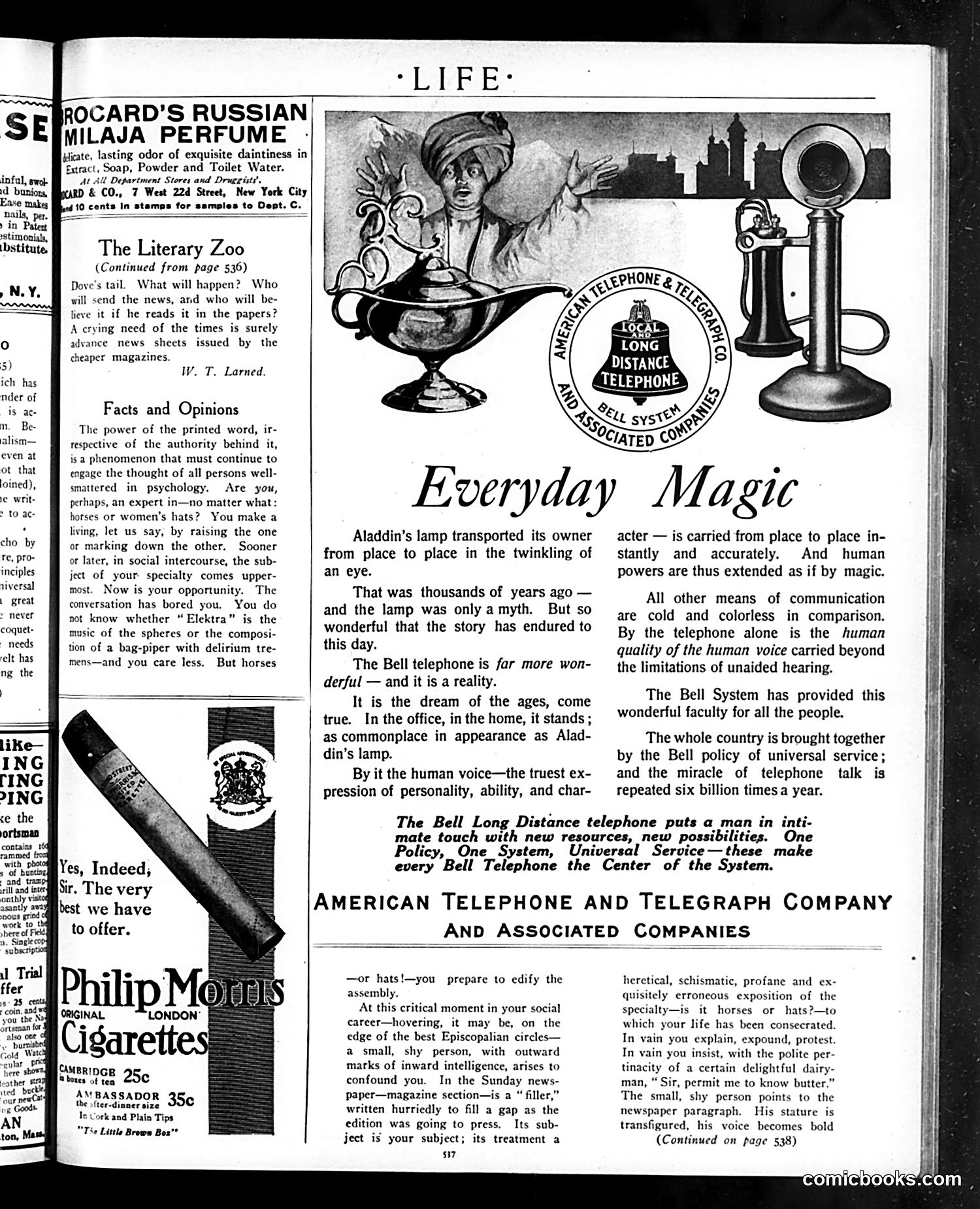
This page is primarily a **Bell System telephone advertisement** disguised as editorial content. The central image depicts Aladdin's lamp alongside modern telephone equipment, establishing the advertisement's central metaphor: the telephone is the modern equivalent of magical wish-fulfillment. The text compares the Bell telephone to Aladdin's legendary lamp—both supposedly miraculous devices that transcend normal limitations. However, the telephone is "far more wonderful" because it's *real*, not mythical. The advertisement emphasizes the telephone's ability to transmit "the human voice" across distances, making it seem like magic extended to ordinary people. Surrounding this are cigarette and perfume ads, plus "The Literary Zoo" column mocking social pretension—a humorous contrast to the serious advertising pitch beside it. The message: Bell's "Universal Service" policy brings magical communication within reach of all Americans.
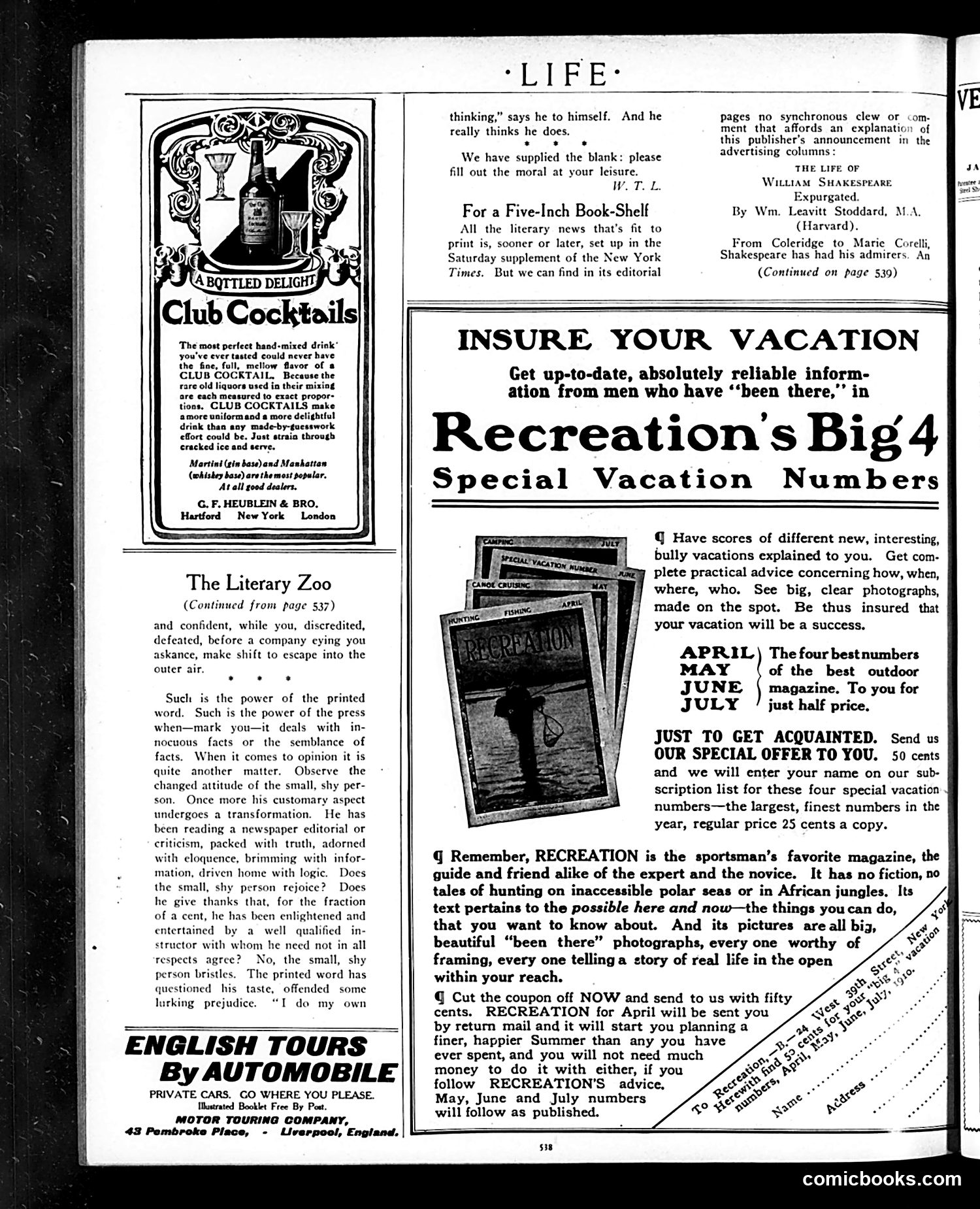
This page is primarily **advertising and literary content** rather than political satire. The main elements are: **"The Literary Zoo" column** (left): Discusses how printed words—particularly newspapers and editorials—affect people's behavior. It notes that shy, quiet individuals often become defensive when reading opinion pieces, bristling at challenges to their taste rather than appreciating enlightenment. The point is satirical commentary on how people react to media criticism. **Advertisements**: The page features ads for Club Cocktails (pre-mixed drinks), English automobile tours, and Recreation magazine's vacation guides. These reflect early 20th-century leisure and consumer culture. **"The Life of William Shakespeare Expurgated"**: A brief notice advertising an expurgated (censored) edition of Shakespeare by William Leavitt Stoddard, sardonically noting that even Shakespeare has "admirers"—likely mocking Victorian prudishness about the Bard's content. The page doesn't contain specific political cartoons or caricatures requiring historical context beyond understanding early 1900s consumer advertising and attitudes toward literature.
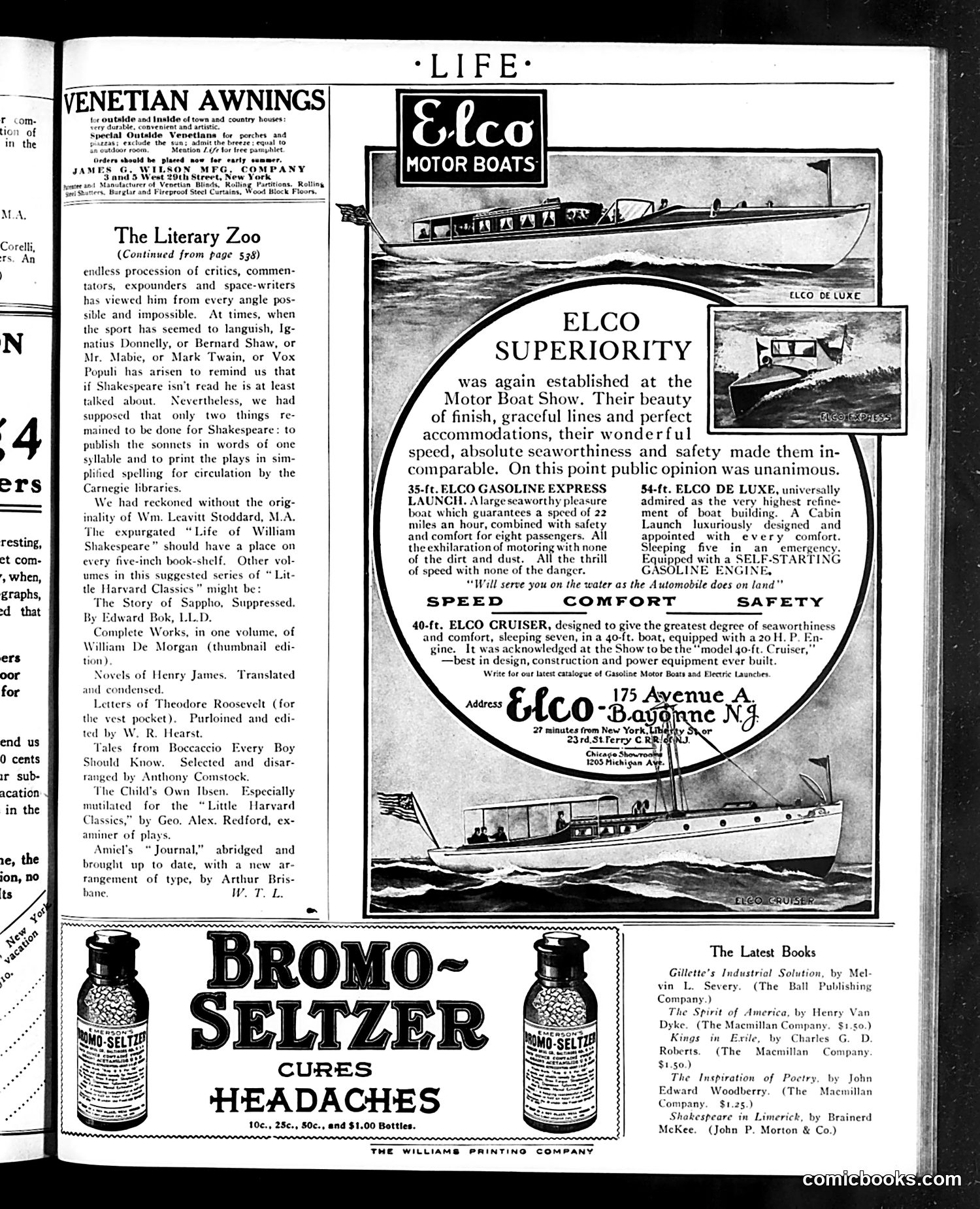
This page is primarily **advertising and book reviews**, not political satire. The main content is a lengthy article titled "The Literary Zoo," which satirizes the endless critical commentary surrounding Shakespeare. The text mocks how various public figures—Ignatius Donnelly, Bernard Shaw, Mark Twain—periodically emerge to comment on Shakespeare, and suggests absurd new expurgated and simplified editions could be published (like "The Story of Sappho, Suppressed" or "Shakespeare in Limerick"). The right side features large advertisements for **Elco Motor Boats**, emphasizing their superiority in design, speed, comfort, and safety—typical early 1900s marketing language. Below is an advertisement for **Bromo-Seltzer** headache remedy. The bottom section lists recent books, including works by Henry Van Dyke and Charles G.D. Roberts. The satire here is literary and cultural, not political—poking fun at Shakespeare scholarship and academic pretension rather than contemporary political figures or events.
This appears to be a **Life magazine advertisement page from March 24, 1910**, displayed upside-down in the scan. The visible content shows a product advertisement for **Crystal Domino Sugar**, featuring: - A box of the sugar product displayed prominently - Text reading "Best Sugar for Tea and Coffee" - Marketing copy indicating "2 lb. Packages" and "25¢" - Wooden crate/barrel imagery in the background Rather than political satire or social commentary, **this is a straightforward commercial advertisement** typical of early 20th-century Life magazine content. The page demonstrates how period magazines mixed editorial content with full-page product ads. The rustic, textured background styling was common design for food product advertisements of that era, suggesting quality and natural origins.