
Life, 1910-03-24 · page 29 of 44
Life — March 24, 1910 — page 29: what you’re looking at
What you’re looking at
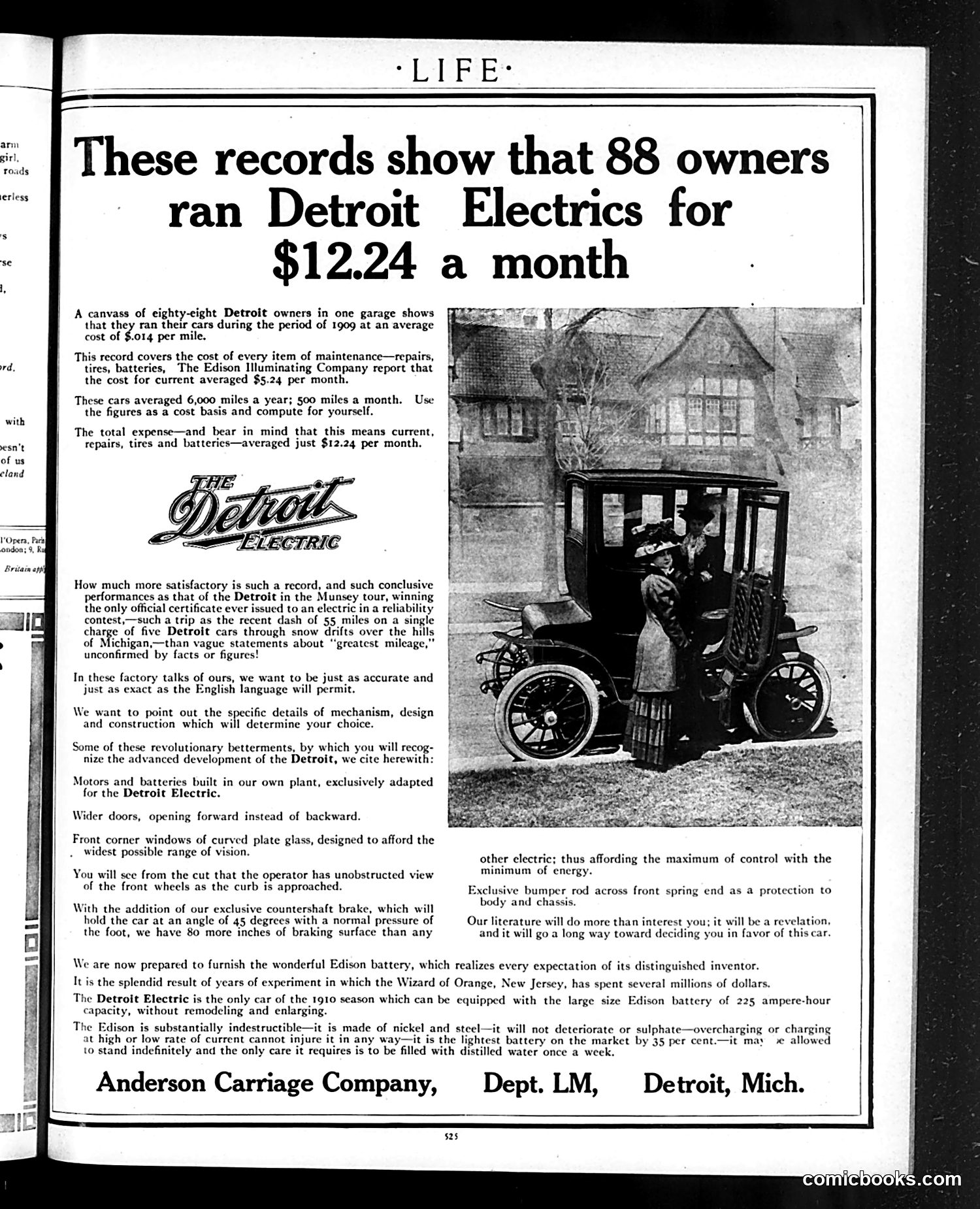
This is primarily a **product advertisement**, not satire or political commentary. The Anderson Carriage Company promotes the Detroit Electric automobile by presenting statistical evidence of low operating costs ($12.24/month based on 88 actual owners' records). The advertisement appeals to early-1900s consumers by emphasizing **reliability and economy** over vague marketing claims. It references specific achievements: winning the only official reliability certificate for an electric vehicle and a documented 55-mile winter drive through Michigan snow. The pitch highlights technical innovations (wider doors, curved windows for visibility, exclusive braking system) and notably the **Edison battery**—named for Thomas Edison ("Wizard of Orange, New Jersey")—as a revolutionary, indestructible component exclusive to Detroit Electrics. The photograph shows a well-dressed woman operating the vehicle, suggesting the car's ease of use and appeal to affluent female drivers of the era. This represents early electric vehicles' niche market before gasoline engines dominated.
📄 Transcribed text from this page (OCR, searchable)
Machine-transcribed from the original scan — historical spelling and the odd misread are preserved.
arn girl, roads erless with esn't of us cland "Opera, Par} ondoa; 9, R These records show that 88 owners ran Detroit Electrics for $12.24 a month A canvass of eighty-eight Detroit owners in one garage shows that they ran their cars during the period of 1909 at an average cost of $.014 per mile. This record covers the cost of every item of maintenance—repairs, tires, batteries, The Edison Illuminating Company report that the cost for current averaged $5.24 per month. These cars averaged 6,000 miles a year; 500 miles a month. Use the figures as a cost basis and compute for yourself. The total expense—and bear in mind that this means current, repairs, tires and batterics—averaged just $12.24 per month. How much more satisfactory is such a record, and such conclusive performances as that of the Detroit in the Munsey tour, winning the only official certificate ever issued to an electric in a reliability contest,—such a trip as the recent dash of 55 miles on a single charge of five Detroit cars through snow drifts over the hills of Michigan—-than vague statements about “greatest mileage,” unconfirmed by facts or figures! In these factory talks of ours, we want to be just as accurate and just as exact as the English language will permit. We want to point out. the specific details of mechanism, design and construction which will determine your choice. Some of these revolutionary betterments, by which you will recog- nize the advanced development of the Detroit, we cite herewith: Motors and batteries built in our own plant, exclusively adapted for the Detroit Electric. Wider doors, opening forward instead of backward. Front corner windows of curved plate glass, designed to afford the widest possible range of vision. You will sce from the cut that the operator has unobstructed view of the front wheels as the curb is approached. With the addition of our exclusive countershaft brake, which will hold the car at an angle of 45 degrees with a normal pressure of the foot, we have 80 more inches of braking surface than any other electric; thus affording the maximum of control with the minimum of energy. Exclusive bumper rod across front spring end as a protection to body and chassis. Our literature will do more than interest you; it will be a revelation, and it will go a long way toward deciding you in favor of this car. We are now prepared to furnish the wonderful Edison battery, which realizes every expectation of its distinguished inventor. It is the splendid result of years of experiment in which the Wizard of Orange, New Jersey, has spent several millions of dollars. The Detroit Electric is the only car of the 1910 season which can be equipped with the large size Edison battery of 225 ampere-hour capacity, without remodeling and enlarging. The Edison is substantially indestructible—it is made of nickel and stcel—it will not deteriorate or sulphate—overcharging or charging at high or low rate of current cannot injure it in any way— to stand indefinitely and the only care it requires is to be filled Anderson Carriage Company, s the lightest battery on the market by 35 per cent.—it may allowed ith distilled water once a week. Dept. LM Detroit, Mich.