
Life, 1910-03-24 · page 10 of 44
Life — March 24, 1910 — page 10: what you’re looking at
What you’re looking at
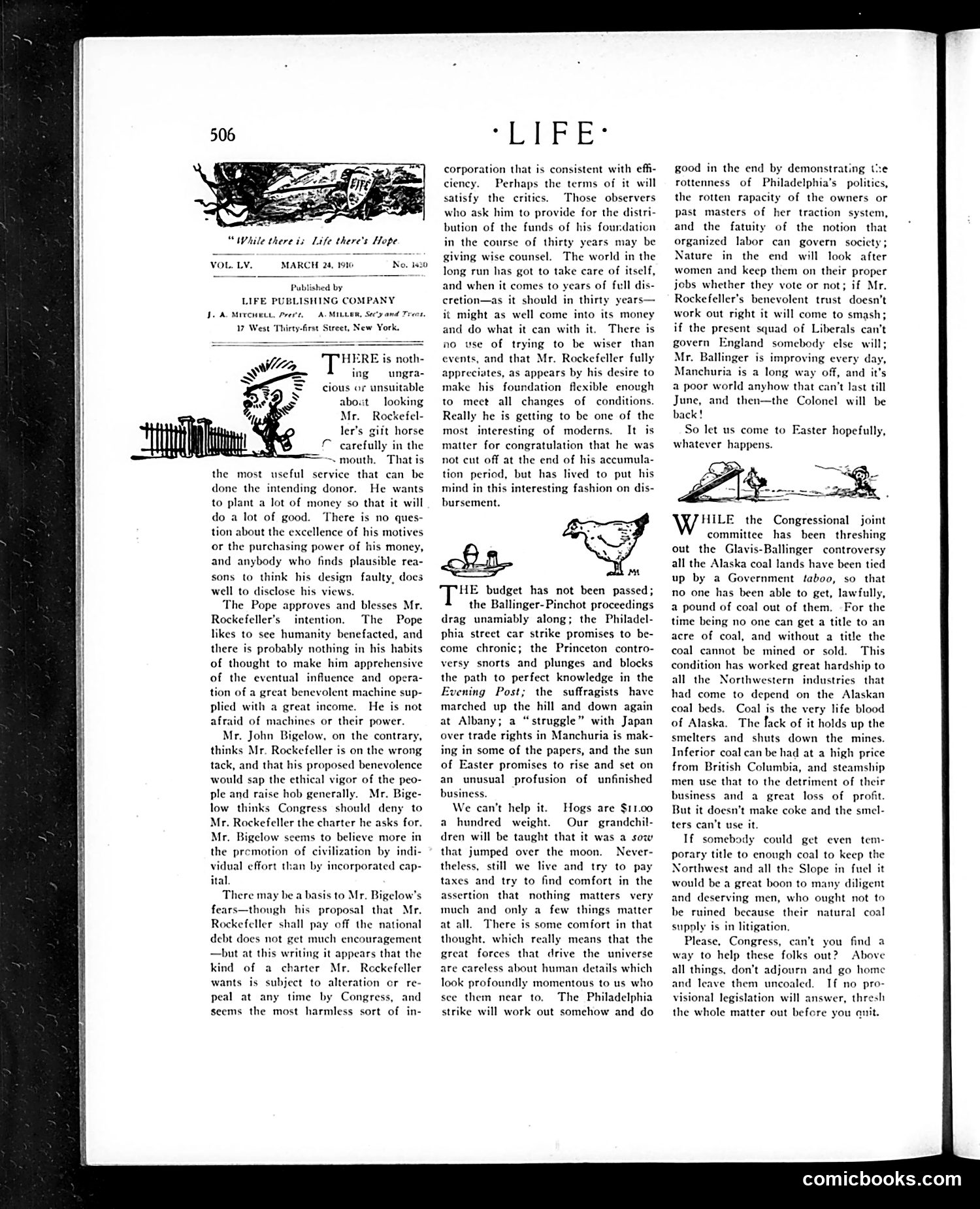
This page contains editorial commentary on contemporary issues rather than cartoons. The main topics discussed are: 1. **Mr. Rockefeller's foundation** - The writer defends Rockefeller's charitable intentions against critics demanding he explain his wealth distribution plans over thirty years. 2. **Various political controversies** - Including the Glavis-Ballinger Alaska coal lands scandal, Philadelphia street-car strikes, Princeton controversies, and trade disputes with Japan over Manchuria. 3. **Social issues** - References to suffragists, taxes, and labor concerns. The small illustrations (a fence scene, a chicken) appear decorative rather than specific satirical cartoons. The piece takes a somewhat centrist stance, defending Rockefeller while acknowledging legitimate public concerns about monopolies and labor conditions.
📄 Transcribed text from this page (OCR, searchable)
Machine-transcribed from the original scan — historical spelling and the odd misread are preserved.
“While there is Life there's Hope No. 1820 VOL. LY. MARCH 24, 1916 ublished by SHING COMPANY ALM eet, New York. LIFE PUBL J. A Mirren KEL, Pree. 17 West Thirty-frst R, Sec'y and Trees. ing — ungra- cious of unsuitable about looking Mr. Rockefel- ler’s gift horse carefully in the ~ mouth. That is the most useful service that can be done the intending donor. He wants to plant a lot of money so that it will do a lot of good. There is no ques- i tion about the excellence of his motives or the purchasing power of his money, and anybody who finds plausible rea- sons to think his design faulty, docs well to disclose his views. The Pope approves and blesses Mr. Rockefeller’s intention. The Pope likes to see humanity benefacted, and there is probably nothing in his habits of thought to make him apprehensive of the eventual influence and opera- tion of a great benevolent machine sup- plied with a great income. He is not afraid of machines or their power. Mr. John Bigelow, on the contrary, thinks Mr. Rockefeller is on the wrong tack, and that his proposed benevolence would sap the ethical vigor of the peo- ple and raise hob generally. Mr. Bige- low thinks Congress should deny to Mr. Rockefeller the charter he asks for. Mr. Bigelow seems to believe more in the promotion of civilization by indi- vidual effort than by incorporated cap- ital. There may be a basis to Mr. Bigelow’s fears—though his proposal that Mr. Rockefeller shall pay off the national debt does not get much encouragement —but at this writing it appears that the kind of a charter Mr. Rockefeller wants is subject to alteration or re- peal at any time by Congress, and seems the most harmless sort of in- ge Oe als corporation that is consistent with effi- ciency. Perhaps the terms of it will satisfy the critics. Those observers who ask him to provide for the distri- bution of the funds of his foundation in the course of thirty years may be giving wise counsel. The world in the long run has got to take care of itself, and when it comes to years of full dis- cretion—as it should in thirty years— it might as well come into its money and do what it can with it. There is no use of trying to be wiser than events, and that Mr. Rockefeller fully appreciates, as appears by his desire to make his foundation flexible enough to meet all changes of conditions. Really he is getting to be one of the most interesting of moderns. It is matter for congratulation that he was not cut off at the end of his accumula- tion period, but has lived to put his mind in this interesting fashion on dis- bursement. «fis HE budget has not been passed; the Ballinger-Pinchot proceedings drag unamiably along; the Philadel- phia street car strike promises to be- come chronic; the Princeton contro- versy snorts and plunges and blocks the path to perfect knowledge in the ening Post; the suffragists have marched up the hill and down again at Albany; a “struggle” with Japan over trade rights in Manchuria is mak- ing in some of the papers, and the sun of Easter promises to rise and set on an unusual profusion of unfinished business. We can’t help it. Hogs are $11.00 a hundred weight. Our grandchil- dren will be taught that it was a sow that jumped over the moon. Never- theless, still we live and try to pay taxes and try to find comfort in the assertion that nothing matters very much and only a few things matter at all. There is some comfort in that thought, which really means that the great forces that drive the universe are careless about human details which look profoundly momentous to us who sce them near to, The Philadelphia strike will work out somehow and do Bh mt good in the end by demonstrating tre rottenness of Philadelphia’s politics, the rotten rapacity of the owners or past masters of her traction system, and the fatuity of the notion that organized labor can govern society; Nature in the end will look after women and keep them on their proper jobs whether they vote or not; if Mr. Rockefeller’s benevolent trust doesn’t work out right it will come to smash; if the present squad of Liberals can't govern England somebody else will; Mr. Ballinger is improving every day, Manchuria is a long way off, and it’s a poor world anyhow that can’t last till June, and then—the Colonel will be back! So let us come to Easter hopefully, whatever happens. HILE the Congressional joint committee has been threshing out the Glavis-Ballinger controversy all the Alaska coal lands have been tied up by a Government taboo, so that no one has been able to get, lawfull a pound of coal out of them. For the time being no one can get a title to an acre of coal, and without a title the coal cannot be mined or sold. This condition has worked great hardship to all the Northwestern industries that had come to depend on the Alaskan coal beds. Coal is the very life blood of Alaska. The fack of it holds up the smelters and shuts down the mines. Inferior coal can be had at a high price from British Columbia, and steamship men use that to the detriment of their business and a great loss of profit. But it doesn’t make coke and the smel- ters can’t use it. If somebody could get even tem- porary title to enough coal to keep the Northwest and all the Slope in fuel it would be a great boon to many diligent and deserving men, who ought not to be ruined because their natural coal supply is in litigation, Please, Congress, can’t you find a way to help these folks out? Above all things, don’t adjourn and go home and leave them uncoaled. If no pro- visional legislation will answer, thresh the whole matter out before you anit. comicbooks.com