
Life, 1910-03-24 · page 12 of 44
Life — March 24, 1910 — page 12: what you’re looking at
What you’re looking at
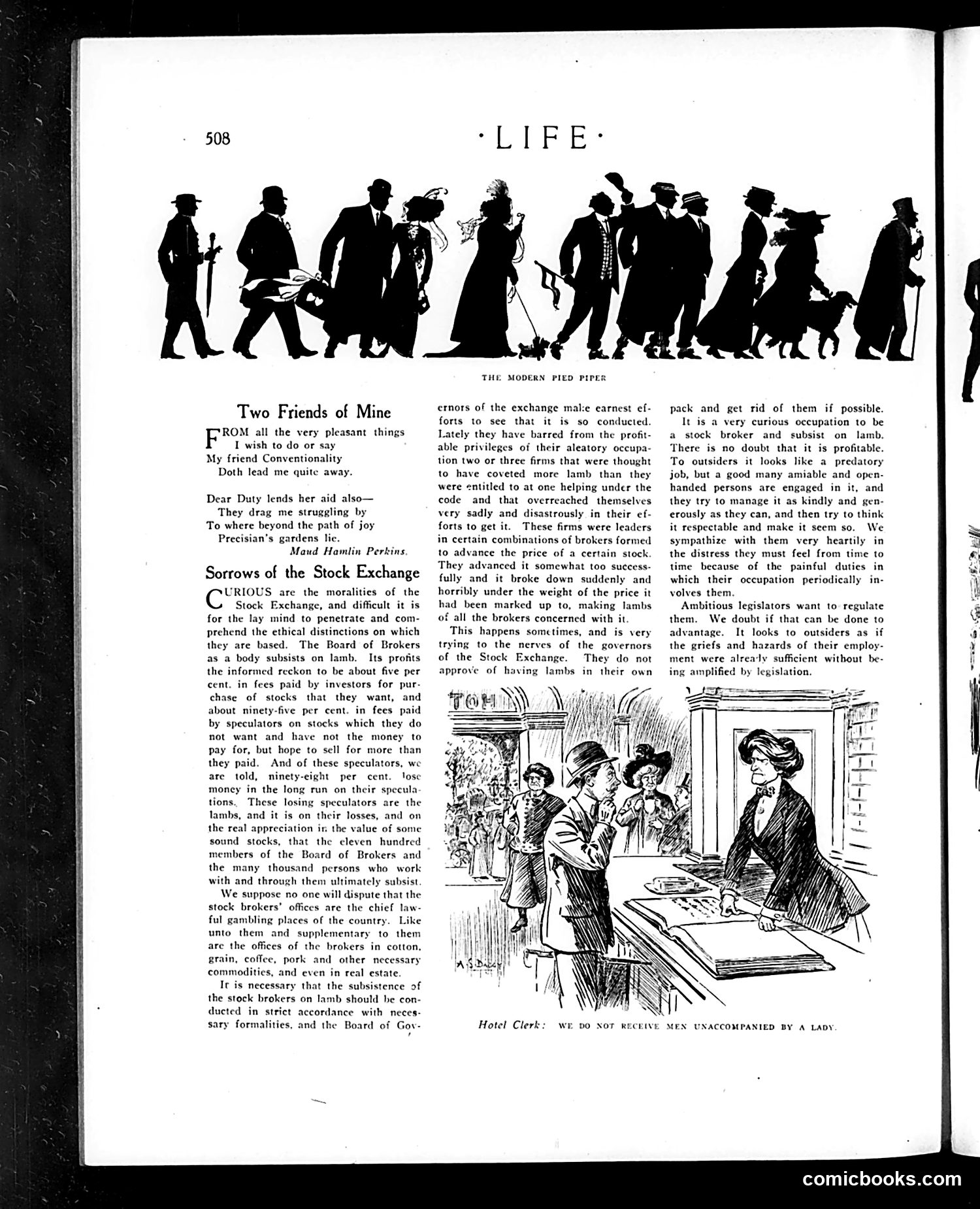
This page contains two satirical pieces about financial markets and social propriety. **"The Modern Pied Piper"** (silhouette illustration at top) appears to reference stock brokers or financial manipulators leading people, though the specific historical reference is unclear without additional context. **"Sorrows of the Stock Exchange"** discusses brokers' difficulties managing client investments, noting their losses and moral hazards—particularly their temptation to engage in improper practices to recover losses. **The cartoon below** shows a hotel clerk refusing entry to an unaccompanied man and woman, captioned "We do not receive men unaccompanied by a lady." This reverses typical period social conventions (when women needed male escorts), satirizing either changing social mores or highlighting hypocrisy around propriety standards. The page critiques both financial impropriety and social double standards of the era.
📄 Transcribed text from this page (OCR, searchable)
Machine-transcribed from the original scan — historical spelling and the odd misread are preserved.
Two Friends of Mine ROM all the very pleasant things I wish to do or say My friend Conventionality Doth lead me quite away. Dear Duty lends her aid also— They drag me struggling by To where beyond the path of joy Precisian’s gardens lic. Maud Hamlin Perkins Sorrows of the Stock Exchange URIOUS are the moralities of the Stock Exchange, and difficult it is for the lay mind to penetrate and com- prehend the ethical distinctions on which they are based. The Board of Brokers as a body subsists on lamb. Its profits the informed reckon to be about five per cent. in fees paid by investors for pur- chase of stocks that they want, and about ninety-five per cent. in fees paid by speculators on stocks which they do not want and have not the money to pay for, but hope to sell for more than they paid. And of these speculators, we are told, ninety-eight per cent. lose money in the long run on their specula tions. These losing speculators are the lambs, and it is on their losses, and on the real appreciation ir: the value of some sound stocks, that the cleven hundred members of the Board of Brokers and the many thousand persons who work with and through them ultimately subsist We suppose no one will dispute that the stock brokers’ offices are the chief law- ful gambling places of the country. Like unto them and supplementary to them are the offices of the brokers in cotton, grain, coffee, pork and other necessary commodities, and even in real estate. It is necessary that the subsistence of the stock brokers on lamb should he con- ducted in strict accordance with neces- sary formalities, and the Board of Gov- THE MODERN PIED PIPER crnors of the exchange male earnest ef- forts to see that it is so conducted. Lately they have barred from the profit- able privileges of their aleatory occupa- tion two or three firms that were thought to have coveted more lamb than they were entitled to at one helping under the code and that overreached themselves very sadly and disastrously in their ef- forts to get it. These firms were leaders in certain combinations of brokers formed to advance the price of a certain stock They advanced it somewhat too success: fully and it broke down suddenly and horribly under the weight of the price it had been marked up to, making lambs of all the brokers concerned with it This happens sometimes, and is very trying to the nerves of the governors of the Stock Exchange. They do not approve of having lambs in their own Hotel Clerk: wer po xor receive pack and get rid of them if possible. It is a very curious occupation to be a stock broker and subsist. on lamb, There is no doubt that it is profitable. To outsiders it looks like a predatory job, but a good many amiable and open- handed persons are engaged in it, and they try to manage it as kindly and gen- erously as they can, and then try to think it respectable and make it seem so. We sympathize with them very heartily in the distress they must feel from time to time because of the painful duties in which their occupation periodically in- volves them. Ambitious legislators want to regulate them. We doubt if that can be done to advantage. It looks to outsiders as if the griefs and hazards of their empl ment were alrealy sufficient without be ing ele by legislation, MEN UNACCOMPANIED BY A LADY comicbooks.com