
Life, 1910-03-24 · page 24 of 44
Life — March 24, 1910 — page 24: what you’re looking at
What you’re looking at
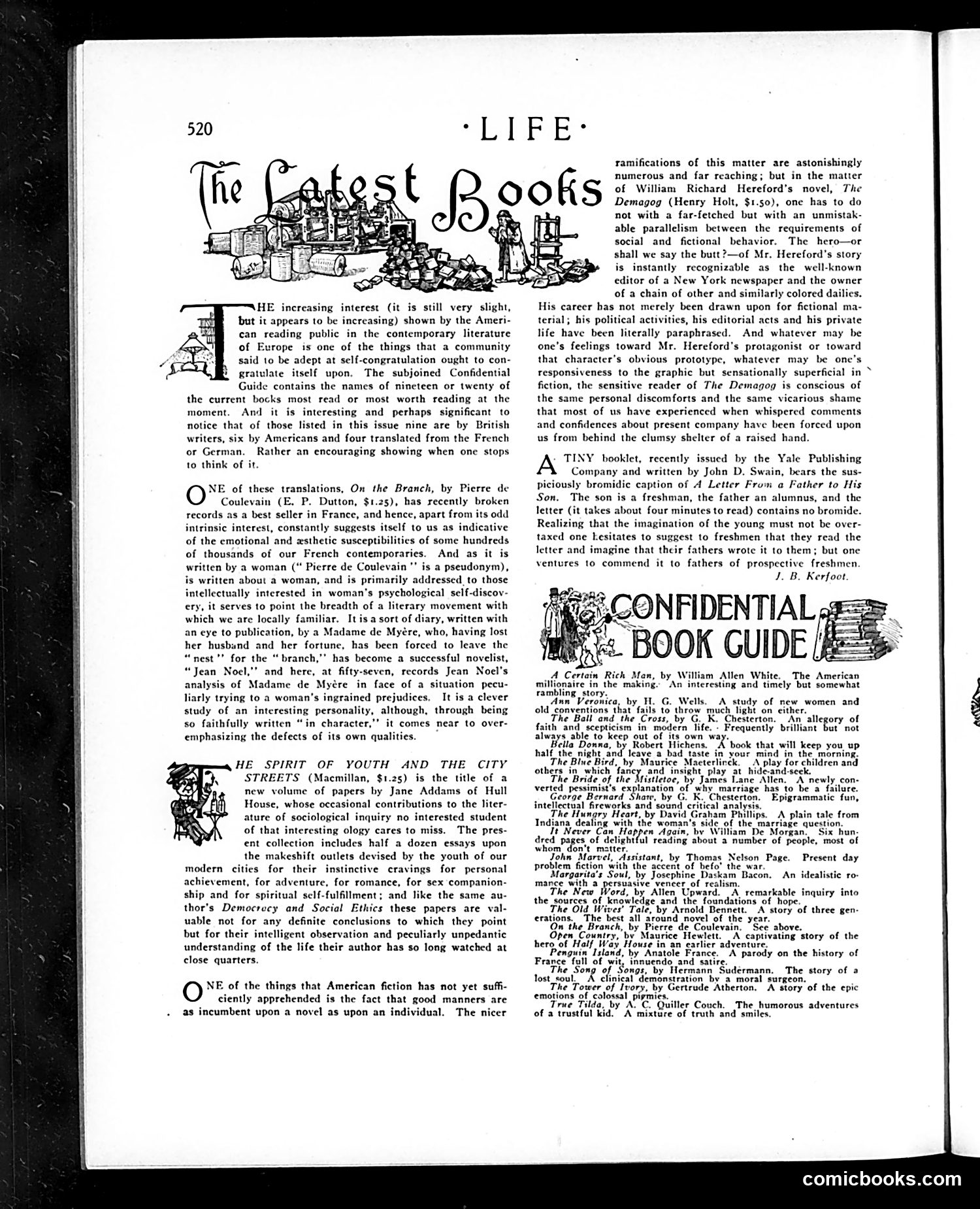
This is a book review section discussing contemporary European and American literature. The page critiques recent novels, including William Richard Hereford's *The Demagog* (Henry Holt, $1.50). The satire targets *The Demagog*, which portrays a thinly-veiled New York newspaper editor and newspaper chain owner. The reviewer criticizes the novel's lack of "good manners"—the author has not disguised his real-life subject but rather "literally paraphrased" the man's actual career, political activities, and private life. This violates fictional decorum: the character is instantly recognizable as an actual person rather than a proper fictional creation. The broader complaint is that American fiction hasn't yet learned that novels require the same courtesy as polite society—you shouldn't directly lampoon identifiable living people. The review treats this as poor literary form rather than libel, emphasizing artistic standards over legal ones.
📄 Transcribed text from this page (OCR, searchable)
Machine-transcribed from the original scan — historical spelling and the odd misread are preserved.
HE increasing interest (it is still very slight, but it appears to be increasing) shown by the Ameri- can reading public in the contemporary literature of Europe is one of the things that a community said to be adept at self-congratulation ought to con- gratulate itself upon. The subjoined Confidential Guide contains the names of nineteen or twenty of the current bocks most read or most worth reading at the moment. And it is interesting and perhaps significant to notice that of those listed in this issue nine are by British writers, six by Americans and four translated from the French or German. Rather an encouraging showing when one stops to think of it. translations, On the Branch, by Pierre de Coulevain (E, P. Dutton, $1.25), has recently broken records as a best seller in France, and hence, apart from its odd trinsic interest, constantly suggests itself to us as indicative of the emotional and xsthetic susceptibilities of some hundreds of thousands of our French contemporaries. And as it is written by a woman (“ Pierre de Coulevain "’ is a pseudonym), is written about a woman, and is primarily addressed. to those intellectually interested in woman's psychological self-discov- ery, it serves to point the breadth of a literary movement with which we are locally familiar. It isa sort of diary, written with an eye to publication, by a Madame de Myére, who, having lost her husband and her fortune, has been forced to leave the “nest '” for the “branch,” has become a successful novelist, “Jean Noel,”’ and here, at fifty-seven, records Jean Noel's analysis of Madame de Myére in face of a situation pecu- liarly trying to a woman's ingrained prejudices. It is a clever study of an interesting personality, although, through being so faithfully written “in character,” it comes near to over- emphasizing the defects of its own qualities. * HE SPIRIT OF YOUTH AND THE CITY STREETS (Macmillan, $1.25) is the title of a new volume of papers by Jane Addams of Hull House, whose occasional contributions to the liter- ature of sociological inquiry no interested student of that interesting ology cares to miss. The pres- ent collection includes half a dozen essays upon the makeshift outlets devised by the youth of our modern cities for thcir instinctive cravings for personal achievement, for adventure, for romance, for sex companion- ship and for spiritual self-fulfillment; and like the same au- thor's Democrocy and Social Ethics these papers are val- uable not for any definite conclusions to which they point but for their intelligent observation and peculiarly unpedantic understanding of the life their author has so long watched at close quarters. NE of the things that American fiction has not yet suffi- ciently apprehended is the fact that good manners are as incumbent upon a novel as upon an individual. The nicer ramifications of this matter are astonishingly numerous and far reaching; but in the matter of William Richard Hereford’s novel, The Demagog (Henry Holt, $1.50), one has to do not with a far-fetched but with an unmistak- able parallelism between the requirements of social and fictional behavior. The hero—or shall we say the butt?—of Mr. Hereford’s story is instantly recognizable as the well-known editor of a New York newspaper and the owner of a chain of other and similarly colored dailies. His career has not merely been drawn upon for fictional ma- his political activities, his editorial acts and his private life have been literally paraphrased. And whatever may be one’s feelings toward Mr. Hereford’s protagonist or toward that character's obvious prototype, whatever may be one’s responsiveness to the graphic but sensationally superficial in fiction, the sensitive reader of The Demagog is conscious of the same personal discomforts and the same vicarious shame that most of us have experienced when whispered comments and confidences about present company have been forced upon us from behind the clumsy shelter of a raised hand. A TINY booklet, recently issued by the Yale Publishing Company and written by John D, Swain, bears the sus- piciously bromidic caption of A Letter From a Father to His Son. The son is a freshman, the father an alumnus, and the letter (it takes about four minutes to read) contains no bromide. Realizing that the imagination of the young must not be over- taxed one kesitates to suggest to freshmen that they read the letter and imagine that their fathers wrote it to them; but one ventures to commend it to fathers of prospective freshmen J. B. Kerfoot A Certain Rich Man, by William Allen White. The American millionaire in the making» An interesting and timely but somewhat rambling. story. ‘Ann Veronica, by H. G. Wells. A study of new women and old conventions that fails to throw much light on either. The Ball and the Cross, by G. K. Chesterton. An allegory of faith and. scepticism in modern life. Frequently. brilliant but’ not always able to keep out of its own way. fella Donna, by Robert Hichens. A book that will keep you up half the night and leave a bad taste in your mind in the morning. The Bine Bird, by Maurice Macterlirek. _\ play for children and others in which fancy and insight play at hide-and-seek. The Bride of the Mistletoe, by James Lane Allen. A newly con verted pessimist’s explanation ‘of why marriage has to be a failure. «George Bernard Share, by G. K. Chesterton. Epigrammatic fun, intellectual fireworks and sound critical analysis. The Hunary Heart, by David Graham Phillips. A plain tale from Indiana dealing with the woman's side of the marriage question, Jt Never Can Happen Again, by William De Morgan. Six hun. dred pages, of delightful reading about a number of people, most of whom don’t mstter. John Marvel, Assistant, by Thomas Nelson Page. problem fiction with the accent of hefo' the war. Margarita’s Soul, by Josephine Daskam Bacon. An idealistic ro- mance with a persuasive veneer of realism. The New Word, by Allen Upward. A remarkable inquiry into the sources of knowledge and the foundations of hope. The Old Wives’ Tale, by Arnold Bennett. A story of three gen- erations. The best all around novel of the year. Qn the Branch, by Pierre de Coulevain. See above. Open Country, by Maurice Hewlett. A captivating story of the hero of Half Way House in an earlier adventure. Penguin Island, by Anatole France. A parody on the history of France full of wit, innuendo and satire. The Song of Sonos, by Hermann Sudérmann. | The story of 2 lost_soul. clinical demonstration by a moral surgeon. The Tower of Ivory, by Gertrude Atherton. A story of the epic emotions of colossal pipmics. True Tilda, by A. C. Quiller Couch. The humorous adventures of a trustful kid. A mixture of truth and smiles Present day comicbooks.com