
Life, 1910-03-24 · page 21 of 44
Life — March 24, 1910 — page 21: what you’re looking at
What you’re looking at
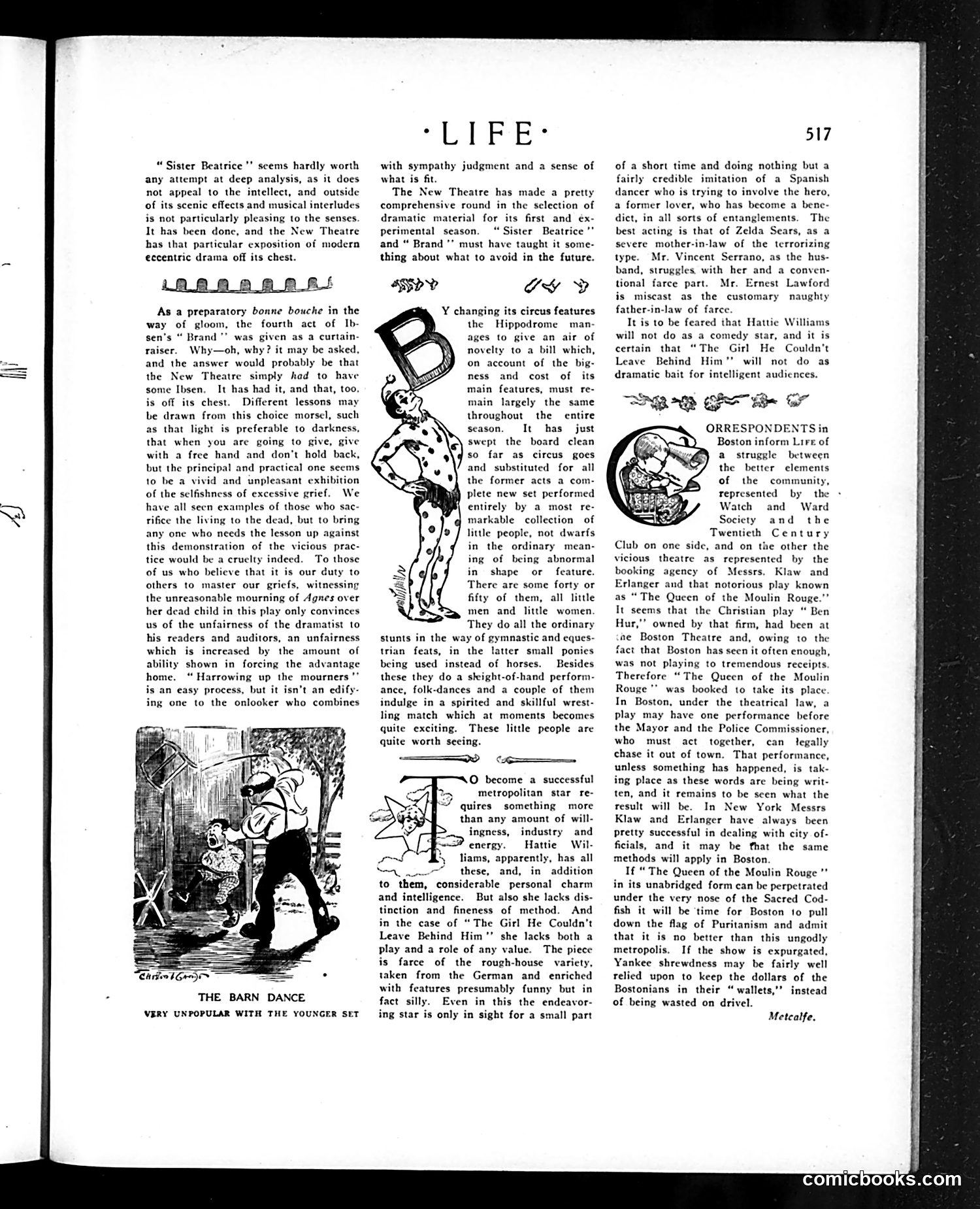
This page contains three theater reviews. The critic dismisses the New Theatre's production of "Sister Beatrice" as shallow entertainment lacking intellectual merit, though visually competent. He criticizes their programming choice of Ibsen's "Brand" as a curtain-raiser, arguing it depicts "unreasonable mourning" that punishes audiences rather than edifies them. The Hippodrome review praises their circus revamp featuring "little people" (approximately 40-50 performers of short stature, distinguished from dwarfs) performing standard gymnastics, equestrian stunts, folk-dances, and wrestling—proving entertainingly novel despite the venue's limited budget flexibility. The final review critiques actress Hattie Williams's performance in "The Girl He Couldn't Leave Behind Him," a German farce deemed silly. While acknowledging Williams possesses charm and intelligence, the critic faults her lack of "distinction and fineness of method" and notes she has minimal stage time in a mediocre vehicle.
📄 Transcribed text from this page (OCR, searchable)
Machine-transcribed from the original scan — historical spelling and the odd misread are preserved.
“ Sister Beatrice "’ scems hardly worth any attempt at deep analysis, as it does not appeal to the intellect, and outside of its scenic effects and musical interludes is not particularly pleasing to the senses. It has been done, and the New Theatre has that particular exposition of modern eccentric drama off its chest. As a preparatory bonne bouche in the way of gloom, the fourth act of Ib- sen's “ Brand "” was given as a curtain- raiser. Why—oh, why? it may be asked, and the answer would probably be that the New Theatre simply had to have some Ibsen. It has had it, and that, too, is off its chest. Different lessons may be drawn from this choice morsel, such as that light is preferable to darkness, that when you are going to give, give with a free hand and don’t hold back, but the principal and practical one seems to be a vivid and unpleasant exhibition of the selfishness of excessive grief. We have all secn examples of those who sac- rifice the living to the dead, but to bring any one who needs the lesson up against this demonstration of the vicious prac- tice would be a cruelty indeed. To those of us who believe that it is our duty to others to master our griefs, witnessing the unreasonable mourning of Agnes over her dead child in this play only convinces us of the unfairness of the dramatist to his readers and auditors, an unfairness which is increased by the amount of ability shown in forcing the advantage home. “Harrowing up the mourners" is an easy process, but it isn’t an edify: ing one to the onlooker who combines THE BARN DANCE VERY UNPOPULAR WITH THE YOUNGER SET “LIFE: with sympathy judgment and a sense of what is fit. The New Theatre has made a pretty comprehensive round in the selection of dramatic material for its first and éx- perimental season. “Sister Beatrice ”* and “ Brand "* must have taught it some- thing about what to avoid in the future. oy Y Y changing its circus features the Hippodrome man- ages to give an air of novelty to a bill which, on account of the big- ness and cost of its main features, must re- main largely the same throughout the entire season. It has just swept the board clean so far as circus goes and substituted for all the former acts a com- plete new set performed entirely by a most re- markable collection of little people, not dwarfs in the ordinary mean- ing of being abnormal in shape or feature. There are some forty or fifty of them, all little men and little women. They do all the ordinary stunts in the way of gymnastic and eques- trian feats, in the latter small ponies being used instead of horses. Besides these they do a sheight-of-hand perform- ance, folk-dances and a couple of them indulge in a spirited and skillful wrest- ling match which at moments becomes quite exciting. These little people are quite worth seeing. © become a successful metropolitan star re- / quires something more than any amount of will- ingness, industry and energy. Hattie Wil- liams, apparently, has all we these, and, in addition to them, considerable personal charm and intelligence. But also she lacks dis- tinction and fineness of method. And in the case of “The Girl He Couldn't Leave Behind Him’ she lacks both a play and a role of any value. The piece is farce of the rough-house variety, taken from the German and enriched with features presumably funny but in fact silly. Even in this the endeavor- ing star is only in sight for a small part SV 517 of a short time and doing nothing but a fairly credible imitation of a Spanish dancer who is trying to involve the hero, a former lover, who has become a bene- dict, in all sorts of entanglements. The best acting is that of Zelda Sears, as a severe mother-in-law of the terrorizing type. Mr. Vincent Serrano, as the hus- band, struggles. with her and a conven- tional farce part. Mr. Ernest Lawford is miscast as the customary naughty father-in-law of farce. It is to be feared that Hattie Williams will not do as a comedy star, and it is certain that “The Girl He Couldn't Leave Behind Him’ will not do as dramatic bait for intelligent audiences. SARA ORR ORRESPONDENTS in Boston inform Lire of a struggle between the better elements of the community, represented by the Watch and Ward Society and the Twentieth Century Club on one side, and on the other the vicious theatre as represented by the booking agency of Messrs. Klaw and Erlanger and that notorious play known as “The Queen of the Moulin Rouge.” It seems that the Christian play “Ben Hur," owned by that firm, had been at te Boston Theatre and, owing to the fact that Boston has seen it often enough, was not playing to tremendous receipts. Therefore “The Queen of the Moulin Rouge " was booked to take its place In Boston, under the theatrical law, a play may have one performance before the Mayor and the Police Commissioner, who must act together, can legally chase it out of town. That performance, unless something has happened, is tak- ing place as these words are being writ- ten, and it remains to be scen what the result will be. In New York Messrs Klaw and Erlanger have always been pretty successful in dealing with city of- ficials, and it may be that the same methods will apply in Boston. If “The Queen of the Moulin Rouge "* in its unabridged form can be perpetrated under the very nose of the Sacred Cod- fish it will be ‘time for Boston to pull down the flag of Puritanism and admit that it is no better than this ungodly metropolis. If the show is expurgated, Yankee shrewdness may be fairly well relied upon to keep the dollars of the Bostonians in their “ wallets,”’ instead of being wasted on drivel. Metcalfe. comicbooks.com