
Life, 1910-03-24 · page 18 of 44
Life — March 24, 1910 — page 18: what you’re looking at
What you’re looking at
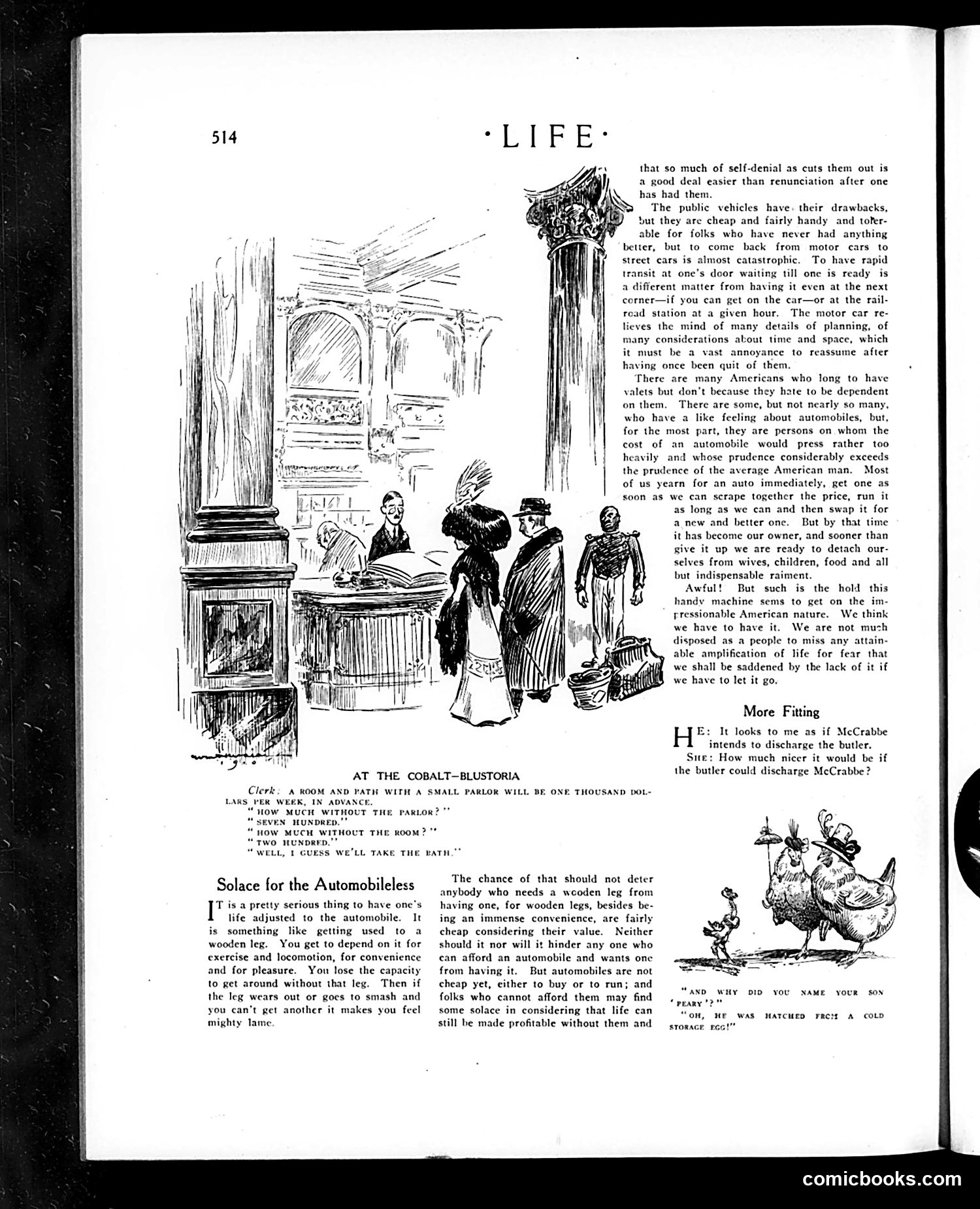
This page satirizes American attitudes toward automobiles and consumer culture in the early 20th century. **Main Articles:** The dominant text discusses how owning an automobile becomes psychologically addictive—Americans become so dependent on cars that giving them up feels worse than never having owned one. The piece argues we'll sacrifice family, food, and necessities rather than lose our vehicles, calling this "the hold this handy machine seems to get on the impressionable American nature." **Cartoons:** "At the Cobalt-Blustoria" shows a hotel clerk negotiating room prices downward, ultimately choosing just a bath—satirizing budget consciousness and declining standards. "More Fitting" depicts a butler discharge scenario, with the joke being that servants might discharge their employers instead, reversing power dynamics. "Solace for the Automobileless" compares life without a car to being disabled by a missing wooden leg—you become crippled without it. Yet the author notes automobiles aren't cheap, so the poor must find consolation that life remains "profitable" without them. The humor targets middle-class anxiety about status symbols and dependency on modern conveniences.
📄 Transcribed text from this page (OCR, searchable)
Machine-transcribed from the original scan — historical spelling and the odd misread are preserved.
that so much of self-denial as cuts them out is a good deal easier than renunciation after one has had them. The public vehicles have. their drawbacks, but they are cheap and fairly handy and tofer- able for folks who have never had anything better, but to come back from motor cars to street cars is almost catastrophic. To have rapid transit at one’s door waiting till one is ready is a different matter from having it even at the next corner—if you can get on the car—or at the rail- road station at a given hour. The motor car re- lieves the mind of many details of planning, of many considerations aout time and space, which it must be a vast annoyance to reassume after having once been quit of them. There are many Americans who long to have valets but don’t because they hate to be dependent on them. There are some, but not nearly so many, who have a like feeling about automobiles, but, for the most part, they are persons on whom the cost of an automobile would press rather too heavily and whose prudence considerably exceeds the prudence of the average American man. Most of us yearn for an auto immediately, get one as soon as we can scrape together the price, run it as long as we can and then swap it for a new and better one. But by that time it has become our owner, and sooner than give it up we are ready to detach our- selves from wives, children, food and all but indispensable raiment. Awful! But such is the hold this handy machine sems to get on the im- rressionable American nature. We think we have to have it. We are not much disposed as a people to miss any attain- able amplification of life for fear that we shall be saddened by the lack of it if More Fitting E: It looks to me as if McCrabbe intends to discharge the butler. Sue: How much nicer it would be if butle id dis ? AT THE COBALT-BLUSTORIA the butler could discharge McCrabbe ? Clerk: & ROOM AND VATH WITH A SMALL PARLOR WILL BE ONE THOUSAND DOL~ LARS VER WEEK, IN ADVANCE. “HOW MUCH WITHOUT TIE PARLOR?" “SEVEN HUNDRED.” “ Wow MUCH WITHOUT THE Room? "* “Two DRED." “WELL, 1 GUESS WE'LL TAKE THE BATH.” The chance of that should not deter Solace for the Automobileless .yicuy who needs a wooden leg from T is a pretty serious thing to have one’s life adjusted to the automobile. It is something like getting used to a wooden leg. You get to depend on it for exercise and locomotion, for convenience and for pleasure. You lose the capacity to get around without that leg. Then if the leg wears out or goes to smash and you can’t get another it makes you feel mighty lame. having one, for wooden legs, besides be- ing an immense convenience, are fairly cheap conside value. Neither should it nor will it hinder any one who can afford an automobile and wants one from having it. But automobiles are not cheap yet, either to buy or to run; and folks who cannot afford them may find some solace in considering that life can still he made profitable without them and “AND WHY DID you * reary '?"" “on, Me was sTosace Foc!” NAME YOUR SON MATCHED FRC!t A COLD comicbooks.com