
Life, 1910-03-24 · page 20 of 44
Life — March 24, 1910 — page 20: what you’re looking at
What you’re looking at
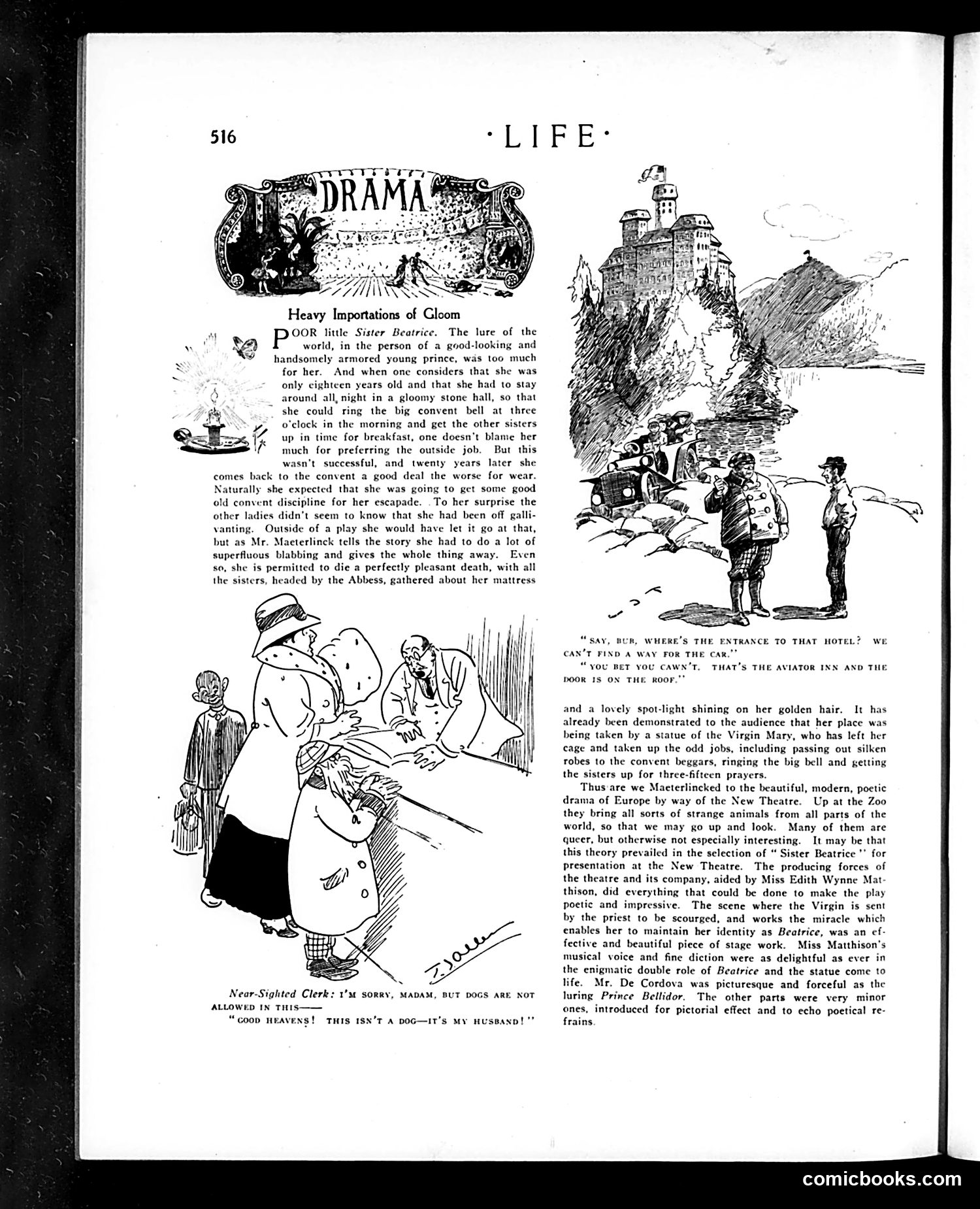
This page reviews Maurice Maeterlinck's play "Sister Beatrice" at the New Theatre. The main critique uses a zoo metaphor: just as zoos display exotic animals from around the world for curiosity rather than inherent interest, the New Theatre imports European "poetic drama" the same way—presenting something culturally prestigious but not necessarily compelling. The plot synopsis describes a nun who abandons convent life for a prince, returns twenty years later corrupted, but receives forgiveness and a pleasant death—all while a statue of the Virgin Mary mysteriously performs her duties. Three cartoon vignettes satirize unrelated modern absurdities: a near-sighted clerk denying a dog entry (claiming it's the customer's husband), drivers unable to find the Aviator Inn because "the door is on the roof," and a castle scene with lost tourists. The review praises actress Edith Wynne Matthison's performance but suggests the play itself, despite theatrical effort, remains more curiosity than art—imported Continental pretension rather than genuine drama.
📄 Transcribed text from this page (OCR, searchable)
Machine-transcribed from the original scan — historical spelling and the odd misread are preserved.
Heavy Importations of Gloom OOR little Sister Beatrice. The lure of the world, in the person of a good-looking and handsomely armored young prince, was too much for her. And when one considers that she was only cightcen years old and that she had to stay around all, night in a gloomy stone hall, so that she could ring the big convent bell at three J, o'clock in the morning and get the other sisters QF. % up in time for breakfast, one doesn’t blame her 'K much for preferring the outside job. But this wasn’t successful, and twenty years later she comes back to the convent a good deal the worse for wear. Naturally she expected that she was going to get some good old convent discipline for her escapade. .To her surprise the other ladies didn’t seem to know that she had been off galli- vanting. Outside of a play she would have let it go at that, but as Mr. Macterlinck tells the story she had to do a lot of superfiuous blabbing and gives the whole thing away. Even so, she is permitted to die a perfectly pleasant death, with all the sisters, headed by the Abbess, gathered about her mattress “Say, BUR, WHERE'S THE ENTRANCE TO THAT HOTEL? WE. CAN'T FIND A WAY FOR THE CaR,”” “You BET YOU CAWN’T. THAT'S THE AVIATOR INN AND THE DOOR 18 ON THE ROOF.” and a lovely spot-light shining on her golden hair. It has already been demonstrated to the audience that her place was being taken by a statue of the Virgin Mary, who has left her cage and taken up the odd jobs, including passing out silken robes to the convent beggars, ringing the big bell and getting the sisters up for three-fifteen prayers. Thus-are we Macterlincked to the beautiful, modern, poetic drama of Europe by way of the New Theatre. Up at the Zoo they bring all sorts of strange animals from all parts of the world, so that we may go up and look. Many of them are queer, but otherwise not especially interesting. It may be that this theory prevailed in the selection of “ Sister Beatrice "’ for presentation at the New Theatre. The producing forces of the theatre and its company, aided by Miss Edith Wynne Mat- thison, did everything that could be done to make the play poetic and impressive. The scene where the Virgin is sent by the priest to be scourged, and works the miracle which enables her to maintain her identity as Beatrice, was an ef fective and beautiful piece of stage work. Miss Matthison’s musical voice and fine diction were as delightful as ever in the enigmatic double role of Beatrice and the statue come to life. Mr. De Cordova was picturesque and forceful as the Near-Sighted Clerk: 1's sorry, MADAM, BUT DOGS ARE NoT luring Prince Bellidor. The other parts were very minor ALLOWED IN THIs—— ones, introduced for pictorial effect and to echo poetical re- “ coop IKAVE "TA poG—It's MY HUSBAND!’ frains comicbooks.com