
A complete issue · 68 pages · 1907
Life — December 5, 1907
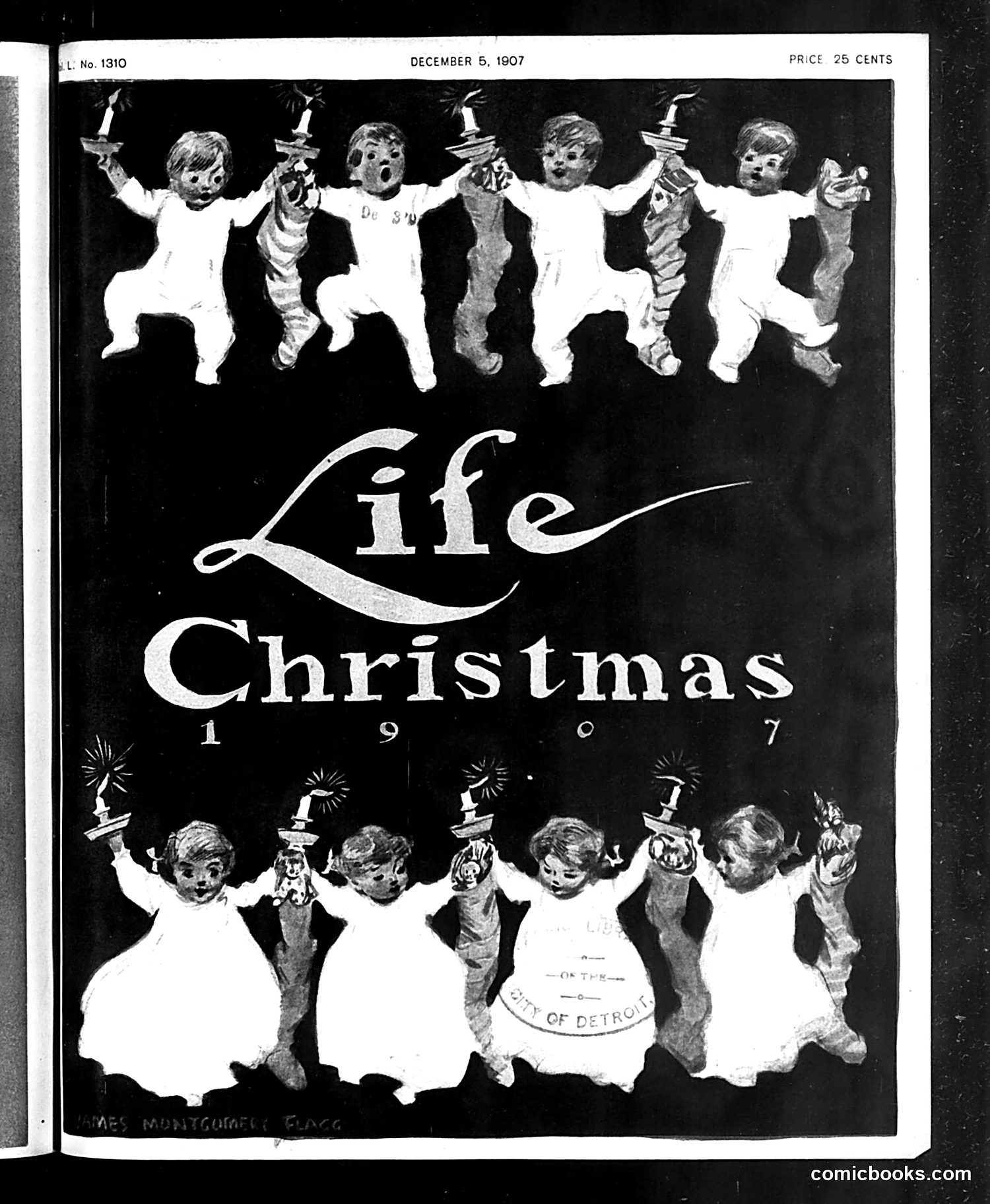
This is a **Life magazine Christmas cover** from December 5, 1907 (No. 1310, 25 cents). The image features cherubic baby figures—appearing as animated cherubs or putti—arranged in two rows. The babies wear white garments and hold lit candles, creating a festive, celebratory composition. The design is purely **decorative and seasonal**, with no apparent political satire. The "Life Christmas 1907" text and year markers anchor the holiday theme. One baby appears to wear a Detroit city seal, suggesting possible local interest. This appears to be a **straightforward holiday cover** rather than satirical commentary—typical of Life's occasional turn toward whimsical, non-political festive content during the Christmas season.
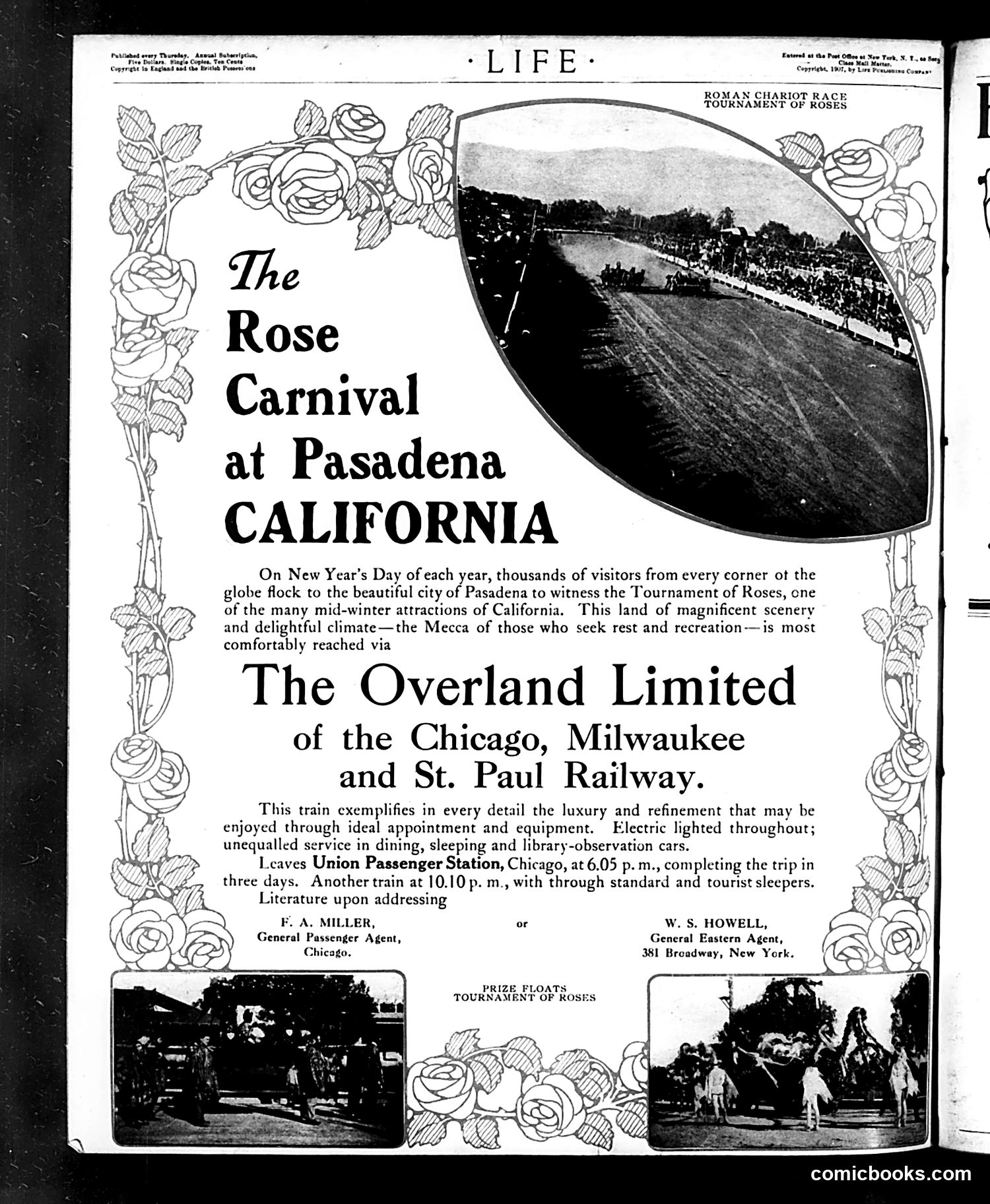
This page is **primarily an advertisement**, not satirical content. It promotes "The Overland Limited" train service operated by the Chicago, Milwaukee and St. Paul Railway, encouraging travelers to visit Pasadena, California for the Tournament of Roses on New Year's Day. The decorative rose border and three photographs (showing the chariot race, prize floats, and tournament scenes) are marketing images meant to entice potential passengers. The text emphasizes the train's luxury amenities—dining cars, sleeping cars, library observation cars—and provides contact information for booking. There is no political satire or social commentary on this page. It represents early 20th-century advertising that leveraged *Life* magazine's circulation to promote rail travel and tourism.
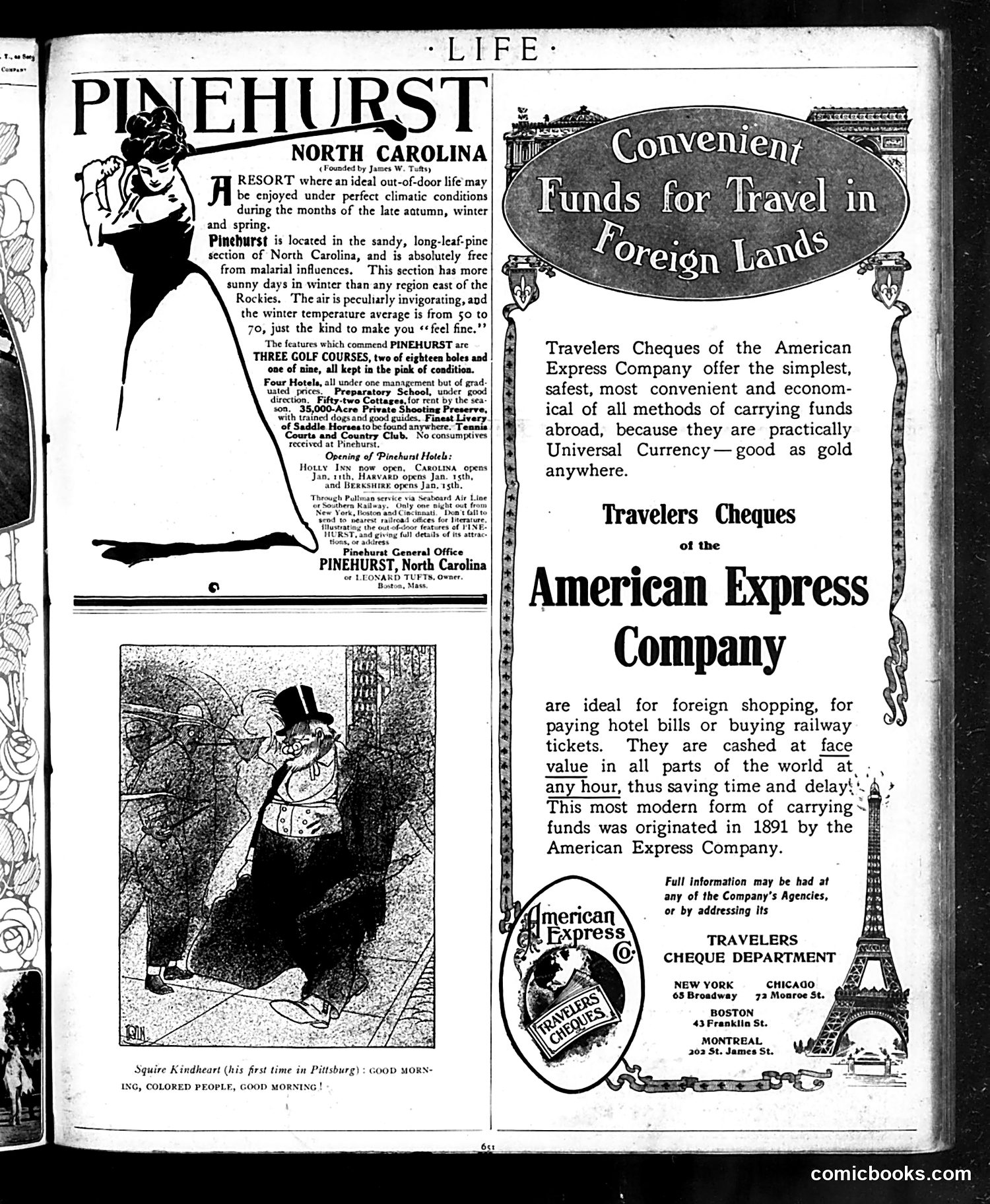
This page contains two distinct elements: a Pinehurst, North Carolina resort advertisement on the left, and an American Express Travelers Cheques advertisement on the right. The left includes a cartoon captioned "Squire Kindheart (his first time in Pittsburg): GOOD MORNING, COLORED PEOPLE, GOOD MORNING!" This depicts a well-dressed gentleman greeting Black pedestrians with exaggerated formality. The satire targets upper-class affectation and possibly condescension toward working-class or marginalized people. The "first time in Pittsburgh" suggests the character is a naive outsider unfamiliar with urban norms, making his overly-formal greeting appear ridiculous. The right page is primarily advertising travel services, not editorial content.
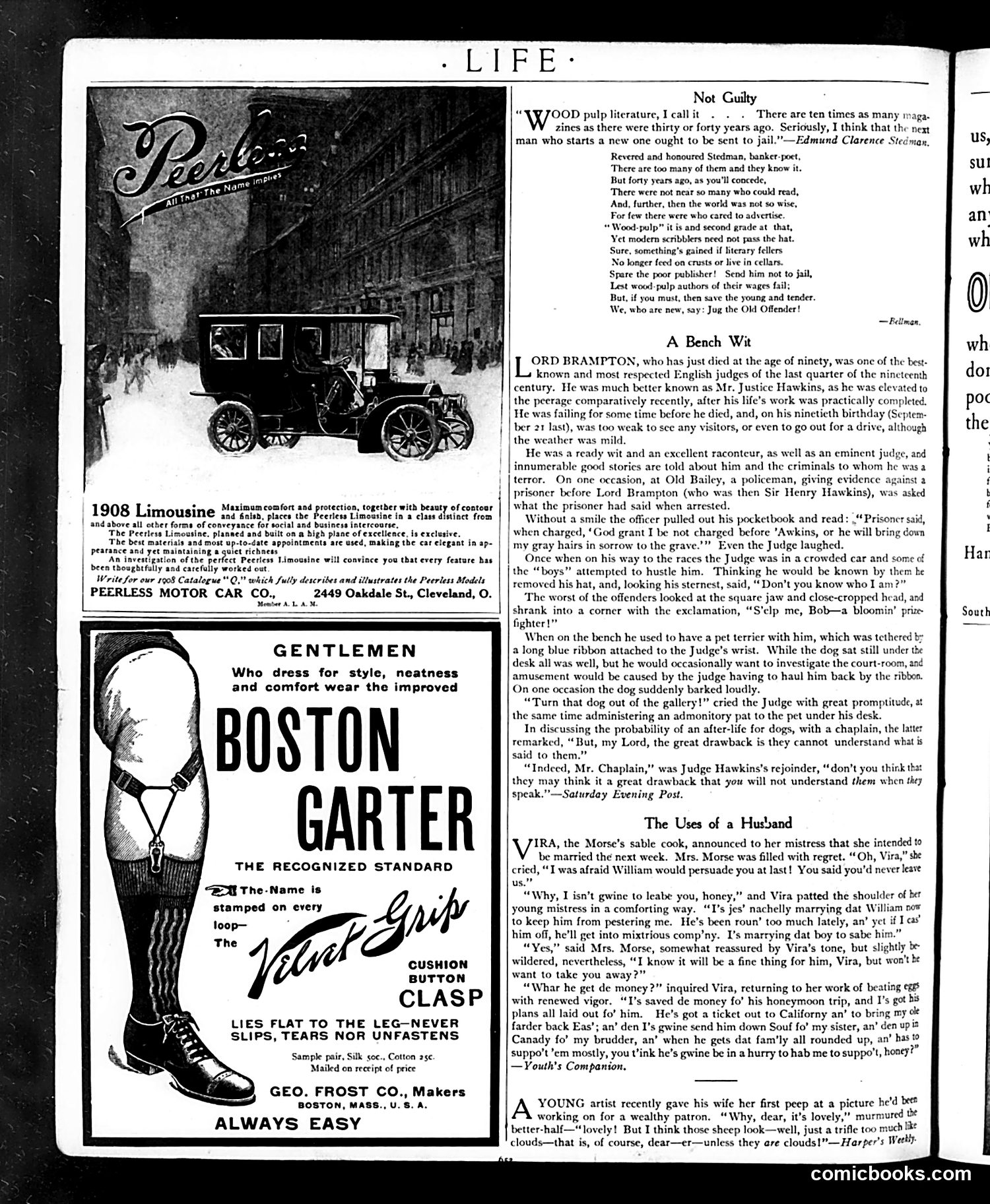
This page is primarily **advertising and humor columns** rather than political satire. The left side features ads for a 1908 Peerless Motor Car and Boston Garter hosiery. The right side contains three humor pieces: "Not Guilty" (a poem defending "wood pulp literature" against critics), "A Bench Wit" (an anecdote about Lord Brampton, a respected 19th-century English judge known for witty courtroom remarks and his pet terrier), and "The Uses of a Husband" (domestic humor about a cook named Vira planning marriage). These pieces reflect **turn-of-the-century genteel humor** targeting middle-class readers—satirizing pretension, marital dynamics, and class anxieties rather than engaging in political commentary.
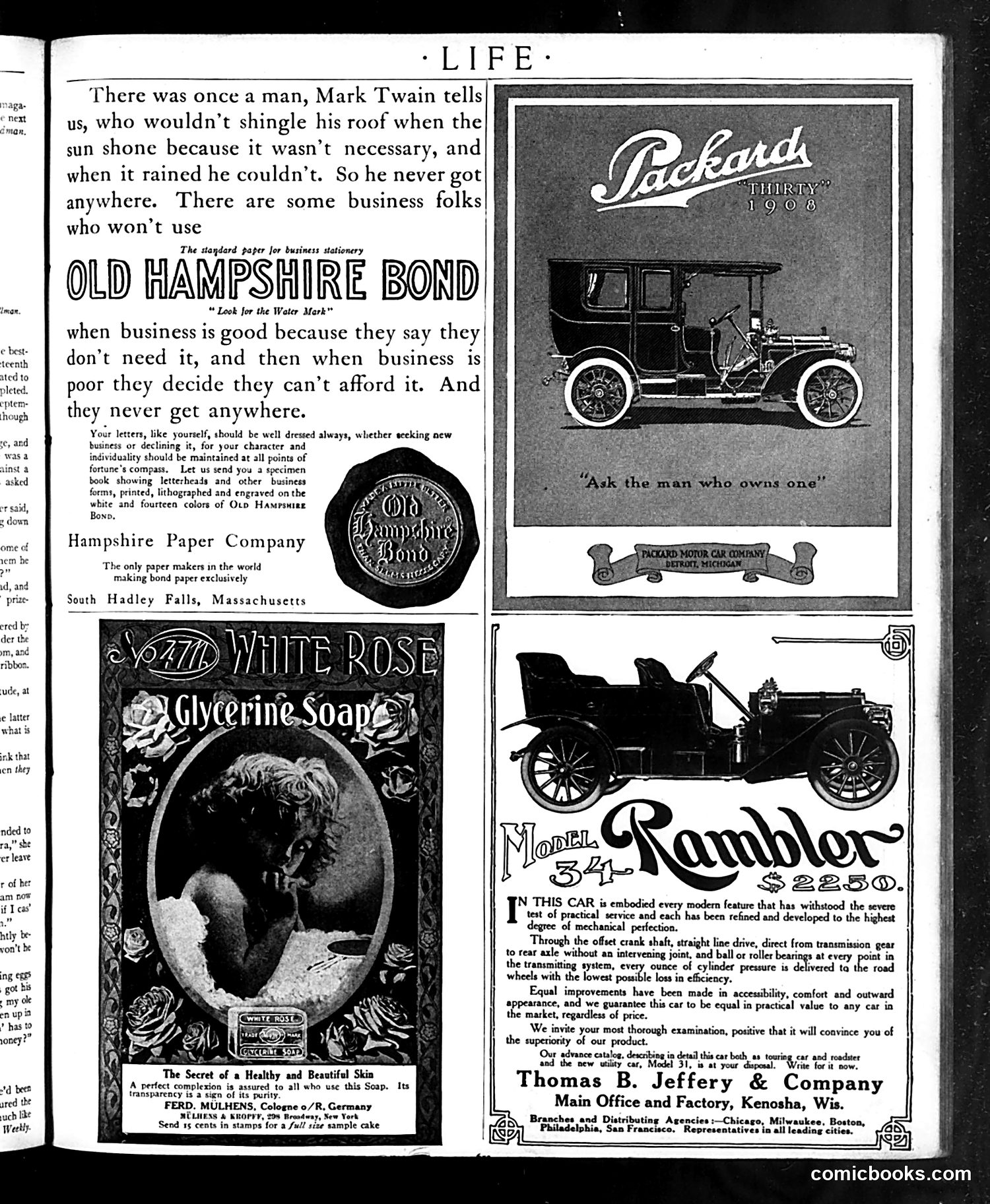
This page is **primarily advertising** rather than political satire. The dominant content includes ads for: - **Old Hampshire Bond** paper (with a Mark Twain anecdote about procrastination) - **White Rose Glycerine Soap** (featuring a classical bust) - **Packard automobile** (1908 model) - **Rambler automobile** (Model 34, priced at $2,250) The Twain story criticizes businessmen who procrastinate unnecessarily—avoiding action when conditions are perfect, then claiming inability when circumstances change, thereby "never getting anywhere." This serves as a metaphorical pitch for Hampshire Bond paper as a tool for decisive business communication. The automobile advertisements reflect the early 1900s automotive boom, showcasing luxury cars to affluent Life magazine readers. There is **no political cartoon or satirical commentary** on this particular page.
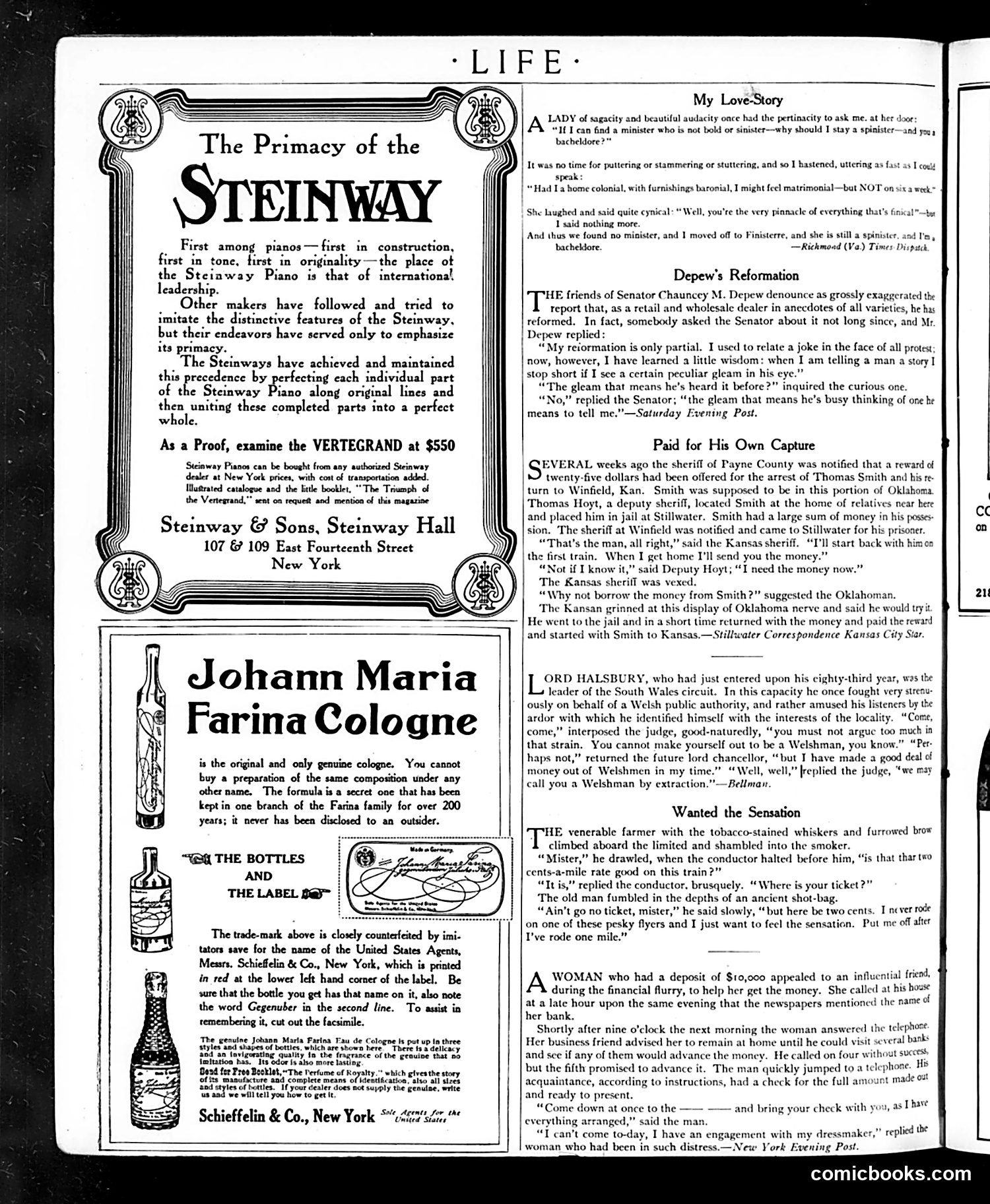
This page is primarily **advertising and satirical stories** rather than political cartoons. The main content includes: 1. **Steinway Piano advertisement** - promoting the brand's primacy in piano manufacturing 2. **Johann Maria Farina Cologne ad** - claiming originality and trade-mark authenticity 3. **Satirical short stories** with titles like "My Love-Story," "Depew's Reformation," "Paid for His Own Capture," and "Wanted the Sensation" The stories appear to be humorous anecdotes mocking various social situations—romantic misadventures, political reformations, and absurd predicaments. One story references "Senator Chauncey M. Depew," likely the real Gilded Age politician and orator, used here for satirical effect. The page reflects Life magazine's typical mix of **consumer advertising and gentle social satire** targeting middle-class readers.
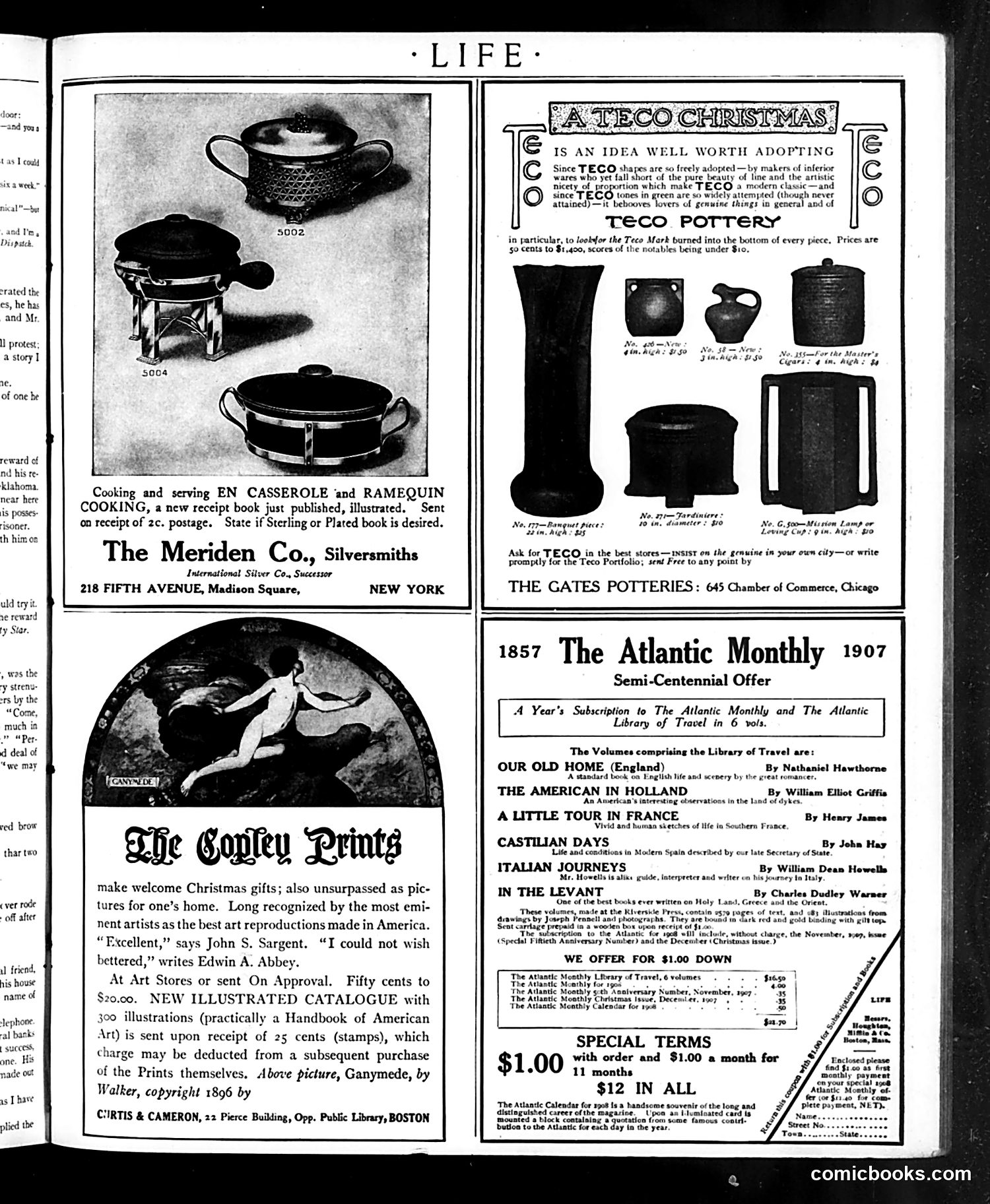
This page consists primarily of **advertisements rather than political cartoons or satire**. It includes: 1. **The Meriden Co. Silversmiths** ad promoting casserole cookware 2. **Teco Pottery Christmas** ad featuring decorative vases and serving pieces 3. **The Goofy Prints** ad highlighting art reproductions as Christmas gifts, quoting art critic John S. Sargent 4. **The Atlantic Monthly** semi-centennial subscription offer (1857-1907) The page represents typical early 20th-century *Life* magazine content—a mix of consumer goods and literary/cultural promotions targeting middle-class readers. The "Goofy Prints" reference appears to be a brand name rather than satirical commentary. There is **no identifiable political cartoon or satire** on this particular page.
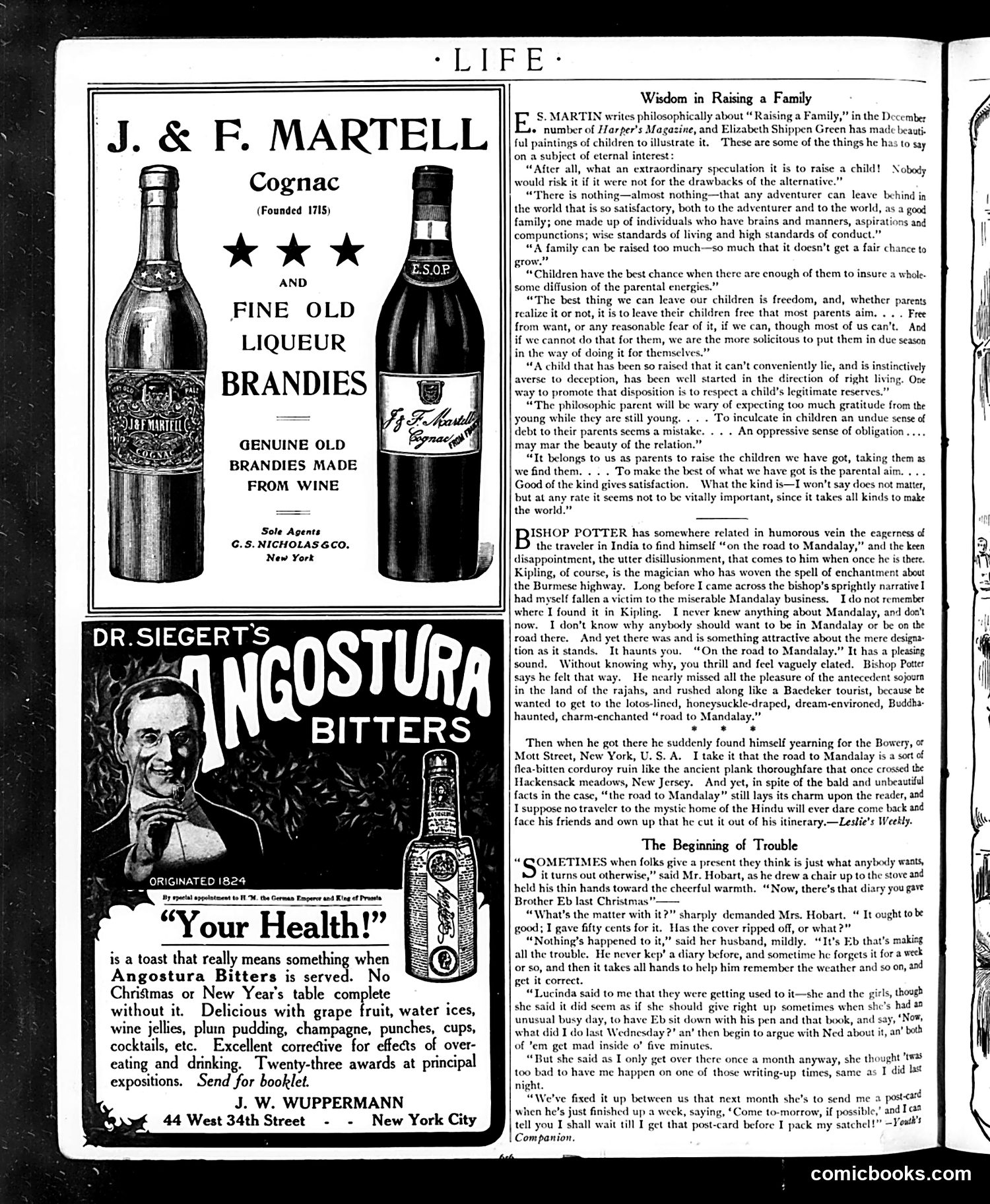
This page is primarily **advertising and editorial content** rather than political satire. The advertisements include: - **J. & F. Martell Cognac** (brandy) - **Dr. Siegert's Angostura Bitters** (featuring a caricatured figure, likely meant to evoke exotic/colonial imagery from the product's origin) The editorial text discusses "**Wisdom in Raising a Family**" by E.S. Martin, quoting philosopher observations about child-rearing and parental responsibility. Included is an anecdote by Bishop Potter about travel to Mandalay, and a humorous domestic dialogue ("The Beginning of Trouble") between Mr. and Mrs. Hobart about a lost diary. The satirical content is **mild domestic humor** rather than political commentary—focusing on everyday family disputes and parental frustrations rather than social or political critique.
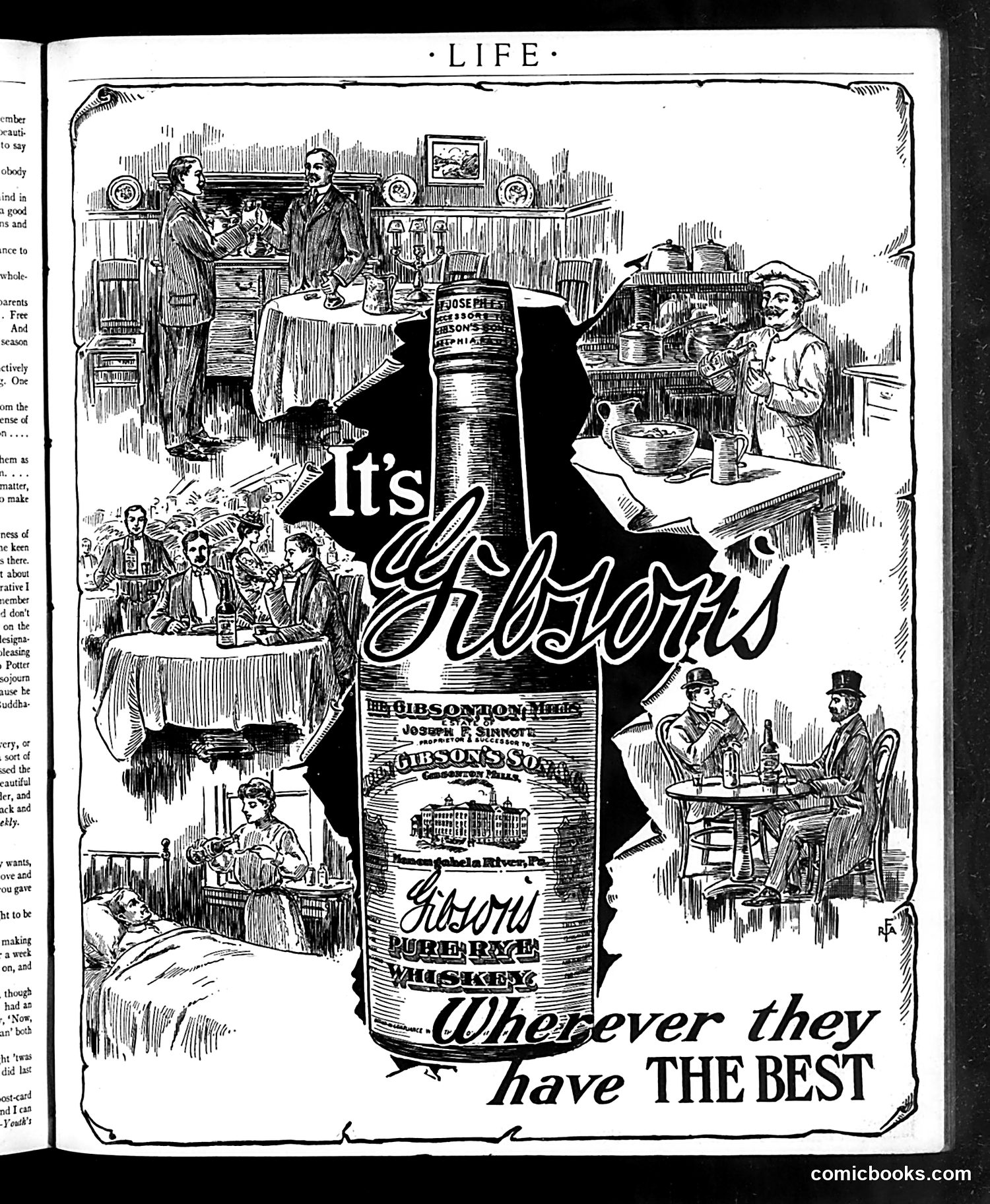
This page is primarily a **whiskey advertisement** for Gibson's Whiskey, not political satire. The ad uses an illustrated silhouette of a whiskey bottle filled with various social scenes depicting different American life contexts where people consume alcohol: formal dining, casual gatherings, working-class taverns, and domestic settings. The tagline "It's Gibson's Whiskey wherever they have THE BEST" suggests the product's ubiquity across all social classes. The advertisement appears designed to appeal broadly by depicting whiskey consumption as integral to American social life—from high society to working people. This represents early 20th-century alcohol marketing before Prohibition, celebrating whiskey as a normal, desirable social commodity across American life.
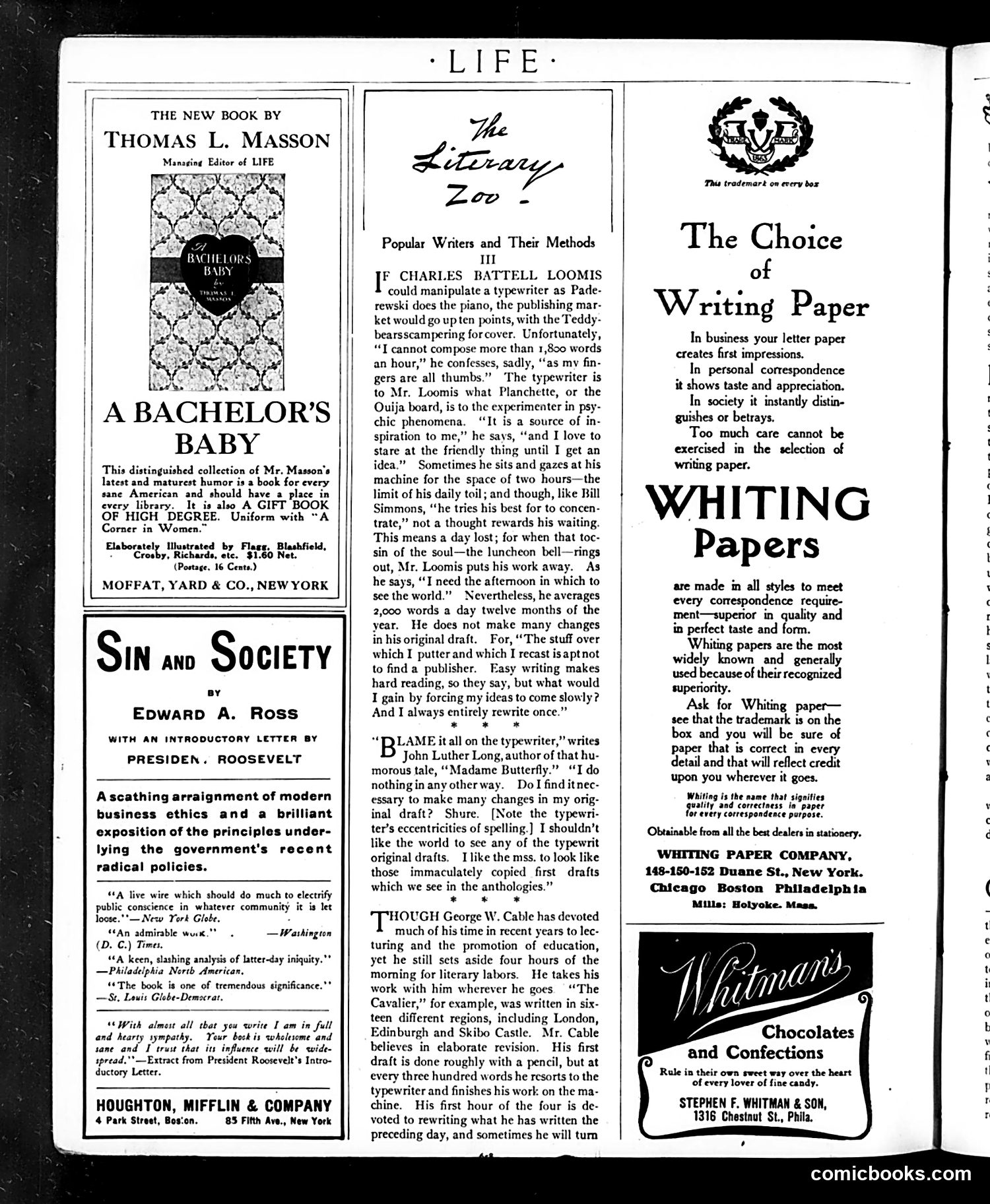
This page is primarily **advertising and literary content**, not political satire or cartooning. The page features book advertisements (including Thomas L. Masson's "A Bachelor's Baby" and Edward A. Ross's "Sin and Society") alongside a literary column titled "The Literary Zoo" discussing how various famous writers work. The column includes quotes from authors like Charles Battell Loomis, John Luther Long, and George W. Cable about their writing processes and methods—discussing typewriters, revision habits, and daily work routines. The remaining content consists of product advertisements for writing paper and Whitman's Chocolates. **There is no political cartoon or satire visible on this page.** It represents typical early 20th-century magazine content mixing literature, book promotion, and consumer advertising.
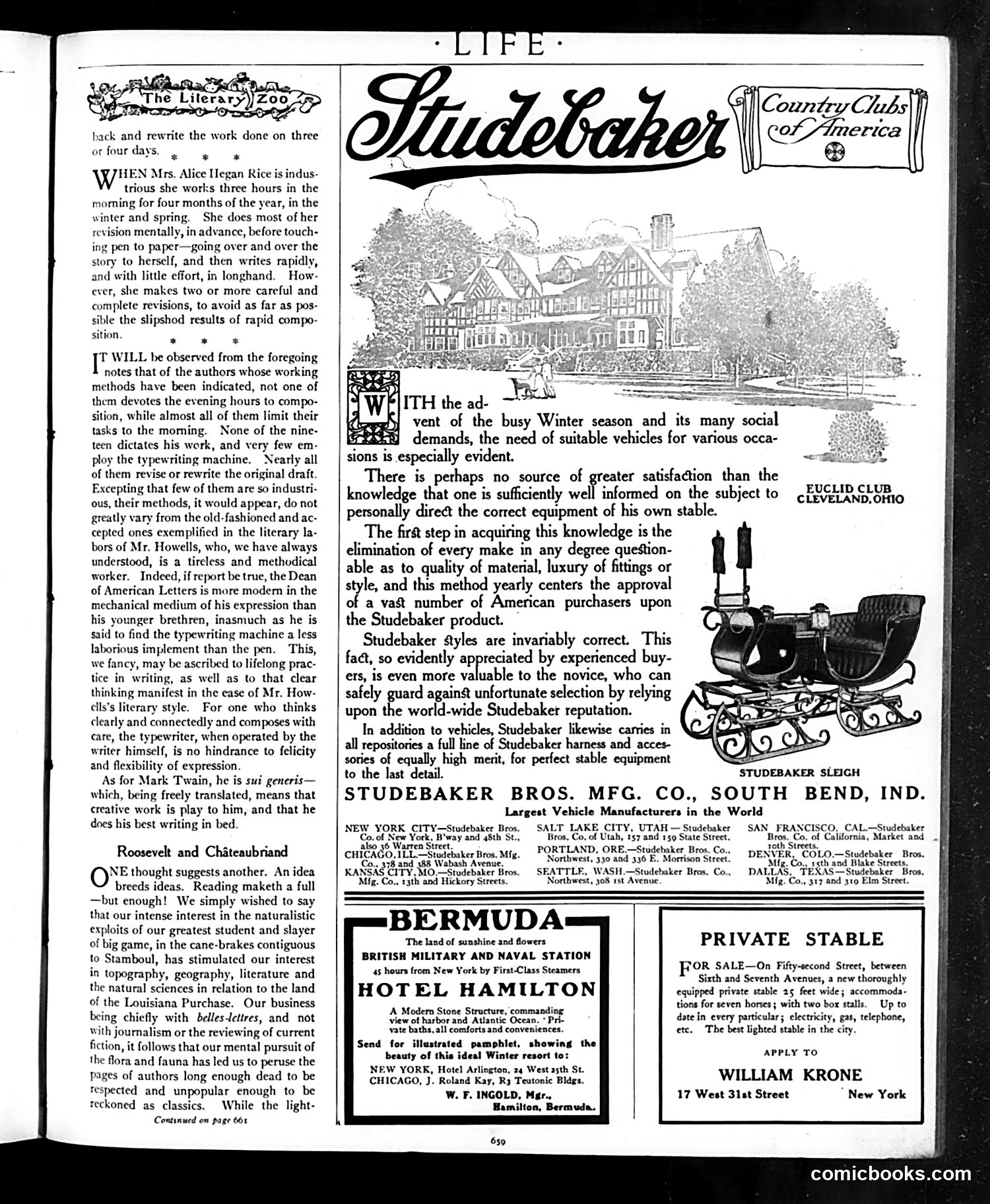
This page is **primarily advertising**, not satire or political commentary. The main content is a lengthy advertisement for **Studebaker Bros. Mfg. Co.**, a vehicle manufacturer based in South Bend, Indiana. The ad emphasizes the quality and reliability of Studebaker's winter vehicles and stable equipment, listing distributors across major American cities. The smaller text at the top discusses writing methods of various authors (including references to Roosevelt and Chateaubriand), which appears to be general editorial content about the literary process—unrelated to the advertisements below. Additional ads promote the Hotel Hamilton in Bermuda and a private stable facility in New York. **No political satire or cartoon commentary is present on this page.**
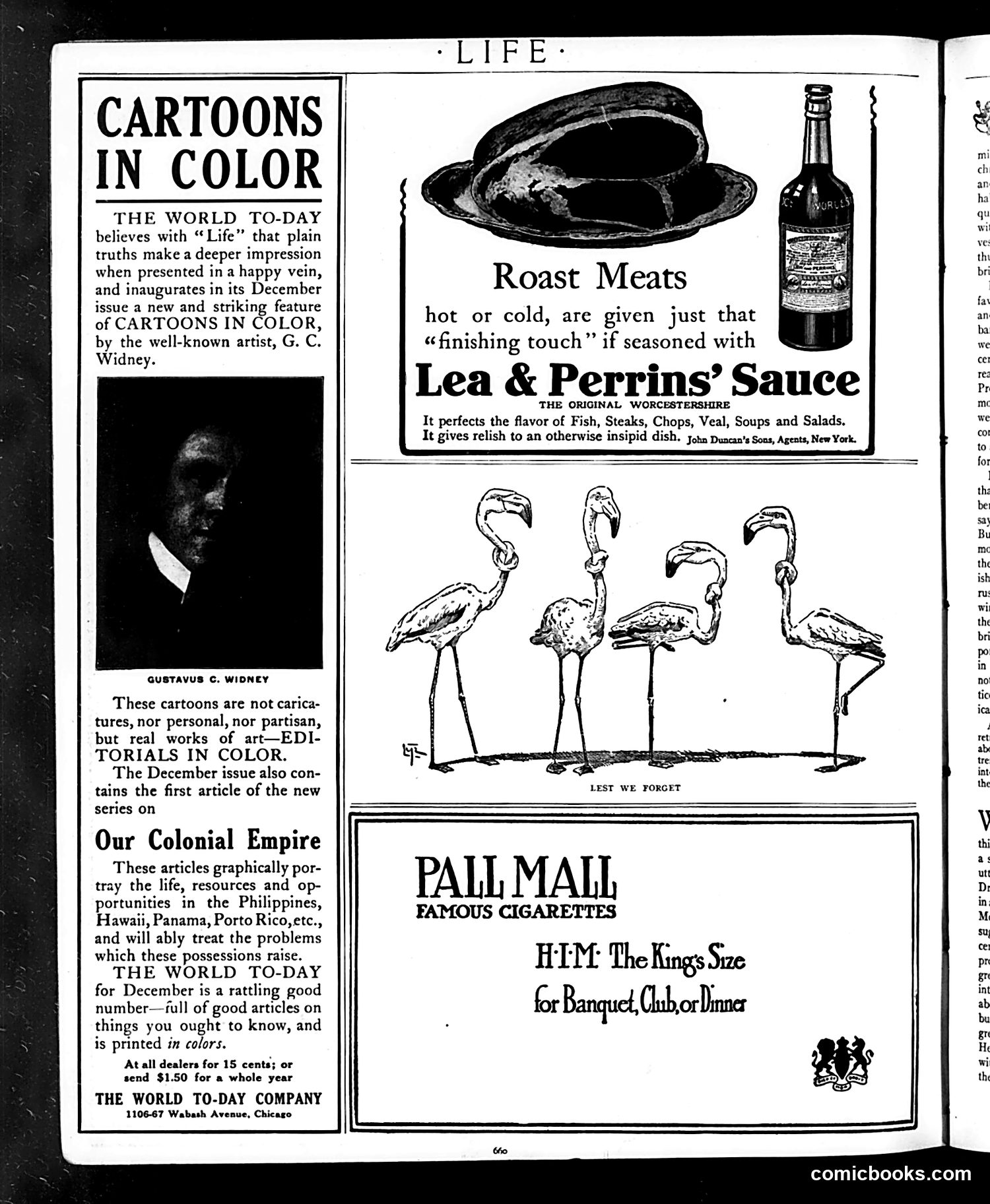
This page is primarily **advertising and promotional content** rather than political satire. The left column promotes **"Cartoons in Color"** by artist G.C. Widney, announced as a new December feature in *Life* magazine. These are described as "editorials in color"—artistic commentaries on topics like "Our Colonial Empire" (the Philippines, Hawaii, Panama, Puerto Rico), reflecting early 20th-century American imperial interests. The center cartoon shows **four flamingos** captioned "LEST WE FORGET"—likely a memorial reference, though the specific context is unclear. The page also contains **product advertisements**: Lea & Perrins' Sauce for roasted meats and Pall Mall Famous Cigarettes. Without the full magazine context or date, the precise meaning of the flamingo cartoon remains ambiguous.
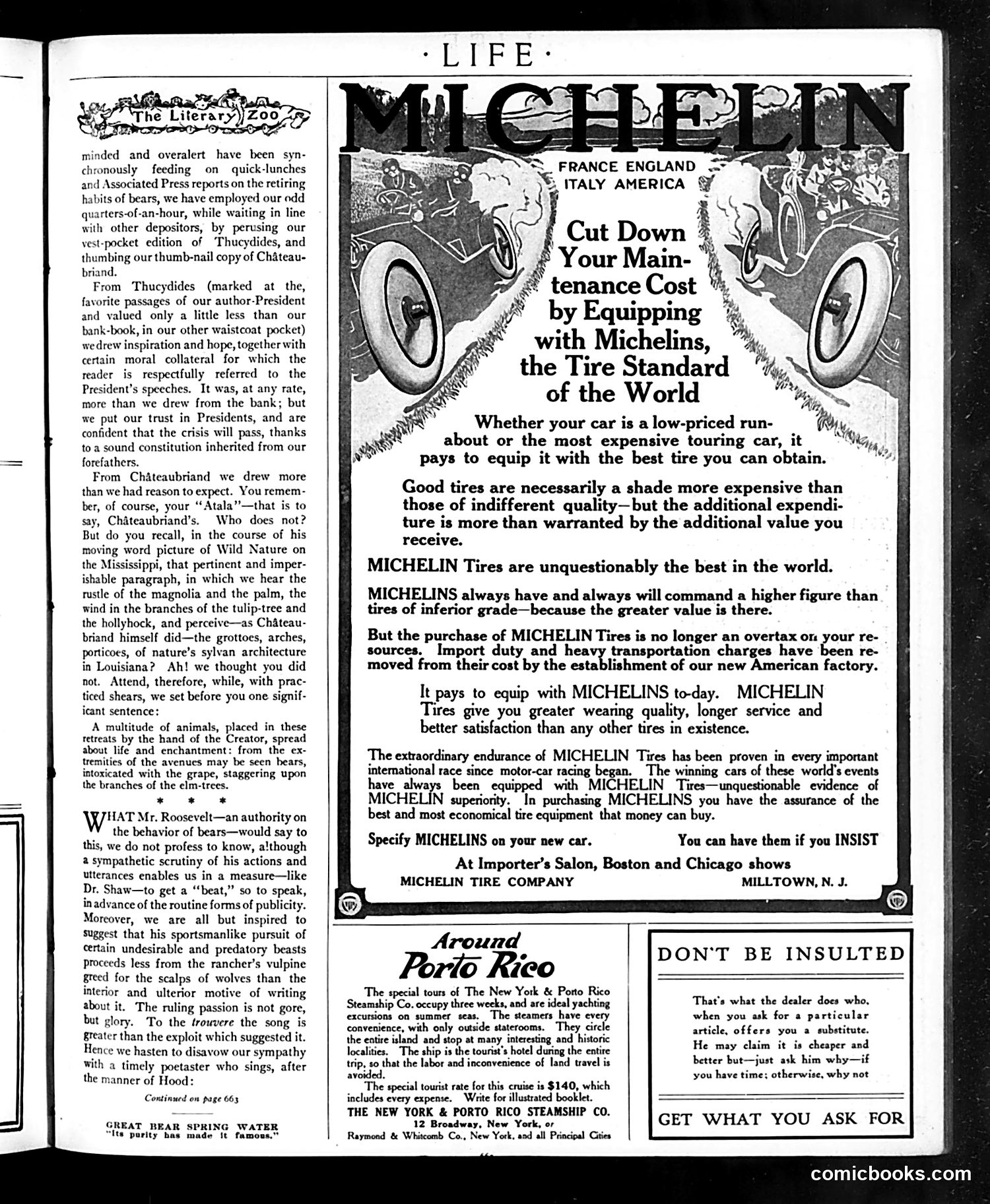
This page is primarily **advertising**, not political satire. The dominant content is a large Michelin Tires advertisement claiming their product as "the Tire Standard of the World." The ad emphasizes that while Michelin tires cost more initially, they provide superior durability and value—a common early automotive-era sales pitch. The left column contains "The Literary Zoo," a humorous essay discussing various historical and literary figures (Thucydides, Châteaubriand, Roosevelt). This is satirical commentary on intellectual pretension, not political cartooning. Below are smaller ads for a Puerto Rico cruise and a generic "Don't Be Insulted/Get What You Ask For" advertisement about dealer honesty. **No political cartoons or caricatures appear on this page.**
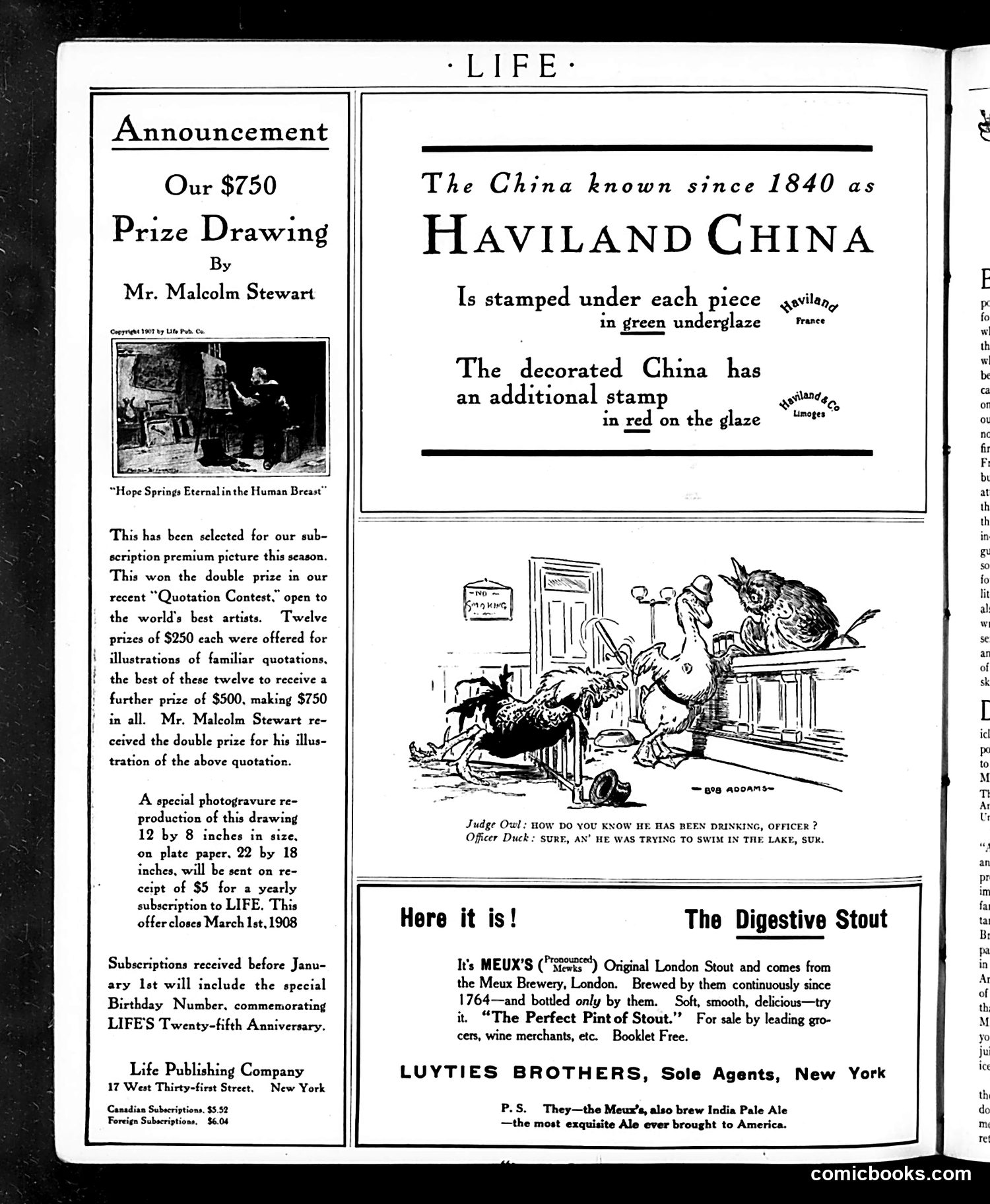
This page contains three main elements: 1. **Malcolm Stewart Prize Announcement** (left): Life magazine promoted a quotation-illustration contest offering $750 total prize money. Stewart won the grand prize for illustrating "Hope Springs Eternal in the Human Breast." The announcement offers subscribers a photogravure reproduction for $5. 2. **Haviland China Advertisement** (top right): A straightforward product notice identifying Haviland China by its maker's stamps—green underglaze for plain pieces, red glaze stamp for decorated items. This appears to be a legitimate manufacturer's mark advertisement. 3. **Animal Court Cartoon** (center): A humorous judicial scene with an owl judge and duck officer. The joke plays on animal characteristics: the officer suspects intoxication because the defendant was "trying to swim in the lake"—implying someone drunk might confuse a lake with a bathtub or behave nonsensically. 4. **Meux's Stout Advertisement** (bottom): A beer advertisement emphasizing brewing heritage since 1764, targeting upscale consumers through *Life* magazine's readership. The page primarily serves advertiser and subscription interests rather than editorial satire.
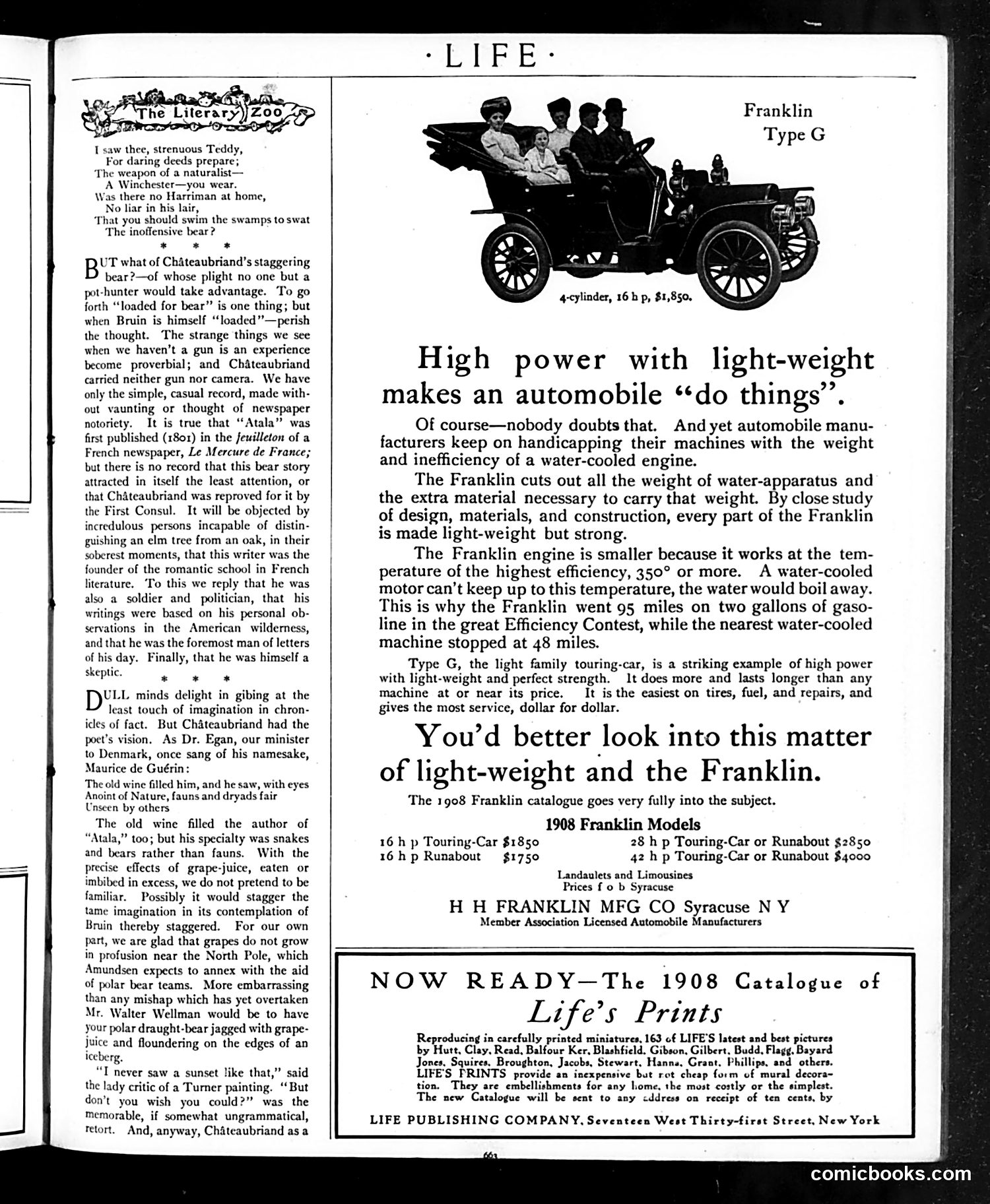
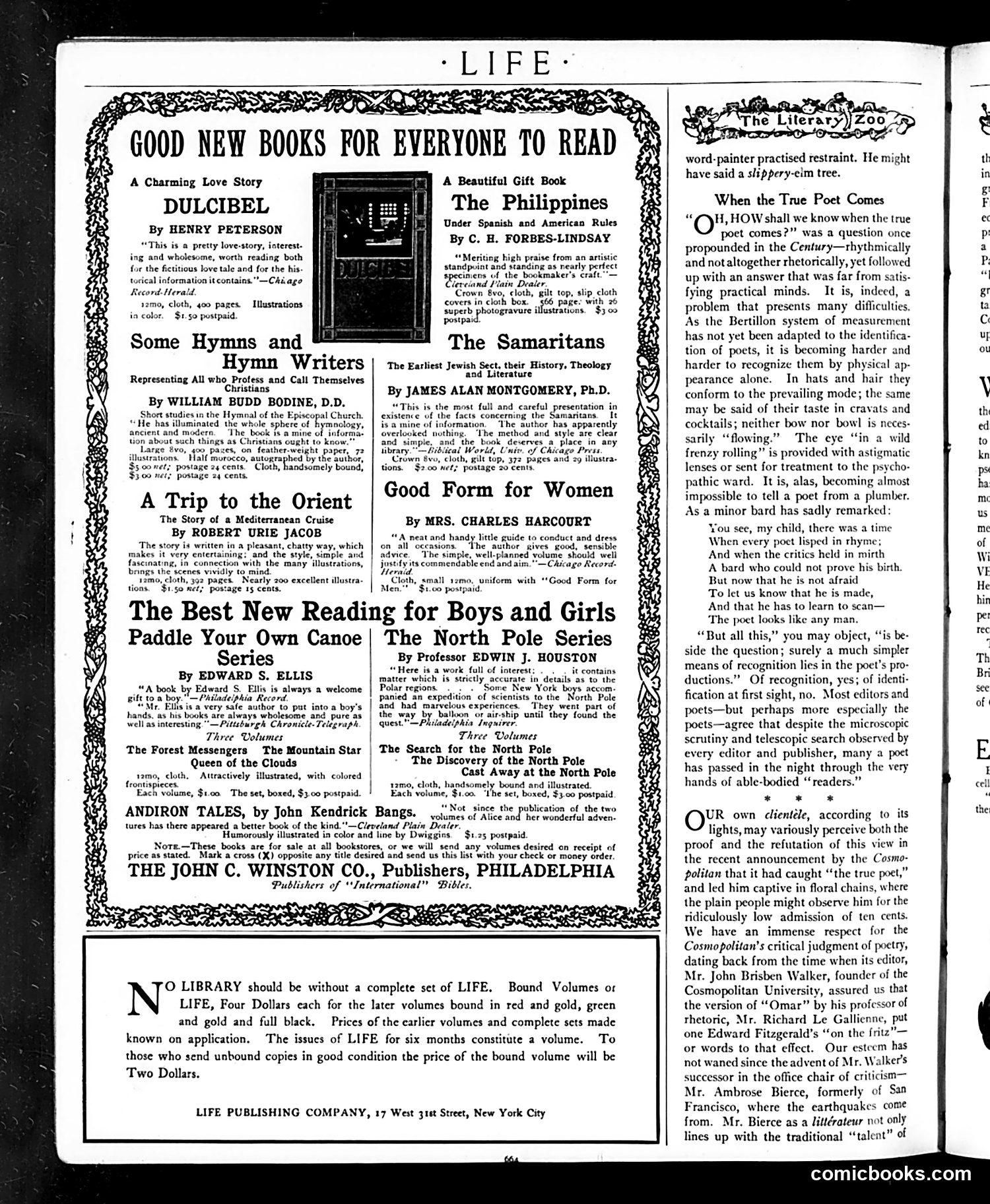
This is primarily a **book advertisement page**, not a satirical cartoon or political content page. It showcases new publications available circa early 1900s, organized by category. The page advertises books spanning educational and leisure reading: romantic fiction (*Dulcibel*), religious scholarship (*Hymns and Hymn Writers*, *The Samaritans*), travel narratives (*Trip to the Orient*, *The Philippines*), etiquette guides (*Good Form for Women*), and adventure series for young readers (*Paddle Your Own Canoe*, *North Pole Series*). The content reflects **early 20th-century publishing priorities**: colonial-era interest in the Philippines (under American rule), religious instruction, and boys' adventure fiction. The *North Pole Series* references contemporary Arctic exploration fascination. The footer announces LIFE magazine's own bound volumes are available for subscription—a self-promotional advertisement. **No political satire or caricature appears on this page.** It's a straightforward commercial book promotion targeting middle-class, educated readers.
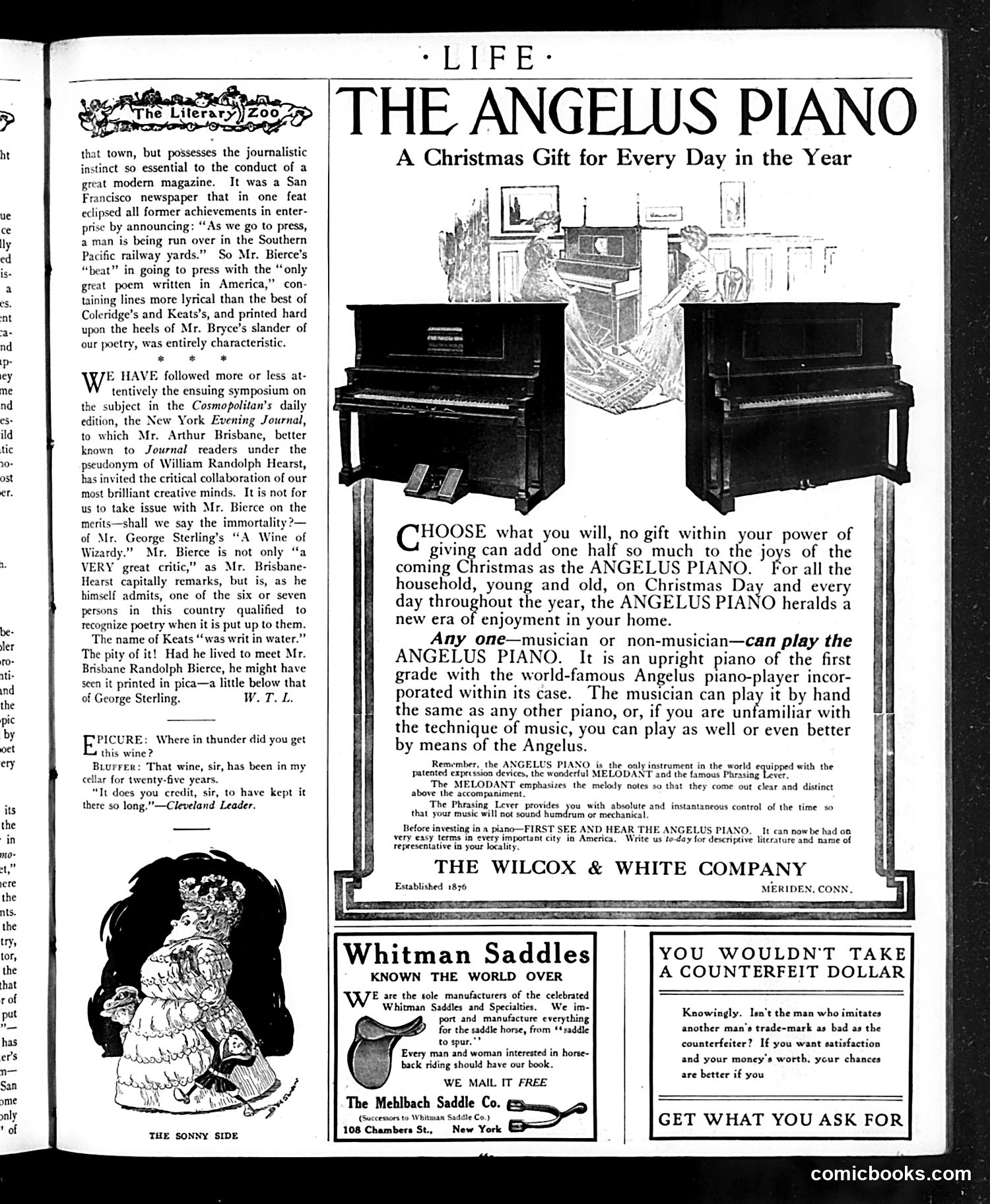
This page is primarily **advertising**, with a small satirical article and cartoon. ## The Satire ("The Sonny Side") The brief joke mocks pretentious wine collecting. A man claims to have kept wine in his cellar for 25 years; the response praises him for this restraint—the humor being that holding onto wine that long suggests either hoarding or inability to enjoy it, making the "credit" backhanded. ## Main Content: Advertisements The page features three major ads: 1. **Angelus Piano** (center): Markets a player piano as the ideal Christmas gift for everyone—"musician or non-musician"—claiming it democratizes music-playing through mechanical assistance. 2. **Whitman Saddles** (bottom left): Promotes saddle equipment and invites readers to request a free catalog. 3. **Mehlbach Saddle Co.** and counterfeit warning (bottom right): Warns against imitation products, equating counterfeits to theft. The left column discusses literary criticism regarding poet George Sterling's work and Ambrose Bierce's editorial championing of it—likely satire on literary pretension, though names and specific disputes aren't fully clear without additional context.
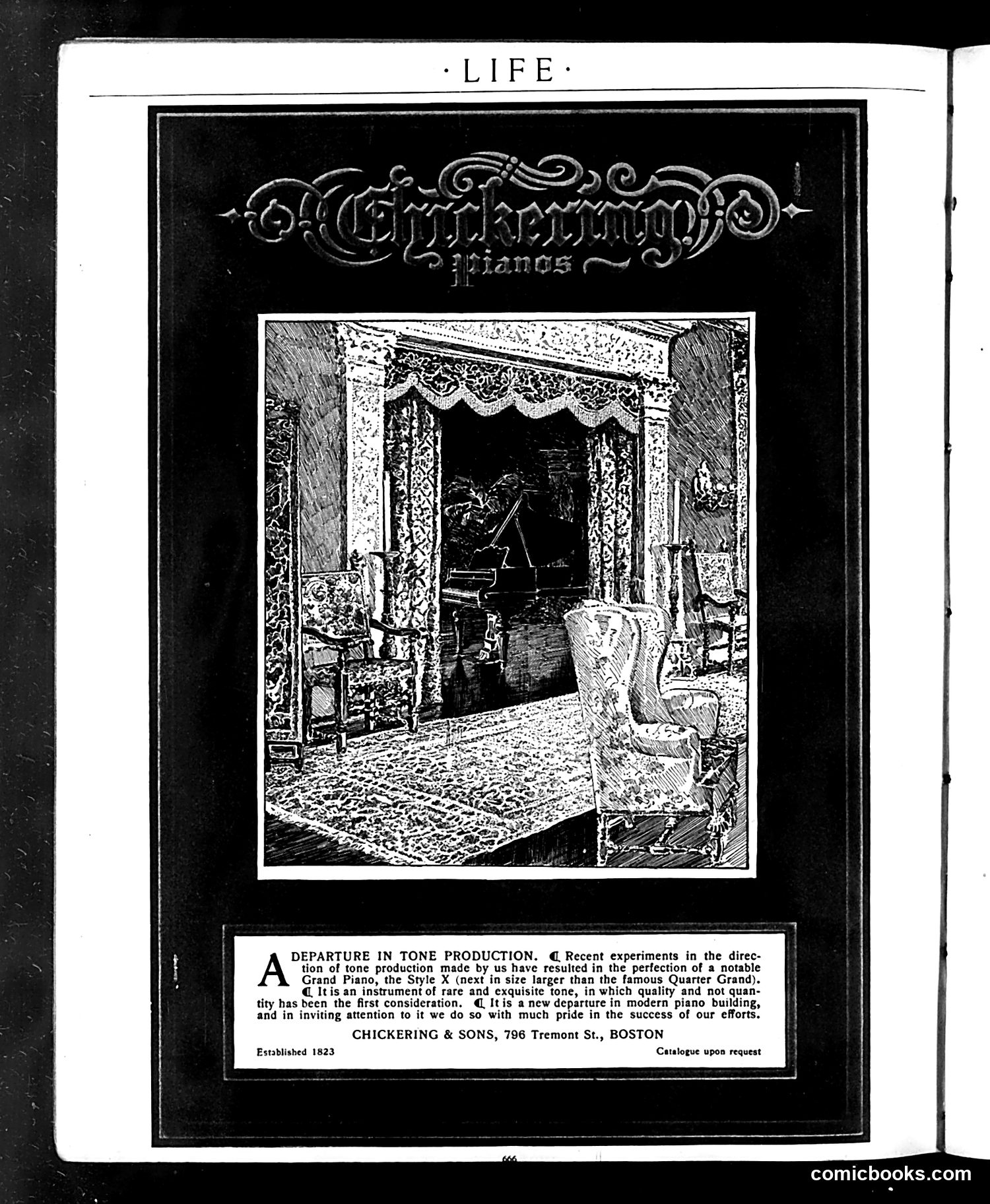
This is an advertisement page from *Life* magazine, not political satire or comics. It features a Chickering & Sons piano company ad promoting their new "Style X" Grand Piano model. The illustration shows an elegant parlor scene with a woman seated at a piano while a man plays, surrounded by ornate furniture and decorative drapes—imagery designed to suggest sophistication and refined taste. The "departure in tone production" referenced in the headline refers to Chickering & Sons' claimed innovations in piano manufacturing, emphasizing quality of tone over quantity. The ad positions the Style X as a luxury instrument for the cultured elite. Founded in 1823, Chickering & Sons was a prestigious Boston piano manufacturer. This type of aspirational imagery was typical advertising strategy for high-end consumer goods in early 20th-century magazines.
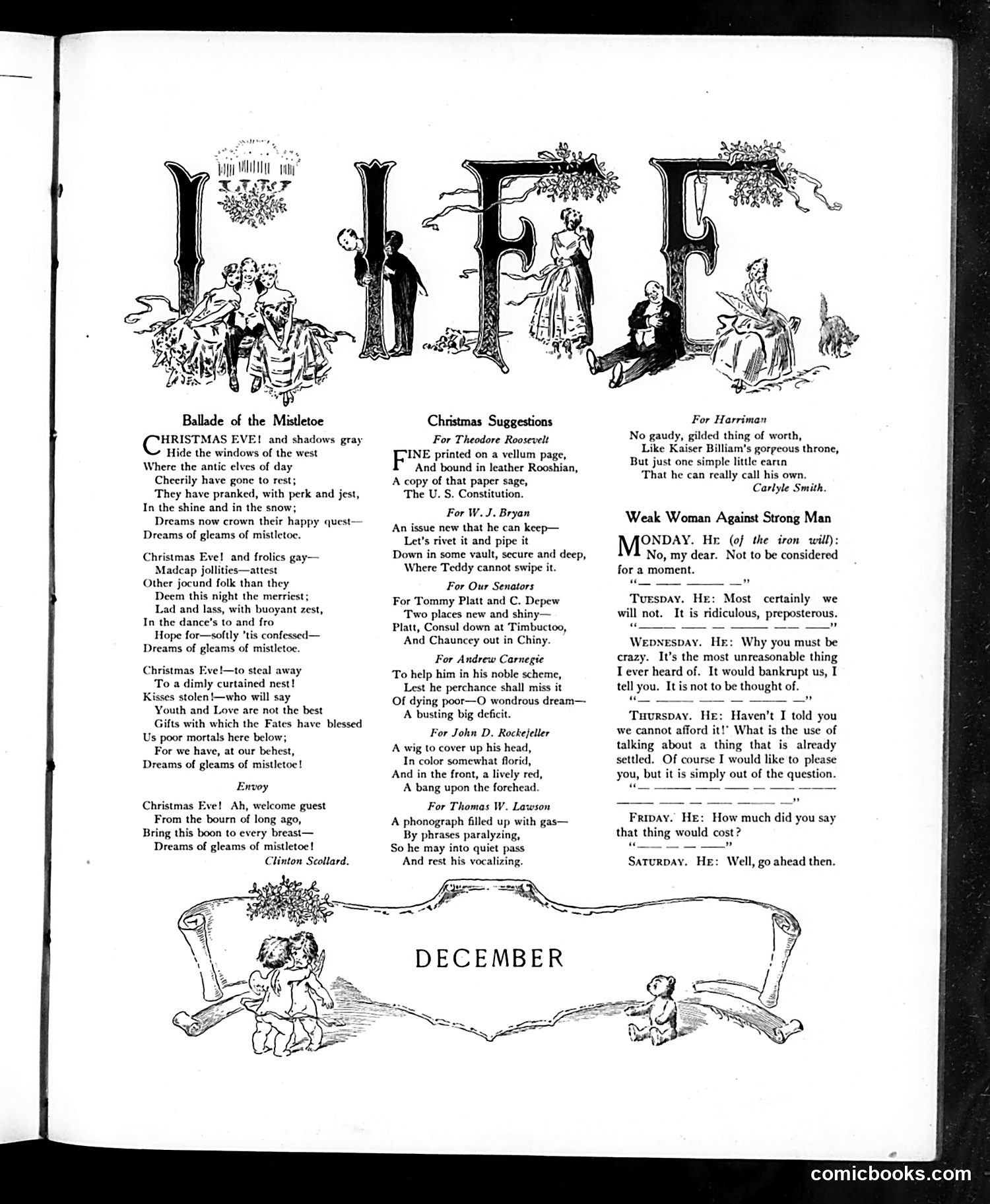
This is a Christmas-themed page from Life magazine featuring holiday content and political satire. **The "Life" Header Illustration** uses large decorative letters containing Victorian-era scenes of mistletoe romance—couples kissing and flirting—reflecting the page's romantic opening poem. **"Christmas Suggestions"** is biting political satire targeting prominent 1900s figures: - **Theodore Roosevelt**: mockingly suggests binding him a copy of the Constitution (implying he ignores it) - **W.J. Bryan**: suggests locking away a newspaper so "Teddy cannot swipe it" (referencing political rivalry) - **Senators Platt and Depew**: proposes exiling them to remote posts (Timbuctoo, China) - **Carnegie, Rockefeller, Lawson**: jabs at their wealth-hoarding and verbosity **"Weak Woman Against Strong Man"** satirizes marital dynamics—a husband repeatedly refusing his wife's (unspecified) request across the week, dismissing her as irrational while claiming financial hardship. It critiques patriarchal power dynamics humorously.
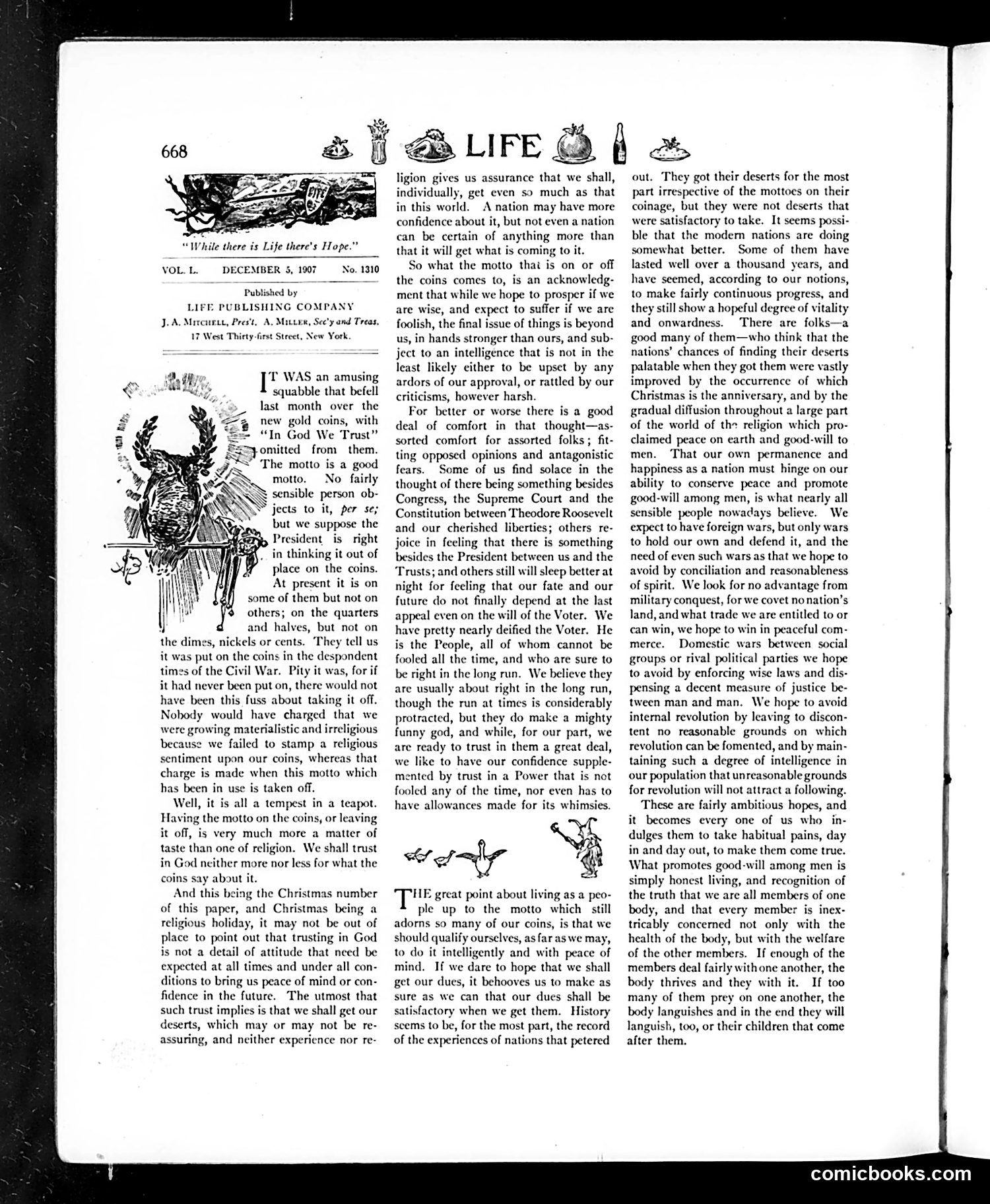
This editorial addresses a contemporary controversy: President Theodore Roosevelt's decision to remove "In God We Trust" from newly minted gold coins. **The Issue:** The motto had appeared on some coins since the Civil War but was omitted from new designs, sparking public debate about whether this reflected growing materialism and irreligion. **Life's Position:** The magazine treats this as "a tempest in a teapot"—a matter of taste rather than genuine religious principle. The editorial argues that trusting in God doesn't require motto endorsement on currency. **The Deeper Point:** Written for Life's Christmas issue, the piece uses the controversy to discuss faith pragmatically. It suggests people across the political spectrum—whether they fear Roosevelt's power, corporate "Trusts," or democratic voters—find comfort in believing ultimate outcomes rest with a power beyond human institutions (Congress, courts, the President, or "the Voter"). The editorial reflects Progressive-era anxieties about institutional power while maintaining that religious sentiment matters less than actual conduct.
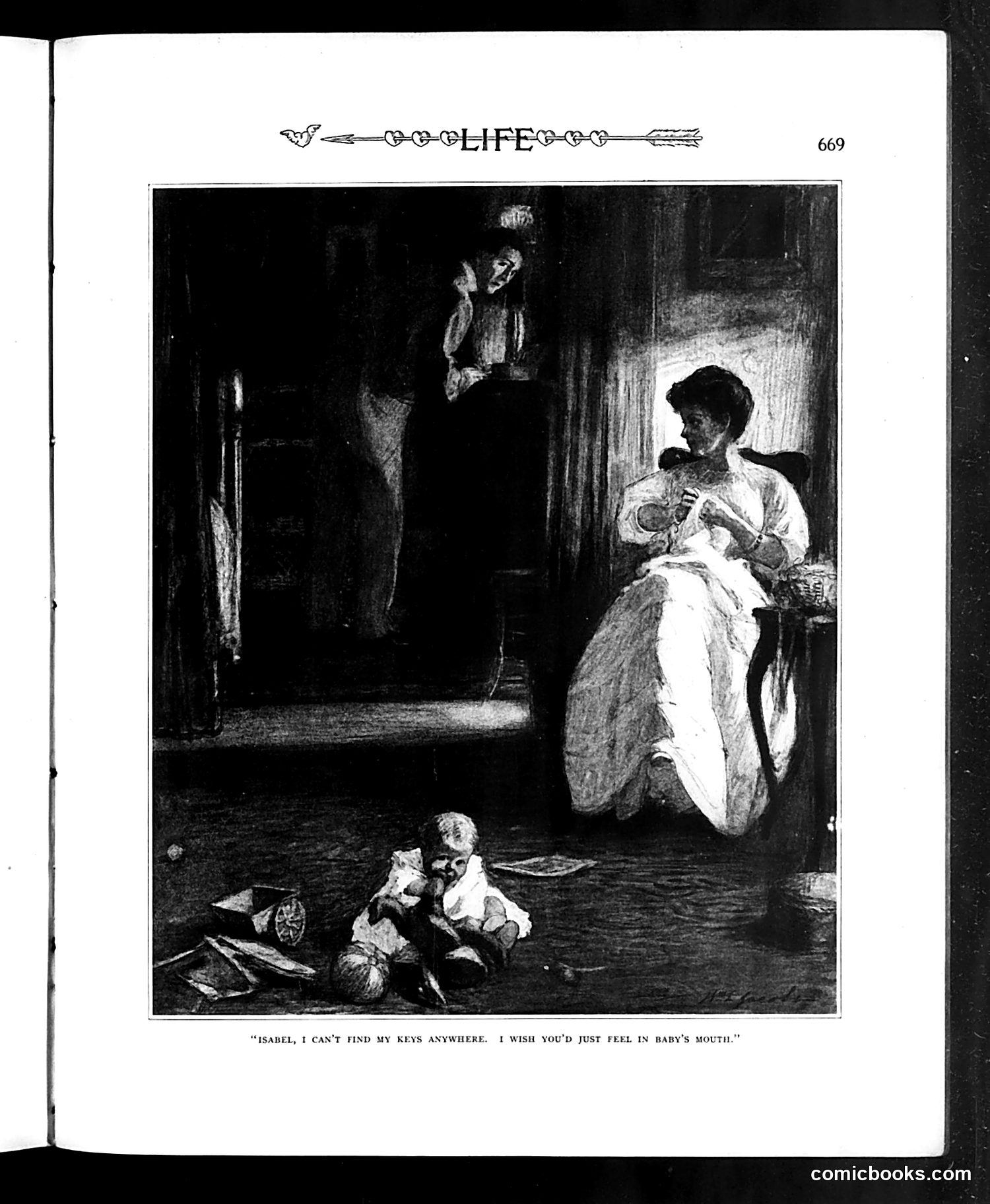
This appears to be a domestic comedy illustration from *Life* magazine showing a marital scene. A man speaks to a woman (Isabel) seated in a chair holding a baby, with toys scattered on the floor. His complaint—"I can't find my keys anywhere. I wish you'd just feel in baby's mouth"—is a satirical jab at the chaos of parenthood and domestic life. The humor targets the stereotype of babies putting everything in their mouths, turning the baby into an inadvertent repository for lost household items. It's gentle domestic satire mocking how children disrupt orderly adult life and how parents must search through various indignities to recover missing objects. The illustration's dark, moody aesthetic contrasts with the mundane complaint, adding to the comedic effect.
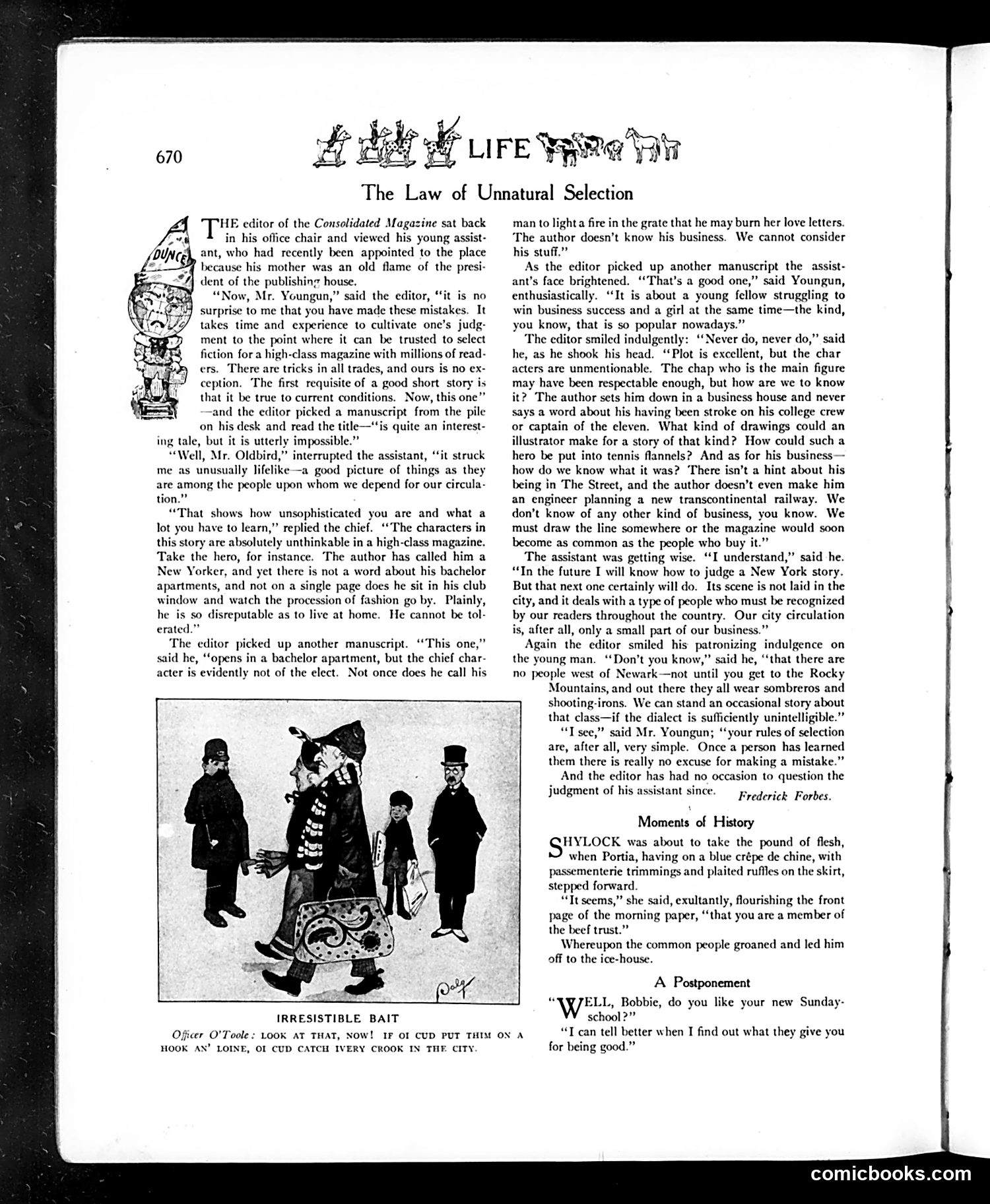
This satirical story mocks magazine editors' formulaic approach to fiction selection. An experienced editor rejects story manuscripts based not on literary merit or realism, but on whether characters fit upper-class stereotypes. The editor dismisses a realistic New York story because the protagonist lives at home rather than in a bachelor apartment and doesn't perform rituals like burning love letters in a fireplace. He rejects another story about a young man pursuing business success and romance because the character lacks markers of elite status—no college crew experience, no tennis imagery, no Wall Street connections, no involvement in transcontinental railways. The satire targets how magazines catered exclusively to wealthy urban readers, requiring all characters conform to their lifestyle and concerns. The editor's final comment—dismissing all people west of Newark as nonexistent until the Rocky Mountains—emphasizes this absurd, insular worldview. The joke is that editors' artificial selection criteria made magazine fiction increasingly disconnected from actual human experience.
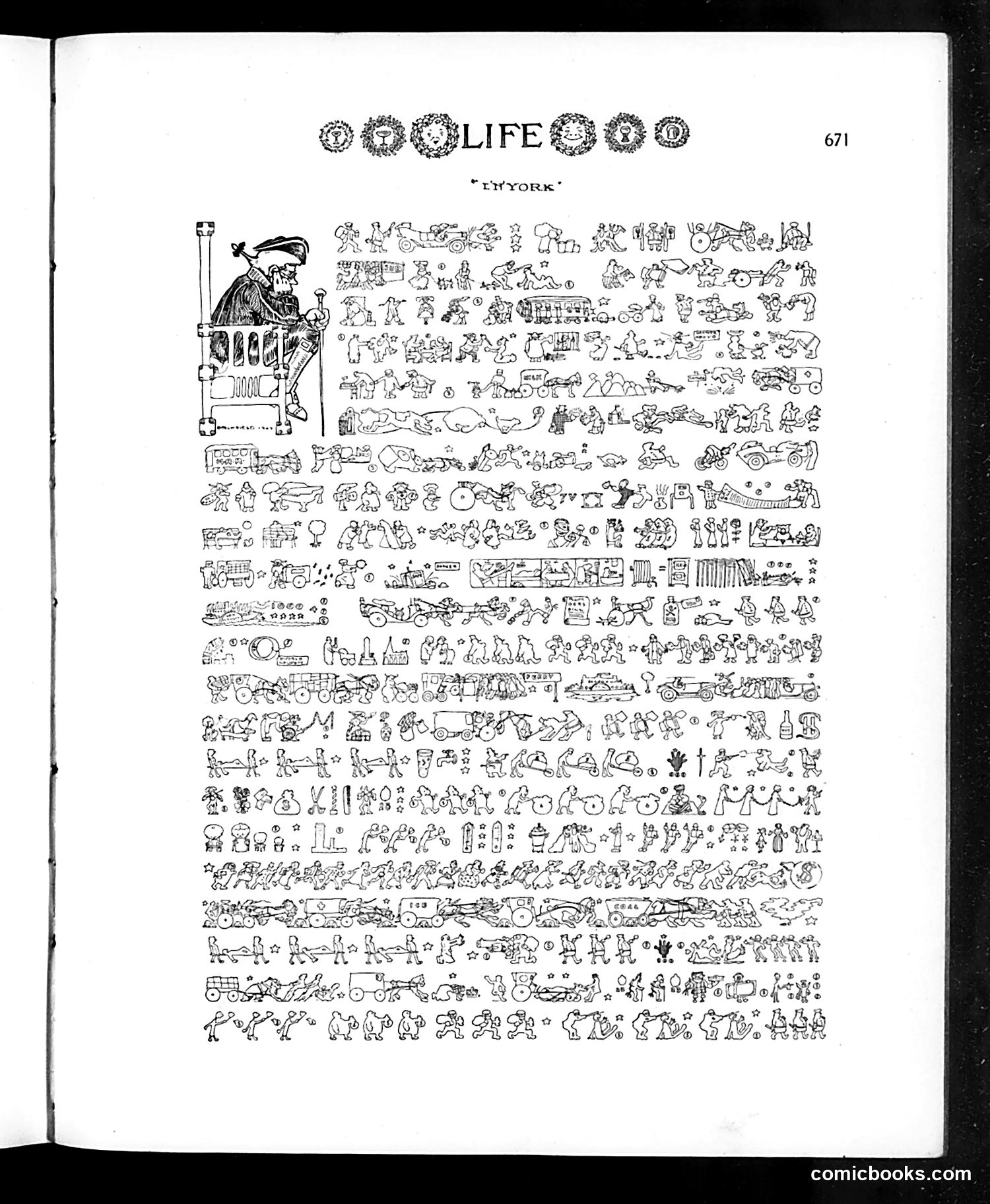
This page from Life magazine features a large illustration on the left showing a figure in period dress (appears to be Dutch or colonial-era clothing) peering through a telescope from a window or balcony labeled "NEW YORK." The right side contains hundreds of tiny detailed drawings depicting various scenes of New York life—people, activities, vehicles, buildings, and daily occurrences arranged densely across the page. This appears to be a visual metaphor or satirical commentary: the historical figure observing modern New York through a telescope, contrasting past and present. The multitude of small vignettes on the right likely represent the chaotic, bustling complexity of contemporary New York City life—suggesting themes about urban crowding, progress, social change, or the overwhelming nature of modern metropolitan existence compared to simpler historical times. The satirical point seems to be commentary on how dramatically New York has transformed, presented through this device of historical observation of modern chaos.
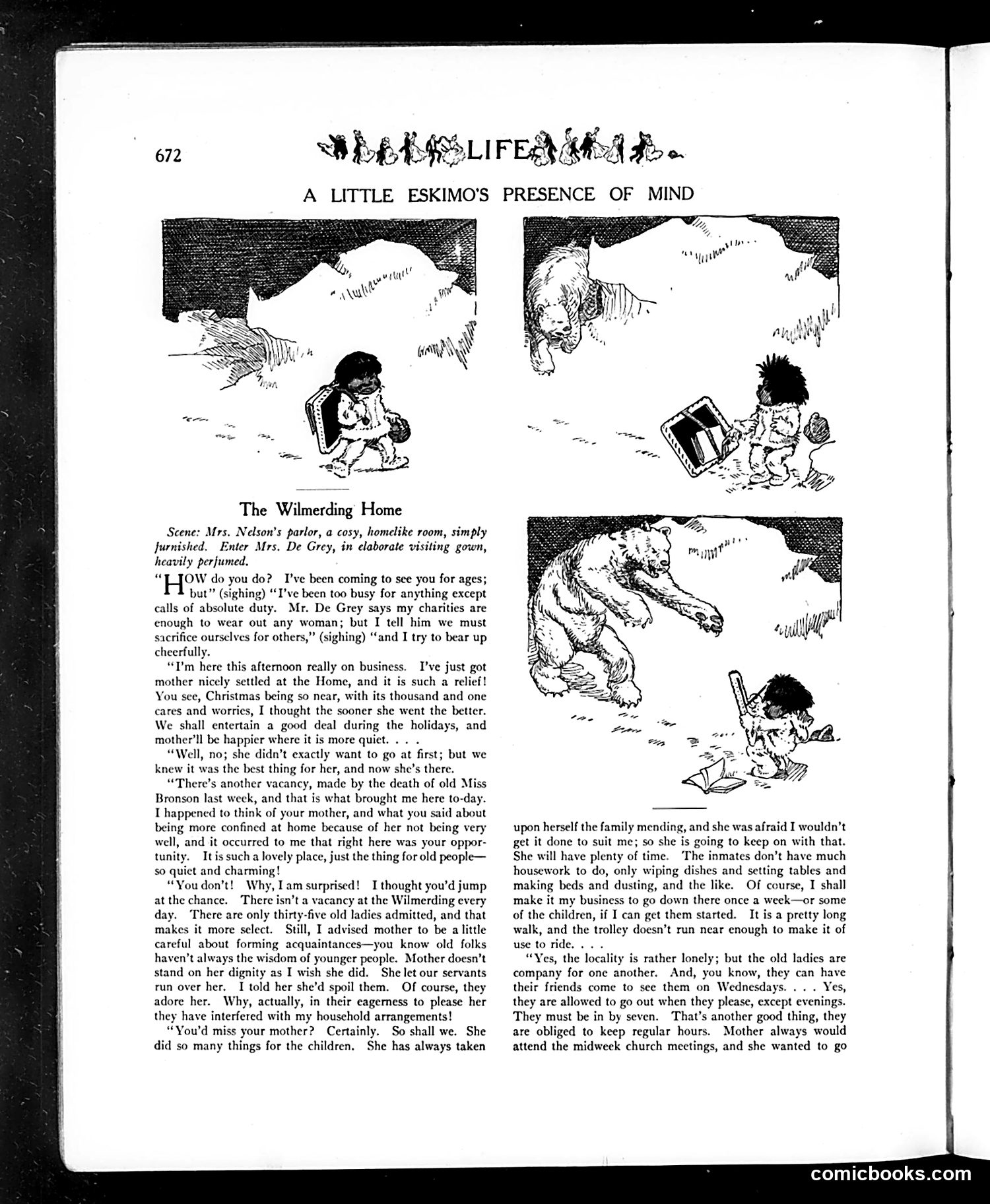
This page satirizes the hypocrisy of wealthy women who place elderly mothers in "homes" (nursing facilities) under the guise of charity and the mothers' own good, while actually seeking to free themselves from caregiving burdens. Mrs. De Grey visits Mrs. Nelson to convince her to institutionalize her mother at the Wilmerding Home. De Grey frames the placement as beneficial—"quiet and charming"—while revealing selfish motives: Christmas entertaining, relief from domestic duties, and the loss of the mother's unpaid labor (mending, childcare). She acknowledges the mother didn't want to go but was persuaded. The cartoon mocks De Grey's self-serving language about "sacrifice" and "duty" while she actually abandons her mother-in-law to limited visiting hours, restricted outings (must be in by 7 PM), and minimal autonomy. The illustrations show Eskimos, likely evoking the period's stereotypes about primitive peoples, suggesting the contrast between De Grey's civilized pretenses and her crude emotional abandonment.
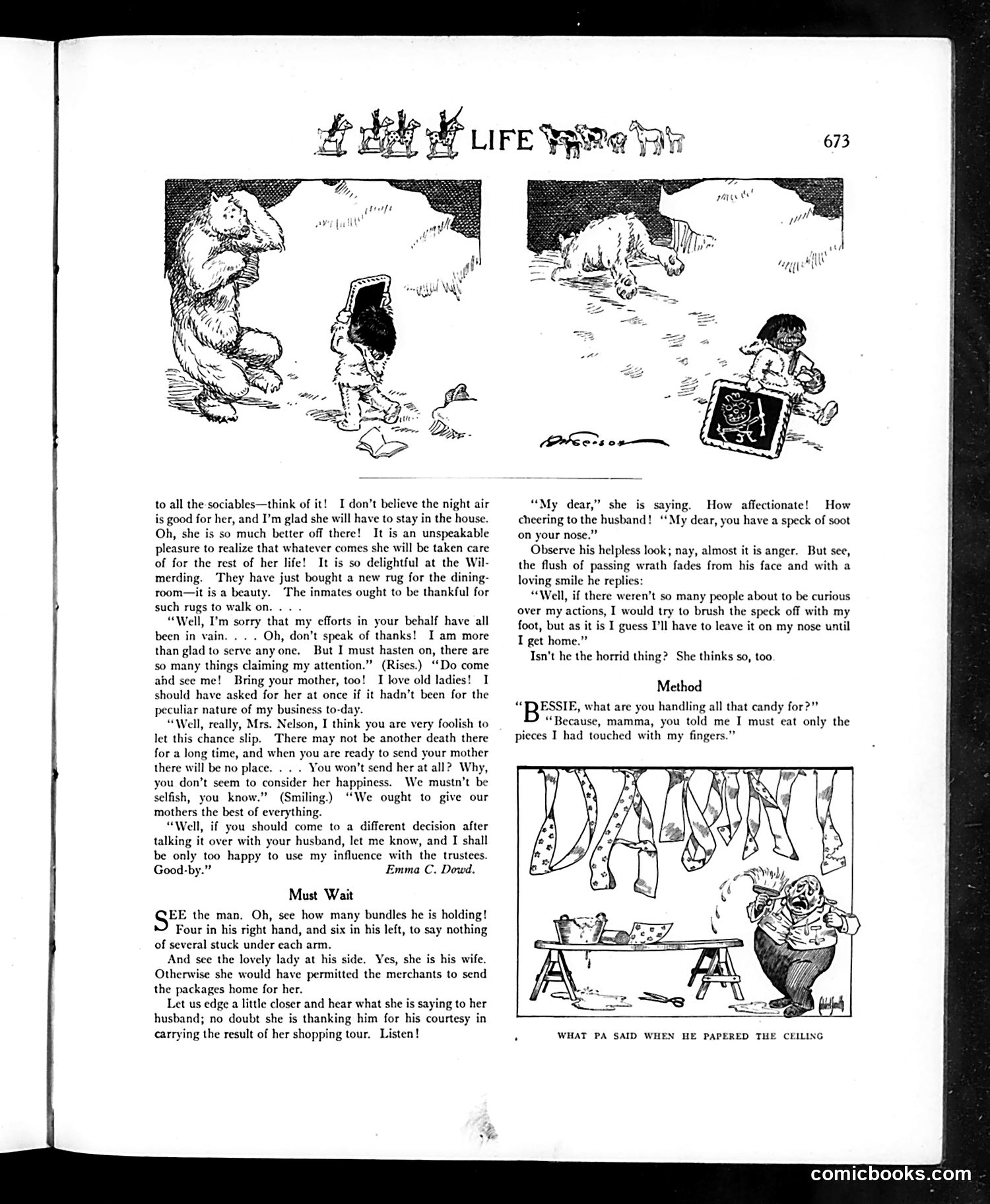
This page contains three separate satirical pieces mocking social hypocrisy and domestic dynamics of the era. **Top section ("Must Wait"):** A woman pressures her widowed friend to place her elderly mother in what appears to be a boarding house or nursing facility, using flattery and appeals to "happiness" while clearly hoping for the mother's death to free up a future spot. The satire targets the callousness disguised as concern—the visitor speaks of loving "old ladies" while actively trying to place someone away. **Bottom left ("Method"):** A heavily laden husband carries all his wife's shopping packages because she won't allow merchants to deliver them. When he has a smudge on his nose, she points it out but prevents him from wiping it (suggesting he'd look foolish in public), forcing him to endure discomfort. The satire mocks wives' control over husbands' behavior and public image. **Bottom right ("What Pa Said When He Papered the Ceiling"):** A brief visual gag showing a child following a parent's literal instruction about only eating candy she touched—illustrating parental carelessness through ironic obedience. All three mock gender dynamics and self-interest masked as propriety.
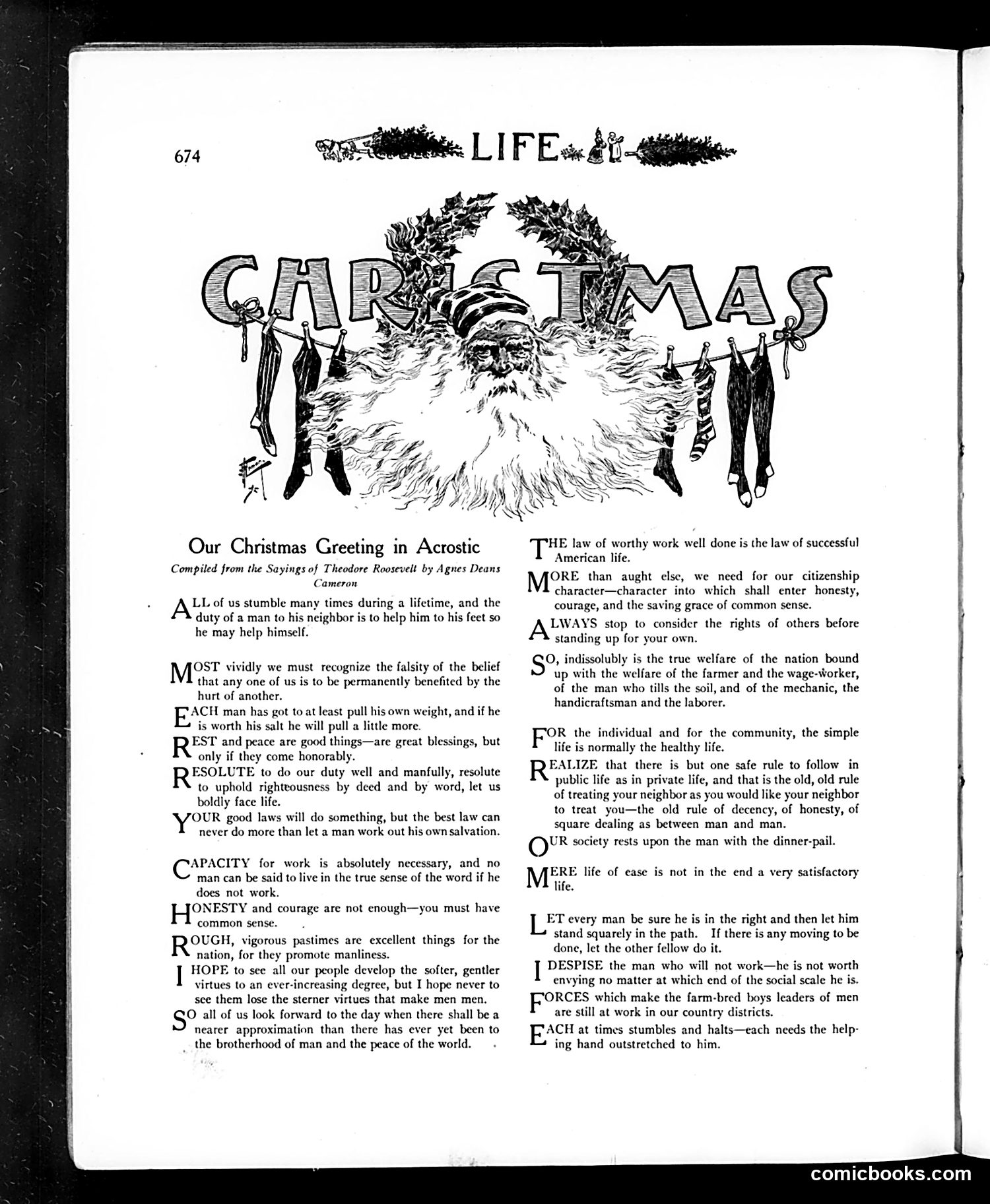
This page presents a Christmas greeting spelled acrostically using Theodore Roosevelt quotations, compiled by Agnes Deans Cameron. The illustration shows Santa Claus's head framed by a wreath, with stockings hanging below. The content is **not satirical**—it's sincere moralizing. Rather than mocking Roosevelt, *Life* magazine presents his philosophy as inspirational holiday wisdom. The acrostic spells "MERRY CHRISTMAS" vertically down the left margin, with Roosevelt's statements on duty, honest work, character, and social responsibility filling both columns. The emphasis throughout reflects early 20th-century Progressive values: workers deserve dignity ("the man with the dinner-pail"), citizens must balance individual rights with community welfare, and honest labor builds national character. This represents Roosevelt's philosophy of robust individualism paired with social obligation—positioned here as timeless Christmas principles rather than contemporary political commentary.
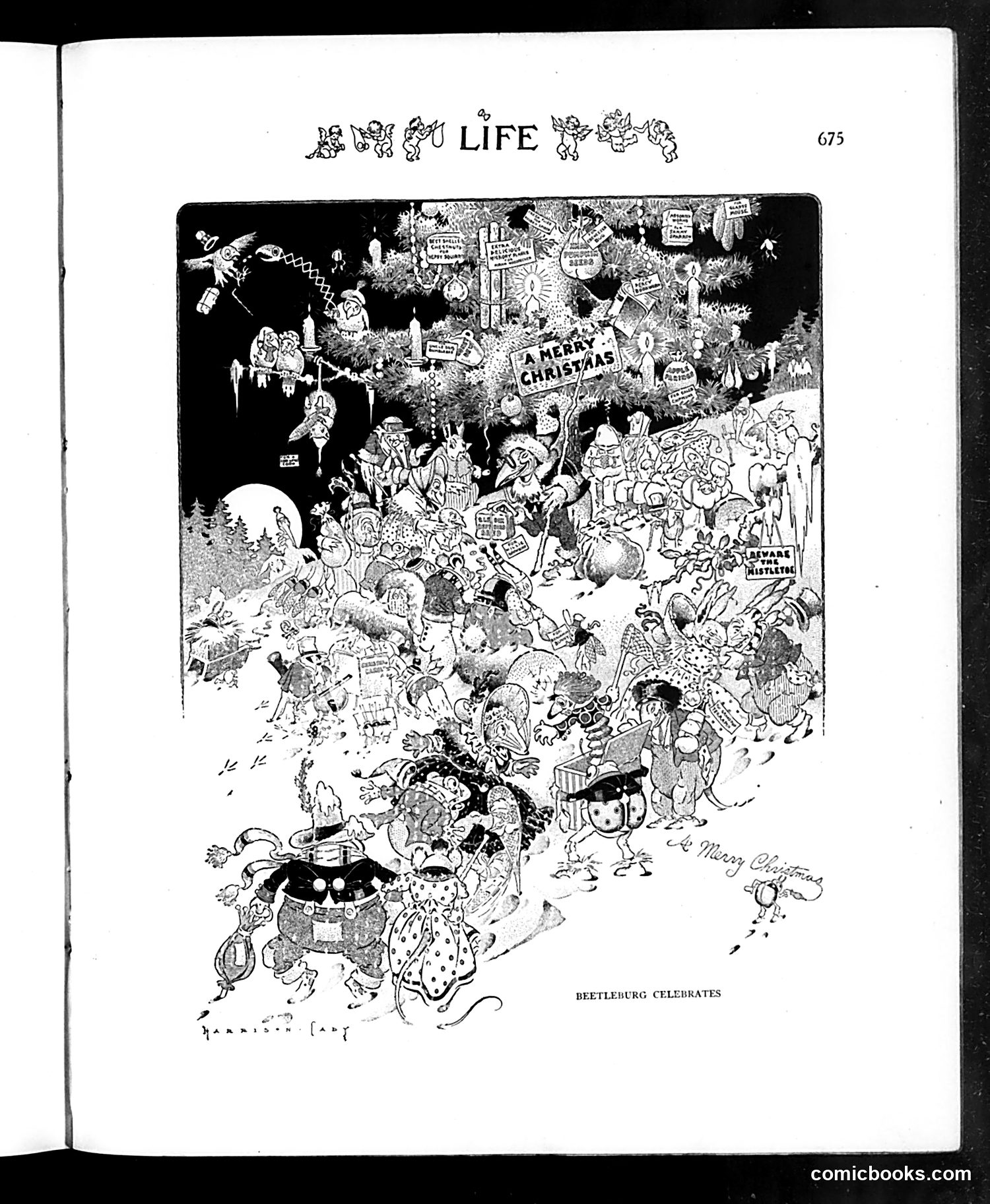
This is a whimsical, densely-packed illustration titled "Beetleburg Celebrates" showing an anthropomorphic insect community preparing for Christmas. The cartoon depicts beetles and other insects engaged in holiday activities—decorating, caroling, exchanging gifts, and general festivities. A prominent "A Merry Christmas" banner hangs in the scene, and Santa Claus (riding what appears to be an insect-pulled sleigh) is visible in the lower portion. The satire likely works by presenting an elaborate, miniature society with fully human customs, creating humor through the absurdity of insects celebrating human holidays with complete earnestness. The sheer visual density and elaborate detail of the scene adds to the comedic effect. This appears to be lighthearted seasonal entertainment rather than political satire—a humorous fantasy world for holiday amusement.
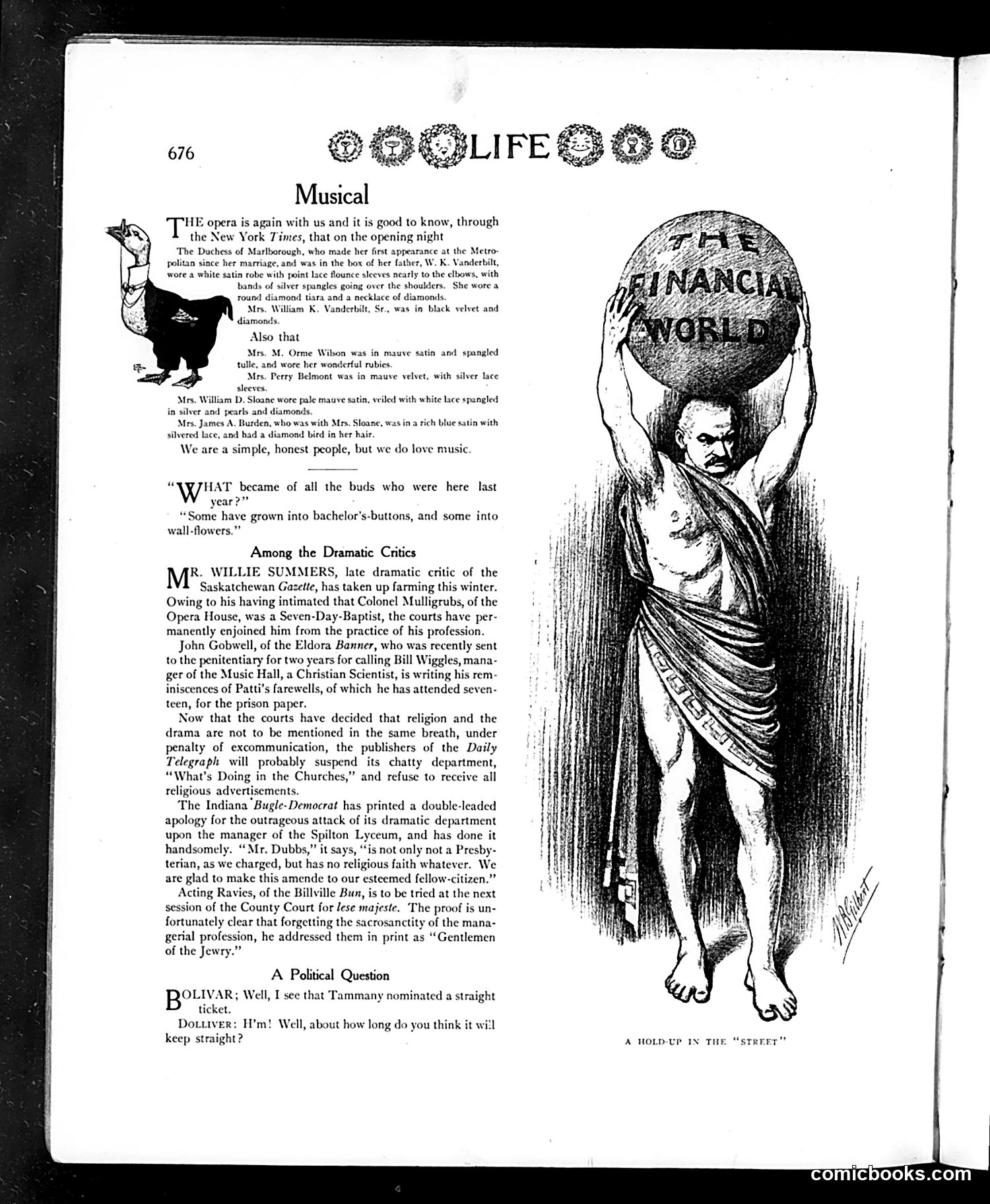
This page satirizes upper-class hypocrisy and press censorship through multiple pieces. The opening "Musical" section mocks wealthy New York society's pretensions. After extensive paragraphs describing opera attendees' lavish diamond-and-satin attire in obsessive detail, it concludes: "We are a simple, honest people, but we do love music"—the irony being obvious: these are anything but simple or honest. The "Dramatic Critics" section lampoons press censorship of theater reviews. It describes fictional critics facing legal consequences for insulting opera/theater managers by calling them religious names (Seven-Day-Baptist, Christian Scientist), concluding that theater and religion cannot be discussed together. The satire targets libel laws that effectively silence dramatic criticism. The cartoon labeled "A Hold-up in the Street" depicts what appears to be Financial Ward—a personified figure representing Wall Street or financial institutions being robbed/coerced, likely criticizing financial manipulation or corruption. The final joke about Tammany Hall's "straight ticket" questions whether political machines (Tammany was NYC's Democratic organization) can remain honest—suggesting they inherently cannot.
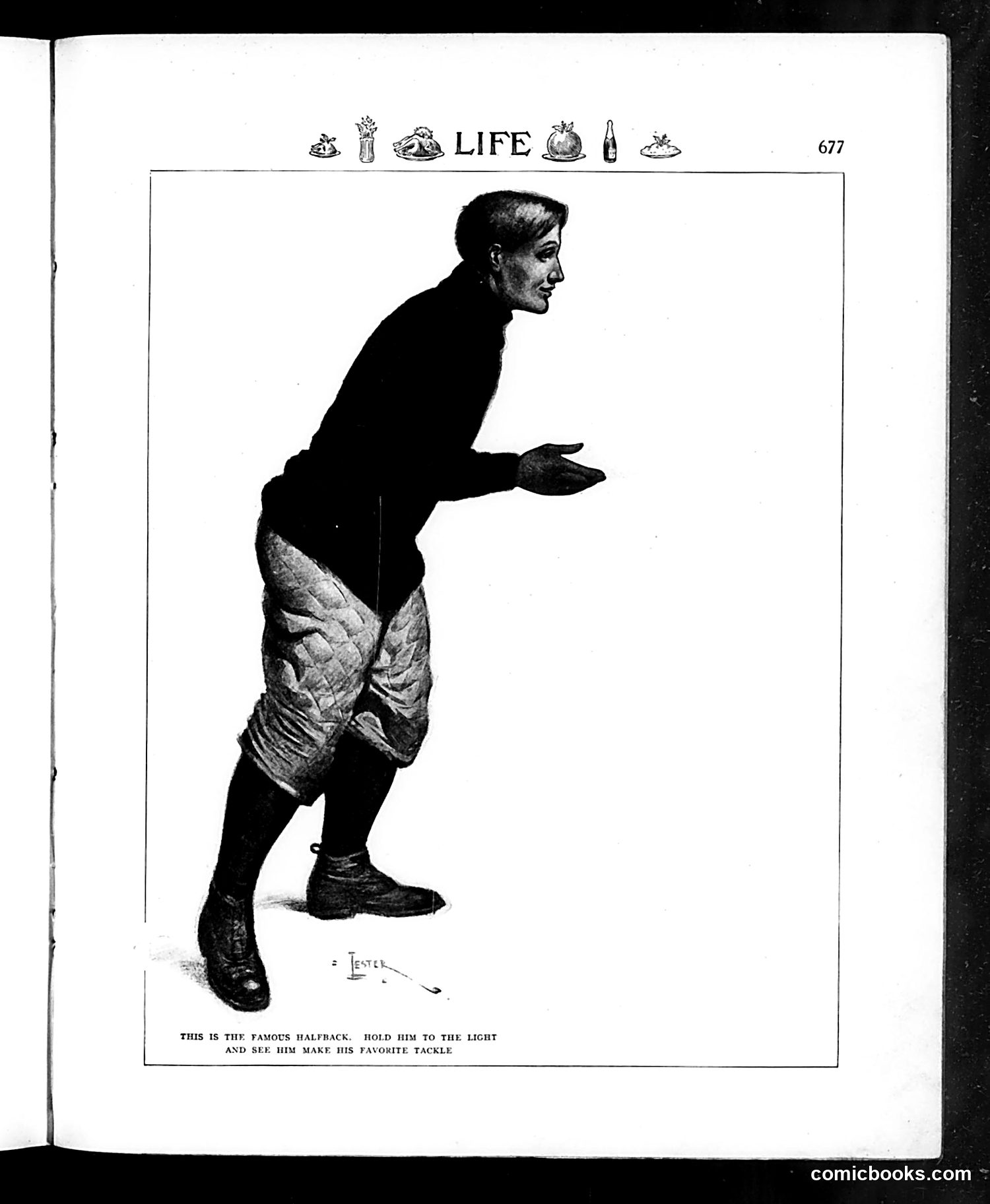
This appears to be a sports satire illustration from Life magazine (page 677). The image shows a man in an athletic crouching position wearing a dark jacket and light-colored shorts, depicted in profile. The caption references "the famous halfback" and instructs readers to "hold him to the light" to see him "make his favorite tackle." This suggests the illustration contains a hidden image or optical illusion visible only when backlit—a common gimmick in early 20th-century publications. Without additional context, the specific athlete being referenced is unclear. The satire likely mocks either a particular football player's tackling technique or athletic ability, relying on the visual trick to deliver its comedic point. The illustration's style and page number suggest this is from an early 1900s issue of Life.
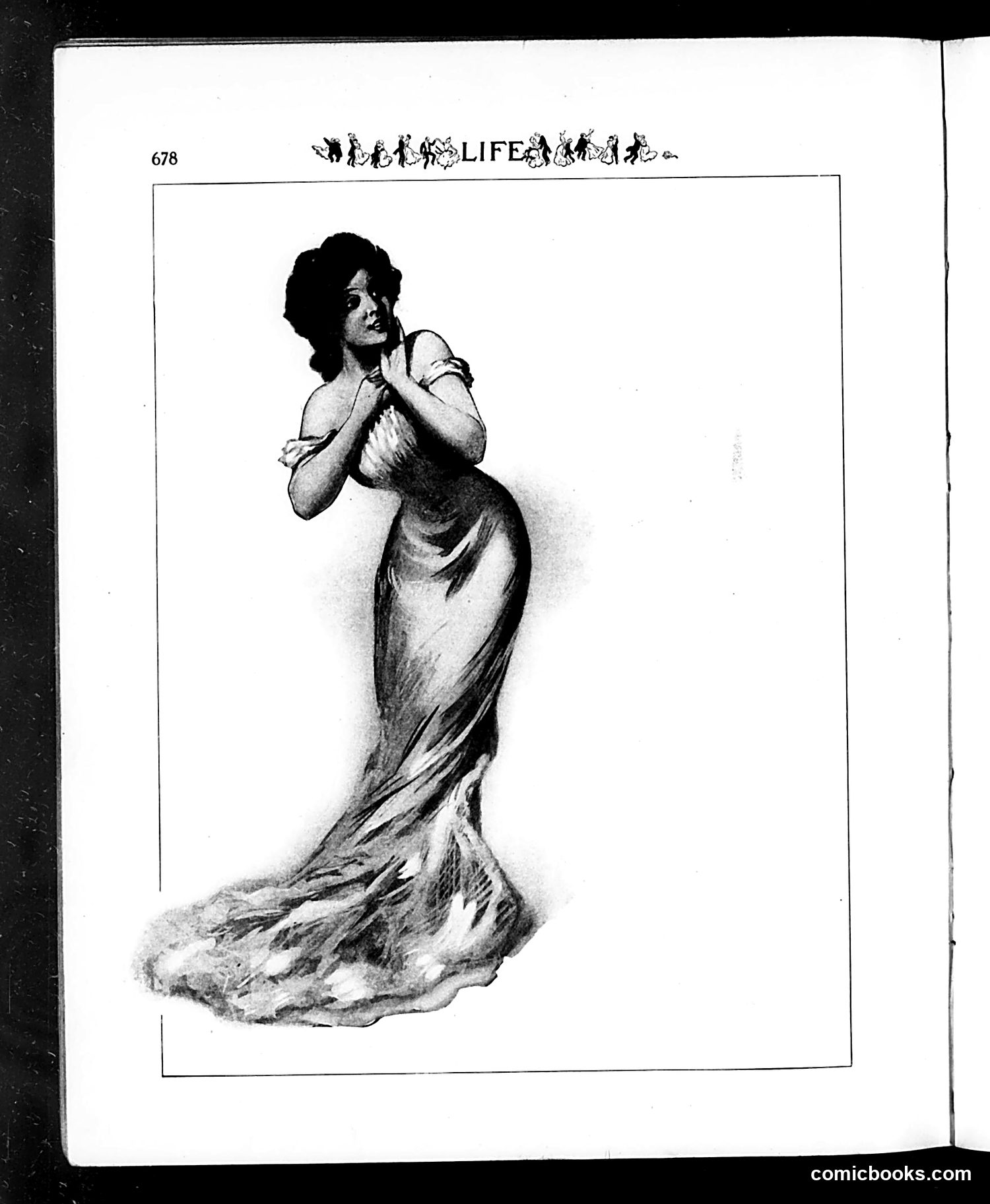
This page from *Life* magazine (page 678) features a single illustration: a stylized drawing of a woman in an elegant, flowing gown with a long train. She is posed gracefully, looking upward with her hands positioned near her shoulders in a contemplative or distressed gesture. Without additional context or caption text visible on this page, the specific satirical point is unclear. The illustration appears to be either: - A fashion or beauty commentary - Possibly social satire about women's roles or expectations - A generic artistic illustration rather than political cartoon The absence of OCR text and visible captions makes it impossible to identify the intended subject, reference, or satirical target with confidence. More context from surrounding pages would be needed for accurate interpretation.
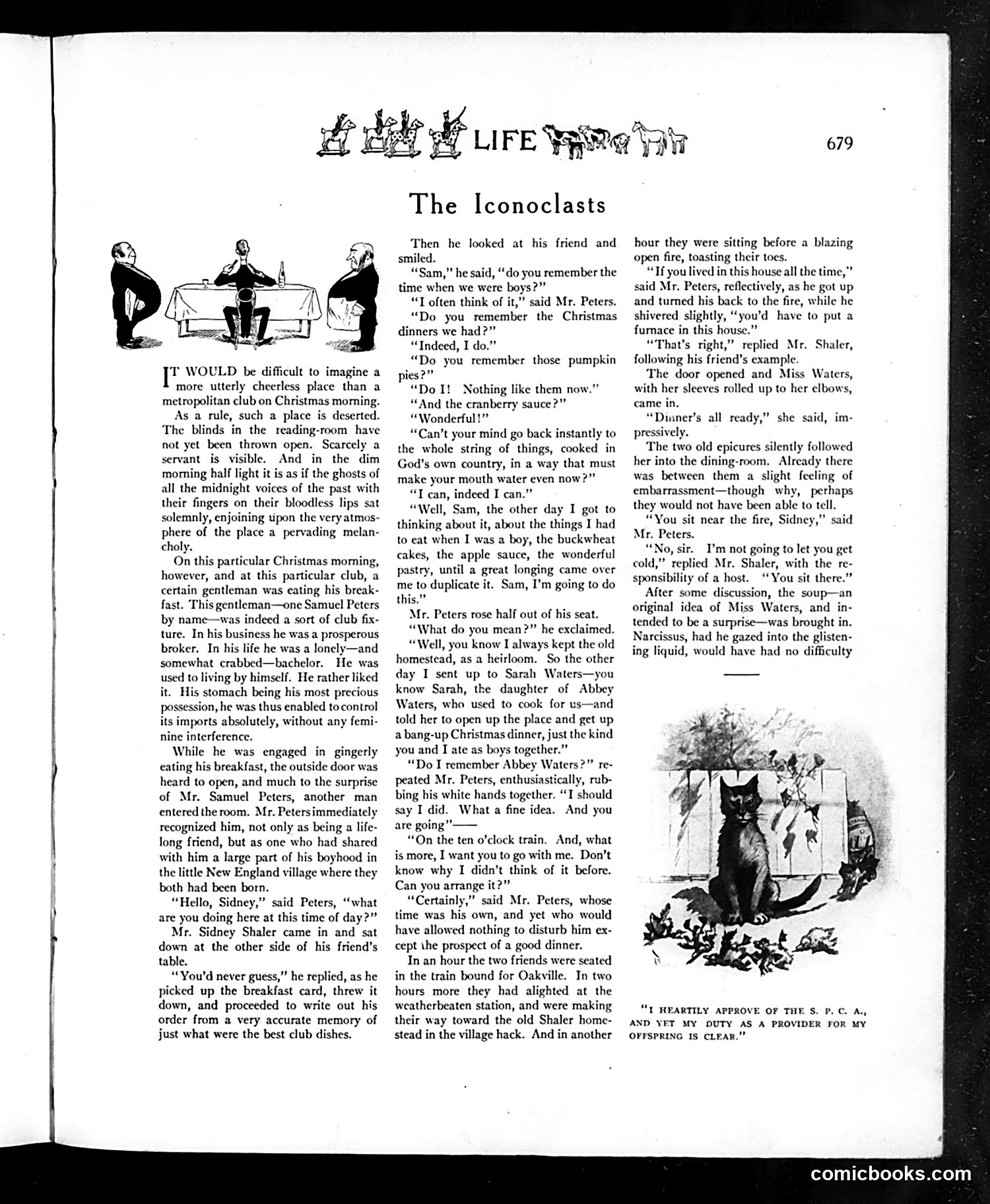
This is a short story (not a political cartoon), appearing in *Life* magazine's satirical section. Two elderly bachelor friends—Samuel Peters and Sidney Shaler—reconnect on Christmas morning at their metropolitan club. Shaler proposes they recreate the food experiences of their New England boyhood by traveling to his family homestead and having an old family cook (Sarah Waters, daughter of Abbey Waters) prepare a traditional Christmas dinner. The satire targets **upper-class male nostalgia and bachelor domesticity**. The joke centers on how these prosperous, independent men—who pride themselves on controlling their lives through precise eating habits—become childishly sentimental over childhood memories. Their willingness to abandon their comfortable club life for recreated "home cooking" satirizes the romantic idealization of rural New England simplicity among wealthy urbanites, and the weakness of supposedly self-sufficient bachelors when confronted with sentimental longing. The title "The Iconoclasts" is ironic: these men who consider themselves independent are actually enslaved by nostalgia.
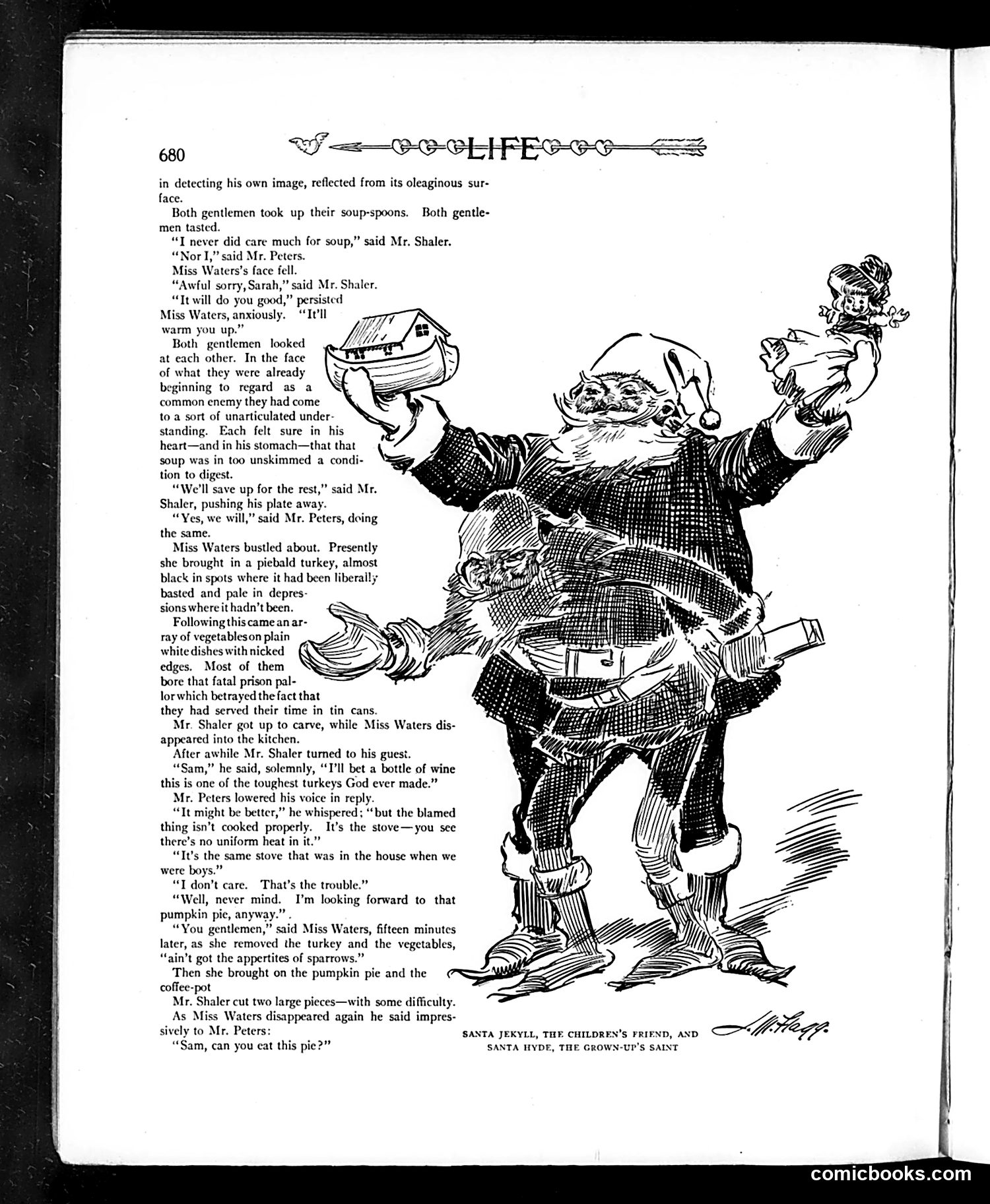
This page presents a humorous domestic narrative illustrated by a central cartoon figure. The text describes two gentlemen (Mr. Shaler and Mr. Peters) dining at Miss Waters's home, where they secretly bond over their mutual dismay at her cooking—unappetizing soup, a tough turkey, canned vegetables, and an inedible pie. The accompanying illustration depicts "Santa Jekyll" and "Santa Hyde"—a visual pun on Robert Louis Stevenson's *Dr. Jekyll and Mr. Hyde* (1886). The dual-natured Santa figure holds both children's gifts and kitchen implements, suggesting the contrast between Santa's cheerful public persona and the domestic reality of poor cooking or household management. The caption labels him as both "the children's friend" and "the grown-up's saint," emphasizing the moral duality. The satire mocks both poor domestic cooking and the polite social fiction of appreciating bad food—a common early-20th-century household scenario where guests suffered silently through inadequate meals.
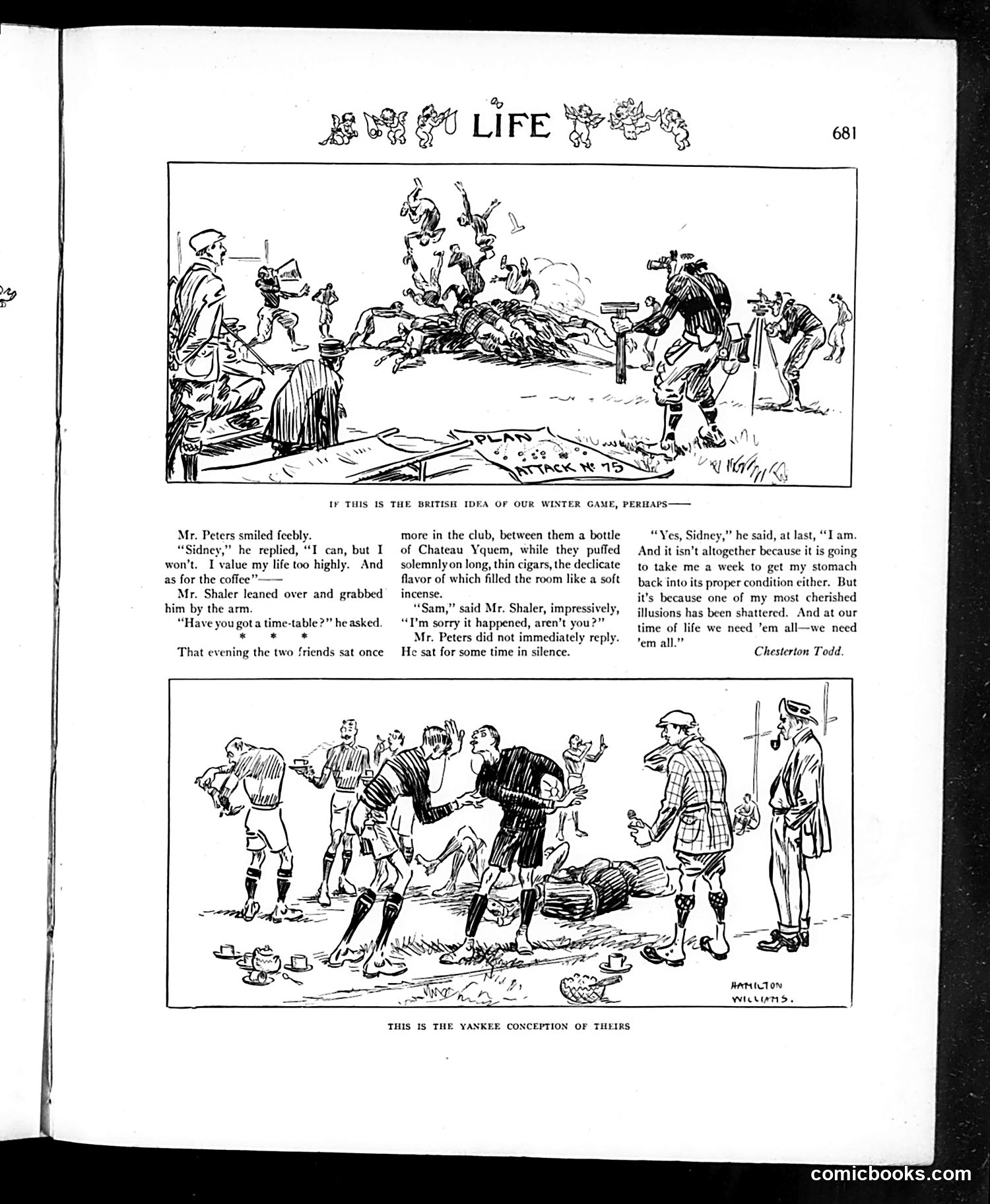
This page contains two contrasting cartoons satirizing how British and American attitudes differ regarding winter sports and outdoor activities. **Top cartoon:** Titled "If This Is the British Idea of Our Winter Game," it depicts a chaotic, violent scene with men engaged in rough play. The accompanying dialogue between Mr. Peters and Mr. Shaler humorously suggests that British people find American winter sports dangerously brutal—Peters refuses to participate because he "value[s] my life too highly." **Bottom cartoon:** Captioned "This Is the Yankee Conception of Theirs," it shows Americans' stereotypical view of British winter activities: genteel, civilized men in formal dress leisurely enjoying tea and refreshments outdoors. **The satire:** The page mocks Anglo-American cultural stereotypes—depicting Britons as viewing American sports as violent and chaotic, while Americans imagine British recreation as refined and mannered. The juxtaposition humorously exaggerates the perceived cultural differences between the two nations regarding leisure and masculine activity.
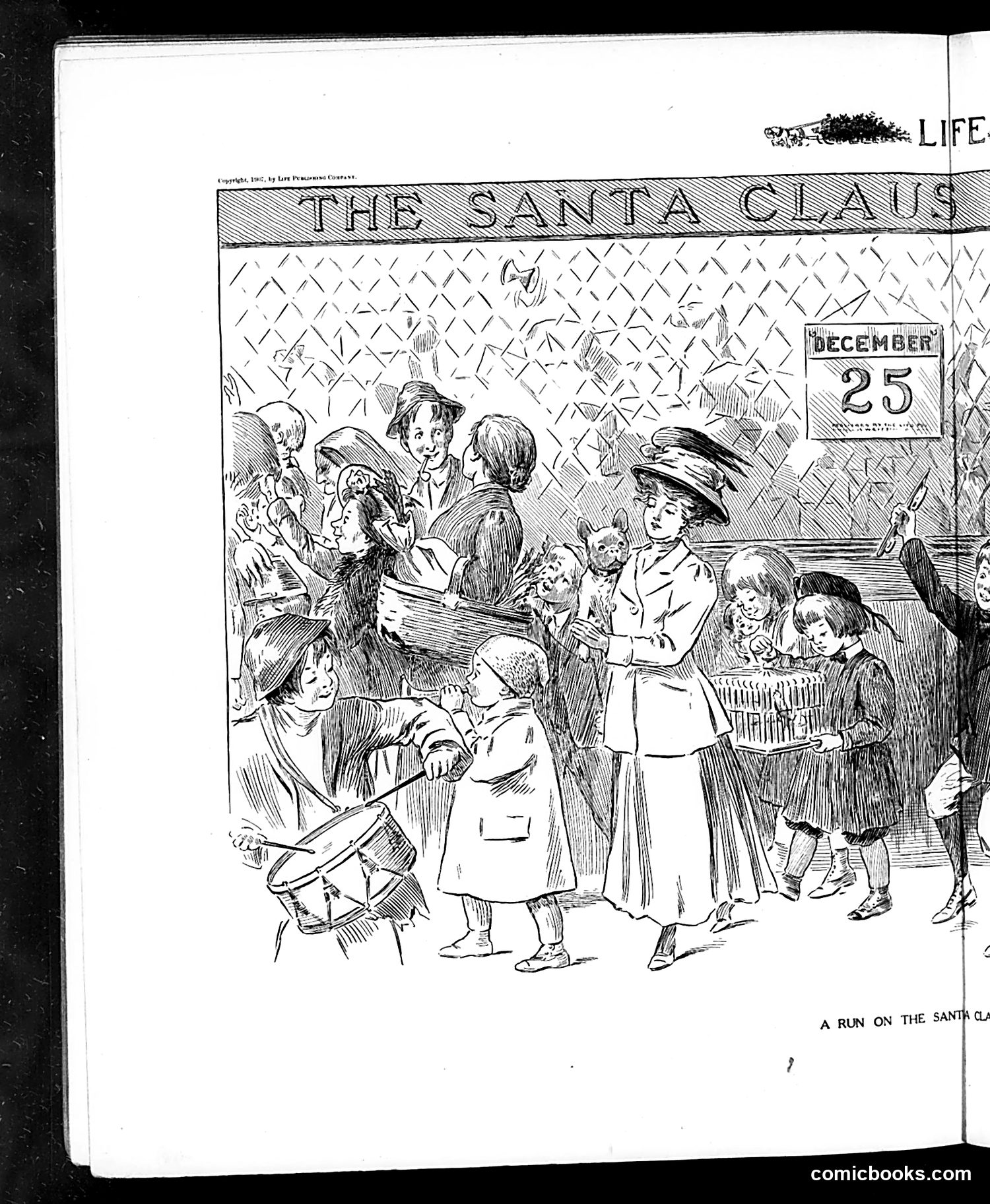
This Life magazine cartoon, titled "A Run on the Santa Claus" (caption visible at bottom), depicts a crowded scene of children and adults mobbing what appears to be a Santa Claus figure during the Christmas season. The date stamp shows December 25, suggesting this is a holiday-themed satirical piece. The satire appears to mock the commercial frenzy and desperation surrounding Christmas gift-giving and Santa Claus visits. The chaotic crowd scene—with children pushing, adults gesturing, and general pandemonium—exaggerates the stampede-like behavior of holiday shoppers and parents seeking Santa experiences. This critiques how Christmas had become increasingly commercialized by the early 20th century, transforming the holiday into a frantic, materialistic scramble rather than a peaceful, spiritual celebration.
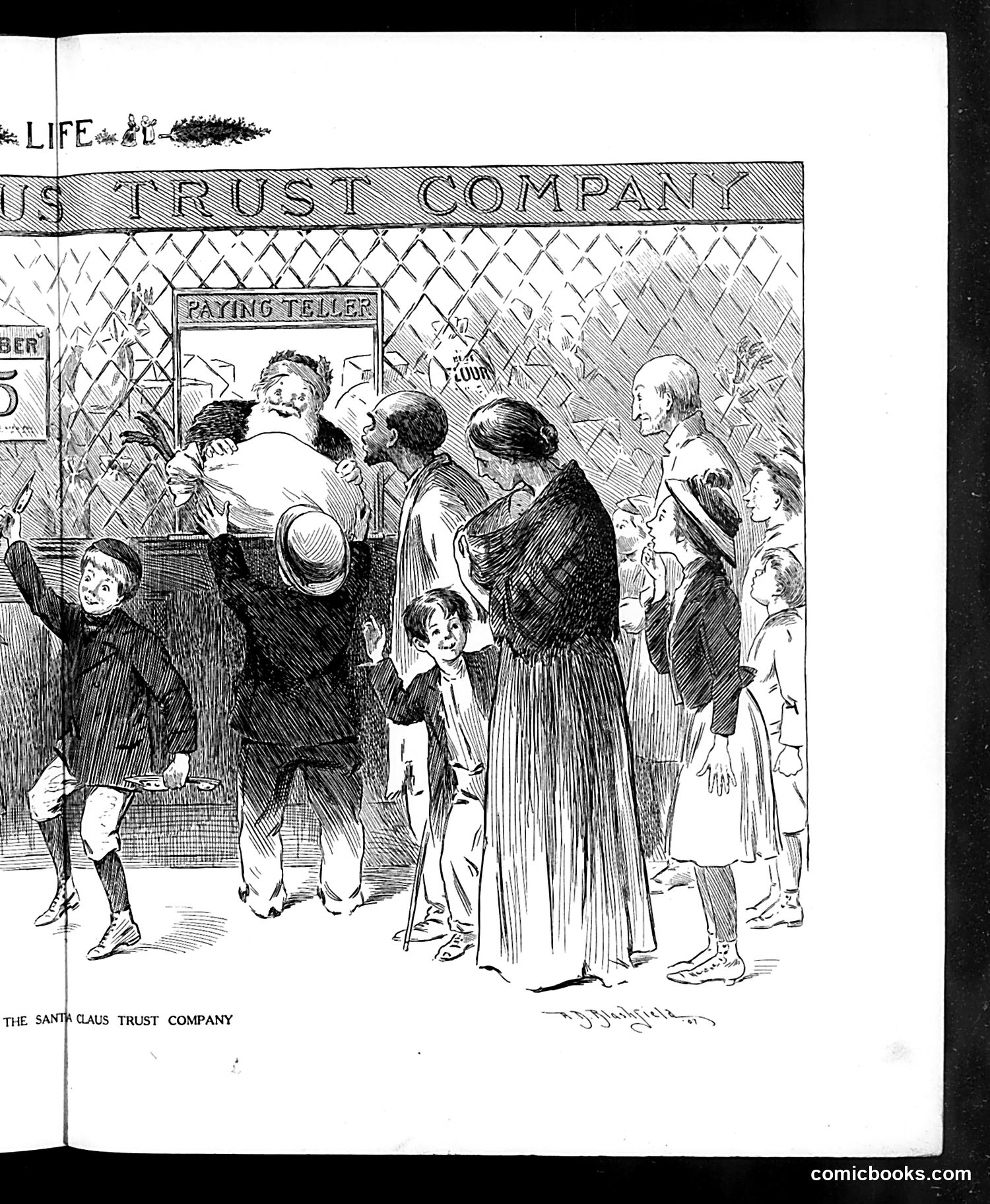
This satirical cartoon critiques fraudulent financial schemes masquerading as legitimate businesses. The image shows a crowd—including families with children—queuing at a "Paying Teller" window of the "Santa Claus Trust Company." The "trust company" signage at top suggests this is a banking operation. The satire works on multiple levels: the name "Santa Claus Trust Company" implies false promises and deception (Santa Claus being associated with magical gift-giving), while the actual operation appears to be a scam targeting ordinary citizens, including vulnerable families. The crowded scene suggests this fraudulent enterprise is thriving despite its obvious dishonesty. This likely references real financial scandals or con-artist schemes common in the early 20th century when Life magazine was active, mocking how easily people could be duped by official-sounding names and operations.
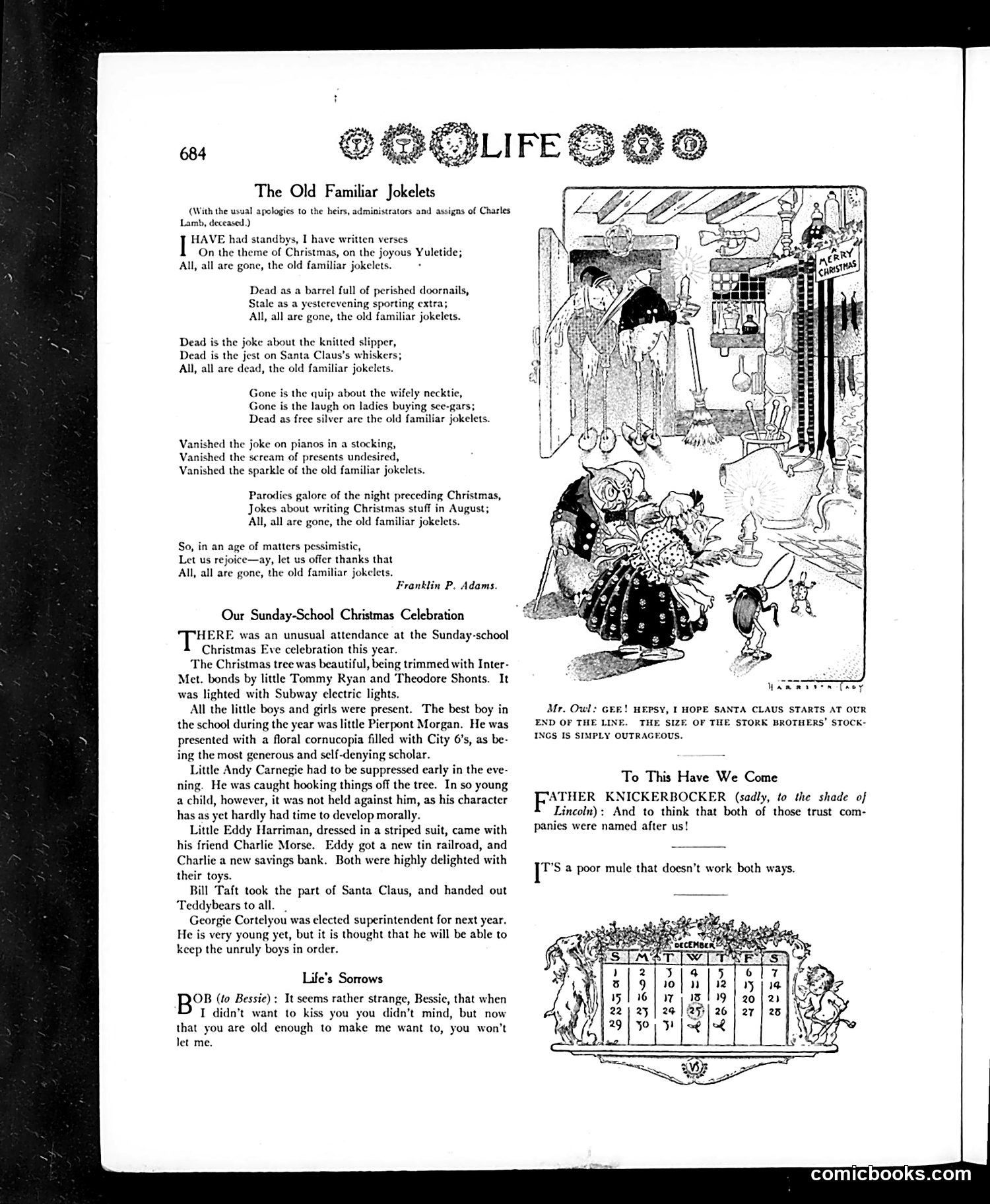
This page mocks the exhausted state of Christmas humor by the early 1900s. Franklin P. Adams's poem laments that all the traditional holiday jokes—about knitted slippers as gifts, Santa's whiskers, pianos in stockings, unwanted presents—have become so stale they're essentially dead. The accompanying illustration satirizes wealthy industrialists through a fake "Sunday-School Christmas" where capitalist titans appear as misbehaving children: **Pierpont Morgan** is the "best boy" rewarded for generosity (ironic, given his monopolistic practices); **Andrew Carnegie** is caught stealing from the tree; **William Howard Taft** plays Santa; and **Eddie Harriman** and **Charlie Morse** receive toys symbolizing their business interests. **George Cortelyou** (Roosevelt's Secretary of Commerce) is elected superintendent—suggesting he'll manage these "unruly boys." The satire targets how these powerful men behaved like undisciplined children in their business dealings, while society rewarded their greed as virtue.
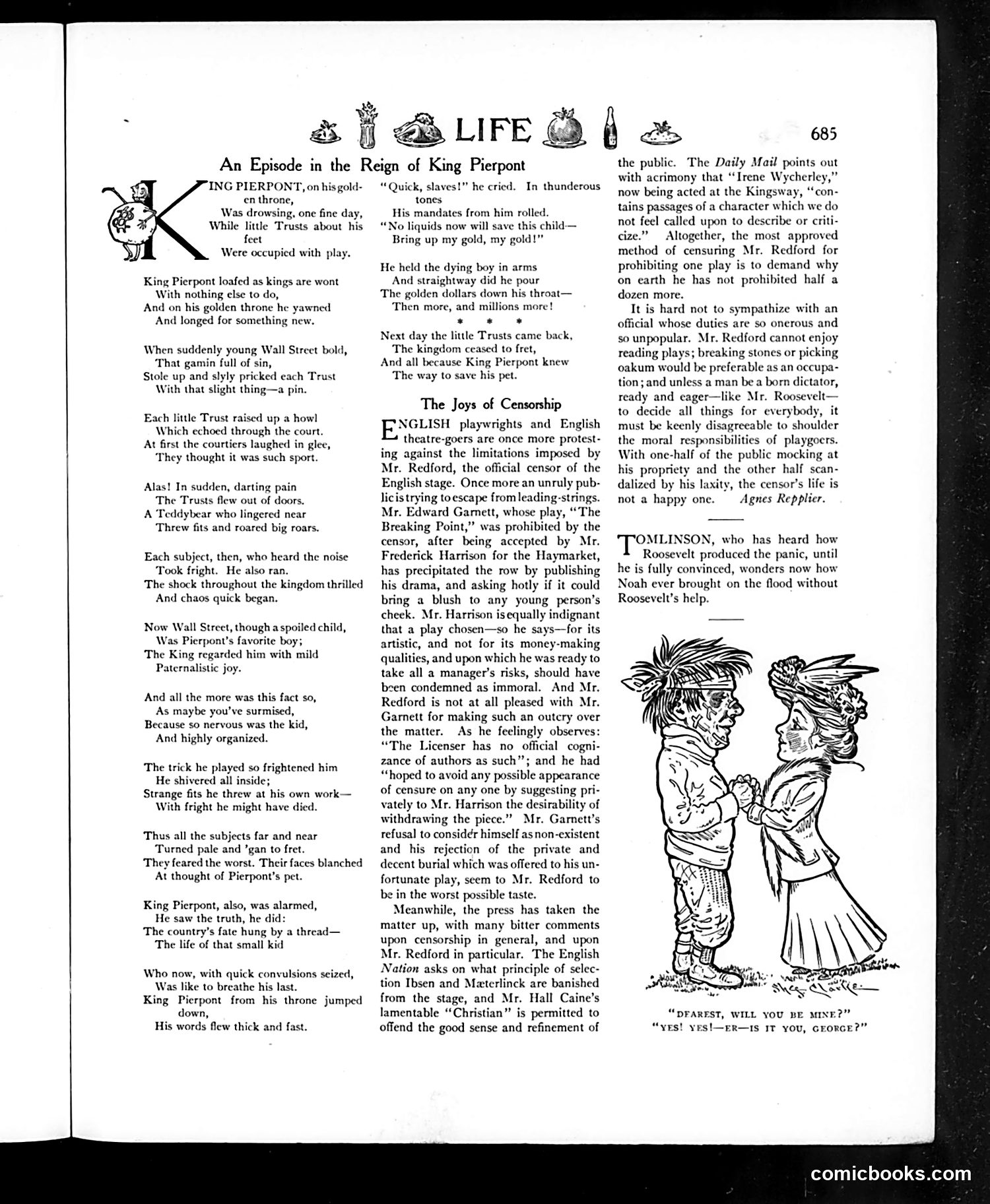
**"King Pierpont"** is a satirical poem about J.P. Morgan (nicknamed "Pierpont"), the powerful financier. "Wall Street" (personified as a mischievous child) causes chaos by "pricking" the Trusts—Morgan's business monopolies—with a pin. When the Trusts scatter and panic spreads through the kingdom, only Morgan's gold can restore order, saving his favorite subject (Wall Street itself). The satire criticizes how Morgan's wealth and financial manipulation control the nation's economy and stability. A small disruption causes massive chaos, yet throwing money at the problem fixes everything—mocking both Morgan's power and the era's financial instability. **"The Joys of Censorship"** discusses English theater censorship under official censor Mr. Redford. Playwright Edward Garnett's play "The Breaking Point" was banned despite being accepted by a theater manager. Garnett published it publicly and questioned whether it was actually immoral. The article criticizes Redford's secretive, paternalistic censorship while mocking his offense at being publicly challenged.
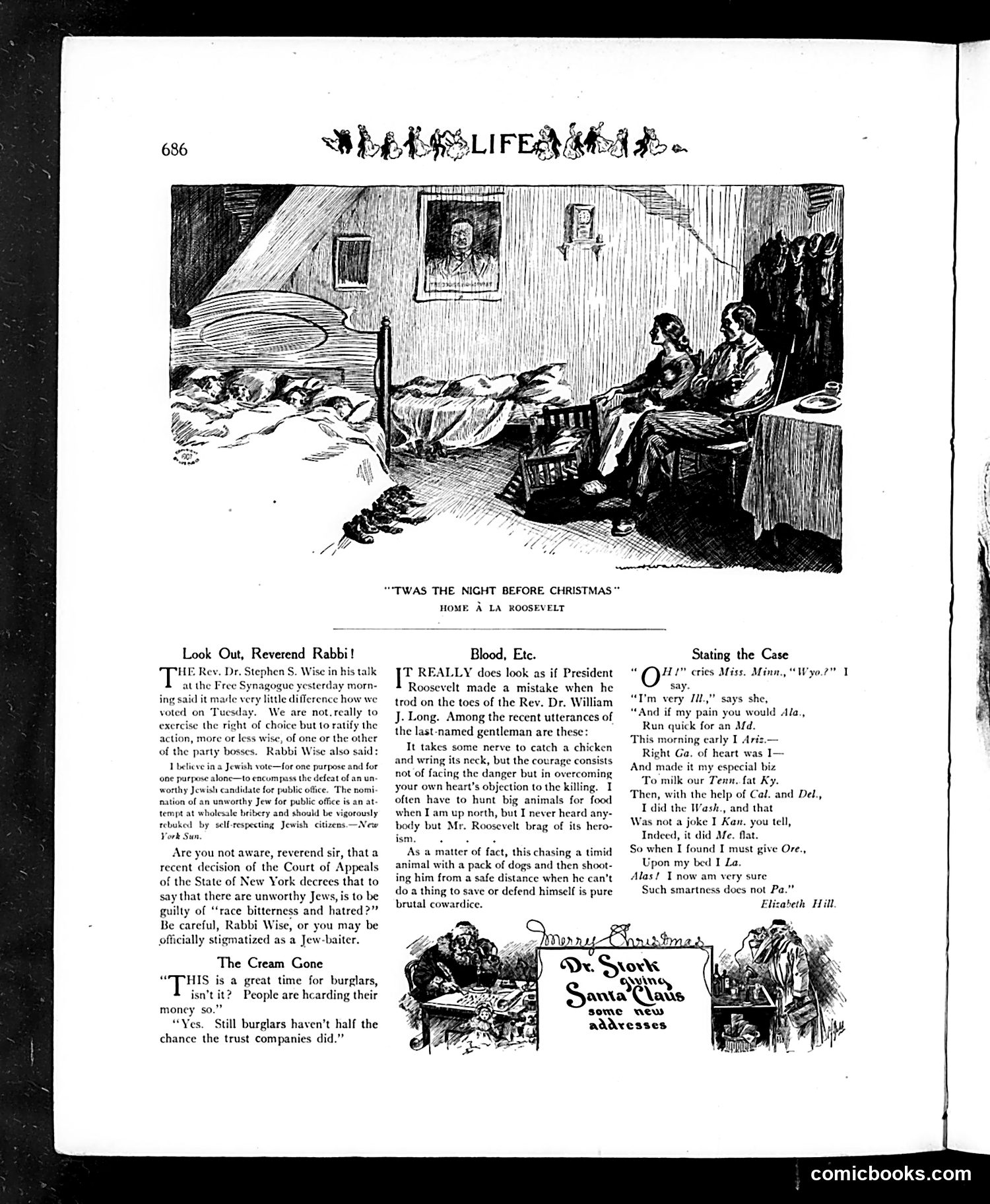
This page contains three distinct satirical pieces: **"Look Out, Reverend Rabbi!"** attacks Rabbi Stephen S. Wise for advocating a "Jewish vote" to prevent unworthy Jewish candidates from office. The satire warns that a recent New York Court of Appeals decision declared it illegal to claim Jews can be unworthy—making Wise's statement potentially prosecutable as "race hatred." This reflects tension between ethnic bloc voting and anti-discrimination law. **"The Cream Gone"** is a brief joke about trust companies being worse for burglars than current economic hoarding—likely referencing public distrust of financial institutions. **"'Twas the Night Before Christmas: Home à la Roosevelt"** appears to criticize President Theodore Roosevelt's hunting practices. Reverend William J. Long accused Roosevelt of cowardice for shooting cornered animals from safe distances rather than engaging them fairly, contrasting it with genuine hunting courage. The bottom contains "Stating the Case," a state-name pun poem (unclear exact reference without date context).
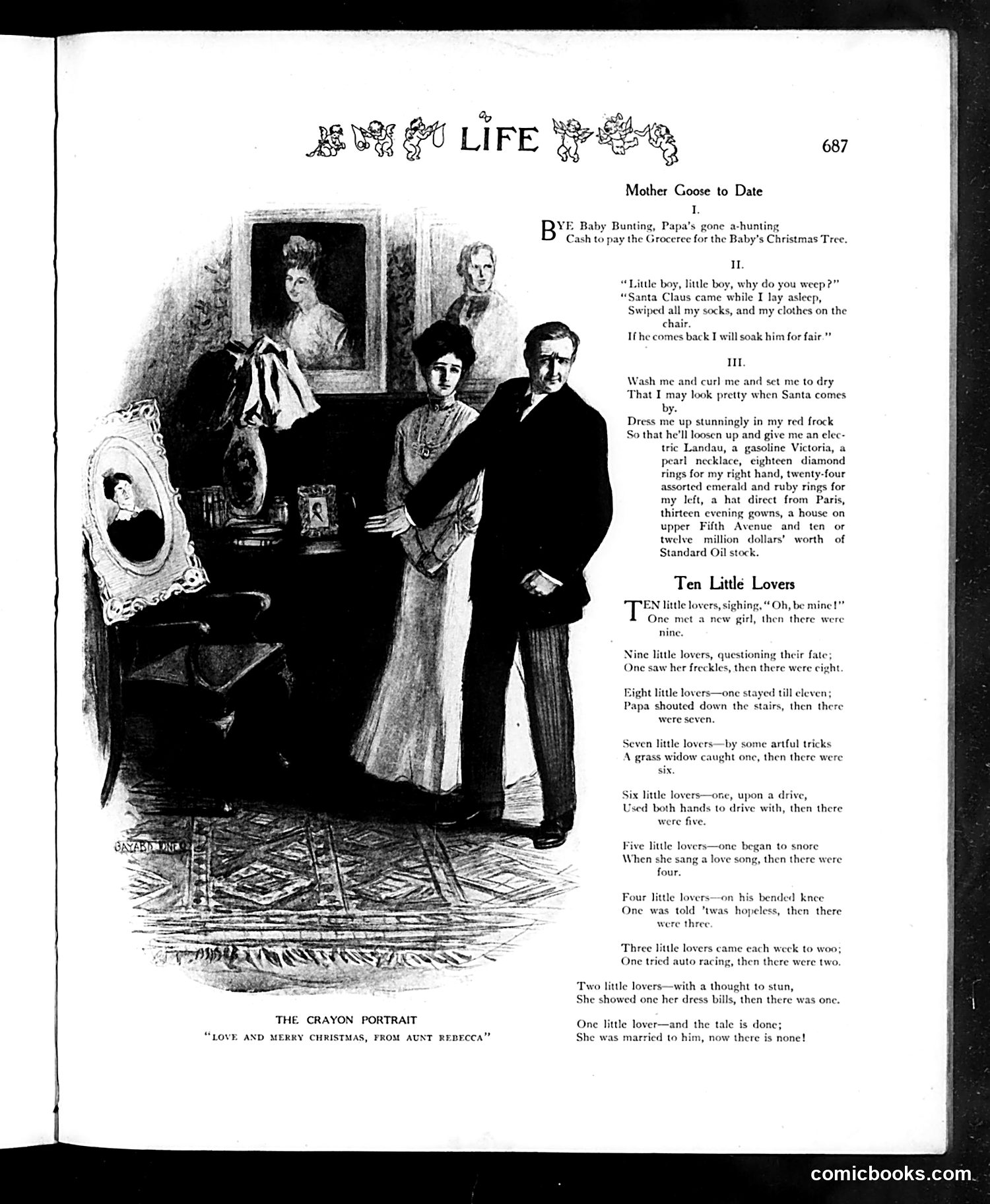
This page contains three satirical pieces mocking early 20th-century materialism and social customs: **"Mother Goose to Date"** updates traditional nursery rhymes with contemporary greed. Section I jokes that fathers must work to afford Christmas trees. Section II presents a child complaining Santa "swiped" his clothes—inverting the gift-giving dynamic. Section III depicts a girl's materialistic Christmas wishes: not toys, but jewelry, luxury cars, Fifth Avenue homes, and Standard Oil stock—mocking the extravagant expectations wealthy children had developed. **"Ten Little Lovers"** is a darkly comic countdown rhyme (based on "Ten Little Indians") where romantic relationships collapse for mundane reasons: infidelity, physical flaws, parental interference, distraction while driving, snoring, financial burden (dress bills), and racing. The final lover marries and becomes "none"—suggesting marriage ends the romantic phase. **"The Crayon Portrait"** illustration shows a family gathering, with the caption humorously attributing the scene to "Aunt Rebecca," likely a sentimental greeting typical of the era. Overall, the page satirizes materialistic values, failed romance, and sentimental hypocrisy in contemporary American society.
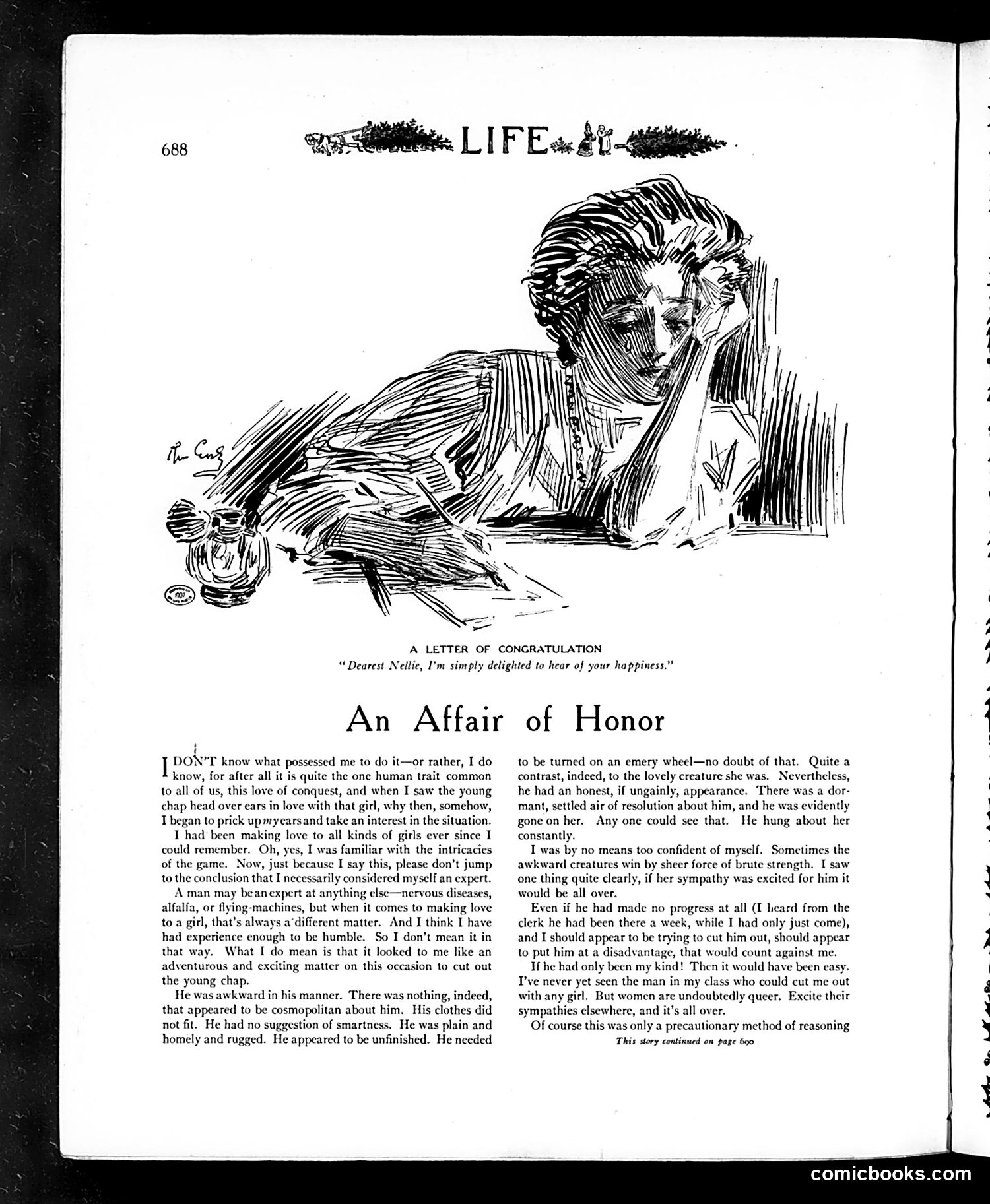
This page presents the opening of a serialized short story rather than political satire. The illustration shows a woman writing a letter of congratulation to "Dearest Nellie" about her happiness. The narrative that follows is a first-person account by a man describing his decision to romantically pursue a young woman already courted by another man—described as plain, awkward, and homely. The narrator, considering himself more sophisticated and accomplished, sees winning her affections as an "adventurous" conquest. The story explores themes of romantic rivalry and social competition common to early 20th-century popular fiction. There's no apparent political commentary; this appears to be straightforward magazine entertainment aimed at readers interested in romantic drama and character psychology. The text continues on page 60, indicating this is serialized fiction rather than a standalone comic or satirical piece.
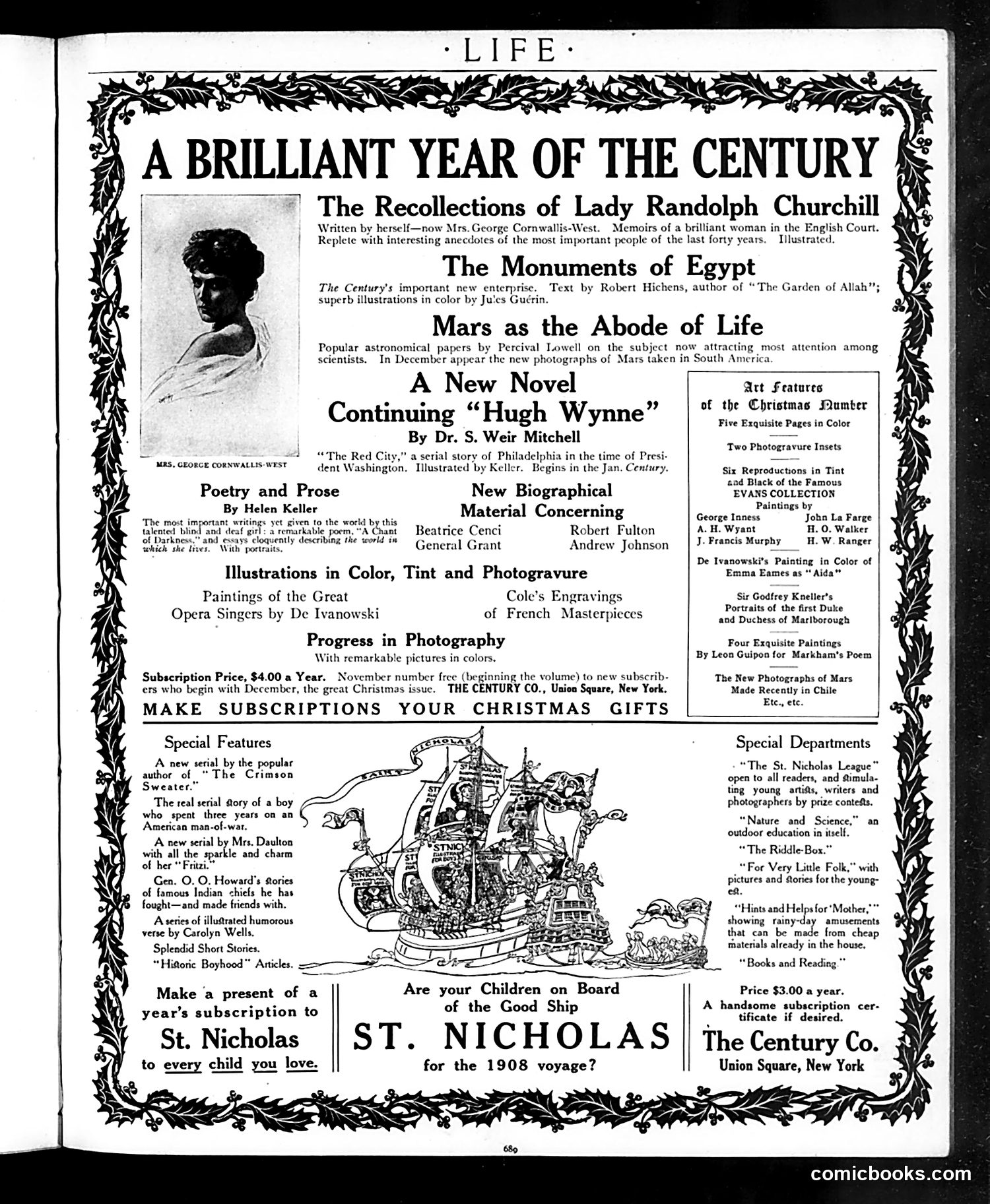
This is primarily an **advertising/contents page** for The Century Magazine and St. Nicholas children's magazine, not a satirical cartoon page. The page announces upcoming content including Lady Randolph Churchill's memoirs, articles on Egyptian monuments and Mars, and serialized fiction. It features a portrait of **Mrs. George Cornwallis-West** (Churchill's married name), identifying her as "a brilliant woman in the English Court." The decorative ship illustration promotes **St. Nicholas magazine's 1908 voyage**—a subscription gift marketed to parents for children. Key context for modern readers: This represents *Life* magazine's pre-1920s format as a **literary and cultural publication** rather than the photo-journalism magazine it later became. The emphasis on serialized novels, poetry by Helen Keller, and high-art reproductions reflects early 20th-century elite reading culture. The $4.00 annual subscription price ($130+ today) indicates this was expensive, upscale content for wealthy families.
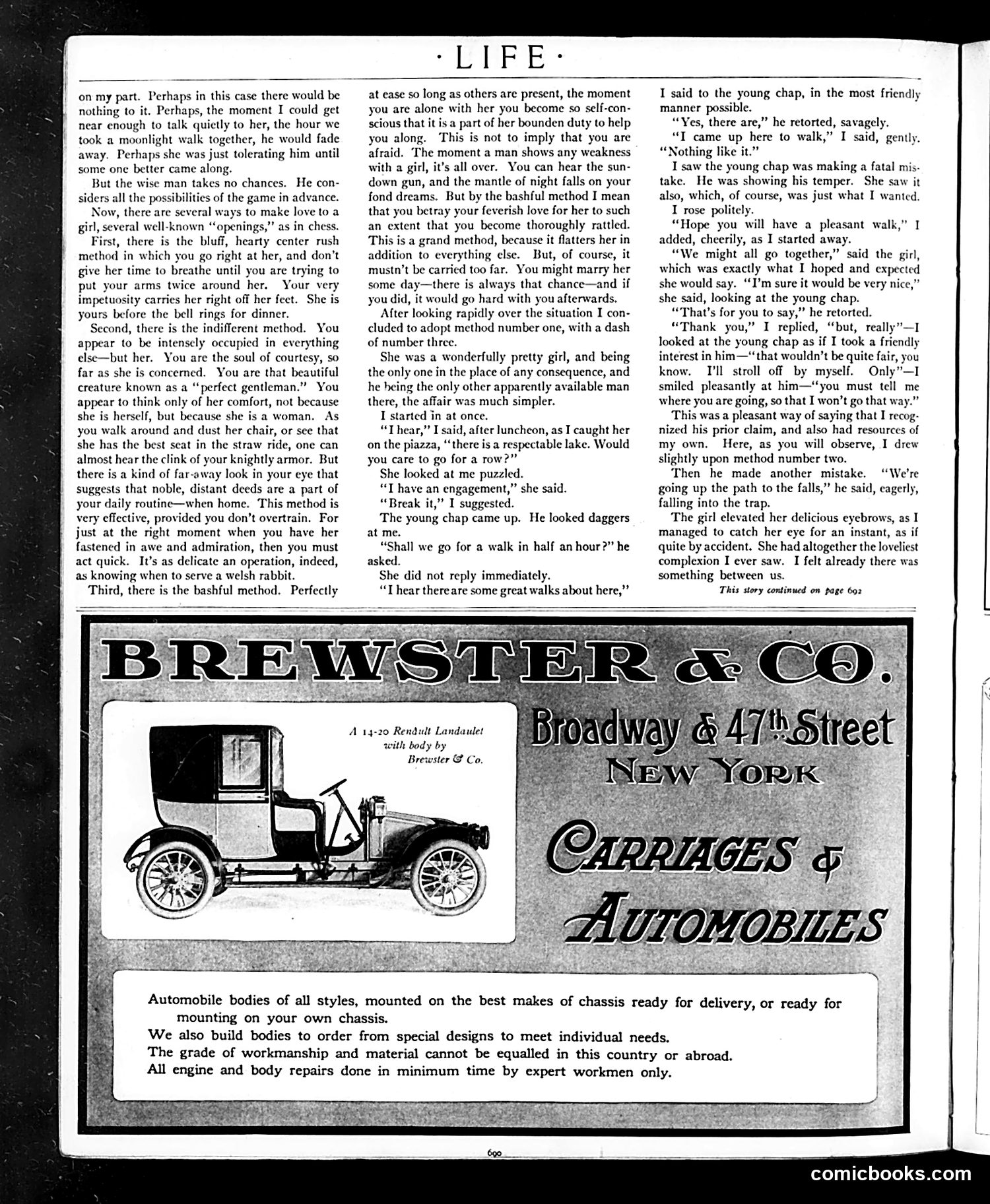
This page presents a serialized short story about courtship strategy, not a political cartoon. The narrative describes three "methods" for courting women—the aggressive "center rush," the detached "perfect gentleman," and the bashful approach—written as if romance were a chess game to be strategically calculated. The story's protagonist applies these tactics to win over a "wonderfully pretty girl" away from a rival suitor. The humor derives from treating romantic pursuit as a calculated game with psychological manipulation, which reflects early 20th-century attitudes toward courtship as a competitive male enterprise. The advertisement below shows a Brewster & Co. automobile (a luxury carriage-maker), reflecting the era when automobiles signaled wealth and status—relevant context for a story about social competition and courting. The page reflects period attitudes about gender dynamics that modern readers would find problematic: women are objects to be strategically "won" rather than active participants in romantic choice.
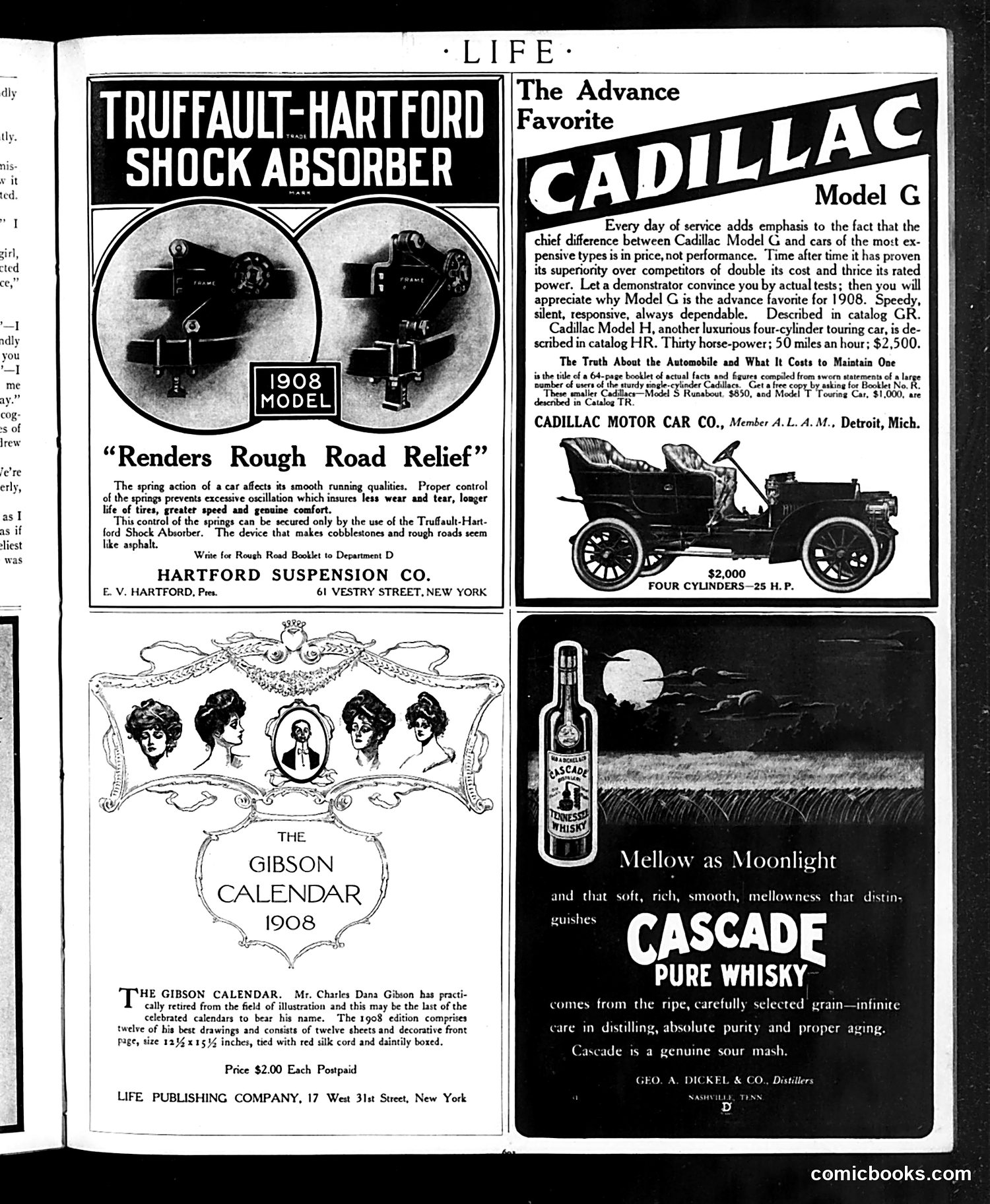
This page consists entirely of **advertisements**, not satirical cartoons. It features four commercial promotions typical of 1908: 1. **Truffault-Hartford Shock Absorber**: Promotes suspension technology for automobiles, claiming it smooths rough roads. 2. **Cadillac Model G automobile**: Emphasizes that Cadillac's quality matches more expensive competitors, priced at $2,500 for the Model H touring car. 3. **Gibson Calendar**: Announces Charles Dana Gibson's 1908 calendar—described as possibly his last—featuring twelve illustrations, priced at $2.00. Gibson was famous for his "Gibson Girl" illustrations. 4. **Cascade Pure Whisky**: A spirits advertisement using poetic language ("Mellow as Moonlight") and imagery of moonlit fields. The page reflects early 1900s consumer culture, showcasing luxury goods (automobiles, whisky) and cultural products (Gibson's prestigious artwork) targeted at affluent readers. No satire or political commentary is present.
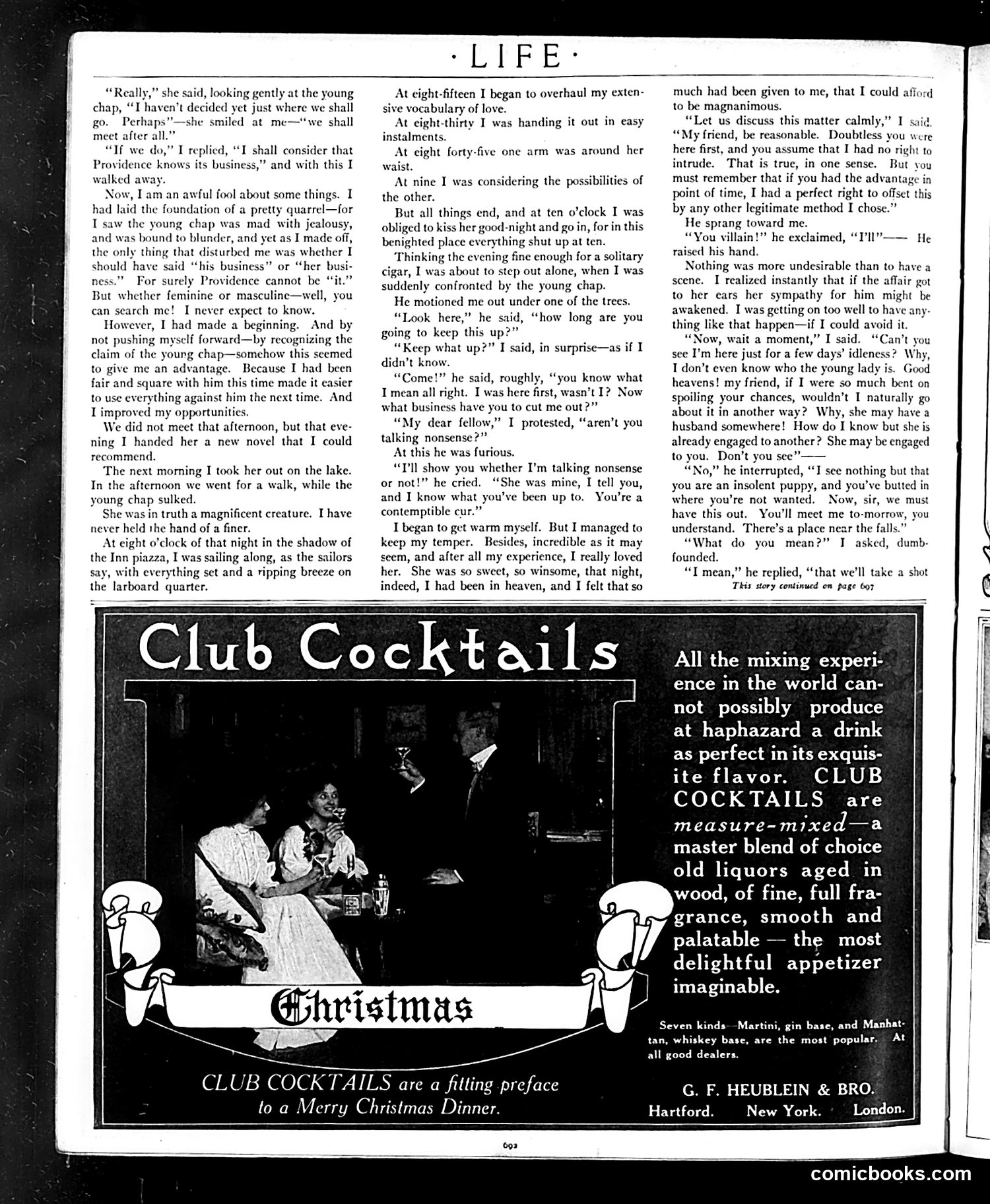
This page contains a serialized short story (continued from previous issue) about romantic rivalry, alongside a **Club Cocktails advertisement** featuring a Christmas scene. **The Story:** A narrator describes systematically winning over a woman from a rival suitor through calculated charm. He acknowledges his own moral weakness—admitting he's willing to exploit an advantage unfairly—while justifying his behavior through superior reasoning and emotional investment. When the original suitor confronts him, the narrator claims magnanimity while internally recognizing the real advantage lies in avoiding a "scene" that might damage his standing with the woman. **The Social Context:** This reflects early 20th-century attitudes about romantic conquest as strategic competition between men, with the woman as a prize. The narrator's self-aware narration suggests *Life* magazine's satirical intent—exposing masculine duplicity and rationalization rather than endorsing it. **The Advertisement:** Uses an elegant Christmas party scene to market pre-mixed cocktails as sophisticated holiday refreshments, positioning them as markers of refined taste and proper entertaining.
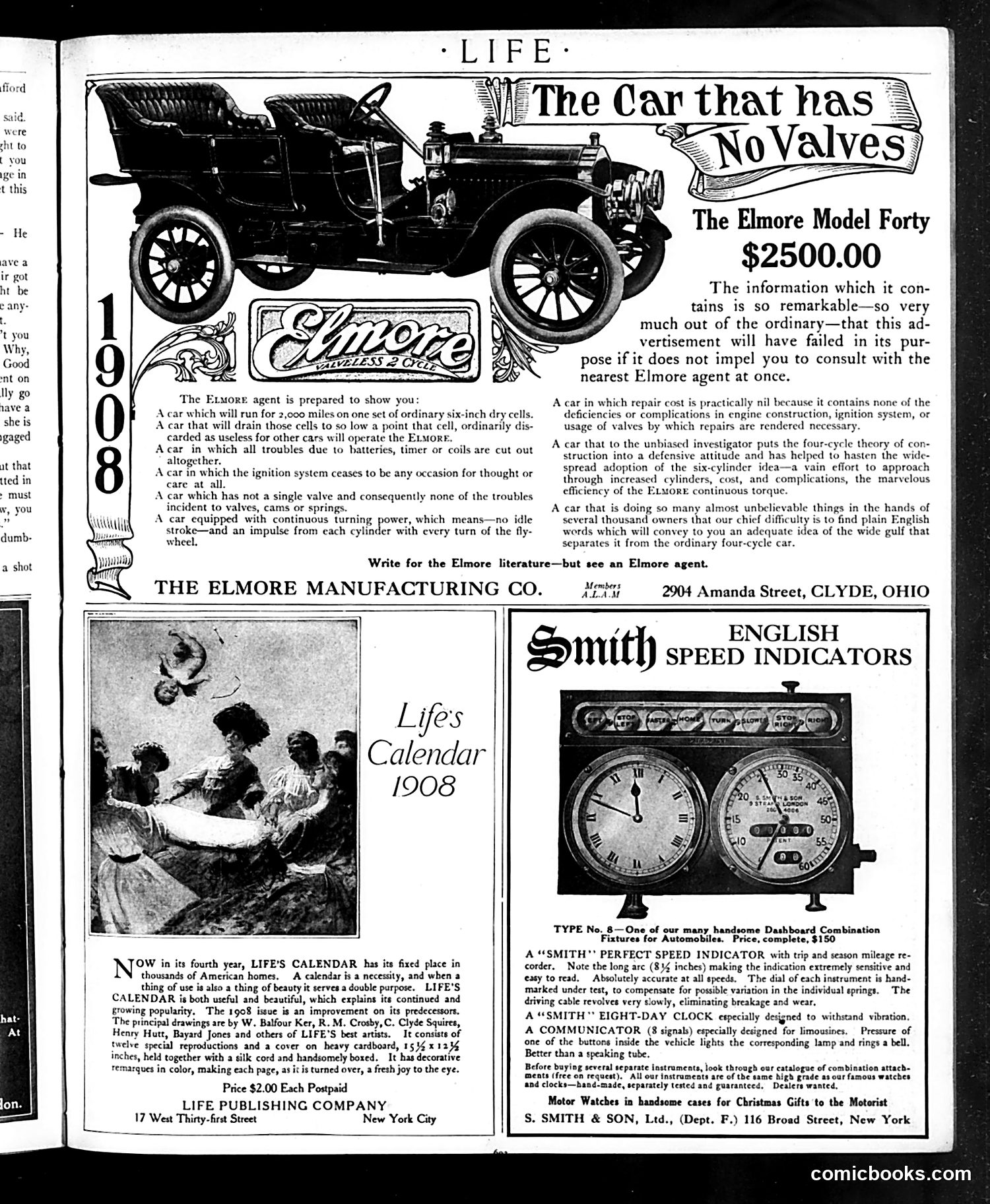
This page contains **advertising rather than satire**. The dominant content is a full-page advertisement for the **Elmore Model Forty automobile** ($2,500), which the manufacturer promotes as "The Car that has No Valves." The advertisement's pitch is that the Elmore's lack of valves, along with its six-cylinder design and "continuous turning power," eliminates common car troubles. It makes grandiose claims—repair costs "practically nil," runs 2,000 miles on one battery set, and represents superior engineering theory compared to traditional four-cycle engines. The page also includes announcements for **Life's 1908 Calendar** (a collectible publication featuring artwork by prominent illustrators) and an advertisement for **Smith Speed Indicators** (automotive dashboard gauges). There is no political cartoon or satire on this page—it represents typical early 1900s magazine content mixing editorial matter with automobile and consumer product advertising aimed at wealthy readers.
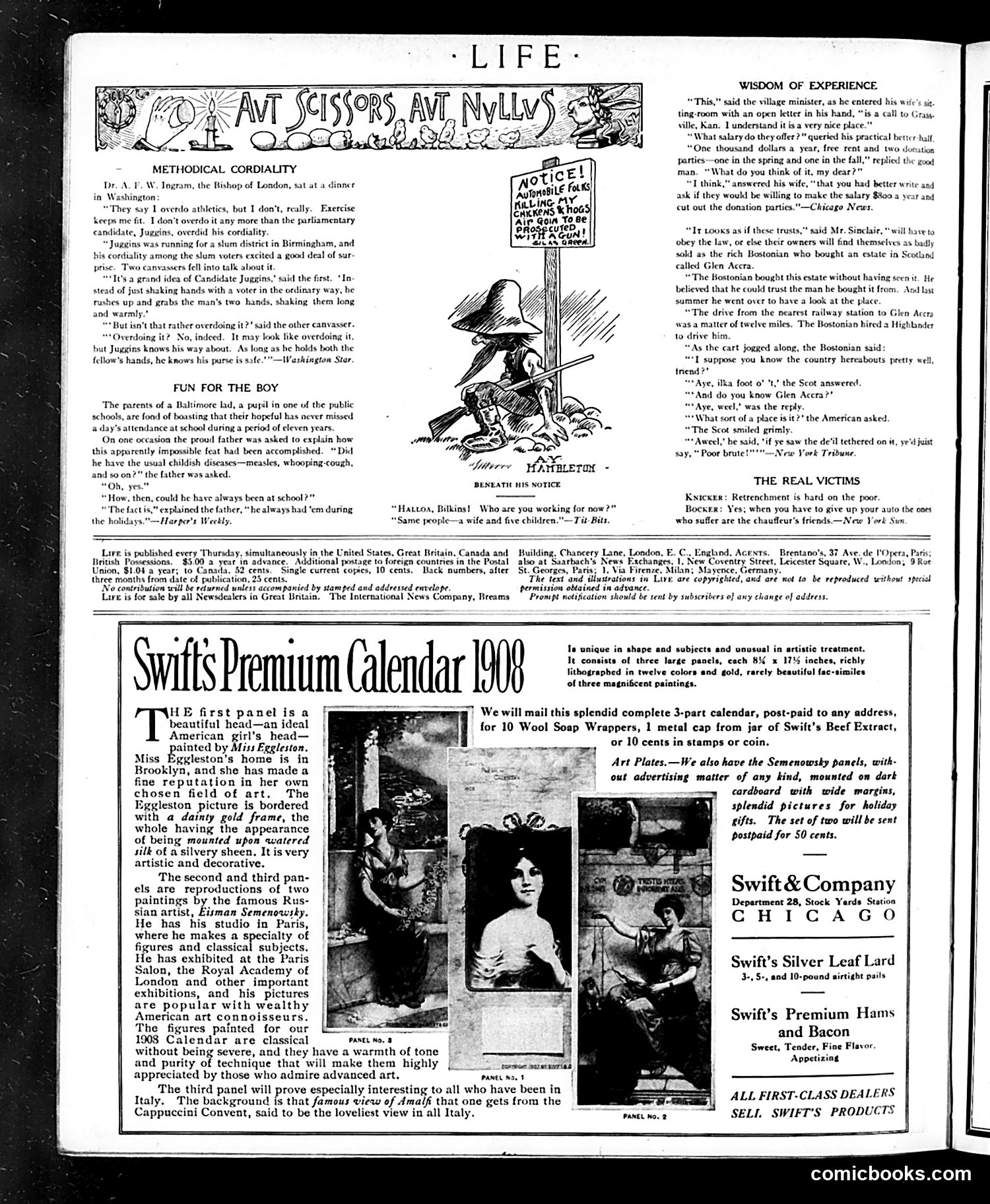
This page contains several brief satirical anecdotes typical of *Life* magazine's humor: **"Wisdom of Experience"**: A minister receives a job offer from a Kansas church. His wife negotiates shrewdly—rather than accept the stated salary plus donation parties, she demands the salary be reduced but donations eliminated, recognizing that unpredictable "donation parties" are unreliable income. **"Methodical Cordiality"**: A politician running for office aggressively shakes voters' hands with both hands held—not from warmth, but because holding both hands prevents voters from reaching their wallets. Dark humor about political manipulation. **"Fun for the Boy"**: A father explains his son's perfect school attendance: he had childhood diseases (measles, whooping-cough) only during holidays, not school days—a joke about parental exaggeration. **"Beneath His Notice"**: A Scottish driver describes the American's purchased estate grimly as cursed ("the dell rethered on it")—satirizing rural Scottish pessimism and the wealthy buyer's gullibility. The page also advertises Swift's Premium Calendar and meat products. The humor reflects early 1900s middle-class anxieties about money, trust, and social climbing.
This is a **full-page advertisement**, not satire or editorial content. It promotes The Prudential Insurance Company's new "Low Cost Policy" for life insurance. The page uses a shield emblem (referencing Gibraltar's strength) and claims the policy provides family protection, home security, and accessible cash. Key marketing points: over 25,000 policies sold in fifteen weeks, $30 million in ordinary life insurance issued, endorsement from business and professional men across all regions. The advertisement targets middle-class readers worried about financial security—a significant concern in early 20th-century America before social safety nets existed. The "Do you want to make money?" closing line recruits agents to sell the policy. **Modern context**: This represents early mass-market life insurance marketing, when such products were still relatively novel and required aggressive salesmanship to convince Americans to adopt them.
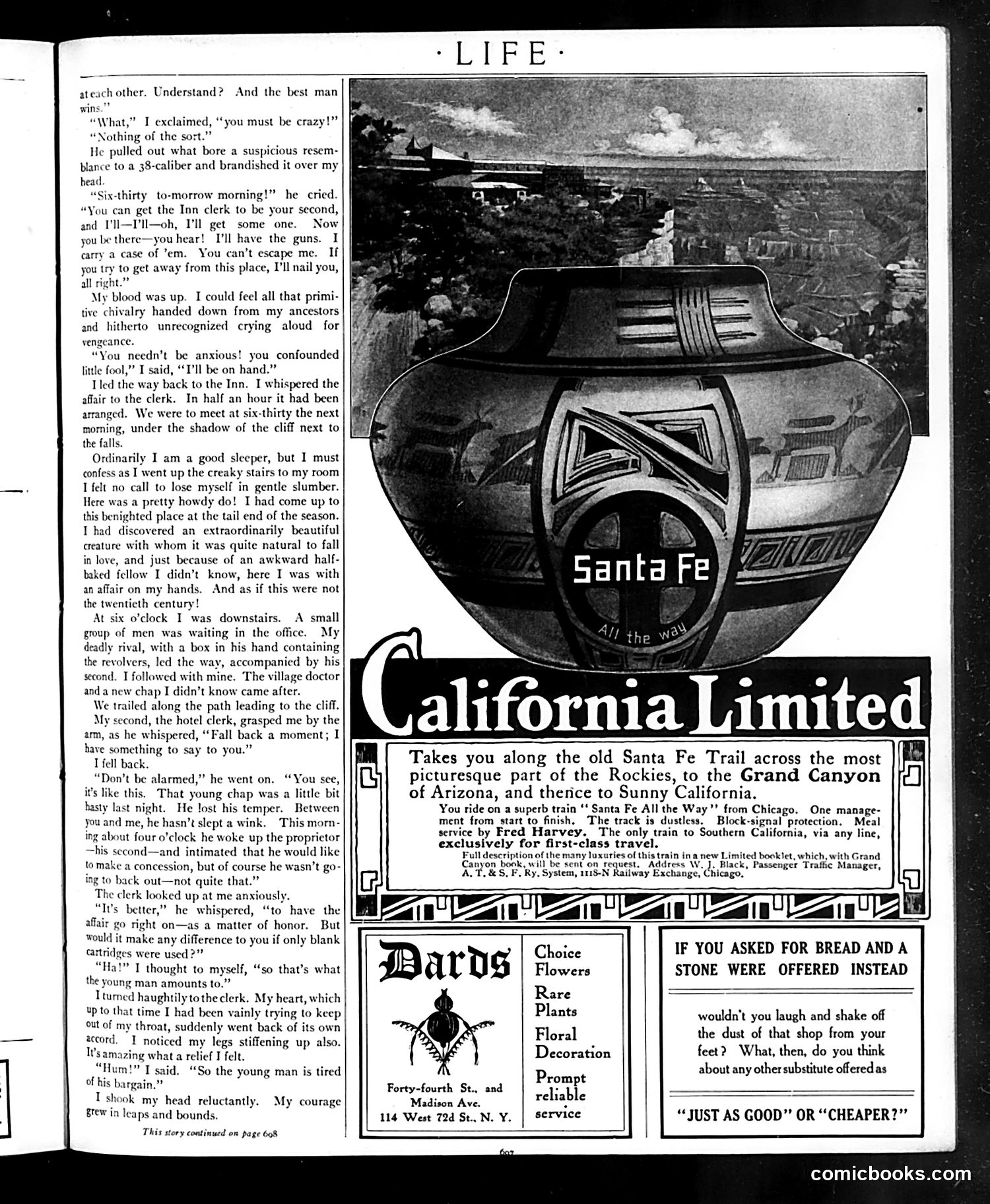
This page combines a serialized short story with advertisements. The main narrative depicts a dramatic duel scenario set at a scenic location (a cliff near falls). The protagonist has become romantically entangled with a woman, prompting a rival to challenge him to a gunfight at dawn. The satire emerges in the resolution: the hotel clerk reveals the rival is merely a hot-headed young man who regrets his challenge and proposes using blank cartridges instead—deflating the melodramatic confrontation into an absurd, face-saving ritual. **Advertisements** include the "California Limited" train service (promoting Santa Fe rail travel to Arizona and California) and Dardos florist shop (offering flowers and plants in Manhattan). The lower advertisement humorously asks: if offered a stone instead of bread, wouldn't you question the substitute? This appears to critique accepting inferior substitutes—likely a meta-joke about advertising itself or consumer skepticism. The page exemplifies *Life*'s blend of satirical fiction mocking romantic melodrama with period advertising.
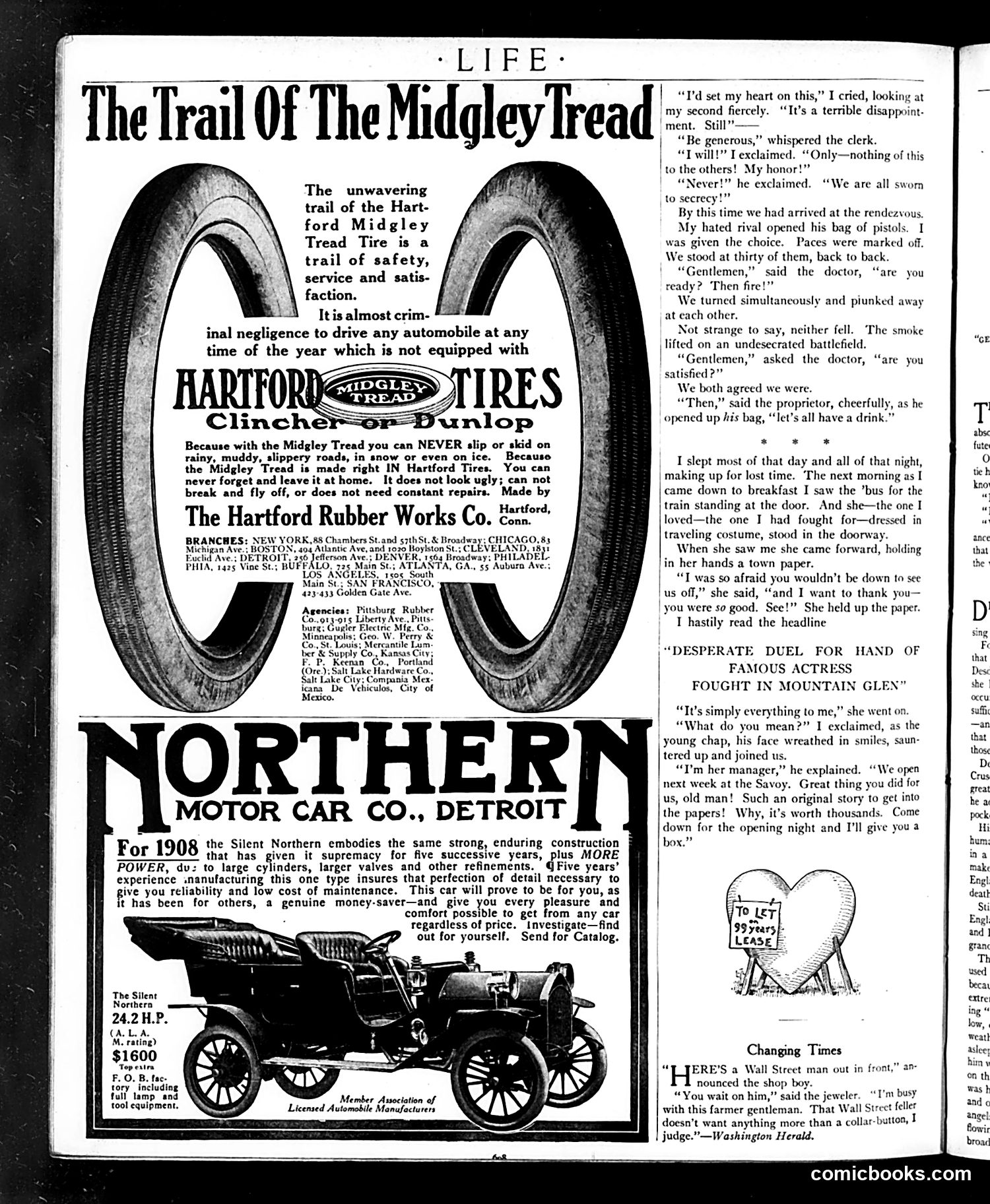
This page mixes **advertising with satirical fiction**. The main narrative (right column) is a short story titled "The Trail of the Midgley Tread" that parodies romantic melodrama: two men duel over a woman, neither is hit, and they reconcile to drink together. The joke's twist: the "duel" was actually staged theater. The woman reveals she's a famous actress, and her manager explains the duel story is now valuable publicity—"worth thousands"—for her theatrical opening. The satire targets how **sensational news gets manufactured and exploited** for commercial gain. What seemed like genuine drama becomes mere marketing fodder. The page is dominated by **automobile advertisements**: Hartford Midgley Tread Tires and Northern Motor Car Company pitch reliability and value to 1908 consumers. The bottom section, "Changing Times," mocks class distinctions—a jeweler prioritizes a farmer customer over an impatient Wall Street man. The overall message: modern life is increasingly theatrical and commercialized.
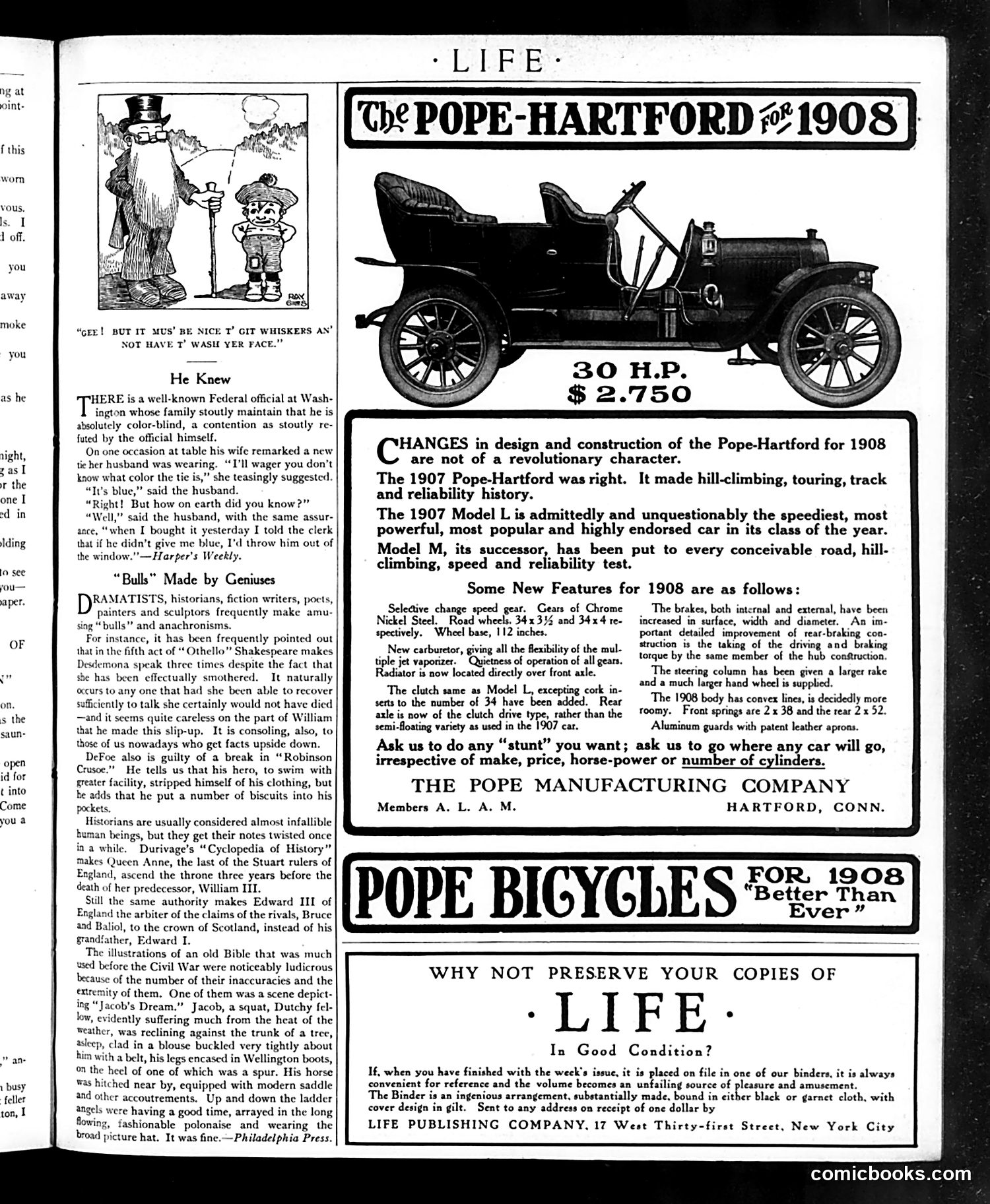
This cartoon satirizes a Federal official's claim of color-blindness. His wife tests him by asking what color his new necktie is. He confidently answers "blue"—then reveals his method: he told the clerk he'd throw him out the window if it *wasn't* blue, so he knows by deduction rather than sight. The joke mocks the official's supposed color-blindness as a transparent fiction. The family maintains he's color-blind; he denies it. This cartoon suggests he's actually neither truly blind nor honest—he's simply clever enough to fake knowledge. It's gentle political satire about bureaucratic pretension and the gap between official claims and reality, illustrated through a domestic anecdote that exposes his opportunistic logic. The page also contains extensive automobile advertising (Pope-Hartford and Pope Bicycles), typical of *Life* magazine's mixed content format.
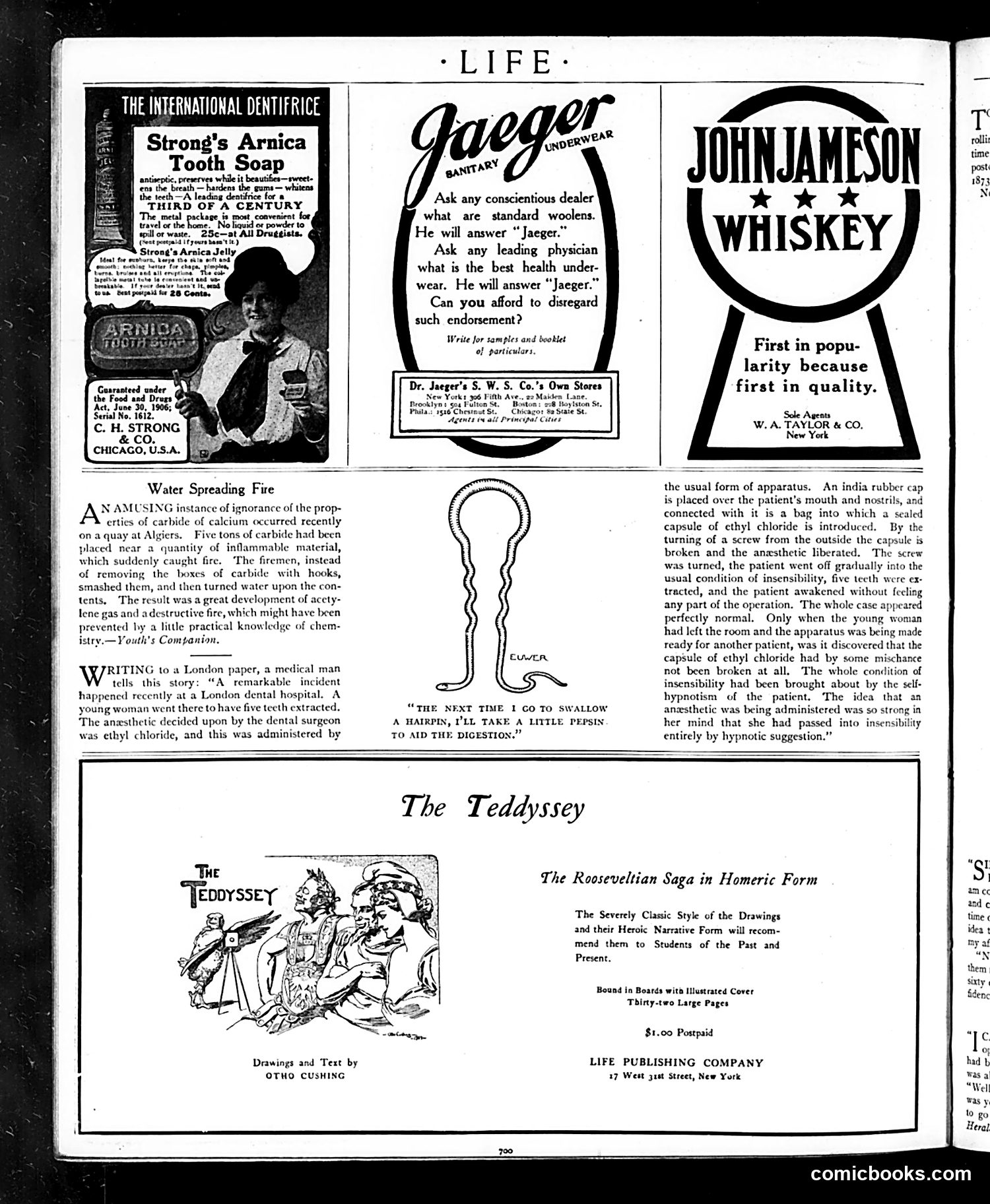
This page from Life magazine (circa early 1900s) contains advertisements and two notable editorial items: **Advertisements:** The top half features three ads promoting consumer goods—dental hygiene, Jaeger brand underwear (claiming physician endorsement), and John Jameson whiskey—typical of the era's marketing tactics. **"Water Spreading Fire":** A brief cautionary anecdote about firemen unknowingly making a calcium carbide fire worse by applying water, illustrating public ignorance of chemistry. **Medical Anecdote:** A London dental hospital story where a patient's tooth extraction proceeds painlessly because the anesthetic capsule *failed to break*—the patient was rendered unconscious entirely by *hypnotic suggestion* and belief in the anesthetic. The passage satirizes the power of psychological expectation over actual medical intervention. **"The Teddyssey":** An advertisement for a book by Otho Cushing featuring drawings about Theodore Roosevelt, presenting his life in the style of Homer's *Odyssey*—a humorous literary parody popular during Roosevelt's presidency. The page is primarily advertising and light editorial content rather than political satire.
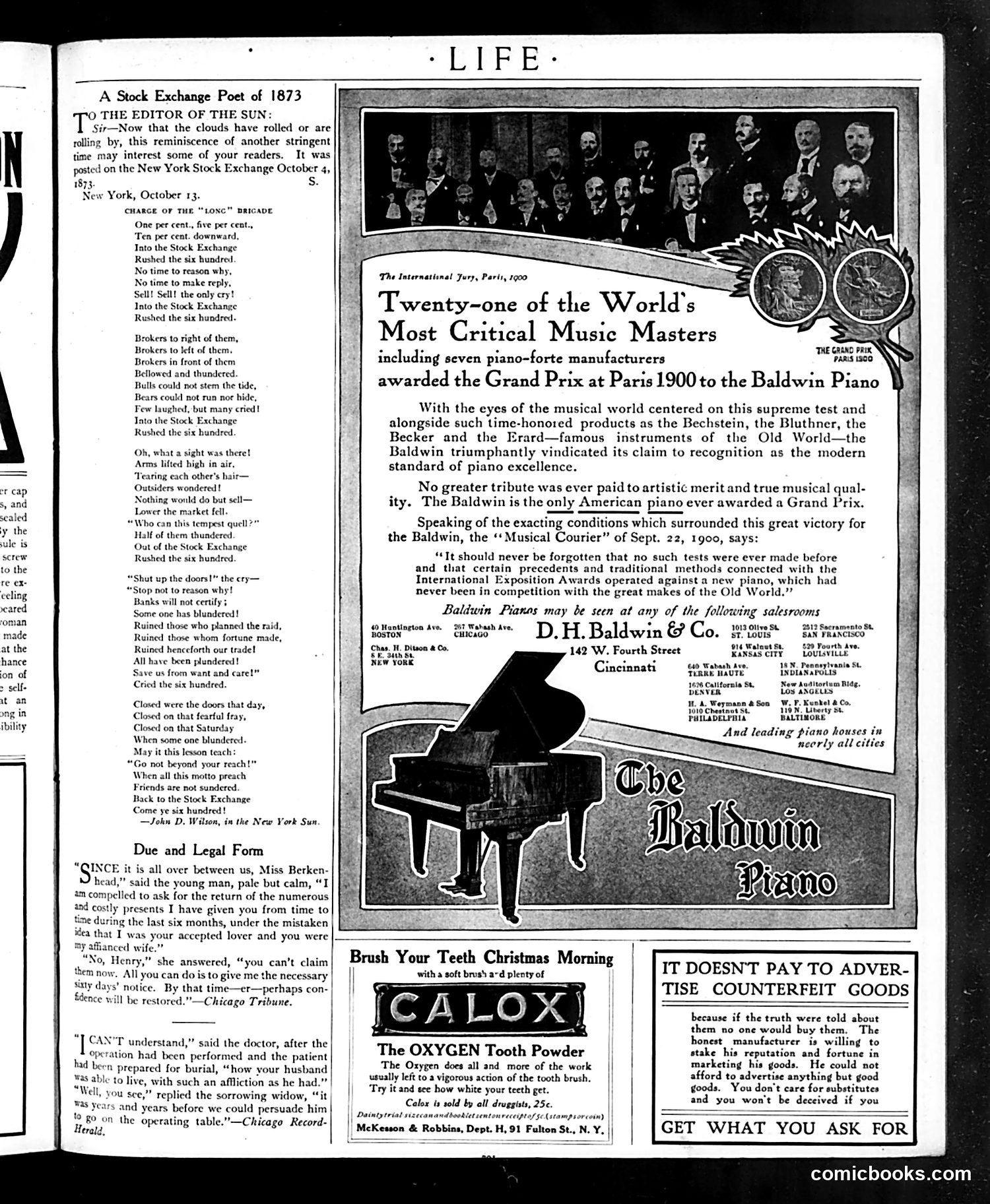
This page contains two main elements: **Left side - "A Stock Exchange Poet of 1873":** A satirical poem parodying Tennyson's "Charge of the Light Brigade," applied to the 1873 stock market crash. It mocks brokers and traders who rushed into the Stock Exchange during financial panic, with lines like "Rushed the six hundred" and "Lower the market fell." The satire compares financial recklessness to military disaster, suggesting both involve blind obedience and avoidable catastrophe. **Right side - Baldwin Piano advertisement:** Celebrates the Baldwin Piano's 1900 Grand Prix award at the Paris International Exposition, positioning it as superior to European competitors (Bechstein, Bluthner, Erard). The ad emphasizes this as the first American piano to win such recognition, appealing to national pride and assertions of American manufacturing excellence. The juxtaposition is typical of *Life* magazine: serious satirical commentary about financial folly paired with contemporary commercial advertising.
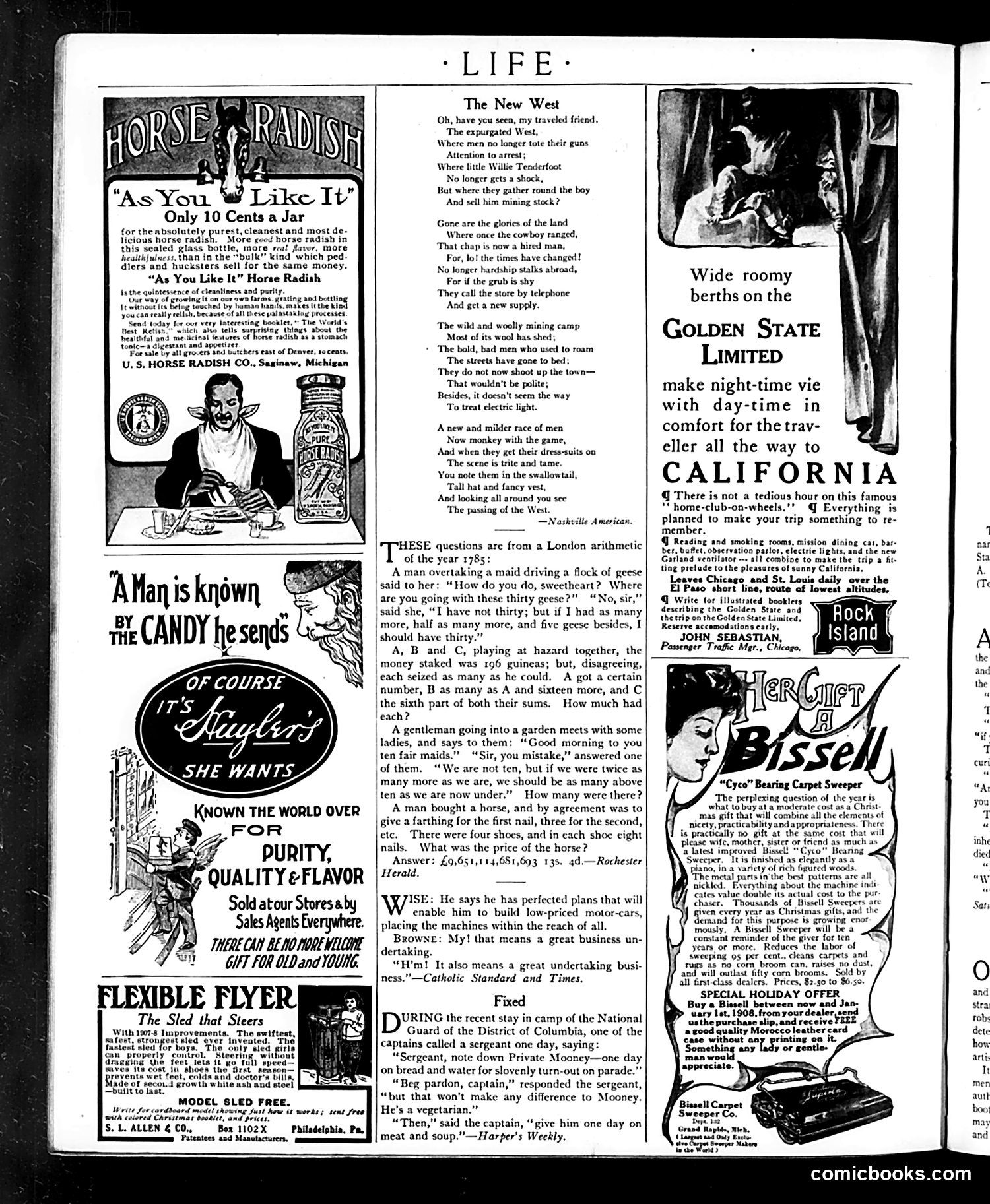
This page features a poem satirizing how the American West has become domesticated and commercialized. The text laments that the "Wild West" of frontier mythology—with gunfights, hardship, and rough cowboys—has been replaced by a sanitized, modern version where: - Former cowboys are now "hired men" - Mining camps have electricity and telephones - Rough miners wear "dress-suits" and "tall hats" - Rowdy behavior is considered "impolite" The satire targets the transformation of the West from a symbol of American frontier toughness into a commodified tourist attraction. The accompanying advertisement for the Golden State Limited railroad ironically proves the poem's point—selling "comfort" and civilized amenities to travelers seeking the romantic "West." The humor lies in mourning the loss of Western authenticity even as commercial forces actively erase it, reflecting early 20th-century anxieties about modernization destroying American pioneer mythology.
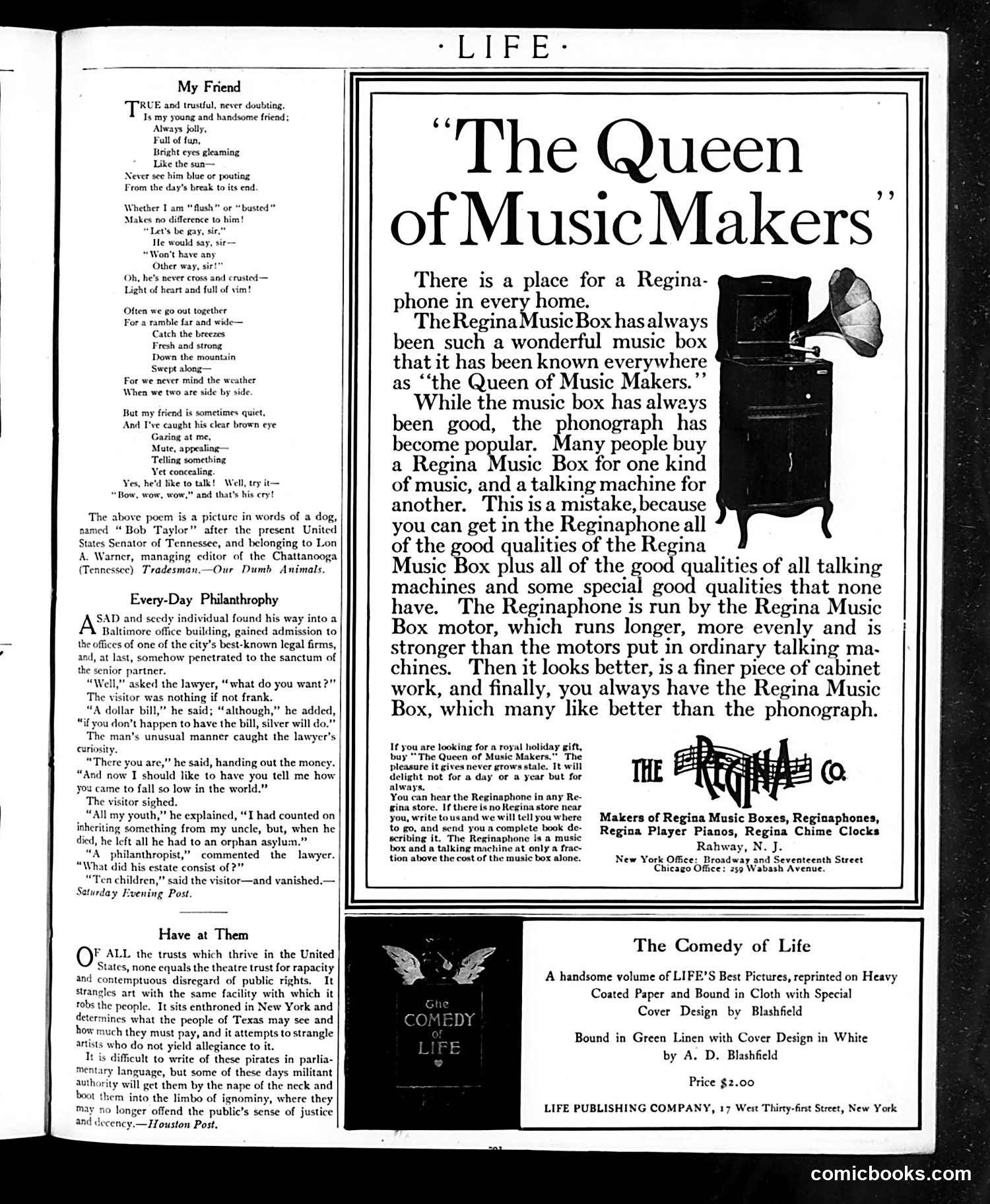
This page from *Life* magazine contains three distinct pieces: **"My Friend" (left column):** A sentimental poem praising a cheerful dog named Bob Taylor, belonging to a Tennessee politician. The satire is gentle—celebrating the dog's unfailing good humor compared to human moodiness. It's a nostalgic tribute to animal loyalty. **"The Queen of Music Makers" (center/right):** A Regina phonograph advertisement masquerading as editorial content. The text argues the Regina music box-phonograph hybrid is superior to buying separate devices. This is straightforward commercial advertising, not satire. **"Every-Day Philanthropy" (lower left):** A brief humorous anecdote about a destitute man asking a lawyer for money. The joke: the man explains his poverty resulted from his uncle leaving his entire estate to an orphan asylum rather than to him—revealing self-centered irony masked as understanding sympathy. **"Have at Them" (bottom):** An editorial fragment criticizing theatrical trusts for exploiting artists and the public—a serious reform critique, not humor. The page mixes advertising, sentiment, and social commentary typical of *Life*'s early editorial approach.
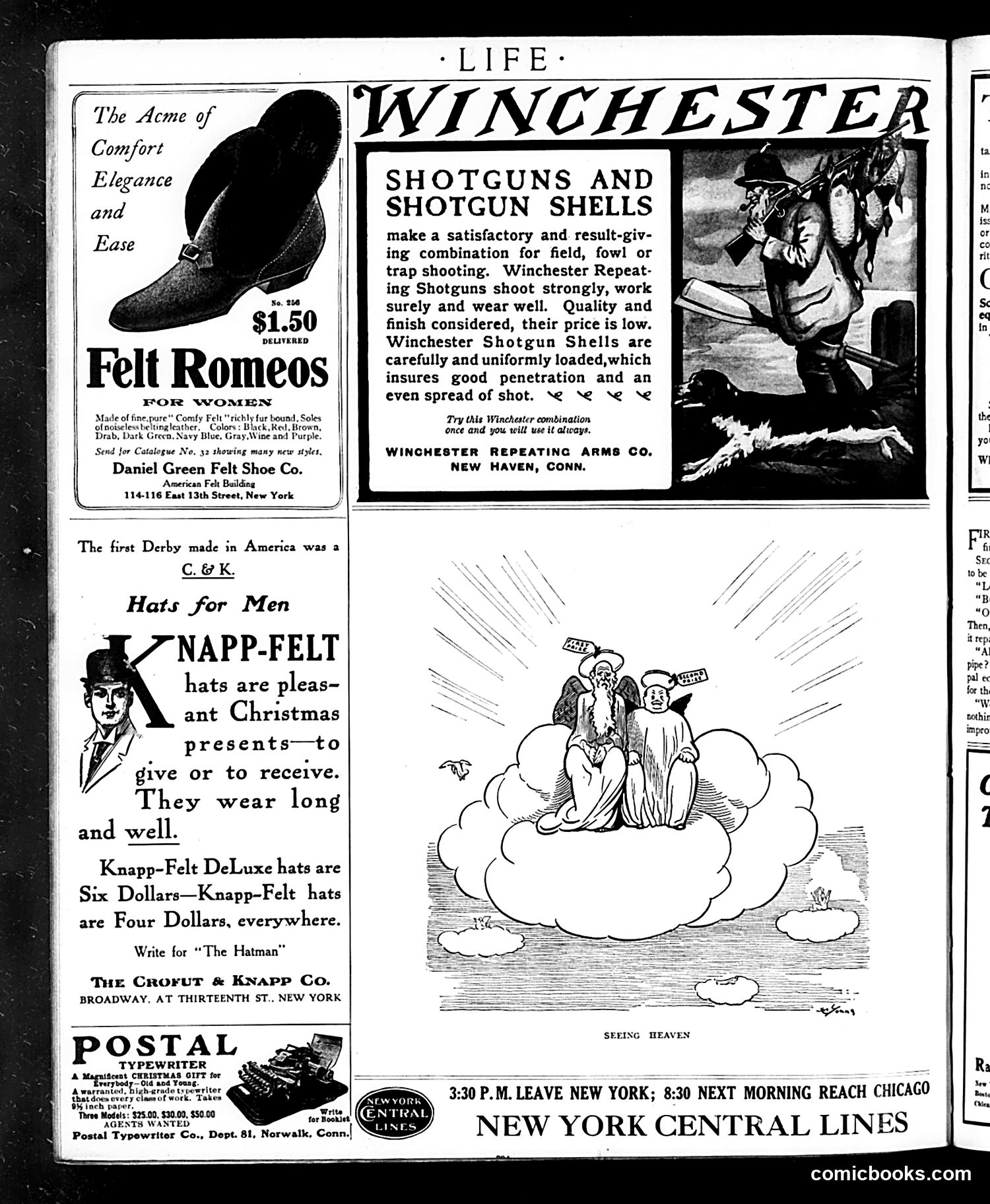
This page is primarily **advertising**, not political satire. It features multiple product advertisements typical of early 20th-century magazines: Felt Romeos (women's shoes), Knapp-Felt hats, Winchester shotguns and ammunition, a Postal typewriter, and New York Central Lines railroad service. The only cartoon is titled "Seeing Heaven"—a generic, whimsical illustration showing three figures (appearing to be angels or cherubs) sitting on a cloud. This is likely a seasonal or thematic cartoon accompanying holiday-related advertisements, not a political or social commentary. The page reflects the era's consumer culture and Christmas shopping season. No specific political figures, events, or satirical targets are evident. This appears to be a standard commercial magazine page rather than satirical content.
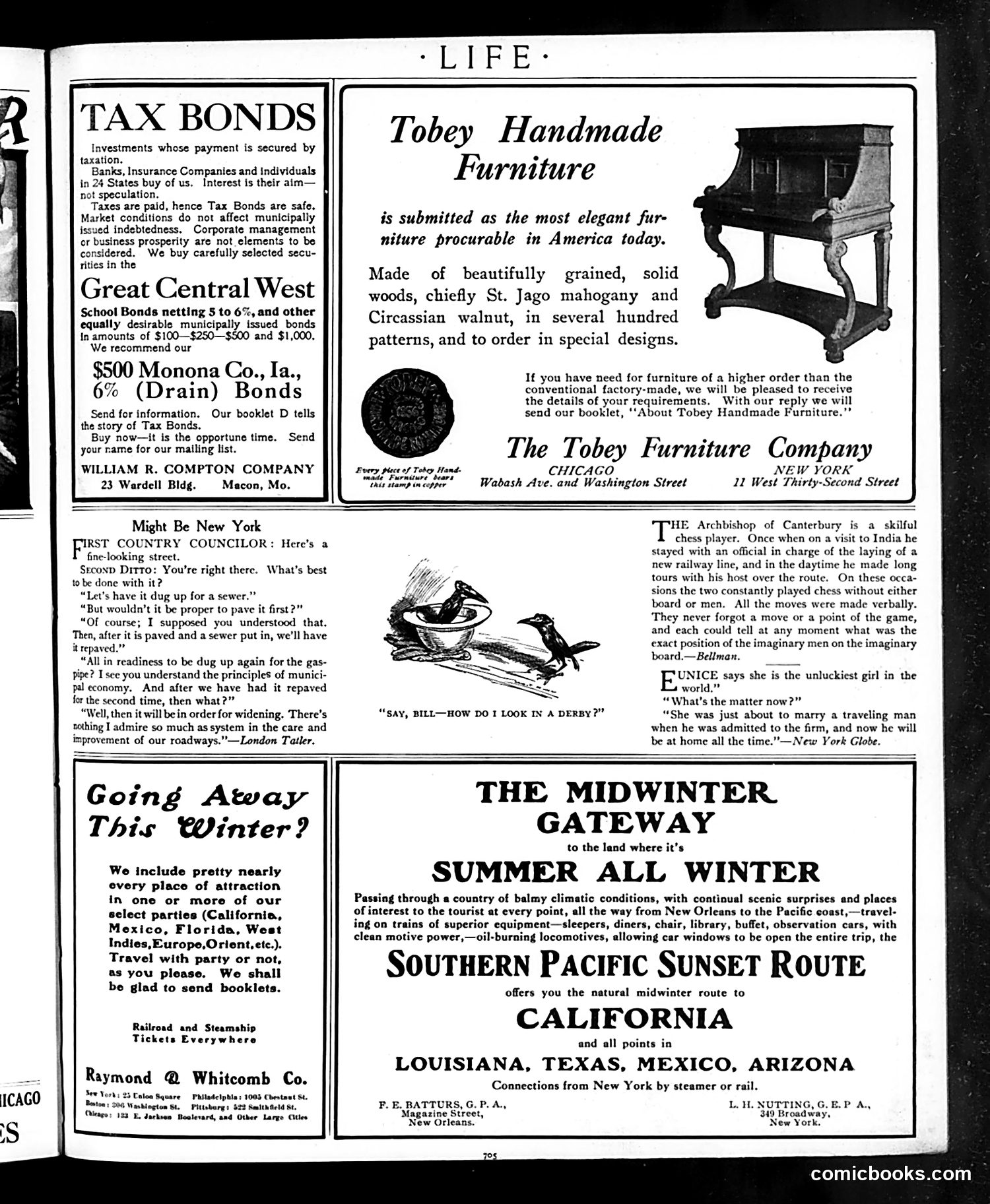
This page is primarily **advertising**, with one satirical cartoon embedded. ## The Cartoon: "Might Be New York" The single cartoon mocks **municipal government inefficiency**, specifically the absurd cycle of repeatedly digging up and repaving streets. Two country councilors discuss a fine street, proposing to: dig it up for a sewer, pave it first, then repave after the sewer installation, then dig it up again for gas pipes, then widen it. One character praises this wasteful cycle as "system" in road maintenance. **The satire**: This critiques real early-20th-century urban infrastructure problems—poorly coordinated public works projects that destroyed streets multiple times. The "country" officials' naive acceptance of this chaos as proper procedure ridicules both municipal incompetence and the pretense of calling such waste "system" or economy. The attribution to *London Tatler* suggests this reflected concerns on both sides of the Atlantic. ## Rest of Page The remaining content consists of period advertisements for tax bonds, furniture, travel services, and railroads, plus brief humorous anecdotes about chess and unlucky romance.
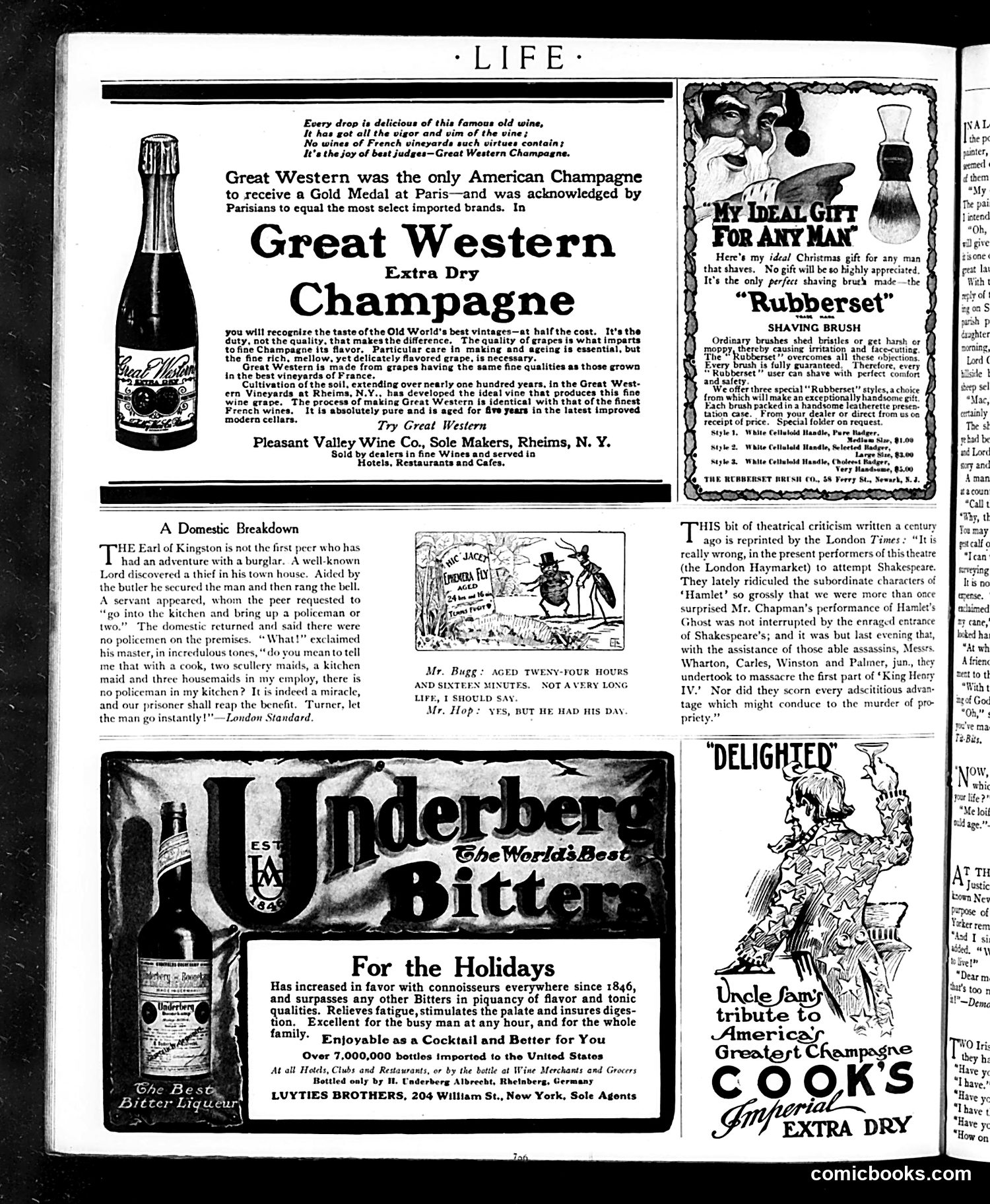
This page consists primarily of **advertisements** rather than political cartoons or satirical content. The main ads are: 1. **Great Western Champagne** — promoting an American champagne that won a Gold Medal at Paris, emphasizing it equals French imports at half the cost. This reflects early 20th-century American pride in domestic products competing with European goods. 2. **Rubberset Shaving Brush** — advertising a superior brush design that doesn't shed bristles. 3. **Underberg Bitters** — promoting a digestive tonic for holiday consumption. 4. **Cook's Imperial Extra Dry** champagne ad (bottom right). The page also contains two brief humorous anecdotes: "A Domestic Breakdown" about an earl discovering a burglar, and a theatrical criticism from the *London Times* mocking Shakespearean performances. These are light humor pieces, not political satire. The page reflects early 20th-century American consumer culture and advertising priorities rather than political commentary.
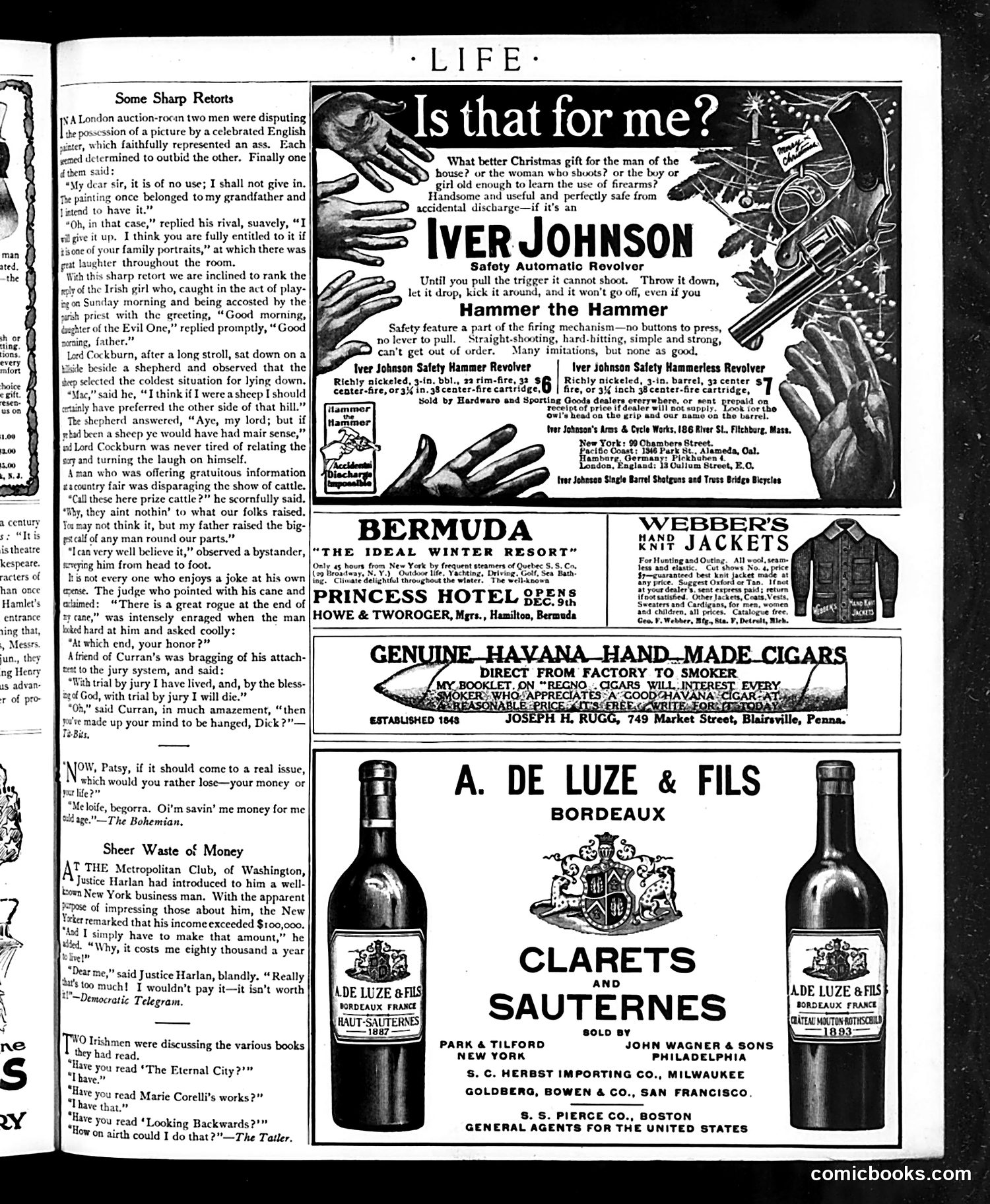
This page is primarily **advertising**, not political satire. The dominant content is a large advertisement for the **Iver Johnson Safety Automatic Revolver**, positioned as a Christmas gift recommendation for households with children. The ad's key selling point is safety: the revolver cannot discharge accidentally—it can be dropped or kicked without firing. This addresses a genuine concern of the era regarding household firearms and child safety. The left column contains "Some Sharp Retorts"—brief humorous anecdotes featuring wordplay and comebacks, likely reprinted from other sources. These include Irish dialect humor and jokes about misunderstandings or clever insults, typical of period comedy. Below the main content are additional product advertisements for luxury goods: Bermuda resort travel, Webber's knit jackets, Havana cigars, and A. De Luze & Fils French wines—all marketed to affluent readers. The page reflects early 20th-century consumer culture and advertising strategies targeting middle-to-upper-class Americans.
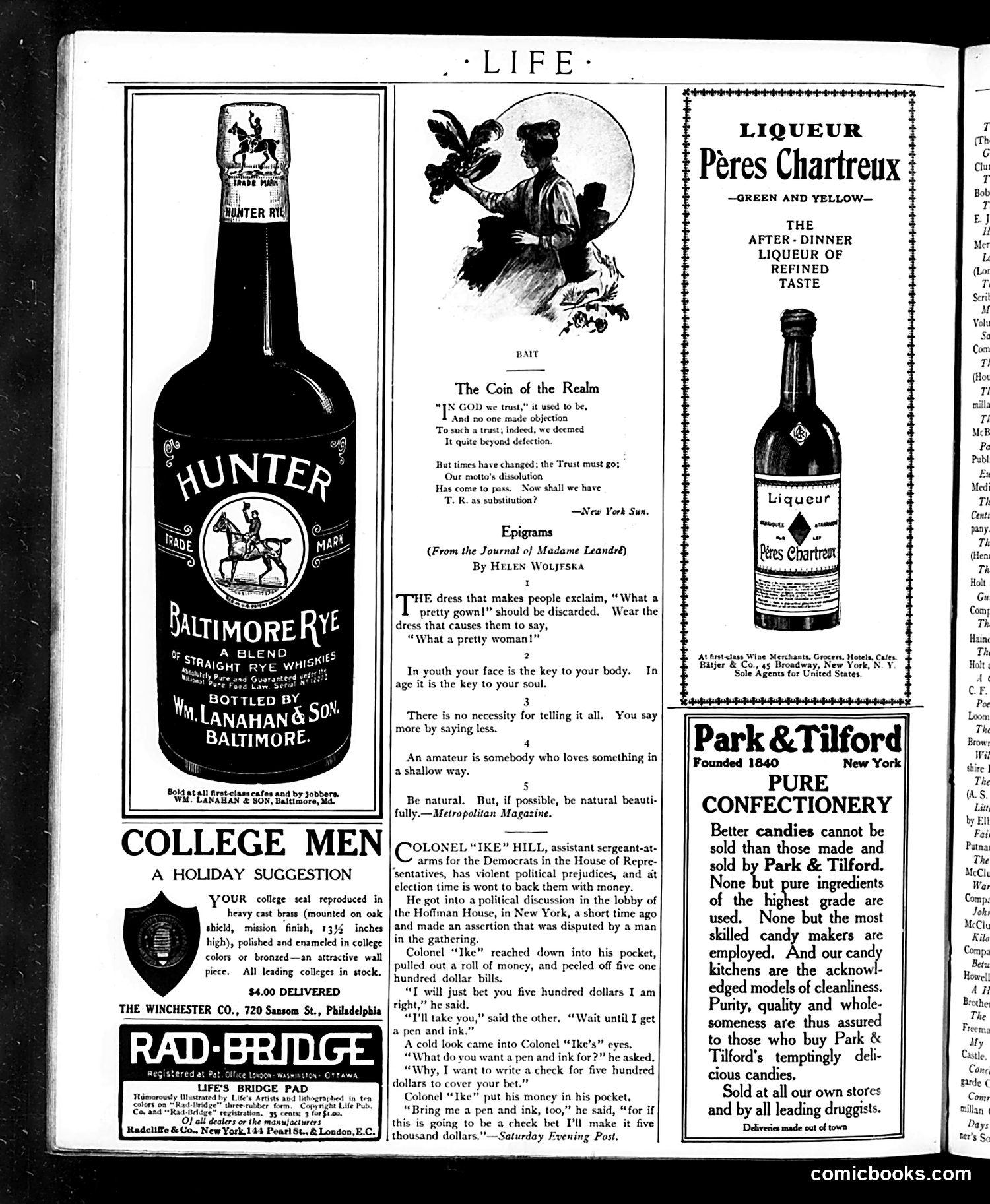
This page is primarily **advertising**, with brief editorial content. The main satirical piece is a short anecdote about Colonel "Ike" Hill, a Democratic operative known for using cash to settle political bets. The joke hinges on class and character: when challenged to a bet, Hill confidently produces cash, but when his opponent asks for "a pen and ink" to write a check instead, Hill's confidence evaporates. He realizes the man has exposed him as someone who trusts only physical currency, not credit—implying Hill lacks the social standing of wealthier men who casually write checks. The humor mocks Hill's pretension and suggests money alone doesn't confer respectability. The page also includes advertisements for Hunter Baltimore Rye whiskey, college seals, and luxury goods (Chartreaux liqueur, Park & Tilford candies), reflecting early-20th-century advertising conventions in *Life* magazine.
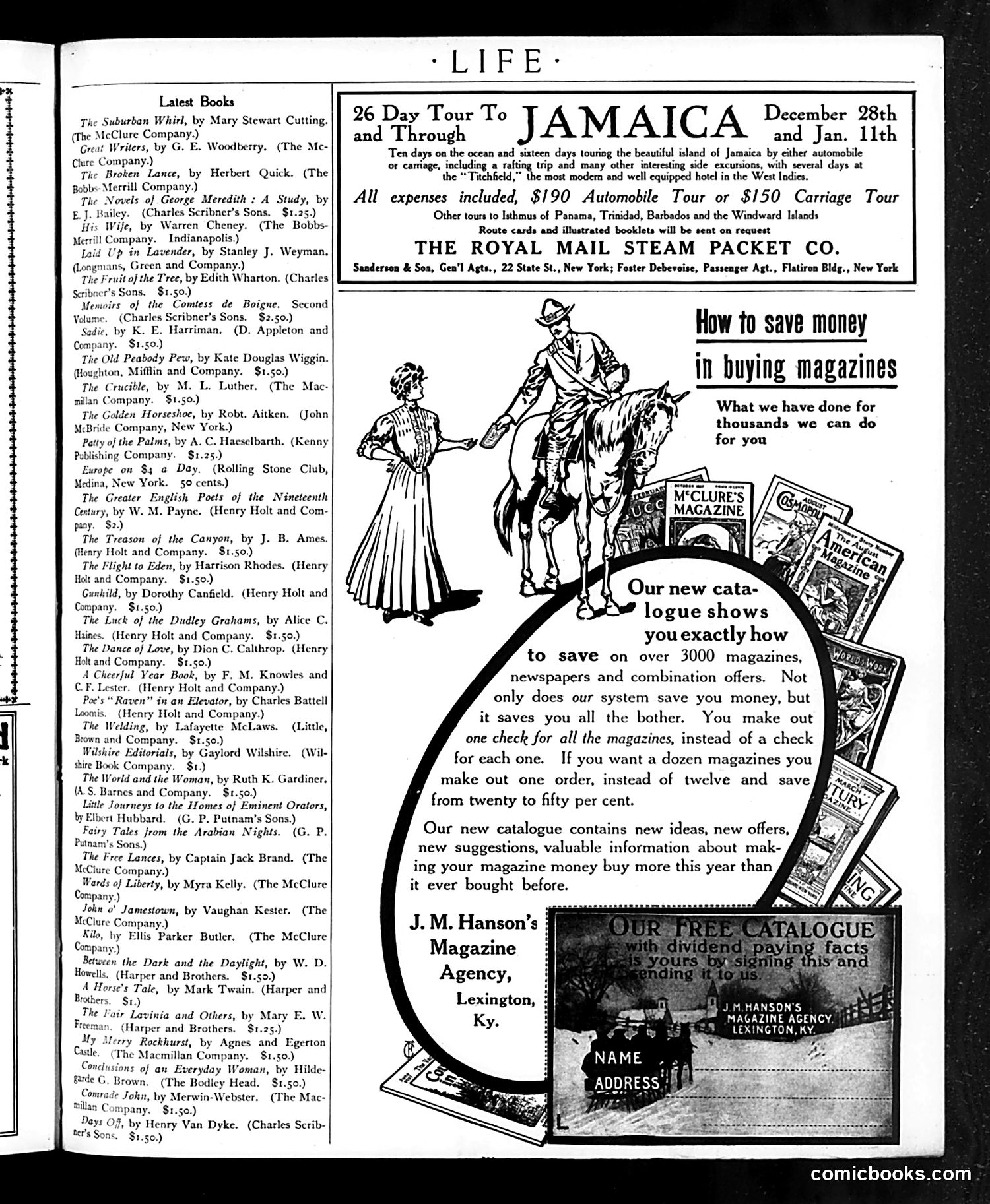
This page is primarily **advertising and book listings**, not political satire. The left column lists newly published books (circa 1911) from major publishers like Henry Holt, McClure Company, and Harper and Brothers—typical turn-of-the-century literary offerings. The main advertising content features two items: 1. **Jamaica cruise advertisement** (top right): A 26-day tour package costing $190 or $150, highlighting the newly modern "Titchfield" hotel. This reflects the era's growing leisure travel industry for affluent Americans. 2. **Magazine subscription service** (center-right): J.M. Hanson's Magazine Agency promotes a catalog claiming to save customers money by consolidating subscriptions to "over 3000 magazines, newspapers and combination offers"—essentially an early magazine subscription bundling service. The illustrated couple suggests this targets middle-class households managing household expenses. No political cartoons or satire appear on this page. It's a straightforward commercial publication showcasing period consumer goods and services.
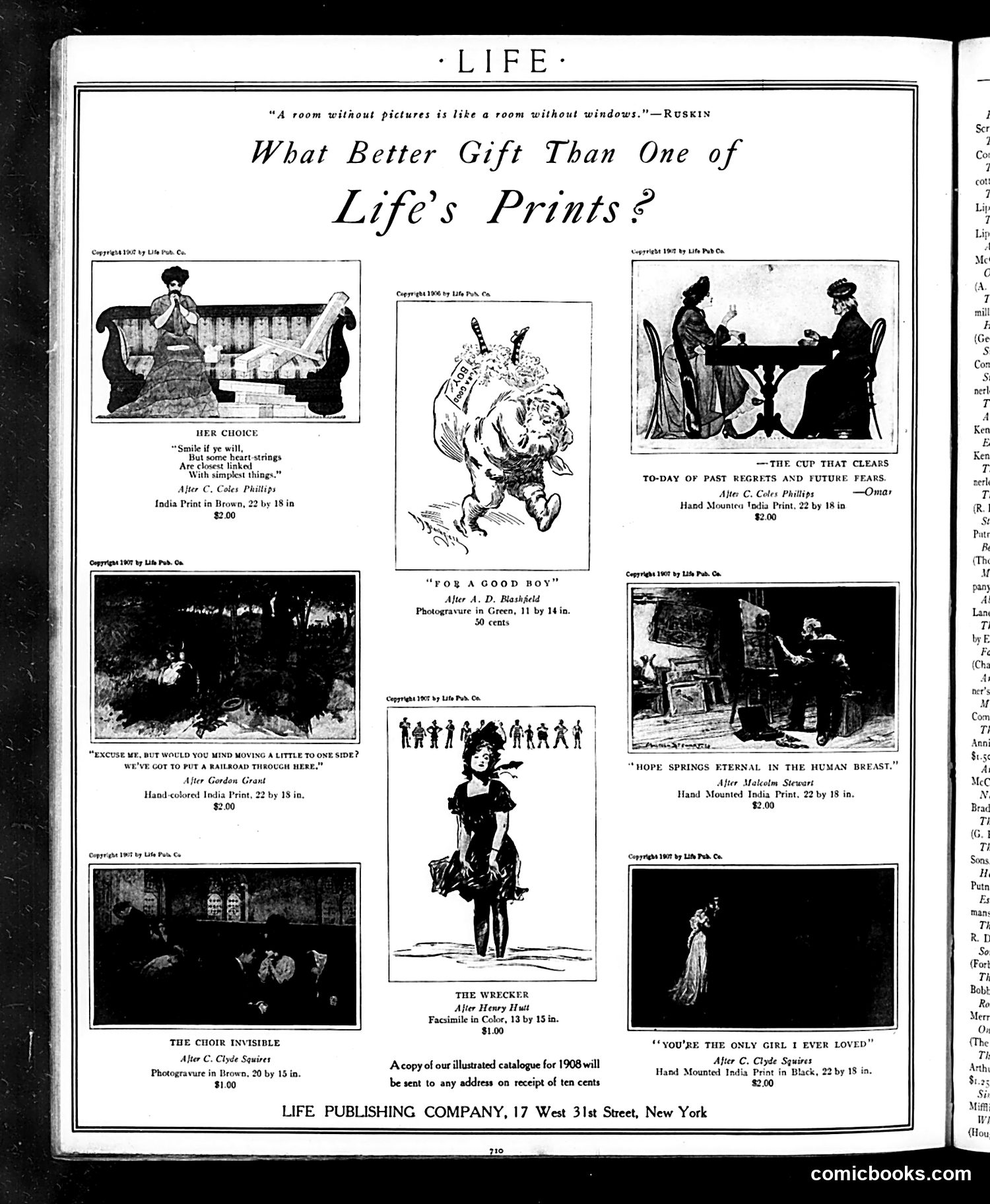
This is primarily an **advertisement page**, not political satire. Life Publishing Company promotes its line of decorative art prints suitable as gifts. The page features various illustrated works by popular artists of the era (Coles Phillips, Gordon Craig, Henry Hutt, etc.), each with romantic or sentimental titles: "Her Choice," "For a Good Boy," "The Cup That Clears," "Hope Springs Eternal in the Human Breast," and "You're the Only Girl I Ever Loved." The opening Ruskin quote frames pictures as essential to domestic life. One cartoon shows a man asking someone to move so they can install a railroad—a satirical jab at industrial progress disrupting everyday life. The prints range from $0.30 to $2.00, marketed as affordable home décor for middle-class Americans. This reflects the era's commercialization of sentimental art and the magazine's dual role as both satirist and merchant.
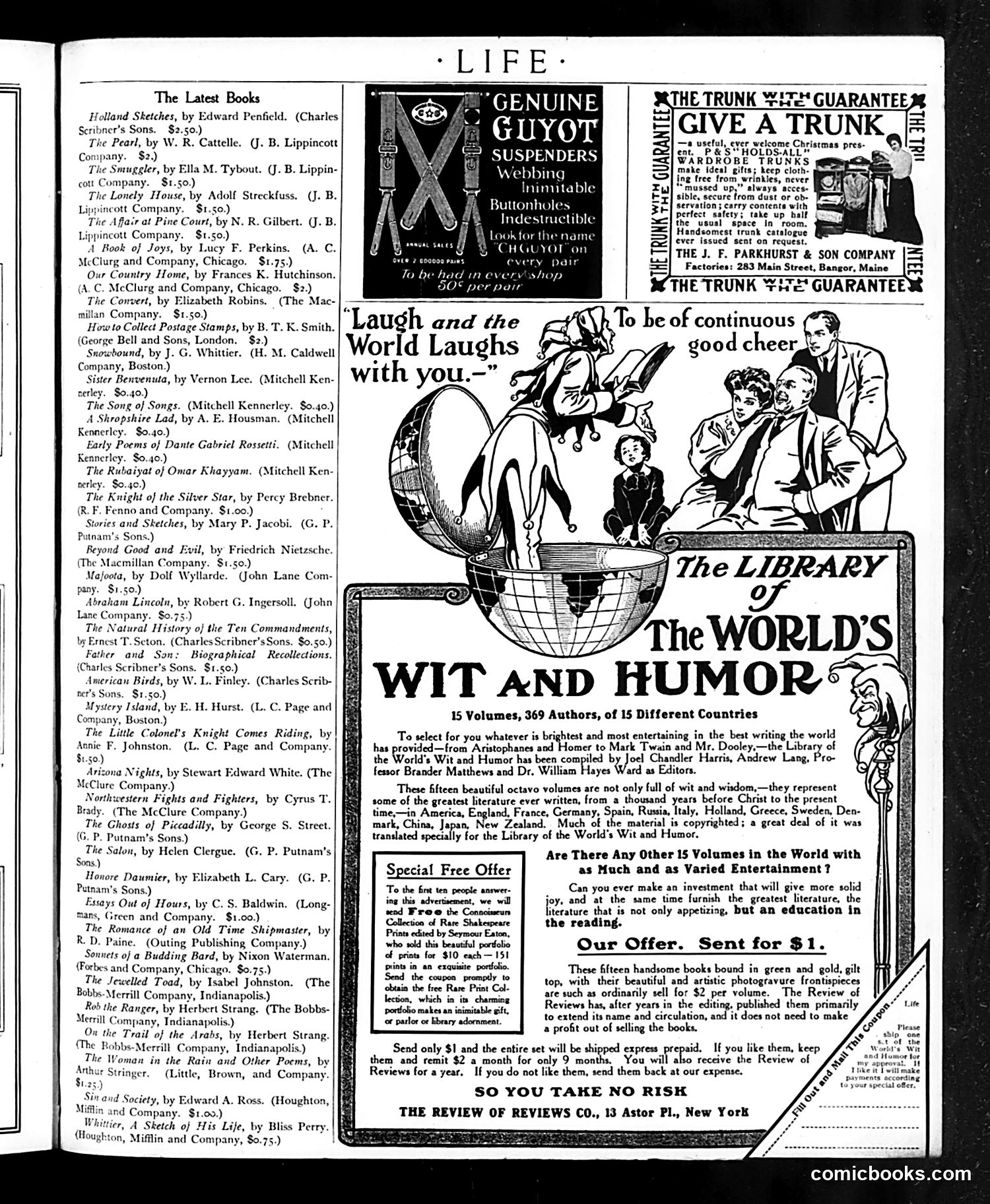
This page is primarily a **book review and advertising section** rather than a political cartoon. The left column lists recent book publications with prices, typical of early 20th-century literary coverage. The dominant content is a **large advertisement for "The Library of the World's Wit and Humor,"** a 15-volume book set. The marketing copy emphasizes entertainment value and breadth of content (369 authors from 15 countries), promising selections from classical literature (Aristophanes, Homer) through contemporary writers (Mark Twain). The cartoon illustration accompanying this ad shows a globe with laughing people, serving as visual shorthand for "worldwide" humor and the cheerfulness the books supposedly provide. The phrase "Laugh and the World Laughs with you" references a popular sentiment (likely from Ella Wheeler Wilcox's poem). Secondary advertisements promote **Guyot suspenders** and **Parkhurst trunks**, typical holiday gift merchandise. The page reflects early-1900s consumer culture—positioning books as luxury gifts while normalizing commercial messaging within editorial content.
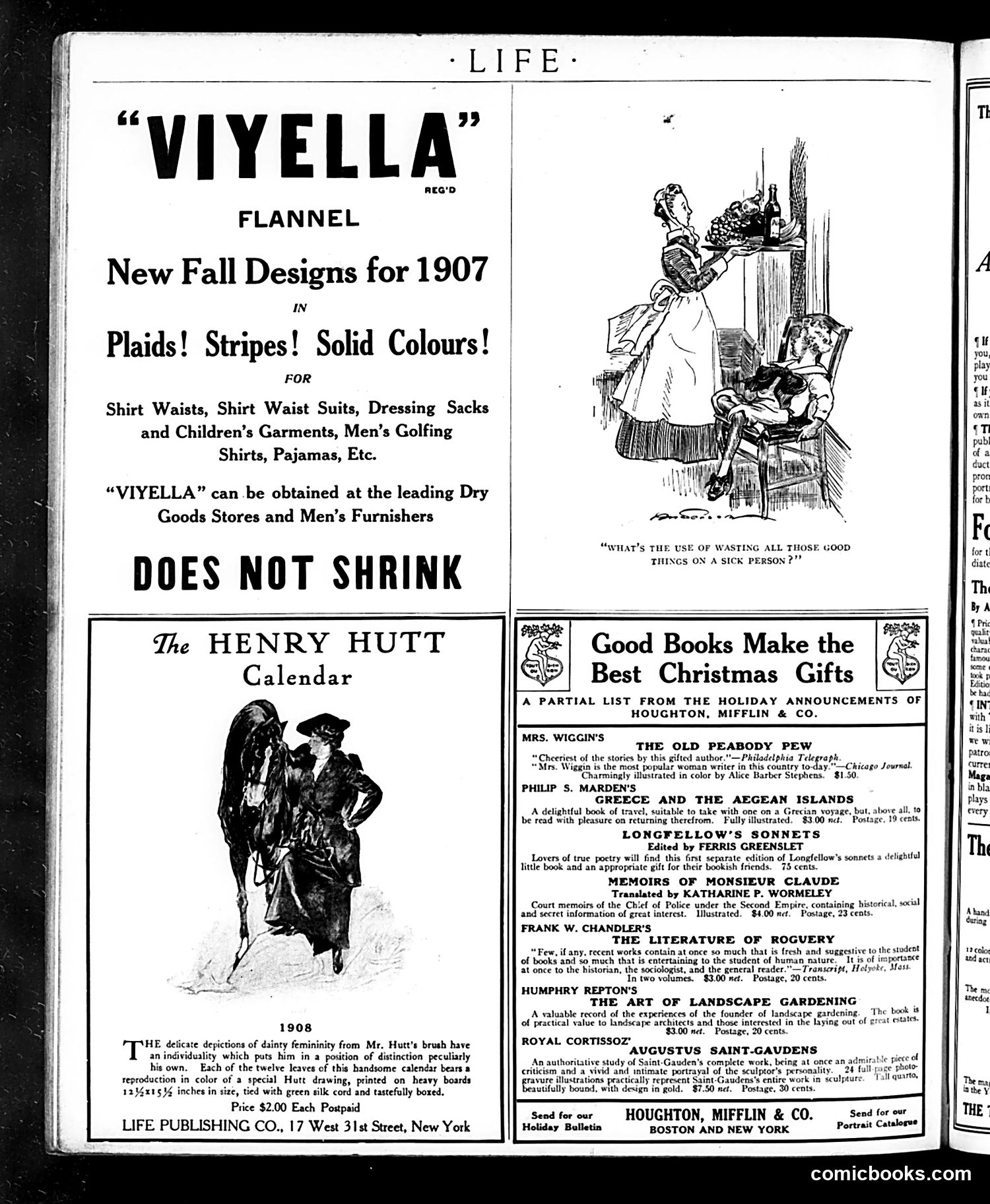
This is primarily an **advertising page** rather than editorial content. The main satirical element appears in a small illustration accompanying a Viyella Flannel ad, showing a woman offering food/gifts to a sick person in bed with the caption: "What's the use of wasting all those good things on a sick person?" **The Joke:** This reflects turn-of-the-century attitudes toward illness and economy—a darkly humorous suggestion that providing luxuries to the infirm is wasteful. It plays on penny-pinching sentiments of the era. The page is otherwise dominated by: - **Viyella Flannel advertisements** (fall 1907 fashions) - **Henry Hutt Calendar** promotional copy (featuring "dainty femininity") - **Book advertisements** from Houghton Mifflin & Co., listing holiday gift recommendations including works on Greek travel, landscape gardening, and sculpture The content reflects 1907 consumer culture and gender ideals (emphasizing feminine delicacy in Hutt's work), with no significant political satire beyond the small sick-person joke.
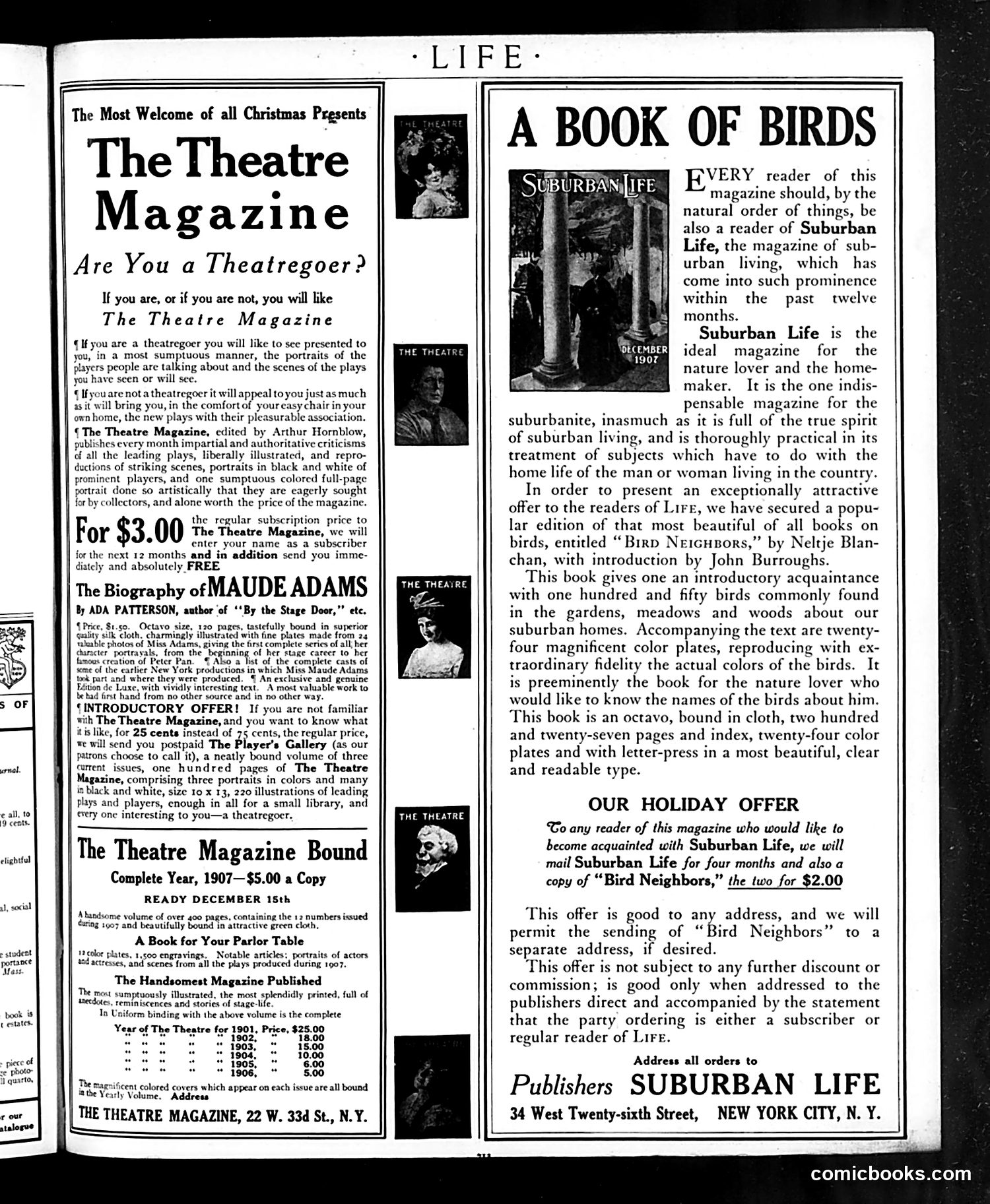
This is primarily a **advertising page**, not a political cartoon. It contains three major product advertisements from early 1900s publishers. The left side promotes **The Theatre Magazine**, a theatrical publication edited by Arthur Hornblow, offering subscription deals and a free biography of actress **Maude Adams** (a prominent stage performer of the era). The ads emphasize lavish illustrations and color portraits—luxury features for the period. The right side advertises **"A Book of Birds"** by Neltje Blanchan, cross-promoted through **Suburban Life magazine**. The pitch targets "nature lovers and homemakers" in suburban settings, offering the bird book plus a four-month subscription to Suburban Life for $2.00. There is **no satire or political content** visible. This represents straightforward commercial advertising typical of Life magazine's revenue model—using editorial space to promote books, magazines, and cultural products to affluent, educated readers interested in theatre and nature.
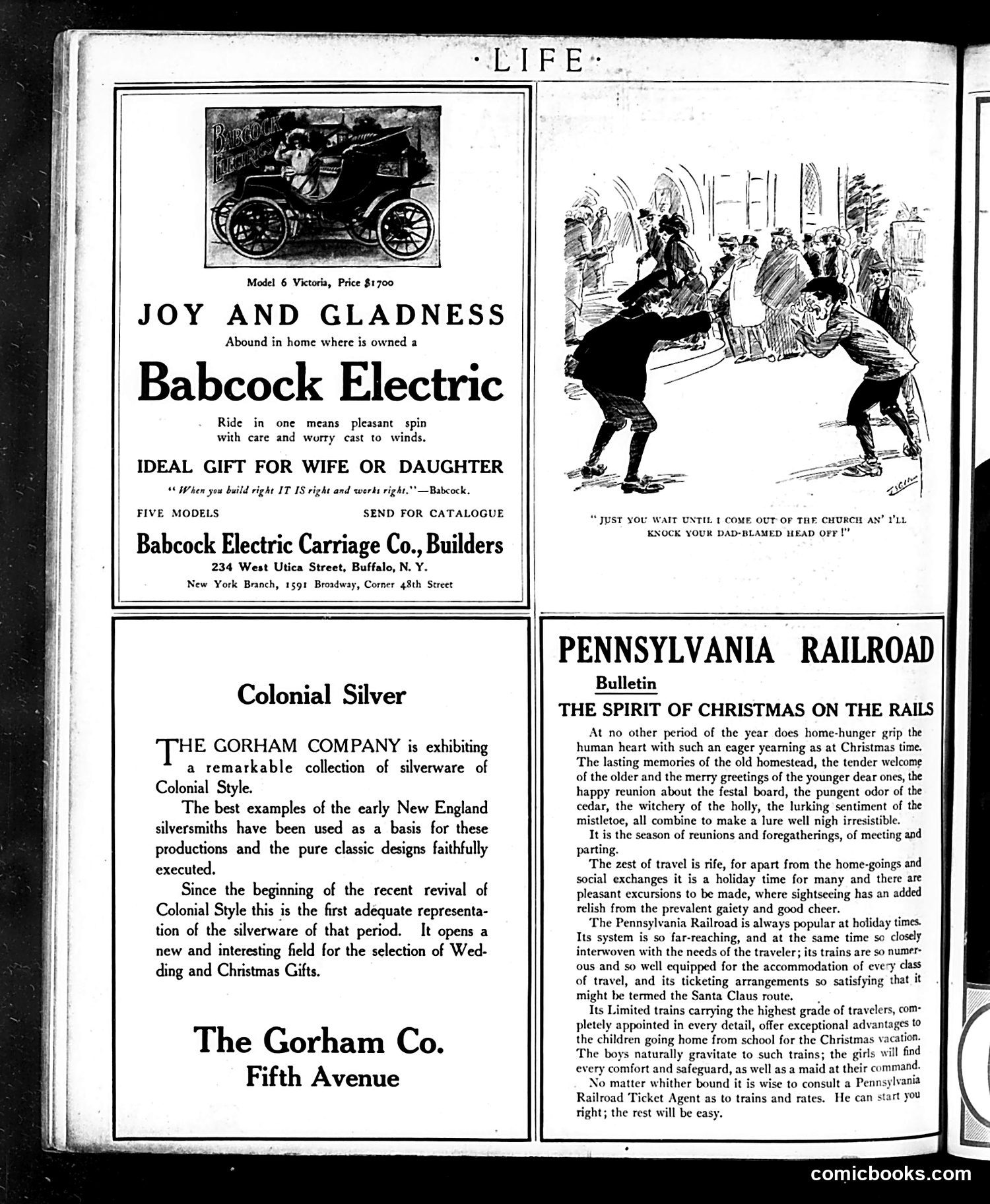
This page is primarily **advertising**, with one satirical cartoon. The cartoon (right side) depicts a young couple at what appears to be a church entrance. The woman threatens the man with violence, saying she'll "knock your dad-blamed head off" when she exits the church. The joke satirizes **wedding day tensions**—likely poking fun at the groom's nervousness or pre-marital anxiety, or possibly commenting on the bride's aggressive assertiveness (unusual for the era's gender expectations). The humor relies on the incongruity of genteel church setting versus crude threats. The advertisements emphasize **gift-giving for women**: the Babcock Electric carriage is pitched as an "ideal gift for wife or daughter," and the Gorham silverware promotes "Wedding and Christmas Gifts." These ads reflect early 1900s consumer culture targeting affluent households purchasing luxury goods for female family members. The Pennsylvania Railroad bulletin romanticizes **Christmas travel and family reunion**, appealing to holiday nostalgia and the railroad's role in enabling domestic gatherings.
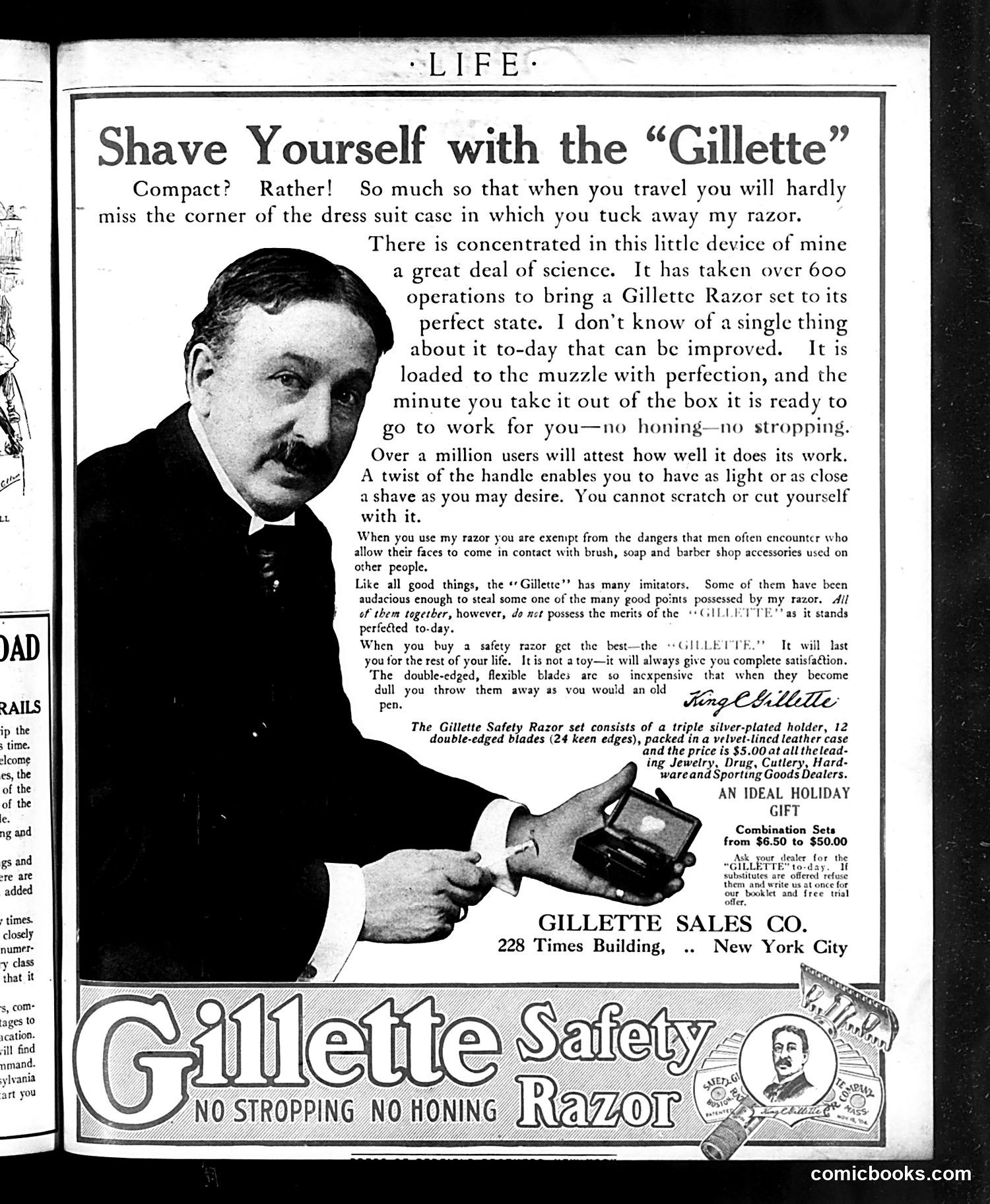
This is a **product advertisement**, not political satire. A man (presumably representing King C. Gillette, the razor's inventor) endorses his safety razor by emphasizing its convenience and superiority over competitors. The pitch targets travelers and businessmen with claims of compactness, requiring no honing or stropping (maintenance steps traditional razors needed), and safety—avoiding the dangers of barbershop tools shared among patrons. The text dismisses imitators as inferior knockoffs. The phrase "loaded to the muzzle with perfection" uses military language, treating the razor as a precision instrument. Holiday gift sets are promoted at various prices. This reflects early-1900s advertising's shift toward emphasizing scientific innovation and hygiene—selling the Gillette as modern, efficient, and sanitary compared to traditional barber services. It's straightforward promotion rather than satire.
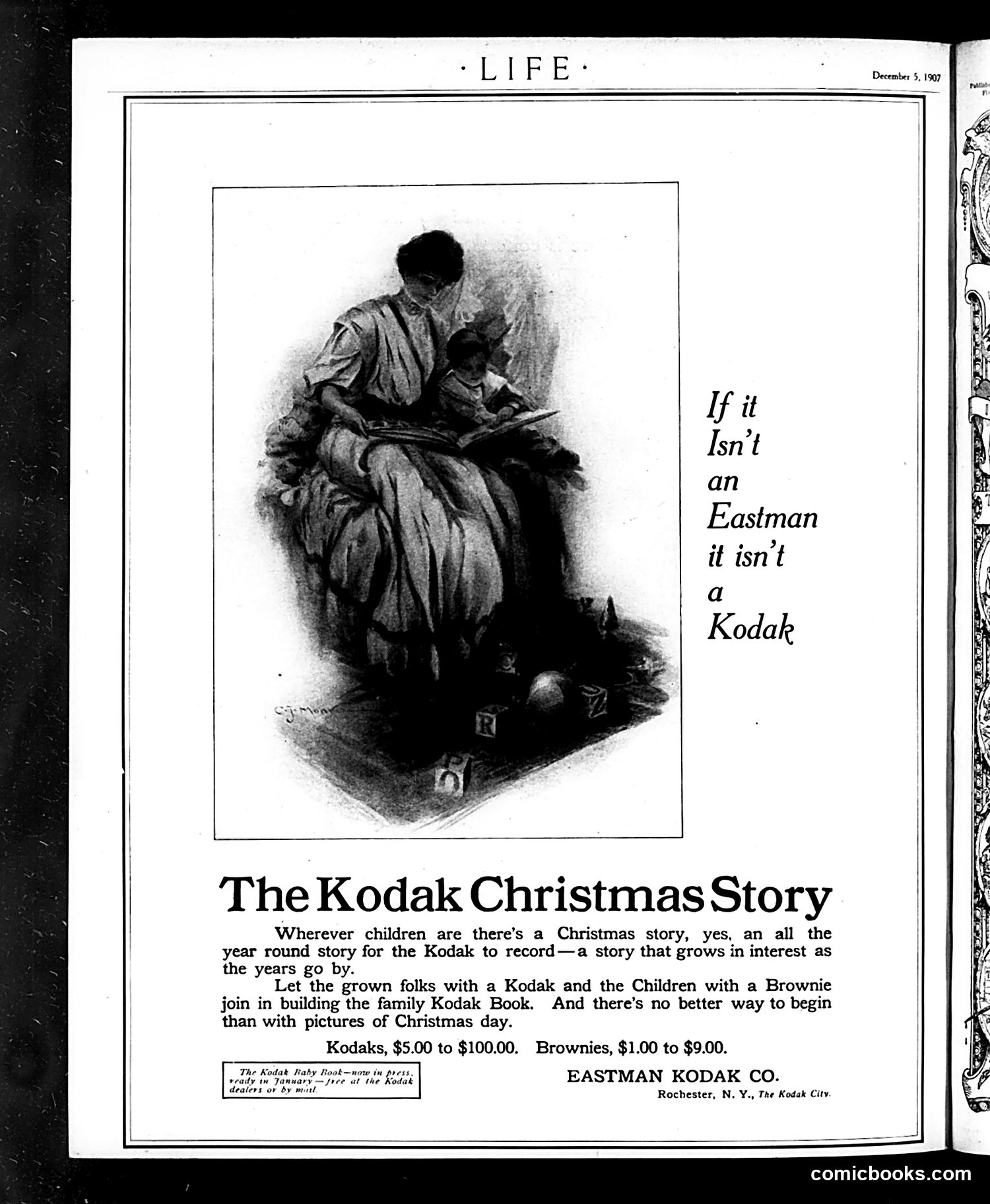
This is **not a political cartoon or satire**—it's a **commercial advertisement** for Eastman Kodak cameras from December 5, 1907. The page features a sentimental illustration of a mother and child reading together, promoting the idea that families should use Kodak cameras to document Christmas moments and build a "family Kodak Book" over time. The tagline "If it Isn't an Eastman it isn't a Kodak" emphasizes brand superiority and market dominance. The ad targets both adults (with expensive Kodak cameras priced $5-$100) and children (with cheaper Brownie cameras at $1-$9). The marketing strategy—associating photography with family memory-making and Christmas sentiment—was innovative for early 20th-century advertising. There is no political commentary or satirical intent; this represents straightforward product marketing using emotional appeals common to the era.