
Life, 1907-12-05 · page 31 of 68
Life — December 5, 1907 — page 31: what you’re looking at
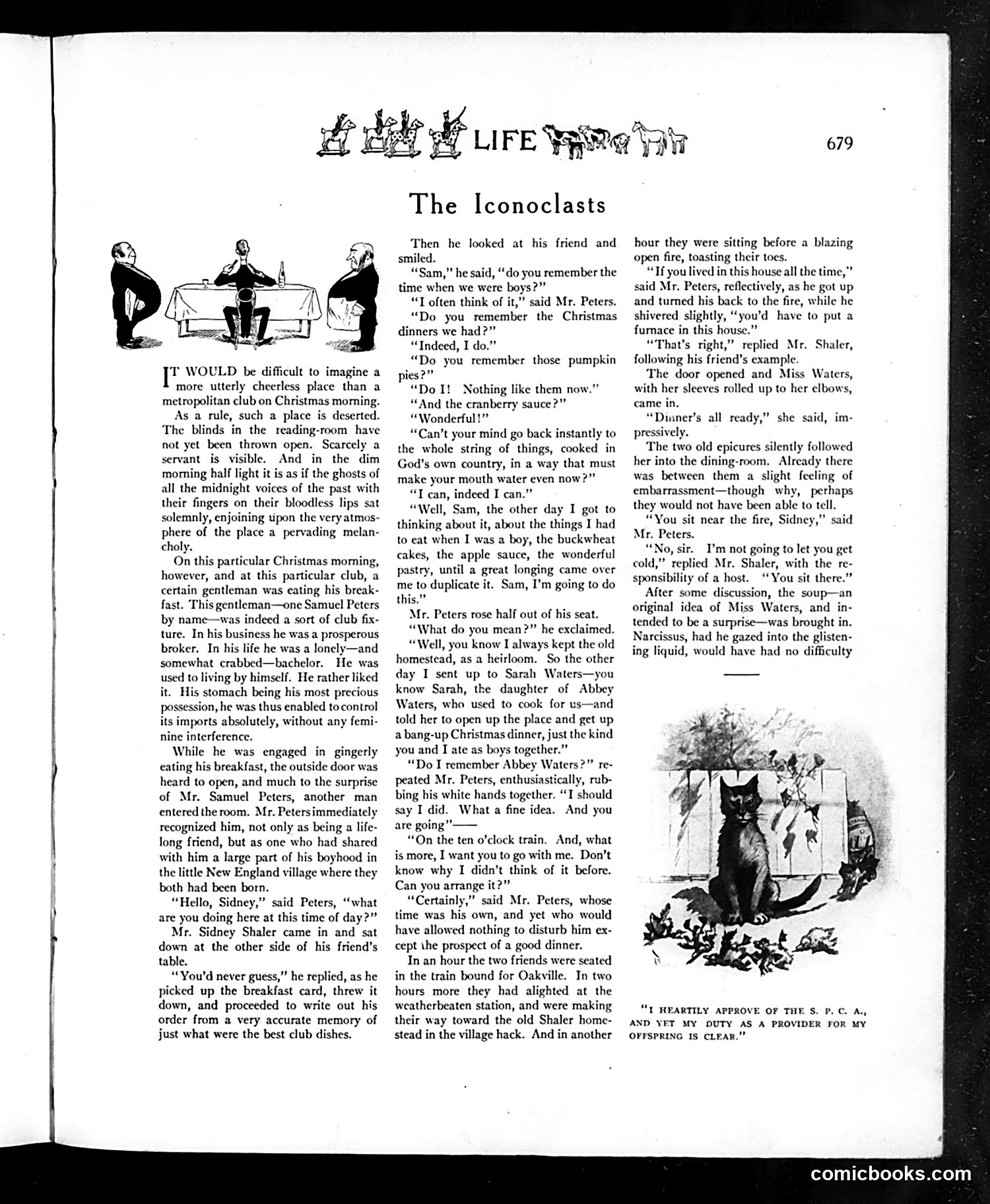
What you’re looking at
This is a short story (not a political cartoon), appearing in *Life* magazine's satirical section. Two elderly bachelor friends—Samuel Peters and Sidney Shaler—reconnect on Christmas morning at their metropolitan club. Shaler proposes they recreate the food experiences of their New England boyhood by traveling to his family homestead and having an old family cook (Sarah Waters, daughter of Abbey Waters) prepare a traditional Christmas dinner. The satire targets **upper-class male nostalgia and bachelor domesticity**. The joke centers on how these prosperous, independent men—who pride themselves on controlling their lives through precise eating habits—become childishly sentimental over childhood memories. Their willingness to abandon their comfortable club life for recreated "home cooking" satirizes the romantic idealization of rural New England simplicity among wealthy urbanites, and the weakness of supposedly self-sufficient bachelors when confronted with sentimental longing. The title "The Iconoclasts" is ironic: these men who consider themselves independent are actually enslaved by nostalgia.
📄 Transcribed text from this page (OCR, searchable)
Machine-transcribed from the original scan — historical spelling and the odd misread are preserved.
‘i WOULD be difficult to imagine a more utterly cheerless place than a metropolitan club on Christmas moming. As a rule, such a place is deserted. The blinds in the reading-room have not yet been thrown open. Scarcely a servant is visible. And in the dim moming half light it is as if the ghosts of all the midnight voices of the past with their fingers on their bloodless lips sat solemnly, enjoining upon the very atmos- phere of the place a pervading melan- choly. On this particular Christmas moming, however, and at this particular club, a certain gentleman was eating his break- fast. This gentleman—one Samuel Peters by name—was indeed a sort of club fix- ture. In his business he was a prosperous broker. In his life he was a lonely—and somewhat crabbed—bachelor. He was used to living by himself. He rather liked it. His stomach being his most precious possession, he was thus enabled tocontrol its imports absolutely, without any femi- nine interference. While he was engaged in gingerly eating his breakfast, the outside door was heard to open, and much to the surprise of Mr. Samuel Peters, another man entered the room. Mr. Petersimmediately recognized him, not only as being a life- long friend, but as one who had shared with him a large part of his boyhood in the little New England village where they both had been born. “Hello, Sidney,” said Peters, “what are you doing here at this time of day?” Mr. Sidney Shaler came in and sat down at the other side of his friend’s table. “You'd never guess,” he replied, as he picked up the breakfast card, threw it down, and proceeded to write out his order from a very accurate memory of just what were the best club dishes. The Iconoclasts Then he looked at his friend and smiled. “Sam,” he said, “do you remember the time when we were boys?” “T often think of it,” said Mr. Peters. “Do you remember the Christmas dinners we had?” “Indeed, I do.” “Do you remember those pumpkin pies?” “Do I! Nothing like them now.” “And the cranberry sauce?” “Wonderful!” “Can’t your mind go back instantly to the whole string of things, cooked in God’s own country, in a way that must make your mouth water even now?” “T can, indeed I can.” “Well, Sam, the other day I got to thinking about it, about the things I had to eat when I was a boy, the buckwheat cakes, the apple sauce, the wonderful pastry, until a great longing came over me to duplicate it. Sam, I’m going to do this. Mr. Peters rose half out of his seat. “What do you mean?” he exclaimed. “Well, you know I always kept the old homestead, as a heirloom. So the other day I sent up to Sarah Waters—you know Sarah, the daughter of Abbey Waters, who used to cook for us—and told her to open up the place and get up a bang-up Christmas dinner, just the kind you and I ate as boys together.” “Do I remember Abbey Waters?” re- peated Mr. Peters, enthusiastically, rub- bing his white hands together. “I should say I did. What a fine idea. And you are going””—— “On the ten o’clock train. And, what is more, I want you to go with me. Don’t know why I didn’t think of it before. Can you arrange it?” “Certainly,” said Mr. Peters, whose time was his own, and yet who would have allowed nothing to disturb him ex- cept the prospect of a good dinner. In an hour the two friends were seated in the train bound for Oakville. In two hours more they had alighted at the weatherbeaten station, and were making their way toward the old Shaler home- stead in the village hack. And in another hour they were sitting before a blazing open fire, toasting their toes. “Tf you lived in this house all the time, said Mr. Peters, reflectively, as he got up and turned his back to the fire, while he shivered slightly, “you'd have to put a furnace in this house.” “That's right,” replied Mr. Shaler, following his friend’s example. The door opened and Miss Waters, with her sleeves rolled up to her elbows, came in. “Dinner’s all ready,” she said, im- pressively. The two old epicures silently followed her into the dining-room. Already there was between them a slight feeling of embarrassment—though why, perhaps they would not have been able to tell. “You sit near the fire, Sidney,” said Mr. Peters. “No, sir. I’m not going to let you get cold,” replied Mr. Shaler, with the re- sponsibility of a host. ‘You sit there.” After some discussion, the soup—an original idea of Miss Waters, and in- tended to be a surprise—was brought in. Narcissus, had he gazed into the glisten- ing liquid, would have had no difficulty “T HEARTILY APPROVE OF THE S. P.C. A. AND YET MY DUTY AS A PROVIDER FOR MY OFFSPRING IS CLEAR.” comicbooks.com