
Life, 1907-12-05 · page 22 of 68
Life — December 5, 1907 — page 22: what you’re looking at
What you’re looking at
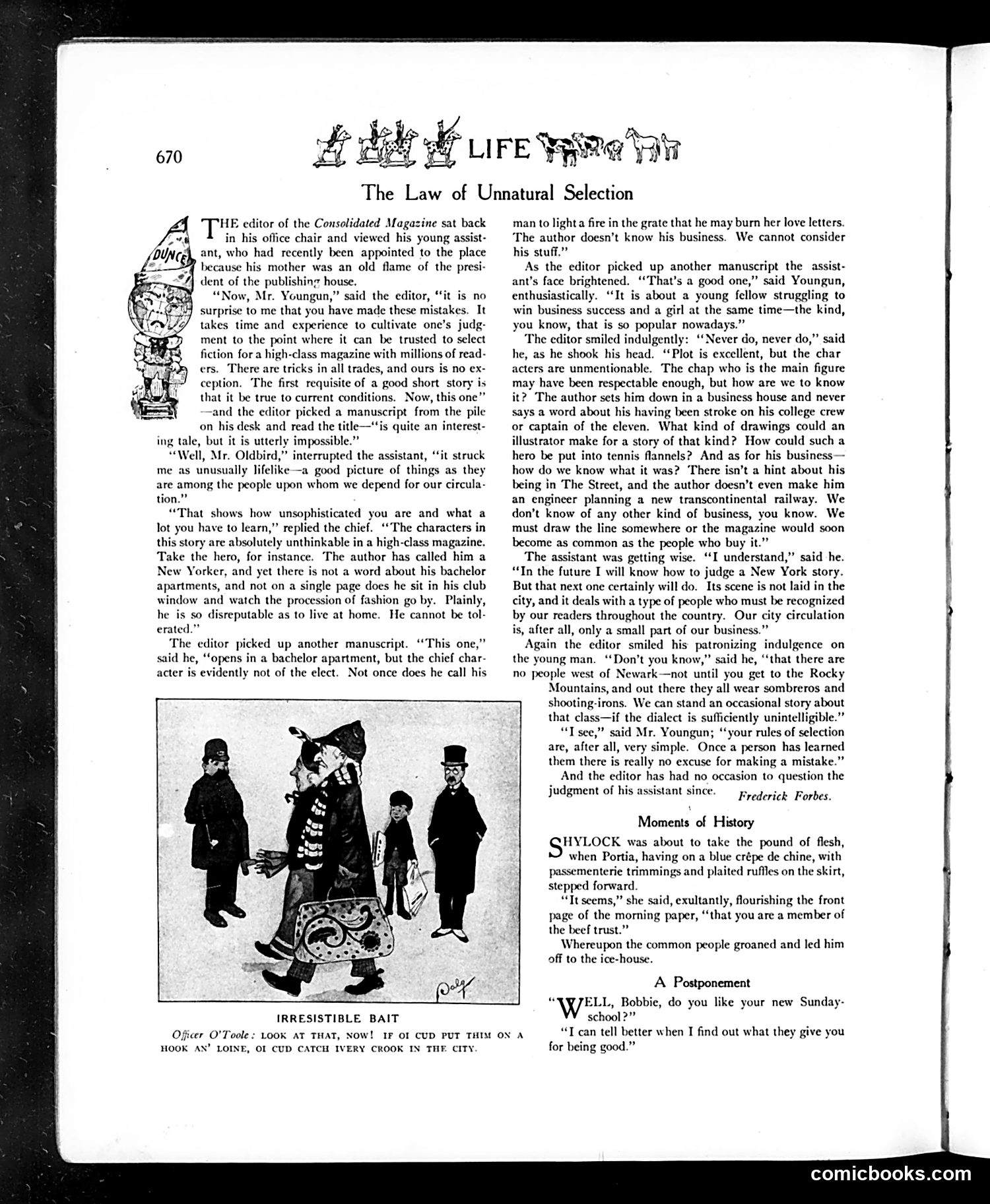
This satirical story mocks magazine editors' formulaic approach to fiction selection. An experienced editor rejects story manuscripts based not on literary merit or realism, but on whether characters fit upper-class stereotypes. The editor dismisses a realistic New York story because the protagonist lives at home rather than in a bachelor apartment and doesn't perform rituals like burning love letters in a fireplace. He rejects another story about a young man pursuing business success and romance because the character lacks markers of elite status—no college crew experience, no tennis imagery, no Wall Street connections, no involvement in transcontinental railways. The satire targets how magazines catered exclusively to wealthy urban readers, requiring all characters conform to their lifestyle and concerns. The editor's final comment—dismissing all people west of Newark as nonexistent until the Rocky Mountains—emphasizes this absurd, insular worldview. The joke is that editors' artificial selection criteria made magazine fiction increasingly disconnected from actual human experience.
📄 Transcribed text from this page (OCR, searchable)
Machine-transcribed from the original scan — historical spelling and the odd misread are preserved.
Add The Law of Unn HE editor of the Consolidated Magazine sat back in his office chair and viewed his young assist- ant, who had recently been appointed to the place because his mother was an old flame of the presi- dent of the publishing house. “Now, Mr. Youngun,” said the editor, “it is no surprise to me that you have made these mistakes. It takes time and experience to cultivate one’s judg- ment to the point where it can be trusted to select fiction for a high-class magazine with millions of read- ers. There are tricks in all trades, and ours is no ex- ception. The first requisite of a good short story is that it be true to current conditions. Now, this one” -and the editor picked a manuscript from the pile on his desk and read the title—‘‘is quite an interest- ing tale, but it is utterly impossible.” “Well, Mr. Oldbird,” interrupted the assistant, ‘it struck me as unusually lifelike—a good picture of things are among the people upon whom we depend for our circula- tion.” “That shows how unsophisticated you are and what a lot you have to learn,” replied the chief. ‘The characters in this story are absolutely unthinkable in a high-class magazine. Take the hero, for instance. The author has called him a New Yorker, and yet there is not a word about his bachelor apartments, and not on a single page does he sit in his club window and watch the procession of fashion go by. Plainly, he is so disreputable as to live at home. He cannot be tol- erated.” The editor picked up another manuscript. ‘‘This one,” said he, “opens in a bachelor apartment, but the chief char- acter is evidently not of the elect. Not once does he call his df LIFE ¥eiR@ Wh atural Selection man to lighta fire in the grate that he may burn her love letters. ‘The author doesn’t know his business. We cannot consider his stuff.” As the editor picked up another manuscript the assist- ant’s face brightened. ‘That's a good one,” said Youngun, enthusiastically. “It is about a young fellow struggling to win business success and a girl at the same time—the kind, you know, that is so popular nowadays.” The editor smiled indulgently: ‘Never do, never do,” said he, as he shook his head. ‘Plot is excellent, but the char acters are unmentionable. The chap who is the main figure may have been respectable enough, but how are we to know it? The author sets him down in a business house and never says a word about his having been stroke on his college crew or captain of the eleven. What kind of drawings could an illustrator make for a story of that kind? How could such a hero be put into tennis flannels? And as for his business— how do we know what it was? There isn’t a hint about his being in The Street, and the author doesn’t even make him an engineer planning a new transcontinental railway. We don’t know of any other kind of business, you know. We must draw the line somewhere or the magazine would soon become as common as the people who buy it.” The assistant was getting wise. ‘I understand,” said he. “In the future I will know how to judge a New York story. But that next one certainly will do. Its scene is not laid in the city, and it deals with a type of people who must be recognized by our readers throughout the country. Our city circulation is, after all, only a small part of our business.” Again the editor smiled his patronizing indulgence on the young man. “Don’t you know,” said he, “that there are no people west of Newark—not until you get to the Rocky Mountains, and out there they all wear sombreros and if shooting-irons. We can stand an occasional story about that class—if the dialect is sufficiently unintelligible.” “T see,” said Mr. Youngun; “your rules of selection are, after all, very simple. Once a person has learned them there is really no excuse for making a mistake.” And the editor has had no occasion to question the judgment of his assistant since. yederick Forbes. Moments of History SIBTOCK was about to take the pound of flesh, when Portia, having on a blue crépe de chine, with passementerie trimmings and plaited ruffles on the skirt, stepped forward. “It seems,” she said, exultantly, flourishing the front page of the morning paper, “that you are a member of the beef trust.” Whereupon the common people groaned and led him off to the ice-house. A Postponement IRRESISTIBLE BAIT Oficer O'Toole: LOOK AT THAT, NOW! IF OF CUD PUT THIM ON HOOK AN’ LOINE, OL CUD CATCH IVERY CROOK IN THE CITY. “NYZELL, Bobbie, do you like your new Sunday- school ?”” “T can tell better when I find out what they give you for being good.” A comicbooks.com