
Life, 1907-12-05 · page 10 of 68
Life — December 5, 1907 — page 10: what you’re looking at
What you’re looking at
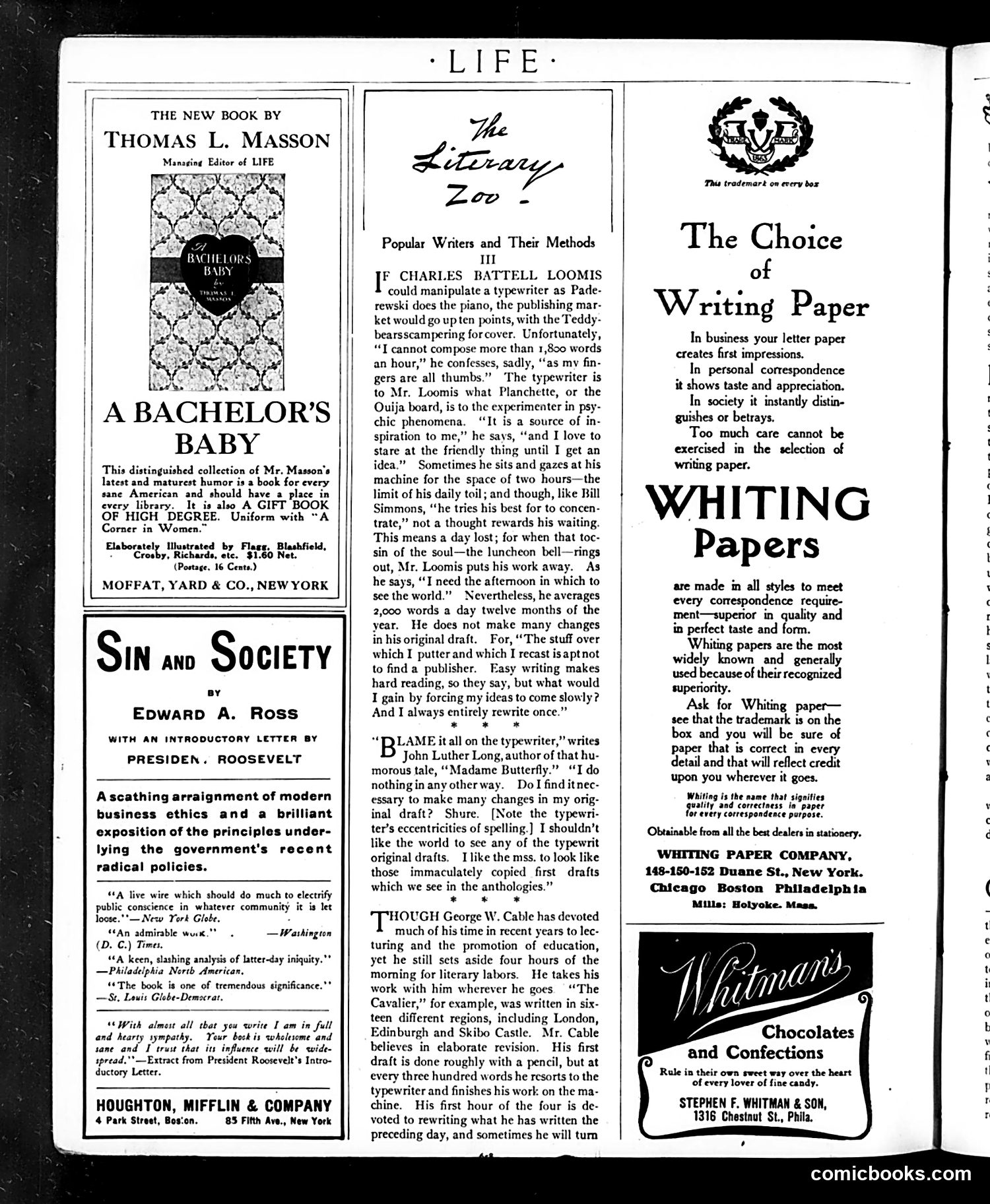
This page is primarily **advertising and literary content**, not political satire or cartooning. The page features book advertisements (including Thomas L. Masson's "A Bachelor's Baby" and Edward A. Ross's "Sin and Society") alongside a literary column titled "The Literary Zoo" discussing how various famous writers work. The column includes quotes from authors like Charles Battell Loomis, John Luther Long, and George W. Cable about their writing processes and methods—discussing typewriters, revision habits, and daily work routines. The remaining content consists of product advertisements for writing paper and Whitman's Chocolates. **There is no political cartoon or satire visible on this page.** It represents typical early 20th-century magazine content mixing literature, book promotion, and consumer advertising.
📄 Transcribed text from this page (OCR, searchable)
Machine-transcribed from the original scan — historical spelling and the odd misread are preserved.
THE NEW BOOK BY | THOMAS L. MASSON Managing Editor of LIFE aacitt LORS BABY A BACHELOR'S 1 BABY | This distinguished collection of Mr. Masson's latest and maturest humor is a book for every sane American and should have a place in every library. It is also A GIFT BOOK OF HIGH_DEGR!I Uniform with “A Corner in Women.” Elaborate! Illustrated by Flags, Blashfield, Crosby, Richards, etc. $1.60 Net. (Postage, 16 Cents.) MOFFAT, YARD & CO., NEW YORK SIN au Society Epwarp A. Ross WITH AN INTRODUCTORY LETTER BY PRESIDEN. ROOSEVELT Ascathing arraignment of modern business ethics and a brilliant exposition of the principles under- lying the government's recent radical policies. “A live wire which should do much to electrify public conscience in whatever community it is let loose."*— New York Globe. “An admirable wuik.’* (D. C.) Times, “A keen, slashing analysis of latter-day iniquity."* —Philadelphia Nerth American, “The book is one of tremendous significance."* —S:, Lauis Globe-Demscrat. —Washington “With almest all that yeu write I am in full and hearty sympathy. Your beck is wheleiome and sane and I trust that its influence will be wide- spread," —Extract from President Roosevelt's Intro- ductory Letter. HOUGHTON, MIFFLIN & COMPANY 4 Park Street, Bos:on. 85 Fitth Ave., New York Popular Writers and Their Methods IIL F CHARLES BATTELL LOOMIS could manipulate a typewriter as Pade- rewski does the piano, the publishing mar- ket would go up ten points, with the Teddy- bearsscampering forcover. Unfortunately, “T cannot compose more than 1,800 words an hour,” he confesses, sadly, “‘as my fin- gers are all thumbs.” The typewriter is to Mr. Loomis what Planchette, or the Ouija board, is to the experimenter in psy- chic phenomena. “It is a source of in- spiration to me,” he says, ‘‘and I love to stare at the friendly thing until I get an idea.” Sometimes he sits and gazes at his machine for the space of two hours—the limit of his daily toil; and though, like Bill Simmons, “‘he tries his best for to concen- trate,” not a thought rewards his waiting. This means a day lost; for when that toc- sin of the soul—the luncheon bell—rings out, Mr. Loomis puts his work away. As he says, ‘I need the afternoon in which to see the world.” Nevertheless, he averages 2,000 words a day twelve months of the year. He does not make many changes in his original draft. For, “The stuff over which I putter and which I recast isaptnot to find a publisher. Easy writing makes hard reading, so they say, but what would I gain by forcing my ideas to come slowly? And I always entirely rewrite once.” * * & LAME itall on the typewriter,” writes John Luther Long, author of that hu- morous tale, ‘Madame Butterfly.” “I do nothing in any other way. Dol find itnec- essary to make many changes in my orig- inal draft? Shure. [Note the typewri- ter’s eccentricities of spelling.) I shouldn’t like the world to sce any of the typewrit original drafts. I like the mss. to look like those immaculately copied first drafts which we see in the anthologies.” * £ * HOUGH George W. Cable has devoted much of his time in recent years to lec- turing and the promotion of education, yet he still sets aside four hours of the morning for literary labors. He takes his work with him wherever he goes. “The Cavalier,” for example, was written in six- teen different regions, including London, Edinburgh and Skibo Castle. Mr. Cable believes in elaborate revision. His first draft is done roughly with a pencil, but at every three hundred words he resorts to the typewriter and finishes his work on the ma- chine. His first hour of the four is de- voted to rewriting what he has written the preceding day, and sometimes he will tum 9 ‘This trademark on every box The Choice of Writing Paper In business your letter paper creates first impressions. In personal correspondence it shows taste and appreciation. In society it instantly distin- guishes or betrays. Too much care cannot be exercised in the selection of writing paper. WHITING Papers are made in all styles to meet every correspondence require- ment—supenor in quality and in perfect taste and form. Whiting papers are the most widely known and _ generally used because of their recognized superiority. Ask for Whiting paper— see that the trademark is on the box and you will be sure of paper that is correct in every detail and that will reflect credit upon you wherever it goes. Whiting is the name that sigaities AUR, and correctness ia Upaper y correspondence pu Obtainable from all the best dealers in stationery. WHITING PAPER COMPANY, 148-150-152 Duane St., New York. Chicago Boston Philadelphia Mills: Holyoke. Mass. Chocolates and Confections Role in their own sweet way over the heart of every lover of fine candy. STEPHEN F. WHITMAN & SON, 1316 Chestnut St., Phila, comicbooks.com