
Life, 1907-12-05 · page 20 of 68
Life — December 5, 1907 — page 20: what you’re looking at
What you’re looking at
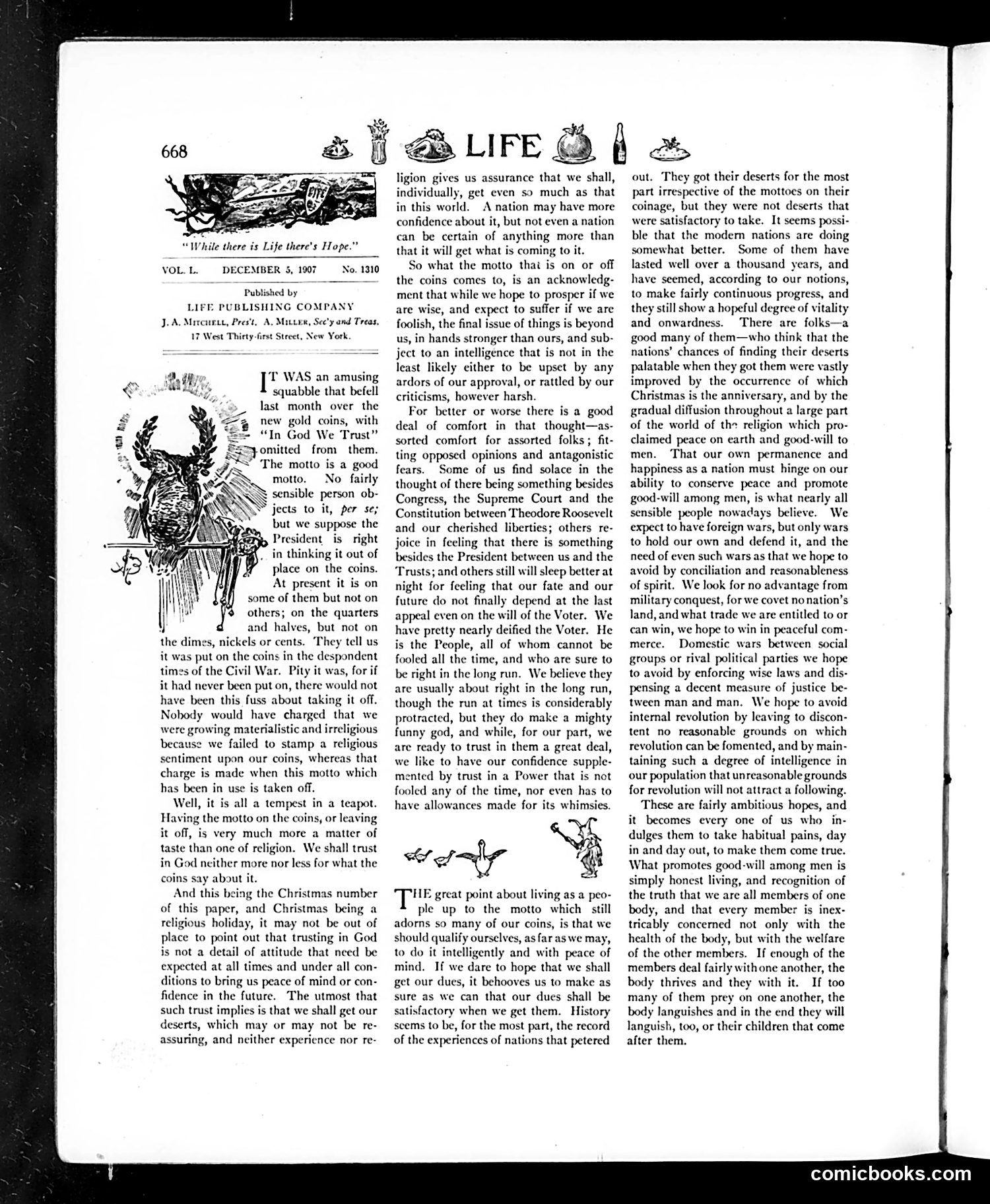
This editorial addresses a contemporary controversy: President Theodore Roosevelt's decision to remove "In God We Trust" from newly minted gold coins. **The Issue:** The motto had appeared on some coins since the Civil War but was omitted from new designs, sparking public debate about whether this reflected growing materialism and irreligion. **Life's Position:** The magazine treats this as "a tempest in a teapot"—a matter of taste rather than genuine religious principle. The editorial argues that trusting in God doesn't require motto endorsement on currency. **The Deeper Point:** Written for Life's Christmas issue, the piece uses the controversy to discuss faith pragmatically. It suggests people across the political spectrum—whether they fear Roosevelt's power, corporate "Trusts," or democratic voters—find comfort in believing ultimate outcomes rest with a power beyond human institutions (Congress, courts, the President, or "the Voter"). The editorial reflects Progressive-era anxieties about institutional power while maintaining that religious sentiment matters less than actual conduct.
📄 Transcribed text from this page (OCR, searchable)
Machine-transcribed from the original scan — historical spelling and the odd misread are preserved.
“While there is Life there's Hope.” No. 1310 VOL. L. DECEMBER 5, 1907 Published by LIFE PUBLISHING COMPANY J.A, Mireur, Pres't, A, Mitten, Sec'y and Treas, 17 West Thirty-first Street, New York. I WAS an amusing squabble that befell last month over the new gold coins, with = “In God We Trust” Tyomitted from them. “The motto is a good motto. No fairly SX sensible person ob- ~ jects to it, per se; but we suppose the President is right in thinking it out of place on the coins. At present it is on some of them but not on id halves, but not on nickels or cents. They tell us it was put on the coins in the despondent times of the Civil War. Pity it was, for if it had never been put on, there would not have been this fuss about taking it off. Nobody would have charged that we were growing materialistic and irreligious because we failed to stamp a religious sentiment upon our coins, whereas that charge is made when this motto which has been in use is taken off, Well, it is all a tempest in a teapot. Having the motto on the coins, or leaving it off, is very much more a matter of taste than one of religion. We shall trust in God neither more nor less for what the coins say about it. And this being the Christmas number of this paper, and Christmas being a religious holiday, it may not be out of place to point out that trusting in God is not a detail of attitude that need be expected at all times and under all con- ditions to bring us peace of mind or con- fidence in the future. The utmost that such trust implies is that we shall get our deserts, which may or may not be re- assuring, and neither experience nor re- ligion gives us assurance that we shall, individually, get even so much as that in this world. A nation may have more confidence about it, but not even a nation can be certain of anything more than that it will get what is coming to it. So what the motto thai is on or off the coins comes to, is an acknowledg- ment that while we hope to prosper if we are wise, and expect to suffer if we are foolish, the final issue of things is beyond us, in hands stronger than ours, and sub- ject to an intelligence that is not in the least likely either to be upset by any ardors of our approval, or rattled by our criticisms, however harsh. For better or worse there is a good deal of comfort in that thought—as- sorted comfort for assorted folks; fit- ting opposed opinions and antagonistic fears. Some of us find solace in the thought of there being something besides Congress, the Supreme Court and the Constitution between Theodore Roosevelt and our cherished liberties; others re- joice in feeling that there is something besides the President between us and the Trusts; and others still will sleep better at night for feeling that our fate and our future do not finally depend at the last appeal even on the will of the Voter. We have pretty nearly deified the Voter. He is the People, all of whom cannot be fooled all the time, and who are sure to be right in the long run. We believe they are usually about right in the long run, though the run at times is considerably protracted, but they do make a mighty funny god, and while, for our part, we are ready to trust in them a great deal, we like to have our confidence supple- mented by trust in a Power that is not fooled any of the time, nor even has to have allowances made for its whimsies. Mf HE great point about living as a peo- ple up to the motto which still adorns so many of our coins, is that we should qualify ourselves, as far as we may, to do it intelligently and with peace of mind. If we dare to hope that we shall get our dues, it behooves us to make as sure as we can that our dues shall be satisfactory when we get them. History scems to be, for the most part, the record of the experiences of nations that petered out. They got their deserts for the most part irrespective of the mottocs on their coinage, but they were not deserts that were satisfactory to take. It seems po: ble that the modem nations are doing somewhat better. Some of them have lasted well over a thousand years, and have seemed, according to our notions, to make fairly continuous progress, and they still show a hopeful degree of vitality and onwardness. There are folks—a good many of them—who think that the nations’ chances of finding their deserts palatable when they got them were vastly improved by the occurrence of which Christmas is the anniversary, and by the gradual diffusion throughout a large part of the world of the religion which pro- claimed peace on earth and good-will to men. That our own permanence and happiness as a nation must hinge on our ability to conserve peace and promote good-will among men, is what nearly all sensible people nowadays believe. We expect to have foreign wars, but only wars to hold our own and defend it, and the need of even such wars as that we hope to avoid by conciliation and reasonableness. of spirit. We look for no advantage from military conquest, for we covet no nation’s land, and what trade we are entitled to or can win, we hope to win in peaceful com- merce. Domestic wars between social groups or rival political parties we hope to avoid by enforcing wise laws and dis- pensing a decent measure of justice be- tween man and man. We hope to avoid internal revolution by leaving to discon- tent no reasonable grounds on which revolution can be fomented, and by main- taining such a degree of intelligence in our population that unreasonable grounds for revolution will not attract a following. These are fairly ambitious hopes, and it becomes every one of us who in- dulges them to take habitual pains, day in and day out, to make them come true. What promotes good-will among men is simply honest living, and recognition of the truth that we are all members of one body, and that every member is inex- tricably concerned not only with the health of the body, but with the welfare of the other members. If enough of the members deal fairly with one another, the body thrives and they with it. If too many of them prey on one another, the body languishes and in the end they will languish, too, or their children that come after them. comicbooks.com