
Life, 1907-12-05 · page 4 of 68
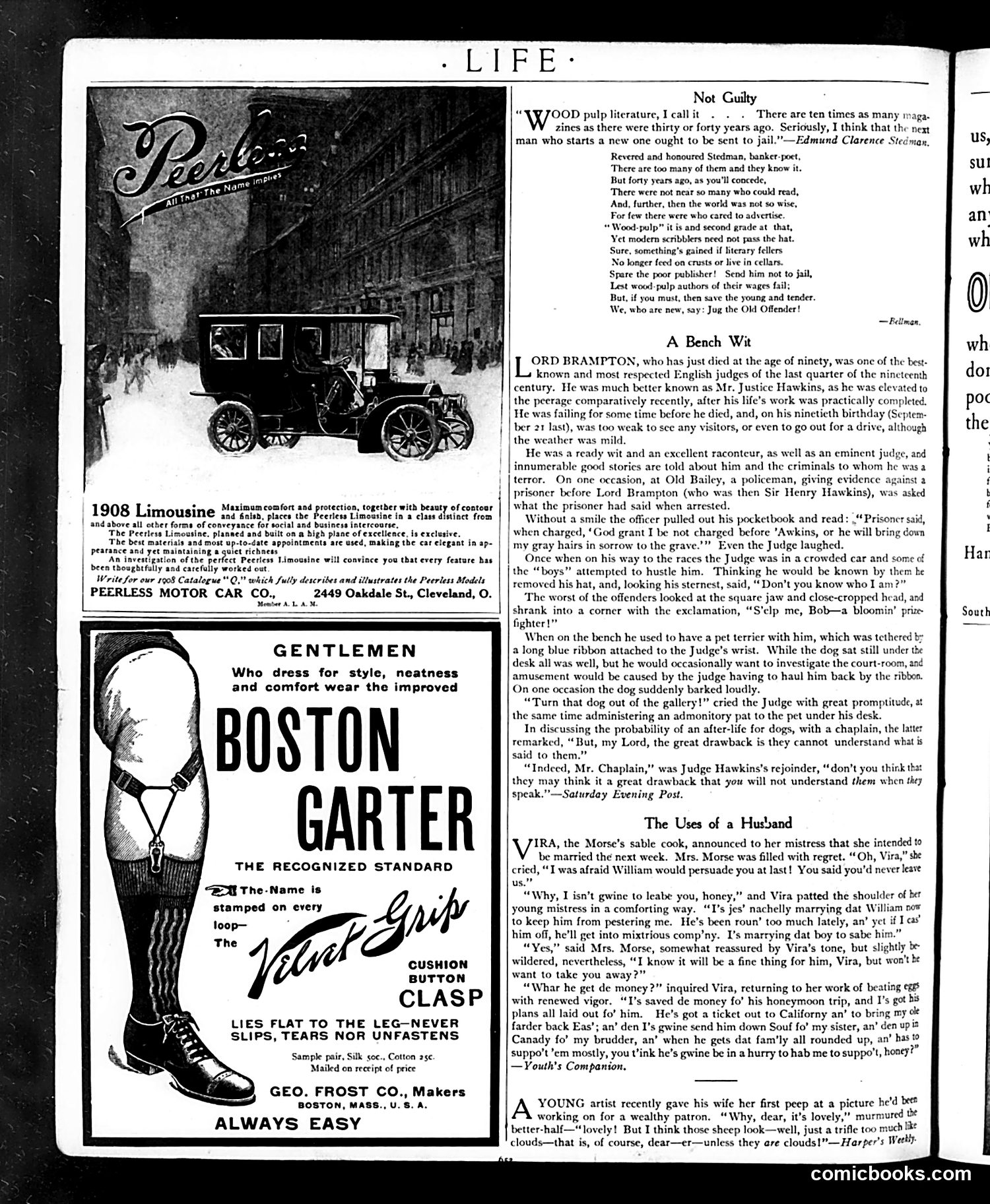
Life — December 5, 1907 — page 4: what you’re looking at
What you’re looking at
This page is primarily **advertising and humor columns** rather than political satire. The left side features ads for a 1908 Peerless Motor Car and Boston Garter hosiery. The right side contains three humor pieces: "Not Guilty" (a poem defending "wood pulp literature" against critics), "A Bench Wit" (an anecdote about Lord Brampton, a respected 19th-century English judge known for witty courtroom remarks and his pet terrier), and "The Uses of a Husband" (domestic humor about a cook named Vira planning marriage). These pieces reflect **turn-of-the-century genteel humor** targeting middle-class readers—satirizing pretension, marital dynamics, and class anxieties rather than engaging in political commentary.
📄 Transcribed text from this page (OCR, searchable)
Machine-transcribed from the original scan — historical spelling and the odd misread are preserved.
3 + Maximum comfort and protection, together with beauty of contoer 1908 Limousine Me fiin since che feesicts Limeseing in a chase dletecs toe and above all other forms of conveyance for social and business intercourse, The Peerless Limousine. planned and built on a high plane of excellence, is exclesive. The best materials and most up-to-date appointments are used, making the car elegant in ap- pearance and yet maintaining a guiet richness An investigation of the perfect Peerless Limousine will convince you that every feature has been thoughtfully and carefully worked out Write for our 1908 Catalogue" Q," which fully describes and illustrates the Peerless Models PEERLESS MOTOR CAR CO., 2449 Oakdale St., Cleveland, O. Menten AL A.M. GENTLEMEN Who dress for style, neatness and comfort wear the improved BOSTON GARTER THE RECOGNIZED STANDARD stamped on every CUSHION BUTTON CLASP LIES FLAT TO THE LEG-NEVER SLIPS, TEARS NOR UNFASTENS Sample pair, Silk soc., Cotton ase. Mailed on receipt of price GEO. FROST CO., Makers BOSTON, MASS.,U . ALWAYS EASY | | the weather was mild. Not Guilty 4 ‘OOD pulp literature, I call it ‘There are ten times as many maga. zines as there were thirty or forty years ago. Seriously, I think that the next man who starts a new one ought to be sent to jail.”"—Edmund Clarence Stedman, us, Revered and honoured Stedman, banker-poct, ‘There are too many of them and they know it. sul But forty years ago, as you'll concede, h ‘There were not near so many who could read, Ww. And, further, then the world was not so wise, For few there were who cared to advertise an’ “ Wood-pulp” it is and second grade at that, f Yet modern scribblers need not pass the hat. Sure, something's gained if literary fellers Tonger feed on crusts of live in cellars. Spare the poor publisher! Send him not to jail, Lest wood-pulp authors of their wages fail; 0 But, if you must, then save the young and tender. We, who are new, say: Jug the Old Offender! — Belmar A Bench Wit ORD BRAMPTON, who has just died at the age of ninety, was one of the best- known and most respected English judges of the last quarter of the nineteenth century, He was much better known as Mr. Justice Hawkins, as he was elevated to the peerage comparatively recently, after his life’s work was practically completed. He was failing for some time before he died, and, on his nineticth birthday (Septem- ber 21 last), was too weak to sce any visitors, or even to go out for a drive, although He was a ready wit and an excellent raconteur, as well as an eminent judge, aod innumerable good storics are told about him and the criminals to whom he was a terror. On one occasion, at Old Bailey, a policeman, giving evidence against a t i f prisoner before Lord Brampton (who was then Sir Henry Hawkins), was asked ' f : I what the prisoner had said when arrested. Without a smile the officer pulled out his pocketbook and read: d, when charged, ‘God grant I be not charged before "Awkins, or he will bring down my gray hairs in sorrow to the grave.” Even the Judge laughed. Once when on his way to the races the Judge was in a crowded car and some of the “boys” attempted to hustle him. Thinking he would be known by the removed his hat, and, looking his sternest, said, “Don’t you know who I am?” ‘The worst of the offenders looked at the square jaw and close-cropped head, and shrank into a corner with the exclamation, “S'elp me, Bob—a bloomin’ prize fighter!” When on the bench he used to have a pet terrier with him, which was tether a long blue ribbon attached to the Judge’s wrist. While the dog sat still under desk all was well, but he would occasionally want to investigate the court-room, and amusement would be caused by the judge having to haul him back by the ribbon. On one occasion the dog suddenly barked loudly. “Turn that dog out of the gallery!” cried the Judge with great promptitude, a the same time administering an admonitory pat to the pet under his desk. In discussing the probability of an after-life for dogs, with a chaplain, the latter remarked, “But, my Lord, the great drawback is they cannot understand what is said to them.” “Indeed, Mr. Chaplain,” was Judge Hawkins’s rejoinder, “don’t you think thst they may think it a great drawback that you will not understand them when they speak.""—Saturday Evening Post. The Uses of a Husband IRA, the Morse’s sable cook, announced to her mistress that she intended to be married the next week. Mrs. Morse was filled with regret. “Oh, Vira,” she cried, “I was afraid William would persuade you at last! You said you'd never leave us.” “Why, I isn’t gwine to leabe you, honey,” and Vira patted the shoulder of ber young mistress ina comforting way. “I’s jes’ nachelly marrying dat William now to keep him from pestering me. He’s been roun’ too much lately, an’ yet if him off, he'll get into mixtrious comp’ny. I’s marrying dat boy to sabe Yes,” said Mrs. Morse, somewhat reassured by Vira’s tone, but slightly be wildered, nevertheless, “I know it will be a fine thing for him, Vira, but won't be want to take you away?” “Whar he get de money?” inquired Vira, returning to her work of beating egg with renewed vigor. “I’s saved de money fo’ his honeymoon trip, and I’s got bis plans all laid out fo’ him. He's got a ticket out to Californy an’ to bring my farder back Eas’; an’ den I’s gwine send him down Souf fo my sister, an’ den up 2 Canady fo" my brudder, an’ when he gets dat fam'ly all rounded up, an’ has !9 suppo’t ’em mostly, you Vink he’s gwine be in a hurry to hab me to suppo't, honey? —VYouth’s Companion. YOUNG artist recently gave his wife her first peep at a picture he'd bet working on for a wealthy patron. “Why, dear, it’s lovely,” murmured bt better-half—“lovely! But I think those sheep look—well, just a trifle too much Hit clouds—that is, of course, dear—er—unless they are clouds!”—Harper’s Weel comicbooks.com