
Life, 1907-12-05 · page 8 of 68
Life — December 5, 1907 — page 8: what you’re looking at
What you’re looking at
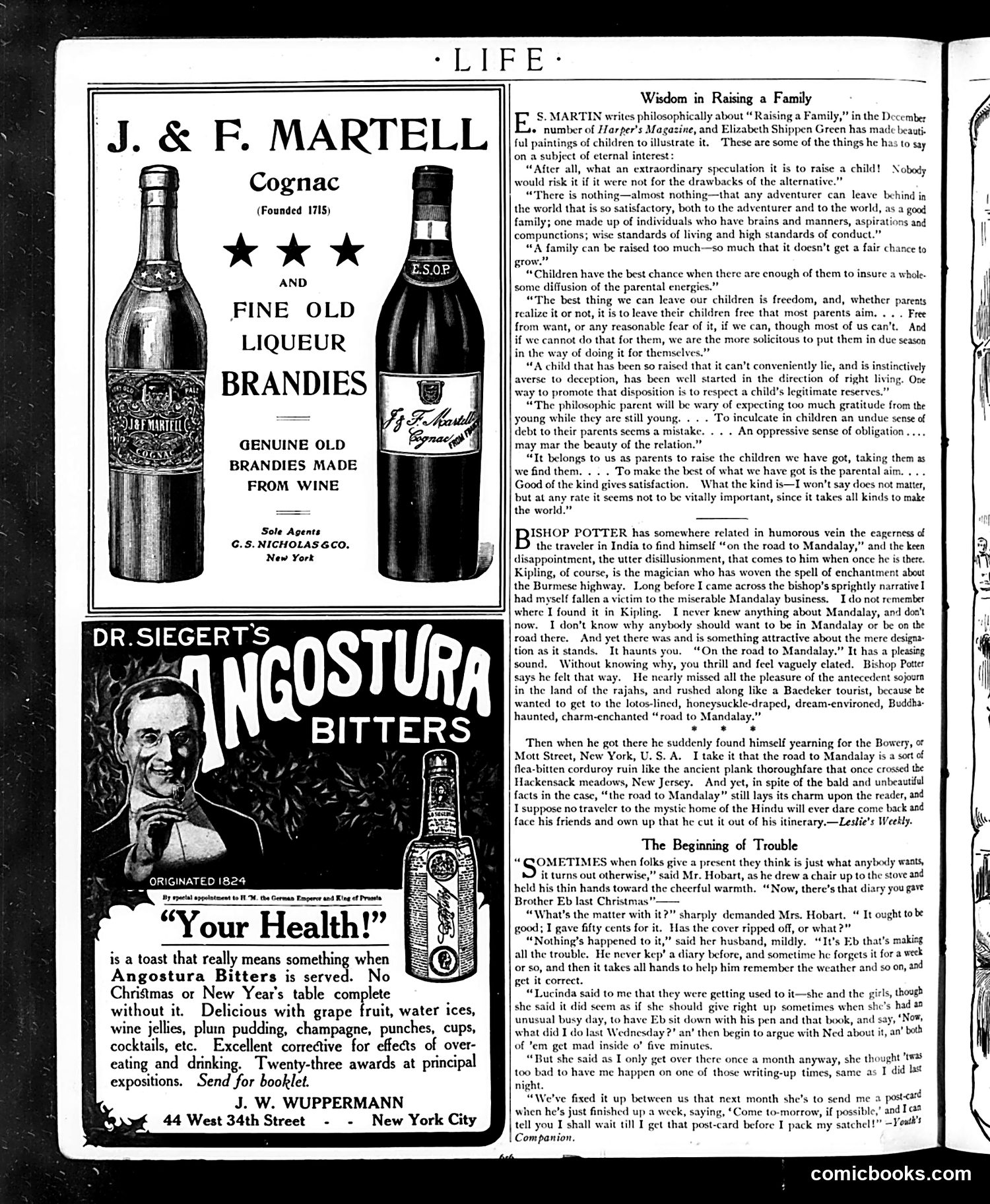
This page is primarily **advertising and editorial content** rather than political satire. The advertisements include: - **J. & F. Martell Cognac** (brandy) - **Dr. Siegert's Angostura Bitters** (featuring a caricatured figure, likely meant to evoke exotic/colonial imagery from the product's origin) The editorial text discusses "**Wisdom in Raising a Family**" by E.S. Martin, quoting philosopher observations about child-rearing and parental responsibility. Included is an anecdote by Bishop Potter about travel to Mandalay, and a humorous domestic dialogue ("The Beginning of Trouble") between Mr. and Mrs. Hobart about a lost diary. The satirical content is **mild domestic humor** rather than political commentary—focusing on everyday family disputes and parental frustrations rather than social or political critique.
📄 Transcribed text from this page (OCR, searchable)
Machine-transcribed from the original scan — historical spelling and the odd misread are preserved.
Cognac (Founded 1715) Kk AND FINE OLD LIQUEUR BRANDIES GENUINE OLD BRANDIES MADE FROM WINE Sole Agents G.S. NICHOLAS &CO. New York DR.SIEGERTS N iy epctal eppolatment to PLM. the German Emperor and King ef Proms “Your Health!” is a toast that really means something when Angostura Bitters is served. No Christmas or New Year's table complete without it. Delicious with grape fruit, water ices, wine jellies, pluin pudding, champagne, punches, cups, cocktails, etc. Excellent corrective for effects of over- eating and drinking. Twenty-three awards at principal expositions. Send for booklet. J. W. WUPPERMANN 44 West 34th Street - - New York City OSTURR BITTERS - \ Wisdom in Raising a Family FS: MARTIN writes philosophically about “Raising a Family," nthe December number of Harper's Magazine, and Elizabeth Shippen Green has made beaut ful paintings of children to illustrate it, ‘These are some of the things he has to say on a subject of eternal inter “After all, what an extraordinary speculation it is to ral would risk it if it were not for the drawbacks of the alternati: “There is nothing—almost nothing—that any adventurer can leave behind in the world that is so satisfactory, both to the adventurer and to the world, as a good family; one made up of individuals who have brains and manners, aspir compunctions; wise standards of living and high standards of conduct “A family can be raised too much—so much that it doesn’t get a fair chance to grow.” “Children have the best chance when there are cnough of them to insure a whole- some diffusion of the parental energies.” “The best thing we can leave our children is freedom, and, whether parents realize it or not, it is to leave their children free that most parents aim, « Free from want, or any reasonable fear of it, if we can, though most of us ‘And if we cannot do that for them, we are the more solicitous to put them in due season in the way of doing it for themselves.” child that has been so raised that it can’t conveniently lic, and is instinctively averse to deception, has been well started in the direction of right living. One ay \o promote that disposition is to respect & child’s legitimate reserves.” “The philosophic parent will be wary of expecting too much gratitude from the young while they are still young. . . . To inculcate in children an undue sense of debt to their parents secms a mistake. . . . An oppressive sense of obligation... may mar the beauty of the relation. “Jt belongs to us as parents to raise the children we have got, taking them as we find them. . . . To make the best of what we have got is the parental aim. . . . Good of the kind gives satisfaction. What the kind is—I won't say does not matter, but at any rate it seems not to be vitally important, since it takes all kinds to make the world.” a child! Nobody ISHOP POTTER has somewhere related in humorous vein the eagerness of the traveler in India to find himself “on the road to Mandalay,” and the keen disappointment, the utter disillusionment, that comes to him when once he is there. Kipling, of course, is the magician who has woven the spell of enchantment about the Burmese highway. Long before I came across the bishop's sprightly narrative I had myself fallen a victim to the miserable Mandalay business. I do not remember where I found it in Kipling. I never knew anything about Mandalay, and doa't now. I don’t know why anybody should want to be in Mandalay or be on the road there. And yet there was and is something attractive about the mere designa- tion as it stands. “It haunts you. “On the road to Mandalay.” It has a pleasing sound, Without knowing why, you thrill and feel vaguely elated. Bishop Potter ys he felt that way. He nearly missed all the pleasure of the antecedent sojourn in the land of the rajahs, and rushed along like a Bacdeker tourist, because be wanted to get to the lotos-lined, honeysuckle-draped, dream-environed, Buddha- haunted, charm-enchanted “road to Mandalay.” . 8 8 Then when he got there he suddenly found himself yearning for the Bowery, of Mott Street, New York, U.S. A. I take it that the road to Mandalay is a sort of flea-bitten corduroy ruin like the ancient plank thoroughfare that once crossed the Hackensack meadows, New Jersey. And yct, in spite of the bald and unbeautiful facts in the case, “the road to Mandalay” still lays its charm upon the reader, and I suppose no traveler to the mystic home of the Hindu will ever dare come back and face his friends and own up that he cut it out of his itinerary,—Lestie’s Weekly. The Beginning of Trouble “ QOMETIMES when folks give a present they think is just what anybody wants, t turns out otherwise,” said Mr. Hobart, as he drew a chair up to the stove and held his thin hands toward the cheerful warmth. ‘Now, there's that diary you gave Brother Eb last Christmas”. “What's the matter with it?” sharply demanded Mrs. Hobart, “ It ought to be good; I gave fifty cents for it. Has the cover ripped off, or what?” “Nothing’s happened to it,” said her husband, mildly. “It's Eb that's makieg all the trouble. He never kep’ a diary before, and sometime he forgets it for a week or so, and then it takes all hands to help him remember the weather and so on, and get it correct. “Lucinda said to me that they were getting used to it—she and the girls, though she said it did seem as if she should give right up sometimes when she’s had 39 unusual busy day, to have Eb sit down with his pen and that book, and say, ‘Nom, what did I do last Wednesday ?? an’ then begin to argue with Ned about it, an’ both of ’em get mad inside o! five minutes. “But she said as I only get over there once a month anyway too bad to have me happen on one of those writing-up times, sam night. “We've fixed it up between us that next month she’s to send me a postcard when he’s just finished up a week, saying, ‘Come to-morrow, if possible,’ and 1a tell you I shall wait till I get that post-card before I pack my satchel!” —Youtl's she thought "twas as I did last Companion, comicbooks.com